
Market Overview
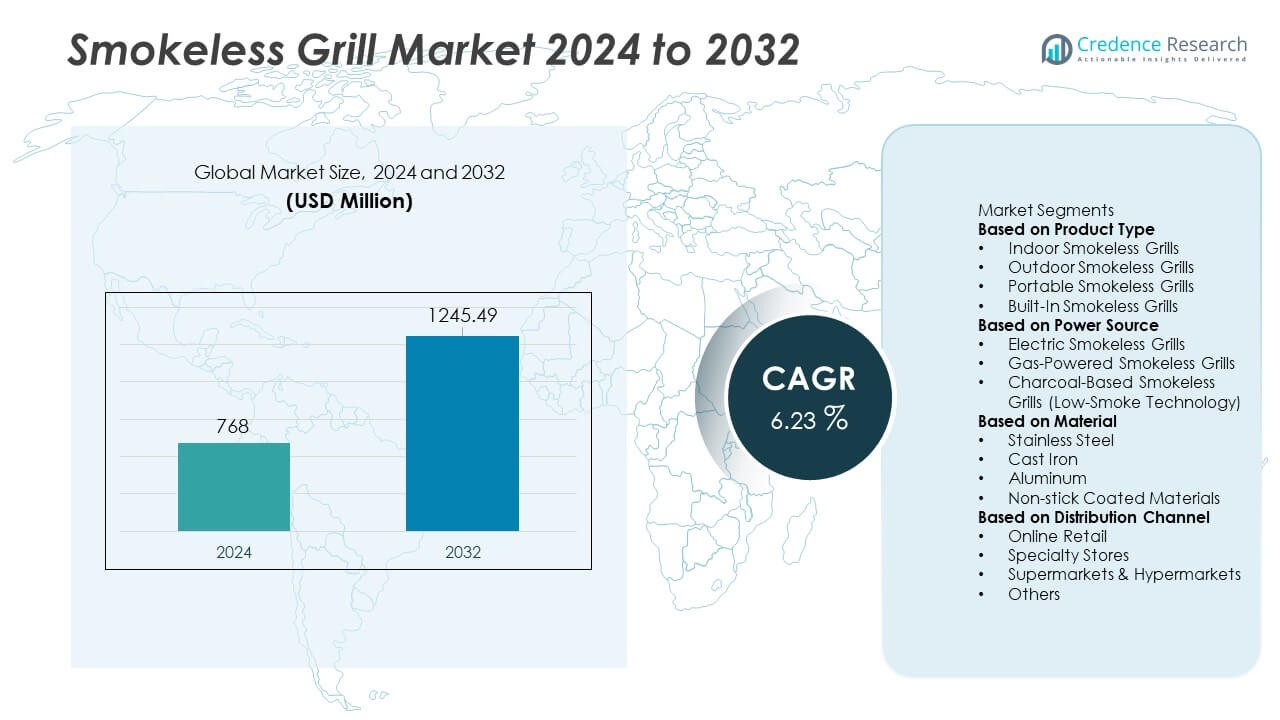
The Smokeless Grill Market was valued at USD 768 million in 2024 and is expected to reach USD 1,245.49 million by 2032, expanding at a CAGR of 6.23% during the forecast period.
| REPORT ATTRIBUTE | DETAILS |
|---|---|
| Historical Period | 2020-2023 |
| Base Year | 2024 |
| Forecast Period | 2025-2032 |
| Smokeless Grill Market Size 2024 | USD 768 Million |
| Smokeless Grill Market, CAGR | 6.23% |
| Smokeless Grill Market Size 2032 | USD 1,245.49 Million |
Top players in the Smokeless Grill market include Philips, Hamilton Beach Brands, Cuisinart, George Foreman, Ninja, Tefal, Zojirushi, Weber-Stephen, Char-Broil, and Kenyon International. These companies expand their presence through advanced heating systems, durable materials, and compact indoor-friendly designs. Continuous upgrades in non-stick surfaces, smart controls, and multi-function cooking features help them capture rising household demand. North America leads the global market with 36% share, supported by strong adoption of premium electric grills and high spending on smart kitchen appliances. Europe follows with 29% share, driven by rising demand for low-emission indoor cooking equipment and strict safety standards that favor high-quality smokeless grills.
Market Insights
- The Smokeless Grill market reached USD 768 million in 2024 and is set to grow at a 6.23% CAGR, driven by rising demand for clean and convenient indoor grilling solutions.
- Strong market drivers include growing adoption of electric grills, which hold 55% share, and increasing preference for low-smoke cooking in apartments and small homes.
- Key trends highlight the rise of smart features, multi-function grill designs, and durable stainless-steel models, which lead the material segment with 38% share.
- Competitive activity remains high as brands like Philips, Ninja, Cuisinart, and George Foreman enhance heating performance, expand e-commerce reach, and introduce energy-efficient models while facing restraints from maintenance issues in low-cost products.
- North America leads with 36% share, followed by Europe at 29% and Asia Pacific at 25%, supported by strong urban adoption, increasing wellness trends, and expanding retail networks across these regions.
Market Segmentation Analysis:
By Product Type:
Indoor smokeless grills held the dominant position with 42% share due to strong demand for compact, low-emission cooking devices in urban homes. Buyers prefer indoor models for year-round use, steady temperature control, and ease of cleaning. Portable grills followed as a key growth category, supported by rising outdoor leisure and travel activities. Outdoor and built-in models gained traction in premium homes and restaurants that seek smoke-free grilling without complex ventilation needs. The steady shift toward healthier cooking and reduced household smoke continues to support the leading role of indoor smokeless grills in this segment.
- For instance, Philips introduced an indoor smokeless grill using a 1,660-watt infrared heating system. The design maintains a steady surface temperature of 230°C (446°F) and keeps fat away from heating coils, which helps to significantly reduce airborne smoke compared to conventional electric grills.
By Power Source:
Electric smokeless grills led the segment with 55% share, driven by safety compliance, plug-and-cook convenience, and widespread residential adoption. Electric models support precise heat control and low-smoke operation, making them ideal for apartments and indoor settings with limited ventilation. Gas-powered variants gained use in commercial kitchens that require higher heat output, while charcoal-based low-smoke grills found niche demand among users seeking a traditional flavor profile with reduced emissions. Regulatory focus on clean indoor air and user preference for energy-efficient appliances continues to reinforce the strong position of electric-powered smokeless grills.
- For instance, the Ninja electric grill uses a 1,760-watt cyclonic heating unit that reaches 500°F (approximately 260°C) in under 8 minutes, with a virtually smoke-free system achieved through a temperature-controlled grill grate, splatter shield, and cool-air zone.
By Material:
Stainless steel accounted for the largest share with 38%, supported by high durability, corrosion resistance, and strong performance under continuous heating. Manufacturers prefer stainless steel for premium indoor and commercial models due to its long service life and ease of maintenance. Cast iron gained demand among users seeking superior heat retention, while aluminum remained a lightweight option for portable designs. Non-stick coated materials expanded in entry-level residential grills due to easy cleaning and fast cooking. The continued push for long-lasting and hygienic cookware supports the leading role of stainless steel in this segment.
Key Growth Drivers
Rising Adoption of Indoor and Apartment-Friendly Cooking Solutions
Urban households increasingly prefer smokeless grills because they support clean and odor-controlled cooking inside compact living spaces. Growing apartment occupancy drives the shift away from traditional grills that create smoke and require strong ventilation. Consumers value appliances that reduce indoor pollutants while offering steady heat control and fast meal preparation. Manufacturers enhance heating elements and airflow systems to minimize visible smoke during grilling. This rising preference for clean and convenient indoor cooking strengthens the market for smokeless grills.
- For instance, Cuisinart developed an indoor grill with a 1,800-watt heating coil that channels grease into an integrated drip tray. The product features specially designed plates and a dedicated "Smoke-Less Mode" to manage grease and minimize smoke during use.
Expansion of Health-Conscious and Low-Fat Cooking Preferences
Health-focused consumers seek appliances that support low-oil and low-fat cooking without sacrificing taste. Smokeless grills drain excess grease and reduce direct smoke exposure, making them appealing for daily meal preparation. Even heat distribution improves cooking quality and helps retain nutrients in meats and vegetables. Brands introduce preset temperatures and advanced heating plates to match evolving wellness trends. The widespread focus on clean eating continues to position smokeless grills as a healthier alternative to frying or traditional grilling.
- For instance, Hamilton Beach launched a smokeless grill featuring a powerful 1,200 to 1,500-watt element and a sloped plate that channels excess fat away into a drip tray during cooking for low-fat grilling.
Growth in Outdoor Recreation and Portable Cooking Appliances
Outdoor dining, weekend travel, and camping activities increase the demand for compact smokeless grills. Consumers want portable models that deliver efficient heating without producing disruptive smoke in shared or small outdoor spaces. Manufacturers respond with lightweight designs, detachable components, and faster heat-up features. Families and young buyers choose these grills for small gatherings and recreational outings. As outdoor leisure expands, portable smokeless grills gain strong traction due to convenience and low-smoke performance.
Key Trends & Opportunities
Integration of Smart Features and Temperature Automation
Smokeless grills increasingly incorporate smart features such as app connectivity, automated temperature control, and cooking alerts. These upgrades help users monitor heat levels and follow guided cooking steps on mobile devices. Automated functions reduce burning risks and improve cooking precision, appealing to tech-driven households. Manufacturers also explore AI-supported heat adjustment and preset cooking modes. Growing adoption of smart kitchen appliances creates strong opportunities for advanced, connected smokeless grills.
- For instance, Weber introduced a smart-enabled grill with a digital probe that measures internal food temperature with a ±1°C accuracy range. The grill connects to the Weber Connect app and sends real-time alerts through Bluetooth covering up to 9 meters.
Expanding Product Innovation Through Multi-Function Cooking Designs
Manufacturers accelerate innovation by developing smokeless grills that combine grilling, air-frying, searing, and hotplate cooking in one appliance. This multi-function setup supports consumers who want flexibility while saving kitchen space. Dual-zone heating, improved ceramic coatings, and rapid-heat systems enhance performance and broaden meal options. Young professionals and families prefer these versatile designs for daily cooking. Rising demand for compact, space-efficient appliances positions hybrid smokeless grills as a strong growth opportunity.
- For instance, the Tefal OptiGrill Elite is an intelligent health grill equipped with a 2,000-watt heating module that automatically adjusts cooking time based on the meat's thickness.
Key Challenges
High Maintenance Needs and Durability Issues in Low-Cost Models
Lower-priced smokeless grills often struggle with coating wear, uneven heating, and difficult cleanup, reducing long-term reliability. These issues lead to frequent maintenance and affect customer satisfaction in cost-sensitive markets. Material degradation also increases replacement rates, limiting repeat purchases. Manufacturers face pressure to improve durability while keeping prices competitive. Balancing quality and affordability remains a major challenge across entry-level product ranges.
Increasing Competition from Air Fryers and Multi-Purpose Kitchen Appliances
Air fryers, convection cookers, and hybrid kitchen appliances directly compete with smokeless grills by offering multi-function cooking and faster operation. Many households prefer one versatile device rather than a dedicated grill, especially in smaller kitchens. This shift reduces the adoption rate of smokeless grills despite strong grilling performance. Brands must focus on superior flavor, advanced smoke reduction, and precise heat management to stay competitive. Without clear differentiation, smokeless grills face pressure from rising multi-purpose appliance adoption.
Regional Analysis
North America
North America led the Smokeless Grill market with 36% share, driven by strong indoor cooking demand and widespread adoption of compact kitchen appliances. Consumers value grills that reduce smoke and odors in apartments and suburban homes. High spending on premium electric models and smart kitchen devices strengthens regional growth. Retail chains and online platforms boost product visibility, while brands introduce multi-function grills tailored to U.S. and Canadian cooking habits. Rising interest in healthier, low-oil meals continues to support steady market expansion across the region.
Europe
Europe held 29% share, supported by increasing preference for eco-friendly and low-emission cooking appliances. Buyers in the UK, Germany, France, and Italy favor indoor smokeless grills for controlled heat performance and smoke reduction in compact kitchens. Growing wellness trends and interest in low-fat cooking encourage adoption of electric models. Manufacturers focus on stainless steel and high-durability materials to meet strict EU safety standards. Expansion of e-commerce and specialty kitchen stores further boosts product accessibility across both Western and Northern Europe.
Asia Pacific
Asia Pacific accounted for 25% share, driven by rising urbanization, small living spaces, and the need for clean indoor cooking appliances. Consumers in China, Japan, South Korea, and India choose smokeless grills to avoid heavy smoke in high-density housing. Growth in middle-class spending, strong online retail networks, and rising food tech awareness support rapid adoption. Portable and multi-function grills gain traction among younger households. Manufacturers expand product lines with compact designs and affordable models, reinforcing Asia Pacific as the fastest-advancing regional market.
Latin America
Latin America captured 6% share, supported by increasing demand for indoor-friendly cooking appliances in Brazil, Mexico, Argentina, and Chile. Urban households adopt smokeless grills to reduce smoke and maintain indoor air quality. Rising interest in healthier cooking methods boosts demand for models with improved heat control and non-stick surfaces. E-commerce channels expand product availability, while global brands strengthen distribution partnerships. Economic recovery and growth in residential appliance upgrades support steady regional adoption despite price sensitivity.
Middle East & Africa
The Middle East & Africa region held 4% share, driven by growing demand for compact and convenient cooking appliances in urban households. Buyers in the UAE, Saudi Arabia, and South Africa prefer smokeless grills for quick meal preparation with minimal indoor smoke. Hotels, cafés, and serviced apartments also adopt premium models for safe indoor grilling. Expanding retail infrastructure and increased exposure to global brands support gradual market penetration. Rising tourism and hospitality investments continue to create new opportunities for adoption across the region.
Market Segmentations:
By Product Type
- Indoor Smokeless Grills
- Outdoor Smokeless Grills
- Portable Smokeless Grills
- Built-In Smokeless Grills
By Power Source
- Electric Smokeless Grills
- Gas-Powered Smokeless Grills
- Charcoal-Based Smokeless Grills (Low-Smoke Technology)
By Material
- Stainless Steel
- Cast Iron
- Aluminum
- Non-stick Coated Materials
By Distribution Channel
- Online Retail
- Specialty Stores
- Supermarkets & Hypermarkets
- Others
By Geography
- North America
- U.S.
- Canada
- Mexico
- Europe
- Germany
- France
- U.K.
- Italy
- Spain
- Rest of Europe
- Asia Pacific
- China
- Japan
- India
- South Korea
- South-east Asia
- Rest of Asia Pacific
- Latin America
- Brazil
- Argentina
- Rest of Latin America
- Middle East & Africa
- GCC Countries
- South Africa
- Rest of the Middle East and Africa
Competitive Landscape
The Smokeless Grill market features leading players such as Philips, Hamilton Beach Brands, Cuisinart, George Foreman, Ninja, Tefal, Zojirushi, Weber-Stephen, Char-Broil, and Kenyon International. These companies strengthen their presence through product innovation, multi-function designs, and upgraded heating technologies that reduce smoke output and improve cooking consistency. Brands invest in durable materials, non-stick coatings, and smart controls to meet rising demand for clean indoor grilling. Premium manufacturers focus on precision temperature systems, while mid-range brands compete through affordability and compact designs. Partnerships with e-commerce platforms and expansion into emerging markets enhance distribution reach. Companies also highlight energy efficiency, low-maintenance features, and rapid heating to differentiate products in a growing and competitive category.
Key Player Analysis
- Philips
- Hamilton Beach Brands
- Cuisinart (Conair Corporation)
- George Foreman (Spectrum Brands)
- Ninja (SharkNinja)
- Tefal (Groupe SEB)
- Zojirushi Corporation
- Weber-Stephen Products
- Char-Broil
- Kenyon International
Recent Developments
- In January 2025, Weber-Stephen Products announced its 2025 product collection, which did in fact include the new SLATE® griddle and the WEBER SMOQUE™ wood pellet smoker. The announcement was made in an official press release on January 14, 2025.
- In January 2025, Weber‑Stephen Products unveiled its 2025 product collection which includes innovations around electric and pellet grills.
Report Coverage
The research report offers an in-depth analysis based on Product Type, Power Source, Material, Distribution Channel and Geography. It details leading market players, providing an overview of their business, product offerings, investments, revenue streams, and key applications. Additionally, the report includes insights into the competitive environment, SWOT analysis, current market trends, as well as the primary drivers and constraints. Furthermore, it discusses various factors that have driven market expansion in recent years. The report also explores market dynamics, regulatory scenarios, and technological advancements that are shaping the industry. It assesses the impact of external factors and global economic changes on market growth. Lastly, it provides strategic recommendations for new entrants and established companies to navigate the complexities of the market.
Future Outlook
- Demand for indoor-friendly grills will rise as urban households prefer low-smoke cooking.
- Electric smokeless grills will gain momentum with improved heat control and energy efficiency.
- Smart connectivity features will expand, enabling app control and automated temperature settings.
- Multi-function models will grow as consumers seek compact appliances with diverse cooking options.
- Durable stainless-steel and ceramic-coated designs will gain wider adoption for long-term use.
- Portable smokeless grills will see stronger demand from outdoor recreation and travel activities.
- Manufacturers will increase focus on rapid-heating technology to enhance cooking speed and precision.
- E-commerce channels will strengthen sales as buyers prefer online product comparisons and fast delivery.
- Hospitality and commercial sectors will adopt premium smokeless grills for safer indoor grilling.
- Emerging markets will show greater adoption due to rising income levels and kitchen modernization trends.

Request a Free Sample
Fill in your details and we'll send you a free sample report.
- Sample data tables & charts
- Research methodology
Market Dynamics
Urbanization and Apartment Living
The increasing number of urban households and apartment dwellers drives demand for smokeless grills, as these consumers seek clean, odor-controlled cooking solutions suitable for compact indoor spaces where traditional grilling is impractical.
Health and Wellness Trends
Growing consumer focus on low-fat, low-oil cooking and healthier meal preparation boosts adoption of smokeless grills, which drain excess grease and minimize smoke exposure, aligning with wellness and clean-eating preferences.
Advancements in Electric and Smart Grill Technology
Continuous innovation in electric heating systems, smart controls, and multi-function features enhances user convenience, safety, and cooking precision, making smokeless grills more attractive for modern households.
Expansion of E-commerce and Retail Networks
The proliferation of online retail platforms and specialty kitchen stores increases product accessibility and visibility, enabling consumers to compare features and purchase smokeless grills more easily, thus accelerating market growth.
Outdoor Recreation and Portable Cooking Demand
Rising interest in outdoor leisure, travel, and camping activities fuels demand for portable smokeless grills, which offer efficient, low-smoke cooking in shared or small outdoor spaces, broadening the market beyond traditional indoor use.
Need a Custom Version of This Report?
Tailor the scope, geography, or segments to your exact requirements.
- Custom geography or segment scope
- Direct access to our analyst team
Frequently Asked Questions
What is the current market size for the Smokeless Grill market, and what is its projected size in 2032?
At what Compound Annual Growth Rate is the Smokeless Grill market projected to grow between 2025 and 2032?
Which Smokeless Grill market segment held the largest share in 2024?
What are the primary factors fueling the growth of the Smokeless Grill market?
Who are the leading companies in the Smokeless Grill market?
Which region commanded the largest share of the Smokeless Grill market in 2024?
Table of Content
Chapter 1 Market Segmentation
- 1.1 Segmentation Framework
- 1.1.1 Product and Service Classification
- 1.1.2 Application and End-Use Classification
- 1.1.3 Technology and Solution Classification
- 1.1.4 Customer and Distribution Channel Classification
- 1.1.5 Geographic Segmentation
- 1.1.6 Market Segment Definitions and Boundaries
- 1.2 By Material
- 1.2.1 Stainless Steel
- 1.2.2 Cast Iron
- 1.2.3 Aluminum
- 1.2.4 Non-stick Coated Materials
- 1.3 By Power Source
- 1.3.1 Electric Smokeless Grills
- 1.3.2 Gas-Powered Smokeless Grills
- 1.3.3 Charcoal-Based Smokeless Grills (Low-Smoke Technology)
- 1.4 By Product Type
- 1.4.1 Indoor Smokeless Grills
- 1.4.2 Outdoor Smokeless Grills
- 1.4.3 Portable Smokeless Grills
- 1.4.4 Built-In Smokeless Grills
Chapter 2 Introduction
- 2.1 Report Objectives and Scope
- 2.2 Product Definition and Industry Terminology
- 2.3 Market Inclusions and Exclusions
- 2.4 Research Process
- 2.4.1 Primary Research and Expert Interviews
- 2.4.2 Secondary Research and Source Review
- 2.4.3 Top-Down and Bottom-Up Estimation
- 2.4.4 Data Triangulation and Verification
- 2.5 Market Size Measurement Basis
- 2.5.1 2024: USD 768 million → 2032: USD 1,245.49 million
- 2.6 Historical and Forecast Reference Periods
- 2.6.1 Base Year: 2024
- 2.6.2 Forecast Period: 2024-2032
- 2.7 Research Assumptions and Limitations
Chapter 3 Executive Summary
- 3.1 Market Snapshot and Key Findings
- 3.2 Base-Year Market Size, 2024
- 3.3 Forecast Market Size, 2032
- 3.4 Revenue and Volume Growth Outlook
- 3.5 Key Demand and Supply Indicators
- 3.6 Leading Market Segments
- 3.7 Fastest-Growing Market Opportunities
- 3.8 Regional Performance Highlights
- 3.9 Technology and Industry Transformation
- 3.10 Competitive Landscape Summary
- 3.11 Analyst View and Strategic Implications
Chapter 4 Global Smokeless Grill Market Trends and Developments
- 4.1 Historical Industry Development
- 4.2 Recent Market Trends and Developments
- 4.3 Demand and Customer Behavior Trends
- 4.4 Technology and Product Innovation
- 4.5 Artificial Intelligence, Automation and Digitalization
- 4.6 Local Manufacturing and Supply Chain Realignment
- 4.7 Industry Partnerships, Mergers and Acquisitions
- 4.8 Sustainability and Circular Economy Developments
- 4.9 Government and Private Sector Investment Trends
- 4.10 Emerging Business Models and Commercialization
- 4.11 Industry Developments and Announcements
Chapter 5 Global Smokeless Grill Market Production, Supply and Demand Analysis
- 5.1 Demand Trend and Consumption Analysis
- 5.2 Demand Forecast, 2024-2032
- 5.3 Production and Output Trend
- 5.4 Production and Output Forecast, 2024-2032
- 5.5 Installed Capacity and Capacity Utilization
- 5.6 Company-Wise Production Plants and Statistics
- 5.6.1 Installed Production Capacity
- 5.6.2 Actual Production
- 5.6.3 Planned Capacity and Expansion Targets
- 5.7 Supply Chain Structure and Procurement Trends
- 5.8 Supply-Demand Gap and Bottlenecks
- 5.9 Import Dependence and Sourcing Structure
- 5.10 Contract Manufacturing and Outsourcing
- 5.11 Regional Supply and Demand Concentration
Chapter 6 Global Smokeless Grill Market Pricing Analysis
- 6.1 Pricing Structure and Measurement
- 6.2 Historical Pricing Trends
- 6.3 Pricing Outlook, 2024-2032
- 6.4 Average Selling Price and Unit Economics
- 6.5 Pricing by Product and Market Segment
- 6.6 Geographic Pricing Differences
- 6.7 Key Input, Energy, Labor and Logistics Costs
- 6.8 Contract Pricing and Purchasing Models
- 6.9 Pricing Sensitivity and Competitive Positioning
- 6.10 Price, Margin and Profitability Implications
Chapter 7 Global Smokeless Grill Market Dynamics
- 7.1 Market Growth Drivers
- 7.1.1 Demand-Side Drivers
- 7.1.2 Technology and Innovation Drivers
- 7.1.3 Infrastructure and Investment Drivers
- 7.1.4 Regulatory and Policy Drivers
- 7.2 Market Restraints
- 7.2.1 Cost and Affordability Constraints
- 7.2.2 Technology and Adoption Barriers
- 7.2.3 Supply Chain and Operational Constraints
- 7.3 Market Challenges
- 7.3.1 Competitive Pressure and Margin Erosion
- 7.3.2 Skills, Infrastructure and Implementation Gaps
- 7.4 Emerging Market Opportunities
- 7.5 Market Dynamics Impact and Time-Horizon Assessment
Chapter 8 Global Smokeless Grill Value Chain Analysis
- 8.1 Industry Value Chain Overview
- 8.2 Upstream Suppliers and Critical Inputs
- 8.3 Technology and Component Providers
- 8.4 Manufacturing or Service Delivery
- 8.5 Distribution, Channel Partners and Integrators
- 8.6 Downstream Applications and End Users
- 8.7 Value Addition and Profit Pools
- 8.8 Vertical Integration and Outsourcing
- 8.9 Supplier Concentration and Risk
- 8.10 Supply Chain Localization and Resilience
Chapter 9 Global Smokeless Grill Market Regulations and Policies
- 9.1 Relevant Laws, Standards and Compliance Frameworks
- 9.2 Product, Service, Safety and Quality Requirements
- 9.3 Government Policies, Incentives and Subsidies
- 9.4 Imports, Exports and Trade Barriers
- 9.5 Public Procurement and Local Content Requirements
- 9.6 Environmental and Sustainability Compliance
- 9.7 Upcoming Policy Changes and Market Implications
Chapter 10 Global Smokeless Grill Market Hotspots and Opportunities
- 10.1 Market Opportunity Mapping and Growth Hotspots
- 10.2 High-Growth Applications and Customer Groups
- 10.3 Underserved Markets and White-Space Opportunities
- 10.4 Emerging Technology and Product Opportunities
- 10.5 New Capacity and Investment Hotspots
- 10.6 Market Entry and Expansion Opportunities
- 10.7 Distribution and Partnership Opportunities
- 10.8 Near-Term and Long-Term Commercial Potential
- 10.9 Opportunity Attractiveness and Execution Risks
Chapter 11 Global Smokeless Grill Market Outlook, 2024-2032
- 11.1 Market Size and Analysis
- 11.1.1 Revenue (Market Measurement: 2024: USD 768 million → 2032: USD 1,245.49 million)
- 11.1.2 Market Volume and Quantity Sold
- 11.1.3 Historical Market Size
- 11.1.4 Base-Year Market Size, 2024
- 11.2 Market Forecast, 2024-2032
- 11.2.1 Revenue Forecast to 2032
- 11.2.2 Volume Forecast to 2032
- 11.2.3 CAGR and Year-on-Year Growth
- 11.2.4 Incremental Revenue Opportunity
- 11.3 Forecast Assumptions and Scenario Analysis
- 11.3.1 Base-Case Forecast
- 11.3.2 Optimistic and Conservative Scenarios
- 11.3.3 Technology, Pricing and Policy Sensitivities
- 11.4 Market Attractiveness and Growth Outlook
Chapter 12 Global Smokeless Grill Market Segmentation and Outlook
- 12.1 Segmentation Summary and Market Shares, 2024
- 12.2 Largest and Fastest-Growing Segments
- 12.3 By Material - Market Size and Forecast, 2024-2032
- 12.3.1 Segment Definition and Scope
- 12.3.2 Historical Market Size
- 12.3.3 Revenue Forecast, 2024-2032
- 12.3.4 Volume Forecast, 2024-2032
- 12.3.5 Base-Year Market Share, 2024
- 12.3.6 Segment CAGR and Growth Drivers
- 12.3.7 Subsegment Market Size and Forecast
- 12.3.7.1 Stainless Steel
- 12.3.7.2 Cast Iron
- 12.3.7.3 Aluminum
- 12.3.7.4 Non-stick Coated Materials
- 12.3.8 Subsegment Pricing and Adoption Trends
- 12.3.9 Leading Suppliers and Competition
- 12.3.10 Regional Demand and Opportunities
- 12.4 By Power Source - Market Size and Forecast, 2024-2032
- 12.4.1 Segment Definition and Scope
- 12.4.2 Historical Market Size
- 12.4.3 Revenue Forecast, 2024-2032
- 12.4.4 Volume Forecast, 2024-2032
- 12.4.5 Base-Year Market Share, 2024
- 12.4.6 Segment CAGR and Growth Drivers
- 12.4.7 Subsegment Market Size and Forecast
- 12.4.7.1 Electric Smokeless Grills
- 12.4.7.2 Gas-Powered Smokeless Grills
- 12.4.7.3 Charcoal-Based Smokeless Grills (Low-Smoke Technology)
- 12.4.8 Subsegment Pricing and Adoption Trends
- 12.4.9 Leading Suppliers and Competition
- 12.4.10 Regional Demand and Opportunities
- 12.5 By Product Type - Market Size and Forecast, 2024-2032
- 12.5.1 Segment Definition and Scope
- 12.5.2 Historical Market Size
- 12.5.3 Revenue Forecast, 2024-2032
- 12.5.4 Volume Forecast, 2024-2032
- 12.5.5 Base-Year Market Share, 2024
- 12.5.6 Segment CAGR and Growth Drivers
- 12.5.7 Subsegment Market Size and Forecast
- 12.5.7.1 Indoor Smokeless Grills
- 12.5.7.2 Outdoor Smokeless Grills
- 12.5.7.3 Portable Smokeless Grills
- 12.5.7.4 Built-In Smokeless Grills
- 12.5.8 Subsegment Pricing and Adoption Trends
- 12.5.9 Leading Suppliers and Competition
- 12.5.10 Regional Demand and Opportunities
- 12.6 Segment Growth Comparison
- 12.7 Segment Attractiveness and Priority Matrix
Chapter 13 Global Smokeless Grill Geographic Market Outlook, 2024-2032
- 13.1 Regional Market Size and Share, 2024
- 13.2 Regional Market Forecast, 2024-2032
- 13.3 Regional Pricing, Production and Demand Differences
- 13.4 North America
- 13.4.1 United States
- 13.4.2 Canada
- 13.4.3 Mexico
- 13.5 Europe
- 13.5.1 Germany
- 13.5.2 France
- 13.5.3 Italy
- 13.5.4 United Kingdom
- 13.5.5 Spain
- 13.5.6 Poland
- 13.5.7 Russia
- 13.5.8 Netherlands
- 13.5.9 Belgium
- 13.5.10 Sweden
- 13.5.11 Denmark
- 13.5.12 Norway
- 13.5.13 Rest of Europe
- 13.6 Asia Pacific
- 13.6.1 China
- 13.6.2 India
- 13.6.3 Japan
- 13.6.4 South Korea
- 13.6.5 Thailand
- 13.6.6 Indonesia
- 13.6.7 Vietnam
- 13.6.8 Malaysia
- 13.6.9 Australia
- 13.6.10 Rest of Asia Pacific
- 13.7 Latin America
- 13.7.1 Brazil
- 13.7.2 Argentina
- 13.7.3 Colombia
- 13.7.4 Chile
- 13.7.5 Rest of Latin America
- 13.8 Middle East
- 13.8.1 Saudi Arabia
- 13.8.2 United Arab Emirates
- 13.8.3 Turkey
- 13.8.4 Israel
- 13.8.5 Iran
- 13.8.6 Rest of the Middle East
- 13.9 Africa
- 13.9.1 South Africa
- 13.9.2 Egypt
- 13.9.3 Nigeria
- 13.9.4 Morocco
- 13.9.5 Rest of Africa
- 13.10 Regional Investment, Policy and Supply Chain Differences
- 13.11 Regional Competitive Landscape
- 13.12 Geographic Growth Hotspots
Chapter 14 Global Smokeless Grill Technology, Innovation and Sustainability Outlook
- 14.1 Technology Landscape and Maturity
- 14.2 Product, Process and Service Innovation
- 14.3 AI, Automation and Digital Tools in the Industry
- 14.4 Technology Adoption and Performance Benchmarking
- 14.5 Innovation Pipeline and R&D Investment
- 14.6 Patent and Intellectual Property Trends
- 14.7 Energy Efficiency and Resource Management
- 14.8 Sustainability, Recycling and Circularity
- 14.9 Technology Roadmap, 2024-2032
- 14.10 Risks of Obsolescence and Technology Substitution
Chapter 15 Global Smokeless Grill Market Key Strategic Imperatives
- 15.1 Growth and Market Entry Priorities
- 15.2 High-Return Products and Segments
- 15.3 Pricing, Profitability and Cost Optimization
- 15.4 Technology Investment and Product Differentiation
- 15.5 Supply Chain Localization and Resilience
- 15.6 Distribution and Customer Acquisition
- 15.7 Partnership, Acquisition and Capacity Strategy
- 15.8 Regional Expansion Priorities
- 15.9 Short-, Medium- and Long-Term Actions
Chapter 16 Competition Outlook
- 16.1 Industry Competition Characteristics
- 16.2 Market Structure and Concentration
- 16.3 Market Share and Competitive Positioning, 2024
- 16.4 Company-Wise Revenue and Product Benchmarking
- 16.5 Production and Service Capacity Benchmarking
- 16.6 Technology, Pricing and Differentiation
- 16.7 Regional Footprint and Distribution Strength
- 16.8 Mergers, Acquisitions and Strategic Alliances
- 16.9 New Entrants and Competitive Threats
- 16.10 Porter's Five Forces and Industry Attractiveness
- 16.11 Competitive Outlook, 2024-2032
Chapter 17 Company Profiles
- 17.1 Company Coverage and Selection Criteria
- 17.2 Philips
- 17.2.1 Business Description
- 17.2.2 Company Ownership and Geographic Presence
- 17.2.3 Product and Service Portfolio
- 17.2.4 Manufacturing and Operating Footprint
- 17.2.5 Production Capacity and Expansion Plans
- 17.2.6 Financial Performance and Investment
- 17.2.7 Market Share and Competitive Position
- 17.2.8 Technology and Innovation Capabilities
- 17.2.9 Strategic Alliances or Partnerships
- 17.2.10 Recent Developments
- 17.2.11 Growth Strategy and Outlook
- 17.3 Hamilton Beach Brands
- 17.4 Cuisinart (Conair Corporation)
- 17.5 George Foreman (Spectrum Brands)
- 17.6 Ninja (SharkNinja)
- 17.7 Tefal (Groupe SEB)
- 17.8 Zojirushi Corporation
- 17.9 Weber-Stephen Products
- 17.10 Char-Broil
- 17.11 Kenyon International
- 17.12 Other Relevant Market Participants
Note: Every listed company is profiled on the structure shown under the first company. The company list is preliminary and may change based on research findings, market developments, data availability and client requirements.
Chapter 18 Disclaimer
- 18.1 Research and Forecast Disclaimer
- 18.2 Data Source and Estimation Limitations
Note: The depth of individual sections depends on data availability for this market. Volume, capacity, trade and other unit-based metrics are included where applicable.

