Home » Information and Communications Technology » IT & Telecom » Soft Skill Management Market

Soft Skill Management Market By Type (Online, Offline); By Distribution Channel (Personal, Enterprise) – Growth, Share, Opportunities & Competitive Analysis, 2024 – 2032

Report ID: 10481 | Report Format : Excel, PDF

Market Overview

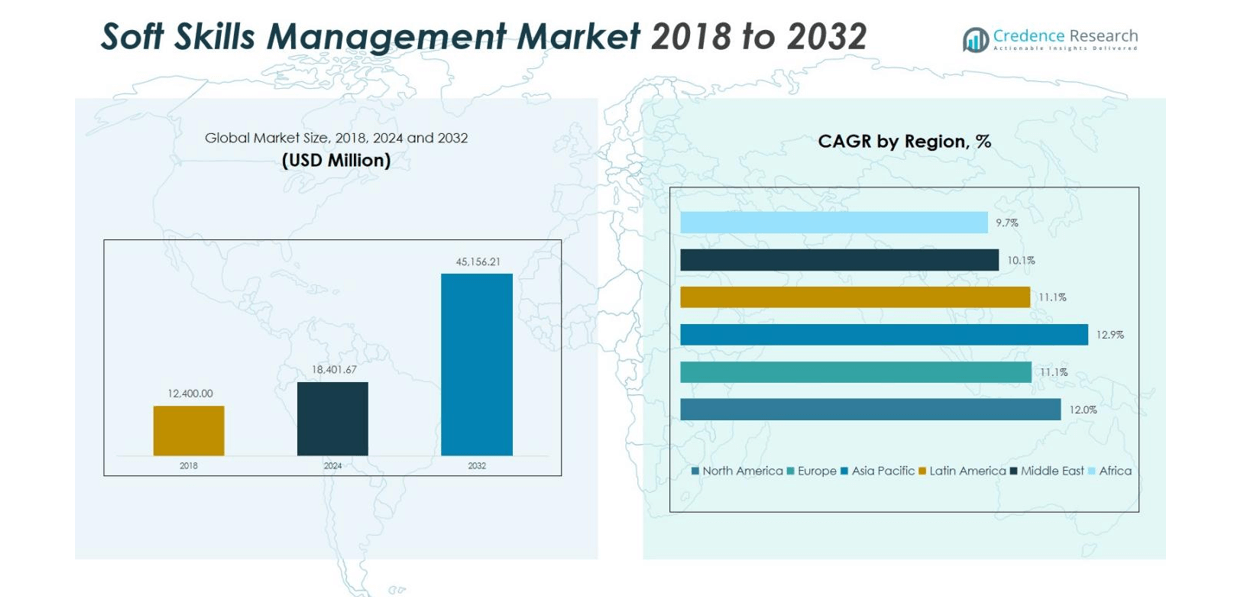
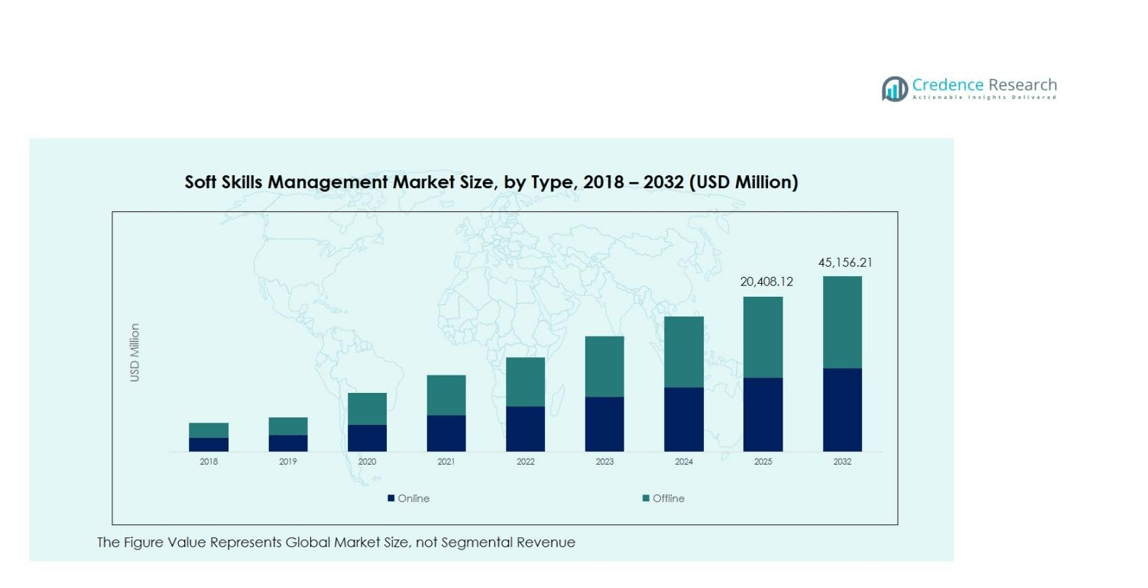
The Soft Skill Management Market size was valued at USD 12,400.00 million in 2018, growing to USD 18,401.67 million in 2024, and is anticipated to reach USD 45,156.21 million by 2032, at a CAGR of 12.01% during the forecast period.

REPORT ATTRIBUTE DETAILS
Historical Period 2020-2023
Base Year 2024
Forecast Period 2025-2032
Soft Skill Management Market Size 2024 USD 18,401.67 million
Soft Skill Management Market, CAGR 12.01%
Soft Skill Management Market Size 2032 USD 45,156.21 million


The Soft Skill Management Market is highly competitive, with key players such as Articulate Global, Cengage Learning, Computer Generated Solutions, D2L Corporation, edX, Interaction Associates, New Horizons Worldwide, NIIT Limited, Pearson PLC, and QA Ltd. leading the landscape. These companies focus on expanding their digital learning portfolios, integrating AI-driven platforms, and forming strategic alliances to enhance global reach. North America emerged as the leading region in 2024, holding 35.2% of the global market share, driven by strong corporate learning adoption and technological innovation. Europe and Asia Pacific followed, supported by growing investments in skill development and digital training infrastructure.

Soft Skill Management Market size

Market Insights

  • The Soft Skill Management Market was valued at USD 18,401.67 million in 2024 and is projected to reach USD 45,156.21 million by 2032, growing at a CAGR of 12.01% during the forecast period.
  • The market growth is driven by the increasing demand for workforce development, communication, and leadership programs as organizations prioritize employee engagement and productivity.
  • The rising adoption of AI-based e-learning platforms and gamified training modules is shaping market trends, making learning more personalized and interactive.
  • The competitive landscape features major players such as Articulate Global, Cengage Learning, D2L Corporation, edX, NIIT Limited, and Pearson PLC, focusing on partnerships and digital content expansion to strengthen their presence.
  • North America accounted for 2% of the market share in 2024, while Europe and Asia Pacific showed strong growth potential; the Online segment led with 68.4% share, driven by remote learning and digital training initiatives.

Access crucial information at unmatched prices!

Request your sample report today & start making informed decisions powered by Credence Research Inc.!

Download Sample

Market Segmentation Analysis:

By Type

The Online segment dominated the Soft Skills Management Market in 2024, capturing 68.4% of the total market share. This growth is driven by the rising adoption of e-learning platforms, remote work culture, and AI-powered personalized training solutions. Organizations favor online soft skills programs due to their flexibility, scalability, and measurable learning outcomes. The integration of cloud-based systems and mobile applications has made learning more accessible, enabling continuous professional development across global teams. Conversely, the Offline segment, with a 31.6% market share, remains relevant for its interactive and experiential learning benefits, especially in leadership and communication training where face-to-face engagement is crucial.

  • For instance, Coursera has introduced tailored skill tracks backed by data analytics to accelerate critical soft skills development across functional teams.

By Distribution Channel

The Enterprise segment led the market with 72.1% share in 2024, fueled by corporate investments in employee development and leadership enhancement programs. Companies are increasingly deploying customized Learning Management Systems (LMS) and blended training models to strengthen workplace collaboration and productivity. Meanwhile, the Personal segment held a 27.9% market share, driven by individuals seeking self-paced professional growth through online certifications and soft skill courses. Growing awareness of emotional intelligence, adaptability, and communication skills among job seekers continues to propel this segment’s steady expansion globally.

  • For instance, Adobe launched Adobe Captivate 12.4 in September 2024, a tool designed for creating interactive, device-independent eLearning content.

Key Growth Drivers

Rising Demand for Workforce Development and Employability Skills

The growing emphasis on workforce readiness and professional competency has significantly fueled the Soft Skills Management Market. Organizations across industries are prioritizing soft skill enhancement to improve communication, leadership, and adaptability among employees. Educational institutions and enterprises are integrating these programs to bridge the skills gap between academic knowledge and workplace requirements. The increasing competition for employable talent and the shift toward service-oriented economies have further accelerated investments in structured soft skills training and certification programs globally.

  • For instance, Urban Company, which launched its Urban Academy platform during the pandemic to provide remote soft skills training, including leadership and problem-solving, effectively supporting workforce adaptability and continuous learning.

Expansion of Digital Learning Platforms

The proliferation of digital learning ecosystems has become a major growth catalyst for the Soft Skills Management Market. The adoption of e-learning, mobile learning, and AI-driven training platforms enables personalized, on-demand learning experiences. These technologies provide scalable solutions that can reach global workforces efficiently while offering real-time performance tracking. Additionally, the growing affordability of online courses and cloud-based training solutions has encouraged both enterprises and individuals to embrace continuous learning models, making digital platforms the backbone of soft skills development strategies.

  • For instance, TalentLMS, a cloud-based platform, integrates AI-powered course generation and progress tracking tools to help organizations deliver scalable and personalized employee soft skills training.

Corporate Focus on Employee Retention and Productivity

Enterprises are increasingly recognizing soft skills as vital drivers of organizational success and employee engagement. Companies are investing in targeted training initiatives to improve leadership, collaboration, and emotional intelligence, which in turn enhance overall productivity and retention rates. As hybrid work models become more prevalent, the need for effective communication and adaptability has grown, prompting businesses to embed soft skill programs within their human capital development strategies. This focus on holistic employee development continues to shape long-term corporate learning investments.

Soft Skill Management Market share

Key Trends and Opportunities

Integration of AI and Analytics in Training Programs

Artificial intelligence and analytics are reshaping the Soft Skills Management Market by enabling personalized learning journeys and data-driven insights. AI-powered tools assess learning patterns, recommend tailored modules, and measure progress effectively. Analytics help organizations evaluate training ROI and identify skill gaps, fostering more targeted learning outcomes. The increasing use of adaptive learning technologies and virtual simulations provides learners with interactive, immersive experiences—creating a major opportunity for tech-driven innovation in the global training and development ecosystem.

  • For instance, 360Learning, an AI-powered platform that combines collaborative learning with AI tools, allowing internal experts and L&D teams to create highly relevant training content at scale.

Growing Adoption of Hybrid and Blended Learning Models

The convergence of online and offline training models is emerging as a significant opportunity within the market. Hybrid learning combines the flexibility of virtual modules with the engagement of in-person workshops, appealing to both enterprises and educational institutions. This approach enhances knowledge retention and offers learners a more interactive experience. As organizations seek to balance remote and onsite workforce training, blended learning models are becoming the preferred choice for scalable, cost-efficient, and impactful soft skills development programs.

  • For instance, Intel adopted a blended learning approach combining digital simulations and instructor-led sessions for training manufacturing technicians, resulting in faster skill acquisition and a 157% return on investment.

Key Challenges

Measuring Training Effectiveness and ROI

One of the major challenges in the Soft Skills Management Market is quantifying the impact of soft skills training on performance outcomes. Unlike technical skills, soft skills improvements are often subjective and difficult to measure through conventional metrics. Organizations struggle to assess ROI, making it challenging to justify large-scale training budgets. The lack of standardized assessment frameworks and post-training evaluation tools continues to hinder market growth, despite advancements in digital learning analytics.

High Cost of Customized Corporate Training Solutions

While demand for soft skills programs is rising, the high cost of designing and implementing customized training modules poses a significant barrier. Developing content tailored to specific corporate cultures, roles, and industries requires substantial investment in instructional design and technology. Small and medium-sized enterprises often find these programs financially unfeasible, limiting adoption. Additionally, ongoing updates to align with evolving business environments add to the operational expenses, restraining market expansion among budget-sensitive organizations.

Regional Analysis

North America

In 2024, North America dominated the Soft Skill Management Market with a 35.2% share, reaching a value of USD 4,482.54 million, up from USD 3,075.20 million in 2018. The market is projected to attain USD 10,977.56 million by 2032, registering a CAGR of 12.0%. The region’s leadership is driven by the strong adoption of corporate learning programs, advanced e-learning technologies, and AI-based skill assessment tools. U.S. enterprises, in particular, are emphasizing leadership, communication, and emotional intelligence training to enhance workforce productivity and engagement. The integration of cloud-based learning systems continues to sustain North America’s competitive edge.

Europe

Europe held 27.6% of the global market in 2024, valued at USD 3,979.78 million, growing from USD 2,808.60 million in 2018. The market is forecasted to reach USD 9,132.96 million by 2032, expanding at a CAGR of 11.1%. Growth is fueled by strong government initiatives and corporate investments in workforce skill development. The region’s emphasis on lifelong learning and integration of soft skills into formal education systems supports continuous upskilling. Major economies such as Germany, France, and the U.K. are adopting hybrid learning models to strengthen employee engagement and professional competence across industries.

Asia Pacific

Asia Pacific emerged as the fastest-growing region, accounting for 24.8% of the global market in 2024, valued at USD 7,663.30 million, rising from USD 5,029.44 million in 2018. The market is estimated to reach USD 19,999.72 million by 2032, advancing at a CAGR of 12.9%. Rapid digital transformation, expanding corporate training initiatives, and government-backed skill development programs are major drivers. Countries like China, India, and Japan are witnessing a surge in e-learning adoption through mobile and AI-integrated platforms. The region’s large workforce and focus on employability standards continue to position Asia Pacific as a key growth hub.

Latin America

Latin America accounted for 6.9% of the Soft Skill Management Market in 2024, valued at USD 1,221.69 million, up from USD 830.80 million in 2018. The market is projected to reach USD 2,793.81 million by 2032, growing at a CAGR of 11.1%. The expansion is driven by increasing awareness of professional development and rising participation in online learning. Countries such as Brazil and Argentina are promoting digital education and partnerships with international edtech firms to improve workforce competencies. The growing penetration of internet infrastructure further supports demand for accessible, affordable soft skill training programs across the region.

Middle East

The Middle East region represented 3.1% of the global market in 2024, with a valuation of USD 483.84 million, compared to USD 355.88 million in 2018. It is projected to reach USD 1,029.81 million by 2032, growing at a CAGR of 10.1%. Growth is supported by strong government-led education reforms and corporate learning initiatives, especially in GCC nations. The region’s focus on leadership, collaboration, and communication skills aligns with national workforce transformation goals. Adoption of e-learning and blended models is expanding, enhancing professional development among both public and private sector employees.

Africa

Africa accounted for 2.4% of the global Soft Skill Management Market in 2024, reaching USD 570.53 million, up from USD 300.08 million in 2018. The market is forecasted to achieve USD 1,222.34 million by 2032, reflecting a CAGR of 9.7%. The continent’s growth is driven by improving internet connectivity, youth-focused upskilling programs, and government initiatives promoting digital literacy. Countries like South Africa, Nigeria, and Kenya are embracing mobile-based learning to enhance employability. Despite challenges such as funding constraints and infrastructure gaps, Africa’s expanding edtech ecosystem presents significant long-term opportunities for soft skills development.

Soft Skill Management Market segmentation

Market Segmentations:

By Type

  • Online
  • Offline

By Distribution Channel:

  • Personal
  • Enterprise

By Region

  • North America
    • U.S.
    • Canada
    • Mexico
  • Europe
    • Germany
    • France
    • U.K.
    • Italy
    • Spain
    • Rest of Europe
  • Asia Pacific
    • China
    • Japan
    • India
    • South Korea
    • South-east Asia
    • Rest of Asia Pacific
  • Latin America
    • Brazil
    • Argentina
    • Rest of Latin America
  • Middle East & Africa
    • GCC Countries
    • South Africa
    • Rest of the Middle East and Africa

Competitive Landscape

The competitive landscape of the Soft Skills Management Market is characterized by the strong presence of leading players such as Articulate Global, Cengage Learning, Computer Generated Solutions, D2L Corporation, edX, Interaction Associates, New Horizons Worldwide, NIIT Limited, Pearson PLC, and QA Ltd. These companies are focusing on expanding their digital learning portfolios, enhancing AI-driven training platforms, and forming strategic partnerships to strengthen their global footprint. The market is witnessing intensified competition as vendors introduce cloud-based learning management systems and personalized training modules tailored to enterprise needs. Continuous innovation in virtual learning tools, gamified content, and analytics-based assessment solutions is reshaping the industry dynamics. Furthermore, mergers, acquisitions, and collaborations with educational institutions and corporate organizations are enabling players to enhance their service offerings. The increasing demand for scalable and interactive soft skill programs continues to encourage both established and emerging players to invest in technology integration and content diversification.

Shape Your Report to Specific Countries or Regions & Enjoy 30% Off!

Key Player Analysis

Recent Developments

  • In May 2025, Udemy, Inc. introduced its innovative AI-powered Role Play tool, designed to enhance communication, leadership, and problem-solving skills through immersive, interactive simulations for professionals.
  • In October 2025, United Nations Development Programme (UNDP) and Korea International Cooperation Agency (KOICA) in partnership with the Government of Timor-Leste launched an Accredited Soft Job Skills Module and a five-day Training of Trainers programme aimed at enhancing youth employability through soft skills development.
  • In March 19, 2024, Cornerstone OnDemand, Inc. acquired Talespin (an immersive learning/XR company) to bolster its soft-skills and behavioral training capabilities.

Report Coverage

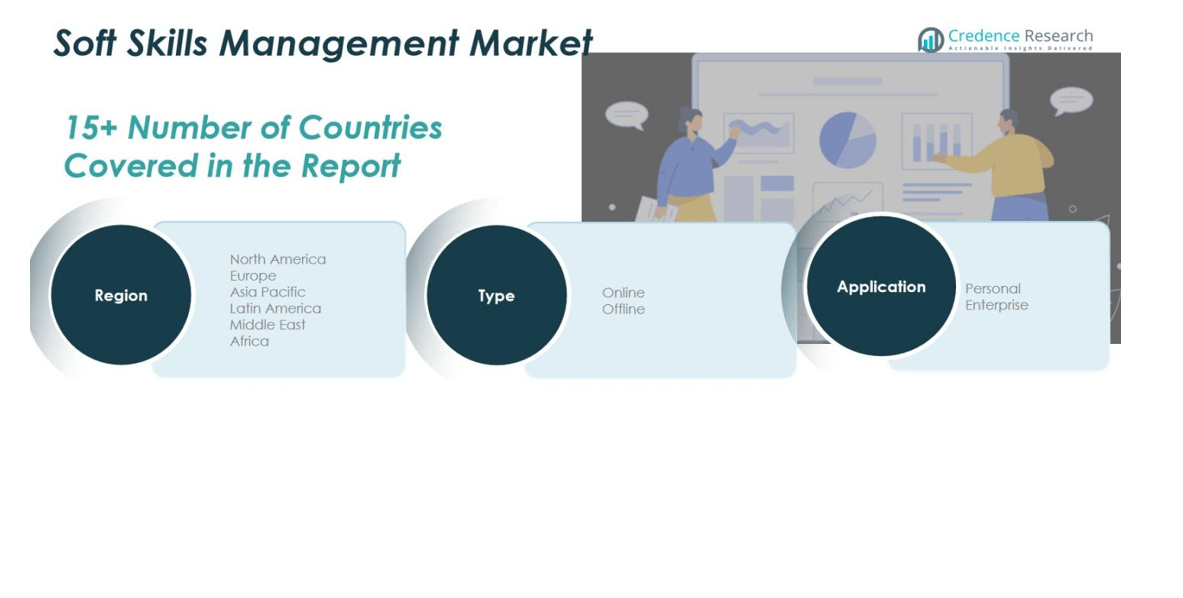
The research report offers an in-depth analysis based on Type, Distribution Channel and Region. It details leading market players, providing an overview of their business, product offerings, investments, revenue streams, and key applications. Additionally, the report includes insights into the competitive environment, SWOT analysis, current market trends, as well as the primary drivers and constraints. Furthermore, it discusses various factors that have driven market expansion in recent years. The report also explores market dynamics, regulatory scenarios, and technological advancements that are shaping the industry. It assesses the impact of external factors and global economic changes on market growth. Lastly, it provides strategic recommendations for new entrants and established companies to navigate the complexities of the market.

Future Outlook

  1. The market will continue to expand driven by the growing need for workforce adaptability and interpersonal effectiveness.
  2. Digital transformation will accelerate the adoption of AI-powered and data-driven learning platforms.
  3. Enterprises will increasingly integrate soft skills training into corporate leadership and talent development strategies.
  4. Personalized and gamified learning experiences will enhance engagement and retention rates among learners.
  5. Mobile-based and microlearning formats will dominate due to convenience and flexibility for remote workers.
  6. Partnerships between edtech providers and corporations will rise to deliver customized learning solutions.
  7. Educational institutions will embed soft skills programs into curricula to improve graduate employability.
  8. The demand for certified and measurable learning outcomes will shape the future of assessment tools.
  9. Hybrid and blended learning models will remain a preferred approach for comprehensive skill development.
  10. Emerging economies will experience strong growth as digital education infrastructure continues to improve.

CHAPTER NO. 1 :   GENESIS OF THE MARKET      

1.1 Market Prelude – Introduction & Scope

1.2 The Big Picture – Objectives & Vision

1.3 Strategic Edge – Unique Value Proposition

1.4 Stakeholder Compass – Key Beneficiaries

CHAPTER NO. 2 :   EXECUTIVE LENS

2.1 Pulse of the Industry – Market Snapshot

2.2 Growth Arc – Revenue Projections (USD Million)

2.3. Premium Insights – Based on Primary Interviews

CHAPTER NO. 3 :   SOFT SKILLS MANAGEMENT MARKET FORCES & INDUSTRY PULSE 

3.1 Foundations of Change – Market Overview
3.2 Catalysts of Expansion – Key Market Drivers
3.2.1 Momentum Boosters – Growth Triggers
3.2.2 Innovation Fuel – Disruptive Technologies
3.3 Headwinds & Crosswinds – Market Restraints
3.3.1 Regulatory Tides – Compliance Challenges
3.3.2 Economic Frictions – Inflationary Pressures
3.4 Untapped Horizons – Growth Potential & Opportunities
3.5 Strategic Navigation – Industry Frameworks
3.5.1 Market Equilibrium – Porter’s Five Forces
3.5.2 Ecosystem Dynamics – Value Chain Analysis
3.5.3 Macro Forces – PESTEL Breakdown

3.6 Price Trend Analysis

3.6.1 Regional Price Trend
3.6.2 Price Trend by product

CHAPTER NO. 4 :   KEY INVESTMENT EPICENTER           

4.1 Regional Goldmines – High-Growth Geographies

4.2 Type Frontiers – Lucrative Type Categories

4.3 Distribution Channel Sweet Spots – Emerging Demand Segments

CHAPTER NO. 5: REVENUE TRAJECTORY & WEALTH MAPPING

5.1 Momentum Metrics – Forecast & Growth Curves

5.2 Regional Revenue Footprint – Market Share Insights

5.3 Segmental Wealth Flow – Type & Distribution Channel Revenue

CHAPTER NO. 6 :   TRADE & COMMERCE ANALYSIS      

6.1.      Import Analysis by Region

6.1.1.   Global Soft Skills Management Market Import Revenue By Region

6.2.      Export Analysis by Region

6.2.1.   Global Soft Skills Management Market Export Revenue By Region

CHAPTER NO. 7 :   COMPETITION ANALYSIS         

7.1.      Company Market Share Analysis

7.1.1.   Global Soft Skills Management Market: Company Market Share

7.2.      Global Soft Skills Management Market Company Revenue Market Share

7.3.      Strategic Developments

7.3.1.   Acquisitions & Mergers

7.3.2.   New Type Launch

7.3.3.   Regional Expansion

7.4.      Competitive Dashboard

7.5.    Company Assessment Metrics, 2024

CHAPTER NO. 8 :   SOFT SKILLS MANAGEMENT MARKET – BY TYPE SEGMENT ANALYSIS

8.1.      Soft Skills Management Market Overview by Type Segment

8.1.1.   Soft Skills Management Market Revenue Share By Type

8.1.2.   Soft Skills Management Market Revenue Share By Type

8.2.      Online

8.3.      Offline

CHAPTER NO. 9 :   SOFT SKILLS MANAGEMENT MARKET – BY DISTRIBUTION CHANNEL SEGMENT ANALYSIS

9.1.      Soft Skills Management Market Overview by Distribution Channel Segment

9.1.1.   Soft Skills Management Market Revenue Share By Distribution Channel

9.1.2.   Soft Skills Management Market Revenue Share By Distribution Channel

9.2.      Personal

9.3.      Enterprise

CHAPTER NO. 10 : SOFT SKILLS MANAGEMENT MARKET – REGIONAL ANALYSIS

10.1.    Soft Skills Management Market Overview by Region Segment

10.1.1. Global Soft Skills Management Market Revenue Share By Region

10.1.2. Regions

10.1.3. Global Soft Skills Management Market Revenue By Region

10.1.4. Global Soft Skills Management Market Revenue By Region

10.1.5. Type

10.1.6. Global Soft Skills Management Market Revenue By Type

10.1.7. Global Soft Skills Management Market Revenue By Type

10.1.8. Distribution Channel

10.1.9. Global Soft Skills Management Market Revenue By Distribution Channel

10.1.10.           Global Soft Skills Management Market Revenue By Distribution Channel

CHAPTER NO. 11 : NORTH AMERICA SOFT SKILLS MANAGEMENT MARKET – COUNTRY ANALYSIS        

11.1.    North America Soft Skills Management Market Overview by Country Segment

11.1.1. North America Soft Skills Management Market Revenue Share By Region

11.2.    North America

11.2.1. North America Soft Skills Management Market Revenue By Country

11.2.2. Type

11.2.3. North America Soft Skills Management Market Revenue By Type

11.2.4. Distribution Channel

11.2.5. North America Soft Skills Management Market Revenue By Distribution Channel

11.3.    U.S.

11.4.    Canada

11.5.    Mexico

CHAPTER NO. 12 : EUROPE SOFT SKILLS MANAGEMENT MARKET – COUNTRY ANALYSIS

12.1.    Europe Soft Skills Management Market Overview by Country Segment

12.1.1. Europe Soft Skills Management Market Revenue Share By Region

12.2.    Europe

12.2.1. Europe Soft Skills Management Market Revenue By Country

12.2.2. Type

12.2.3. Europe Soft Skills Management Market Revenue By Type

12.2.4. Distribution Channel

12.2.5. Europe Soft Skills Management Market Revenue By Distribution Channel

12.3.    UK

12.4.    France

12.5.    Germany

12.6.    Italy

12.7.    Spain

12.8.    Russia

12.9.   Rest of Europe

CHAPTER NO. 13 : ASIA PACIFIC SOFT SKILLS MANAGEMENT MARKET – COUNTRY ANALYSIS

13.1.    Asia Pacific Soft Skills Management Market Overview by Country Segment

13.1.1. Asia Pacific Soft Skills Management Market Revenue Share By Region

13.2.    Asia Pacific

13.2.1. Asia Pacific Soft Skills Management Market Revenue By Country

13.2.2. Type

13.2.3. Asia Pacific Soft Skills Management Market Revenue By Type

13.2.4. Distribution Channel

13.2.5. Asia Pacific Soft Skills Management Market Revenue By Distribution Channel

13.3.    China

13.4.    Japan

13.5.    South Korea

13.6.    India

13.7.    Australia

13.8.    Southeast Asia

13.9.    Rest of Asia Pacific

CHAPTER NO. 14 : LATIN AMERICA SOFT SKILLS MANAGEMENT MARKET – COUNTRY ANALYSIS

14.1.    Latin America Soft Skills Management Market Overview by Country Segment

14.1.1. Latin America Soft Skills Management Market Revenue Share By Region

14.2.    Latin America

14.2.1. Latin America Soft Skills Management Market Revenue By Country

14.2.2. Type

14.2.3. Latin America Soft Skills Management Market Revenue By Type

14.2.4. Distribution Channel

14.2.5. Latin America Soft Skills Management Market Revenue By Distribution Channel

14.3.    Brazil

14.4.    Argentina

14.5.    Rest of Latin America

CHAPTER NO. 15 : MIDDLE EAST SOFT SKILLS MANAGEMENT MARKET – COUNTRY ANALYSIS

15.1.    Middle East Soft Skills Management Market Overview by Country Segment

15.1.1. Middle East Soft Skills Management Market Revenue Share By Region

15.2.    Middle East

15.2.1. Middle East Soft Skills Management Market Revenue By Country

15.2.2. Type

15.2.3. Middle East Soft Skills Management Market Revenue By Type

15.2.4. Distribution Channel

15.2.5. Middle East Soft Skills Management Market Revenue By Distribution Channel

15.3.    GCC Countries

15.4.    Israel

15.5.    Turkey

15.6.    Rest of Middle East

CHAPTER NO. 16 : AFRICA SOFT SKILLS MANAGEMENT MARKET – COUNTRY ANALYSIS

16.1.    Africa Soft Skills Management Market Overview by Country Segment

16.1.1. Africa Soft Skills Management Market Revenue Share By Region

16.2.    Africa

16.2.1. Africa Soft Skills Management Market Revenue By Country

16.2.2. Type

16.2.3. Africa Soft Skills Management Market Revenue By Type

16.2.4. Distribution Channel

16.2.5. Africa Soft Skills Management Market Revenue By Distribution Channel

16.3.    South Africa

16.4.    Egypt

16.5.    Rest of Africa

CHAPTER NO. 17 : COMPANY PROFILES     

17.1.    Articulate Global

17.1.1. Company Overview

17.1.2. Type Portfolio

17.1.3. Financial Overview

17.1.4. Recent Developments

17.1.5. Growth Strategy

17.1.6. SWOT Analysis

17.2.    Cengage Learning, Inc.

17.3.    Computer Generated Solutions, Inc.

17.4.    D2L Corporation

17.5.    edX, Inc.

17.6.    Interaction Associates, Inc.

17.7.    New Horizons Worldwide, LLC.

17.8.    NIIT Limited

17.9.    Pearson PLC

17.10.  QA Ltd.

Request Free Sample

We prioritize the confidentiality and security of your data. Our promise: your information remains private.

Ready to Transform Data into Decisions?

Request Your Sample Report and Start Your Journey of Informed Choices


Providing the strategic compass for industry titans.

cr-clients-logos

Frequently Asked Question:

What is the current market size for the Soft Skill Management Market, and what is its projected size in 2032?

The Soft Skill Management Market was valued at USD 18,401.67 million in 2024 and is projected to reach USD 45,156.21 million by 2032.

At what Compound Annual Growth Rate is the Soft Skill Management Market projected to grow between 2025 and 2032?

The Soft Skill Management Market is expected to grow at a CAGR of 12.01% during the forecast period from 2025 to 2032.

Which Soft Skill Management Market segment held the largest share in 2024?

The Online segment dominated the Soft Skill Management Market in 2024, capturing 68.4% of the total market share.

What are the primary factors fueling the growth of the Soft Skill Management Market?

Key drivers include rising demand for workforce development, expansion of digital learning platforms, and corporate focus on employee productivity.

Which region commanded the largest share of the Soft Skill Management Market in 2024?

North America led the Soft Skill Management Market in 2024, accounting for 35.2% of the global market share.

Who are the major players in this market?

Major players include Articulate Global, Cengage Learning, D2L Corporation, NIIT Limited, Pearson PLC, and edX, Inc.

About Author

Sushant Phapale

Sushant Phapale

ICT & Automation Expert

Sushant is an expert in ICT, automation, and electronics with a passion for innovation and market trends.

View Profile

Related Reports

Industrial Annunciators Market

Industrial Annunciators Market size was valued at USD 452.27 Million in 2024 and is anticipated to reach USD 710.04 Million by 2032, at a CAGR of 5.8% during the forecast period.

Predictive Maintenance Market

The global predictive maintenance market was valued at USD 10.6 billion in 2024 and is projected to reach USD 116.23 billion by 2032, expanding at a CAGR of 34.9% over the forecast period (2024–2032).

Mobile Wallet And Payment Market

The global mobile wallet and payment market was valued at USD 10.14 billion in 2024 and is projected to reach USD 64.81 billion by 2032, expanding at a CAGR of 26.1% over the forecast period (2024–2032).

Artificial Intelligence Platform Market

The global Artificial Intelligence (AI) Platform Market was valued at USD 23.32 billion in 2024 and is projected to reach USD 66.61 billion by 2032, expanding at a CAGR of 14.02% during the forecast period (2025–2032).

Head-Up Display (HUD) Market

The head-up display (HUD) market was valued at USD 2.53 billion in 2024 and is projected to reach USD 11.7 billion by 2032, registering a CAGR of 21.1% during the forecast period (2025–2032).

Converged Infrastructure Market

Converged Infrastructure Market was valued at USD 10.18 billion in 2024 and is anticipated to reach USD 32.25 billion by 2032, growing at a CAGR of 15.5 % during the forecast period.

Spear Phishing Protection Market

The Spear Phishing Protection Market is projected to grow from USD 1,747.6 million in 2024 to an estimated USD 4,296.18 million by 2032, with a CAGR of 11.9% from 2024 to 2032.

Corporate Training Market

The Global Corporate Training Market size was valued at USD 236.87 billion in 2018 to USD 371.27 billion in 2024 and is anticipated to reach USD 682.93 billion by 2032, at a CAGR of 7.37% during the forecast period.

U.S. IT Staffing Market

The U.S. IT Staffing Market size was valued at USD 87.26 billion in 2018, grew to USD 113.81 billion in 2024, and is anticipated to reach USD 156.23 billion by 2032, at a CAGR of 3.76% during the forecast period.

Serverless Apps Market

The global serverless applications market was valued at USD 4,937.5 million in 2024 and is projected to reach USD 27,279.32 million by 2032, expanding at a CAGR of 23.82% during the forecast period (2025–2032).

Block Chain Technology Market

Block Chain Technology Market size was valued at USD 26.89 Billion in 2024 and is anticipated to reach USD 794.84 Billion by 2032, at a CAGR of 52.7% during the forecast period.

Smart Rings Market

The Smart Rings Market size was valued at USD 319.4 million in 2024 and is anticipated to reach USD 2,404.16 million by 2032, at a CAGR of 28.7% during the forecast period (2024-2032).

Licence Option

The report comes as a view-only PDF document, optimized for individual clients. This version is recommended for personal digital use and does not allow printing. Use restricted to one purchaser only.
$4999

To meet the needs of modern corporate teams, our report comes in two formats: a printable PDF and a data-rich Excel sheet. This package is optimized for internal analysis. Unlimited users allowed within one corporate location (e.g., regional office).
$6999

The report will be delivered in printable PDF format along with the report’s data Excel sheet. This license offers 100 Free Analyst hours where the client can utilize Credence Research Inc. research team. Permitted for unlimited global use by all users within the purchasing corporation, such as all employees of a single company.
$12999

Report delivery within 24 to 48 hours

Europe

North America

Email

Smallform of Sample request
User Review

Thank you for the data! The numbers are exactly what we asked for and what we need to build our business case.

Materials Scientist
(privacy requested)

User Review

The report was an excellent overview of the Industrial Burners market. This report does a great job of breaking everything down into manageable chunks.

Imre Hof
Management Assistant, Bekaert

cr-clients-logos

Request Sample