
| REPORT ATTRIBUTE | DETAILS |
|---|---|
| Historical Period | 2020-2023 |
| Base Year | 2024 |
| Forecast Period | 2025-2032 |
| South Korea Writing Instruments Market Size 2023 | USD 931.26 Million |
| South Korea Writing Instruments Market, CAGR | 11.79% |
| South Korea Writing Instruments Market Size 2032 | USD 2,541.73 Million |
Market Overview
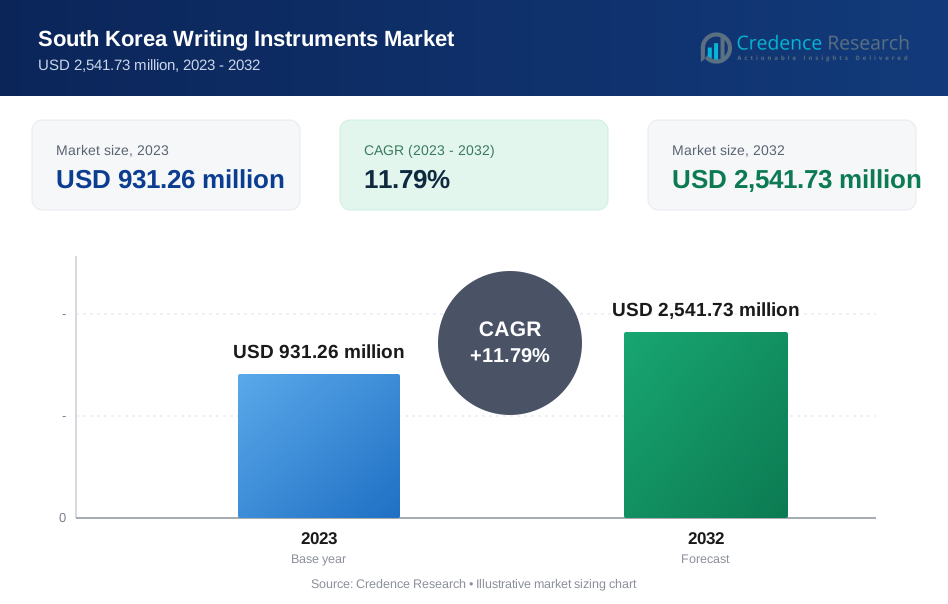
South Korea Writing Instruments Market size was valued at USD 931.26 million in 2023 and is anticipated to reach USD 2,541.73 million by 2032, at a CAGR of 11.79% during the forecast period (2023-2032). The South Korea writing instruments market is driven by several factors, including the growing demand for high-quality, innovative writing products, as well as the increasing emphasis on personalization and customization. Consumers are increasingly seeking premium pens, notebooks, and other stationery items, contributing to market growth. Additionally, the rising awareness of eco-friendly and sustainable materials is pushing manufacturers to develop environmentally conscious products. Trends such as the incorporation of advanced technology in writing instruments, like smart pens, and the growing preference for branded stationery products in both professional and educational sectors further fuel market expansion. The shift towards online retail channels and increased disposable income are also significant drivers, enhancing accessibility and driving sales. The South Korea writing instruments market is primarily concentrated in major metropolitan areas such as Seoul, Gyeonggi, Busan, and Daegu, where the demand for high-quality pens, pencils, and other writing tools is robust. Key players in the market include internationally recognized brands like Lamy, Montblanc, Waterman, Faber-Castell, and Pelikan, alongside strong local brands such as Monami and Cello pens. These companies dominate the market by offering a wide range of writing instruments, from luxury and premium options to affordable, everyday products. Their presence is bolstered by an expanding retail network and e-commerce platforms, catering to the diverse needs of consumers across the country. The competition is intense, with brands focusing on innovation, personalization, and sustainability to differentiate themselves and capture consumer interest. The market is driven by both established players and emerging local brands, ensuring a dynamic and competitive landscape.Market Insights
- The South Korea writing instruments market was valued at USD 931.26 million in 2023 and is projected to reach USD 2,541.73 million by 2032, growing at a CAGR of 11.79% from 2023 to 2032.
- The Global Writing Instruments market was valued at USD 22,000.00 million in 2023 and is expected to reach USD 57,196.01 million by 2032, growing at a CAGR of 11.20% during the forecast period.
- Increasing demand for personalized and luxury writing instruments is driving market growth, especially among professionals and collectors.
- Rising preference for eco-friendly and sustainable products is reshaping the market, with consumers opting for recyclable and refillable options.
- The integration of technology into traditional writing tools, such as smart pens and digital notepads, is gaining traction.
- Strong competition exists between global brands like Montblanc, Lamy, and Faber-Castell and local brands such as Monami and Cello pens.
- The market faces challenges from the digitalization of writing tools, reducing demand for traditional products.
- The Seoul Metropolitan Region dominates the market, followed by Gyeonggi Province and other key areas like Busan and Daegu.
Report Scope
This report segments the South Korea Writing Instruments Market as follows:
Market Drivers
Rising Demand for Premium and Luxury Writing Instruments One of the key drivers of the South Korea writing instruments market is the growing demand for premium and luxury writing products. For instance, surveys conducted by South Korean consumer research organizations highlight the increasing preference for high-quality pens among professionals and collectors. As disposable income levels rise, consumers are increasingly inclined to invest in high-quality pens and stationery. The market is witnessing a shift from traditional, budget-friendly options to more sophisticated, high-end writing instruments. Luxury pens from renowned brands are gaining popularity, particularly among professionals and collectors. The appeal of these products lies not only in their functionality but also in their aesthetic design and brand prestige. As more consumers view writing instruments as a status symbol, the demand for premium options is expected to continue growing, thereby propelling market growth in South Korea. Growing Emphasis on Personalization and Customization The trend of personalization and customization is another significant driver in the South Korean writing instruments market. Consumers are increasingly seeking unique and personalized stationery items that reflect their individual style. From engraved pens to custom-designed notebooks, personalized writing instruments are becoming a popular choice among consumers. This demand is particularly prevalent in the corporate sector, where companies use customized writing products for branding and promotional purposes. Furthermore, as people look for meaningful gifts, personalized writing instruments offer a thoughtful and distinctive option. The rising trend of customization is expected to continue fueling market demand, as consumers place more value on personal expression and unique designs. Shift Towards Eco-friendly and Sustainable Products Environmental consciousness is becoming a major influence on consumer purchasing decisions in South Korea, and this trend extends to the writing instruments market. For instance, environmental campaigns led by South Korean green organizations have encouraged manufacturers to adopt recycled and biodegradable materials in their products. Increasing awareness of environmental issues has led to a rising demand for eco-friendly and sustainable writing products. Consumers are more inclined to purchase items made from recycled or biodegradable materials, as well as pens that can be refilled and reused. Many companies are responding by developing writing instruments that are both functional and environmentally friendly, contributing to the growing popularity of these products. This shift towards sustainability is expected to drive the demand for eco-conscious writing instruments, making it an important market driver over the forecast period. Advancement in Technology and Innovation Technological advancements and product innovations are also playing a crucial role in the growth of the South Korea writing instruments market. The introduction of smart pens and other technologically advanced writing instruments is revolutionizing the way consumers interact with traditional writing tools. Smart pens, which can digitize handwriting and sync with digital devices, are gaining traction among tech-savvy individuals, students, and professionals. Additionally, innovations in pen design, such as ergonomic pens, multifunctional tools, and pens with advanced ink technologies, are enhancing the overall writing experience. As consumer preferences shift towards more innovative and high-tech products, the writing instruments market in South Korea is set to experience sustained growth, driven by these advancements.Market Trends
Surge in Personalized and Luxury Writing Instruments In South Korea, there is a notable shift towards personalized and luxury writing instruments. For instance, surveys conducted by luxury stationery brands highlight the popularity of limited-edition series like Monami's Tin Case collection, which has garnered significant consumer interest. Consumers are increasingly seeking high-end pens and stationery items that reflect their individual style and status. Brands like Monami have capitalized on this trend by releasing limited-edition series, such as the Tin Case series, which have garnered significant attention and consumer interest. Additionally, luxury brands like Montblanc have expanded their presence in South Korea, opening pop-up stores like The Library Spirit to cater to the growing demand for premium writing instruments. This trend signifies a broader appreciation for craftsmanship and exclusivity in the writing instruments market. Integration of Technology with Traditional Writing Tools The convergence of technology and traditional writing instruments is another prominent trend in South Korea. The rise of smart pens and digital notepads reflects a growing consumer interest in products that blend analog and digital functionalities. These innovations cater to tech-savvy individuals, students, and professionals who seek enhanced productivity and convenience. The demand for such hybrid tools is expected to continue as consumers look for writing instruments that offer both traditional tactile experiences and modern digital capabilities. Emphasis on Eco-Friendly and Sustainable Products Environmental consciousness is increasingly influencing consumer purchasing decisions in South Korea's writing instruments market. For instance, environmental campaigns led by South Korean green organizations have encouraged manufacturers to adopt recycled materials and biodegradable plastics in their products. Manufacturers are responding by introducing products made from recycled materials, biodegradable plastics, and refillable ink pens. This shift towards sustainability appeals to environmentally conscious consumers, particularly younger generations who prioritize eco-friendly options. The growing demand for sustainable writing instruments is expected to drive innovation and influence product offerings in the market. Expansion of Online Retail Channels The expansion of online retail channels is significantly impacting the South Korean writing instruments market. E-commerce platforms such as Coupang, Gmarket, and 11st have become primary sales avenues, offering consumers a convenient shopping experience. The COVID-19 pandemic accelerated this shift, leading to increased online sales of writing instruments. This trend is expected to persist as consumers continue to favor the convenience and accessibility of online shopping, prompting brands to enhance their digital presence and e-commerce strategies.Market Challenges Analysis
Intense Competition and Price Sensitivity One of the primary challenges facing the South Korea writing instruments market is the intense competition among local and international brands. For instance, reports from the South Korean Chamber of Commerce highlight the influx of inexpensive imports, which exacerbate price competition and challenge premium brands. The market is saturated with a wide range of products, from budget-friendly options to premium offerings, leading to fierce price competition. This pricing pressure is compounded by the availability of inexpensive imports, which further intensify competition. As a result, companies must continuously innovate and differentiate their products to maintain a competitive edge while managing cost constraints. Shifting Consumer Preferences and Market Trends Another challenge is the rapidly changing consumer preferences and trends in the writing instruments market. With the increasing digitization of work and education, the demand for traditional writing tools is facing competition from digital alternatives, such as tablets and smart pens. These technological innovations provide consumers with more efficient and multifunctional solutions, potentially reducing the need for traditional writing instruments. Additionally, the growing shift towards sustainable and eco-friendly products presents challenges for manufacturers to adapt to changing regulations and consumer demands. Companies must invest in sustainable materials and production processes to stay aligned with evolving market expectations, adding to operational costs and complexity.Market Opportunities
The South Korea writing instruments market presents several opportunities driven by shifting consumer preferences and emerging trends. One of the most significant opportunities lies in the growing demand for personalized and luxury writing products. As disposable income increases, there is a noticeable shift toward premium, high-quality writing instruments, particularly in the corporate and professional sectors. Consumers are increasingly interested in customized products, including engraved pens and unique designs that reflect personal style. This trend is gaining traction in both the retail and B2B markets, offering a lucrative opportunity for brands to cater to the need for exclusive, luxury items. Companies that can capitalize on these preferences by offering innovative, high-end products stand to benefit from a growing market segment. Another key opportunity lies in the rising demand for eco-friendly and sustainable writing products. With increasing environmental awareness, consumers in South Korea are becoming more inclined to purchase writing instruments made from recycled or biodegradable materials. This trend presents an opportunity for manufacturers to develop products that align with sustainability values, from refillable pens to biodegradable stationery. As government regulations around sustainability tighten and consumers become more eco-conscious, companies that invest in green innovation will have a competitive advantage in the market. Additionally, expanding digital technologies such as smart pens and writing tools with integrated functionalities offer new possibilities, particularly among tech-savvy consumers and professionals. These advancements provide an opportunity for brands to differentiate their products and capture the attention of a modern, tech-driven consumer base.Market Segmentation Analysis:
By Type: The South Korea writing instruments market can be segmented into several categories, with pens holding the largest share due to their widespread use in everyday writing tasks across both professional and educational sectors. Pens, including ballpoint, gel, fountain, and rollerball varieties, cater to diverse consumer preferences for writing smoothness, precision, and durability. Pencils, while representing a smaller portion of the market, remain essential in both educational and artistic applications. They are particularly popular among students and professionals who require precision in writing and sketching. Additionally, the demand for coloring instruments, such as colored pencils, crayons, and markers, has surged, driven by both educational and leisure activities. Highlighters and markers also represent a growing segment, particularly in professional and academic settings, where they are widely used for note-taking and document highlighting. Other writing instruments, including specialty tools like calligraphy pens and styluses for digital devices, contribute a smaller but growing portion of the market as interest in niche and multifunctional tools increases. By Application: The South Korea writing instruments market is also segmented based on application, with the largest share attributed to the writing segment. This includes all types of pens and pencils used for everyday writing tasks in schools, offices, and homes. The continuous demand for efficient and reliable writing instruments in these areas drives significant growth in this segment. The drawing, coloring, and artwork segment is witnessing increasing demand, particularly among students, artists, and hobbyists. As creative pursuits gain popularity, especially with younger demographics, coloring instruments such as crayons, colored pencils, and art markers are essential. The growth in this segment is supported by the expanding market for adult coloring books, art supplies, and creative workshops. Lastly, the 'Others' segment, which includes specialty and multifunctional writing instruments, continues to grow as consumers seek tools that offer more than just basic writing capabilities, such as smart pens and high-tech stylus devices for digital use. This diversification in applications enhances the market's overall growth potential.Segments:
Based on Type:- Pen
- Pencil
- Coloring Instruments
- Highlighters and Markers
- Others
- Writing
- Drawing/Colouring/Art Work
- Others
- Students
- Working Professionals
- Institutions
- Stationaries
- Hypermarket/Supermarket
- Departmental Stores
- Online
- Seoul Metropolitan Region
- Gyeonggi Province
- Busan and Ulsan Regions
- Daegu Region
Regional Analysis
Seoul Metropolitan Region The Seoul Metropolitan Region holds the largest market share in South Korea's writing instruments market, accounting for approximately 40% of the total market. As the capital and economic hub of the country, Seoul is home to a large portion of the nation's population, including students, professionals, and office workers. This region’s substantial market share is driven by its dense concentration of businesses, educational institutions, and government offices, all of which require a high volume of writing instruments for daily operations. The strong demand for both basic and premium writing tools, including pens, pencils, and specialty items, has bolstered the market's growth in this region. Furthermore, Seoul's thriving retail sector, which includes both physical stores and e-commerce platforms, makes it a prime market for writing instrument manufacturers. Gyeonggi Province Gyeonggi Province, which surrounds Seoul, represents the second-largest market for writing instruments, capturing around 30% of the total market share. As one of the most industrialized regions in South Korea, Gyeonggi is home to numerous businesses, schools, and tech companies. This has led to an increasing demand for office supplies and educational tools, including writing instruments. Additionally, Gyeonggi’s proximity to Seoul makes it a key area for distribution, further driving sales of writing products. The population in this region also exhibits a growing preference for premium and customized writing products, which has contributed to a steady growth rate in recent years. The expanding middle class and rising disposable incomes in Gyeonggi Province are likely to continue boosting demand in this market segment. Busan and Ulsan Regions The Busan and Ulsan regions combined hold approximately 15% of the South Korean writing instruments market. As the second-largest metropolitan area in South Korea, Busan benefits from significant commercial activity, particularly in logistics, shipping, and tourism. The demand for writing instruments in this region is primarily driven by educational institutions and office-related needs. The Ulsan region, known for its heavy industrial sector, also contributes to the market through the high volume of office supplies required by manufacturing companies. While these regions are not as large as Seoul or Gyeonggi, their growing population and development initiatives present a notable opportunity for manufacturers to increase market penetration. The demand for both standard and specialized writing tools is on the rise due to urbanization and economic development. Daegu Region Daegu, the fourth-largest city in South Korea, holds around 10% of the writing instruments market share. As an important cultural and educational center, Daegu has a consistent demand for writing products, particularly in schools and universities. The region’s market is driven by the educational sector, where writing instruments are essential for students. The city's stable economy and population growth contribute to a steady demand for both affordable and high-end writing tools. While Daegu’s market share is smaller compared to the other regions, its significant role in education ensures sustained growth in the writing instruments sector. Additionally, with increasing urbanization, Daegu is witnessing higher consumption of office supplies and personal stationery, further enhancing market prospects.Key Player Analysis
- Lamy
- Montblanc
- Waterman
- Faber-Castell
- Montegrappa
- Pelikan
- Kaweco
- Diplomat
- Aurora
- Sheaffer
- Cello pens
- Monami
Competitive Analysis
The competitive landscape of the South Korea writing instruments market is characterized by a mix of established international brands and strong local players. Leading global brands such as Lamy, Montblanc, Waterman, Faber-Castell, Montegrappa, Pelikan, Kaweco, Diplomat, Aurora, and Sheaffer compete fiercely with local brands like Cello Pens and Monami. These companies maintain a significant market presence by offering a diverse range of products, from luxury and premium writing instruments to affordable, everyday pens and pencils. International brands dominate the high-end segment, emphasizing quality, design, and craftsmanship to appeal to professionals, collectors, and affluent consumers. These brands often invest heavily in innovation, such as offering customizable and personalized products, which helps them differentiate themselves in the market. On the other hand, local brands target the mass market by providing cost-effective solutions for students, office workers, and general consumers. These companies prioritize functionality and affordability, ensuring that their products meet the demands of a large and price-sensitive population. The competitive advantage for these local players lies in their ability to offer high-quality products at lower price points compared to their international counterparts. With growing consumer interest in sustainability, many companies are incorporating eco-friendly materials and designs into their offerings, further intensifying competition. As digitalization continues to impact the writing instruments market, there is also an increasing demand for smart pens and hybrid tools that integrate technology with traditional writing methods, adding another layer of competition among market players.Recent Developments
- In February 2023, Zebra Pen Corp., a prominent player in the industry, announced its partnership with Liqui-Mark. This collaboration aims to enhance distribution aspects in the market, bringing about a new era of possibilities.
- In July 2023, Montblanc launched its exclusive "Meisterstück 146 LeGrand" fountain pen, featuring a handcrafted design with intricate detailing, addressing the rising demand for personalized, high-end writing tools in luxury segments.
- In April 2022, Zebra Pen Corp. announced the launch of its official website. This step was taken by the company to enhance user experience, increase e-commerce functionality, and improve brand communication, among other objectives.
Market Concentration & Characteristics
The South Korea writing instruments market exhibits a moderate to high level of concentration, with both global and local players contributing to its growth. While international brands dominate the premium segment, local manufacturers hold a significant share in the mass-market category, focusing on affordable and functional products for a broad consumer base. The market is characterized by intense competition, particularly in terms of pricing, innovation, and product differentiation. Premium brands emphasize quality, design, and personalization, while local brands focus on meeting the everyday needs of students, professionals, and office workers. Additionally, the increasing demand for eco-friendly and sustainable writing instruments has led to a shift in market dynamics, with more brands incorporating environmentally friendly materials and processes into their product lines. The market is also witnessing a growing interest in technological innovations, such as smart pens and hybrid writing tools, reflecting changing consumer preferences and digital trends.Report Coverage
The research report offers an in-depth analysis based on Type, Application, End-User, Distribution Channel and Geography. It details leading market players, providing an overview of their business, product offerings, investments, revenue streams, and key applications. Additionally, the report includes insights into the competitive environment, SWOT analysis, current market trends, as well as the primary drivers and constraints. Furthermore, it discusses various factors that have driven market expansion in recent years. The report also explores market dynamics, regulatory scenarios, and technological advancements that are shaping the industry. It assesses the impact of external factors and global economic changes on market growth. Lastly, it provides strategic recommendations for new entrants and established companies to navigate the complexities of the market.Future Outlook
- South Korea's writing instruments market is expected to witness steady growth, driven by innovation and consumer demand for premium products.
- The increasing adoption of eco-friendly materials will shape the future of writing instruments, with manufacturers focusing on sustainability.
- Digital integration in writing tools, such as smart pens, will likely see higher adoption in educational and corporate sectors.
- The rise of personalized stationery products will fuel demand for custom-made writing instruments in both individual and corporate markets.
- Expansion of retail and online channels will provide greater accessibility to consumers, improving market penetration.
- South Korea's strong educational system will continue to drive demand for high-quality writing tools among students and professionals.
- The growing trend toward luxury and premium writing instruments will enhance market value and appeal to niche segments.
- Increased disposable income in South Korea will boost the demand for high-end pens and markers.
- Technological advancements in ink and ergonomics will improve the performance and comfort of writing instruments.
- South Korea’s export potential will strengthen, particularly in markets such as Japan, China, and Southeast Asia, owing to their demand for quality writing tools.
Request a Free Sample
Fill in your details and we'll send you a free sample report.
- Sample data tables & charts
- Research methodology
Market Dynamics
Rising Demand for Premium and Luxury Writing Instruments
As disposable incomes increase in South Korea, consumers are shifting from basic to high-end writing products, viewing them as status symbols and collectibles. This trend is especially strong among professionals and collectors, driving growth in the premium segment.
Emphasis on Personalization and Customization
Consumers and corporations in South Korea are increasingly seeking personalized and custom-designed writing instruments for gifting, branding, and personal use. This demand for unique, engraved, or limited-edition products is fueling innovation and expanding the market.
Shift Towards Eco-friendly and Sustainable Products
Growing environmental awareness is pushing both consumers and manufacturers to prioritize writing instruments made from recycled, biodegradable, or refillable materials. This shift is encouraging the development and adoption of sustainable products, supporting market expansion.
Integration of Technology and Smart Writing Tools
The adoption of smart pens and digital notepads that bridge analog and digital experiences is gaining traction among tech-savvy students and professionals. This technological integration is opening new market segments and enhancing the value proposition of traditional writing instruments.
Expansion of Online Retail Channels
The rapid growth of e-commerce platforms in South Korea has made writing instruments more accessible to a wider audience, especially post-pandemic. Online channels offer convenience, variety, and customization options, significantly boosting market penetration and sales.
Need a Custom Version of This Report?
Tailor the scope, geography, or segments to your exact requirements.
- Custom geography or segment scope
- Direct access to our analyst team
Frequently Asked Questions
What is the current size of the South Korea Writing Instruments?
What factors are driving the growth of the South Korea Writing Instruments?
What are the key segments within the South Korea Writing Instruments?
What are some challenges faced by the South Korea Writing Instruments?
Who are the major players in the South Korea Writing Instruments?
Table of Content
Chapter 1 Market Segmentation
- 1.1 Segmentation Framework
- 1.1.1 Product and Service Classification
- 1.1.2 Application and End-Use Classification
- 1.1.3 Technology and Solution Classification
- 1.1.4 Customer and Distribution Channel Classification
- 1.1.5 Geographic Segmentation
- 1.1.6 Market Segment Definitions and Boundaries
- 1.2 By Type
- 1.2.1 Pen
- 1.2.2 Pencil
- 1.2.3 Coloring Instruments
- 1.2.4 Highlighters and Markers
- 1.2.5 Others
- 1.3 By End-User
- 1.3.1 Students
- 1.3.2 Working Professionals
- 1.3.3 Institutions
- 1.4 By Application
- 1.4.1 Writing
- 1.4.2 Drawing/Colouring/Art Work
- 1.4.3 Others
Chapter 2 Introduction
- 2.1 Report Objectives and Scope
- 2.2 Product Definition and Industry Terminology
- 2.3 Market Inclusions and Exclusions
- 2.4 Research Process
- 2.4.1 Primary Research and Expert Interviews
- 2.4.2 Secondary Research and Source Review
- 2.4.3 Top-Down and Bottom-Up Estimation
- 2.4.4 Data Triangulation and Verification
- 2.5 Market Size Measurement Basis
- 2.5.1 2023: USD 931.26 million → 2032: USD 2,541.73 million
- 2.6 Historical and Forecast Reference Periods
- 2.6.1 Base Year: 2023
- 2.6.2 Forecast Period: 2023-2032
- 2.7 Research Assumptions and Limitations
Chapter 3 Executive Summary
- 3.1 Market Snapshot and Key Findings
- 3.2 Base-Year Market Size, 2023
- 3.3 Forecast Market Size, 2032
- 3.4 Revenue and Volume Growth Outlook
- 3.5 Key Demand and Supply Indicators
- 3.6 Leading Market Segments
- 3.7 Fastest-Growing Market Opportunities
- 3.8 Regional Performance Highlights
- 3.9 Technology and Industry Transformation
- 3.10 Competitive Landscape Summary
- 3.11 Analyst View and Strategic Implications
Chapter 4 South Korea Writing Instruments Market Trends and Developments
- 4.1 Historical Industry Development
- 4.2 Recent Market Trends and Developments
- 4.3 Demand and Customer Behavior Trends
- 4.4 Technology and Product Innovation
- 4.5 Artificial Intelligence, Automation and Digitalization
- 4.6 Local Manufacturing and Supply Chain Realignment
- 4.7 Industry Partnerships, Mergers and Acquisitions
- 4.8 Sustainability and Circular Economy Developments
- 4.9 Government and Private Sector Investment Trends
- 4.10 Emerging Business Models and Commercialization
- 4.11 Industry Developments and Announcements
Chapter 5 South Korea Writing Instruments Market Production, Supply and Demand Analysis
- 5.1 Demand Trend and Consumption Analysis
- 5.2 Demand Forecast, 2023-2032
- 5.3 Production and Output Trend
- 5.4 Production and Output Forecast, 2023-2032
- 5.5 Installed Capacity and Capacity Utilization
- 5.6 Company-Wise Production Plants and Statistics
- 5.6.1 Installed Production Capacity
- 5.6.2 Actual Production
- 5.6.3 Planned Capacity and Expansion Targets
- 5.7 Supply Chain Structure and Procurement Trends
- 5.8 Supply-Demand Gap and Bottlenecks
- 5.9 Import Dependence and Sourcing Structure
- 5.10 Contract Manufacturing and Outsourcing
- 5.11 Regional Supply and Demand Concentration
Chapter 6 South Korea Writing Instruments Market Pricing Analysis
- 6.1 Pricing Structure and Measurement
- 6.2 Historical Pricing Trends
- 6.3 Pricing Outlook, 2023-2032
- 6.4 Average Selling Price and Unit Economics
- 6.5 Pricing by Product and Market Segment
- 6.6 Geographic Pricing Differences
- 6.7 Key Input, Energy, Labor and Logistics Costs
- 6.8 Contract Pricing and Purchasing Models
- 6.9 Pricing Sensitivity and Competitive Positioning
- 6.10 Price, Margin and Profitability Implications
Chapter 7 South Korea Writing Instruments Market Dynamics
- 7.1 Market Growth Drivers
- 7.1.1 Demand-Side Drivers
- 7.1.2 Technology and Innovation Drivers
- 7.1.3 Infrastructure and Investment Drivers
- 7.1.4 Regulatory and Policy Drivers
- 7.2 Market Restraints
- 7.2.1 Cost and Affordability Constraints
- 7.2.2 Technology and Adoption Barriers
- 7.2.3 Supply Chain and Operational Constraints
- 7.3 Market Challenges
- 7.3.1 Competitive Pressure and Margin Erosion
- 7.3.2 Skills, Infrastructure and Implementation Gaps
- 7.4 Emerging Market Opportunities
- 7.5 Market Dynamics Impact and Time-Horizon Assessment
Chapter 8 South Korea Writing Instruments Value Chain Analysis
- 8.1 Industry Value Chain Overview
- 8.2 Upstream Suppliers and Critical Inputs
- 8.3 Technology and Component Providers
- 8.4 Manufacturing or Service Delivery
- 8.5 Distribution, Channel Partners and Integrators
- 8.6 Downstream Applications and End Users
- 8.7 Value Addition and Profit Pools
- 8.8 Vertical Integration and Outsourcing
- 8.9 Supplier Concentration and Risk
- 8.10 Supply Chain Localization and Resilience
Chapter 9 South Korea Writing Instruments Market Regulations and Policies
- 9.1 Relevant Laws, Standards and Compliance Frameworks
- 9.2 Product, Service, Safety and Quality Requirements
- 9.3 Government Policies, Incentives and Subsidies
- 9.4 Imports, Exports and Trade Barriers
- 9.5 Public Procurement and Local Content Requirements
- 9.6 Environmental and Sustainability Compliance
- 9.7 Upcoming Policy Changes and Market Implications
Chapter 10 South Korea Writing Instruments Market Hotspots and Opportunities
- 10.1 Market Opportunity Mapping and Growth Hotspots
- 10.2 High-Growth Applications and Customer Groups
- 10.3 Underserved Markets and White-Space Opportunities
- 10.4 Emerging Technology and Product Opportunities
- 10.5 New Capacity and Investment Hotspots
- 10.6 Market Entry and Expansion Opportunities
- 10.7 Distribution and Partnership Opportunities
- 10.8 Near-Term and Long-Term Commercial Potential
- 10.9 Opportunity Attractiveness and Execution Risks
Chapter 11 South Korea Writing Instruments Market Outlook, 2023-2032
- 11.1 Market Size and Analysis
- 11.1.1 Revenue (Market Measurement: 2023: USD 931.26 million → 2032: USD 2,541.73 million)
- 11.1.2 Market Volume and Quantity Sold
- 11.1.3 Historical Market Size
- 11.1.4 Base-Year Market Size, 2023
- 11.2 Market Forecast, 2023-2032
- 11.2.1 Revenue Forecast to 2032
- 11.2.2 Volume Forecast to 2032
- 11.2.3 CAGR and Year-on-Year Growth
- 11.2.4 Incremental Revenue Opportunity
- 11.3 Forecast Assumptions and Scenario Analysis
- 11.3.1 Base-Case Forecast
- 11.3.2 Optimistic and Conservative Scenarios
- 11.3.3 Technology, Pricing and Policy Sensitivities
- 11.4 Market Attractiveness and Growth Outlook
Chapter 12 South Korea Writing Instruments Market Segmentation and Outlook
- 12.1 Segmentation Summary and Market Shares, 2023
- 12.2 Largest and Fastest-Growing Segments
- 12.3 By Type - Market Size and Forecast, 2023-2032
- 12.3.1 Segment Definition and Scope
- 12.3.2 Historical Market Size
- 12.3.3 Revenue Forecast, 2023-2032
- 12.3.4 Volume Forecast, 2023-2032
- 12.3.5 Base-Year Market Share, 2023
- 12.3.6 Segment CAGR and Growth Drivers
- 12.3.7 Subsegment Market Size and Forecast
- 12.3.7.1 Pen
- 12.3.7.2 Pencil
- 12.3.7.3 Coloring Instruments
- 12.3.7.4 Highlighters and Markers
- 12.3.7.5 Others
- 12.3.8 Subsegment Pricing and Adoption Trends
- 12.3.9 Leading Suppliers and Competition
- 12.3.10 Regional Demand and Opportunities
- 12.4 By End-User - Market Size and Forecast, 2023-2032
- 12.4.1 Segment Definition and Scope
- 12.4.2 Historical Market Size
- 12.4.3 Revenue Forecast, 2023-2032
- 12.4.4 Volume Forecast, 2023-2032
- 12.4.5 Base-Year Market Share, 2023
- 12.4.6 Segment CAGR and Growth Drivers
- 12.4.7 Subsegment Market Size and Forecast
- 12.4.7.1 Students
- 12.4.7.2 Working Professionals
- 12.4.7.3 Institutions
- 12.4.8 Subsegment Pricing and Adoption Trends
- 12.4.9 Leading Suppliers and Competition
- 12.4.10 Regional Demand and Opportunities
- 12.5 By Application - Market Size and Forecast, 2023-2032
- 12.5.1 Segment Definition and Scope
- 12.5.2 Historical Market Size
- 12.5.3 Revenue Forecast, 2023-2032
- 12.5.4 Volume Forecast, 2023-2032
- 12.5.5 Base-Year Market Share, 2023
- 12.5.6 Segment CAGR and Growth Drivers
- 12.5.7 Subsegment Market Size and Forecast
- 12.5.7.1 Writing
- 12.5.7.2 Drawing/Colouring/Art Work
- 12.5.7.3 Others
- 12.5.8 Subsegment Pricing and Adoption Trends
- 12.5.9 Leading Suppliers and Competition
- 12.5.10 Regional Demand and Opportunities
- 12.6 Segment Growth Comparison
- 12.7 Segment Attractiveness and Priority Matrix
Chapter 13 South Korea Writing Instruments End-Use and Application Market Outlook
- 13.1 End-Use Industry and Customer Demand Structure
- 13.2 Leading Applications and Customer Groups
- 13.3 End-Use Market Size, Share and Forecast
- 13.4 Major End-Use Industry Deep Dives
- 13.4.1 Customer Requirements and Use Cases
- 13.4.2 Demand and Replacement Cycles
- 13.4.3 Technical and Regulatory Considerations
- 13.4.4 Purchasing and Procurement Models
- 13.4.5 Leading Vendors and Distribution Channels
- 13.4.6 Forecast and Commercial Opportunities
- 13.5 Emerging Applications and Cross-Segment Demand
- 13.6 End-Use Industry Investment Priorities
Chapter 14 South Korea Writing Instruments Geographic Market Outlook, 2023-2032
- 14.1 Domestic Market Distribution and Demand Clusters
- 14.2 State- or Province-Wise Market Size and Forecast, 2023-2032
- 14.3 City and Metropolitan Market Outlook
- 14.4 Industrial, Manufacturing and Commercial Clusters
- 14.5 Geographic Concentration of Key End Users
- 14.6 Local Pricing and Purchasing Differences
- 14.7 Domestic Production Facilities and Capacity Map
- 14.8 Local Infrastructure and Project Pipeline
- 14.9 State-Level Policy and Incentive Differences
- 14.10 Subnational Investment Hotspots and Opportunities
- 14.11 Distribution and Logistics Networks
- 14.12 Domestic Competitive Footprint
Chapter 15 South Korea Writing Instruments Technology, Innovation and Sustainability Outlook
- 15.1 Technology Landscape and Maturity
- 15.2 Product, Process and Service Innovation
- 15.3 AI, Automation and Digital Tools in the Industry
- 15.4 Technology Adoption and Performance Benchmarking
- 15.5 Innovation Pipeline and R&D Investment
- 15.6 Patent and Intellectual Property Trends
- 15.7 Energy Efficiency and Resource Management
- 15.8 Sustainability, Recycling and Circularity
- 15.9 Technology Roadmap, 2023-2032
- 15.10 Risks of Obsolescence and Technology Substitution
Chapter 16 South Korea Writing Instruments Market Key Strategic Imperatives
- 16.1 Growth and Market Entry Priorities
- 16.2 High-Return Products and Segments
- 16.3 Pricing, Profitability and Cost Optimization
- 16.4 Technology Investment and Product Differentiation
- 16.5 Supply Chain Localization and Resilience
- 16.6 Distribution and Customer Acquisition
- 16.7 Partnership, Acquisition and Capacity Strategy
- 16.8 Regional Expansion Priorities
- 16.9 Short-, Medium- and Long-Term Actions
Chapter 17 Competition Outlook
- 17.1 Industry Competition Characteristics
- 17.2 Market Structure and Concentration
- 17.3 Market Share and Competitive Positioning, 2023
- 17.4 Company-Wise Revenue and Product Benchmarking
- 17.5 Production and Service Capacity Benchmarking
- 17.6 Technology, Pricing and Differentiation
- 17.7 Regional Footprint and Distribution Strength
- 17.8 Mergers, Acquisitions and Strategic Alliances
- 17.9 New Entrants and Competitive Threats
- 17.10 Porter's Five Forces and Industry Attractiveness
- 17.11 Competitive Outlook, 2023-2032
Chapter 18 Company Profiles
- 18.1 Company Coverage and Selection Criteria
- 18.2 Lamy
- 18.2.1 Business Description
- 18.2.2 Company Ownership and Geographic Presence
- 18.2.3 Product and Service Portfolio
- 18.2.4 Manufacturing and Operating Footprint
- 18.2.5 Production Capacity and Expansion Plans
- 18.2.6 Financial Performance and Investment
- 18.2.7 Market Share and Competitive Position
- 18.2.8 Technology and Innovation Capabilities
- 18.2.9 Strategic Alliances or Partnerships
- 18.2.10 Recent Developments
- 18.2.11 Growth Strategy and Outlook
- 18.3 Montblanc
- 18.4 Faber-Castell
- 18.5 Pelikan
- 18.6 Monami
- 18.7 Cello Pens
- 18.8 Waterman
- 18.9 Kaweco
- 18.10 Diplomat
- 18.11 Aurora
- 18.12 Other Relevant Market Participants
Note: Every listed company is profiled on the structure shown under the first company. The company list is preliminary and may change based on research findings, market developments, data availability and client requirements.
Chapter 19 Disclaimer
- 19.1 Research and Forecast Disclaimer
- 19.2 Data Source and Estimation Limitations
Note: The depth of individual sections depends on data availability for this market. Volume, capacity, trade and other unit-based metrics are included where applicable.

