
Market Overview:
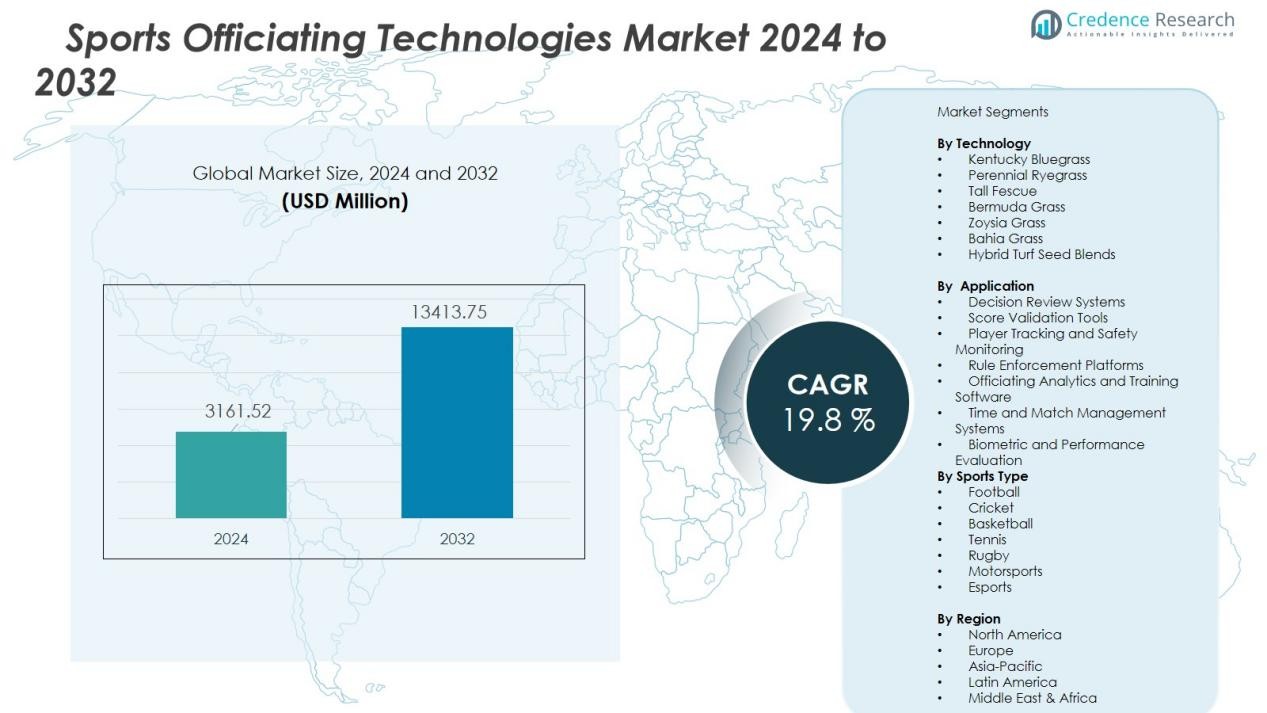
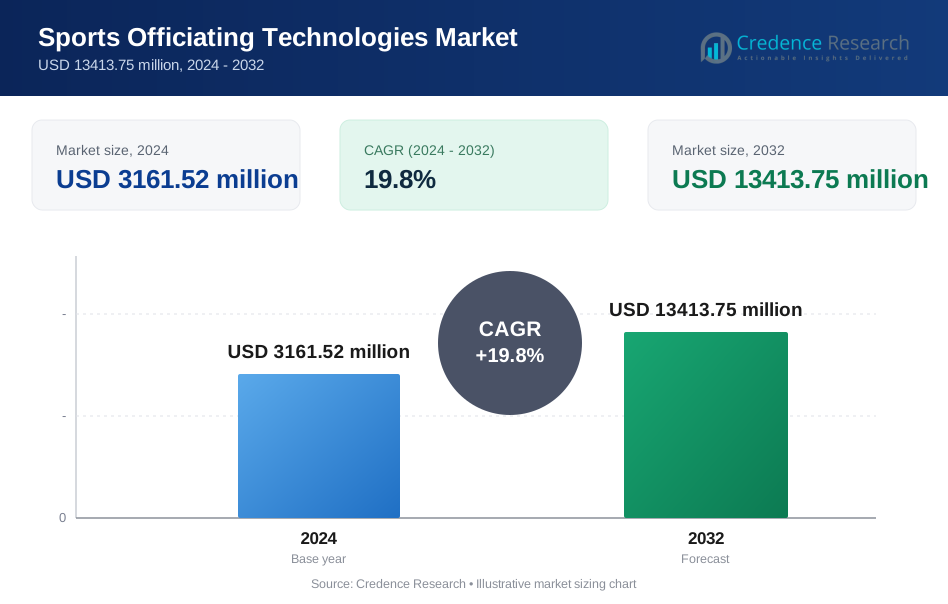
The Sports Officiating Technologies Market size was valued at USD 3161.52 million in 2024 and is anticipated to reach USD 13413.75 million by 2032, at a CAGR of 19.8 % during the forecast period.
| REPORT ATTRIBUTE | DETAILS |
|---|---|
| Historical Period | 2020-2023 |
| Base Year | 2024 |
| Forecast Period | 2025-2032 |
| Sports Officiating Technologies Market Size 2024 | USD 3161.52 Million |
| Sports Officiating Technologies Market, CAGR | 19.8% |
| Sports Officiating Technologies Market Size 2032 | USD 13413.75 Million |
Market growth is propelled by rising expectations for fair play, commercialization of sports, and the influence of high-definition broadcasting that highlights officiating accuracy. Increasing reliance on real-time data verification, automated timekeeping systems, and wearable sensors strengthens officiating credibility while improving player safety through impact monitoring. The expanding role of artificial intelligence in rule enforcement and decision assistance further accelerates technology deployment, especially in high-stakes team sports and global tournaments. Partnerships between sports federations and tech innovators continue to open premium product opportunities.
Regionally, North America leads due to significant spending on advanced officiating platforms in professional leagues, followed by Europe with strong regulatory support for match fairness and high-value tournament infrastructure. Asia-Pacific is emerging as the fastest-growing region, driven by rising sports commercialization in India, China, and Japan, alongside investments in smart stadiums and youth sports development programs. Latin America and the Middle East gradually adopt digital officiating tools as broadcasting standards improve and regional leagues modernize their sports ecosystems.
Market Insights:
- The Sports Officiating Technologies Market was valued at USD 3,161.52 million in 2024 and is projected to reach USD 13,413.75 million by 2032, growing at a CAGR of 19.8% during the forecast period.
- North America holds the largest market share at 38.5%, driven by significant investments in advanced officiating platforms by professional leagues and high adoption in university and youth sports programs.
- Europe follows with a 27.4% share due to strong regulatory frameworks for fair play and integration of multi-sport digital review systems, while Asia-Pacific holds 21.3%, supported by smart stadium development and sports commercialization.
- Asia-Pacific is the fastest-growing region with a 21.3% market share, fueled by youth sports initiatives, smart infrastructure expansion, and the rising popularity of esports and mainstream leagues in India, China, and Japan.
- Hardware dominates with a 63.2% share, primarily due to high deployment of sensors, cameras, and wearable tech, while software holds 36.8%, driven by demand for analytics platforms and digital review tools.
Market Drivers:
Rising Demand for Accurate and Transparent Decision-Making
The Sports Officiating Technologies Market grows due to strong expectations for error-free and transparent judgments across global sports formats. High-definition broadcasting exposes every on-field action, which raises scrutiny around officiating quality. Sports organizations invest in advanced systems to limit human error and reinforce competitive fairness. Broad adoption of instant review solutions strengthens trust among teams, audiences, and regulatory bodies.
- For instance, Hawk-Eye's camera-based system in tennis provides line call accuracy exceeding 99.9% in ATP tournaments, enabling precise ball trajectory tracking
Integration of Real-Time Data Verification and Sensor-Based Systems
Growth accelerates due to advanced timekeeping tools, automated tracking modules, and sensor-enabled impact detection platforms. The Sports Officiating Technologies Market benefits from technology that elevates match accuracy while improving athlete protection. It transforms officiating frameworks by enabling faster validation of ball movement, boundary decisions, and player metrics. Adoption expands across professional leagues that prioritize precision and regulatory compliance.
- For instance, Hawk-Eye's sensor-based system delivers line call decisions with 2.6 millimeter accuracy in tennis matches across professional tours.
AI-Driven Rule Enforcement and Decision Assistance
AI capabilities shape a new standard in officiating by supporting complex, time-critical judgments. It processes high-volume match data to identify rule violations and recommend accurate decisions within seconds. The market grows due to strong interest in predictive analytics that strengthen fairness and match integrity. Adoption rises in sports with high commercial value, where decision delays can influence outcomes and viewership.
Growing Investments in Sports Infrastructure and Digital Transformation
Federations and league operators invest heavily in smart stadium technologies that integrate officiating platforms into centralized control systems. It advances operational efficiency by aligning video review rooms, scoring tools, and referee communication networks. The market expands due to international tournaments that adopt unified officiating standards supported by digital tools. Demand strengthens in emerging regions that prioritize modernization of sports infrastructure and structured youth development programs.
Market Trends:
Growing Integration of AI, Smart Sensors, and Advanced Video Systems for Real-Time Decision Accuracy
The Sports Officiating Technologies Market is witnessing rapid integration of artificial intelligence, machine-learning algorithms, and high-speed video systems to refine officiating accuracy. VAR, goal-line systems, hawk-eye cameras, and automated offside detection tools are becoming essential in professional sports to minimize judgment errors. It supports objective decision-making by delivering precise data within seconds, increasing transparency for teams, audiences, and regulatory bodies. Smart wearables and ball-tracking sensors enhance player and object monitoring with greater precision than manual observation. It reinforces fairness by documenting events with indisputable evidence. Broadcasters encourage adoption to improve audience trust in match outcomes. Frequent upgrades in high-definition cameras and cloud-based analytics platforms expand their utility across premium tournaments and regional leagues.
- For instance, Hawk-Eye's system in tennis uses 10 synchronized cameras capturing 340 frames per second to track ball trajectories with millimeter precision.
Expansion of Digital Review Standards, Licensing Models, and League-Technology Partnerships Creating Commercial Value
A strong trend toward standardization of review protocols and digital rule enforcement increases technology investments across national and international sports federations. Licensing agreements and multi-year partnerships between leagues and tech providers ensure consistent deployment of proprietary officiating systems. It drives commercialization by linking technology performance to broadcasting quality, viewer ratings, and sponsorship value. Subscription-based review software and hardware leasing models reduce upfront costs for emerging leagues and university sports programs. Integrated officiating analytics platforms support referee training and post-match evaluation through recorded performance metrics. Regulations mandating fair play compliance accelerate interest in scalable tools with certified accuracy standards. Strong emphasis on brand credibility encourages sports organizations to align with globally recognized technology developers.
- For instance, Hudl, the sports performance analysis company, provides analytics to over 300,000 teams worldwide—ranging from youth to professional levels—processing a massive volume of video footage and associated data annually for detailed performance review.
Market Challenges Analysis:
High Implementation Costs, Technical Complexity, and Limited Standardization Across Competitive Leagues
The Sports Officiating Technologies Market faces challenges related to high acquisition and installation costs that restrict adoption in developing leagues, amateur tournaments, and regional sports programs. Expensive equipment, network infrastructure, and maintenance contracts demand strong financial support. It becomes difficult for smaller associations to justify investment without clear revenue benefits. Technical complexity creates operational barriers, requiring skilled technicians and dedicated training for referees. Variations in device standards and proprietary systems disrupt interoperability between competitions. Limited guidelines for integration lead to inconsistent usage across domestic and international tournaments. These constraints slow widespread deployment despite clear performance benefits.
Resistance from Traditional Officiating Structures and Concerns About Over-Reliance on Technology
Sporting bodies face resistance from officials and fans who believe excessive technology reduces human judgment and disrupts game flow. It creates debates on fairness when delays occur during reviews or when interpretation still requires human oversight. Referees must adjust decision-making styles to align with automated tools, which increases pressure on officiating credibility. Player data tracking raises concerns about data ownership, security, and consent. Unsuccessful trials or disputed calls reduce trust in advanced systems. Regulatory approval processes delay market expansion by imposing lengthy certification cycles. This resistance, combined with ethical concerns, slows full transition toward tech-driven officiating models.
Market Opportunities:
Rising Demand for Scalable, AI-Driven Officiating Solutions Across Professional, Amateur, and Youth Sports
The Sports Officiating Technologies Market presents strong opportunities through scalable systems that cater to professional leagues and community-level sports programs. Cloud-enabled officiating tools reduce dependence on expensive hardware and create affordable subscription models for smaller organizations. AI-driven decision support broadens adoption in fast-growing sports such as esports, cricket, basketball, and regional football leagues. It enables automated rule enforcement, real-time analytics, and precision timekeeping. Portable camera systems and sensor-based kits offer mobile deployment in school tournaments and amateur competitions. Broadcasters and streaming platforms seek integrated replay tools to enhance viewer engagement. Growing tournaments in youth sports create large untapped demand for low-cost officiating technologies.
Expansion of Smart Stadiums, Multi-Sport Technology Platforms, and Data Monetization Models
Growth in smart stadium infrastructure encourages integration of connected officiating systems with surveillance, scoreboards, and fan engagement platforms. Multi-sport technology suites that support different rules and sensor configurations help organizations optimize investment. It opens recurring revenue streams through performance analytics, training modules, and referee evaluation software. Data monetization from player metrics, match statistics, and audience interaction provides new commercial value. Partnerships with broadcasting firms increase relevance of analytics-rich decision reviews. Sports federations seek certified technology vendors to build compliance ecosystems for fair play standards. Enhanced focus on global tournaments drives demand for standardized, exportable officiating platforms.
Market Segmentation Analysis:
By Technology
The Sports Officiating Technologies Market is segmented by technology into video assistant systems, goal-line and sensor-based tracking, wearable monitoring devices, timekeeping tools, and AI-enabled decision support platforms. Video review systems and VAR dominate due to widespread adoption in global tournaments and professional leagues. It gains demand because high-resolution replay and automated detection minimize human errors. Sensor-based tracking and ball-chip technologies continue to grow with strong investment in precision performance analytics. AI-driven tools support predictive decision-making, improving rule enforcement. Wearable and biometric monitoring systems see rising usage for referee positioning and player safety compliance.
- For instance, Hawk-Eye's goal-line technology tracks the ball with accuracy to within 5mm and delivers information to referees in less than 0.5 seconds. AI-driven tools support predictive decision-making, improving rule enforcement.
By Application
Market applications include decision review, score validation, player tracking, officiating analytics, and rule enforcement systems. Decision review leads usage due to its critical role in minimizing disputes and ensuring fair outcomes. Score validation tools expand rapidly in ball and racquet sports requiring instant scoring accuracy. Player-tracking systems support officiating and safety regulation in high-contact sports. It reinforces objectivity in referee assessments by providing measurable performance data.
- For Instance, Foxtenn technology in tennis provides highly accurate (millimeter precision) real-time shot validation, officially certified by major tennis bodies (ITF, ATP, WTA) with a zero-error rating in studies.
By Sports Type
Segmentation by sports type covers football, cricket, basketball, tennis, rugby, motorsports, and emerging categories such as esports. Football holds the leading share due to global integration of VAR, goal-line systems, and offside detection. Cricket and tennis adopt advanced tracking and line-calling technologies for ball trajectory validation. Motorsports deploy high-speed sensors and timing systems to maintain accuracy in competitive racing. Esports introduces rule automation, real-time analytics, and performance adjudication tools, creating new digital officiating opportunities.
Segmentations:
By Technology
- Video Assistant Systems
- Sensor-Based Tracking
- AI-Enabled Decision Support
- Wearable Monitoring Devices
- Goal-Line and Ball-Tracking Technologies
- Timekeeping and Scoring Systems
- Smart Camera and Replay Platforms
By Application
- Decision Review Systems
- Score Validation Tools
- Player Tracking and Safety Monitoring
- Rule Enforcement Platforms
- Officiating Analytics and Training Software
- Time and Match Management Systems
- Biometric and Performance Evaluation
By Sports Type
- Football
- Cricket
- Basketball
- Tennis
- Rugby
- Motorsports
- Esports
By Region
- North America
- U.S.
- Canada
- Mexico
- Europe
- Germany
- France
- U.K.
- Italy
- Spain
- Rest of Europe
- Asia Pacific
- China
- Japan
- India
- South Korea
- South-east Asia
- Rest of Asia Pacific
- Latin America
- Brazil
- Argentina
- Rest of Latin America
- Middle East & Africa
- GCC Countries
- South Africa
- Rest of the Middle East and Africa
Regional Analysis:
North America Leads with Strong Technology Investments, Professional Leagues, and High Adoption Standards
North America holds a dominant position in the Sports Officiating Technologies Market due to extensive spending by professional leagues and a mature sports technology ecosystem. The region benefits from early adoption of VAR, biometric tracking, and AI-driven decision systems across football, basketball, baseball, and hockey. It gains momentum through collaboration between top-tier leagues and technology developers that prioritize certified precision tools. Broadcasters demand advanced replay systems to improve viewer engagement, creating stronger commercial incentives. Universities and youth sports programs invest in portable review kits and scalable officiating software. Growing smart stadium projects across the United States and Canada support real-time data integration and unified rule enforcement tools.
Europe Strengthens Adoption Through Regulatory Compliance, Multi-Sport Integration, and Broadcasting Standards
Europe shows robust growth driven by strict fair-play regulations and rapid integration of standardized review systems across premier football leagues and major tournaments. Strong demand for goal-line technologies, tracking sensors, and referee decision analytics enhances competitive fairness. It benefits from government-backed sports infrastructure modernization and regulatory compliance initiatives. Broadcasters support replay expansion to improve transparency for audiences. Multi-sport applications extend adoption to tennis, rugby, motorsports, and athletics. Ongoing partnerships between federations and technology firms support continuous system upgrades.
Asia-Pacific Emerges as the Fastest-Growing Region with Expanding Smart Stadiums and Youth Sports Investments
Asia-Pacific is the fastest-growing market due to rising commercialization of sports in India, China, Japan, and Australia. Investment in smart stadiums and data-led league management encourages rapid adoption of digital officiating systems. It expands through cricket, football, basketball, and esports, where real-time decision enforcement builds audience credibility. Growing youth leagues create demand for portable camera systems and low-cost review tools. Local broadcasters adopt AI-powered replay technology to meet global production standards. Government focus on sports development and international tournaments accelerates uptake of certified officiating technologies.
Key Player Analysis:
- Hawk-Eye Innovations
- ChyronHego Corporation
- Sportradar AG
- Intel Corporation
- Dartfish
- PlaySight Interactive Ltd.
- Genius Sports
Competitive Analysis:
The Sports Officiating Technologies Market demonstrates a competitive landscape characterized by technology-driven innovation, multi-sport integration, and recurring service models that expand revenue streams for industry leaders. Key companies include Hawk-Eye Innovations, ChyronHego Corporation, Sportradar AG, and Intel Corporation, each investing in high-precision systems, data analytics, and automated review platforms. It focuses on developing certified decision-support technologies for global leagues and high-value tournaments, where accuracy, response speed, and regulatory compliance remain critical differentiators.
Hawk-Eye Innovations leads with advanced ball-tracking and line-calling tools widely deployed in football, tennis, and cricket. ChyronHego strengthens its presence through real-time tracking systems for broadcast enhancement and referee decision support. Sportradar AG leverages sports data intelligence and integrity solutions that support rule enforcement and anti-manipulation frameworks. Intel Corporation expands capabilities through AI and sensor-powered analytics that enhance performance evaluation and officiating efficiency. Strategic partnerships with sports federations and broadcasters sustain competitive growth and encourage global market penetration.
Recent Developments:
- In January 2024 saw Hawk-Eye Innovations partner with Personar to integrate AI-powered speech-to-text for enhanced video review in sports operations.
- In July 2024, marked Sony and the NFL launching a technology partnership with Hawk-Eye Innovations for officiating tools like line-to-gain tracking.
Report Coverage:
The research report offers an in-depth analysis based on By Technology, By Application, By Sports Type and Region It details leading Market players, providing an overview of their business, product offerings, investments, revenue streams, and key applications. Additionally, the report includes insights into the competitive environment, SWOT analysis, current Market trends, as well as the primary drivers and constraints. Furthermore, it discusses various factors that have driven Market expansion in recent years. The report also explores Market dynamics, regulatory scenarios, and technological advancements that are shaping the industry. It assesses the impact of external factors and global economic changes on Market growth. Lastly, it provides strategic recommendations for new entrants and established companies to navigate the complexities of the Market.
Future Outlook:
- Wider integration of AI-driven decision systems will improve accuracy and reduce referee dependency on subjective judgment.
- Expansion of portable, low-cost officiating kits will accelerate adoption in amateur leagues, school tournaments, and community sports programs.
- Cloud-based review software and subscription models will boost recurring revenue for technology providers and reduce upfront infrastructure needs.
- Smart stadium development will create unified platforms that connect scoring systems, replay tools, player tracking, and rule enforcement technologies.
- Real-time biometric monitoring for referees and players will strengthen safety protocols and assist compliance in high-contact sports.
- Automated officiating platforms for esports will expand rapidly as global competitive gaming seeks standardized rule enforcement.
- Broadcast partnerships will increase demand for analytics-rich review visuals that enhance viewer engagement and strengthen media value.
- Data monetization from performance analytics and officiating metrics will form new commercial models for leagues and technology developers.
- Cross-sport compatibility will become essential, enabling multi-league organizations to deploy the same platform across diverse sports formats.
- Government-backed sports development programs in emerging economies will drive investments in certified officiating technologies and infrastructure modernization.
Request a Free Sample
Fill in your details and we'll send you a free sample report.
- Sample data tables & charts
- Research methodology
Need a Custom Version of This Report?
Tailor the scope, geography, or segments to your exact requirements.
- Custom geography or segment scope
- Direct access to our analyst team
Frequently Asked Questions
What is the current market size for the Sports Officiating Technologies Market, and what is its projected size in 2032?
At what Compound Annual Growth Rate is the Sports Officiating Technologies Market projected to grow between 2024 and 2032?
Which Sports Officiating Technologies Market segment held the largest share in 2024?
What are the primary factors fueling the growth of the Sports Officiating Technologies Market?
Who are the leading companies in the Sports Officiating Technologies Market?
Which region commanded the largest share of the Sports Officiating Technologies Market in 2024?
Table of Content
Chapter 1. Report Introduction
- 1.1 Report Description & Purpose
- 1.1.1 Report Title & Market Definition
- 1.1.2 Unique Selling Propositions (USP) & Key Differentiators
- 1.1.3 Value Proposition for Stakeholders
- 1.2 Research Objectives
- 1.2.1 Market Sizing Objectives (Volume & Revenue)
- 1.2.2 Segmentation Objectives
- 1.2.3 Competitive Intelligence Objectives
- 1.2.4 Forecast & Scenario Objectives
- 1.3 Report Scope
- 1.3.1 Sports Officiating Technologies Scope – Types & Subtypes Covered
- 1.3.2 Geographic Scope – Regions & Countries Covered
- 1.3.3 Historical Period, Base Year & Forecast Period (2024; forecast to 2032)
- 1.3.4 Inclusions & Exclusions
- 1.4 HS Code & Classification Framework
- 1.5 Currency, Units & Pricing Basis
- 1.6 Target Stakeholders
- 1.7 Limitations & Assumptions
Chapter 2. Executive Summary
- 2.1 Global Sports Officiating Technologies Market Snapshot
- 2.1.1 Market Size – Historical (2024) & Forecast (2024-2032) (2024: USD 3161.52 million → 2032: USD 13413.75 million)
- 2.1.2 Volume & Revenue – Global Totals
- 2.1.3 Key Market Highlights – Top Five Facts
- 2.2 Sports Officiating Technologies Market Segmentation Snapshot
- 2.2.1 Market Split by Region – 2024 vs. 2032
- 2.3 Competitive Snapshot
- 2.3.1 Top 10 Players by Revenue Share – 2024
- 2.3.2 Top 10 Players by Volume Share – 2024
- 2.3.3 Recent Strategic Developments (18-Month Summary)
- 2.4 Key Investment Highlights & Strategic Conclusions
Chapter 3. Sports Officiating Technologies Market Dynamics & Industry Analysis
- 3.1 Market Overview & Context
- 3.1.1 Sports Officiating Technologies Market Position in the Broader Automotive Value Chain
- 3.1.2 OEM vs. Replacement Market Dynamics
- 3.1.3 Market Maturity & Development Stage by Region
- 3.2 Sports Officiating Technologies Market Drivers
- 3.3 Sports Officiating Technologies Market Restraints & Challenges
- 3.4 Sports Officiating Technologies Market Opportunities
- 3.5 Porter's Five Forces Analysis
- 3.5.1 Threat of New Entrants
- 3.5.2 Bargaining Power of Suppliers
- 3.5.3 Bargaining Power of Buyers
- 3.5.4 Threat of Substitutes
- 3.5.5 Competitive Rivalry – Intensity Assessment
- 3.6 Sports Officiating Technologies Value Chain Analysis
- 3.6.1 Upstream – Raw Material/Input Suppliers
- 3.6.1.1 Raw Material/Input 1
- 3.6.1.2 Raw Material/Input 2
- 3.6.1.3 Raw Material/Input 3
- 3.6.2 Midstream – Production/Manufacturing/Service Delivery
- 3.6.2.1 Production/Process Overview
- 3.6.2.2 Key Facility Locations & Capacity by Manufacturer
- 3.6.3 Downstream – Distribution & End Consumer
- 3.6.3.1 Primary Channel – B2B/OEM
- 3.6.3.2 Secondary Channels – Dealer, Retail, Online, Direct
- 3.6.4 Value Chain Profitability Analysis
- 3.6.1 Upstream – Raw Material/Input Suppliers
- 3.7 PESTEL Analysis
- 3.7.1 Political Factors
- 3.7.2 Economic Factors
- 3.7.3 Social Factors
- 3.7.4 Technological Factors
- 3.7.5 Environmental Factors
- 3.7.6 Legal Factors
- 3.8 Sports Officiating Technologies Supply Chain Analysis
- 3.8.1 Raw Material/Input Supply Risk Assessment
- 3.8.2 Manufacturing Concentration Risk (Geographic Exposure)
- 3.8.3 Trade Disruption Impact Analysis
- 3.9 Regulatory & Policy Landscape
Note: The regulatory and policy landscape section covers regulations based on their applicability to the market, Sports Officiating Technologies category, geography, and scope of the study. Only regulatory frameworks with a material impact on operations, compliance, trade, sustainability, or market access are analyzed in detail.
Chapter 4. Key Investment Pockets & Opportunity Analysis
- 4.1 Sports Officiating Technologies Market Attractiveness Analysis
- 4.1.1 By Region – Investment Attractiveness Matrix (Volume × CAGR)
- 4.2 Absolute Revenue Growth Opportunity
- 4.2.1 By Region – Absolute USD Growth Through 2032
- 4.3 Incremental Volume Opportunity
- 4.3.1 By Region – Incremental Volume Through 2032
- 4.3.2 Segment – Incremental Volume
- 4.4 Emerging Submarket Opportunity Deep Dive (Subject to Applicability)
- 4.5 Emerging Market Opportunity Scorecards
- 4.5.1 United States
- 4.5.2 Europe
- 4.5.3 Asia
- 4.5.4 Middle East & Africa
Note: Emerging Market Opportunity Scorecards will be included based on relevance and strategic importance. Regions listed are indicative and may vary depending on data availability and market dynamics.
Chapter 5. Sports Officiating Technologies Import-Export Analysis & Trade Flows
- 5.1 Global Trade Overview
- 5.1.1 Global Export Value by Country (2024)
- 5.1.2 Global Export Volume by Country (2024)
- 5.1.3 Global Import Value by Country (2024)
- 5.1.4 Global Import Volume by Country (2024)
- 5.1.5 Net Trade Balance by Country (2024)
- 5.2 Export Analysis – Segment
- 5.2.1 Type 1 (HS Code)
- 5.2.2 Type 2 (HS Code)
- 5.2.3 Type 3 (HS Code)
- 5.2.4 Type 4 (HS Code)
- 5.2.5 Type 5 (HS Code)
- 5.3 Import Analysis – Segment
- 5.3.1 Type 1 (HS Code)
- 5.3.2 Type 2 (HS Code)
- 5.3.3 Type 3 (HS Code)
- 5.3.4 Type 4 (HS Code)
- 5.3.5 Type 5 (HS Code)
- 5.4 Average Unit Trade Prices
- 5.4.1 Average Export Price – Segment & Country
- 5.4.2 Average Import Price – Segment & Source Country
- 5.4.3 Price Trends (2024)
- 5.5 Key Trade Route Analysis
- 5.5.1 Trade Route 1
- 5.5.2 Trade Route 2
- 5.5.3 Trade Route 3
- 5.5.4 Trade Route 4
- 5.5.5 Trade Route 5
- 5.6 Trade Policy Impact Assessment
- 5.6.1 US Anti-Dumping & Section 301 Tariffs
- 5.6.2 EU Customs Union Impact
- 5.6.3 Major Free Trade Agreements
- 5.6.4 USMCA Rules of Origin
Note: Trade policy analysis will be included only where relevant to the Sports Officiating Technologies market.
Chapter 6. Competitive Landscape & Company Benchmarking
- 6.1 Sports Officiating Technologies Market Concentration & Structure
- 6.1.1 Herfindahl-Hirschman Index (HHI) – vs. 2024
- 6.1.2 Tier 1, Tier 2 & Tier 3 Market Structure
- 6.1.3 Global, Regional & Local Player Dynamics
- 6.2 Sports Officiating Technologies Market Share Analysis – 2024
- 6.2.1 Global Revenue Share by Company
- 6.2.2 Global Volume Share by Company
- 6.2.3 Regional Revenue Share
- 6.2.4 Market Share Evolution ( vs. 2024)
- 6.2.5 OEM Segment Share by Company
- 6.2.6 Replacement Segment Share by Company
- 6.3 Production/Delivery Capacity & Facility Analysis
- 6.3.1 Global Installed Capacity
- 6.3.2 Capacity Utilization Rates
- 6.3.3 Production/Output Volume
- 6.3.4 Facility Locations & Capacity Map
- 6.3.5 Planned Capacity Additions
- 6.4 Sports Officiating Technologies Competitive Benchmarking Matrix
- 6.4.1 Revenue, Volume, CAGR & Profitability Comparison
- 6.4.2 Channel Revenue Mix
- 6.4.3 Geographic Revenue Exposure
- 6.4.4 R&D Intensity
- 6.4.5 Sustainability Maturity
- 6.5 Strategic Developments in Sports Officiating Technologies (Last 24 Months)
- 6.5.1 Mergers, Acquisitions & Divestments
- 6.5.2 New Sports Officiating Technologies Launches
- 6.5.3 Facility Expansions
- 6.5.4 Strategic Alliances, Joint Ventures & Partnerships
- 6.5.5 Distribution Expansion & Market Entry
- 6.5.6 Sustainability & ESG Initiatives
- 6.6 Competitive Strategy Mapping
- 6.6.1 Leader, Challenger, Follower & Niche Classification
- 6.6.2 Pricing Strategy Comparison
- 6.6.3 Channel Strategy Matrix
Note: Strategic developments are included based on their materiality and the availability of reliable information.
Chapter 7. Global Sports Officiating Technologies Market – By Distribution Channel
- 7.1 Segment Overview
- 7.1.1 Volume & Revenue Split by Channel (2024 & 2032)
- 7.1.2 Channel Mix Evolution (2024-2032)
Chapter 8. Regional Market Analysis – Global Overview
- 8.1 Global Regional Overview
- 8.1.1 Regional Volume Share
- 8.1.2 Regional Revenue Share
- 8.1.3 Regional Volume by Region
- 8.1.4 Regional Revenue by Region
- 8.1.5 Regional Forecast Through 2032
- 8.2 Cross-Regional Segment Analysis
- 8.2.1 By Distribution Channel
- 8.2.2 By Brand/Price Tier
Chapter 9. North America Sports Officiating Technologies Market
- 9.1 United States
- 9.2 Canada
- 9.3 Mexico
Chapter 10. Europe Sports Officiating Technologies Market
- 10.1 Germany
- 10.2 France
- 10.3 Italy
- 10.4 United Kingdom
- 10.5 Spain
- 10.6 Poland
- 10.7 Russia
- 10.8 Netherlands
- 10.9 Belgium
- 10.10 Sweden
- 10.11 Denmark
- 10.12 Norway
- 10.13 Rest of Europe
Chapter 11. Asia Pacific Sports Officiating Technologies Market
- 11.1 China
- 11.2 India
- 11.3 Japan
- 11.4 South Korea
- 11.5 Thailand
- 11.6 Indonesia
- 11.7 Vietnam
- 11.8 Malaysia
- 11.9 Australia
- 11.10 Rest of Asia Pacific
Chapter 12. Latin America Sports Officiating Technologies Market
- 12.1 Brazil
- 12.2 Argentina
- 12.3 Colombia
- 12.4 Chile
- 12.5 Rest of Latin America
Chapter 13. Middle East Sports Officiating Technologies Market
- 13.1 Saudi Arabia
- 13.2 United Arab Emirates
- 13.3 Turkey
- 13.4 Israel
- 13.5 Iran
- 13.6 Rest of the Middle East
Chapter 14. Africa Sports Officiating Technologies Market
- 14.1 South Africa
- 14.2 Egypt
- 14.3 Nigeria
- 14.4 Morocco
- 14.5 Rest of Africa
Chapter 15. Sports Officiating Technologies Company Profiles
- 15.1 [Company 01]
- 15.1.1 Company Overview
- 15.1.2 Key Management Personnel
- 15.1.3 Products & Services Portfolio
- 15.1.4 Financial Performance
- 15.1.5 Key Market Focus & Geographic Presence
- 15.1.6 Recent Developments & Strategic Initiatives
Note: The company profile list is preliminary and may change based on research findings, market developments, data availability, and client requirements.
Chapter 16. Appendices
- Appendix A – List of Abbreviations & Acronyms
- Appendix B – Industry Classification Code Reference – Full Series
- Appendix C – Production & Capacity Data Tables
- Appendix D – End-Use & Demand Base Tables
- Appendix E – Consumption & Replacement Rate Assumptions
- Appendix F – ASP Reference Tables
- Appendix G – Manufacturing & Facility Database
- Appendix H – Import-Export Data Tables
- Appendix I – Regulatory Summary Tables
- Appendix J – Primary Research Participant List (Anonymized)
- Appendix K – Primary Research Questionnaire Framework
- Appendix L – Data Sources & Bibliography
- Appendix M – Market Size Divergence & Source Comparison
Chapter 17. Research Methodology
- 17.1 Research Framework & Philosophy
- 17.2 Secondary Research – Sources, Hierarchy & Data Extraction
- 17.3 Data Modeling – Bottom-Up & Top-Down Market Sizing
- 17.4 Primary Research – Stakeholder Framework, LOI & Sample Sizes
- 17.5 Forecast Methodology – Regression, Scenario & Sensitivity Analysis
- 17.6 Quality Control – Four-Layer Validation Framework
- 17.7 Limitations & Standard Assumptions
- 17.8 Disclaimer
