
Market Overview
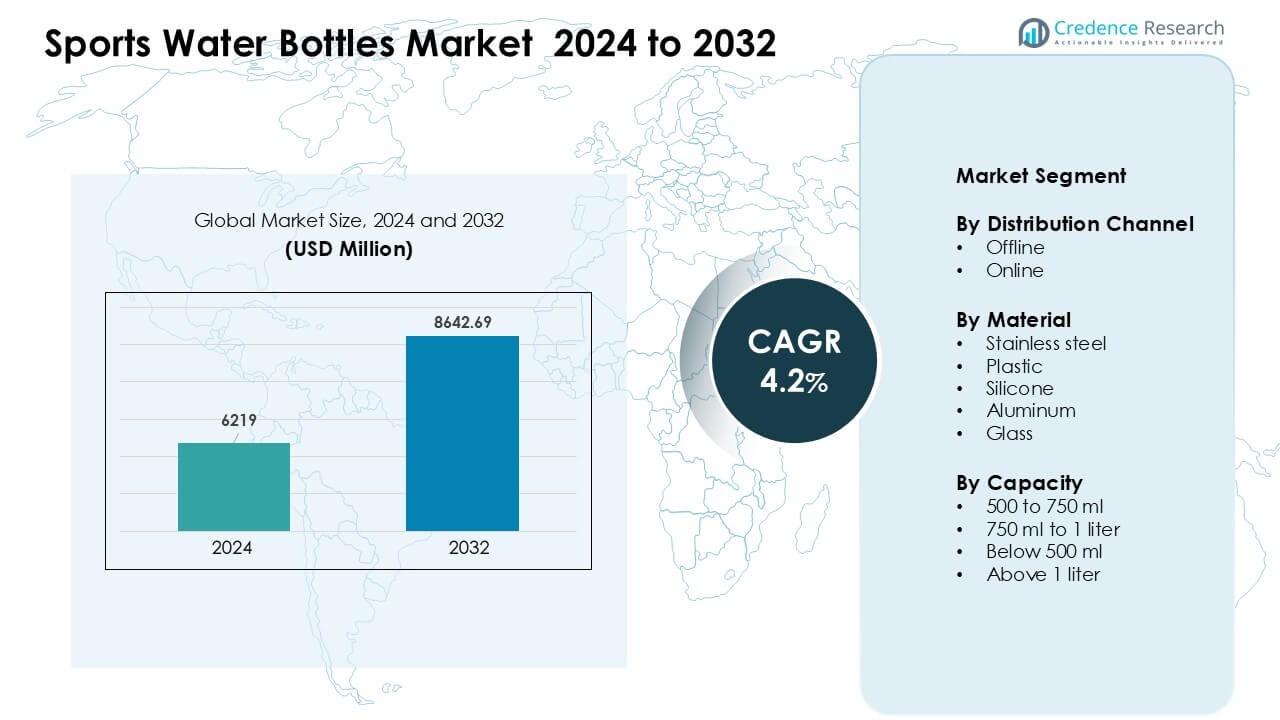
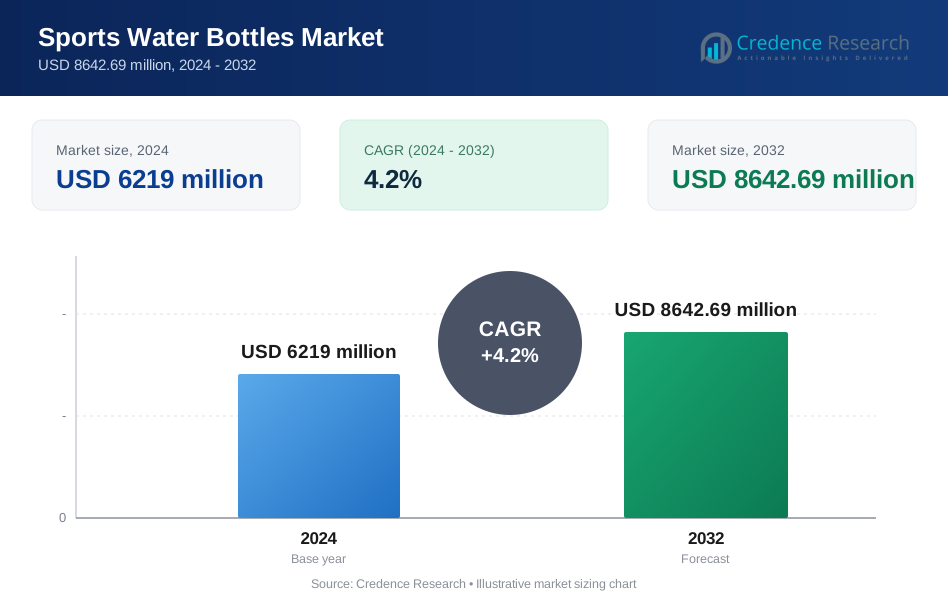
Sports Water Bottles Market was valued at USD 6219 million in 2024 and is anticipated to reach USD 8642.69 million by 2032, growing at a CAGR of 4.2 % during the forecast period.
| REPORT ATTRIBUTE | DETAILS |
|---|---|
| Historical Period | 2020-2023 |
| Base Year | 2024 |
| Forecast Period | 2025-2032 |
| Sports Water Bottles Market Size 2024 | USD 6219 Million |
| Sports Water Bottles Market, CAGR | 4.2 % |
| Sports Water Bottles Market Size 2032 | USD 8642.69 Million |
The Sports Water Bottles Market features strong competition from major players such as Helen of Troy Ltd., Embrava Sports, Newell Brands Inc., HydraPak LLC, MIRA Brands, Borosil Ltd., Everich Commerce Group Ltd., Adidas AG, Klean Kanteen, and Bhalla International. These companies expanded their reach through premium insulated designs, durable materials, and wider distribution across retail and online channels. Many brands focus on eco-friendly products and ergonomic features to attract fitness users and outdoor consumers. North America emerged as the leading region in 2024 with about 37% share, supported by high fitness participation and strong demand for reusable hydration products.
Market Insights
- The Sports Water Bottles Market reached USD 6219 million in 2024 and is projected to hit USD 69 million by 2032, growing at a CAGR of 4.2%.
- Rising fitness culture and outdoor sports participation drive higher demand for reusable bottles, led by the 500–750 ml segment with about 41% share.
- Premium insulated bottles and smart hydration features shape major trends, while sustainability pushes consumers toward stainless steel models, which held nearly 47% share.
- Strong competition from Helen of Troy Ltd., Embrava Sports, Newell Brands Inc., HydraPak LLC, and others increases product innovation and price pressure.
- North America led the market with around 37% share in 2024, followed by Europe at 29%, while Asia-Pacific grew fastest due to expanding fitness adoption and rising middle-income buyers.
 Market Segmentation Analysis:
By Distribution Channel
Offline stores led the distribution channel segment in 2024 with about 63% share. Many buyers preferred in-store purchases due to product feel, design checks, and faster access. Sports shops and hypermarkets gained strong footfall from fitness users who wanted trusted brands. Offline channels also expanded premium shelf space for insulated and metal bottles, which pushed higher sales. Rising interest in outdoor sports supported this lead, as many buyers chose quick replenishment from nearby stores. Online channels grew fast due to wider choice and strong price deals.
- For instance, offline retail (supermarkets, hypermarkets, specialty stores) held around 70% of all reusable water bottle sales worldwide in 2024, reflecting a strong consumer preference for physical inspection of bottles before purchase.
By Material
Stainless steel dominated the material segment in 2024 with nearly 47% share. Many fitness users trusted steel bottles due to durability, insulation, and odor resistance. Brands promoted double-wall designs that kept drinks cold for long hours, which increased demand. Growing worry about plastic waste also pushed more buyers toward metal options. Sports teams and gyms adopted stainless steel bottles in bulk, which boosted wider market reach. Plastic held steady demand for low-cost use, while silicone and glass stayed niche due to weight and break risks.
- For instance, stainless‑steel (metal) bottles accounted for about 42.5% of total reusable water‑bottle demand, making metal the leading material globally that year.
By Capacity
The 500 to 750 ml range held the dominant position in 2024 with around 41% share. This size worked well for workouts, cycling, and daily hydration, which made it a top choice for many users. The range offered a good balance between weight and volume, so athletes could carry it with ease. Brands also released many insulated and flip-top variants in this size, which improved shelf appeal. Larger sizes above 1 liter saw steady growth among hikers, while smaller bottles stayed popular for kids and short sessions.
Key Growth Drivers
Rising Fitness Adoption and Outdoor Activity Growth
Growing interest in fitness, sports, and outdoor routines drives strong demand for sports water bottles. More individuals join gyms, running clubs, cycling groups, and trekking communities, which increases the need for durable and easy-to-carry hydration products. Many buyers now prefer insulated and leak-proof designs that support long sessions in warm weather. Schools and sports academies also push hydration habits, leading to higher repeat purchases. Brands expand into lifestyle segments as people carry bottles to offices and travel. This wider use case supports steady market expansion and encourages new features across material, size, and design categories.
- For instance, the number of fitness facilities worldwide was on average up by nearly 4%, and total gym memberships increased by about 6% between 2023 and 2024, signaling more active consumers likely to use reusable hydration
Shift Toward Sustainable and Reusable Products
Consumers now choose reusable bottles to cut single-use plastic waste, which drives major growth in metal and glass-based sports bottles. The shift fits with global sustainability goals and pushes brands to offer eco-friendly lines with BPA-free materials. Stainless steel and aluminum options gain strong traction due to long life, better insulation, and reduced odor. Many companies promote green packaging and recycling programs, which improves brand awareness and trust. Government rules against disposable plastics also speed adoption across schools, workplaces, and public spaces. This sustainability shift creates long-term demand for premium reusable designs.
- For instance, manufacturers of stainless‑steel bottles reported that insulated double‑wall bottles which maintain beverage temperature for 12–24 hours increasingly dominate new product SKUs, appealing to sustainability‑ and performance‑conscious users.
Product Innovation and Brand Differentiation
Strong innovation boosts market growth as brands compete through advanced features that support hydration needs. Many companies introduce double-wall insulation, smart lids, digital hydration reminders, and ergonomic grips to appeal to active users. Custom prints and athlete-focused shapes help brands target niche sports communities. Collaborations with influencers and sports events also increase visibility and create stronger engagement. New materials such as lightweight alloys and flexible silicone allow more choices for runners and travelers. This steady stream of new designs helps expand the user base and raises replacement demand among frequent buyers.
Key Trends & Opportunities
Rising Demand for Smart Hydration Solutions
Smart water bottles with tracking sensors and hydration alerts emerge as a strong trend. Many users want real-time intake reminders linked to fitness apps, which improves hydration discipline during workouts. Connected bottles offer Bluetooth sync, temperature display, and activity-based suggestions, attracting tech-focused athletes. Corporate wellness programs also adopt such products to encourage healthy habits among employees. As fitness technology becomes mainstream, these smart solutions gain wider reach. This trend offers strong growth opportunities for brands blending digital features with durable bottle designs.
- For instance, one report states that smart water bottles dominate the market, holding approximately 27% of the 2024 market share of the overall smart bottle market.
Expansion of Premium and Customizable Designs
Premium bottles with stylish finishes and personalization options gain momentum as users view hydration products as lifestyle accessories. Matte textures, gradient shades, and laser-engraved names create strong appeal. Gyms, schools, and sports clubs order customized batches for branding, which expands bulk sales. Higher-income consumers also adopt insulated metal bottles for travel and work, boosting premium segment revenue. This rise of aesthetic and functional customization creates clear opportunities for brands that blend quality with personalization.
- For instance, many premium bottle manufacturers now offer insulated stainless‑steel bottles that keep beverages cold for up to 24 hours and hot for up to 12 hours a feature that appeals to professionals carrying bottles to office or travel.
Key Challenges
Supply Chain Volatility in Raw Materials
Fluctuating prices of stainless steel, aluminum, and high-grade plastics create supply chain stress. Many manufacturers face unstable sourcing and higher production costs, which affect pricing and margins. Global shipping delays also slow delivery for brands depending on international suppliers. Smaller companies struggle to maintain steady inventory due to rising procurement risk. These disruptions limit production planning and slow innovation cycles. Managing raw material volatility remains a core challenge for industry players.
Intense Market Competition and Price Pressure
The market faces high competition from global brands, private labels, and low-cost manufacturers. Many companies offer similar designs, which increases price-based competition and reduces brand loyalty. Online marketplaces further amplify discount-driven sales, forcing established players to reduce margins. New entrants imitate popular features, making differentiation harder. Premium brands struggle to balance innovation costs with accessible pricing. This rising competitive pressure remains a major challenge that limits long-term profitability.
Regional Analysis
North America
North America held about 37% share in the Sports Water Bottles Market in 2024, supported by high fitness awareness and strong adoption of reusable metal bottles. Many users joined gyms, outdoor sports, and cycling groups, which boosted steady demand. Premium insulated steel bottles gained wide traction due to long cooling performance. Brands expanded retail presence through sporting stores and online platforms, improving reach across the U.S. and Canada. Rising sustainability programs in schools and workplaces also pushed consumers toward BPA-free and eco-friendly options, strengthening regional sales growth.
Europe
Europe accounted for nearly 29% share in 2024, driven by strong sustainability habits and wide acceptance of reusable bottles. Many buyers avoided single-use plastics due to strict environmental rules across the region. Stainless steel and glass bottles gained popularity, especially among office workers and outdoor hobbyists. Sports clubs and cycling communities also increased bulk demand for durable, insulated models. Growing tourism and travel culture supported higher sales of lightweight designs. Expanding e-commerce platforms enabled fast product reach across Germany, the U.K., France, Italy, and Nordic countries.
Asia-Pacific
Asia-Pacific captured about 24% share in 2024 and showed strong growth potential due to rising fitness adoption and expanding middle-income populations. Many buyers joined gyms and running groups, which boosted sales of affordable plastic and premium steel bottles. Urban consumers preferred insulated models for hot climates, increasing demand in India, China, Japan, and Southeast Asia. Local manufacturers offered low-cost designs that attracted large volumes. Rising school hydration programs and outdoor sports events further pushed market expansion. E-commerce growth helped brands reach younger buyers quickly.
Latin America
Latin America held close to 6% share in 2024, driven by expanding sports culture and growing interest in wellness. Countries such as Brazil, Mexico, and Argentina showed rising purchases of lightweight plastic bottles due to affordability. Fitness centers, football clubs, and outdoor groups encouraged the use of reusable hydration products. Warmer climates increased demand for insulated models, especially during travel and adventure sports. Online platforms gained traction and improved product access in urban areas. Sustainability awareness continued to rise, supporting long-term adoption of reusable designs.
Middle East & Africa
The Middle East & Africa region accounted for around 4% share in 2024, supported by warm climates that increased daily hydration needs. Users preferred insulated bottles that kept drinks cool for long periods, leading to steady demand. Outdoor sports, gym activities, and travel habits grew in cities like Dubai, Riyadh, and Johannesburg. Affordable plastic bottles maintained volume sales, while premium steel designs gained interest among fitness users. Retail expansion in malls and online marketplaces improved access. Rising sustainability awareness also pushed consumers toward reusable options.
Market Segmentations:
By Distribution Channel
- Offline
- Online
By Material
- Stainless steel
- Plastic
- Silicone
- Aluminum
- Glass
By Capacity
- 500 to 750 ml
- 750 ml to 1 liter
- Below 500 ml
- Above 1 liter
By Geography
- North America
- U.S.
- Canada
- Mexico
- Europe
- Germany
- France
- U.K.
- Italy
- Spain
- Rest of Europe
- Asia Pacific
- China
- Japan
- India
- South Korea
- South-east Asia
- Rest of Asia Pacific
- Latin America
- Brazil
- Argentina
- Rest of Latin America
- Middle East & Africa
- GCC Countries
- South Africa
- Rest of the Middle East and Africa
Competitive Landscape
The competitive landscape of the Sports Water Bottles Market features strong activity from global brands, regional manufacturers, and emerging niche players that target fitness-focused consumers. Leading companies such as Helen of Troy Ltd., Embrava Sports, Newell Brands Inc., HydraPak LLC, MIRA Brands, Borosil Ltd., Everich Commerce Group Ltd., Adidas AG, Klean Kanteen, and Bhalla International expanded their portfolios with insulated steel bottles, lightweight travel designs, and BPA-free materials. Many brands focused on premium finishes, leak-proof lids, and durable construction to strengthen product appeal. Partnerships with gyms, sports clubs, and outdoor retailers enhanced visibility across key markets. E-commerce channels also supported rapid growth by offering wide assortments and customization options, increasing brand reach among younger users. Sustainability-driven innovation remained central, pushing companies to introduce recyclable materials and long-life designs.
Key Player Analysis
- Helen of Troy Ltd.
- Embrava Sports
- Newell Brands Inc.
- HydraPak LLC
- MIRA Brands
- Borosil Ltd.
- Everich Commerce Group Ltd.
- Adidas AG
- Klean Kanteen
- Bhalla International
Recent Developments
- In January 2025, Helen of Troy Ltd. built extra Hydro Flask inventory and moved to diversify sourcing to brace for potential U.S. tariff impacts and supply-chain uncertainty; the company called out weaker consumer demand and tightened retail inventory in its fiscal updates around this period.
- In September 2024, Helen of Troy Ltd. (Hydro Flask brand) launched a refreshed Hydro Flask brand campaign and new product drops (including Travel Bottle additions and limited-edition/colorway releases), leaning into cultural moments to drive engagement.
- In 2024, Newell Brands (Contigo) launched a limited-edition Contigo x Ally Love water-bottle/tumbler collection (Ally Love named Contigo’s Chief Hydration Officer / collaborator) a branded-collaboration push of limited-edition colorways and special packaging to stimulate demand in the hydration category.
Report Coverage
The research report offers an in-depth analysis based on Distribution Channel, Material, Capacity and Geography. It details leading market players, providing an overview of their business, product offerings, investments, revenue streams, and key applications. Additionally, the report includes insights into the competitive environment, SWOT analysis, current market trends, as well as the primary drivers and constraints. Furthermore, it discusses various factors that have driven market expansion in recent years. The report also explores market dynamics, regulatory scenarios, and technological advancements that are shaping the industry. It assesses the impact of external factors and global economic changes on market growth. Lastly, it provides strategic recommendations for new entrants and established companies to navigate the complexities of the market.
Future Outlook
- Demand for reusable bottles will rise as fitness habits grow worldwide.
- Stainless steel models will gain more traction due to durability and insulation.
- Smart hydration bottles will expand as tech adoption increases among athletes.
- Brands will focus on sustainable materials to meet rising eco-friendly expectations.
- Customizable and premium designs will gain popularity among lifestyle buyers.
- E-commerce sales will accelerate as online platforms offer wider choices.
- Partnerships with gyms and sports events will strengthen brand visibility.
- Lightweight travel-friendly bottles will see higher demand from outdoor users.
- Competition will intensify as new entrants offer low-cost and stylish options.
- Growth in Asia-Pacific will speed up as fitness participation continues to rise.
Request a Free Sample
Fill in your details and we'll send you a free sample report.
- Sample data tables & charts
- Research methodology
Need a Custom Version of This Report?
Tailor the scope, geography, or segments to your exact requirements.
- Custom geography or segment scope
- Direct access to our analyst team
Frequently Asked Questions
What is the current market size for Sports Water Bottles Market, and what is its projected size in 2032?
At what Compound Annual Growth Rate is Sports Water Bottles Market projected to grow between 2024 and 2032?
Which Sports Water Bottles Market segment held the largest share in 2024?
What are the primary factors fueling the growth of Sports Water Bottles Market?
Who are the leading companies in Sports Water Bottles Market?
Which region commanded the largest share of Sports Water Bottles Market?
Table of Content
Chapter 1 Market Segmentation
- 1.1 Segmentation Framework
- 1.1.1 Product and Service Classification
- 1.1.2 Application and End-Use Classification
- 1.1.3 Technology and Solution Classification
- 1.1.4 Customer and Distribution Channel Classification
- 1.1.5 Geographic Segmentation
- 1.1.6 Market Segment Definitions and Boundaries
Chapter 2 Introduction
- 2.1 Report Objectives and Scope
- 2.2 Product Definition and Industry Terminology
- 2.3 Market Inclusions and Exclusions
- 2.4 Research Process
- 2.4.1 Primary Research and Expert Interviews
- 2.4.2 Secondary Research and Source Review
- 2.4.3 Top-Down and Bottom-Up Estimation
- 2.4.4 Data Triangulation and Verification
- 2.5 Market Size Measurement Basis
- 2.5.1 2024: USD 6219 million → 2032: USD 8642.69 million
- 2.6 Historical and Forecast Reference Periods
- 2.6.1 Base Year: 2024
- 2.6.2 Forecast Period: 2024-2032
- 2.7 Research Assumptions and Limitations
Chapter 3 Executive Summary
- 3.1 Market Snapshot and Key Findings
- 3.2 Base-Year Market Size, 2024
- 3.3 Forecast Market Size, 2032
- 3.4 Revenue and Volume Growth Outlook
- 3.5 Key Demand and Supply Indicators
- 3.6 Leading Market Segments
- 3.7 Fastest-Growing Market Opportunities
- 3.8 Regional Performance Highlights
- 3.9 Technology and Industry Transformation
- 3.10 Competitive Landscape Summary
- 3.11 Analyst View and Strategic Implications
Chapter 4 Global Sports Water Bottles Market Trends and Developments
- 4.1 Historical Industry Development
- 4.2 Recent Market Trends and Developments
- 4.3 Demand and Customer Behavior Trends
- 4.4 Technology and Product Innovation
- 4.5 Artificial Intelligence, Automation and Digitalization
- 4.6 Local Manufacturing and Supply Chain Realignment
- 4.7 Industry Partnerships, Mergers and Acquisitions
- 4.8 Sustainability and Circular Economy Developments
- 4.9 Government and Private Sector Investment Trends
- 4.10 Emerging Business Models and Commercialization
- 4.11 Industry Developments and Announcements
Chapter 5 Global Sports Water Bottles Market Production, Supply and Demand Analysis
- 5.1 Demand Trend and Consumption Analysis
- 5.2 Demand Forecast, 2024-2032
- 5.3 Production and Output Trend
- 5.4 Production and Output Forecast, 2024-2032
- 5.5 Installed Capacity and Capacity Utilization
- 5.6 Company-Wise Production Plants and Statistics
- 5.6.1 Installed Production Capacity
- 5.6.2 Actual Production
- 5.6.3 Planned Capacity and Expansion Targets
- 5.7 Supply Chain Structure and Procurement Trends
- 5.8 Supply-Demand Gap and Bottlenecks
- 5.9 Import Dependence and Sourcing Structure
- 5.10 Contract Manufacturing and Outsourcing
- 5.11 Regional Supply and Demand Concentration
Chapter 6 Global Sports Water Bottles Market Pricing Analysis
- 6.1 Pricing Structure and Measurement
- 6.2 Historical Pricing Trends
- 6.3 Pricing Outlook, 2024-2032
- 6.4 Average Selling Price and Unit Economics
- 6.5 Pricing by Product and Market Segment
- 6.6 Geographic Pricing Differences
- 6.7 Key Input, Energy, Labor and Logistics Costs
- 6.8 Contract Pricing and Purchasing Models
- 6.9 Pricing Sensitivity and Competitive Positioning
- 6.10 Price, Margin and Profitability Implications
Chapter 7 Global Sports Water Bottles Market Dynamics
- 7.1 Market Growth Drivers
- 7.1.1 Demand-Side Drivers
- 7.1.2 Technology and Innovation Drivers
- 7.1.3 Infrastructure and Investment Drivers
- 7.1.4 Regulatory and Policy Drivers
- 7.2 Market Restraints
- 7.2.1 Cost and Affordability Constraints
- 7.2.2 Technology and Adoption Barriers
- 7.2.3 Supply Chain and Operational Constraints
- 7.3 Market Challenges
- 7.3.1 Competitive Pressure and Margin Erosion
- 7.3.2 Skills, Infrastructure and Implementation Gaps
- 7.4 Emerging Market Opportunities
- 7.5 Market Dynamics Impact and Time-Horizon Assessment
Chapter 8 Global Sports Water Bottles Value Chain Analysis
- 8.1 Industry Value Chain Overview
- 8.2 Upstream Suppliers and Critical Inputs
- 8.3 Technology and Component Providers
- 8.4 Manufacturing or Service Delivery
- 8.5 Distribution, Channel Partners and Integrators
- 8.6 Downstream Applications and End Users
- 8.7 Value Addition and Profit Pools
- 8.8 Vertical Integration and Outsourcing
- 8.9 Supplier Concentration and Risk
- 8.10 Supply Chain Localization and Resilience
Chapter 9 Global Sports Water Bottles Market Regulations and Policies
- 9.1 Relevant Laws, Standards and Compliance Frameworks
- 9.2 Product, Service, Safety and Quality Requirements
- 9.3 Government Policies, Incentives and Subsidies
- 9.4 Imports, Exports and Trade Barriers
- 9.5 Public Procurement and Local Content Requirements
- 9.6 Environmental and Sustainability Compliance
- 9.7 Upcoming Policy Changes and Market Implications
Chapter 10 Global Sports Water Bottles Market Hotspots and Opportunities
- 10.1 Market Opportunity Mapping and Growth Hotspots
- 10.2 High-Growth Applications and Customer Groups
- 10.3 Underserved Markets and White-Space Opportunities
- 10.4 Emerging Technology and Product Opportunities
- 10.5 New Capacity and Investment Hotspots
- 10.6 Market Entry and Expansion Opportunities
- 10.7 Distribution and Partnership Opportunities
- 10.8 Near-Term and Long-Term Commercial Potential
- 10.9 Opportunity Attractiveness and Execution Risks
Chapter 11 Global Sports Water Bottles Market Outlook, 2024-2032
- 11.1 Market Size and Analysis
- 11.1.1 Revenue (Market Measurement: 2024: USD 6219 million → 2032: USD 8642.69 million)
- 11.1.2 Market Volume and Quantity Sold
- 11.1.3 Historical Market Size
- 11.1.4 Base-Year Market Size, 2024
- 11.2 Market Forecast, 2024-2032
- 11.2.1 Revenue Forecast to 2032
- 11.2.2 Volume Forecast to 2032
- 11.2.3 CAGR and Year-on-Year Growth
- 11.2.4 Incremental Revenue Opportunity
- 11.3 Forecast Assumptions and Scenario Analysis
- 11.3.1 Base-Case Forecast
- 11.3.2 Optimistic and Conservative Scenarios
- 11.3.3 Technology, Pricing and Policy Sensitivities
- 11.4 Market Attractiveness and Growth Outlook
Chapter 12 Global Sports Water Bottles Market Segmentation and Outlook
- 12.1 Segmentation Summary and Market Shares, 2024
- 12.2 Largest and Fastest-Growing Segments
- 12.3 Segment Growth Comparison
- 12.4 Segment Attractiveness and Priority Matrix
Chapter 13 Global Sports Water Bottles Geographic Market Outlook, 2024-2032
- 13.1 Regional Market Size and Share, 2024
- 13.2 Regional Market Forecast, 2024-2032
- 13.3 Regional Pricing, Production and Demand Differences
- 13.4 North America
- 13.4.1 United States
- 13.4.2 Canada
- 13.4.3 Mexico
- 13.5 Europe
- 13.5.1 Germany
- 13.5.2 France
- 13.5.3 Italy
- 13.5.4 United Kingdom
- 13.5.5 Spain
- 13.5.6 Poland
- 13.5.7 Russia
- 13.5.8 Netherlands
- 13.5.9 Belgium
- 13.5.10 Sweden
- 13.5.11 Denmark
- 13.5.12 Norway
- 13.5.13 Rest of Europe
- 13.6 Asia Pacific
- 13.6.1 China
- 13.6.2 India
- 13.6.3 Japan
- 13.6.4 South Korea
- 13.6.5 Thailand
- 13.6.6 Indonesia
- 13.6.7 Vietnam
- 13.6.8 Malaysia
- 13.6.9 Australia
- 13.6.10 Rest of Asia Pacific
- 13.7 Latin America
- 13.7.1 Brazil
- 13.7.2 Argentina
- 13.7.3 Colombia
- 13.7.4 Chile
- 13.7.5 Rest of Latin America
- 13.8 Middle East
- 13.8.1 Saudi Arabia
- 13.8.2 United Arab Emirates
- 13.8.3 Turkey
- 13.8.4 Israel
- 13.8.5 Iran
- 13.8.6 Rest of the Middle East
- 13.9 Africa
- 13.9.1 South Africa
- 13.9.2 Egypt
- 13.9.3 Nigeria
- 13.9.4 Morocco
- 13.9.5 Rest of Africa
- 13.10 Regional Investment, Policy and Supply Chain Differences
- 13.11 Regional Competitive Landscape
- 13.12 Geographic Growth Hotspots
Chapter 14 Global Sports Water Bottles Technology, Innovation and Sustainability Outlook
- 14.1 Technology Landscape and Maturity
- 14.2 Product, Process and Service Innovation
- 14.3 AI, Automation and Digital Tools in the Industry
- 14.4 Technology Adoption and Performance Benchmarking
- 14.5 Innovation Pipeline and R&D Investment
- 14.6 Patent and Intellectual Property Trends
- 14.7 Energy Efficiency and Resource Management
- 14.8 Sustainability, Recycling and Circularity
- 14.9 Technology Roadmap, 2024-2032
- 14.10 Risks of Obsolescence and Technology Substitution
Chapter 15 Global Sports Water Bottles Market Key Strategic Imperatives
- 15.1 Growth and Market Entry Priorities
- 15.2 High-Return Products and Segments
- 15.3 Pricing, Profitability and Cost Optimization
- 15.4 Technology Investment and Product Differentiation
- 15.5 Supply Chain Localization and Resilience
- 15.6 Distribution and Customer Acquisition
- 15.7 Partnership, Acquisition and Capacity Strategy
- 15.8 Regional Expansion Priorities
- 15.9 Short-, Medium- and Long-Term Actions
Chapter 16 Competition Outlook
- 16.1 Industry Competition Characteristics
- 16.2 Market Structure and Concentration
- 16.3 Market Share and Competitive Positioning, 2024
- 16.4 Company-Wise Revenue and Product Benchmarking
- 16.5 Production and Service Capacity Benchmarking
- 16.6 Technology, Pricing and Differentiation
- 16.7 Regional Footprint and Distribution Strength
- 16.8 Mergers, Acquisitions and Strategic Alliances
- 16.9 New Entrants and Competitive Threats
- 16.10 Porter's Five Forces and Industry Attractiveness
- 16.11 Competitive Outlook, 2024-2032
Chapter 17 Company Profiles
- 17.1 Company Coverage and Selection Criteria
- 17.2 Leading Market Participants – Standard Profile Structure
- 17.2.1 Business Description
- 17.2.2 Company Ownership and Geographic Presence
- 17.2.3 Product and Service Portfolio
- 17.2.4 Manufacturing and Operating Footprint
- 17.2.5 Production Capacity and Expansion Plans
- 17.2.6 Financial Performance and Investment
- 17.2.7 Market Share and Competitive Position
- 17.2.8 Technology and Innovation Capabilities
- 17.2.9 Strategic Alliances or Partnerships
- 17.2.10 Recent Developments
- 17.2.11 Growth Strategy and Outlook
- 17.3 Other Relevant Market Participants
Note: Every listed company is profiled on the structure shown under the first company. The company list is preliminary and may change based on research findings, market developments, data availability and client requirements.
Chapter 18 Disclaimer
- 18.1 Research and Forecast Disclaimer
- 18.2 Data Source and Estimation Limitations
Note: The depth of individual sections depends on data availability for this market. Volume, capacity, trade and other unit-based metrics are included where applicable.
