Market Overview
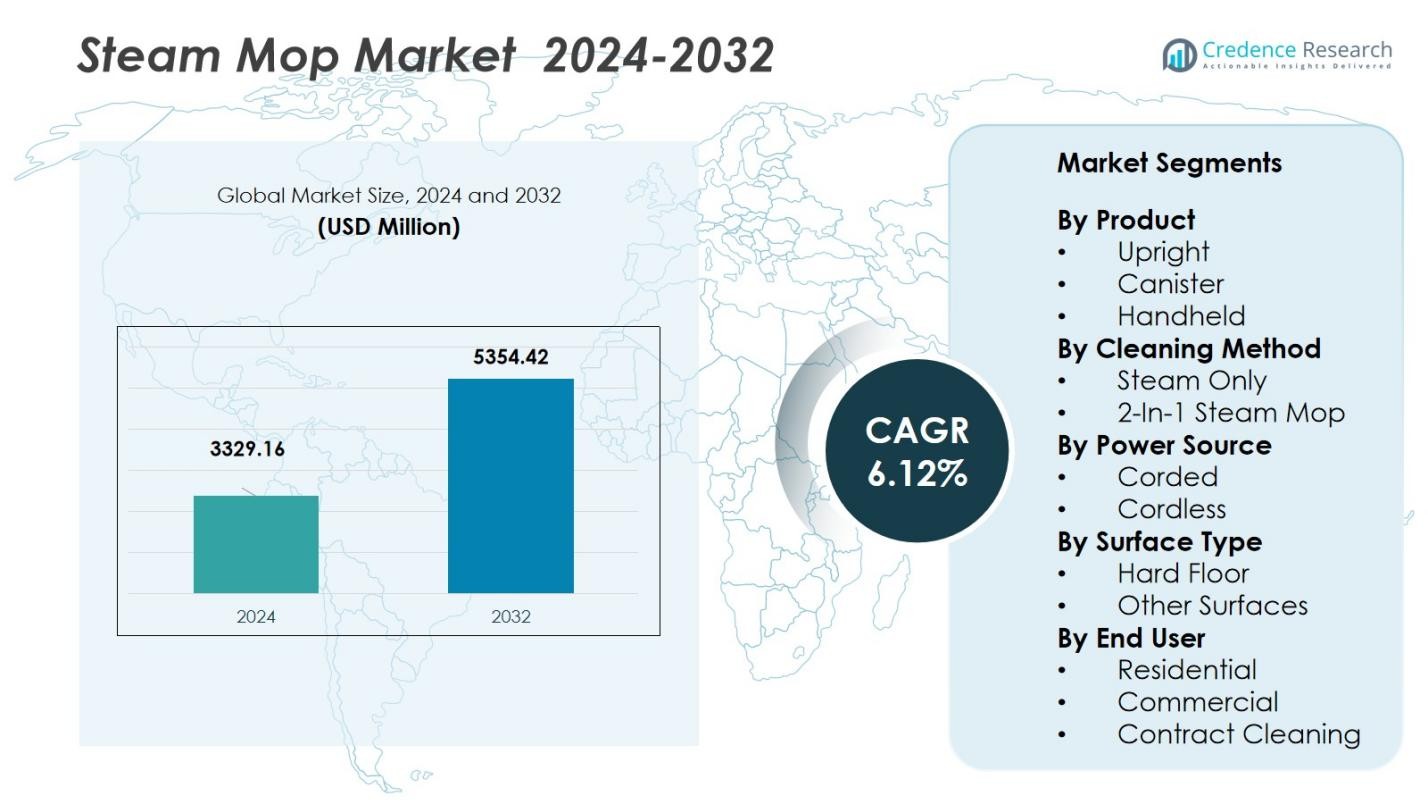
The Steam Mop Market size was valued at USD 3,329.16 Million in 2024 and is anticipated to reach USD 5,354.42 Million by 2032, at a CAGR of 6.12% during the forecast period.
| REPORT ATTRIBUTE | DETAILS |
|---|---|
| Historical Period | 2020-2023 |
| Base Year | 2024 |
| Forecast Period | 2025-2032 |
| Steam Mop Market Size 2024 | USD 3,329.16 Million |
| Steam Mop Market, CAGR | 6.12% |
| Steam Mop Market Size 2032 | USD 5,354.42 Million |
The Steam Mop Market features prominent companies including BLACK+DECKER, Eureka Forbes, light‑n‑easy, Wagner SprayTech, SALAV USA, Dupray, Vornado Air, Ladybug and POLTI Spa driving product innovation and market expansion. These firms are leveraging advanced features such as rapid‑heat boilers, multifunction attachments, cordless mobility and eco‑friendly design to strengthen their footprint globally. Regionally, North America dominates with a 40% market share supported by high consumer awareness and strong retail infrastructure. Europe follows with a 30% share, led by eco‑conscious consumers and stringent hygiene regulations. Asia Pacific holds approximately 23%, driven by rising urbanisation, increasing disposable incomes and growing acceptance of modern cleaning technologies.
Market Insights
- The Steam Mop Market size was valued at USD 3,329.16 Million in 2024 and is projected to reach USD 5,354.42 Million by 2032, growing at a CAGR of 6.12% during the forecast period.
- Key drivers of market growth include rising consumer demand for convenient, time-saving cleaning solutions and growing awareness of eco-friendly, chemical-free cleaning alternatives.
- Technological advancements, such as smart features, cordless models, and rapid heating systems, are key trends shaping the market’s future.
- The market faces challenges such as high initial costs and limited penetration in developing regions where traditional cleaning methods are more prevalent.
- Regionally, North America leads the market with a 40% share, followed by Europe with 30%. The Asia-Pacific region holds 23%, driven by rising disposable incomes and increasing urbanization. The Latin American and MEA regions represent smaller shares but show potential for future growth.
Market Segmentation Analysis:
By Product:
The product segment of the Steam Mop Market includes Upright, Canister, and Handheld models. Upright steam mops lead the segment with a dominant 58% market share, supported by their ergonomic design, strong suction, and suitability for large surface areas. Their widespread adoption in residential cleaning is fueled by rising preferences for quick, efficient, and user-friendly cleaning tools. Canister and handheld models follow, but their combined share remains lower due to limited capacity and reduced convenience for whole-floor cleaning compared to upright systems.
- For instance, Kärcher’s SC 2 Upright EasyFix steam cleaner is designed specifically for sealed hard floors and is marketed as removing up to 99.999% of coronaviruses and 99.99% of common household bacteria from hard surfaces using high‑temperature steam, illustrating why upright models are favored for hygienic, large‑area floor cleaning.
By Cleaning Method:
The cleaning method segment comprises Steam Only and 2-In-1 Steam Mops. The 2-In-1 Steam Mop segment dominates with a 63% market share, driven by its multifunctional capability that allows users to switch between steaming and traditional mopping. The growing demand for versatile household cleaning equipment strongly supports this segment’s expansion. Steam-only mops retain the remaining share, preferred mainly by users seeking simple, chemical-free sanitization solutions but lacking the multifunctional appeal that fuels the 2-in-1 category’s leadership.
- For instance, Bissell PowerFresh Slim 2233F, a 3-in-1 steam cleaner that transforms from an upright mop to a handheld steamer and extended reach tool
By Power Source:
In the power source category, Corded and Cordless steam mops make up the market structure. Corded steam mops hold a leading 57% market share, primarily due to their continuous steam generation, reliable operation, and suitability for extended cleaning sessions without battery limitations. This makes them the preferred choice in commercial environments and larger homes. Cordless steam mops, accounting for the remaining share, are rapidly growing in popularity due to enhanced mobility and convenience, appealing to consumers seeking flexible and wire-free cleaning solutions.
Key Growth Drivers
Rising Consumer Demand for Convenient Cleaning Solutions
The increasing preference for convenient, time-saving cleaning appliances is a major driver for the growth of the steam mop market. As consumers prioritize efficiency in household chores, steam mops have emerged as an effective solution for quick and thorough cleaning. The demand for user-friendly, easy-to-store, and multifunctional devices has expanded, particularly in busy households. This growing trend toward convenience in cleaning is expected to drive significant market growth, with consumers seeking solutions that minimize effort while maintaining high standards of cleanliness.
- For instance, "SteamForce X1" from GlobeClean Industries is utilized by professional cleaning services to deep-clean extensive surfaces effectively without chemicals, restoring hygiene in luxury homes.
Growing Awareness of Eco-Friendly Cleaning Products
Another significant growth driver is the increasing consumer awareness of eco-friendly and chemical-free cleaning options. Steam mops, which sanitize floors using steam without the need for harsh chemicals, are gaining popularity due to their environmental benefits. Consumers are increasingly turning to steam mops as a safer and more sustainable cleaning alternative, especially in households with young children or pets. This growing eco-consciousness is fueling market demand, with consumers actively seeking products that promote sustainability and reduce the environmental impact of cleaning.
- For instance, the Shark Steam Pocket Mop, praised for its lightweight design and long cord, offers effective cleaning while reducing reliance on chemical cleaners.
Expansion of Residential and Commercial Applications
The steam mop market is also benefitting from the expanding application of steam mops in both residential and commercial settings. In residential markets, the growing number of dual-income households and busy lifestyles have led to an increased demand for time-saving appliances. Commercial sectors, including hospitality and healthcare, are recognizing the efficiency and effectiveness of steam mops for large-scale cleaning tasks. This broadening application base in multiple environments is expected to further fuel market expansion, as steam mops are recognized for their versatility in both home and business cleaning.
Key Trends & Opportunities
Technological Advancements in Steam Mop Features
Technological innovations in steam mop design and functionality present significant opportunities for market growth. The introduction of features such as adjustable steam levels, faster heating times, and integrated filtration systems allows steam mops to cater to a wider range of cleaning needs. Furthermore, advancements in cordless models, offering greater mobility, are reshaping consumer expectations. As technology continues to improve the efficiency and convenience of steam mops, manufacturers can capitalize on these innovations to attract tech-savvy consumers and increase market penetration.
- For instance, Newbealer's advanced steam mop heats up in just 20 seconds and features three adjustable steam modes, allowing users to control steam intensity for various surfaces efficiently.
Integration of Smart Features and Connectivity
The integration of smart features and connectivity into steam mops is another emerging opportunity in the market. With the rise of smart homes, consumers are increasingly seeking devices that can be connected to mobile apps or home automation systems. Features such as remote control, scheduled cleaning, and performance monitoring through smartphones or voice assistants are gaining traction. This shift towards smart home integration opens up significant growth opportunities for steam mop manufacturers, allowing them to tap into the growing demand for connected home appliances.
- For instance, Agaro’s Alpha Robot Vacuum Cleaner and Mop supports smart app control and voice commands through Alexa and Google Assistant, enabling voice-activated cleaning routines and remote operation.
Key Challenges
High Initial Cost of Steam Mops
One of the major challenges in the steam mop market is the relatively high initial cost of these devices compared to traditional mops. While steam mops offer long-term benefits, such as chemical-free cleaning and time savings, the upfront investment can be a barrier for many price-sensitive consumers. This challenge is particularly pronounced in developing markets, where consumers may opt for more affordable cleaning solutions. Manufacturers will need to address cost concerns through pricing strategies and introducing lower-cost models to widen their consumer base.
Limited Market Penetration in Developing Regions
Despite the growing demand in developed countries, the steam mop market faces challenges in penetrating developing regions. Factors such as low awareness, limited access to advanced cleaning technologies, and economic constraints hinder market expansion. Consumers in emerging economies are often more accustomed to traditional cleaning methods and may be reluctant to invest in new technology without understanding its benefits. Overcoming these barriers will require targeted marketing campaigns, localized product offerings, and education on the advantages of steam mops to encourage adoption in these regions.
Regional Analysis
North America
The North America region commands a market share of 40% in the global steam mop market, owing to heightened consumer awareness of hygiene and a strong preference for chemical‑free cleaning solutions. With dual‑income households growing, time‑sensitive consumers increasingly adopt steam mops for efficient floor care. Additionally, the presence of a robust retail ecosystem online platforms and specialty stores supports rapid product penetration. Commercial establishments in hospitality and healthcare further boost demand. As a result, North America remains the largest regional contributor and key growth driver within the market.
Europe
In Europe, the steam mop market holds 30% of global share, underpinned by rising demand for eco‑friendly cleaning solutions in countries like Germany, the UK and France. European consumers prioritise premium, low‑chemical devices and actively invest in home‑care appliances that meet stringent environmental standards. Additionally, strong regulations on indoor air quality and hygiene in commercial settings propel steam mop usage in B2B segments. Retail chains and online platforms in Europe effectively promote innovations and drive adoption, enabling this region to remain a solid and mature market contributor.
Asia‑Pacific
Asia‑Pacific accounts for 23% of the global steam mop market, driven by increasing urbanisation, rising disposable incomes and greater awareness of modern cleaning technologies. Countries such as China, India and Australia show strong growth potential as households shift toward automated and steam‑based cleaning devices. Several regional manufacturers invest in R&D and expand distribution networks to cater to local preferences. While its share is lower than North America and Europe, Asia‑Pacific is emerging rapidly and expected to play an increasingly influential role in future market expansion.
Latin America
The Latin America region contributes 5% of the global steam mop market, reflecting its current developing‑market status. Growth in this region is stimulated by expanding middle‑class populations, accelerating urbanisation and rising preference for modern household appliances. Brazil, in particular, shows notable adoption of eco‑friendly cleaning solutions. However, market penetration remains constrained by lower per‑capita income and limited retail infrastructure compared to more developed regions. Nonetheless, Latin America presents untapped opportunities for manufacturers seeking to diversify beyond mature markets.
Middle East & Africa
The Middle East & Africa (MEA) region holds 2% of the global steam mop market, driven by increasing hygiene awareness, especially in the Gulf Cooperation Council (GCC) countries and among hospitality sectors. Investment in commercial infrastructure and rising standards of cleanliness in hotels and public buildings are gradually boosting demand. Nevertheless, economic disparities, limited consumer awareness and under‑penetrated retail channels restrict growth. With targeted educational campaigns and infrastructure improvements, MEA offers niche opportunities for steam mop market players seeking early‑mover advantage.
Market Segmentations:
By Product
- Upright
- Canister
- Handheld
By Cleaning Method
- Steam Only
- 2-In-1 Steam Mop
By Power Source
- Corded
- Cordless
By Surface Type
- Hard Floor
- Other Surfaces
By End User
- Residential
- Commercial
- Contract Cleaning
By Region
- North America
- U.S.
- Canada
- Mexico
- Europe
- Germany
- France
- U.K.
- Italy
- Spain
- Rest of Europe
- Asia Pacific
- China
- Japan
- India
- South Korea
- South-east Asia
- Rest of Asia Pacific
- Latin America
- Brazil
- Argentina
- Rest of Latin America
- Middle East & Africa
- GCC Countries
- South Africa
- Rest of the Middle East and Africa
Competitive Landscape
Competitive landscape analysis in the steam mop market features key players such as BLACK+DECKER, Eureka Forbes, light‑n‑easy, Wagner SprayTech, SALAV, Dupray and POLTI. These companies vigorously compete on product innovation, distribution reach, and marketing strategies to consolidate market share. Firms emphasise differentiated features such as rapid‑heating boilers, cordless mobility, and multifunctional attachments to appeal to convenience‑seeking consumers. Price competition remains intense especially in mature regions, prompting companies to leverage value‑added services and bundled accessories to retain customers. Strategic collaborations with e‑commerce platforms and expansion into emerging geographies reinforce competitive positioning. Overall, the landscape is characterised by moderate market concentration but high product‑level rivalry and continuous feature escalation.
Key Player Analysis
- POLTI Spa
- Guangdong
- Vornado Air
- Dupray
- Ladybug
- Eureka Forbes
- BLACK+DECKER
- Wagner SprayTech
- SALAV USA
- light-n-easy
Recent Developments
- In October 2024, Alfred Kärcher SE & Co. KG expanded its SC‑1/SC steam mop range with new multifunctional models, emphasising compact design and accessory kits.
- In August 2025, LG Electronics introduced a robot vacuum with integrated steam‑mop mode as part of its new cleaning‑appliance lineup at IFA 2025.
- In August 2025, Aterian, Inc. (via its brands including PurSteam) announced the launch of several new products on BestBuy.com (effective 19 Aug 2025) which included steam‑mop items among its home‑appliance SKUs.
Report Coverage
The research report offers an in-depth analysis based on Product, Cleaning Method, Power Source, Surface Type, End User and Region. It details leading market players, providing an overview of their business, product offerings, investments, revenue streams, and key applications. Additionally, the report includes insights into the competitive environment, SWOT analysis, current market trends, as well as the primary drivers and constraints. Furthermore, it discusses various factors that have driven market expansion in recent years. The report also explores market dynamics, regulatory scenarios, and technological advancements that are shaping the industry. It assesses the impact of external factors and global economic changes on market growth. Lastly, it provides strategic recommendations for new entrants and established companies to navigate the complexities of the market.
Future Outlook
- Rapid urbanisation and rising dual‑income households will increase demand for efficient floor‑cleaning devices.
- Growing consumer preference for chemical‑free and eco‑friendly cleaning solutions will boost steam mop adoption.
- Advances in cordless and battery‑powered steam mops will enhance portability and convenience, reshaping product offerings.
- Integration of smart features such as app connectivity and voice control will become more common in steam mop models.
- Manufacturers will expand their presence in emerging markets where awareness of modern cleaning technologies is still low.
- Multi‑surface and multifunction steam mops will gain traction as consumers seek versatile cleaning solutions for mixed flooring types.
- Growth in commercial applications (such as hospitality and healthcare) will increase demand for heavy‑duty steam mop models.
- Increase in online retail and direct‑to‑consumer channels will accelerate product reach and reduce distribution costs.
- Collaborations between appliance brands and home‑cleaning service providers will drive bundled product–service offerings.
- Sustainable design and recyclable materials will become key differentiators as environmental concerns influence purchasing decisions.

Request a Free Sample
Fill in your details and we'll send you a free sample report.
- Sample data tables & charts
- Research methodology
Market Dynamics
Demand for Convenient and Time-Saving Cleaning Solutions
Busy lifestyles and the rise of dual-income households are increasing the need for efficient, easy-to-use cleaning appliances. Steam mops offer quick, thorough cleaning with minimal effort, making them highly attractive for modern consumers.
Growing Awareness of Eco-Friendly and Chemical-Free Cleaning
Consumers are increasingly seeking cleaning solutions that avoid harsh chemicals, especially in homes with children or pets. Steam mops sanitize using only water, aligning with the trend toward sustainability and health-conscious living.
Technological Advancements and Smart Features
Innovations such as rapid heating, adjustable steam levels, cordless operation, and smart connectivity are enhancing the appeal and functionality of steam mops. These features attract tech-savvy consumers and expand the market’s reach.
Expansion in Commercial and Contract Cleaning Applications
The adoption of steam mops is rising in commercial sectors like hospitality and healthcare, where hygiene standards are critical. Their effectiveness in large-scale, chemical-free cleaning is driving demand beyond residential use.
Rising Urbanization and Disposable Incomes in Emerging Markets
Urbanization and increasing disposable incomes in Asia Pacific and Latin America are fueling the adoption of modern cleaning technologies. As awareness grows, these regions are becoming significant contributors to market growth.
Need a Custom Version of This Report?
Tailor the scope, geography, or segments to your exact requirements.
- Custom geography or segment scope
- Direct access to our analyst team
Frequently Asked Questions
What is the current market size for Steam Mop Market, and what is its projected size in 2032?
At what Compound Annual Growth Rate is the Steam Mop Market projected to grow between 2025 and 2032?
Which Steam Mop Market segment held the largest share in 2024?
What are the primary factors fueling the growth of the Steam Mop Market?
Who are the leading companies in the Steam Mop Market?
Which region commanded the largest share of the Steam Mop Market in 2024?
Table of Content
Chapter 1 Market Segmentation
- 1.1 Segmentation Framework
- 1.1.1 Product and Service Classification
- 1.1.2 Application and End-Use Classification
- 1.1.3 Technology and Solution Classification
- 1.1.4 Customer and Distribution Channel Classification
- 1.1.5 Geographic Segmentation
- 1.1.6 Market Segment Definitions and Boundaries
- 1.2 By Product
- 1.2.1 Upright
- 1.2.2 Canister
- 1.2.3 Handheld
- 1.3 By End User
- 1.3.1 Residential
- 1.3.2 Commercial
- 1.3.3 Contract Cleaning
- 1.4 By Power Source
- 1.4.1 Corded
- 1.4.2 Cordless
- 1.5 By Cleaning Method
- 1.5.1 Steam Only
- 1.5.2 2-In-1 Steam Mop
Chapter 2 Introduction
- 2.1 Report Objectives and Scope
- 2.2 Product Definition and Industry Terminology
- 2.3 Market Inclusions and Exclusions
- 2.4 Research Process
- 2.4.1 Primary Research and Expert Interviews
- 2.4.2 Secondary Research and Source Review
- 2.4.3 Top-Down and Bottom-Up Estimation
- 2.4.4 Data Triangulation and Verification
- 2.5 Market Size Measurement Basis
- 2.5.1 2024: USD 3,329.16 Million → 2032: USD 5,354.42 Million
- 2.6 Historical and Forecast Reference Periods
- 2.6.1 Base Year: 2024
- 2.6.2 Forecast Period: 2024-2032
- 2.7 Research Assumptions and Limitations
Chapter 3 Executive Summary
- 3.1 Market Snapshot and Key Findings
- 3.2 Base-Year Market Size, 2024
- 3.3 Forecast Market Size, 2032
- 3.4 Revenue and Volume Growth Outlook
- 3.5 Key Demand and Supply Indicators
- 3.6 Leading Market Segments
- 3.7 Fastest-Growing Market Opportunities
- 3.8 Regional Performance Highlights
- 3.9 Technology and Industry Transformation
- 3.10 Competitive Landscape Summary
- 3.11 Analyst View and Strategic Implications
Chapter 4 Global Steam Mop Market Trends and Developments
- 4.1 Historical Industry Development
- 4.2 Recent Market Trends and Developments
- 4.3 Demand and Customer Behavior Trends
- 4.4 Technology and Product Innovation
- 4.5 Artificial Intelligence, Automation and Digitalization
- 4.6 Local Manufacturing and Supply Chain Realignment
- 4.7 Industry Partnerships, Mergers and Acquisitions
- 4.8 Sustainability and Circular Economy Developments
- 4.9 Government and Private Sector Investment Trends
- 4.10 Emerging Business Models and Commercialization
- 4.11 Industry Developments and Announcements
Chapter 5 Global Steam Mop Market Production, Supply and Demand Analysis
- 5.1 Demand Trend and Consumption Analysis
- 5.2 Demand Forecast, 2024-2032
- 5.3 Production and Output Trend
- 5.4 Production and Output Forecast, 2024-2032
- 5.5 Installed Capacity and Capacity Utilization
- 5.6 Company-Wise Production Plants and Statistics
- 5.6.1 Installed Production Capacity
- 5.6.2 Actual Production
- 5.6.3 Planned Capacity and Expansion Targets
- 5.7 Supply Chain Structure and Procurement Trends
- 5.8 Supply-Demand Gap and Bottlenecks
- 5.9 Import Dependence and Sourcing Structure
- 5.10 Contract Manufacturing and Outsourcing
- 5.11 Regional Supply and Demand Concentration
Chapter 6 Global Steam Mop Market Pricing Analysis
- 6.1 Pricing Structure and Measurement
- 6.2 Historical Pricing Trends
- 6.3 Pricing Outlook, 2024-2032
- 6.4 Average Selling Price and Unit Economics
- 6.5 Pricing by Product and Market Segment
- 6.6 Geographic Pricing Differences
- 6.7 Key Input, Energy, Labor and Logistics Costs
- 6.8 Contract Pricing and Purchasing Models
- 6.9 Pricing Sensitivity and Competitive Positioning
- 6.10 Price, Margin and Profitability Implications
Chapter 7 Global Steam Mop Market Dynamics
- 7.1 Market Growth Drivers
- 7.1.1 Demand-Side Drivers
- 7.1.2 Technology and Innovation Drivers
- 7.1.3 Infrastructure and Investment Drivers
- 7.1.4 Regulatory and Policy Drivers
- 7.2 Market Restraints
- 7.2.1 Cost and Affordability Constraints
- 7.2.2 Technology and Adoption Barriers
- 7.2.3 Supply Chain and Operational Constraints
- 7.3 Market Challenges
- 7.3.1 Competitive Pressure and Margin Erosion
- 7.3.2 Skills, Infrastructure and Implementation Gaps
- 7.4 Emerging Market Opportunities
- 7.5 Market Dynamics Impact and Time-Horizon Assessment
Chapter 8 Global Steam Mop Value Chain Analysis
- 8.1 Industry Value Chain Overview
- 8.2 Upstream Suppliers and Critical Inputs
- 8.3 Technology and Component Providers
- 8.4 Manufacturing or Service Delivery
- 8.5 Distribution, Channel Partners and Integrators
- 8.6 Downstream Applications and End Users
- 8.7 Value Addition and Profit Pools
- 8.8 Vertical Integration and Outsourcing
- 8.9 Supplier Concentration and Risk
- 8.10 Supply Chain Localization and Resilience
Chapter 9 Global Steam Mop Market Regulations and Policies
- 9.1 Relevant Laws, Standards and Compliance Frameworks
- 9.2 Product, Service, Safety and Quality Requirements
- 9.3 Government Policies, Incentives and Subsidies
- 9.4 Imports, Exports and Trade Barriers
- 9.5 Public Procurement and Local Content Requirements
- 9.6 Environmental and Sustainability Compliance
- 9.7 Upcoming Policy Changes and Market Implications
Chapter 10 Global Steam Mop Market Hotspots and Opportunities
- 10.1 Market Opportunity Mapping and Growth Hotspots
- 10.2 High-Growth Applications and Customer Groups
- 10.3 Underserved Markets and White-Space Opportunities
- 10.4 Emerging Technology and Product Opportunities
- 10.5 New Capacity and Investment Hotspots
- 10.6 Market Entry and Expansion Opportunities
- 10.7 Distribution and Partnership Opportunities
- 10.8 Near-Term and Long-Term Commercial Potential
- 10.9 Opportunity Attractiveness and Execution Risks
Chapter 11 Global Steam Mop Market Outlook, 2024-2032
- 11.1 Market Size and Analysis
- 11.1.1 Revenue (Market Measurement: 2024: USD 3,329.16 Million → 2032: USD 5,354.42 Million)
- 11.1.2 Market Volume and Quantity Sold
- 11.1.3 Historical Market Size
- 11.1.4 Base-Year Market Size, 2024
- 11.2 Market Forecast, 2024-2032
- 11.2.1 Revenue Forecast to 2032
- 11.2.2 Volume Forecast to 2032
- 11.2.3 CAGR and Year-on-Year Growth
- 11.2.4 Incremental Revenue Opportunity
- 11.3 Forecast Assumptions and Scenario Analysis
- 11.3.1 Base-Case Forecast
- 11.3.2 Optimistic and Conservative Scenarios
- 11.3.3 Technology, Pricing and Policy Sensitivities
- 11.4 Market Attractiveness and Growth Outlook
Chapter 12 Global Steam Mop Market Segmentation and Outlook
- 12.1 Segmentation Summary and Market Shares, 2024
- 12.2 Largest and Fastest-Growing Segments
- 12.3 By Product - Market Size and Forecast, 2024-2032
- 12.3.1 Segment Definition and Scope
- 12.3.2 Historical Market Size
- 12.3.3 Revenue Forecast, 2024-2032
- 12.3.4 Volume Forecast, 2024-2032
- 12.3.5 Base-Year Market Share, 2024
- 12.3.6 Segment CAGR and Growth Drivers
- 12.3.7 Subsegment Market Size and Forecast
- 12.3.7.1 Upright
- 12.3.7.2 Canister
- 12.3.7.3 Handheld
- 12.3.8 Subsegment Pricing and Adoption Trends
- 12.3.9 Leading Suppliers and Competition
- 12.3.10 Regional Demand and Opportunities
- 12.4 By End User - Market Size and Forecast, 2024-2032
- 12.4.1 Segment Definition and Scope
- 12.4.2 Historical Market Size
- 12.4.3 Revenue Forecast, 2024-2032
- 12.4.4 Volume Forecast, 2024-2032
- 12.4.5 Base-Year Market Share, 2024
- 12.4.6 Segment CAGR and Growth Drivers
- 12.4.7 Subsegment Market Size and Forecast
- 12.4.7.1 Residential
- 12.4.7.2 Commercial
- 12.4.7.3 Contract Cleaning
- 12.4.8 Subsegment Pricing and Adoption Trends
- 12.4.9 Leading Suppliers and Competition
- 12.4.10 Regional Demand and Opportunities
- 12.5 By Power Source - Market Size and Forecast, 2024-2032
- 12.5.1 Segment Definition and Scope
- 12.5.2 Historical Market Size
- 12.5.3 Revenue Forecast, 2024-2032
- 12.5.4 Volume Forecast, 2024-2032
- 12.5.5 Base-Year Market Share, 2024
- 12.5.6 Segment CAGR and Growth Drivers
- 12.5.7 Subsegment Market Size and Forecast
- 12.5.7.1 Corded
- 12.5.7.2 Cordless
- 12.5.8 Subsegment Pricing and Adoption Trends
- 12.5.9 Leading Suppliers and Competition
- 12.5.10 Regional Demand and Opportunities
- 12.6 By Cleaning Method - Market Size and Forecast, 2024-2032
- 12.6.1 Segment Definition and Scope
- 12.6.2 Historical Market Size
- 12.6.3 Revenue Forecast, 2024-2032
- 12.6.4 Volume Forecast, 2024-2032
- 12.6.5 Base-Year Market Share, 2024
- 12.6.6 Segment CAGR and Growth Drivers
- 12.6.7 Subsegment Market Size and Forecast
- 12.6.7.1 Steam Only
- 12.6.7.2 2-In-1 Steam Mop
- 12.6.8 Subsegment Pricing and Adoption Trends
- 12.6.9 Leading Suppliers and Competition
- 12.6.10 Regional Demand and Opportunities
- 12.7 Segment Growth Comparison
- 12.8 Segment Attractiveness and Priority Matrix
Chapter 13 Global Steam Mop End-Use and Application Market Outlook
- 13.1 End-Use Industry and Customer Demand Structure
- 13.2 Leading Applications and Customer Groups
- 13.3 End-Use Market Size, Share and Forecast
- 13.4 Major End-Use Industry Deep Dives
- 13.4.1 Customer Requirements and Use Cases
- 13.4.2 Demand and Replacement Cycles
- 13.4.3 Technical and Regulatory Considerations
- 13.4.4 Purchasing and Procurement Models
- 13.4.5 Leading Vendors and Distribution Channels
- 13.4.6 Forecast and Commercial Opportunities
- 13.5 Emerging Applications and Cross-Segment Demand
- 13.6 End-Use Industry Investment Priorities
Chapter 14 Global Steam Mop Geographic Market Outlook, 2024-2032
- 14.1 Regional Market Size and Share, 2024
- 14.2 Regional Market Forecast, 2024-2032
- 14.3 Regional Pricing, Production and Demand Differences
- 14.4 North America
- 14.4.1 United States
- 14.4.2 Canada
- 14.4.3 Mexico
- 14.5 Europe
- 14.5.1 Germany
- 14.5.2 France
- 14.5.3 Italy
- 14.5.4 United Kingdom
- 14.5.5 Spain
- 14.5.6 Poland
- 14.5.7 Russia
- 14.5.8 Netherlands
- 14.5.9 Belgium
- 14.5.10 Sweden
- 14.5.11 Denmark
- 14.5.12 Norway
- 14.5.13 Rest of Europe
- 14.6 Asia Pacific
- 14.6.1 China
- 14.6.2 India
- 14.6.3 Japan
- 14.6.4 South Korea
- 14.6.5 Thailand
- 14.6.6 Indonesia
- 14.6.7 Vietnam
- 14.6.8 Malaysia
- 14.6.9 Australia
- 14.6.10 Rest of Asia Pacific
- 14.7 Latin America
- 14.7.1 Brazil
- 14.7.2 Argentina
- 14.7.3 Colombia
- 14.7.4 Chile
- 14.7.5 Rest of Latin America
- 14.8 Middle East
- 14.8.1 Saudi Arabia
- 14.8.2 United Arab Emirates
- 14.8.3 Turkey
- 14.8.4 Israel
- 14.8.5 Iran
- 14.8.6 Rest of the Middle East
- 14.9 Africa
- 14.9.1 South Africa
- 14.9.2 Egypt
- 14.9.3 Nigeria
- 14.9.4 Morocco
- 14.9.5 Rest of Africa
- 14.10 Regional Investment, Policy and Supply Chain Differences
- 14.11 Regional Competitive Landscape
- 14.12 Geographic Growth Hotspots
Chapter 15 Global Steam Mop Technology, Innovation and Sustainability Outlook
- 15.1 Technology Landscape and Maturity
- 15.2 Product, Process and Service Innovation
- 15.3 AI, Automation and Digital Tools in the Industry
- 15.4 Technology Adoption and Performance Benchmarking
- 15.5 Innovation Pipeline and R&D Investment
- 15.6 Patent and Intellectual Property Trends
- 15.7 Energy Efficiency and Resource Management
- 15.8 Sustainability, Recycling and Circularity
- 15.9 Technology Roadmap, 2024-2032
- 15.10 Risks of Obsolescence and Technology Substitution
Chapter 16 Global Steam Mop Market Key Strategic Imperatives
- 16.1 Growth and Market Entry Priorities
- 16.2 High-Return Products and Segments
- 16.3 Pricing, Profitability and Cost Optimization
- 16.4 Technology Investment and Product Differentiation
- 16.5 Supply Chain Localization and Resilience
- 16.6 Distribution and Customer Acquisition
- 16.7 Partnership, Acquisition and Capacity Strategy
- 16.8 Regional Expansion Priorities
- 16.9 Short-, Medium- and Long-Term Actions
Chapter 17 Competition Outlook
- 17.1 Industry Competition Characteristics
- 17.2 Market Structure and Concentration
- 17.3 Market Share and Competitive Positioning, 2024
- 17.4 Company-Wise Revenue and Product Benchmarking
- 17.5 Production and Service Capacity Benchmarking
- 17.6 Technology, Pricing and Differentiation
- 17.7 Regional Footprint and Distribution Strength
- 17.8 Mergers, Acquisitions and Strategic Alliances
- 17.9 New Entrants and Competitive Threats
- 17.10 Porter's Five Forces and Industry Attractiveness
- 17.11 Competitive Outlook, 2024-2032
Chapter 18 Company Profiles
- 18.1 Company Coverage and Selection Criteria
- 18.2 BLACK+DECKER
- 18.2.1 Business Description
- 18.2.2 Company Ownership and Geographic Presence
- 18.2.3 Product and Service Portfolio
- 18.2.4 Manufacturing and Operating Footprint
- 18.2.5 Production Capacity and Expansion Plans
- 18.2.6 Financial Performance and Investment
- 18.2.7 Market Share and Competitive Position
- 18.2.8 Technology and Innovation Capabilities
- 18.2.9 Strategic Alliances or Partnerships
- 18.2.10 Recent Developments
- 18.2.11 Growth Strategy and Outlook
- 18.3 Eureka Forbes
- 18.4 light-n-easy
- 18.5 Wagner SprayTech
- 18.6 SALAV USA
- 18.7 Dupray
- 18.8 Vornado Air
- 18.9 Ladybug
- 18.10 POLTI Spa
- 18.11 Alfred Kärcher SE & Co. KG
- 18.12 Other Relevant Market Participants
Note: Every listed company is profiled on the structure shown under the first company. The company list is preliminary and may change based on research findings, market developments, data availability and client requirements.
Chapter 19 Disclaimer
- 19.1 Research and Forecast Disclaimer
- 19.2 Data Source and Estimation Limitations
Note: The depth of individual sections depends on data availability for this market. Volume, capacity, trade and other unit-based metrics are included where applicable.