
Market Overview
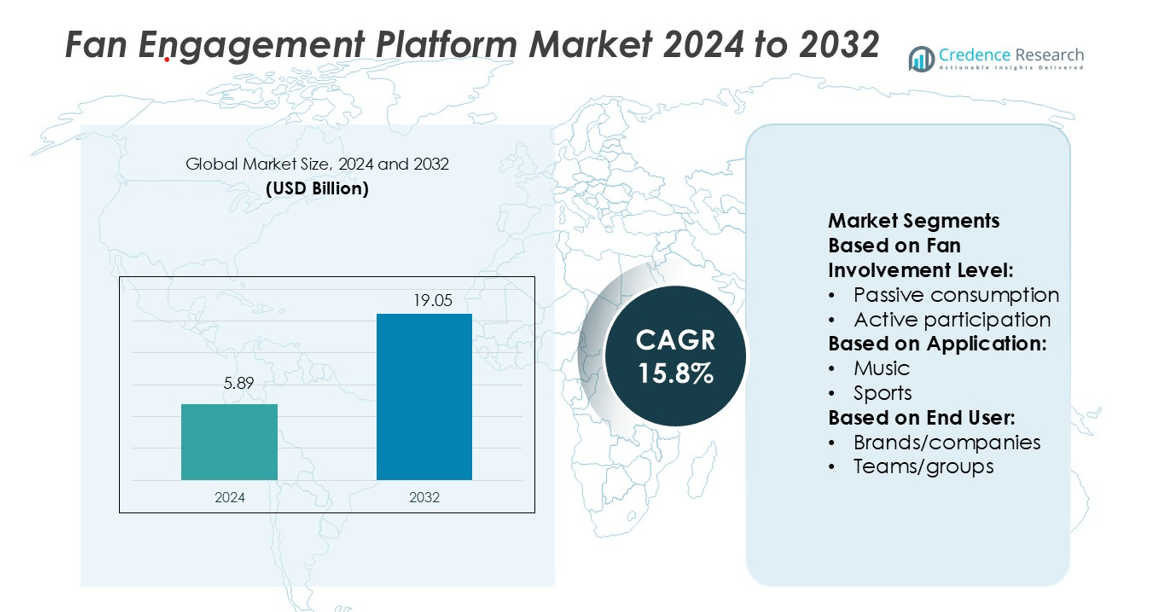
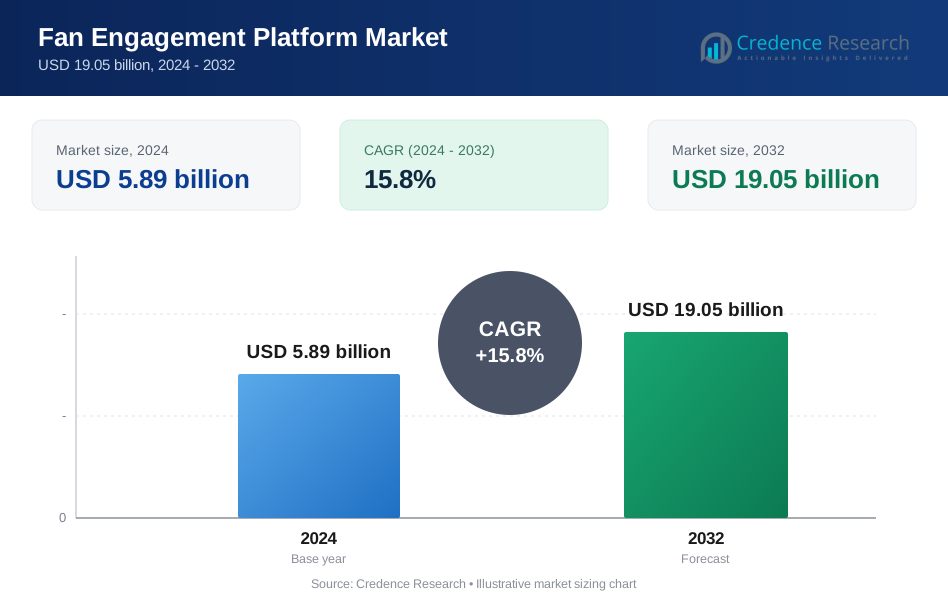
Fan Engagement Platform Market size was valued USD 5.89 billion in 2024 and is anticipated to reach USD 19.05 billion by 2032, at a CAGR of 15.8% during the forecast period.
| REPORT ATTRIBUTE | DETAILS |
|---|---|
| Historical Period | 2020-2023 |
| Base Year | 2024 |
| Forecast Period | 2025-2032 |
| Fan Engagement Platform Market Size 2024 | USD 5.89 billion |
| Fan Engagement Platform Market, CAGR | 15.8% |
| Fan Engagement Platform Market Size 2032 | USD 19.05 billion |
The Fan Engagement Platform Market is shaped by major players such as Twilio Inc., Salesforce Inc., Sitecore, SAP SE, Adobe Inc., Microsoft Corporation, Braze, Tealium, Oracle Corporation, and SAS. These companies focus on enhancing fan interaction through AI-powered personalization, omnichannel integration, and immersive technologies like AR and VR. They invest in real-time engagement solutions, loyalty programs, and data analytics to strengthen user retention and monetization. North America leads the global market with a 34.2% share in 2024, supported by advanced digital infrastructure, strong sports and entertainment ecosystems, and high consumer adoption of interactive engagement platforms.
Market Insights
- The Fan Engagement Platform Market was valued at USD 5.89 billion in 2024 and is projected to reach USD 19.05 billion by 2032, growing at a CAGR of 15.8%.
- AI-powered personalization, AR/VR integration, and real-time interaction tools are driving stronger user engagement and platform adoption.
- Strategic investments in data analytics, loyalty programs, and omnichannel strategies are strengthening competitive positioning.
- North America holds the largest share at 34.2%, supported by strong sports and entertainment ecosystems and advanced digital infrastructure.
- The sports segment leads the market with 32.5% share, driven by interactive experiences, fan loyalty initiatives, and global event integration.
Market Segmentation Analysis:
By Fan Involvement Level
Passive consumption leads the Fan Engagement Platform Market with a 46.8% share in 2024. This segment dominates due to the high number of users engaging through streaming, browsing, or attending online events without direct interaction. Platforms leverage AI-driven recommendations, real-time notifications, and personalized feeds to keep passive audiences consistently engaged. Growth is supported by increasing content availability and easy mobile access. Companies are also integrating immersive viewing experiences, like 360° content and AR filters, to increase engagement duration and retention rates within this segment.
- For instance, Salesforce’s Agentforce has handled over 1.4 million request interactions through the company’s internal Help portal, demonstrating its ability to manage high-volume workflows.
By Application
Sports dominates the Fan Engagement Platform Market with a 32.5% share in 2024. The segment benefits from rising digital fan communities, live match interaction, and exclusive behind-the-scenes content. Sports franchises are deploying interactive features such as live polls, AR/VR experiences, and in-app reward programs to build loyalty. Partnerships between leagues, streaming platforms, and sponsors drive broader fan outreach. Esports and entertainment also show strong growth, driven by influencer-led live streams and event participation. High emotional investment and structured fan bases strengthen the market leadership of sports engagement.
- For instance, Sitecore’s composable DXP includes over 250 AI-powered enhancements that enable advanced behavioral targeting and real-time engagement personalization.
By End User
Brands and companies account for the largest share of 39.2% in the Fan Engagement Platform Market in 2024. Their dominance stems from high marketing budgets and extensive fan outreach strategies. Organizations are adopting gamified engagement, real-time loyalty programs, and community-building tools to deepen audience relationships. This segment benefits from data-driven insights, enabling personalized interactions at scale. Collaborations with influencers and celebrities further enhance visibility and fan retention. Media organizations and teams/groups follow closely, as they leverage fan platforms to build sustained engagement ecosystems.
Key Growth Drivers
Rising Demand for Real-Time Interaction
Real-time interaction is driving rapid adoption of fan engagement platforms. Audiences increasingly expect instant updates, live chats, polls, and Q&A sessions during events. Sports leagues, entertainment brands, and creators use live streaming and interactive tools to build deeper fan relationships. Platforms with real-time engagement features see higher retention and monetization rates. Strong demand for personalized and immediate interaction creates a competitive advantage for companies offering seamless live engagement experiences across mobile and web channels.
- For instance, Equinix and its joint venture partner GIC developed the SL2x and SL3x xScale data centers in Seoul, which together will have over 45 MW of power capacity.
Expansion of Digital Fan Communities
The surge in digital fan communities is boosting platform usage. Fans gather around creators, teams, and causes, forming interactive online ecosystems. These communities encourage repeat visits, content sharing, and emotional investment. Platforms with integrated forums, chat rooms, and loyalty programs enable sustained engagement. Brands benefit from valuable data insights generated by community behavior. The rapid shift from one-way broadcasting to participatory experiences positions fan platforms as essential tools for relationship building and brand loyalty.
- For instance, Microsoft’s Secure Future Initiative mobilizes roughly 34,000 full-time engineers to embed security throughout its product stack, reducing vulnerabilities in real-time systems.
Interation of Advanced Technologies
I, AR, VR, and gamification technologies are transforming fan experiences. Personalized recommendations, immersive virtual events, and interactive storytelling enhance emotional connection. Brands use AI to analyze fan preferences and deliver tailored content, improving engagement metrics. Gamified features like leaderboards and digital rewards increase participation rates. These technologies enable scalable engagement strategies, supporting higher conversion rates and stronger brand affinity. Continuous innovation is turning fan engagement platforms into strategic digital assets for creators and companies.
Key Trends & Opportunities
Monetization Through Direct-to-Fan Channels
Fan engagement platforms are enabling creators and brands to generate revenue through subscriptions, exclusive content, and virtual goods. Direct-to-fan models reduce dependency on intermediaries, allowing higher profit margins. NFTs, digital collectibles, and tiered memberships are creating new monetization layers. Platforms are also integrating secure payment gateways and tokenized rewards. This trend presents significant opportunities for long-term revenue growth and brand sustainability through loyal fan communities.
- For instance, Eaton is helping lead the shift to 800 V high-voltage direct current (HVDC) infrastructure to support 1 megawatt racks in AI data centers, collaborating with NVIDIA on reference architectures.
Growing Adoption in Non-Entertainment Sectors
Fan engagement platforms are expanding beyond sports and entertainment. Political campaigns, NGOs, and education providers are leveraging these tools for targeted communication and mobilization. Interactive campaigns, live updates, and digital communities improve outreach and participation. The shift opens new market segments and encourages platform diversification. Companies investing in adaptable and customizable engagement solutions can capture growing demand from these emerging use cases.
- For instance, IBM introduced its Power11 server lineup, engineered to maintain just 30 seconds of unplanned downtime per year, and equipped with AI-driven security that detects ransomware in under 60 seconds.
Rise of AI-Driven Personalization
AI-driven personalization is becoming central to fan engagement strategies. Platforms use behavioral analytics to recommend relevant content, events, and offers. This approach boosts engagement time and loyalty while improving conversion rates for paid features. Personalization also enables segmented marketing and targeted campaigns. The growing use of AI creates opportunities for innovation in predictive engagement and automated fan relationship management.
Key Challenges
Data Privacy and Security Concerns
Handling large volumes of fan data increases privacy and compliance risks. Unauthorized access or misuse can damage trust and brand reputation. Stricter data protection laws require robust governance frameworks and secure infrastructure. Platforms must invest in encryption, authentication, and consent management. High compliance costs and regulatory complexity pose barriers for smaller players entering the market.
High Competition and Monetization Pressure
The market faces intense competition from established social media and niche engagement platforms. Monetizing engagement while maintaining user trust remains a major challenge. Over-commercialization can lead to fan fatigue and churn. Companies must balance interactive experiences with sustainable revenue strategies. Differentiation through technology and value-added services becomes essential to secure long-term growth in this crowded landscape.
Regional Analysis
North America
North America leads the Fan Engagement Platform Market with a 34.2% share in 2024. The region benefits from high digital adoption, strong social media penetration, and major sports leagues with large fan bases. Companies invest heavily in AI-driven engagement tools and real-time interaction platforms. U.S. entertainment brands and teams use personalized content and gamification to strengthen loyalty and increase revenue streams. Advanced payment infrastructure supports direct-to-fan monetization models. Strategic partnerships between media companies and technology providers further boost platform innovation and market expansion.
Europe
Europe holds a 28.6% share of the Fan Engagement Platform Market in 2024. The region’s growth is driven by expanding fan bases across sports, music, and cultural events. Football clubs and entertainment organizations actively deploy interactive platforms to connect with global audiences. Investments in multilingual content and immersive technologies support fan inclusivity and engagement. Regulatory frameworks around data privacy also encourage platform transparency and trust. The presence of established sports teams and large event networks strengthens Europe’s position as a key market for fan engagement solutions.
Asia Pacific
Asia Pacific accounts for a 24.7% share of the Fan Engagement Platform Market in 2024. The region experiences rapid growth due to strong mobile penetration, rising influencer culture, and expanding e-sports ecosystems. Markets like China, India, Japan, and South Korea drive adoption through social media-led fan communities and live streaming platforms. Local brands and entertainment companies leverage real-time engagement tools to reach younger, tech-savvy audiences. Government support for digital infrastructure and growing investments in sports and entertainment industries fuel further expansion across the region.
Latin America
Latin America represents a 7.5% share of the Fan Engagement Platform Market in 2024. The region is witnessing rising adoption of engagement platforms, particularly in sports and music segments. Brazil and Mexico lead market growth due to their strong football culture and active fan communities. Increased mobile internet usage supports wider accessibility to live streaming and interactive experiences. Regional content localization and partnerships with influencers strengthen engagement strategies. Despite infrastructure gaps, expanding digital ecosystems create opportunities for new entrants and technology providers.
Middle East & Africa
The Middle East & Africa hold a 5% share of the Fan Engagement Platform Market in 2024. Growth is driven by rising investments in sports, entertainment, and cultural initiatives. Gulf countries are expanding digital infrastructure and hosting major events, increasing fan interaction opportunities. Social media platforms and influencer networks play a key role in building communities. Although digital penetration remains uneven across some regions, ongoing investments in connectivity and localized engagement strategies are expected to boost platform adoption over the forecast period.
Market Segmentations:
By Fan Involvement Level:
- Passive consumption
- Active participation
By Application:
- Music
- Sports
By End User:
- Brands/companies
- Teams/groups
By Geography
- North America
- U.S.
- Canada
- Mexico
- Europe
- Germany
- France
- U.K.
- Italy
- Spain
- Rest of Europe
- Asia Pacific
- China
- Japan
- India
- South Korea
- South-east Asia
- Rest of Asia Pacific
- Latin America
- Brazil
- Argentina
- Rest of Latin America
- Middle East & Africa
- GCC Countries
- South Africa
- Rest of the Middle East and Africa
Competitive Landscape
The Fan Engagement Platform Market is shaped by key players including Twilio Inc., Salesforce Inc., Sitecore, SAP SE, Adobe Inc., Microsoft Corporation, Braze, Tealium, Oracle Corporation, and SAS. The Fan Engagement Platform Market is highly competitive, with companies focusing on advanced technologies, seamless integration, and data-driven engagement strategies. Vendors are prioritizing AI, AR/VR, and real-time analytics to create personalized fan experiences across multiple channels. Many platforms are expanding their capabilities through omnichannel engagement, loyalty programs, and gamification to increase user retention and lifetime value. Strategic partnerships with entertainment brands, sports organizations, and media platforms support faster market expansion. Continuous investment in cloud infrastructure, security frameworks, and predictive insights enhances platform reliability and scalability. This strong focus on innovation and user experience is driving intense competition and market differentiation.
Key Player Analysis
- Twilio Inc.
- Salesforce Inc.
- Sitecore
- SAP SE
- Adobe Inc.
- Microsoft Corporation
- Braze
- Tealium
- Oracle Corporation
- SAS
Recent Developments
- In September 2025, Kolkata Metro Railway launched a project to upgrade the air-conditioning and tunnel ventilation systems along the 16 km Belgachhia Rabindra Sarobar corridor.
- In July 2025, North American esports team Evil Geniuses (EG) has launched a new fan engagement app called the EG Villainverse Fan App, developed in partnership with Xborg.
- In July 2025, ShotTracker FanThreeSixty partnership revolutionizes real-time analytics and fan experience in sports. FanThreeSixty formed a strategic partnership with ShotTracker, integrating real-time tracking data with mobilized fan engagement tools for enhanced live-facing experiences.
- In April 2024, Travelex, a global foreign exchange company, leveraged a cloud-based customer data platform to boost customer retention. By customizing customer data, Travelex will encourage people to take advantage of its services more frequently. It will enable real-time customization and personalization of products based on customer needs. The platform will also keep track of customers when they contact the company.
Report Coverage
The research report offers an in-depth analysis based on Fan Involvement Level, Application, End-User and Geography. It details leading market players, providing an overview of their business, product offerings, investments, revenue streams, and key applications. Additionally, the report includes insights into the competitive environment, SWOT analysis, current market trends, as well as the primary drivers and constraints. Furthermore, it discusses various factors that have driven market expansion in recent years. The report also explores market dynamics, regulatory scenarios, and technological advancements that are shaping the industry. It assesses the impact of external factors and global economic changes on market growth. Lastly, it provides strategic recommendations for new entrants and established companies to navigate the complexities of the market.
Future Outlook
- Fan engagement platforms will integrate deeper AI and automation to personalize user experiences.
- Real-time interaction tools will become standard features for driving fan loyalty.
- AR and VR technologies will enhance immersive event experiences and boost engagement.
- Direct-to-fan monetization models will expand through subscriptions and digital collectibles.
- Mobile-first platforms will dominate user acquisition strategies across all regions.
- Data-driven insights will shape targeted marketing and fan retention strategies.
- Gamification features will increase participation rates and strengthen community building.
- Cross-platform integration will support seamless fan interaction across digital touchpoints.
- Demand from non-entertainment sectors like education and activism will grow rapidly.
- Investment in security and privacy frameworks will become a major competitive priority.
Request a Free Sample
Fill in your details and we'll send you a free sample report.
- Sample data tables & charts
- Research methodology
Need a Custom Version of This Report?
Tailor the scope, geography, or segments to your exact requirements.
- Custom geography or segment scope
- Direct access to our analyst team
Frequently Asked Questions
What is the current market size for Fan Engagement Platform Market, and what is its projected size in 2032?
At what Compound Annual Growth Rate is the Fan Engagement Platform Market projected to grow between 2025 and 2032?
Which Fan Engagement Platform Market segment held the largest share in 2024?
What are the primary factors fueling the growth of the Fan Engagement Platform Market?
Who are the leading companies in the Fan Engagement Platform Market?
Table of Content
Chapter 1. Report Introduction
- 1.1 Report Description & Purpose
- 1.1.1 Report Title & Market Definition
- 1.1.2 Unique Selling Propositions (USP) & Key Differentiators
- 1.1.3 Value Proposition for Stakeholders
- 1.2 Research Objectives
- 1.2.1 Market Sizing Objectives (Volume & Revenue)
- 1.2.2 Segmentation Objectives
- 1.2.3 Competitive Intelligence Objectives
- 1.2.4 Forecast & Scenario Objectives
- 1.3 Report Scope
- 1.3.1 Fan Engagement Platform Scope – Types & Subtypes Covered
- 1.3.2 Geographic Scope – Regions & Countries Covered
- 1.3.3 Historical Period, Base Year & Forecast Period (2024; forecast to 2032)
- 1.3.4 Inclusions & Exclusions
- 1.4 HS Code & Classification Framework
- 1.5 Currency, Units & Pricing Basis
- 1.6 Target Stakeholders
- 1.7 Limitations & Assumptions
Chapter 2. Executive Summary
- 2.1 Global Fan Engagement Platform Market Snapshot
- 2.1.1 Market Size – Historical (2024) & Forecast (2024-2032) (2024: USD 5.89 billion → 2032: USD 19.05 billion)
- 2.1.2 Volume & Revenue – Global Totals
- 2.1.3 Key Market Highlights – Top Five Facts
- 2.2 Fan Engagement Platform Market Segmentation Snapshot
- 2.2.1 Market Split by Region – 2024 vs. 2032
- 2.3 Competitive Snapshot
- 2.3.1 Top 10 Players by Revenue Share – 2024
- 2.3.2 Top 10 Players by Volume Share – 2024
- 2.3.3 Recent Strategic Developments (18-Month Summary)
- 2.4 Key Investment Highlights & Strategic Conclusions
Chapter 3. Fan Engagement Platform Market Dynamics & Industry Analysis
- 3.1 Market Overview & Context
- 3.1.1 Fan Engagement Platform Market Position in the Broader Automotive Value Chain
- 3.1.2 OEM vs. Replacement Market Dynamics
- 3.1.3 Market Maturity & Development Stage by Region
- 3.2 Fan Engagement Platform Market Drivers
- 3.3 Fan Engagement Platform Market Restraints & Challenges
- 3.4 Fan Engagement Platform Market Opportunities
- 3.5 Porter's Five Forces Analysis
- 3.5.1 Threat of New Entrants
- 3.5.2 Bargaining Power of Suppliers
- 3.5.3 Bargaining Power of Buyers
- 3.5.4 Threat of Substitutes
- 3.5.5 Competitive Rivalry – Intensity Assessment
- 3.6 Fan Engagement Platform Value Chain Analysis
- 3.6.1 Upstream – Raw Material/Input Suppliers
- 3.6.1.1 Raw Material/Input 1
- 3.6.1.2 Raw Material/Input 2
- 3.6.1.3 Raw Material/Input 3
- 3.6.2 Midstream – Production/Manufacturing/Service Delivery
- 3.6.2.1 Production/Process Overview
- 3.6.2.2 Key Facility Locations & Capacity by Manufacturer
- 3.6.3 Downstream – Distribution & End Consumer
- 3.6.3.1 Primary Channel – B2B/OEM
- 3.6.3.2 Secondary Channels – Dealer, Retail, Online, Direct
- 3.6.4 Value Chain Profitability Analysis
- 3.6.1 Upstream – Raw Material/Input Suppliers
- 3.7 PESTEL Analysis
- 3.7.1 Political Factors
- 3.7.2 Economic Factors
- 3.7.3 Social Factors
- 3.7.4 Technological Factors
- 3.7.5 Environmental Factors
- 3.7.6 Legal Factors
- 3.8 Fan Engagement Platform Supply Chain Analysis
- 3.8.1 Raw Material/Input Supply Risk Assessment
- 3.8.2 Manufacturing Concentration Risk (Geographic Exposure)
- 3.8.3 Trade Disruption Impact Analysis
- 3.9 Regulatory & Policy Landscape
Note: The regulatory and policy landscape section covers regulations based on their applicability to the market, Fan Engagement Platform category, geography, and scope of the study. Only regulatory frameworks with a material impact on operations, compliance, trade, sustainability, or market access are analyzed in detail.
Chapter 4. Key Investment Pockets & Opportunity Analysis
- 4.1 Fan Engagement Platform Market Attractiveness Analysis
- 4.1.1 By Region – Investment Attractiveness Matrix (Volume × CAGR)
- 4.2 Absolute Revenue Growth Opportunity
- 4.2.1 By Region – Absolute USD Growth Through 2032
- 4.3 Incremental Volume Opportunity
- 4.3.1 By Region – Incremental Volume Through 2032
- 4.3.2 Segment – Incremental Volume
- 4.4 Emerging Submarket Opportunity Deep Dive (Subject to Applicability)
- 4.5 Emerging Market Opportunity Scorecards
- 4.5.1 United States
- 4.5.2 Europe
- 4.5.3 Asia
- 4.5.4 Middle East & Africa
Note: Emerging Market Opportunity Scorecards will be included based on relevance and strategic importance. Regions listed are indicative and may vary depending on data availability and market dynamics.
Chapter 5. Fan Engagement Platform Import-Export Analysis & Trade Flows
- 5.1 Global Trade Overview
- 5.1.1 Global Export Value by Country (2024)
- 5.1.2 Global Export Volume by Country (2024)
- 5.1.3 Global Import Value by Country (2024)
- 5.1.4 Global Import Volume by Country (2024)
- 5.1.5 Net Trade Balance by Country (2024)
- 5.2 Export Analysis – Segment
- 5.2.1 Type 1 (HS Code)
- 5.2.2 Type 2 (HS Code)
- 5.2.3 Type 3 (HS Code)
- 5.2.4 Type 4 (HS Code)
- 5.2.5 Type 5 (HS Code)
- 5.3 Import Analysis – Segment
- 5.3.1 Type 1 (HS Code)
- 5.3.2 Type 2 (HS Code)
- 5.3.3 Type 3 (HS Code)
- 5.3.4 Type 4 (HS Code)
- 5.3.5 Type 5 (HS Code)
- 5.4 Average Unit Trade Prices
- 5.4.1 Average Export Price – Segment & Country
- 5.4.2 Average Import Price – Segment & Source Country
- 5.4.3 Price Trends (2024)
- 5.5 Key Trade Route Analysis
- 5.5.1 Trade Route 1
- 5.5.2 Trade Route 2
- 5.5.3 Trade Route 3
- 5.5.4 Trade Route 4
- 5.5.5 Trade Route 5
- 5.6 Trade Policy Impact Assessment
- 5.6.1 US Anti-Dumping & Section 301 Tariffs
- 5.6.2 EU Customs Union Impact
- 5.6.3 Major Free Trade Agreements
- 5.6.4 USMCA Rules of Origin
Note: Trade policy analysis will be included only where relevant to the Fan Engagement Platform market.
Chapter 6. Competitive Landscape & Company Benchmarking
- 6.1 Fan Engagement Platform Market Concentration & Structure
- 6.1.1 Herfindahl-Hirschman Index (HHI) – vs. 2024
- 6.1.2 Tier 1, Tier 2 & Tier 3 Market Structure
- 6.1.3 Global, Regional & Local Player Dynamics
- 6.2 Fan Engagement Platform Market Share Analysis – 2024
- 6.2.1 Global Revenue Share by Company
- 6.2.2 Global Volume Share by Company
- 6.2.3 Regional Revenue Share
- 6.2.4 Market Share Evolution ( vs. 2024)
- 6.2.5 OEM Segment Share by Company
- 6.2.6 Replacement Segment Share by Company
- 6.3 Production/Delivery Capacity & Facility Analysis
- 6.3.1 Global Installed Capacity
- 6.3.2 Capacity Utilization Rates
- 6.3.3 Production/Output Volume
- 6.3.4 Facility Locations & Capacity Map
- 6.3.5 Planned Capacity Additions
- 6.4 Fan Engagement Platform Competitive Benchmarking Matrix
- 6.4.1 Revenue, Volume, CAGR & Profitability Comparison
- 6.4.2 Channel Revenue Mix
- 6.4.3 Geographic Revenue Exposure
- 6.4.4 R&D Intensity
- 6.4.5 Sustainability Maturity
- 6.5 Strategic Developments in Fan Engagement Platform (Last 24 Months)
- 6.5.1 Mergers, Acquisitions & Divestments
- 6.5.2 New Fan Engagement Platform Launches
- 6.5.3 Facility Expansions
- 6.5.4 Strategic Alliances, Joint Ventures & Partnerships
- 6.5.5 Distribution Expansion & Market Entry
- 6.5.6 Sustainability & ESG Initiatives
- 6.6 Competitive Strategy Mapping
- 6.6.1 Leader, Challenger, Follower & Niche Classification
- 6.6.2 Pricing Strategy Comparison
- 6.6.3 Channel Strategy Matrix
Note: Strategic developments are included based on their materiality and the availability of reliable information.
Chapter 7. Global Fan Engagement Platform Market – By Distribution Channel
- 7.1 Segment Overview
- 7.1.1 Volume & Revenue Split by Channel (2024 & 2032)
- 7.1.2 Channel Mix Evolution (2024-2032)
Chapter 8. Regional Market Analysis – Global Overview
- 8.1 Global Regional Overview
- 8.1.1 Regional Volume Share
- 8.1.2 Regional Revenue Share
- 8.1.3 Regional Volume by Region
- 8.1.4 Regional Revenue by Region
- 8.1.5 Regional Forecast Through 2032
- 8.2 Cross-Regional Segment Analysis
- 8.2.1 By Distribution Channel
- 8.2.2 By Brand/Price Tier
Chapter 9. North America Fan Engagement Platform Market
- 9.1 United States
- 9.2 Canada
- 9.3 Mexico
Chapter 10. Europe Fan Engagement Platform Market
- 10.1 Germany
- 10.2 France
- 10.3 Italy
- 10.4 United Kingdom
- 10.5 Spain
- 10.6 Poland
- 10.7 Russia
- 10.8 Netherlands
- 10.9 Belgium
- 10.10 Sweden
- 10.11 Denmark
- 10.12 Norway
- 10.13 Rest of Europe
Chapter 11. Asia Pacific Fan Engagement Platform Market
- 11.1 China
- 11.2 India
- 11.3 Japan
- 11.4 South Korea
- 11.5 Thailand
- 11.6 Indonesia
- 11.7 Vietnam
- 11.8 Malaysia
- 11.9 Australia
- 11.10 Rest of Asia Pacific
Chapter 12. Latin America Fan Engagement Platform Market
- 12.1 Brazil
- 12.2 Argentina
- 12.3 Colombia
- 12.4 Chile
- 12.5 Rest of Latin America
Chapter 13. Middle East Fan Engagement Platform Market
- 13.1 Saudi Arabia
- 13.2 United Arab Emirates
- 13.3 Turkey
- 13.4 Israel
- 13.5 Iran
- 13.6 Rest of the Middle East
Chapter 14. Africa Fan Engagement Platform Market
- 14.1 South Africa
- 14.2 Egypt
- 14.3 Nigeria
- 14.4 Morocco
- 14.5 Rest of Africa
Chapter 15. Fan Engagement Platform Company Profiles
- 15.1 [Company 01]
- 15.1.1 Company Overview
- 15.1.2 Key Management Personnel
- 15.1.3 Products & Services Portfolio
- 15.1.4 Financial Performance
- 15.1.5 Key Market Focus & Geographic Presence
- 15.1.6 Recent Developments & Strategic Initiatives
Note: The company profile list is preliminary and may change based on research findings, market developments, data availability, and client requirements.
Chapter 16. Appendices
- Appendix A – List of Abbreviations & Acronyms
- Appendix B – Industry Classification Code Reference – Full Series
- Appendix C – Production & Capacity Data Tables
- Appendix D – End-Use & Demand Base Tables
- Appendix E – Consumption & Replacement Rate Assumptions
- Appendix F – ASP Reference Tables
- Appendix G – Manufacturing & Facility Database
- Appendix H – Import-Export Data Tables
- Appendix I – Regulatory Summary Tables
- Appendix J – Primary Research Participant List (Anonymized)
- Appendix K – Primary Research Questionnaire Framework
- Appendix L – Data Sources & Bibliography
- Appendix M – Market Size Divergence & Source Comparison
Chapter 17. Research Methodology
- 17.1 Research Framework & Philosophy
- 17.2 Secondary Research – Sources, Hierarchy & Data Extraction
- 17.3 Data Modeling – Bottom-Up & Top-Down Market Sizing
- 17.4 Primary Research – Stakeholder Framework, LOI & Sample Sizes
- 17.5 Forecast Methodology – Regression, Scenario & Sensitivity Analysis
- 17.6 Quality Control – Four-Layer Validation Framework
- 17.7 Limitations & Standard Assumptions
- 17.8 Disclaimer
