
Market Overview
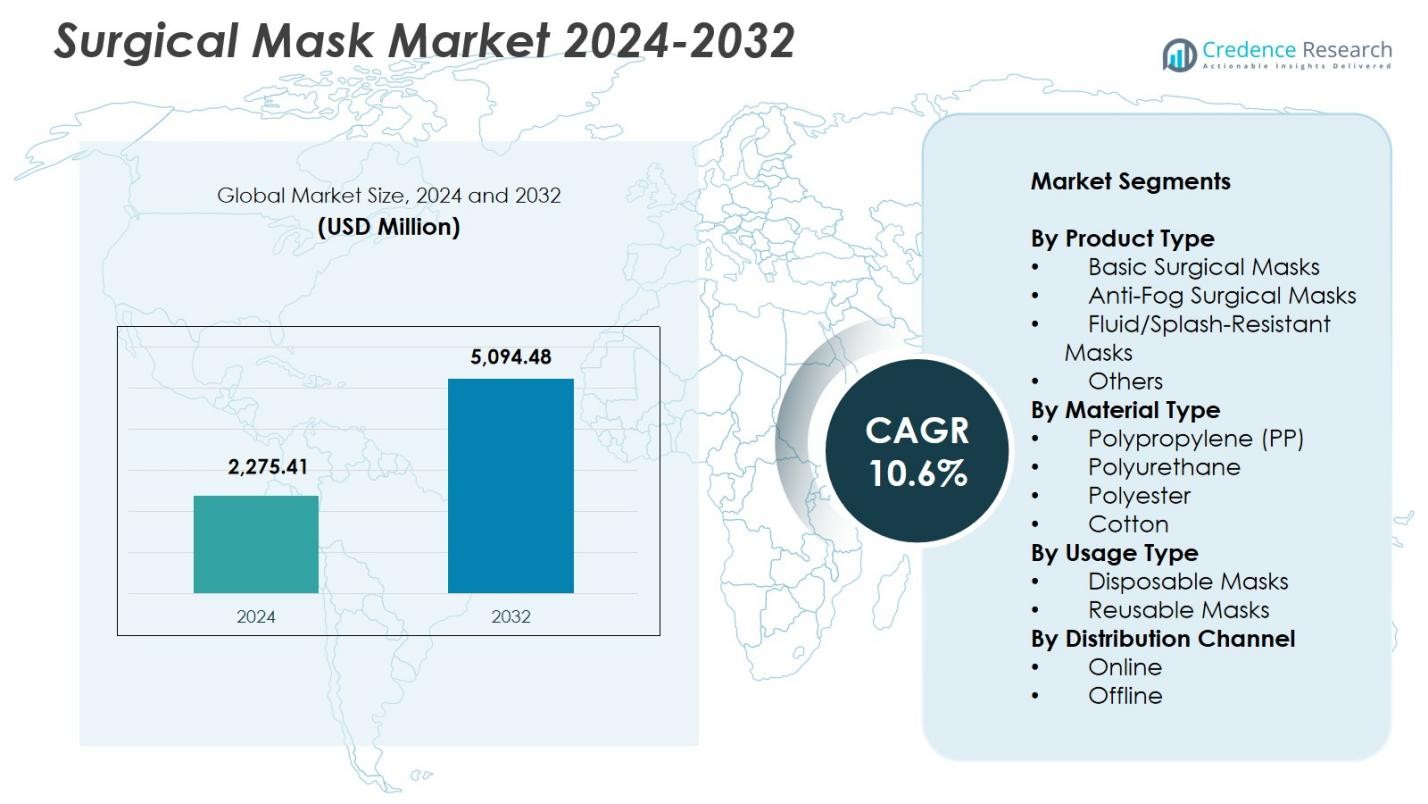
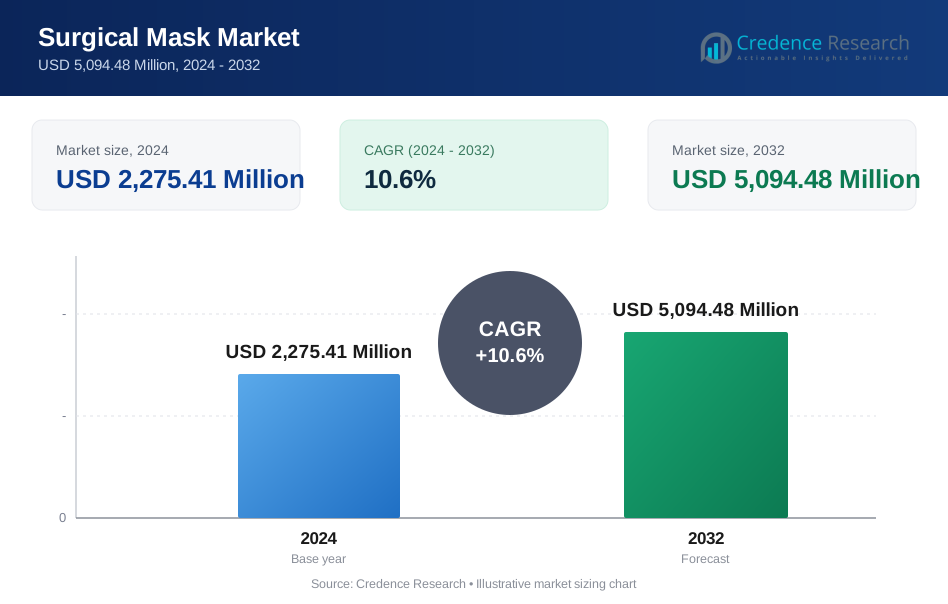
Surgical Mask Market size was valued at USD 2,275.41 Million in 2024 and is anticipated to reach USD 5,094.48 Million by 2032, at a CAGR of 10.6% during the forecast period.
| REPORT ATTRIBUTE | DETAILS |
|---|---|
| Historical Period | 2020-2023 |
| Base Year | 2024 |
| Forecast Period | 2025-2032 |
| Surgical Mask Market Size 2024 | USD 2,275.41 Million |
| Surgical Mask Market, CAGR | 10.6% |
| Surgical Mask Market Size 2032 | USD 5,094.48 Million |
Surgical Mask Market features strong participation from major players such as 3M Company, Honeywell International Inc., Kimberly-Clark Corporation, Cardinal Health, Medline Industries, DuPont de Nemours, Ansell Ltd., Owens & Minor, Dynarex Corporation, and AlphaProTech, each contributing to product innovation, high-quality filtration technologies, and large-scale supply capabilities. These companies focus on enhancing breathability, fluid resistance, and material efficiency to meet rising clinical demand across surgical environments. Regionally, North America leads the market with a 38.2% share, driven by advanced healthcare infrastructure and high procedural volumes, while Europe and Asia-Pacific continue to expand rapidly due to growing hospital capacity and increased infection-control awareness.
Market Insights
- The Surgical Mask Market reached USD 2,275.41 Million in 2024 and will grow at a CAGR of 10.6% through 2032.
- Rising surgical procedures and infection-control protocols drive demand, with disposable masks holding a 71.4% share due to their strong hygiene benefits in clinical environments.
- Premium fluid-resistant and anti-fog mask adoption expands as hospitals prioritize advanced protective materials and improved comfort for long-duration procedures.
- Leading players such as 3M, Honeywell, Medline, Kimberly-Clark, and Cardinal Health focus on high-filtration performance, melt-blown efficiency, and large-scale production capabilities.
- North America leads with a 38.2% share, followed by Europe at 27.6% and Asia-Pacific at 24.9%, supported by strong healthcare infrastructure and rising surgical admissions across key regions.
Market Segmentation Analysis:
By Product Type:
The Surgical Mask Market exhibits strong demand across product categories, with Basic Surgical Masks holding the dominant share of 47.3% in 2024 due to their widespread use in hospitals, outpatient facilities, and emergency care. Their cost-effectiveness, high filtration efficiency, and suitability for routine medical procedures drive adoption globally. Anti-fog surgical masks gain traction in ophthalmic and dental settings, while fluid/splash-resistant masks expand rapidly with rising surgical volumes and infectious-disease preparedness. Growing procedural complexity and stricter healthcare safety protocols reinforce the continued preference for basic masks, strengthening their market position.
- For instance, Cardinal Health’s Secure-Gard Anti-Fog Surgical Masks include a foam strip and are available with eye shields for ophthalmic and dental use, meeting ASTM Level 3 standards.
By Material Type:
Within material segmentation, Polypropylene (PP) accounted for the highest share of 58.6% in 2024, driven by its superior breathability, high bacterial filtration efficiency (BFE), and compatibility with melt-blown and spun-bond manufacturing technologies. PP’s low cost and lightweight structure further support large-scale production, making it the preferred choice for medical-grade masks. Polyurethane and polyester segments grow steadily due to enhanced comfort and elasticity features, while cotton remains relevant in reusable mask designs. Increasing investments in nonwoven innovations continue to reinforce polypropylene’s dominance in the surgical mask industry.
- For instance, 3M's 1860 Series N95 Healthcare Particulate Respirator and Surgical Mask employs polypropylene in its multi-layer construction, achieving over 99% BFE per ASTM F2101 standards while offering fluid resistance up to 80 mmHg.
By Usage Type:
The usage type analysis shows Disposable Surgical Masks dominating with a 71.4% share in 2024, driven by their single-use hygiene benefits, widespread adoption in clinical environments, and compliance with infection-control protocols. Healthcare providers prioritize disposables to prevent cross-contamination, especially in high-risk and high-volume settings. Reusable masks maintain presence in non-clinical and long-term personal use, supported by sustainability initiatives. However, the consistent procedural turnover in hospitals, regulatory emphasis on sterility, and rising surgical admissions strongly reinforce the leadership of disposable masks in overall market demand.
Key Growth Drivers
Rising Surgical Procedures and Infection Control Demand
The Surgical Mask Market grows significantly as global surgical volumes rise and healthcare systems strengthen infection-prevention protocols. Hospitals and ambulatory care centers increasingly rely on high-filtration masks to minimize pathogen transmission during invasive procedures. Heightened awareness of hospital-acquired infections (HAIs) and stringent regulatory frameworks support continuous procurement of certified surgical masks. Expanding healthcare infrastructure in emerging economies and rising elective surgeries further stimulate demand, reinforcing the role of surgical masks as essential medical consumables across clinical environments.
- For instance, Medicom's SafeMask FreeFlow uses "Omega pleats" for enhanced breathability while meeting ASTM F2100 Levels 1-3 protection standards, creating an air pocket without reducing filtration efficacy.
Expansion of Healthcare Infrastructure and Government Support
Rapid expansion of hospitals, clinics, and diagnostic facilities strongly drives the adoption of surgical masks, particularly in developing regions. Government-backed initiatives promoting healthcare accessibility, public health preparedness, and stockpiling of essential medical supplies contribute to sustained market growth. National health agencies increasingly mandate quality standards for surgical masks, boosting demand for advanced, certified products. Public procurement programs, pandemic-readiness strategies, and investments in local manufacturing capacity further accelerate market penetration and improve supply security.
- For instance, India's Bureau of Indian Standards requires surgical masks to obtain ISI certification under IS 16289 before supply to government departments like HLL.
Technological Advancements in Material Efficiency and Mask Design
Innovations in nonwoven materials, improved melt-blown layers, and enhanced filtration technologies contribute significantly to market expansion. Manufacturers develop lightweight, breathable, and skin-friendly surgical masks designed for extended wear without compromising protection. Anti-fog coatings, splash-resistant layers, and ergonomic fits appeal to surgical teams requiring clarity and comfort. Automation in mask production enhances consistency and scalability, helping suppliers meet rising healthcare demand. These advancements improve product performance, reduce production costs, and encourage wider adoption across clinical specialties.
Key Trends & Opportunities
Shift Toward Premium and Specialized Surgical Masks
A clear trend emerges toward specialized masks offering anti-fog, fluid-resistant, and anti-microbial features to meet advanced clinical needs. Surgeons and operating-room staff increasingly prefer premium masks that enhance visibility and comfort during long procedures. This shift creates strong opportunities for manufacturers offering high-performance filtration layers and purpose-specific designs. The growing use of masks tailored for ophthalmology, dental surgeries, and high-risk infectious environments supports product diversification and strengthens the market for specialty offerings.
- For instance, AIR+ Surgical Mask provides fluid resistance rated at 120 mmHg per ASTM F1862 standards, along with 98% bacterial filtration efficiency, suiting dental surgeries where exposure to sprays and fluids occurs.
Rising Demand for Sustainable and Reusable Solutions
Sustainability concerns create new opportunities as healthcare systems explore reusable surgical mask options and eco-friendly materials. Manufacturers innovate with recyclable polymers, biodegradable nonwovens, and reusable mask frameworks that withstand sterilization without compromising filtration efficiency. While disposables continue to dominate clinical use, environmentally conscious procurement strategies and green-hospital initiatives drive interest in sustainable alternatives. This shift encourages long-term material innovation and positions reusable solutions as an emerging growth avenue within the surgical mask landscape.
- For instance, FPInnovations developed a fully biodegradable non-medical mask using Canadian forest fibres for filtration, achieving 95% filtration efficiency under ASTM standards while remaining compostable.
Key Challenges
Fluctuating Raw Material Prices and Supply Chain Instability
Volatility in the cost of polypropylene and other nonwoven materials poses a persistent challenge for surgical mask producers. Supply chain disruptions—driven by geopolitical tensions, transportation bottlenecks, and limited availability of melt-blown fabric—impact production timelines and pricing structures. Manufacturers face pressure to maintain affordability while sustaining quality standards. These fluctuations create uncertainty for procurement departments and hinder long-term planning, particularly in regions dependent on imported raw materials.
Stringent Regulatory Compliance and Product Certification Requirements
Global regulatory agencies enforce strict performance, filtration, and safety standards for surgical masks, creating barriers for new entrants and smaller manufacturers. Achieving certifications such as ASTM, EN, or FDA approvals requires substantial investment in testing, quality control, and advanced manufacturing processes. Non-compliance risks product recalls and restricted market access. As regulatory expectations evolve, manufacturers must continuously upgrade facilities and documentation practices, increasing operational complexity and extending product development cycles.
Regional Analysis
North America
North America leads the Surgical Mask Market with a 38.2% share in 2024, supported by strong healthcare infrastructure, high surgical procedure volumes, and strict infection-control standards. The U.S. drives most of the regional demand through consistent procurement by hospitals, outpatient centers, and government health agencies. Advanced manufacturing capabilities and rapid adoption of premium fluid-resistant and anti-fog masks enhance market expansion. Continuous investment in healthcare preparedness and stockpiling initiatives by public institutions further strengthens North America’s dominant position and ensures steady demand for certified, high-performance surgical masks.
Europe
Europe holds a 27.6% share in 2024, driven by stringent regulatory frameworks, well-established hospital networks, and strong emphasis on occupational safety in clinical environments. Countries such as Germany, France, and the U.K. contribute significantly to demand, particularly for high-filtration and fluid-resistant masks used in specialized surgical procedures. Growing focus on domestic manufacturing reduces dependency on imports and enhances supply stability. Rising surgical admissions, infection-control training, and modernization of operating rooms support market growth. Europe’s focus on sustainability also drives interest in advanced materials and reusable mask solutions within the healthcare sector.
Asia-Pacific
Asia-Pacific emerges as the fastest-growing region with a 24.9% market share in 2024, propelled by expanding healthcare infrastructure, rising surgical volumes, and increasing healthcare expenditure. China, India, and Japan remain major contributors due to large patient populations and heightened awareness of hospital-acquired infections. Government investments in domestic mask manufacturing and emergency stockpiles significantly boost production capacity. Growing medical tourism and rapid adoption of advanced surgical procedures further accelerate demand. The region’s strong manufacturing base supports cost-efficient supply, positioning Asia-Pacific as a high-potential market with sustained growth momentum.
Latin America
Latin America accounts for a 5.4% share in 2024, driven by increasing healthcare modernization across Brazil, Mexico, and Argentina. Rising investments in public hospitals, improved surgical infrastructure, and greater emphasis on infection prevention support regional demand. The availability of cost-effective surgical masks, combined with expanding private healthcare services, boosts consumption. Challenges such as uneven distribution of medical supplies and reliance on imports in some countries persist, but government health initiatives and growing awareness of infection control continue to strengthen adoption across surgical and clinical environments.
Middle East & Africa
The Middle East & Africa region holds a 3.9% share in 2024, with demand supported by expanding hospital networks, modernization of surgical facilities, and rising infectious-disease preparedness programs. Gulf countries such as Saudi Arabia and the UAE lead adoption due to significant healthcare investments and reliance on certified surgical masks for routine and specialty procedures. In Africa, improving access to healthcare and international aid programs contribute to market growth. Although supply chain gaps and limited local manufacturing remain challenges, increasing focus on healthcare resilience drives steady demand across both public and private sectors.
Market Segmentations:
By Product Type
- Basic Surgical Masks
- Anti-Fog Surgical Masks
- Fluid/Splash-Resistant Masks
- Others
By Material Type
- Polypropylene (PP)
- Polyurethane
- Polyester
- Cotton
By Usage Type
- Disposable Masks
- Reusable Masks
By Distribution Channel
- Online
- Offline
By Geography
- North America
- U.S.
- Canada
- Mexico
- Europe
- Germany
- France
- U.K.
- Italy
- Spain
- Rest of Europe
- Asia Pacific
- China
- Japan
- India
- South Korea
- South-east Asia
- Rest of Asia Pacific
- Latin America
- Brazil
- Argentina
- Rest of Latin America
- Middle East & Africa
- GCC Countries
- South Africa
- Rest of the Middle East and Africa
Competitive Landscape
The competitive landscape of the Surgical Mask Market features major players such as 3M Company, Honeywell International Inc., Kimberly-Clark Corporation, Cardinal Health, Medline Industries, DuPont de Nemours, Ansell Ltd., Owens & Minor, Dynarex Corporation, and AlphaProTech, who collectively strengthen global supply through extensive product portfolios and advanced manufacturing capabilities. These companies emphasize high-filtration efficiency, comfort-focused designs, and fluid-resistant technologies to meet diverse clinical requirements. Strategic investments in melt-blown fabric production, automation, and quality certification enhance product reliability and scale. Leading manufacturers increasingly focus on innovation, including anti-fog coatings, breathable nonwoven materials, and sustainable mask solutions. Partnerships with healthcare institutions, government procurement programs, and expansion into emerging markets further reinforce market presence. Continuous R&D efforts and adherence to stringent regulatory standards enable these companies to maintain strong positioning within the evolving surgical mask landscape.
Key Player Analysis
- Owens & Minor, Inc.
- Medline Industries, Inc.
- AlphaProTech
- Cardinal Health, Inc.
- Ansell Ltd.
- Dynarex Corporation
- DuPont de Nemours, Inc.
- Kimberly-Clark Corporation
- Honeywell International Inc.
- 3M Company
Recent Developments
- In May 2025, U.S. Medical Glove Company (USMGC) launched a fully operational face-mask production unit featuring six high-speed lines capable of producing over 75 million masks per year (scalable up to 230 million annually in emergencies).
- In 2024, BioClean (Ansell Ltd.) introduced eco-friendly surgical masks using biodegradable materials for sustainable healthcare use.
Report Coverage
The research report offers an in-depth analysis based on Product Type. Material Type, Usage Type, Distribution Channel and Geography. It details leading market players, providing an overview of their business, product offerings, investments, revenue streams, and key applications. Additionally, the report includes insights into the competitive environment, SWOT analysis, current market trends, as well as the primary drivers and constraints. Furthermore, it discusses various factors that have driven market expansion in recent years. The report also explores market dynamics, regulatory scenarios, and technological advancements that are shaping the industry. It assesses the impact of external factors and global economic changes on market growth. Lastly, it provides strategic recommendations for new entrants and established companies to navigate the complexities of the market.
Future Outlook
- The market will expand steadily as surgical volumes rise and healthcare systems strengthen infection-control protocols.
- Manufacturers will adopt advanced nonwoven technologies to enhance filtration performance and breathability.
- Demand for premium fluid-resistant and anti-fog surgical masks will grow across specialized clinical procedures.
- Automation in mask production will increase to improve efficiency, consistency, and large-scale output.
- Sustainable and reusable surgical mask solutions will gain traction as hospitals pursue eco-friendly procurement.
- Regional manufacturing capacities will expand to reduce dependency on global supply chains.
- Regulatory frameworks will continue to tighten, encouraging higher-quality and certified mask offerings.
- Digital supply-chain management solutions will support more efficient distribution and inventory planning.
- Emerging markets will experience strong adoption due to growing healthcare investments and infrastructure development.
- Innovation in comfort-focused and extended-wear mask designs will enhance user experience and drive wider acceptance.
Request a Free Sample
Fill in your details and we'll send you a free sample report.
- Sample data tables & charts
- Research methodology
Need a Custom Version of This Report?
Tailor the scope, geography, or segments to your exact requirements.
- Custom geography or segment scope
- Direct access to our analyst team
Frequently Asked Questions
What is the current market size for Surgical Mask Market, and what is its projected size in 2032?
At what Compound Annual Growth Rate is the Surgical Mask Market projected to grow between 2025 and 2032?
Which Surgical Mask Market segment held the largest share in 2024?
What are the primary factors fueling the growth of the Surgical Mask Market?
Who are the leading companies in the Surgical Mask Market?
Which region commanded the largest share of the Surgical Mask Market in 2024?
Table of Content
Chapter 1. Report Introduction
- 1.1 Report Description & Purpose
- 1.1.1 Report Title & Market Definition
- 1.1.2 Unique Selling Propositions (USP) & Key Differentiators
- 1.1.3 Value Proposition for Stakeholders
- 1.2 Research Objectives
- 1.2.1 Market Sizing Objectives (Volume & Revenue)
- 1.2.2 Segmentation Objectives
- 1.2.3 Competitive Intelligence Objectives
- 1.2.4 Forecast & Scenario Objectives
- 1.3 Report Scope
- 1.3.1 Surgical Mask Scope – Types & Subtypes Covered
- 1.3.2 Geographic Scope – Regions & Countries Covered
- 1.3.3 Historical Period, Base Year & Forecast Period (2024; forecast to 2032)
- 1.3.4 Inclusions & Exclusions
- 1.4 HS Code & Classification Framework
- 1.5 Currency, Units & Pricing Basis
- 1.6 Target Stakeholders
- 1.7 Limitations & Assumptions
Chapter 2. Executive Summary
- 2.1 Global Surgical Mask Market Snapshot
- 2.1.1 Market Size – Historical (2024) & Forecast (2024-2032) (2024: USD 2,275.41 Million → 2032: USD 5,094.48 Million)
- 2.1.2 Volume & Revenue – Global Totals
- 2.1.3 Key Market Highlights – Top Five Facts
- 2.2 Surgical Mask Market Segmentation Snapshot
- 2.2.1 Market Split by Region – 2024 vs. 2032
- 2.3 Competitive Snapshot
- 2.3.1 Top 10 Players by Revenue Share – 2024
- 2.3.2 Top 10 Players by Volume Share – 2024
- 2.3.3 Recent Strategic Developments (18-Month Summary)
- 2.4 Key Investment Highlights & Strategic Conclusions
Chapter 3. Surgical Mask Market Dynamics & Industry Analysis
- 3.1 Market Overview & Context
- 3.1.1 Surgical Mask Market Position in the Broader Automotive Value Chain
- 3.1.2 OEM vs. Replacement Market Dynamics
- 3.1.3 Market Maturity & Development Stage by Region
- 3.2 Surgical Mask Market Drivers
- 3.3 Surgical Mask Market Restraints & Challenges
- 3.4 Surgical Mask Market Opportunities
- 3.5 Porter's Five Forces Analysis
- 3.5.1 Threat of New Entrants
- 3.5.2 Bargaining Power of Suppliers
- 3.5.3 Bargaining Power of Buyers
- 3.5.4 Threat of Substitutes
- 3.5.5 Competitive Rivalry – Intensity Assessment
- 3.6 Surgical Mask Value Chain Analysis
- 3.6.1 Upstream – Raw Material/Input Suppliers
- 3.6.1.1 Raw Material/Input 1
- 3.6.1.2 Raw Material/Input 2
- 3.6.1.3 Raw Material/Input 3
- 3.6.2 Midstream – Production/Manufacturing/Service Delivery
- 3.6.2.1 Production/Process Overview
- 3.6.2.2 Key Facility Locations & Capacity by Manufacturer
- 3.6.3 Downstream – Distribution & End Consumer
- 3.6.3.1 Primary Channel – B2B/OEM
- 3.6.3.2 Secondary Channels – Dealer, Retail, Online, Direct
- 3.6.4 Value Chain Profitability Analysis
- 3.6.1 Upstream – Raw Material/Input Suppliers
- 3.7 PESTEL Analysis
- 3.7.1 Political Factors
- 3.7.2 Economic Factors
- 3.7.3 Social Factors
- 3.7.4 Technological Factors
- 3.7.5 Environmental Factors
- 3.7.6 Legal Factors
- 3.8 Surgical Mask Supply Chain Analysis
- 3.8.1 Raw Material/Input Supply Risk Assessment
- 3.8.2 Manufacturing Concentration Risk (Geographic Exposure)
- 3.8.3 Trade Disruption Impact Analysis
- 3.9 Regulatory & Policy Landscape
Note: The regulatory and policy landscape section covers regulations based on their applicability to the market, Surgical Mask category, geography, and scope of the study. Only regulatory frameworks with a material impact on operations, compliance, trade, sustainability, or market access are analyzed in detail.
Chapter 4. Key Investment Pockets & Opportunity Analysis
- 4.1 Surgical Mask Market Attractiveness Analysis
- 4.1.1 By Region – Investment Attractiveness Matrix (Volume × CAGR)
- 4.2 Absolute Revenue Growth Opportunity
- 4.2.1 By Region – Absolute USD Growth Through 2032
- 4.3 Incremental Volume Opportunity
- 4.3.1 By Region – Incremental Volume Through 2032
- 4.3.2 Segment – Incremental Volume
- 4.4 Emerging Submarket Opportunity Deep Dive (Subject to Applicability)
- 4.5 Emerging Market Opportunity Scorecards
- 4.5.1 United States
- 4.5.2 Europe
- 4.5.3 Asia
- 4.5.4 Middle East & Africa
Note: Emerging Market Opportunity Scorecards will be included based on relevance and strategic importance. Regions listed are indicative and may vary depending on data availability and market dynamics.
Chapter 5. Surgical Mask Import-Export Analysis & Trade Flows
- 5.1 Global Trade Overview
- 5.1.1 Global Export Value by Country (2024)
- 5.1.2 Global Export Volume by Country (2024)
- 5.1.3 Global Import Value by Country (2024)
- 5.1.4 Global Import Volume by Country (2024)
- 5.1.5 Net Trade Balance by Country (2024)
- 5.2 Export Analysis – Segment
- 5.2.1 Type 1 (HS Code)
- 5.2.2 Type 2 (HS Code)
- 5.2.3 Type 3 (HS Code)
- 5.2.4 Type 4 (HS Code)
- 5.2.5 Type 5 (HS Code)
- 5.3 Import Analysis – Segment
- 5.3.1 Type 1 (HS Code)
- 5.3.2 Type 2 (HS Code)
- 5.3.3 Type 3 (HS Code)
- 5.3.4 Type 4 (HS Code)
- 5.3.5 Type 5 (HS Code)
- 5.4 Average Unit Trade Prices
- 5.4.1 Average Export Price – Segment & Country
- 5.4.2 Average Import Price – Segment & Source Country
- 5.4.3 Price Trends (2024)
- 5.5 Key Trade Route Analysis
- 5.5.1 Trade Route 1
- 5.5.2 Trade Route 2
- 5.5.3 Trade Route 3
- 5.5.4 Trade Route 4
- 5.5.5 Trade Route 5
- 5.6 Trade Policy Impact Assessment
- 5.6.1 US Anti-Dumping & Section 301 Tariffs
- 5.6.2 EU Customs Union Impact
- 5.6.3 Major Free Trade Agreements
- 5.6.4 USMCA Rules of Origin
Note: Trade policy analysis will be included only where relevant to the Surgical Mask market.
Chapter 6. Competitive Landscape & Company Benchmarking
- 6.1 Surgical Mask Market Concentration & Structure
- 6.1.1 Herfindahl-Hirschman Index (HHI) – vs. 2024
- 6.1.2 Tier 1, Tier 2 & Tier 3 Market Structure
- 6.1.3 Global, Regional & Local Player Dynamics
- 6.2 Surgical Mask Market Share Analysis – 2024
- 6.2.1 Global Revenue Share by Company
- 6.2.2 Global Volume Share by Company
- 6.2.3 Regional Revenue Share
- 6.2.4 Market Share Evolution ( vs. 2024)
- 6.2.5 OEM Segment Share by Company
- 6.2.6 Replacement Segment Share by Company
- 6.3 Production/Delivery Capacity & Facility Analysis
- 6.3.1 Global Installed Capacity
- 6.3.2 Capacity Utilization Rates
- 6.3.3 Production/Output Volume
- 6.3.4 Facility Locations & Capacity Map
- 6.3.5 Planned Capacity Additions
- 6.4 Surgical Mask Competitive Benchmarking Matrix
- 6.4.1 Revenue, Volume, CAGR & Profitability Comparison
- 6.4.2 Channel Revenue Mix
- 6.4.3 Geographic Revenue Exposure
- 6.4.4 R&D Intensity
- 6.4.5 Sustainability Maturity
- 6.5 Strategic Developments in Surgical Mask (Last 24 Months)
- 6.5.1 Mergers, Acquisitions & Divestments
- 6.5.2 New Surgical Mask Launches
- 6.5.3 Facility Expansions
- 6.5.4 Strategic Alliances, Joint Ventures & Partnerships
- 6.5.5 Distribution Expansion & Market Entry
- 6.5.6 Sustainability & ESG Initiatives
- 6.6 Competitive Strategy Mapping
- 6.6.1 Leader, Challenger, Follower & Niche Classification
- 6.6.2 Pricing Strategy Comparison
- 6.6.3 Channel Strategy Matrix
Note: Strategic developments are included based on their materiality and the availability of reliable information.
Chapter 7. Global Surgical Mask Market – By Distribution Channel
- 7.1 Segment Overview
- 7.1.1 Volume & Revenue Split by Channel (2024 & 2032)
- 7.1.2 Channel Mix Evolution (2024-2032)
Chapter 8. Regional Market Analysis – Global Overview
- 8.1 Global Regional Overview
- 8.1.1 Regional Volume Share
- 8.1.2 Regional Revenue Share
- 8.1.3 Regional Volume by Region
- 8.1.4 Regional Revenue by Region
- 8.1.5 Regional Forecast Through 2032
- 8.2 Cross-Regional Segment Analysis
- 8.2.1 By Distribution Channel
- 8.2.2 By Brand/Price Tier
Chapter 9. North America Surgical Mask Market
- 9.1 United States
- 9.2 Canada
- 9.3 Mexico
Chapter 10. Europe Surgical Mask Market
- 10.1 Germany
- 10.2 France
- 10.3 Italy
- 10.4 United Kingdom
- 10.5 Spain
- 10.6 Poland
- 10.7 Russia
- 10.8 Netherlands
- 10.9 Belgium
- 10.10 Sweden
- 10.11 Denmark
- 10.12 Norway
- 10.13 Rest of Europe
Chapter 11. Asia Pacific Surgical Mask Market
- 11.1 China
- 11.2 India
- 11.3 Japan
- 11.4 South Korea
- 11.5 Thailand
- 11.6 Indonesia
- 11.7 Vietnam
- 11.8 Malaysia
- 11.9 Australia
- 11.10 Rest of Asia Pacific
Chapter 12. Latin America Surgical Mask Market
- 12.1 Brazil
- 12.2 Argentina
- 12.3 Colombia
- 12.4 Chile
- 12.5 Rest of Latin America
Chapter 13. Middle East Surgical Mask Market
- 13.1 Saudi Arabia
- 13.2 United Arab Emirates
- 13.3 Turkey
- 13.4 Israel
- 13.5 Iran
- 13.6 Rest of the Middle East
Chapter 14. Africa Surgical Mask Market
- 14.1 South Africa
- 14.2 Egypt
- 14.3 Nigeria
- 14.4 Morocco
- 14.5 Rest of Africa
Chapter 15. Surgical Mask Company Profiles
- 15.1 [Company 01]
- 15.1.1 Company Overview
- 15.1.2 Key Management Personnel
- 15.1.3 Products & Services Portfolio
- 15.1.4 Financial Performance
- 15.1.5 Key Market Focus & Geographic Presence
- 15.1.6 Recent Developments & Strategic Initiatives
Note: The company profile list is preliminary and may change based on research findings, market developments, data availability, and client requirements.
Chapter 16. Appendices
- Appendix A – List of Abbreviations & Acronyms
- Appendix B – Industry Classification Code Reference – Full Series
- Appendix C – Production & Capacity Data Tables
- Appendix D – End-Use & Demand Base Tables
- Appendix E – Consumption & Replacement Rate Assumptions
- Appendix F – ASP Reference Tables
- Appendix G – Manufacturing & Facility Database
- Appendix H – Import-Export Data Tables
- Appendix I – Regulatory Summary Tables
- Appendix J – Primary Research Participant List (Anonymized)
- Appendix K – Primary Research Questionnaire Framework
- Appendix L – Data Sources & Bibliography
- Appendix M – Market Size Divergence & Source Comparison
Chapter 17. Research Methodology
- 17.1 Research Framework & Philosophy
- 17.2 Secondary Research – Sources, Hierarchy & Data Extraction
- 17.3 Data Modeling – Bottom-Up & Top-Down Market Sizing
- 17.4 Primary Research – Stakeholder Framework, LOI & Sample Sizes
- 17.5 Forecast Methodology – Regression, Scenario & Sensitivity Analysis
- 17.6 Quality Control – Four-Layer Validation Framework
- 17.7 Limitations & Standard Assumptions
- 17.8 Disclaimer
