
Market Overview:
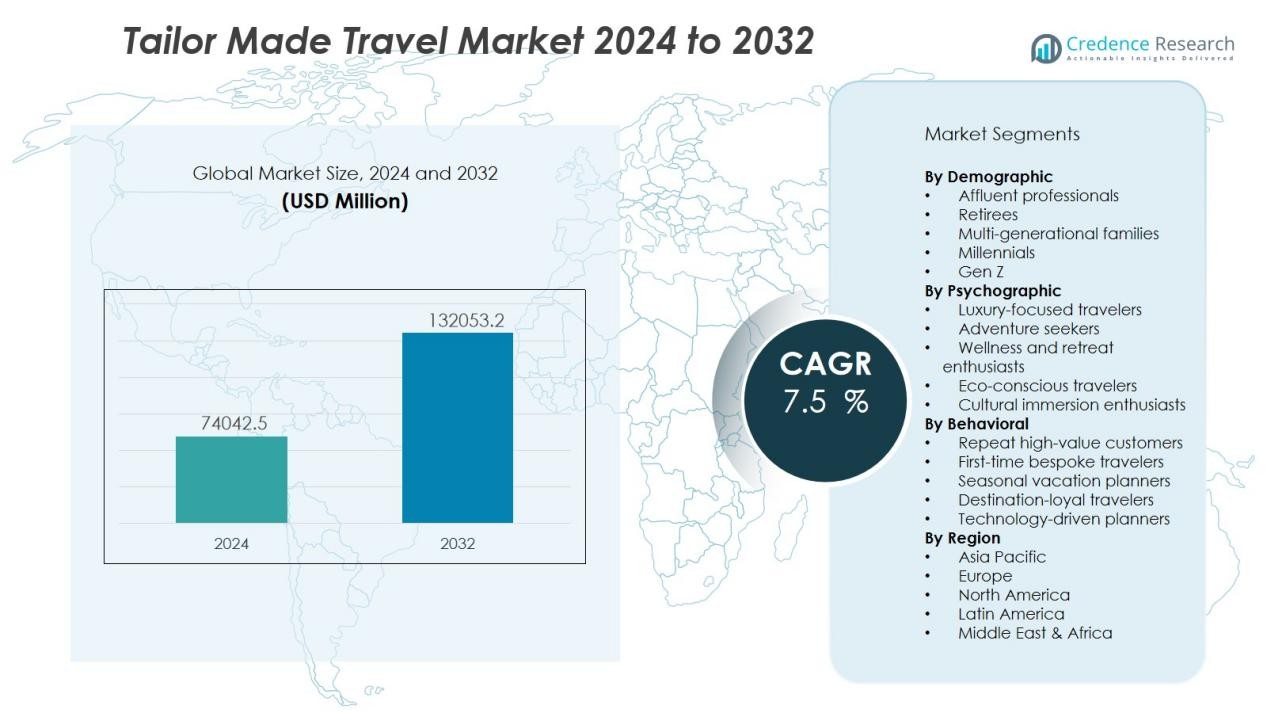
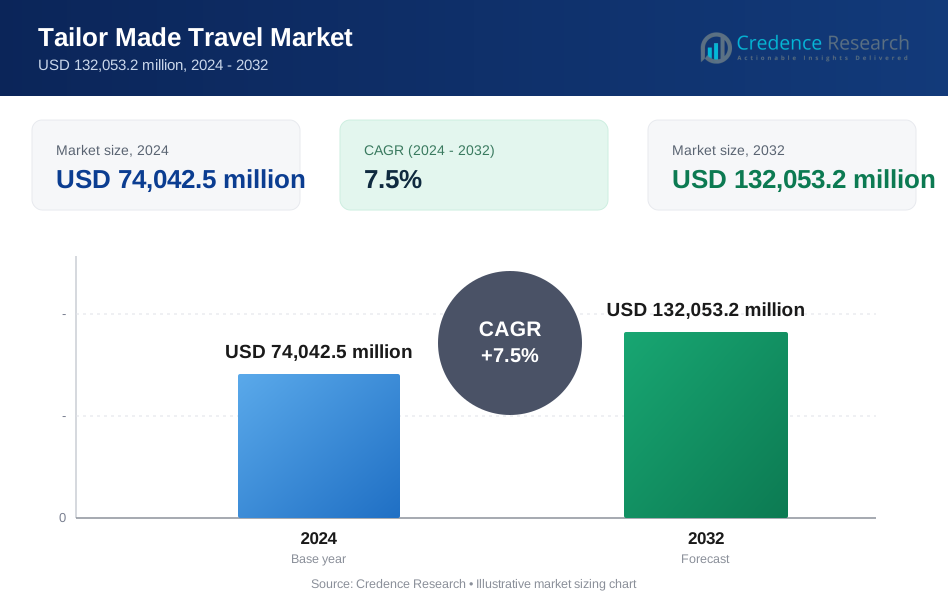
The tailor made travel market size was valued at USD 74042.5 million in 2024 and is anticipated to reach USD 132053.2 million by 2032, at a CAGR of 7.5 % during the forecast period (2024-2032).
| REPORT ATTRIBUTE | DETAILS |
|---|---|
| Historical Period | 2020-2024 |
| Base Year | 2024 |
| Forecast Period | 2025-2032 |
| Tailor Made Travel Market Size 2024 | USD 74042.5 Million |
| Tailor Made Travel Market, CAGR | 7.5 % |
| Tailor Made Travel Market Size 2032 | USD 132053.2 Million |
Growth is supported by shifting consumer behavior toward immersive travel, the influence of social media on destination choices, and an increasing preference for authenticity over standardized tour packages. The integration of advanced technologies, such as AI-driven itinerary planning and virtual destination previews, is enhancing the customer experience. Additionally, rising disposable incomes, expanding outbound tourism, and a growing focus on sustainable and responsible travel practices are further stimulating market expansion.
Regionally, Europe holds a dominant share due to its strong luxury travel infrastructure, diverse cultural offerings, and high inbound tourism. North America follows, supported by affluent domestic and international travelers seeking premium, customized experiences. The Asia-Pacific region is expected to witness the fastest growth, fueled by an expanding middle class, increasing adoption of online travel platforms, and heightened interest in unique, cross-border experiences.
Market Insights:
- The tailor made travel market was valued at USD 74,042.5 million in 2024 and is projected to reach USD 132,053.2 million by 2032, growing at a CAGR of 7.5% during 2024–2032.
- Increasing consumer preference for personalized, authentic, and immersive travel experiences is driving demand for bespoke itineraries.
- Integration of AI-driven planning, virtual destination previews, and dynamic pricing tools is improving customization and traveler engagement.
- Luxury, adventure, and wellness tourism segments are expanding, creating premium opportunities for tailor-made travel providers.
- Europe holds 38% market share, led by France, Italy, and Spain, with strong luxury infrastructure and diverse cultural offerings.
- North America captures 29% market share, supported by affluent travelers, advanced booking platforms, and high-value travel segments.
- Asia-Pacific holds 24% market share and is the fastest-growing region, fueled by rising middle-class incomes, digital adoption, and interest in unique cross-border travel experiences.
Market Drivers:
Rising Demand for Personalized and Experiential Travel:
The tailor made travel market is gaining momentum due to a growing consumer preference for trips that reflect individual tastes and lifestyles. Travelers increasingly value unique itineraries that go beyond conventional tourist circuits, offering authentic cultural immersion, exclusive activities, and tailored accommodations. It enables service providers to differentiate themselves from mass-market offerings and build stronger client loyalty. The shift toward personalization is supported by consumers’ willingness to invest in memorable and bespoke travel experiences.
- For instance, the Virtuoso network comprises over 1 200 agency locations with more than 20 000 luxury travel advisors worldwide.
Influence of Technology and Digital Customization Tools:
Advancements in digital platforms and artificial intelligence are driving efficiency and precision in travel customization. It allows operators to gather detailed traveler profiles, preferences, and past travel behaviors to create highly tailored itineraries. Virtual destination previews, dynamic pricing models, and AI-based recommendations enhance decision-making for travelers. This digital integration reduces planning time while improving the alignment of services with client expectations.
- For instance, Amadeus’ Dynamic Offer Pricing powered by AI delivered an average 3 percent uplift in airline booking conversion across seven major carriers in H1 2025.
Growth of Luxury and Niche Tourism Segments:
The expansion of high-value travel categories such as luxury tourism, adventure travel, and wellness retreats is creating opportunities for tailor-made travel providers. It supports the demand for exclusive packages that combine privacy, comfort, and curated experiences. Affluent travelers seek one-of-a-kind journeys, including private guided tours, luxury cruises, and bespoke culinary experiences. These niche offerings command premium pricing, boosting market profitability.
Increasing Focus on Sustainable and Responsible Travel;
Environmental awareness and ethical tourism trends are influencing travelers to choose customized itineraries that align with their values. It encourages the inclusion of eco-friendly accommodations, low-impact transport options, and community-based tourism initiatives. Service providers are leveraging this shift by offering trips that balance luxury with sustainability, appealing to socially conscious consumers. This alignment with global sustainability goals strengthens brand positioning in competitive markets.
Market Trends:
Integration of Advanced Technology for Enhanced Customization:
The tailor made travel market is witnessing a significant shift toward technology-driven personalization to meet evolving traveler expectations. It leverages artificial intelligence, big data analytics, and machine learning to analyze traveler behavior, preferences, and historical booking patterns. Service providers use these insights to design highly curated itineraries, optimize travel routes, and recommend destination-specific experiences in real time. Virtual reality previews and augmented reality features are enabling travelers to visualize destinations before committing. Mobile applications and integrated communication platforms allow seamless interaction between clients and planners, ensuring flexibility and transparency. This trend strengthens customer satisfaction and fosters repeat business in a competitive landscape.
- For instance, Wanderlog’s trip planner app facilitates itinerary sharing and real-time collaboration for group trips, with features now used by 100's of thousands of travelers monthly.
Rising Popularity of Experiential and Wellness-Oriented Travel:
Consumer interest in experiential tourism is driving demand for immersive, culturally rich, and wellness-focused journeys. It reflects a growing preference for activities such as culinary tours, heritage trails, wildlife safaris, and wellness retreats that combine relaxation with enrichment. Travelers seek itineraries that incorporate mindfulness, adventure, and community engagement, creating meaningful connections with destinations. The emphasis on slow travel and longer stays is supporting the design of in-depth, destination-focused packages. Sustainable and eco-conscious travel options are becoming integral to these experiences, aligning with environmental and social values. This trend positions tailor-made travel as a premium alternative to conventional tour packages while appealing to diverse traveler demographics.
- For instance, Soneva Fushi in the Maldives installed 2.55MWp solar capacity and 2.7MWh battery storage at its resort, generating close to 50% of its energy needs from solar power in 2024, with additional floating solar panels projected to cover up to 90% of energy demand at its new Soneva Secret resort.
Market Challenges Analysis:
High Operational Costs and Resource Requirements:
The tailor made travel market faces significant challenges in managing high operational expenses and resource demands. It requires extensive research, skilled personnel, and reliable local partnerships to deliver premium, personalized experiences. Fluctuating supplier costs, currency volatility, and seasonal demand variations add complexity to pricing strategies. Maintaining quality across diverse destinations demands continuous monitoring and coordination. Smaller operators often struggle to match the scale and efficiency of larger competitors while preserving customization standards. These factors can limit profitability and hinder scalability for niche providers.
Vulnerability to External Disruptions and Market Volatility:
The market remains highly sensitive to geopolitical tensions, economic downturns, and global health crises that can disrupt travel patterns. It faces sudden booking cancellations, shifting consumer priorities, and unpredictable travel restrictions that impact revenue stability. Natural disasters and climate-related events also influence destination appeal and safety perceptions. Adapting itineraries at short notice without compromising quality places pressure on operational agility. Uncertainty in international regulations and visa policies further complicates planning for cross-border travel. This vulnerability underscores the need for resilient business models and diversified market strategies.
Market Opportunities:
Expansion into Emerging Travel Destinations and Segments:
The tailor made travel market has strong growth potential through the inclusion of emerging destinations and underexplored regions. It can capitalize on rising interest in authentic cultural immersion, adventure travel, and wellness tourism. Offering itineraries that combine lesser-known attractions with premium services appeals to travelers seeking exclusivity. The demand for multi-generational travel and themed journeys, such as culinary expeditions or art-focused tours, is also increasing. Partnerships with local service providers can enhance authenticity while supporting community-based tourism. This diversification allows operators to reach new customer segments and strengthen their market position.
Leveraging Technology for Scalable Personalization:
Advances in digital tools create opportunities to streamline customization without compromising quality. It enables travel providers to use artificial intelligence, virtual reality, and big data analytics to deliver precise, interest-based itineraries at scale. Mobile-first booking systems and interactive platforms can improve customer engagement and retention. Integration of sustainable travel features within technology-driven planning platforms can attract eco-conscious travelers. The ability to provide real-time updates and personalized recommendations enhances the overall travel experience. These innovations can expand market reach while reinforcing brand differentiation in a competitive environment.
Market Segmentation Analysis:
By Demographic:
The tailor made travel market caters to a broad range of age groups, with significant demand from affluent professionals, retirees, and multi-generational families. It attracts high-income travelers who prioritize exclusivity, comfort, and cultural enrichment. Younger demographics, particularly millennials and Gen Z, show rising interest in adventure, experiential, and socially responsible travel. Gender distribution remains balanced, though spending patterns vary, with women often influencing itinerary preferences.
- For instance, Intrepid Travel offers its 18-to-35s trip range to younger travelers, featuring a more conscious style of adventure trips with an average group size of 10 and the majority of bookings led by millennials and Gen Z seeking immersive experiences.
By Psychographic:
This segment focuses on travelers’ lifestyles, interests, and values. It appeals to individuals seeking unique, authentic, and memorable experiences that align with personal passions such as art, gastronomy, wellness, or outdoor adventure. The market benefits from a growing audience of eco-conscious and socially aware travelers who prioritize sustainability and ethical tourism. Luxury-oriented customers value privacy, exclusivity, and curated service, reinforcing demand for high-end bespoke offerings.
By Behavioral:
Behavioral segmentation emphasizes travel motivations, spending habits, and loyalty patterns. It serves travelers with high engagement in repeat bookings and a preference for long-term relationships with trusted service providers. Many customers display a willingness to pay premium prices for tailored services and exclusive access to experiences. The market also attracts first-time users seeking a more personalized alternative to conventional travel packages. Seasonal preferences, destination loyalty, and responsiveness to digital customization tools influence buying decisions.
- For instance, Booking.com’s Genius loyalty program offers members who have completed at least 15 stays in two years benefits such ascomplimentary upgrades and exclusive room selections, significantly boosting high-value bookings.
Segmentations:
By Demographic:
- Affluent professionals
- Retirees
- Multi-generational families
- Millennials
- Gen Z
By Psychographic:
- Luxury-focused travelers
- Adventure seekers
- Wellness and retreat enthusiasts
- Eco-conscious travelers
- Cultural immersion enthusiasts
By Behavioral:
- Repeat high-value customers
- First-time bespoke travelers
- Seasonal vacation planners
- Destination-loyal travelers
- Technology-driven planners
By Region:
- North America
- U.S.
- Canada
- Mexico
- Europe
- Germany
- France
- U.K.
- Italy
- Spain
- Rest of Europe
- Asia Pacific
- China
- Japan
- India
- South Korea
- South-east Asia
- Rest of Asia Pacific
- Latin America
- Brazil
- Argentina
- Rest of Latin America
- Middle East & Africa
- GCC Countries
- South Africa
- Rest of the Middle East and Africa
Regional Analysis:
Europe :
Europe holds a market share of 38% in the global tailor made travel market, supported by its diverse cultural heritage and well-developed tourism infrastructure. It benefits from a strong base of luxury accommodations, high-quality transport networks, and an extensive portfolio of premium travel experiences. Countries such as France, Italy, and Spain attract high-spending travelers seeking art, gastronomy, and heritage-focused itineraries. The rise of niche tourism segments, including wine tourism and alpine adventure travel, strengthens the region’s appeal. Regulatory support for sustainable tourism practices aligns with the preferences of eco-conscious travelers. The combination of historical landmarks and modern luxury services ensures steady demand.
North America’s :
North America accounts for a market share of 29%, driven by affluent domestic and outbound travelers who prioritize personalized and exclusive travel experiences. It leverages advanced digital platforms and a mature travel agency network to offer seamless customization. The United States and Canada lead in promoting adventure, wellness, and themed travel packages. Strong air connectivity and diverse landscapes support both short-haul and long-haul tailor-made trips. Partnerships with luxury resorts, private tour operators, and experience curators enhance value propositions. The focus on unique, high-quality experiences sustains premium pricing and customer loyalty.
Asia-Pacific :
Asia-Pacific holds a market share of 24% and is projected to register the highest growth rate in the coming years. It benefits from a rapidly expanding middle-class population, increasing disposable incomes, and rising interest in international travel. Countries such as Japan, Thailand, and Australia attract travelers with unique cultural, natural, and adventure-based experiences. Digital adoption and mobile-first booking platforms facilitate wider access to tailor-made travel services. The region’s growing emphasis on sustainable tourism and community engagement aligns with evolving traveler values. Expanding air routes and tourism infrastructure further accelerate market penetration.
Key Player Analysis:
- Audley Travel Group
- Hays Tour Operating
- Tailor Made Travel
- Abercrombie & Kent
- Trailfinders
- Rovia
- Der Touristik UK
- Original Travel
- Tailor Made Holidays
- Wayfairer Travel
- Tailored Travel
- Ampersand Travel
Competitive Analysis:
The tailor made travel market is characterized by a competitive mix of global luxury travel brands, specialist agencies, and digitally driven operators. Key players include Audley Travel Group, Hays Tour Operating, Tailor Made Travel, Abercrombie & Kent, Trailfinders, Rovia, and Der Touristik UK. It is defined by high service differentiation, where providers compete through exclusive itineraries, destination expertise, and personalized customer engagement. Leading companies leverage strong supplier networks, local partnerships, and advanced customization tools to deliver premium experiences. Brand reputation, service reliability, and the ability to anticipate evolving traveler preferences remain critical success factors. Operators are also focusing on sustainability and niche market offerings to strengthen positioning. Competitive intensity is further heightened by the growing influence of online booking platforms and AI-based personalization technologies, which enhance service efficiency and expand customer reach.
Recent Developments:
- In July 2025, Audley Travel launched three new cruise itineraries in partnership with luxury cruise line Seabourn, combining bespoke land and ocean experiences in Southeast Asia, Alaska/Canada, and Croatia.
- In July 2025, Hays Travel acquired Victoria Travel Group, which operates cruise.co.uk, Seascanner, and a German cruise division.
- In August 2024, saw Wayfairer Travel entering the Middle East market with the addition of Oman to their portfolio, representing the company's first foray into that region.
Market Concentration & Characteristics:
The tailor made travel market exhibits moderate concentration, with a mix of global luxury travel brands, specialized boutique agencies, and technology-driven platforms competing for market share. It is characterized by high service differentiation, where providers focus on personalization, exclusivity, and experiential depth to attract discerning travelers. Strong brand reputation, trusted partnerships with local operators, and advanced customization tools are critical competitive factors. The market shows low entry barriers in terms of service setup but high barriers in building credibility and a loyal client base. Seasonal demand variations and reliance on premium customer segments influence pricing strategies. Continuous innovation in itinerary design and customer engagement remains essential for sustaining competitiveness.
Report Coverage:
The research report offers an in-depth analysis based on Demographic, Psychographic, Behavioral and Region. It details leading Market players, providing an overview of their business, product offerings, investments, revenue streams, and key applications. Additionally, the report includes insights into the competitive environment, SWOT analysis, current Market trends, as well as the primary drivers and constraints. Furthermore, it discusses various factors that have driven Market expansion in recent years. The report also explores Market dynamics, regulatory scenarios, and technological advancements that are shaping the industry. It assesses the impact of external factors and global economic changes on Market growth. Lastly, it provides strategic recommendations for new entrants and established companies to navigate the complexities of the Market.
Future Outlook:
- Demand for hyper-personalized itineraries will increase as travelers seek unique and meaningful experiences over standardized packages.
- Technology integration, including AI, VR, and predictive analytics, will streamline planning and enhance customer engagement.
- Growth in luxury, adventure, and wellness tourism will drive higher-value bookings across diverse traveler demographics.
- Sustainable and responsible tourism will become a standard offering, influencing itinerary design and supplier selection.
- Expansion into emerging destinations will create new revenue streams and diversify market reach.
- Mobile-first booking platforms will dominate customer interactions, improving convenience and service responsiveness.
- Partnerships with local communities and niche experience providers will enhance authenticity and cultural value.
- Younger travelers will fuel demand for immersive, activity-focused travel with flexible itineraries.
- Data-driven insights will enable providers to anticipate customer preferences and improve repeat business rates.
- Competitive differentiation will rely on brand storytelling, experiential marketing, and exclusive service guarantees.
Request a Free Sample
Fill in your details and we'll send you a free sample report.
- Sample data tables & charts
- Research methodology
Need a Custom Version of This Report?
Tailor the scope, geography, or segments to your exact requirements.
- Custom geography or segment scope
- Direct access to our analyst team
Frequently Asked Questions
What is the current market size for the tailor made travel market, and what is its projected size in 2032?
At what Compound Annual Growth Rate is the tailor made travel market projected to grow between 2024 and 2032?
Which tailor made travel market segment held the largest share in 2024?
What are the primary factors fueling the growth of the tailor made travel market?
Who are the leading companies in the tailor made travel market?
Which region commanded the largest share of the tailor made travel market in 2024?
Table of Content
Chapter 1. Report Introduction
- 1.1 Report Description & Purpose
- 1.1.1 Report Title & Market Definition
- 1.1.2 Unique Selling Propositions (USP) & Key Differentiators
- 1.1.3 Value Proposition for Stakeholders
- 1.2 Research Objectives
- 1.2.1 Market Sizing Objectives (Volume & Revenue)
- 1.2.2 Segmentation Objectives
- 1.2.3 Competitive Intelligence Objectives
- 1.2.4 Forecast & Scenario Objectives
- 1.3 Report Scope
- 1.3.1 Tailor Made Travel Scope – Types & Subtypes Covered
- 1.3.2 Geographic Scope – Regions & Countries Covered
- 1.3.3 Historical Period, Base Year & Forecast Period (2024; forecast to 2032)
- 1.3.4 Inclusions & Exclusions
- 1.4 HS Code & Classification Framework
- 1.5 Currency, Units & Pricing Basis
- 1.6 Target Stakeholders
- 1.7 Limitations & Assumptions
Chapter 2. Executive Summary
- 2.1 Global Tailor Made Travel Market Snapshot
- 2.1.1 Market Size – Historical (2024) & Forecast (2024-2032) (2024: USD 74,042.5 million → 2032: USD 132,053.2 million)
- 2.1.2 Volume & Revenue – Global Totals
- 2.1.3 Key Market Highlights – Top Five Facts
- 2.2 Tailor Made Travel Market Segmentation Snapshot
- 2.2.1 Market Split by Region – 2024 vs. 2032
- 2.3 Competitive Snapshot
- 2.3.1 Top 10 Players by Revenue Share – 2024
- 2.3.2 Top 10 Players by Volume Share – 2024
- 2.3.3 Recent Strategic Developments (18-Month Summary)
- 2.4 Key Investment Highlights & Strategic Conclusions
Chapter 3. Tailor Made Travel Market Dynamics & Industry Analysis
- 3.1 Market Overview & Context
- 3.1.1 Tailor Made Travel Market Position in the Broader Automotive Value Chain
- 3.1.2 OEM vs. Replacement Market Dynamics
- 3.1.3 Market Maturity & Development Stage by Region
- 3.2 Tailor Made Travel Market Drivers
- 3.3 Tailor Made Travel Market Restraints & Challenges
- 3.4 Tailor Made Travel Market Opportunities
- 3.5 Porter's Five Forces Analysis
- 3.5.1 Threat of New Entrants
- 3.5.2 Bargaining Power of Suppliers
- 3.5.3 Bargaining Power of Buyers
- 3.5.4 Threat of Substitutes
- 3.5.5 Competitive Rivalry – Intensity Assessment
- 3.6 Tailor Made Travel Value Chain Analysis
- 3.6.1 Upstream – Raw Material/Input Suppliers
- 3.6.1.1 Raw Material/Input 1
- 3.6.1.2 Raw Material/Input 2
- 3.6.1.3 Raw Material/Input 3
- 3.6.2 Midstream – Production/Manufacturing/Service Delivery
- 3.6.2.1 Production/Process Overview
- 3.6.2.2 Key Facility Locations & Capacity by Manufacturer
- 3.6.3 Downstream – Distribution & End Consumer
- 3.6.3.1 Primary Channel – B2B/OEM
- 3.6.3.2 Secondary Channels – Dealer, Retail, Online, Direct
- 3.6.4 Value Chain Profitability Analysis
- 3.6.1 Upstream – Raw Material/Input Suppliers
- 3.7 PESTEL Analysis
- 3.7.1 Political Factors
- 3.7.2 Economic Factors
- 3.7.3 Social Factors
- 3.7.4 Technological Factors
- 3.7.5 Environmental Factors
- 3.7.6 Legal Factors
- 3.8 Tailor Made Travel Supply Chain Analysis
- 3.8.1 Raw Material/Input Supply Risk Assessment
- 3.8.2 Manufacturing Concentration Risk (Geographic Exposure)
- 3.8.3 Trade Disruption Impact Analysis
- 3.9 Regulatory & Policy Landscape
Note: The regulatory and policy landscape section covers regulations based on their applicability to the market, Tailor Made Travel category, geography, and scope of the study. Only regulatory frameworks with a material impact on operations, compliance, trade, sustainability, or market access are analyzed in detail.
Chapter 4. Key Investment Pockets & Opportunity Analysis
- 4.1 Tailor Made Travel Market Attractiveness Analysis
- 4.1.1 By Region – Investment Attractiveness Matrix (Volume × CAGR)
- 4.2 Absolute Revenue Growth Opportunity
- 4.2.1 By Region – Absolute USD Growth Through 2032
- 4.3 Incremental Volume Opportunity
- 4.3.1 By Region – Incremental Volume Through 2032
- 4.3.2 Segment – Incremental Volume
- 4.4 Emerging Submarket Opportunity Deep Dive (Subject to Applicability)
- 4.5 Emerging Market Opportunity Scorecards
- 4.5.1 United States
- 4.5.2 Europe
- 4.5.3 Asia
- 4.5.4 Middle East & Africa
Note: Emerging Market Opportunity Scorecards will be included based on relevance and strategic importance. Regions listed are indicative and may vary depending on data availability and market dynamics.
Chapter 5. Tailor Made Travel Import-Export Analysis & Trade Flows
- 5.1 Global Trade Overview
- 5.1.1 Global Export Value by Country (2024)
- 5.1.2 Global Export Volume by Country (2024)
- 5.1.3 Global Import Value by Country (2024)
- 5.1.4 Global Import Volume by Country (2024)
- 5.1.5 Net Trade Balance by Country (2024)
- 5.2 Export Analysis – Segment
- 5.2.1 Type 1 (HS Code)
- 5.2.2 Type 2 (HS Code)
- 5.2.3 Type 3 (HS Code)
- 5.2.4 Type 4 (HS Code)
- 5.2.5 Type 5 (HS Code)
- 5.3 Import Analysis – Segment
- 5.3.1 Type 1 (HS Code)
- 5.3.2 Type 2 (HS Code)
- 5.3.3 Type 3 (HS Code)
- 5.3.4 Type 4 (HS Code)
- 5.3.5 Type 5 (HS Code)
- 5.4 Average Unit Trade Prices
- 5.4.1 Average Export Price – Segment & Country
- 5.4.2 Average Import Price – Segment & Source Country
- 5.4.3 Price Trends (2024)
- 5.5 Key Trade Route Analysis
- 5.5.1 Trade Route 1
- 5.5.2 Trade Route 2
- 5.5.3 Trade Route 3
- 5.5.4 Trade Route 4
- 5.5.5 Trade Route 5
- 5.6 Trade Policy Impact Assessment
- 5.6.1 US Anti-Dumping & Section 301 Tariffs
- 5.6.2 EU Customs Union Impact
- 5.6.3 Major Free Trade Agreements
- 5.6.4 USMCA Rules of Origin
Note: Trade policy analysis will be included only where relevant to the Tailor Made Travel market.
Chapter 6. Competitive Landscape & Company Benchmarking
- 6.1 Tailor Made Travel Market Concentration & Structure
- 6.1.1 Herfindahl-Hirschman Index (HHI) – vs. 2024
- 6.1.2 Tier 1, Tier 2 & Tier 3 Market Structure
- 6.1.3 Global, Regional & Local Player Dynamics
- 6.2 Tailor Made Travel Market Share Analysis – 2024
- 6.2.1 Global Revenue Share by Company
- 6.2.2 Global Volume Share by Company
- 6.2.3 Regional Revenue Share
- 6.2.4 Market Share Evolution ( vs. 2024)
- 6.2.5 OEM Segment Share by Company
- 6.2.6 Replacement Segment Share by Company
- 6.3 Production/Delivery Capacity & Facility Analysis
- 6.3.1 Global Installed Capacity
- 6.3.2 Capacity Utilization Rates
- 6.3.3 Production/Output Volume
- 6.3.4 Facility Locations & Capacity Map
- 6.3.5 Planned Capacity Additions
- 6.4 Tailor Made Travel Competitive Benchmarking Matrix
- 6.4.1 Revenue, Volume, CAGR & Profitability Comparison
- 6.4.2 Channel Revenue Mix
- 6.4.3 Geographic Revenue Exposure
- 6.4.4 R&D Intensity
- 6.4.5 Sustainability Maturity
- 6.5 Strategic Developments in Tailor Made Travel (Last 24 Months)
- 6.5.1 Mergers, Acquisitions & Divestments
- 6.5.2 New Tailor Made Travel Launches
- 6.5.3 Facility Expansions
- 6.5.4 Strategic Alliances, Joint Ventures & Partnerships
- 6.5.5 Distribution Expansion & Market Entry
- 6.5.6 Sustainability & ESG Initiatives
- 6.6 Competitive Strategy Mapping
- 6.6.1 Leader, Challenger, Follower & Niche Classification
- 6.6.2 Pricing Strategy Comparison
- 6.6.3 Channel Strategy Matrix
Note: Strategic developments are included based on their materiality and the availability of reliable information.
Chapter 7. Global Tailor Made Travel Market – By Distribution Channel
- 7.1 Segment Overview
- 7.1.1 Volume & Revenue Split by Channel (2024 & 2032)
- 7.1.2 Channel Mix Evolution (2024-2032)
Chapter 8. Regional Market Analysis – Global Overview
- 8.1 Global Regional Overview
- 8.1.1 Regional Volume Share
- 8.1.2 Regional Revenue Share
- 8.1.3 Regional Volume by Region
- 8.1.4 Regional Revenue by Region
- 8.1.5 Regional Forecast Through 2032
- 8.2 Cross-Regional Segment Analysis
- 8.2.1 By Distribution Channel
- 8.2.2 By Brand/Price Tier
Chapter 9. North America Tailor Made Travel Market
- 9.1 United States
- 9.2 Canada
- 9.3 Mexico
Chapter 10. Europe Tailor Made Travel Market
- 10.1 Germany
- 10.2 France
- 10.3 Italy
- 10.4 United Kingdom
- 10.5 Spain
- 10.6 Poland
- 10.7 Russia
- 10.8 Netherlands
- 10.9 Belgium
- 10.10 Sweden
- 10.11 Denmark
- 10.12 Norway
- 10.13 Rest of Europe
Chapter 11. Asia Pacific Tailor Made Travel Market
- 11.1 China
- 11.2 India
- 11.3 Japan
- 11.4 South Korea
- 11.5 Thailand
- 11.6 Indonesia
- 11.7 Vietnam
- 11.8 Malaysia
- 11.9 Australia
- 11.10 Rest of Asia Pacific
Chapter 12. Latin America Tailor Made Travel Market
- 12.1 Brazil
- 12.2 Argentina
- 12.3 Colombia
- 12.4 Chile
- 12.5 Rest of Latin America
Chapter 13. Middle East Tailor Made Travel Market
- 13.1 Saudi Arabia
- 13.2 United Arab Emirates
- 13.3 Turkey
- 13.4 Israel
- 13.5 Iran
- 13.6 Rest of the Middle East
Chapter 14. Africa Tailor Made Travel Market
- 14.1 South Africa
- 14.2 Egypt
- 14.3 Nigeria
- 14.4 Morocco
- 14.5 Rest of Africa
Chapter 15. Tailor Made Travel Company Profiles
- 15.1 [Company 01]
- 15.1.1 Company Overview
- 15.1.2 Key Management Personnel
- 15.1.3 Products & Services Portfolio
- 15.1.4 Financial Performance
- 15.1.5 Key Market Focus & Geographic Presence
- 15.1.6 Recent Developments & Strategic Initiatives
Note: The company profile list is preliminary and may change based on research findings, market developments, data availability, and client requirements.
Chapter 16. Appendices
- Appendix A – List of Abbreviations & Acronyms
- Appendix B – Industry Classification Code Reference – Full Series
- Appendix C – Production & Capacity Data Tables
- Appendix D – End-Use & Demand Base Tables
- Appendix E – Consumption & Replacement Rate Assumptions
- Appendix F – ASP Reference Tables
- Appendix G – Manufacturing & Facility Database
- Appendix H – Import-Export Data Tables
- Appendix I – Regulatory Summary Tables
- Appendix J – Primary Research Participant List (Anonymized)
- Appendix K – Primary Research Questionnaire Framework
- Appendix L – Data Sources & Bibliography
- Appendix M – Market Size Divergence & Source Comparison
Chapter 17. Research Methodology
- 17.1 Research Framework & Philosophy
- 17.2 Secondary Research – Sources, Hierarchy & Data Extraction
- 17.3 Data Modeling – Bottom-Up & Top-Down Market Sizing
- 17.4 Primary Research – Stakeholder Framework, LOI & Sample Sizes
- 17.5 Forecast Methodology – Regression, Scenario & Sensitivity Analysis
- 17.6 Quality Control – Four-Layer Validation Framework
- 17.7 Limitations & Standard Assumptions
- 17.8 Disclaimer