
Market Overview
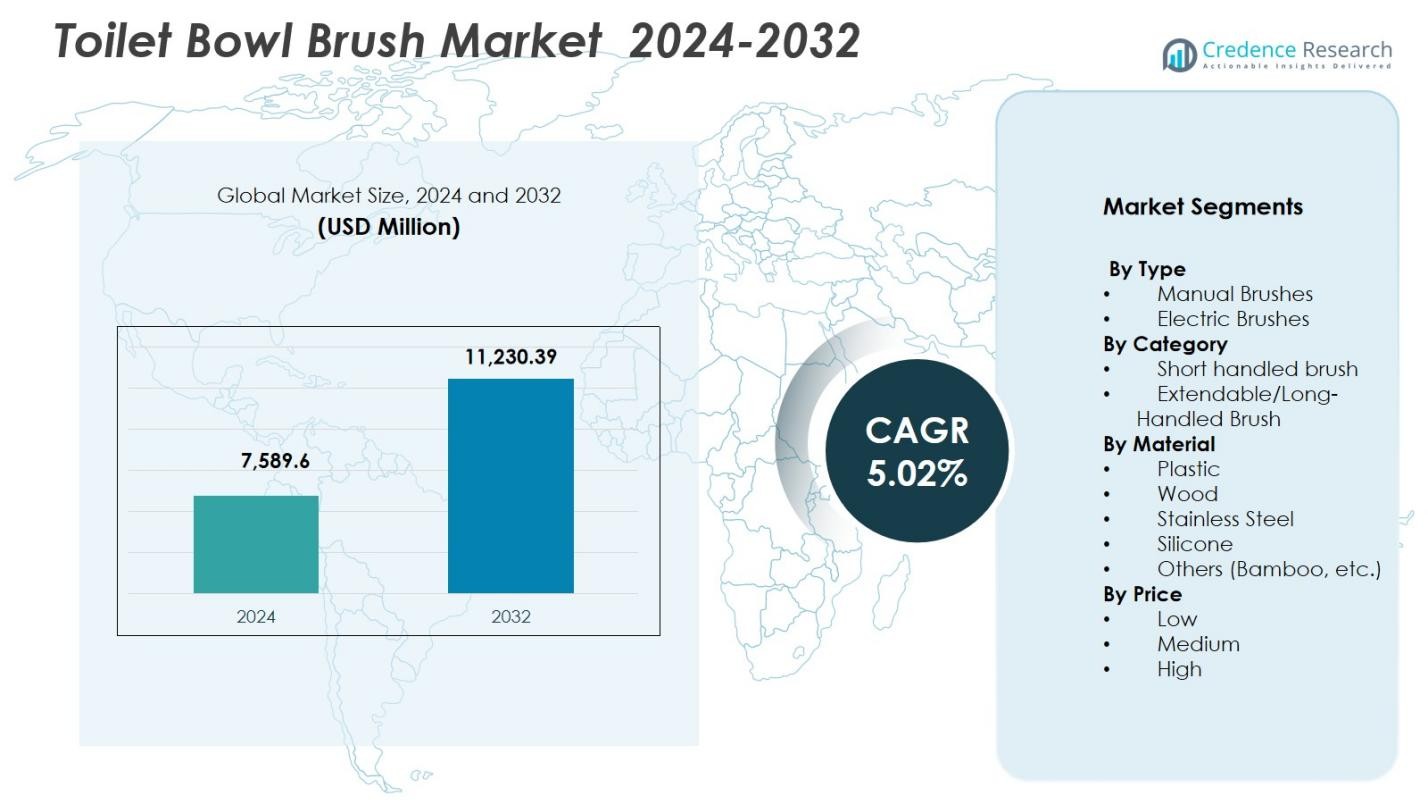
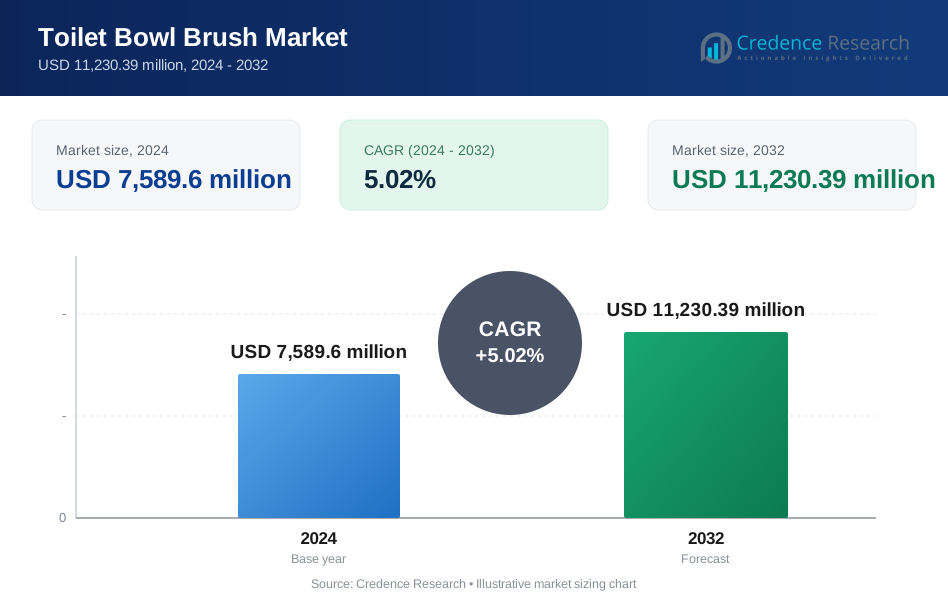
The Toilet Bowl Brush Market size was valued at USD 7,589.6 million in 2024 and is anticipated to reach USD 11,230.39 million by 2032, growing at a CAGR of 5.02% during the forecast period.
| REPORT ATTRIBUTE | DETAILS |
|---|---|
| Historical Period | 2020-2023 |
| Base Year | 2024 |
| Forecast Period | 2025-2032 |
| Toilet Bowl Brush Market Size 2024 | USD 7,589.6 Million |
| Toilet Bowl Brush Market, CAGR | 5.02% |
| Toilet Bowl Brush Market Size 2032 | USD 11,230.39 Million |
The Toilet Bowl Brush Market features the presence of established household care and bathroom accessory manufacturers including Procter & Gamble (P&G), Clorox, Lysol, Libman Company, OXO International, Gala Brush, Casabella, Bürstenhaus Redecker GmbH, MR. Siga, and Korkmaz. These companies focus on durability, ergonomic design, material innovation, and wide retail distribution to strengthen market presence. Asia-Pacific leads the market with a 33.4% share, driven by rapid urbanization, expanding residential construction, and rising hygiene awareness. North America follows with a 28.6% share, supported by strong brand penetration and high replacement rates, while Europe holds 25.1% share, reflecting demand for premium and sustainable bathroom accessories.
Market Insights
- The Toilet Bowl Brush Market was valued at USD 7,589.6 million in 2024 and is projected to grow at a CAGR of 5.02% through the forecast period, supported by steady replacement demand and expanding residential and commercial usage.
- Rising hygiene awareness and sanitation standards are driving demand, with manual brushes holding a dominant 72.4% segment share due to affordability, ease of use, and wide household adoption across regions.
- Product trends highlight growing adoption of silicone and ergonomic designs, while extendable/long-handled brushes lead the category with a 64.8% share, supported by splash prevention and improved user comfort.
- The market faces pressure from price sensitivity and the presence of low-cost alternatives, though established brands focus on durability, design innovation, and retail reach to maintain positioning.
- Asia-Pacific leads regional demand with a 33.4% share, followed by North America at 28.6% and Europe at 25.1%, driven by urbanization, hygiene awareness, and strong retail penetration.
Market Segmentation Analysis:
By Type:
The Toilet Bowl Brush Market by type is led by manual brushes, which accounted for 72.4% market share in 2024, driven by their affordability, wide availability, and ease of use across residential and commercial settings. Manual brushes remain the preferred choice in households due to low maintenance requirements and compatibility with standard toilet designs. Electric brushes held 27.6% share, supported by growing interest in powered cleaning tools and hygiene enhancement. However, higher prices and battery dependence continue to limit rapid adoption, reinforcing the dominance of manual brushes across both developed and emerging regions.
- For instance, the Clorox Toilet Bowl Brush features a round head with durable, crimped bristles and an ergonomic non-slip handle for thorough cleaning of all toilet areas. Antimicrobial material in the bristles provides continuous protection against odor-causing bacteria.
By Category:
By category, extendable/long-handled brushes dominated with a 64.8% market share, supported by rising consumer focus on hygiene, splash prevention, and ergonomic cleaning solutions. Long-handled designs reduce direct contact with toilet surfaces and improve reach, making them popular in both residential and hospitality applications. Short-handled brushes accounted for 35.2% share, primarily used in compact bathrooms and budget segments. Growth in the dominant sub-segment is driven by increasing awareness of sanitary cleaning practices, higher penetration of modern bathroom accessories, and demand for user-friendly, hygienic cleaning tools.
- For instance, OXO Good Grips Toilet Brush with Rim Cleaner provides a compact tapered head with angled dual-action bristles for hard-to-reach spots like rims and corners, paired with a ventilated canister that promotes air drying to reduce odors and bacteria buildup.
By Material:
Based on material, plastic toilet bowl brushes led the market with a 46.9% share, driven by low cost, lightweight construction, and mass production suitability. Plastic brushes are widely adopted across households and commercial facilities due to durability and design flexibility. Silicone brushes followed with 28.7% share, supported by growing preference for non-porous, quick-drying, and bacteria-resistant materials. Stainless steel held 14.1%, while wood and bamboo-based products collectively accounted for 10.3%, driven by niche demand for premium and eco-friendly bathroom accessories.
Key Growth Drivers
Rising Focus on Hygiene and Sanitation
Increasing awareness of hygiene and sanitation is a major growth driver for the Toilet Bowl Brush Market. Consumers are placing greater emphasis on maintaining clean and germ-free bathrooms due to higher health consciousness and improved living standards. Regular toilet maintenance has become a routine practice in residential, commercial, and hospitality environments. Public health awareness initiatives and heightened cleanliness expectations continue to encourage frequent product replacement. This sustained focus on hygiene directly supports steady demand growth for effective and durable toilet bowl brushes worldwide.
- For instance, Pee Safe launched the "Spray. Sit. Flush. Spray." campaign on World Toilet Day, deploying posters and hygiene cards in public, corporate, and educational spaces to promote sanitizing toilet seats before and after use.
Expansion of Residential Construction and Renovation
Growth in residential construction and bathroom renovation activities is significantly driving demand in the Toilet Bowl Brush Market. New housing projects and remodeling initiatives consistently require bathroom accessories as standard installations. Rising disposable incomes and lifestyle upgrades further support purchases of improved and aesthetically designed toilet cleaning tools. The expanding hospitality sector, including hotels and serviced apartments, also contributes to volume demand through bulk procurement. These factors collectively strengthen long-term market expansion across both developed and emerging regions.
- For instance, Rubbermaid offers its Commercial-Grade Toilet Bowl Brush with a 17-inch plastic handle and polypropylene bristles resistant to stains, odors, and bacteria, ideal for hotels' bulk procurement in high-traffic washrooms.
Product Innovation and Ergonomic Design Advancements
Ongoing product innovation plays a vital role in accelerating market growth by enhancing user convenience and cleaning efficiency. Manufacturers are focusing on ergonomic handles, flexible brush heads, and splash-resistant designs to improve usability. These advancements address consumer concerns related to comfort, hygiene, and ease of storage. Improved durability and functional performance encourage repeat purchases and premium product adoption. As differentiation through design becomes increasingly important, innovation remains a key growth catalyst.
Key Trends & Opportunities
Shift Toward Silicone and Hygienic Materials
The Toilet Bowl Brush Market is witnessing a strong shift toward silicone and other hygienic materials. Silicone brushes offer faster drying, reduced bacterial buildup, and longer service life compared to traditional materials. This trend aligns with consumer demand for low-maintenance and more sanitary cleaning solutions. Manufacturers are leveraging this shift to introduce visually appealing and premium designs. Growing acceptance of advanced materials presents opportunities for value-added products and improved profit margins.
- For instance, Sellemer features a flat, bendable TPR silicone head that reaches under toilet rims and into crevices for deep cleaning. Its ventilated holder with drip slots prevents water pooling and bacterial growth, while the rust-proof handle extends usability.
Expansion of E-commerce and Organized Retail Channels
Rapid growth of e-commerce and organized retail is creating significant opportunities in the Toilet Bowl Brush Market. Online platforms provide consumers with convenience, product variety, and access to reviews, supporting informed purchasing decisions. Organized retail enhances brand visibility and promotes bundled bathroom accessory sales. These channels allow manufacturers to reach a broader audience, streamline distribution, and introduce new designs efficiently, supporting faster market penetration and revenue growth.
- For instance, OXO sells its Good Grips Compact Toilet Brush & Canister online with a space-saving footprint (listed as 6" x 4-3/4" x 17-1/4" h), aligning with e-commerce shoppers who filter by dimensions and storage style before buying.
Key Challenges
Price Sensitivity and Intense Market Competition
High price sensitivity poses a major challenge in the Toilet Bowl Brush Market, particularly in cost-conscious regions. The presence of numerous low-priced, unbranded products intensifies competition and limits pricing power for established players. Consumers often prioritize affordability over brand differentiation, pressuring manufacturers to control costs. Maintaining product quality and innovation while competing on price remains a persistent challenge impacting profitability and long-term positioning.
Environmental Concerns and Material Sustainability
Environmental sustainability presents another critical challenge for the Toilet Bowl Brush Market. Conventional plastic products face growing scrutiny due to waste and disposal concerns. Regulatory pressure and shifting consumer preferences are pushing manufacturers toward eco-friendly materials and sustainable production practices. However, higher costs associated with biodegradable and recyclable materials can affect pricing and adoption. Balancing sustainability objectives with cost competitiveness continues to challenge market participants.
Regional Analysis
North America
North America accounted for 28.6% market share in the Toilet Bowl Brush Market, supported by high hygiene awareness, widespread adoption of branded home-care products, and strong retail penetration. Consumers in the United States and Canada emphasize bathroom cleanliness and regularly replace toilet cleaning tools, driving stable demand. The presence of leading household care brands and strong e-commerce infrastructure further supports market expansion. Demand from hospitality, healthcare, and commercial buildings also contributes to consistent sales volumes, reinforcing North America’s position as a mature and value-driven regional market.
Europe
Europe held 25.1% market share in the Toilet Bowl Brush Market, driven by strict sanitation standards, sustainability awareness, and demand for premium bathroom accessories. Countries such as Germany, the UK, and France show strong adoption of ergonomically designed and eco-friendly toilet brushes. Growing preference for silicone, stainless steel, and recyclable materials supports product upgrades across households. Organized retail chains and private-label offerings play a key role in market penetration. Renovation of residential properties and steady growth in hospitality infrastructure continue to sustain regional demand.
Asia-Pacific
Asia-Pacific dominated the Toilet Bowl Brush Market with a 33.4% market share, supported by rapid urbanization, population growth, and expanding residential construction. Rising hygiene awareness in countries such as China, India, and Southeast Asia is driving higher adoption of toilet cleaning products. Increasing disposable income and improved access to modern retail channels further support market growth. The region also benefits from large-scale manufacturing and availability of cost-effective products. Growing hospitality and commercial infrastructure development continues to accelerate demand across urban centers.
Latin America
Latin America accounted for 7.2% market share in the Toilet Bowl Brush Market, supported by improving living standards and gradual growth in hygiene awareness. Countries such as Brazil and Mexico are witnessing increased demand from urban households and hospitality establishments. Expansion of organized retail and growing availability of branded home-care products are improving market accessibility. Price sensitivity remains a key factor influencing purchasing decisions, encouraging demand for affordable and durable products. Ongoing residential development and tourism-related infrastructure continue to support moderate market growth.
Middle East & Africa
The Middle East & Africa region held 5.7% market share in the Toilet Bowl Brush Market, driven by infrastructure development and rising hygiene standards in urban areas. Growth is supported by expanding hospitality, healthcare, and commercial construction, particularly in the Gulf countries. Increasing awareness of sanitation and improved access to modern retail formats are contributing to product adoption. However, demand remains uneven due to income disparities across regions. Gradual urbanization and public sanitation initiatives are expected to support steady market development.
Market Segmentations:
By Type
- Manual Brushes
- Electric Brushes
By Category
- Short handled brush
- Extendable/Long-Handled Brush
By Material
- Plastic
- Wood
- Stainless Steel
- Silicone
- Others (Bamboo, etc.)
By Price
- Low
- Medium
- High
By Geography
- North America
- U.S.
- Canada
- Mexico
- Europe
- Germany
- France
- U.K.
- Italy
- Spain
- Rest of Europe
- Asia Pacific
- China
- Japan
- India
- South Korea
- South-east Asia
- Rest of Asia Pacific
- Latin America
- Brazil
- Argentina
- Rest of Latin America
- Middle East & Africa
- GCC Countries
- South Africa
- Rest of the Middle East and Africa
Competitive Landscape
Competitive landscape analysis in the Toilet Bowl Brush Market highlights the presence of established household care brands such as Procter & Gamble (P&G), Clorox, Lysol, Libman Company, OXO International, Gala Brush, Casabella, Bürstenhaus Redecker GmbH, MR. Siga, and Korkmaz. The market remains moderately fragmented, with strong competition between multinational brands and regional manufacturers. Leading players focus on product durability, ergonomic design, and material innovation to strengthen brand positioning. Premium offerings incorporating silicone heads, stainless steel handles, and splash-resistant designs are gaining traction. Companies leverage extensive retail networks and growing e-commerce channels to enhance visibility and distribution reach. Private-label brands and low-cost manufacturers intensify price competition, particularly in emerging economies. Strategic initiatives such as product line extensions, packaging enhancements, and sustainability-focused materials are increasingly adopted to address evolving consumer preferences and regulatory expectations.
Key Player Analysis
- MR. Siga
- Procter & Gamble (P&G)
- Korkmaz
- Libman Company
- Bürstenhaus Redecker GmbH
- OXO International
- Gala Brush
- Clorox
- Casabella
- Lysol
Recent Developments
- In February 2024, Lysol introduced a high-tech anti-microbial toilet brush using silver ion technology, featuring a coating that eliminates 99.9% of bacteria.
- In July 2023, Vileda Professional acquired Vermop, a cleaning systems manufacturer, to strengthen its product portfolio and enhance its position in the professional cleaning market.
- In July 2023, concerning acquisition advancements, Vileda Professional cut a deal to acquire Vermop, a veteran cleaning systems manufacturer. This move strengthens Vileda Professional’s product portfolio and consolidates their competitive position in the professional cleaning market.
Report Coverage
The research report offers an in-depth analysis based on Type, Category, Material, Price and Geography. It details leading market players, providing an overview of their business, product offerings, investments, revenue streams, and key applications. Additionally, the report includes insights into the competitive environment, SWOT analysis, current market trends, as well as the primary drivers and constraints. Furthermore, it discusses various factors that have driven market expansion in recent years. The report also explores market dynamics, regulatory scenarios, and technological advancements that are shaping the industry. It assesses the impact of external factors and global economic changes on market growth. Lastly, it provides strategic recommendations for new entrants and established companies to navigate the complexities of the market.
Future Outlook
- Growing hygiene awareness will continue to drive consistent replacement demand across residential and commercial settings.
- Product innovation will focus on ergonomic designs, splash control, and improved cleaning efficiency.
- Silicone and non-porous materials will gain wider adoption due to hygiene and durability benefits.
- Eco-friendly materials such as bamboo and recyclable plastics will see gradual penetration driven by sustainability preferences.
- E-commerce channels will play an increasing role in product discovery, comparison, and sales growth.
- Demand from hospitality, healthcare, and institutional facilities will strengthen long-term market stability.
- Urbanization and housing development will support volume growth in emerging economies.
- Manufacturers will emphasize design aesthetics to align with modern bathroom interiors.
- Private-label and value brands will intensify competition in price-sensitive markets.
- Strategic focus on branding and differentiation will remain critical for sustaining market presence.
Request a Free Sample
Fill in your details and we'll send you a free sample report.
- Sample data tables & charts
- Research methodology
Need a Custom Version of This Report?
Tailor the scope, geography, or segments to your exact requirements.
- Custom geography or segment scope
- Direct access to our analyst team
Frequently Asked Questions
What is the current market size for the Toilet Bowl Brush Market, and what is its projected size in 2032?
At what Compound Annual Growth Rate is the Toilet Bowl Brush Market projected to grow between 2024 and 2032?
Which Toilet Bowl Brush Market segment held the largest share in 2024?
What are the primary factors fueling the growth of the Toilet Bowl Brush Market?
Who are the leading companies in the Toilet Bowl Brush Market?
Which region commanded the largest share of the Toilet Bowl Brush Market in 2024?
Table of Content
Chapter 1. Report Introduction
- 1.1 Report Description & Purpose
- 1.1.1 Report Title & Market Definition
- 1.1.2 Unique Selling Propositions (USP) & Key Differentiators
- 1.1.3 Value Proposition for Stakeholders
- 1.2 Research Objectives
- 1.2.1 Market Sizing Objectives (Volume & Revenue)
- 1.2.2 Segmentation Objectives
- 1.2.3 Competitive Intelligence Objectives
- 1.2.4 Forecast & Scenario Objectives
- 1.3 Report Scope
- 1.3.1 Toilet Bowl Brush Scope – Types & Subtypes Covered
- 1.3.2 Geographic Scope – Regions & Countries Covered
- 1.3.3 Historical Period, Base Year & Forecast Period (2024; forecast to 2032)
- 1.3.4 Inclusions & Exclusions
- 1.4 HS Code & Classification Framework
- 1.5 Currency, Units & Pricing Basis
- 1.6 Target Stakeholders
- 1.7 Limitations & Assumptions
Chapter 2. Executive Summary
- 2.1 Global Toilet Bowl Brush Market Snapshot
- 2.1.1 Market Size – Historical (2024) & Forecast (2024-2032) (2024: USD 7,589.6 million → 2032: USD 11,230.39 million)
- 2.1.2 Volume & Revenue – Global Totals
- 2.1.3 Key Market Highlights – Top Five Facts
- 2.2 Toilet Bowl Brush Market Segmentation Snapshot
- 2.2.1 Market Split by Region – 2024 vs. 2032
- 2.3 Competitive Snapshot
- 2.3.1 Top 10 Players by Revenue Share – 2024
- 2.3.2 Top 10 Players by Volume Share – 2024
- 2.3.3 Recent Strategic Developments (18-Month Summary)
- 2.4 Key Investment Highlights & Strategic Conclusions
Chapter 3. Toilet Bowl Brush Market Dynamics & Industry Analysis
- 3.1 Market Overview & Context
- 3.1.1 Toilet Bowl Brush Market Position in the Broader Automotive Value Chain
- 3.1.2 OEM vs. Replacement Market Dynamics
- 3.1.3 Market Maturity & Development Stage by Region
- 3.2 Toilet Bowl Brush Market Drivers
- 3.3 Toilet Bowl Brush Market Restraints & Challenges
- 3.4 Toilet Bowl Brush Market Opportunities
- 3.5 Porter's Five Forces Analysis
- 3.5.1 Threat of New Entrants
- 3.5.2 Bargaining Power of Suppliers
- 3.5.3 Bargaining Power of Buyers
- 3.5.4 Threat of Substitutes
- 3.5.5 Competitive Rivalry – Intensity Assessment
- 3.6 Toilet Bowl Brush Value Chain Analysis
- 3.6.1 Upstream – Raw Material/Input Suppliers
- 3.6.1.1 Raw Material/Input 1
- 3.6.1.2 Raw Material/Input 2
- 3.6.1.3 Raw Material/Input 3
- 3.6.2 Midstream – Production/Manufacturing/Service Delivery
- 3.6.2.1 Production/Process Overview
- 3.6.2.2 Key Facility Locations & Capacity by Manufacturer
- 3.6.3 Downstream – Distribution & End Consumer
- 3.6.3.1 Primary Channel – B2B/OEM
- 3.6.3.2 Secondary Channels – Dealer, Retail, Online, Direct
- 3.6.4 Value Chain Profitability Analysis
- 3.6.1 Upstream – Raw Material/Input Suppliers
- 3.7 PESTEL Analysis
- 3.7.1 Political Factors
- 3.7.2 Economic Factors
- 3.7.3 Social Factors
- 3.7.4 Technological Factors
- 3.7.5 Environmental Factors
- 3.7.6 Legal Factors
- 3.8 Toilet Bowl Brush Supply Chain Analysis
- 3.8.1 Raw Material/Input Supply Risk Assessment
- 3.8.2 Manufacturing Concentration Risk (Geographic Exposure)
- 3.8.3 Trade Disruption Impact Analysis
- 3.9 Regulatory & Policy Landscape
Note: The regulatory and policy landscape section covers regulations based on their applicability to the market, Toilet Bowl Brush category, geography, and scope of the study. Only regulatory frameworks with a material impact on operations, compliance, trade, sustainability, or market access are analyzed in detail.
Chapter 4. Key Investment Pockets & Opportunity Analysis
- 4.1 Toilet Bowl Brush Market Attractiveness Analysis
- 4.1.1 By Region – Investment Attractiveness Matrix (Volume × CAGR)
- 4.2 Absolute Revenue Growth Opportunity
- 4.2.1 By Region – Absolute USD Growth Through 2032
- 4.3 Incremental Volume Opportunity
- 4.3.1 By Region – Incremental Volume Through 2032
- 4.3.2 Segment – Incremental Volume
- 4.4 Emerging Submarket Opportunity Deep Dive (Subject to Applicability)
- 4.5 Emerging Market Opportunity Scorecards
- 4.5.1 United States
- 4.5.2 Europe
- 4.5.3 Asia
- 4.5.4 Middle East & Africa
Note: Emerging Market Opportunity Scorecards will be included based on relevance and strategic importance. Regions listed are indicative and may vary depending on data availability and market dynamics.
Chapter 5. Toilet Bowl Brush Import-Export Analysis & Trade Flows
- 5.1 Global Trade Overview
- 5.1.1 Global Export Value by Country (2024)
- 5.1.2 Global Export Volume by Country (2024)
- 5.1.3 Global Import Value by Country (2024)
- 5.1.4 Global Import Volume by Country (2024)
- 5.1.5 Net Trade Balance by Country (2024)
- 5.2 Export Analysis – Segment
- 5.2.1 Type 1 (HS Code)
- 5.2.2 Type 2 (HS Code)
- 5.2.3 Type 3 (HS Code)
- 5.2.4 Type 4 (HS Code)
- 5.2.5 Type 5 (HS Code)
- 5.3 Import Analysis – Segment
- 5.3.1 Type 1 (HS Code)
- 5.3.2 Type 2 (HS Code)
- 5.3.3 Type 3 (HS Code)
- 5.3.4 Type 4 (HS Code)
- 5.3.5 Type 5 (HS Code)
- 5.4 Average Unit Trade Prices
- 5.4.1 Average Export Price – Segment & Country
- 5.4.2 Average Import Price – Segment & Source Country
- 5.4.3 Price Trends (2024)
- 5.5 Key Trade Route Analysis
- 5.5.1 Trade Route 1
- 5.5.2 Trade Route 2
- 5.5.3 Trade Route 3
- 5.5.4 Trade Route 4
- 5.5.5 Trade Route 5
- 5.6 Trade Policy Impact Assessment
- 5.6.1 US Anti-Dumping & Section 301 Tariffs
- 5.6.2 EU Customs Union Impact
- 5.6.3 Major Free Trade Agreements
- 5.6.4 USMCA Rules of Origin
Note: Trade policy analysis will be included only where relevant to the Toilet Bowl Brush market.
Chapter 6. Competitive Landscape & Company Benchmarking
- 6.1 Toilet Bowl Brush Market Concentration & Structure
- 6.1.1 Herfindahl-Hirschman Index (HHI) – vs. 2024
- 6.1.2 Tier 1, Tier 2 & Tier 3 Market Structure
- 6.1.3 Global, Regional & Local Player Dynamics
- 6.2 Toilet Bowl Brush Market Share Analysis – 2024
- 6.2.1 Global Revenue Share by Company
- 6.2.2 Global Volume Share by Company
- 6.2.3 Regional Revenue Share
- 6.2.4 Market Share Evolution ( vs. 2024)
- 6.2.5 OEM Segment Share by Company
- 6.2.6 Replacement Segment Share by Company
- 6.3 Production/Delivery Capacity & Facility Analysis
- 6.3.1 Global Installed Capacity
- 6.3.2 Capacity Utilization Rates
- 6.3.3 Production/Output Volume
- 6.3.4 Facility Locations & Capacity Map
- 6.3.5 Planned Capacity Additions
- 6.4 Toilet Bowl Brush Competitive Benchmarking Matrix
- 6.4.1 Revenue, Volume, CAGR & Profitability Comparison
- 6.4.2 Channel Revenue Mix
- 6.4.3 Geographic Revenue Exposure
- 6.4.4 R&D Intensity
- 6.4.5 Sustainability Maturity
- 6.5 Strategic Developments in Toilet Bowl Brush (Last 24 Months)
- 6.5.1 Mergers, Acquisitions & Divestments
- 6.5.2 New Toilet Bowl Brush Launches
- 6.5.3 Facility Expansions
- 6.5.4 Strategic Alliances, Joint Ventures & Partnerships
- 6.5.5 Distribution Expansion & Market Entry
- 6.5.6 Sustainability & ESG Initiatives
- 6.6 Competitive Strategy Mapping
- 6.6.1 Leader, Challenger, Follower & Niche Classification
- 6.6.2 Pricing Strategy Comparison
- 6.6.3 Channel Strategy Matrix
Note: Strategic developments are included based on their materiality and the availability of reliable information.
Chapter 7. Global Toilet Bowl Brush Market – By Distribution Channel
- 7.1 Segment Overview
- 7.1.1 Volume & Revenue Split by Channel (2024 & 2032)
- 7.1.2 Channel Mix Evolution (2024-2032)
Chapter 8. Regional Market Analysis – Global Overview
- 8.1 Global Regional Overview
- 8.1.1 Regional Volume Share
- 8.1.2 Regional Revenue Share
- 8.1.3 Regional Volume by Region
- 8.1.4 Regional Revenue by Region
- 8.1.5 Regional Forecast Through 2032
- 8.2 Cross-Regional Segment Analysis
- 8.2.1 By Distribution Channel
- 8.2.2 By Brand/Price Tier
Chapter 9. North America Toilet Bowl Brush Market
- 9.1 United States
- 9.2 Canada
- 9.3 Mexico
Chapter 10. Europe Toilet Bowl Brush Market
- 10.1 Germany
- 10.2 France
- 10.3 Italy
- 10.4 United Kingdom
- 10.5 Spain
- 10.6 Poland
- 10.7 Russia
- 10.8 Netherlands
- 10.9 Belgium
- 10.10 Sweden
- 10.11 Denmark
- 10.12 Norway
- 10.13 Rest of Europe
Chapter 11. Asia Pacific Toilet Bowl Brush Market
- 11.1 China
- 11.2 India
- 11.3 Japan
- 11.4 South Korea
- 11.5 Thailand
- 11.6 Indonesia
- 11.7 Vietnam
- 11.8 Malaysia
- 11.9 Australia
- 11.10 Rest of Asia Pacific
Chapter 12. Latin America Toilet Bowl Brush Market
- 12.1 Brazil
- 12.2 Argentina
- 12.3 Colombia
- 12.4 Chile
- 12.5 Rest of Latin America
Chapter 13. Middle East Toilet Bowl Brush Market
- 13.1 Saudi Arabia
- 13.2 United Arab Emirates
- 13.3 Turkey
- 13.4 Israel
- 13.5 Iran
- 13.6 Rest of the Middle East
Chapter 14. Africa Toilet Bowl Brush Market
- 14.1 South Africa
- 14.2 Egypt
- 14.3 Nigeria
- 14.4 Morocco
- 14.5 Rest of Africa
Chapter 15. Toilet Bowl Brush Company Profiles
- 15.1 [Company 01]
- 15.1.1 Company Overview
- 15.1.2 Key Management Personnel
- 15.1.3 Products & Services Portfolio
- 15.1.4 Financial Performance
- 15.1.5 Key Market Focus & Geographic Presence
- 15.1.6 Recent Developments & Strategic Initiatives
Note: The company profile list is preliminary and may change based on research findings, market developments, data availability, and client requirements.
Chapter 16. Appendices
- Appendix A – List of Abbreviations & Acronyms
- Appendix B – Industry Classification Code Reference – Full Series
- Appendix C – Production & Capacity Data Tables
- Appendix D – End-Use & Demand Base Tables
- Appendix E – Consumption & Replacement Rate Assumptions
- Appendix F – ASP Reference Tables
- Appendix G – Manufacturing & Facility Database
- Appendix H – Import-Export Data Tables
- Appendix I – Regulatory Summary Tables
- Appendix J – Primary Research Participant List (Anonymized)
- Appendix K – Primary Research Questionnaire Framework
- Appendix L – Data Sources & Bibliography
- Appendix M – Market Size Divergence & Source Comparison
Chapter 17. Research Methodology
- 17.1 Research Framework & Philosophy
- 17.2 Secondary Research – Sources, Hierarchy & Data Extraction
- 17.3 Data Modeling – Bottom-Up & Top-Down Market Sizing
- 17.4 Primary Research – Stakeholder Framework, LOI & Sample Sizes
- 17.5 Forecast Methodology – Regression, Scenario & Sensitivity Analysis
- 17.6 Quality Control – Four-Layer Validation Framework
- 17.7 Limitations & Standard Assumptions
- 17.8 Disclaimer
