
| REPORT ATTRIBUTE | DETAILS |
|---|---|
| Historical Period | 2020-2023 |
| Base Year | 2024 |
| Forecast Period | 2025-2032 |
| Tours and Activities Reservations Market Size 2024 | USD 179,025.17 million |
| Tours and Activities Reservations Market, CAGR | 6.6% |
| Tours and Activities Reservations Market Size 2032 | USD 298,518.8 million |
Market Overview:
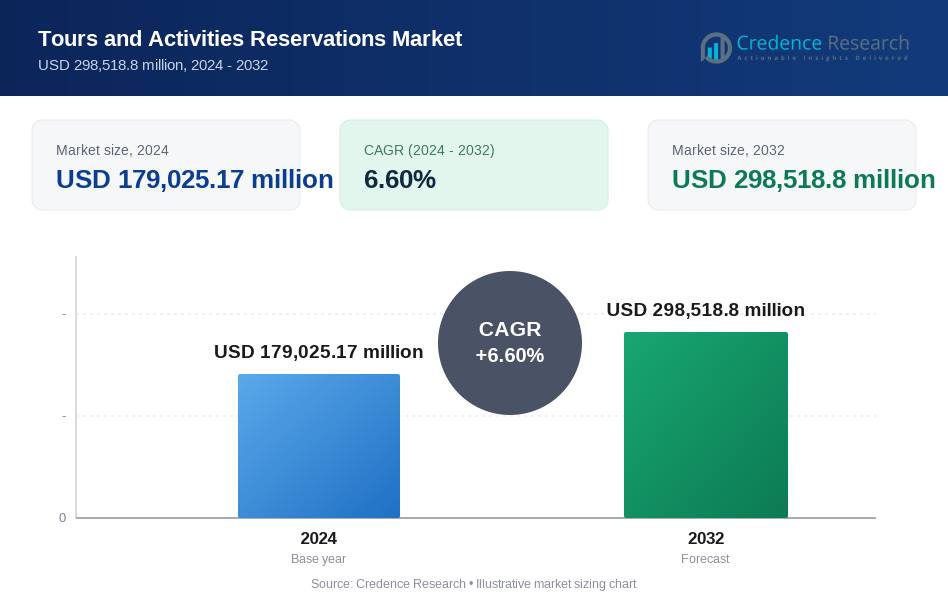
The Tours and Activities Reservations market is projected to grow from USD 179,025.17 million in 2024 to USD 298,518.8 million by 2032, registering a compound annual growth rate (CAGR) of 6.6% during the forecast period.
The Tours and Activities Reservations market is gaining momentum due to increasing global travel demand, the rise of experiential tourism, and the widespread adoption of digital booking platforms. Travelers, especially millennials and Gen Z, prefer personalized and immersive experiences, prompting operators to diversify offerings beyond traditional sightseeing. The proliferation of smartphones and mobile apps has made real-time bookings and last-minute reservations more accessible, boosting consumer convenience. Additionally, integration with AI and data analytics enables providers to offer tailored recommendations and dynamic pricing strategies. Growth in disposable income and rising international tourism, particularly in emerging economies, further fuel market expansion. Strategic partnerships between travel aggregators and local operators enhance service visibility and customer reach. Meanwhile, sustainability trends are influencing tour design, with increasing demand for eco-friendly and culturally sensitive experiences. Governments and tourism boards are also investing in digital infrastructure to support online booking systems, solidifying the transition from offline to digital platforms across the tours and activities ecosystem.
The Tours and Activities Reservations market shows significant regional diversity, with Europe leading at 33% market share due to strong cross-border travel and rich cultural offerings. North America follows with 28%, driven by high domestic travel and widespread digital adoption. Asia Pacific holds 26% and leads in growth momentum, supported by a rising middle class, mobile-first behavior, and increasing international tourism. These regions shape global demand, each with distinct traveler preferences and digital maturity. Key players in the market include Viator, GetYourGuide, Klook, Expedia Group, TUI Group, KKday, GlobalTix, and bookingkit. These companies focus on expanding platform capabilities, integrating local experiences, and enhancing mobile and AI features. Regional and niche players like BookIt Ltd, Adventure Office, Apptha, and AbodeBookingLimited contribute by offering customized solutions that cater to specific travel segments, strengthening the global competitive landscape.
Market Insights:
- The Tours and Activities Reservations market is projected to grow from USD 179,025.17 million in 2024 to USD 298,518.8 million by 2032, with a CAGR of 6.6% during the forecast period.
- Demand for personalized and immersive travel experiences is increasing, especially among millennials and Gen Z, encouraging operators to expand offerings beyond traditional sightseeing.
- Online and mobile booking platforms are becoming dominant, offering real-time availability, user reviews, and AI-powered personalization to streamline the booking process.
- Growing disposable income and international travel in emerging economies such as Asia-Pacific and Latin America are expanding the customer base for curated travel activities.
- Sustainability trends are shaping the market, with travelers opting for eco-friendly, low-impact, and community-based tour experiences that align with their values.
- The market faces challenges from fragmented service providers, lack of standardization, and vulnerability to seasonal and global economic fluctuations.
- Europe holds 33% of the market, followed by North America at 28% and Asia Pacific at 26%, with each region influenced by distinct travel behaviors and levels of digital maturity.
Market Drivers:
Rising Demand for Personalized and Experiential Travel Across Demographics:
Tours and Activities Reservations benefit from the increasing preference for customized travel experiences. Modern travelers seek more than sightseeing; they want cultural immersion, adventure, and unique local interactions. This shift in preference is particularly evident among millennials and Gen Z, who prioritize meaningful experiences over material goods. It drives demand for niche tours such as culinary classes, heritage walks, and outdoor expeditions. Operators respond by expanding their offerings and partnering with local guides and communities. The market continues to grow as travelers actively choose activities that align with their values and interests.
Rapid Digitization and Mobile Accessibility Fuel Booking Growth:
The digital transformation of the travel industry plays a critical role in driving Tours and Activities Reservations. Online platforms and mobile apps have made booking easier, faster, and more transparent. Travelers now expect instant access to real-time availability, pricing, and customer reviews. It increases trust and convenience, encouraging spontaneous and last-minute bookings. Technology companies continue to integrate AI, chatbots, and voice search to further streamline the user experience. This trend supports higher engagement and conversion rates across digital channels.
- For instance, Booking.com has launched an AI Trip Planner that helps travelers turn ideas into concrete plans, instantly answering questions and offering tailored recommendations throughout the journey.
Rising International Tourism and Growing Middle-Class Affluence:
Expanding middle-class populations, particularly in Asia-Pacific and Latin America, are fueling outbound and domestic travel. With more disposable income and greater awareness of global destinations, travelers are eager to explore new cultures and landscapes. It directly increases the demand for curated activities that add value to travel experiences. Tour operators adapt by offering language-specific services, flexible pricing, and regionally relevant content. Economic growth and favorable visa policies in several countries also contribute to higher booking volumes. This creates a broader customer base for reservation platforms.
- For instance, Thailand is projecting 40 million international visitors in 2025, up from 36 million in 2024, driven by relaxed visa policies and targeted tourism campaigns that appeal to middle-class travelers seeking new experiences.
Integration of Sustainable Practices into Tour Offerings:
Sustainability has become a significant factor influencing traveler choices and market behavior. Environmentally conscious travelers are opting for low-impact tours that support local economies and reduce ecological footprints. Tours and Activities Reservations now include eco-tours, wildlife conservation experiences, and carbon-neutral packages. It reflects a growing alignment between consumer values and operator practices. Platforms highlight sustainability credentials to attract responsible tourists. This focus enhances brand reputation and fosters long-term customer loyalty.
Market Trends:
Integration of Artificial Intelligence and Data Analytics for Personalization:
Tours and Activities Reservations are increasingly influenced by the integration of AI and analytics tools. Companies use customer data to offer personalized recommendations based on preferences, past behavior, and real-time location. It improves user engagement and boosts conversion by aligning offerings with specific interests. Predictive analytics help platforms anticipate demand trends and adjust inventory dynamically. Tour operators benefit by optimizing resource allocation and pricing strategies. This level of personalization sets new expectations for customer experience in the travel industry.
- For instance, Marriott’s Renaissance Hotels introduced RENAI, an AI-powered virtual concierge that uses guest data and Navigator insights to provide real-time, personalized local recommendations via smartphone or WhatsApp.
Growth of Mobile-First and App-Based Booking Platforms:
The rise of mobile usage has reshaped how travelers research and book tours. Tours and Activities Reservations now depend heavily on mobile-first platforms that offer seamless navigation, quick payments, and digital vouchers. It simplifies the booking process and supports last-minute decisions. Travel apps often integrate with GPS, digital maps, and review systems to enhance trip planning. Mobile platforms also enable cross-selling of services like transport and insurance. This trend reinforces the shift from traditional agents to self-service digital tools.
- For instance, Airbnb revealed that 57% of its bookings are completed via mobile devices, demonstrating the platform’s focus on seamless mobile experiences for last-minute and on-the-go reservations.
Demand Surge for Sustainable and Community-Centric Experiences:
Travelers are becoming more conscious of the social and environmental impact of their trips. Tours and Activities Reservations are now shaped by growing demand for ethical and sustainable options. It drives interest in community-based tourism, wildlife preservation tours, and experiences that support local artisans and guides. Platforms promote eco-certifications and transparent sustainability practices to build trust. This trend is not limited to developed markets but also influences travel decisions in emerging regions. Operators who align with these values gain a competitive edge.
Expansion of Hybrid and Virtual Tour Models Post-Pandemic:
The pandemic introduced virtual travel experiences, and their relevance continues in hybrid formats. Tours and Activities Reservations now include options for live-streamed cultural sessions, virtual museum tours, and pre-trip digital orientation. It caters to travelers who want to explore before arrival or engage remotely. Hybrid models support inclusive travel for those with mobility or health limitations. It allows operators to reach a broader audience while diversifying revenue streams. This digital shift complements traditional tours and enhances overall engagement.
Market Challenges Analysis:
Fragmented Market Structure Limits Standardization and Scalability:
Tours and Activities Reservations face challenges due to the fragmented nature of the industry, with a large number of small and independent operators. It makes standardization of service quality, pricing, and digital integration difficult across regions. Many providers lack the resources or expertise to adopt advanced booking technologies or meet global service expectations. This inconsistency impacts customer satisfaction and hinders the seamless aggregation of services on large platforms. Language barriers, limited digital literacy, and regional regulatory issues further complicate platform onboarding. These structural limitations slow down the pace of innovation and reduce operational efficiency.
- For instance, Castle of Gropparello in Italy, after adopting bookingkit’s platform, was able to achieve over 90% direct bookings and automate daily operations, but such digital adoption is still rare among small, independent providers who often lack the expertise or capital for similar upgrades.
High Dependence on Seasonality and External Economic Factors:
Seasonal fluctuations and economic instability pose significant challenges to Tours and Activities Reservations. Demand often peaks during holidays or specific travel seasons, leading to inconsistent revenue streams. It makes long-term planning and workforce management more difficult for operators. Global events such as pandemics, political unrest, or economic downturns can drastically reduce international and domestic travel. Inflation and currency volatility also affect customer spending power and booking behavior. These external dependencies create volatility and uncertainty across the entire ecosystem.
Market Opportunities:
Emerging Markets Offer Untapped Growth Potential for Localized Services:
The expansion of middle-class populations and improved internet access in emerging markets create new avenues for Tours and Activities Reservations. Travelers in regions such as Southeast Asia, Latin America, and Africa increasingly seek organized, tech-enabled travel solutions. It presents an opportunity for platforms to localize services, offer region-specific content, and build partnerships with local operators. These markets remain underpenetrated, allowing new entrants to establish strong brand presence early. Government support for tourism development further enhances infrastructure and service capabilities. Companies that adapt their offerings to local cultures and languages can capture significant market share.
Technological Advancements Enable Service Diversification and Accessibility:
Ongoing innovation in digital tools allows providers to expand beyond traditional tours into niche experiences and hybrid formats. Tours and Activities Reservations can incorporate virtual previews, AI-driven itineraries, and smart payment systems to appeal to tech-savvy consumers. It supports seamless customer journeys and expands access for travelers with specific needs or constraints. Integration with wearable devices, voice assistants, and augmented reality offers immersive travel planning. These technologies also help operators collect data, refine offerings, and improve customer retention. The shift toward flexible, tech-enabled travel boosts both platform engagement and long-term loyalty.
Market Segmentation Analysis:
By Destination
The Tours and Activities Reservations market is segmented into domestic and international destinations. Domestic travel holds a larger share due to affordability, convenience, and increasing demand for weekend getaways and local experiences. It appeals to travelers seeking spontaneous, short-term plans and culturally familiar settings. International travel is gaining momentum with relaxed visa rules, rising disposable income, and growing interest in cross-border experiences. Operators targeting international travelers are focusing on multilingual support, currency flexibility, and curated itineraries. This segment continues to grow with expanding airline connectivity and global tourism campaigns.
By Booking Option
Segmented by booking option, group travel dominates Tours and Activities Reservations due to cost-sharing benefits and demand from corporate teams, student groups, and families. It supports structured itineraries and packaged experiences. Couples also represent a significant share, particularly in the leisure and honeymoon travel segment. Solo travel is expanding with growing interest in self-exploration, flexible plans, and wellness retreats. It creates opportunities for operators to offer safety features, personalized assistance, and niche experiences.
By Booking Mode
The shift to digital channels has transformed how consumers engage with Tours and Activities Reservations. Online booking holds the majority share, supported by mobile apps, instant confirmations, and customer reviews. It simplifies the process, increases transparency, and enables broader market access. Offline bookings persist in rural areas or for traditional travelers, but their share is declining. Operators are prioritizing digital transformation to meet customer expectations and maximize reach.
Segments:
Based on Destination
- Domestic
- International
Based on Booking Option
- Couple
- Group
- Solo
Based on Booking Mode
- Offline
- Online
Based on End-user
- Corporate
- Pilgrimage
- Recreational
Based on the Geography:
- North America
- U.S.
- Canada
- Mexico
- Europe
- Germany
- France
- U.K.
- Italy
- Spain
- Rest of Europe
- Asia Pacific
- China
- Japan
- India
- South Korea
- South-east Asia
- Rest of Asia Pacific
- Latin America
- Brazil
- Argentina
- Rest of Latin America
- Middle East & Africa
- GCC Countries
- South Africa
- Rest of the Middle East and Africa
Regional Analysis:
North America
North America holds 28% share of the global Tours and Activities Reservations market, driven by high digital adoption and strong outbound travel activity. Consumers in the United States and Canada prefer curated and experience-focused itineraries, often booked through online platforms. It benefits from advanced tourism infrastructure, widespread use of mobile apps, and high demand for adventure, cultural, and luxury tours. Leading players invest in AI-driven personalization and loyalty programs to retain tech-savvy customers. The region also sees consistent domestic travel growth, supported by national parks, heritage sites, and seasonal events. Strong integration of services across hotel, transport, and activity providers enhances cross-selling opportunities.
Europe
Europe accounts for 33% of the market and remains a leading hub for cultural tourism and cross-border travel. High tourist inflow across France, Italy, Spain, and Germany supports steady bookings for historical, culinary, and art-related activities. Tours and Activities Reservations in the region are shaped by the presence of both global platforms and local operators offering diverse experiences. It benefits from Schengen visa facilitation and well-connected transportation networks, encouraging multi-country itineraries. Consumers value sustainable travel, prompting operators to offer eco-certified and low-impact tours. Seasonal tourism, especially during summer and winter holidays, continues to drive peak demand.
Asia Pacific
Asia Pacific holds 26% of the global share and shows the fastest growth due to rising middle-class populations, increasing international tourism, and mobile-first consumer behavior. Tours and Activities Reservations are expanding rapidly in China, India, Japan, and Southeast Asia, where demand spans both domestic and outbound travel. It benefits from government support for tourism, digital payment penetration, and growing influencer-driven travel culture. Regional operators focus on language localization and instant booking support to serve a diverse customer base. The region's expanding airport networks and tourism-friendly policies boost travel frequency. Growth potential remains strong, especially in second-tier cities and less-explored destinations.'
Key Player Analysis:
- Adventure Office
- Embed, A Helix Leisure Company
- BookIt Ltd
- Apptha
- AbodeBookingLimited
- Arctic Refrigerations
- BookingBuddy
- Avvio
- bookingkit
- ACIS
Competitive Analysis:
The Tours and Activities Reservations market is highly competitive, with a mix of global platforms, regional players, and specialized service providers. Leading companies like GetYourGuide, Viator, Klook, and Expedia Group focus on expanding their digital reach and enhancing user experience through AI-driven personalization and real-time booking capabilities. It drives competition around price transparency, customer support, and local inventory integration. Regional companies such as KKday, BookIt Ltd, and bookingkit strengthen their positions by offering localized content, language support, and tailored experiences. Niche players like Adventure Office and AbodeBookingLimited cater to specific segments such as adventure tours or educational travel. Technology providers including Apptha and Embed support backend systems and reservation management for operators. The market continues to consolidate through partnerships and acquisitions, enabling platforms to scale their operations and improve service delivery. Competitive advantage depends on platform reliability, mobile optimization, and the ability to offer diverse, quality-assured experiences globally.
Recent Developments:
- On May 7, 2025, BookIt.com officially launched its new “Super App” platform, enabling users to book travel, access experiences, and purchase premier retail products using points, cryptocurrency, or cash. The platform offers up to 70% savings via its universal rewards system (“Spree Points”) and features exclusive cash-back rewards on luxury accommodations, cruises, and tours.
- In early 2025, Taiwan-based KKDay, a major Asian OTA, launched its own booking system called Rezio. This platform is designed to help tour and activity operators in Northeast and Southeast Asia digitize their operations.
- In April 2025, Klook raised $200 million to further develop and roll out its merchant SaaS solutions, enhancing its platform for tour and activity operators and supporting its expansion in the Asia-Pacific region.
- In early 2025, Shift4, a payments and ecommerce technology company, announced the acquisition of Global Blue for $2.5 billion.
Market Concentration & Characteristics:
The Tours and Activities Reservations market remains moderately fragmented, characterized by a mix of global platforms, regional aggregators, and small independent operators. It displays low entry barriers, allowing niche players to compete through localized offerings and personalized experiences. The market exhibits strong digital orientation, with online and mobile platforms driving most bookings. Consumer expectations for instant access, transparent pricing, and real-time availability influence operator strategies. The Railway mService System Market, while distinct, shares similarities in digitization trends and customer experience optimization. It reinforces the importance of seamless integration, responsive platforms, and data-driven personalization. Market participants in Tours and Activities Reservations prioritize scalability, AI adoption, and strategic partnerships to improve competitiveness and service consistency across regions. As competition intensifies, companies are expected to invest more in advanced technologies, multilingual support, and dynamic content delivery to retain user engagement. The evolving regulatory landscape and sustainability focus will also shape the strategic direction of leading market players.
Report Coverage:
The research report offers an in-depth analysis based on Destination, Booking Option, Booking Mode, End-User and Geography. It details leading market players, providing an overview of their business, product offerings, investments, revenue streams, and key applications. Additionally, the report includes insights into the competitive environment, SWOT analysis, current market trends, as well as the primary drivers and constraints. Furthermore, it discusses various factors that have driven market expansion in recent years. The report also explores market dynamics, regulatory scenarios, and technological advancements that are shaping the industry. It assesses the impact of external factors and global economic changes on market growth. Lastly, it provides strategic recommendations for new entrants and established companies to navigate the complexities of the market.
Future Outlook
- Digital booking platforms will continue to dominate as consumers favor convenience and instant confirmations.
- Operators will expand personalized offerings to cater to niche interests and traveler preferences.
- Integration of AI and predictive analytics will enhance user experience and operational efficiency.
- Demand for eco-friendly and socially responsible tours will shape future tour design.
- Mobile-first strategies will drive engagement, especially in emerging markets.
- Strategic collaborations between global platforms and local operators will improve service variety.
- Voice search, virtual assistants, and chatbots will become key tools for travel planning and support.
- Growth in solo and wellness tourism will create new revenue opportunities.
- Virtual and hybrid tours will evolve to support pre-travel engagement and accessibility.
- Regional expansion and localization will remain critical to gaining market share and building trust.
Request a Free Sample
Fill in your details and we'll send you a free sample report.
- Sample data tables & charts
- Research methodology
Market Dynamics
Personalized and Experiential Travel Demand
Travelers, especially millennials and Gen Z, increasingly seek unique, immersive, and personalized experiences, prompting operators to diversify offerings beyond traditional sightseeing and fueling demand for curated tours and activities.
Rapid Digitization and Mobile Accessibility
The widespread adoption of online platforms and mobile apps has made booking tours and activities more convenient, enabling real-time reservations, instant confirmations, and AI-powered personalization, which drives higher engagement and conversion rates.
Rising International Tourism and Middle-Class Growth
Expanding middle-class populations, particularly in Asia-Pacific and Latin America, are increasing both outbound and domestic travel, leading to greater demand for organized and tech-enabled travel experiences.
Sustainability and Community-Centric Experiences
Growing consumer awareness of environmental and social impacts is driving demand for eco-friendly, low-impact, and community-based tours, encouraging operators to integrate sustainable practices and attract responsible travelers.
Strategic Partnerships and Platform Integration
Collaborations between global travel aggregators and local operators enhance service visibility, expand inventory, and improve customer reach, supporting market growth and service innovation.
Need a Custom Version of This Report?
Tailor the scope, geography, or segments to your exact requirements.
- Custom geography or segment scope
- Direct access to our analyst team
Frequently Asked Questions
What is the current size of the Tours and Activities Reservations market?
What factors are driving the growth of the Tours and Activities Reservations market?
What are some challenges faced by the Tours and Activities Reservations market?
Who are the major players in the Tours and Activities Reservations market?
Table of Content
Chapter 1 Market Segmentation
- 1.1 Segmentation Framework
- 1.1.1 Product and Service Classification
- 1.1.2 Application and End-Use Classification
- 1.1.3 Technology and Solution Classification
- 1.1.4 Customer and Distribution Channel Classification
- 1.1.5 Geographic Segmentation
- 1.1.6 Market Segment Definitions and Boundaries
- 1.2 By End-user
- 1.2.1 Corporate
- 1.2.2 Pilgrimage
- 1.2.3 Recreational
- 1.3 By Destination
- 1.3.1 Domestic
- 1.3.2 International
- 1.4 By Booking Mode
- 1.4.1 Offline
- 1.4.2 Online
- 1.5 By Booking Option
- 1.5.1 Couple
- 1.5.2 Group
- 1.5.3 Solo
Chapter 2 Introduction
- 2.1 Report Objectives and Scope
- 2.2 Product Definition and Industry Terminology
- 2.3 Market Inclusions and Exclusions
- 2.4 Research Process
- 2.4.1 Primary Research and Expert Interviews
- 2.4.2 Secondary Research and Source Review
- 2.4.3 Top-Down and Bottom-Up Estimation
- 2.4.4 Data Triangulation and Verification
- 2.5 Market Size Measurement Basis
- 2.5.1 2024: USD 179,025.17 million → 2032: USD 298,518.8 million
- 2.6 Historical and Forecast Reference Periods
- 2.6.1 Base Year: 2024
- 2.6.2 Forecast Period: 2024-2032
- 2.7 Research Assumptions and Limitations
Chapter 3 Executive Summary
- 3.1 Market Snapshot and Key Findings
- 3.2 Base-Year Market Size, 2024
- 3.3 Forecast Market Size, 2032
- 3.4 Revenue and Volume Growth Outlook
- 3.5 Key Demand and Supply Indicators
- 3.6 Leading Market Segments
- 3.7 Fastest-Growing Market Opportunities
- 3.8 Regional Performance Highlights
- 3.9 Technology and Industry Transformation
- 3.10 Competitive Landscape Summary
- 3.11 Analyst View and Strategic Implications
Chapter 4 Global Tours and Activities Reservations Market Trends and Developments
- 4.1 Historical Industry Development
- 4.2 Recent Market Trends and Developments
- 4.3 Demand and Customer Behavior Trends
- 4.4 Technology and Product Innovation
- 4.5 Artificial Intelligence, Automation and Digitalization
- 4.6 Local Manufacturing and Supply Chain Realignment
- 4.7 Industry Partnerships, Mergers and Acquisitions
- 4.8 Sustainability and Circular Economy Developments
- 4.9 Government and Private Sector Investment Trends
- 4.10 Emerging Business Models and Commercialization
- 4.11 Industry Developments and Announcements
Chapter 5 Global Tours and Activities Reservations Market Production, Supply and Demand Analysis
- 5.1 Demand Trend and Consumption Analysis
- 5.2 Demand Forecast, 2024-2032
- 5.3 Production and Output Trend
- 5.4 Production and Output Forecast, 2024-2032
- 5.5 Installed Capacity and Capacity Utilization
- 5.6 Company-Wise Production Plants and Statistics
- 5.6.1 Installed Production Capacity
- 5.6.2 Actual Production
- 5.6.3 Planned Capacity and Expansion Targets
- 5.7 Supply Chain Structure and Procurement Trends
- 5.8 Supply-Demand Gap and Bottlenecks
- 5.9 Import Dependence and Sourcing Structure
- 5.10 Contract Manufacturing and Outsourcing
- 5.11 Regional Supply and Demand Concentration
Chapter 6 Global Tours and Activities Reservations Market Pricing Analysis
- 6.1 Pricing Structure and Measurement
- 6.2 Historical Pricing Trends
- 6.3 Pricing Outlook, 2024-2032
- 6.4 Average Selling Price and Unit Economics
- 6.5 Pricing by Product and Market Segment
- 6.6 Geographic Pricing Differences
- 6.7 Key Input, Energy, Labor and Logistics Costs
- 6.8 Contract Pricing and Purchasing Models
- 6.9 Pricing Sensitivity and Competitive Positioning
- 6.10 Price, Margin and Profitability Implications
Chapter 7 Global Tours and Activities Reservations Market Dynamics
- 7.1 Market Growth Drivers
- 7.1.1 Demand-Side Drivers
- 7.1.2 Technology and Innovation Drivers
- 7.1.3 Infrastructure and Investment Drivers
- 7.1.4 Regulatory and Policy Drivers
- 7.2 Market Restraints
- 7.2.1 Cost and Affordability Constraints
- 7.2.2 Technology and Adoption Barriers
- 7.2.3 Supply Chain and Operational Constraints
- 7.3 Market Challenges
- 7.3.1 Competitive Pressure and Margin Erosion
- 7.3.2 Skills, Infrastructure and Implementation Gaps
- 7.4 Emerging Market Opportunities
- 7.5 Market Dynamics Impact and Time-Horizon Assessment
Chapter 8 Global Tours and Activities Reservations Value Chain Analysis
- 8.1 Industry Value Chain Overview
- 8.2 Upstream Suppliers and Critical Inputs
- 8.3 Technology and Component Providers
- 8.4 Manufacturing or Service Delivery
- 8.5 Distribution, Channel Partners and Integrators
- 8.6 Downstream Applications and End Users
- 8.7 Value Addition and Profit Pools
- 8.8 Vertical Integration and Outsourcing
- 8.9 Supplier Concentration and Risk
- 8.10 Supply Chain Localization and Resilience
Chapter 9 Global Tours and Activities Reservations Market Regulations and Policies
- 9.1 Relevant Laws, Standards and Compliance Frameworks
- 9.2 Product, Service, Safety and Quality Requirements
- 9.3 Government Policies, Incentives and Subsidies
- 9.4 Imports, Exports and Trade Barriers
- 9.5 Public Procurement and Local Content Requirements
- 9.6 Environmental and Sustainability Compliance
- 9.7 Upcoming Policy Changes and Market Implications
Chapter 10 Global Tours and Activities Reservations Market Hotspots and Opportunities
- 10.1 Market Opportunity Mapping and Growth Hotspots
- 10.2 High-Growth Applications and Customer Groups
- 10.3 Underserved Markets and White-Space Opportunities
- 10.4 Emerging Technology and Product Opportunities
- 10.5 New Capacity and Investment Hotspots
- 10.6 Market Entry and Expansion Opportunities
- 10.7 Distribution and Partnership Opportunities
- 10.8 Near-Term and Long-Term Commercial Potential
- 10.9 Opportunity Attractiveness and Execution Risks
Chapter 11 Global Tours and Activities Reservations Market Outlook, 2024-2032
- 11.1 Market Size and Analysis
- 11.1.1 Revenue (Market Measurement: 2024: USD 179,025.17 million → 2032: USD 298,518.8 million)
- 11.1.2 Market Volume and Quantity Sold
- 11.1.3 Historical Market Size
- 11.1.4 Base-Year Market Size, 2024
- 11.2 Market Forecast, 2024-2032
- 11.2.1 Revenue Forecast to 2032
- 11.2.2 Volume Forecast to 2032
- 11.2.3 CAGR and Year-on-Year Growth
- 11.2.4 Incremental Revenue Opportunity
- 11.3 Forecast Assumptions and Scenario Analysis
- 11.3.1 Base-Case Forecast
- 11.3.2 Optimistic and Conservative Scenarios
- 11.3.3 Technology, Pricing and Policy Sensitivities
- 11.4 Market Attractiveness and Growth Outlook
Chapter 12 Global Tours and Activities Reservations Market Segmentation and Outlook
- 12.1 Segmentation Summary and Market Shares, 2024
- 12.2 Largest and Fastest-Growing Segments
- 12.3 By End-user - Market Size and Forecast, 2024-2032
- 12.3.1 Segment Definition and Scope
- 12.3.2 Historical Market Size
- 12.3.3 Revenue Forecast, 2024-2032
- 12.3.4 Volume Forecast, 2024-2032
- 12.3.5 Base-Year Market Share, 2024
- 12.3.6 Segment CAGR and Growth Drivers
- 12.3.7 Subsegment Market Size and Forecast
- 12.3.7.1 Corporate
- 12.3.7.2 Pilgrimage
- 12.3.7.3 Recreational
- 12.3.8 Subsegment Pricing and Adoption Trends
- 12.3.9 Leading Suppliers and Competition
- 12.3.10 Regional Demand and Opportunities
- 12.4 By Destination - Market Size and Forecast, 2024-2032
- 12.4.1 Segment Definition and Scope
- 12.4.2 Historical Market Size
- 12.4.3 Revenue Forecast, 2024-2032
- 12.4.4 Volume Forecast, 2024-2032
- 12.4.5 Base-Year Market Share, 2024
- 12.4.6 Segment CAGR and Growth Drivers
- 12.4.7 Subsegment Market Size and Forecast
- 12.4.7.1 Domestic
- 12.4.7.2 International
- 12.4.8 Subsegment Pricing and Adoption Trends
- 12.4.9 Leading Suppliers and Competition
- 12.4.10 Regional Demand and Opportunities
- 12.5 By Booking Mode - Market Size and Forecast, 2024-2032
- 12.5.1 Segment Definition and Scope
- 12.5.2 Historical Market Size
- 12.5.3 Revenue Forecast, 2024-2032
- 12.5.4 Volume Forecast, 2024-2032
- 12.5.5 Base-Year Market Share, 2024
- 12.5.6 Segment CAGR and Growth Drivers
- 12.5.7 Subsegment Market Size and Forecast
- 12.5.7.1 Offline
- 12.5.7.2 Online
- 12.5.8 Subsegment Pricing and Adoption Trends
- 12.5.9 Leading Suppliers and Competition
- 12.5.10 Regional Demand and Opportunities
- 12.6 By Booking Option - Market Size and Forecast, 2024-2032
- 12.6.1 Segment Definition and Scope
- 12.6.2 Historical Market Size
- 12.6.3 Revenue Forecast, 2024-2032
- 12.6.4 Volume Forecast, 2024-2032
- 12.6.5 Base-Year Market Share, 2024
- 12.6.6 Segment CAGR and Growth Drivers
- 12.6.7 Subsegment Market Size and Forecast
- 12.6.7.1 Couple
- 12.6.7.2 Group
- 12.6.7.3 Solo
- 12.6.8 Subsegment Pricing and Adoption Trends
- 12.6.9 Leading Suppliers and Competition
- 12.6.10 Regional Demand and Opportunities
- 12.7 Segment Growth Comparison
- 12.8 Segment Attractiveness and Priority Matrix
Chapter 13 Global Tours and Activities Reservations End-Use and Application Market Outlook
- 13.1 End-Use Industry and Customer Demand Structure
- 13.2 Leading Applications and Customer Groups
- 13.3 End-Use Market Size, Share and Forecast
- 13.4 Major End-Use Industry Deep Dives
- 13.4.1 Customer Requirements and Use Cases
- 13.4.2 Demand and Replacement Cycles
- 13.4.3 Technical and Regulatory Considerations
- 13.4.4 Purchasing and Procurement Models
- 13.4.5 Leading Vendors and Distribution Channels
- 13.4.6 Forecast and Commercial Opportunities
- 13.5 Emerging Applications and Cross-Segment Demand
- 13.6 End-Use Industry Investment Priorities
Chapter 14 Global Tours and Activities Reservations Geographic Market Outlook, 2024-2032
- 14.1 Regional Market Size and Share, 2024
- 14.2 Regional Market Forecast, 2024-2032
- 14.3 Regional Pricing, Production and Demand Differences
- 14.4 North America
- 14.4.1 United States
- 14.4.2 Canada
- 14.4.3 Mexico
- 14.5 Europe
- 14.5.1 Germany
- 14.5.2 France
- 14.5.3 Italy
- 14.5.4 United Kingdom
- 14.5.5 Spain
- 14.5.6 Poland
- 14.5.7 Russia
- 14.5.8 Netherlands
- 14.5.9 Belgium
- 14.5.10 Sweden
- 14.5.11 Denmark
- 14.5.12 Norway
- 14.5.13 Rest of Europe
- 14.6 Asia Pacific
- 14.6.1 China
- 14.6.2 India
- 14.6.3 Japan
- 14.6.4 South Korea
- 14.6.5 Thailand
- 14.6.6 Indonesia
- 14.6.7 Vietnam
- 14.6.8 Malaysia
- 14.6.9 Australia
- 14.6.10 Rest of Asia Pacific
- 14.7 Latin America
- 14.7.1 Brazil
- 14.7.2 Argentina
- 14.7.3 Colombia
- 14.7.4 Chile
- 14.7.5 Rest of Latin America
- 14.8 Middle East
- 14.8.1 Saudi Arabia
- 14.8.2 United Arab Emirates
- 14.8.3 Turkey
- 14.8.4 Israel
- 14.8.5 Iran
- 14.8.6 Rest of the Middle East
- 14.9 Africa
- 14.9.1 South Africa
- 14.9.2 Egypt
- 14.9.3 Nigeria
- 14.9.4 Morocco
- 14.9.5 Rest of Africa
- 14.10 Regional Investment, Policy and Supply Chain Differences
- 14.11 Regional Competitive Landscape
- 14.12 Geographic Growth Hotspots
Chapter 15 Global Tours and Activities Reservations Technology, Innovation and Sustainability Outlook
- 15.1 Technology Landscape and Maturity
- 15.2 Product, Process and Service Innovation
- 15.3 AI, Automation and Digital Tools in the Industry
- 15.4 Technology Adoption and Performance Benchmarking
- 15.5 Innovation Pipeline and R&D Investment
- 15.6 Patent and Intellectual Property Trends
- 15.7 Energy Efficiency and Resource Management
- 15.8 Sustainability, Recycling and Circularity
- 15.9 Technology Roadmap, 2024-2032
- 15.10 Risks of Obsolescence and Technology Substitution
Chapter 16 Global Tours and Activities Reservations Market Key Strategic Imperatives
- 16.1 Growth and Market Entry Priorities
- 16.2 High-Return Products and Segments
- 16.3 Pricing, Profitability and Cost Optimization
- 16.4 Technology Investment and Product Differentiation
- 16.5 Supply Chain Localization and Resilience
- 16.6 Distribution and Customer Acquisition
- 16.7 Partnership, Acquisition and Capacity Strategy
- 16.8 Regional Expansion Priorities
- 16.9 Short-, Medium- and Long-Term Actions
Chapter 17 Competition Outlook
- 17.1 Industry Competition Characteristics
- 17.2 Market Structure and Concentration
- 17.3 Market Share and Competitive Positioning, 2024
- 17.4 Company-Wise Revenue and Product Benchmarking
- 17.5 Production and Service Capacity Benchmarking
- 17.6 Technology, Pricing and Differentiation
- 17.7 Regional Footprint and Distribution Strength
- 17.8 Mergers, Acquisitions and Strategic Alliances
- 17.9 New Entrants and Competitive Threats
- 17.10 Porter's Five Forces and Industry Attractiveness
- 17.11 Competitive Outlook, 2024-2032
Chapter 18 Company Profiles
- 18.1 Company Coverage and Selection Criteria
- 18.2 Viator
- 18.2.1 Business Description
- 18.2.2 Company Ownership and Geographic Presence
- 18.2.3 Product and Service Portfolio
- 18.2.4 Manufacturing and Operating Footprint
- 18.2.5 Production Capacity and Expansion Plans
- 18.2.6 Financial Performance and Investment
- 18.2.7 Market Share and Competitive Position
- 18.2.8 Technology and Innovation Capabilities
- 18.2.9 Strategic Alliances or Partnerships
- 18.2.10 Recent Developments
- 18.2.11 Growth Strategy and Outlook
- 18.3 GetYourGuide
- 18.4 Klook
- 18.5 Expedia Group
- 18.6 TUI Group
- 18.7 KKday
- 18.8 GlobalTix
- 18.9 bookingkit
- 18.10 BookIt Ltd
- 18.11 Adventure Office
- 18.12 Other Relevant Market Participants
Note: Every listed company is profiled on the structure shown under the first company. The company list is preliminary and may change based on research findings, market developments, data availability and client requirements.
Chapter 19 Disclaimer
- 19.1 Research and Forecast Disclaimer
- 19.2 Data Source and Estimation Limitations
Note: The depth of individual sections depends on data availability for this market. Volume, capacity, trade and other unit-based metrics are included where applicable.

