Market Overview
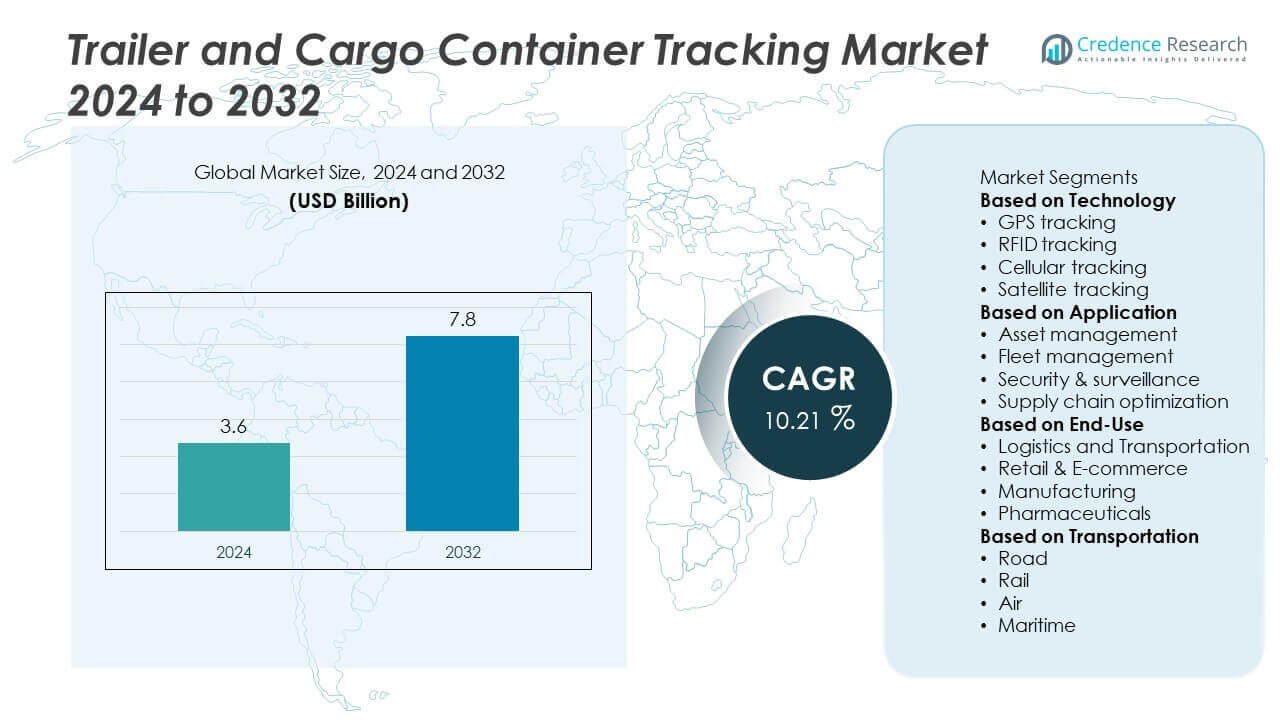
Trailer and Cargo Container Tracking Market size was valued at USD 3.6 billion in 2024 and is projected to reach USD 7.8 billion by 2032, growing at a CAGR of 10.21% during the forecast period.
| REPORT ATTRIBUTE | DETAILS |
|---|---|
| Historical Period | 2020-2023 |
| Base Year | 2024 |
| Forecast Period | 2025-2032 |
| Trailer and Cargo Container Tracking Market Size 2024 | USD 3.6 Billion |
| Trailer and Cargo Container Tracking Market, CAGR | 10.21% |
| Trailer and Cargo Container Tracking Market Size 2032 | USD 7.8 Billion |
The Trailer and Cargo Container Tracking Market grows through rising demand for supply chain visibility, cargo security, and compliance with international trade regulations. Companies adopt IoT-enabled sensors, GPS, and telematics to monitor location, temperature, and conditions of high-value or sensitive goods.
The Trailer and Cargo Container Tracking Market demonstrates strong geographical spread across North America, Europe, Asia-Pacific, Latin America, and the Middle East & Africa, each region contributing unique growth drivers. North America leads with advanced logistics infrastructure, strict safety regulations, and high adoption of telematics. Europe emphasizes regulatory compliance and sustainable transport practices, with Germany, France, and the United Kingdom driving large-scale adoption. Asia-Pacific records rapid expansion, supported by industrial growth, rising e-commerce, and government investments in smart logistics hubs. Latin America and the Middle East & Africa show gradual adoption, with increasing focus on port modernization and trade efficiency. Key players shaping the market include Trimble, Samsara, Orbcomm, and Geotab, all of which focus on integrating IoT, AI-driven analytics, and global connectivity to deliver reliable real-time monitoring solutions that strengthen cargo security and operational transparency across diverse industries.
Market Insights
- The Trailer and Cargo Container Tracking Market was valued at USD 3.6 billion in 2024 and is projected to reach USD 7.8 billion by 2032, at a CAGR of 10.21%.
- Rising demand for supply chain visibility and cargo security drives adoption, supported by globalization, e-commerce expansion, and stricter compliance requirements in international trade.
- Key trends include integration of IoT-enabled sensors, AI-driven analytics, and cloud-based platforms, along with the adoption of 5G connectivity to improve real-time monitoring and predictive insights.
- Competitive dynamics feature leading players such as Trimble, Samsara, Orbcomm, and Geotab, which invest in telematics, advanced tracking solutions, and strategic partnerships to expand global reach.
- Market restraints include high implementation costs, infrastructure limitations in developing regions, and concerns over data security and regulatory complexities across cross-border logistics.
- Regional analysis highlights North America and Europe as early adopters with advanced logistics systems, while Asia-Pacific records rapid expansion driven by port modernization, smart logistics projects, and industrial growth.
- Overall, the Trailer and Cargo Container Tracking Market demonstrates strong resilience by leveraging digital technologies, addressing regulatory demands, and supporting global supply chains, ensuring steady expansion across diverse industries worldwide.
Market Drivers
Growing Demand for Supply Chain Visibility and Security
The Trailer and Cargo Container Tracking Market grows through rising demand for real-time visibility and cargo security. Global trade expansion and complex logistics networks require reliable tracking to reduce theft and loss. It provides fleet managers with accurate location and status updates across international routes. Businesses adopt advanced tracking systems to improve accountability and streamline operations. Growing e-commerce activity further strengthens the need for transparent supply chains. These factors position tracking solutions as essential tools for logistics efficiency.
- For instance, ORBCOMM reported that it had an installed base of nearly 1.6 million trailer and container tracking units worldwide at the end of 2023. A January 2025 report identified ORBCOMM as the largest provider of tracking solutions based on the number of devices deployed for trailers and containers.
Rising Adoption of IoT and Telematics Solutions
IoT-enabled sensors and telematics systems drive strong growth in the market. The Trailer and Cargo Container Tracking Market benefits from connected devices that provide temperature, humidity, and shock data. It enables shippers to monitor sensitive cargo such as pharmaceuticals, perishables, and electronics. Telematics platforms integrate with analytics software to optimize fleet performance and reduce operational costs. Companies invest in predictive maintenance using IoT data to avoid downtime. The integration of real-time tracking with intelligent systems accelerates adoption.
- For instance, Samsara launched its Smart Trailer platform, enabling fleets to track cargo conditions such as tire pressure, trailer power, and door status, with installation completed in under five minutes per trailer using its Powered Asset Gateway.
Expansion of International Trade and Cross-Border Logistics
Globalization and rising exports create strong demand for container tracking systems. The Trailer and Cargo Container Tracking Market benefits from increasing adoption by shipping companies, freight forwarders, and customs authorities. It helps reduce delays at ports by providing automated updates on cargo movement. Cross-border logistics companies adopt tracking to comply with trade regulations and security frameworks. The rise of intermodal transport strengthens reliance on reliable monitoring tools. These drivers ensure consistent demand across international supply chains.
Stringent Regulatory and Compliance Requirements
Governments and regulatory agencies enforce strict rules on cargo monitoring and reporting. The Trailer and Cargo Container Tracking Market aligns with compliance requirements set by organizations such as the International Maritime Organization (IMO) and Customs-Trade Partnership Against Terrorism (C-TPAT). It ensures secure transport of hazardous materials and high-value goods. Regulations on food safety and pharmaceutical logistics further drive system adoption. Companies adopt certified tracking solutions to avoid penalties and maintain trust. This regulatory environment creates steady demand for advanced tracking technologies.
Market Trends
Integration of Advanced IoT and Sensor Technologies
The Trailer and Cargo Container Tracking Market reflects a clear trend toward IoT-enabled devices and smart sensors. Companies deploy GPS trackers, RFID tags, and environmental sensors for real-time visibility. It allows monitoring of location, temperature, humidity, and shock to protect sensitive cargo. Integration with cloud-based platforms improves analytics and reporting. Logistics providers use this data to enhance decision-making and improve customer service. The adoption of advanced sensors ensures higher accuracy and reliability across supply chains.
- For instance, Sensitech's TempTale GEO Ultra device provides real-time monitoring of temperature, light, and location for shipments, with data transmitted via a global cellular network using LTE Cat-M1 (4G) with a 2G fallback. The device is specifically designed for the pharmaceutical cold chain and generates data in compliance with regulatory standards like FDA 21 CFR Part 11 and EC Annex 11, automating and increasing compliance for temperature-sensitive products.
Adoption of Cloud and AI-Driven Platforms
Cloud-based platforms and artificial intelligence are reshaping tracking operations. The Trailer and Cargo Container Tracking Market benefits from predictive analytics, route optimization, and anomaly detection powered by AI. It enables logistics managers to anticipate disruptions and reduce delays. Cloud integration supports seamless sharing of cargo information with multiple stakeholders. Companies also deploy AI to improve predictive maintenance for trailers and containers. This trend highlights the shift from simple tracking to intelligent logistics management.
- For instance, Geotab processes over 80 billion telematics data points per day from more than 4.7 million vehicle subscriptions, serving over 55,000 global customers. This massive real-time dataset enables powerful AI-based predictive maintenance and anomaly detection for asset tracking.
Growing Focus on End-to-End Supply Chain Transparency
End-to-end visibility has become a top priority for logistics operators. The Trailer and Cargo Container Tracking Market supports this demand by offering integrated platforms that track cargo from origin to destination. It enhances accountability, reduces risks of theft, and improves regulatory compliance. Retailers and e-commerce companies adopt these solutions to strengthen customer trust through accurate delivery updates. Real-time data exchange with customs authorities helps reduce clearance times. The trend highlights a stronger focus on transparency across global supply chains.
Expansion of 5G Connectivity and Smart Logistics Networks
The rollout of 5G networks creates new opportunities for high-speed, low-latency tracking. The Trailer and Cargo Container Tracking Market benefits from improved connectivity that supports continuous monitoring. It enables advanced features such as live video feeds and real-time alerts during transit. Smart logistics hubs deploy 5G-enabled tracking for efficient cargo management. The expansion of connected infrastructure supports seamless integration of trailers, containers, and fleet systems. This trend accelerates the evolution of intelligent and highly connected logistics ecosystems.
Market Challenges Analysis
High Implementation Costs and Infrastructure Barriers
The Trailer and Cargo Container Tracking Market faces challenges from high upfront costs associated with advanced tracking systems. Deployment of IoT sensors, GPS devices, and cloud integration requires significant investment from logistics operators. It creates adoption barriers for small and mid-sized companies with limited budgets. Infrastructure limitations in developing regions further restrict widespread usage. Limited availability of reliable internet connectivity impacts real-time monitoring effectiveness. These challenges slow penetration in price-sensitive markets despite growing demand.
Data Security Concerns and Regulatory Complexities
Concerns over data security and privacy remain major obstacles to adoption. The Trailer and Cargo Container Tracking Market depends on continuous data exchange between fleets, shippers, and authorities. It increases exposure to cyber threats and unauthorized access to sensitive cargo information. Complex regulatory frameworks across borders add to operational difficulties. Companies must adapt tracking solutions to comply with varying standards on data protection and cargo security. The need for cybersecurity investments and regulatory alignment raises operational costs. These issues make scaling of solutions more difficult across global logistics networks.
Market Opportunities
Rising Demand for Smart Logistics and Cold Chain Management
The Trailer and Cargo Container Tracking Market holds strong opportunities through the expansion of smart logistics and cold chain operations. Global trade in pharmaceuticals, food, and perishable goods requires precise temperature and condition monitoring. It provides shippers with real-time visibility and alerts, ensuring cargo integrity across long-distance transport. Companies adopt advanced tracking systems to comply with safety standards and reduce spoilage. Growth in e-commerce further supports demand for end-to-end cargo visibility. These factors create new opportunities for providers offering intelligent tracking and monitoring solutions.
Expansion Across Emerging Markets and 5G Integration
Emerging economies present significant opportunities with rising investments in transport infrastructure and trade activities. The Trailer and Cargo Container Tracking Market benefits from rapid urbanization, expanding ports, and government initiatives to modernize logistics. It gains further momentum with the rollout of 5G, enabling faster data transfer and low-latency monitoring. Adoption of connected platforms in Asia-Pacific, Latin America, and Africa strengthens accessibility to advanced tracking technologies. Partnerships between logistics operators and technology firms create scalable solutions for these regions. The convergence of connectivity and infrastructure development positions the market for long-term growth.
Market Segmentation Analysis:
By Technology
The Trailer and Cargo Container Tracking Market segments by technology into GPS, RFID, and cellular-based systems. GPS dominates with widespread adoption due to its ability to provide real-time location updates across long distances. It ensures accuracy in global logistics and reduces risks of theft and misplacement. RFID systems support efficient inventory management and automated identification, particularly in port and warehouse operations. Cellular-based technologies are gaining ground with advancements in 4G and 5G, enabling continuous connectivity and low-latency communication. The combination of these technologies creates robust tracking solutions for diverse logistics requirements.
- For instance, Nexxiot built an installed base of approximately 1.0 million tracking units by the end of 2023, spanning containers and rail freight wagons, underscoring high adoption of satellite/GPS and cellular connectivity in intermodal tracking.
By Application
Segmentation by application highlights cargo tracking, asset management, and fleet management. Cargo tracking holds the largest share, supported by the need for end-to-end visibility of goods across supply chains. It provides monitoring of environmental conditions such as temperature, shock, and humidity, ensuring safety for sensitive goods. Asset management applications focus on optimizing the utilization and security of containers and trailers, reducing downtime and operational costs. Fleet management leverages telematics integration to track driver behavior, route optimization, and fuel efficiency. Together, these applications expand the role of tracking systems beyond location monitoring toward intelligent logistics management.
- For instance, Maersk fully outfitted its entire fleet of 360,000 refrigerated containers with tracking devices, enabling real-time environmental monitoring and location tracking across global shipping routes.
By End-Use
The market segments by end-use into transportation and logistics, retail, food and beverage, healthcare, and others. Transportation and logistics dominate, as fleet operators and freight forwarders increasingly adopt tracking to enhance security and efficiency. It also sees rising use in retail, where e-commerce growth demands transparency and real-time delivery updates. The food and beverage sector relies on tracking systems for cold chain monitoring, ensuring compliance with safety regulations. Healthcare applications grow rapidly with strict requirements for pharmaceutical logistics and condition-sensitive shipments. Other sectors such as chemicals and electronics also adopt tracking systems to safeguard valuable goods. This diverse adoption across industries highlights the critical role of tracking in supporting global trade and modern logistics.
Segments:
Based on Technology
- GPS tracking
- RFID tracking
- Cellular tracking
- Satellite tracking
Based on Application
- Asset management
- Fleet management
- Security & surveillance
- Supply chain optimization
Based on End-Use
- Logistics and Transportation
- Retail & E-commerce
- Manufacturing
- Pharmaceuticals
Based on Transportation
- Road
- Rail
- Air
- Maritime
Based on the Geography:
- North America
- U.S.
- Canada
- Mexico
- Europe
- UK
- France
- Germany
- Italy
- Spain
- Russia
- Belgium
- Netherlands
- Austria
- Sweden
- Poland
- Denmark
- Switzerland
- Rest of Europe
- Asia Pacific
- China
- Japan
- South Korea
- India
- Australia
- Thailand
- Indonesia
- Vietnam
- Malaysia
- Philippines
- Taiwan
- Rest of Asia Pacific
- Latin America
- Brazil
- Argentina
- Peru
- Chile
- Colombia
- Rest of Latin America
- Middle East
- UAE
- KSA
- Israel
- Turkey
- Iran
- Rest of Middle East
- Africa
- Egypt
- Nigeria
- Algeria
- Morocco
- Rest of Africa
Regional Analysis
North America
North America holds the leading position in the Trailer and Cargo Container Tracking Market with a 36% market share in 2024. The region benefits from advanced logistics infrastructure, high adoption of telematics, and strict security regulations. The United States drives growth with strong investments in supply chain visibility and technology-enabled fleet management. It gains further traction from increasing e-commerce demand, which requires real-time monitoring and delivery transparency. Canada supports adoption with cross-border logistics needs, while Mexico contributes through its growing role in trade and manufacturing exports. The region’s regulatory frameworks and emphasis on cargo safety ensure continued market dominance.
Europe
Europe accounts for a 28% market share in 2024, driven by strong trade activity and advanced logistics systems. Countries such as Germany, France, and the United Kingdom lead demand through widespread adoption of smart tracking for high-value goods and cold chain management. It benefits from strict EU regulations on cargo monitoring, food safety, and transport security, which drive system adoption. Eastern Europe also records rising usage as logistics hubs expand across Poland and Hungary. The region’s emphasis on sustainability encourages adoption of tracking solutions that optimize routes and reduce carbon emissions. Europe remains a key market with steady technological advancements and strong regulatory support.
Asia-Pacific
Asia-Pacific secures a 23% share in 2024, reflecting rapid industrialization, growing trade volumes, and large-scale port operations. China dominates with strong investments in logistics modernization and port infrastructure, while Japan and South Korea adopt advanced tracking systems to support high-tech exports. It also gains momentum in India and Southeast Asia, where e-commerce growth and smart city initiatives increase the need for efficient cargo monitoring. Governments in the region prioritize digital logistics platforms to streamline cross-border trade. Affordable connectivity solutions and expanding use of 5G strengthen regional adoption. Asia-Pacific is projected to record the fastest growth during the forecast period.
Latin America
Latin America represents an 8% market share in 2024, with Brazil and Mexico leading adoption. The region benefits from growing trade agreements, expanding retail markets, and rising use of telematics in fleet management. It also shows adoption in the agricultural and food sectors, where cold chain logistics require real-time monitoring. Challenges such as cost constraints and limited infrastructure slow broader adoption in smaller markets. However, ongoing investments in port modernization and logistics efficiency create new opportunities. The region demonstrates steady growth with strong potential in cross-border trade and regional e-commerce expansion.
Middle East & Africa
The Middle East & Africa hold a 5% market share in 2024, reflecting gradual adoption with growing opportunities. Gulf nations such as Saudi Arabia and the United Arab Emirates lead through investments in smart logistics hubs and advanced trade corridors. It also records adoption in South Africa, where modernization of transport systems drives demand for tracking technologies. Limited awareness and infrastructure constraints remain key challenges in parts of Africa. Still, increasing investments in smart port projects and diversification strategies across the Middle East support long-term potential. The region continues to evolve as an emerging market for container and trailer tracking systems.
Key Player Analysis
Competitive Analysis
The competitive landscape of the Trailer and Cargo Container Tracking Market features leading players such as AT&T Fleet Complete, CalAmp, Geotab, Numerex, Orbcomm, Samsara, Sensitech, SkyBitz, Spireon, and Trimble. These companies drive innovation by focusing on IoT-enabled tracking systems, advanced telematics, and cloud-based platforms that deliver real-time visibility and analytics for global supply chains. They prioritize integration of GPS, RFID, and sensor technologies to monitor cargo conditions, improve fleet efficiency, and enhance security across cross-border logistics. Strategic investments in AI, predictive analytics, and 5G connectivity strengthen their ability to provide accurate, low-latency monitoring solutions. Expansions into emerging markets and partnerships with logistics providers and fleet operators extend their global reach. Many players emphasize regulatory compliance and cybersecurity to address growing concerns over data protection and international standards. Competition remains intense as firms differentiate through technological advancements, cost-effective solutions, and end-to-end service offerings, ensuring long-term competitiveness in the evolving logistics landscape.
Recent Developments
- In June 2025, ORBCOMM launched CrewView, a visibility solution for smart refrigerated and dry containers at sea. This system enables real-time monitoring of containers during maritime transport, helping crews detect temperature deviations or power failures early to protect cargo integrity.
- In January 2025, ORBCOMM was identified as the largest provider in the market, with an installed base of nearly 1.6 million tracking units for trailers and containers-more than any other competitor.
- In January 2025, SkyBitz reached an installed base of approximately 750,000 tracking units, securing its position as the third-largest provider in trailers and container tracking devices.
- In 2025, Spireon expanded its leadership team by appointing Todd Abbott, Carla Fitzgerald, and Rick Gruenhagen to head sales, marketing, and technology, respectively. This strategic move supports the firm’s growth in GPS trailer and asset tracking through its FleetLocate platform, which already serves over 3 million active subscribers.
Report Coverage
The research report offers an in-depth analysis based on Technology, Application, End-Use, Transportation and Geography. It details leading market players, providing an overview of their business, product offerings, investments, revenue streams, and key applications. Additionally, the report includes insights into the competitive environment, SWOT analysis, current market trends, as well as the primary drivers and constraints. Furthermore, it discusses various factors that have driven market expansion in recent years. The report also explores market dynamics, regulatory scenarios, and technological advancements that are shaping the industry. It assesses the impact of external factors and global economic changes on market growth. Lastly, it provides strategic recommendations for new entrants and established companies to navigate the complexities of the market.
Future Outlook
- The market will expand with rising demand for real-time supply chain visibility.
- IoT-enabled devices and smart sensors will play a central role in adoption.
- AI and predictive analytics will improve cargo monitoring and route optimization.
- 5G connectivity will enhance low-latency communication and continuous data transfer.
- Cloud-based platforms will support seamless collaboration across logistics stakeholders.
- Cold chain monitoring will create strong opportunities in food and pharmaceutical transport.
- Emerging markets will drive growth with infrastructure modernization and trade expansion.
- Strategic partnerships between technology providers and logistics operators will accelerate innovation.
- Cybersecurity solutions will gain importance to protect sensitive cargo data.
- Sustainable logistics practices will encourage adoption of energy-efficient tracking systems.

Request a Free Sample
Fill in your details and we'll send you a free sample report.
- Sample data tables & charts
- Research methodology
Market Dynamics
Supply Chain Visibility and Security
The need for real-time tracking and monitoring of trailers and cargo containers is driven by the complexity of global supply chains and the imperative to reduce theft, loss, and delays. Enhanced visibility ensures accountability and operational efficiency for logistics providers and shippers.
Adoption of IoT and Telematics
Integration of IoT-enabled sensors, GPS, and telematics platforms allows for continuous monitoring of cargo location, condition, and environment. This enables predictive maintenance, reduces downtime, and supports compliance with safety and quality standards, especially for sensitive goods.
Expansion of International Trade and Cross-Border Logistics
Globalization and the growth of cross-border trade have increased the demand for reliable tracking solutions to comply with international regulations, streamline customs processes, and ensure timely delivery across complex logistics networks.
Stringent Regulatory and Compliance Requirements
Regulations from organizations such as the IMO and C-TPAT require secure and transparent cargo monitoring, especially for hazardous and high-value goods. Compliance pressures drive adoption of certified tracking technologies to avoid penalties and maintain trust with stakeholders.
Growth in E-commerce and Cold Chain Logistics
The surge in e-commerce and the need for precise temperature and condition monitoring in food and pharmaceutical logistics are fueling demand for advanced tracking systems that ensure product integrity and timely delivery.
Need a Custom Version of This Report?
Tailor the scope, geography, or segments to your exact requirements.
- Custom geography or segment scope
- Direct access to our analyst team
Frequently Asked Questions
What is the current market size for Trailer and Cargo Container Tracking, and what is its projected size in 2032?
At what Compound Annual Growth Rate is the Trailer and Cargo Container Tracking market projected to grow between 2025 and 2032?
Which Trailer and Cargo Container Tracking market segment held the largest share in 2024?
What are the primary factors fueling the growth of the Trailer and Cargo Container Tracking market?
Who are the leading companies in the Trailer and Cargo Container Tracking market?
Which region commanded the largest share of the Trailer and Cargo Container Tracking market in 2024?
Table of Content
Chapter 1 Market Segmentation
- 1.1 Segmentation Framework
- 1.1.1 Product and Service Classification
- 1.1.2 Application and End-Use Classification
- 1.1.3 Technology and Solution Classification
- 1.1.4 Customer and Distribution Channel Classification
- 1.1.5 Geographic Segmentation
- 1.1.6 Market Segment Definitions and Boundaries
- 1.2 By End-Use
- 1.2.1 Logistics and Transportation
- 1.2.2 Retail & E-commerce
- 1.2.3 Manufacturing
- 1.2.4 Pharmaceuticals
- 1.3 By Technology
- 1.3.1 GPS tracking
- 1.3.2 RFID tracking
- 1.3.3 Cellular tracking
- 1.3.4 Satellite tracking
- 1.4 By Application
- 1.4.1 Asset management
- 1.4.2 Fleet management
- 1.4.3 Security & surveillance
- 1.4.4 Supply chain optimization
- 1.5 By Transportation
- 1.5.1 Road
- 1.5.2 Rail
- 1.5.3 Air
- 1.5.4 Maritime
Chapter 2 Introduction
- 2.1 Report Objectives and Scope
- 2.2 Product Definition and Industry Terminology
- 2.3 Market Inclusions and Exclusions
- 2.4 Research Process
- 2.4.1 Primary Research and Expert Interviews
- 2.4.2 Secondary Research and Source Review
- 2.4.3 Top-Down and Bottom-Up Estimation
- 2.4.4 Data Triangulation and Verification
- 2.5 Market Size Measurement Basis
- 2.5.1 2024: USD 3.6 billion → 2032: USD 7.8 billion
- 2.6 Historical and Forecast Reference Periods
- 2.6.1 Base Year: 2024
- 2.6.2 Forecast Period: 2024-2032
- 2.7 Research Assumptions and Limitations
Chapter 3 Executive Summary
- 3.1 Market Snapshot and Key Findings
- 3.2 Base-Year Market Size, 2024
- 3.3 Forecast Market Size, 2032
- 3.4 Revenue and Volume Growth Outlook
- 3.5 Key Demand and Supply Indicators
- 3.6 Leading Market Segments
- 3.7 Fastest-Growing Market Opportunities
- 3.8 Regional Performance Highlights
- 3.9 Technology and Industry Transformation
- 3.10 Competitive Landscape Summary
- 3.11 Analyst View and Strategic Implications
Chapter 4 Global Trailer and Cargo Container Tracking Market Trends and Developments
- 4.1 Historical Industry Development
- 4.2 Recent Market Trends and Developments
- 4.3 Demand and Customer Behavior Trends
- 4.4 Technology and Product Innovation
- 4.5 Artificial Intelligence, Automation and Digitalization
- 4.6 Local Manufacturing and Supply Chain Realignment
- 4.7 Industry Partnerships, Mergers and Acquisitions
- 4.8 Sustainability and Circular Economy Developments
- 4.9 Government and Private Sector Investment Trends
- 4.10 Emerging Business Models and Commercialization
- 4.11 Industry Developments and Announcements
Chapter 5 Global Trailer and Cargo Container Tracking Market Production, Supply and Demand Analysis
- 5.1 Demand Trend and Consumption Analysis
- 5.2 Demand Forecast, 2024-2032
- 5.3 Production and Output Trend
- 5.4 Production and Output Forecast, 2024-2032
- 5.5 Installed Capacity and Capacity Utilization
- 5.6 Company-Wise Production Plants and Statistics
- 5.6.1 Installed Production Capacity
- 5.6.2 Actual Production
- 5.6.3 Planned Capacity and Expansion Targets
- 5.7 Supply Chain Structure and Procurement Trends
- 5.8 Supply-Demand Gap and Bottlenecks
- 5.9 Import Dependence and Sourcing Structure
- 5.10 Contract Manufacturing and Outsourcing
- 5.11 Regional Supply and Demand Concentration
Chapter 6 Global Trailer and Cargo Container Tracking Market Pricing Analysis
- 6.1 Pricing Structure and Measurement
- 6.2 Historical Pricing Trends
- 6.3 Pricing Outlook, 2024-2032
- 6.4 Average Selling Price and Unit Economics
- 6.5 Pricing by Product and Market Segment
- 6.6 Geographic Pricing Differences
- 6.7 Key Input, Energy, Labor and Logistics Costs
- 6.8 Contract Pricing and Purchasing Models
- 6.9 Pricing Sensitivity and Competitive Positioning
- 6.10 Price, Margin and Profitability Implications
Chapter 7 Global Trailer and Cargo Container Tracking Market Dynamics
- 7.1 Market Growth Drivers
- 7.1.1 Demand-Side Drivers
- 7.1.2 Technology and Innovation Drivers
- 7.1.3 Infrastructure and Investment Drivers
- 7.1.4 Regulatory and Policy Drivers
- 7.2 Market Restraints
- 7.2.1 Cost and Affordability Constraints
- 7.2.2 Technology and Adoption Barriers
- 7.2.3 Supply Chain and Operational Constraints
- 7.3 Market Challenges
- 7.3.1 Competitive Pressure and Margin Erosion
- 7.3.2 Skills, Infrastructure and Implementation Gaps
- 7.4 Emerging Market Opportunities
- 7.5 Market Dynamics Impact and Time-Horizon Assessment
Chapter 8 Global Trailer and Cargo Container Tracking Value Chain Analysis
- 8.1 Industry Value Chain Overview
- 8.2 Upstream Suppliers and Critical Inputs
- 8.3 Technology and Component Providers
- 8.4 Manufacturing or Service Delivery
- 8.5 Distribution, Channel Partners and Integrators
- 8.6 Downstream Applications and End Users
- 8.7 Value Addition and Profit Pools
- 8.8 Vertical Integration and Outsourcing
- 8.9 Supplier Concentration and Risk
- 8.10 Supply Chain Localization and Resilience
Chapter 9 Global Trailer and Cargo Container Tracking Market Regulations and Policies
- 9.1 Relevant Laws, Standards and Compliance Frameworks
- 9.2 Product, Service, Safety and Quality Requirements
- 9.3 Government Policies, Incentives and Subsidies
- 9.4 Imports, Exports and Trade Barriers
- 9.5 Public Procurement and Local Content Requirements
- 9.6 Environmental and Sustainability Compliance
- 9.7 Data Protection, AI and Cybersecurity Compliance
- 9.8 Upcoming Policy Changes and Market Implications
Chapter 10 Global Trailer and Cargo Container Tracking Market Hotspots and Opportunities
- 10.1 Market Opportunity Mapping and Growth Hotspots
- 10.2 High-Growth Applications and Customer Groups
- 10.3 Underserved Markets and White-Space Opportunities
- 10.4 Emerging Technology and Product Opportunities
- 10.5 New Capacity and Investment Hotspots
- 10.6 Market Entry and Expansion Opportunities
- 10.7 Distribution and Partnership Opportunities
- 10.8 Near-Term and Long-Term Commercial Potential
- 10.9 Opportunity Attractiveness and Execution Risks
Chapter 11 Global Trailer and Cargo Container Tracking Market Outlook, 2024-2032
- 11.1 Market Size and Analysis
- 11.1.1 Revenue (Market Measurement: 2024: USD 3.6 billion → 2032: USD 7.8 billion)
- 11.1.2 Market Volume and Quantity Sold
- 11.1.3 Historical Market Size
- 11.1.4 Base-Year Market Size, 2024
- 11.2 Market Forecast, 2024-2032
- 11.2.1 Revenue Forecast to 2032
- 11.2.2 Volume Forecast to 2032
- 11.2.3 CAGR and Year-on-Year Growth
- 11.2.4 Incremental Revenue Opportunity
- 11.3 Forecast Assumptions and Scenario Analysis
- 11.3.1 Base-Case Forecast
- 11.3.2 Optimistic and Conservative Scenarios
- 11.3.3 Technology, Pricing and Policy Sensitivities
- 11.4 Market Attractiveness and Growth Outlook
Chapter 12 Global Trailer and Cargo Container Tracking Market Segmentation and Outlook
- 12.1 Segmentation Summary and Market Shares, 2024
- 12.2 Largest and Fastest-Growing Segments
- 12.3 By End-Use - Market Size and Forecast, 2024-2032
- 12.3.1 Segment Definition and Scope
- 12.3.2 Historical Market Size
- 12.3.3 Revenue Forecast, 2024-2032
- 12.3.4 Volume Forecast, 2024-2032
- 12.3.5 Base-Year Market Share, 2024
- 12.3.6 Segment CAGR and Growth Drivers
- 12.3.7 Subsegment Market Size and Forecast
- 12.3.7.1 Logistics and Transportation
- 12.3.7.2 Retail & E-commerce
- 12.3.7.3 Manufacturing
- 12.3.7.4 Pharmaceuticals
- 12.3.8 Subsegment Pricing and Adoption Trends
- 12.3.9 Leading Suppliers and Competition
- 12.3.10 Regional Demand and Opportunities
- 12.4 By Technology - Market Size and Forecast, 2024-2032
- 12.4.1 Segment Definition and Scope
- 12.4.2 Historical Market Size
- 12.4.3 Revenue Forecast, 2024-2032
- 12.4.4 Volume Forecast, 2024-2032
- 12.4.5 Base-Year Market Share, 2024
- 12.4.6 Segment CAGR and Growth Drivers
- 12.4.7 Subsegment Market Size and Forecast
- 12.4.7.1 GPS tracking
- 12.4.7.2 RFID tracking
- 12.4.7.3 Cellular tracking
- 12.4.7.4 Satellite tracking
- 12.4.8 Subsegment Pricing and Adoption Trends
- 12.4.9 Leading Suppliers and Competition
- 12.4.10 Regional Demand and Opportunities
- 12.5 By Application - Market Size and Forecast, 2024-2032
- 12.5.1 Segment Definition and Scope
- 12.5.2 Historical Market Size
- 12.5.3 Revenue Forecast, 2024-2032
- 12.5.4 Volume Forecast, 2024-2032
- 12.5.5 Base-Year Market Share, 2024
- 12.5.6 Segment CAGR and Growth Drivers
- 12.5.7 Subsegment Market Size and Forecast
- 12.5.7.1 Asset management
- 12.5.7.2 Fleet management
- 12.5.7.3 Security & surveillance
- 12.5.7.4 Supply chain optimization
- 12.5.8 Subsegment Pricing and Adoption Trends
- 12.5.9 Leading Suppliers and Competition
- 12.5.10 Regional Demand and Opportunities
- 12.6 By Transportation - Market Size and Forecast, 2024-2032
- 12.6.1 Segment Definition and Scope
- 12.6.2 Historical Market Size
- 12.6.3 Revenue Forecast, 2024-2032
- 12.6.4 Volume Forecast, 2024-2032
- 12.6.5 Base-Year Market Share, 2024
- 12.6.6 Segment CAGR and Growth Drivers
- 12.6.7 Subsegment Market Size and Forecast
- 12.6.7.1 Road
- 12.6.7.2 Rail
- 12.6.7.3 Air
- 12.6.7.4 Maritime
- 12.6.8 Subsegment Pricing and Adoption Trends
- 12.6.9 Leading Suppliers and Competition
- 12.6.10 Regional Demand and Opportunities
- 12.7 Segment Growth Comparison
- 12.8 Segment Attractiveness and Priority Matrix
Chapter 13 Global Trailer and Cargo Container Tracking End-Use and Application Market Outlook
- 13.1 End-Use Industry and Customer Demand Structure
- 13.2 Leading Applications and Customer Groups
- 13.3 End-Use Market Size, Share and Forecast
- 13.4 Major End-Use Industry Deep Dives
- 13.4.1 Customer Requirements and Use Cases
- 13.4.2 Demand and Replacement Cycles
- 13.4.3 Technical and Regulatory Considerations
- 13.4.4 Purchasing and Procurement Models
- 13.4.5 Leading Vendors and Distribution Channels
- 13.4.6 Forecast and Commercial Opportunities
- 13.5 Emerging Applications and Cross-Segment Demand
- 13.6 End-Use Industry Investment Priorities
Chapter 14 Global Trailer and Cargo Container Tracking Geographic Market Outlook, 2024-2032
- 14.1 Regional Market Size and Share, 2024
- 14.2 Regional Market Forecast, 2024-2032
- 14.3 Regional Pricing, Production and Demand Differences
- 14.4 North America
- 14.4.1 United States
- 14.4.2 Canada
- 14.4.3 Mexico
- 14.5 Europe
- 14.5.1 Germany
- 14.5.2 France
- 14.5.3 Italy
- 14.5.4 United Kingdom
- 14.5.5 Spain
- 14.5.6 Poland
- 14.5.7 Russia
- 14.5.8 Netherlands
- 14.5.9 Belgium
- 14.5.10 Sweden
- 14.5.11 Denmark
- 14.5.12 Norway
- 14.5.13 Rest of Europe
- 14.6 Asia Pacific
- 14.6.1 China
- 14.6.2 India
- 14.6.3 Japan
- 14.6.4 South Korea
- 14.6.5 Thailand
- 14.6.6 Indonesia
- 14.6.7 Vietnam
- 14.6.8 Malaysia
- 14.6.9 Australia
- 14.6.10 Rest of Asia Pacific
- 14.7 Latin America
- 14.7.1 Brazil
- 14.7.2 Argentina
- 14.7.3 Colombia
- 14.7.4 Chile
- 14.7.5 Rest of Latin America
- 14.8 Middle East
- 14.8.1 Saudi Arabia
- 14.8.2 United Arab Emirates
- 14.8.3 Turkey
- 14.8.4 Israel
- 14.8.5 Iran
- 14.8.6 Rest of the Middle East
- 14.9 Africa
- 14.9.1 South Africa
- 14.9.2 Egypt
- 14.9.3 Nigeria
- 14.9.4 Morocco
- 14.9.5 Rest of Africa
- 14.10 Regional Investment, Policy and Supply Chain Differences
- 14.11 Regional Competitive Landscape
- 14.12 Geographic Growth Hotspots
Chapter 15 Global Trailer and Cargo Container Tracking Technology, Innovation and Sustainability Outlook
- 15.1 Technology Landscape and Maturity
- 15.2 Product, Process and Service Innovation
- 15.3 AI, Automation and Digital Tools in the Industry
- 15.4 Technology Adoption and Performance Benchmarking
- 15.5 Innovation Pipeline and R&D Investment
- 15.6 Patent and Intellectual Property Trends
- 15.7 Energy Efficiency and Resource Management
- 15.8 Sustainability, Recycling and Circularity
- 15.9 Technology Roadmap, 2024-2032
- 15.10 Risks of Obsolescence and Technology Substitution
Chapter 16 Global Trailer and Cargo Container Tracking Market Key Strategic Imperatives
- 16.1 Growth and Market Entry Priorities
- 16.2 High-Return Products and Segments
- 16.3 Pricing, Profitability and Cost Optimization
- 16.4 Technology Investment and Product Differentiation
- 16.5 Supply Chain Localization and Resilience
- 16.6 Distribution and Customer Acquisition
- 16.7 Partnership, Acquisition and Capacity Strategy
- 16.8 Regional Expansion Priorities
- 16.9 Short-, Medium- and Long-Term Actions
Chapter 17 Competition Outlook
- 17.1 Industry Competition Characteristics
- 17.2 Market Structure and Concentration
- 17.3 Market Share and Competitive Positioning, 2024
- 17.4 Company-Wise Revenue and Product Benchmarking
- 17.5 Production and Service Capacity Benchmarking
- 17.6 Technology, Pricing and Differentiation
- 17.7 Regional Footprint and Distribution Strength
- 17.8 Mergers, Acquisitions and Strategic Alliances
- 17.9 New Entrants and Competitive Threats
- 17.10 Porter's Five Forces and Industry Attractiveness
- 17.11 Competitive Outlook, 2024-2032
Chapter 18 Company Profiles
- 18.1 Company Coverage and Selection Criteria
- 18.2 Trimble
- 18.2.1 Business Description
- 18.2.2 Company Ownership and Geographic Presence
- 18.2.3 Product and Service Portfolio
- 18.2.4 Manufacturing and Operating Footprint
- 18.2.5 Production Capacity and Expansion Plans
- 18.2.6 Financial Performance and Investment
- 18.2.7 Market Share and Competitive Position
- 18.2.8 Technology and Innovation Capabilities
- 18.2.9 Strategic Alliances or Partnerships
- 18.2.10 Recent Developments
- 18.2.11 Growth Strategy and Outlook
- 18.3 Samsara
- 18.4 Orbcomm
- 18.5 Geotab
- 18.6 Sensitech
- 18.7 Spireon
- 18.8 AT&T Fleet Complete
- 18.9 SkyBitz
- 18.10 CalAmp
- 18.11 Numerex
- 18.12 Other Relevant Market Participants
Note: Every listed company is profiled on the structure shown under the first company. The company list is preliminary and may change based on research findings, market developments, data availability and client requirements.
Chapter 19 Disclaimer
- 19.1 Research and Forecast Disclaimer
- 19.2 Data Source and Estimation Limitations
Note: The depth of individual sections depends on data availability for this market. Volume, capacity, trade and other unit-based metrics are included where applicable.