
| REPORT ATTRIBUTE | DETAILS |
|---|---|
| Historical Period | 2020-2023 |
| Base Year | 2024 |
| Forecast Period | 2025-2032 |
| United Arab Emirates (UAE) Tire Market Size 2024 | USD 2,287.52 million |
| United Arab Emirates (UAE) Tire Market, CAGR | 2.66% |
| United Arab Emirates (UAE) Tire Market Size 2032 | USD 2,822.09 million |
Market Overview
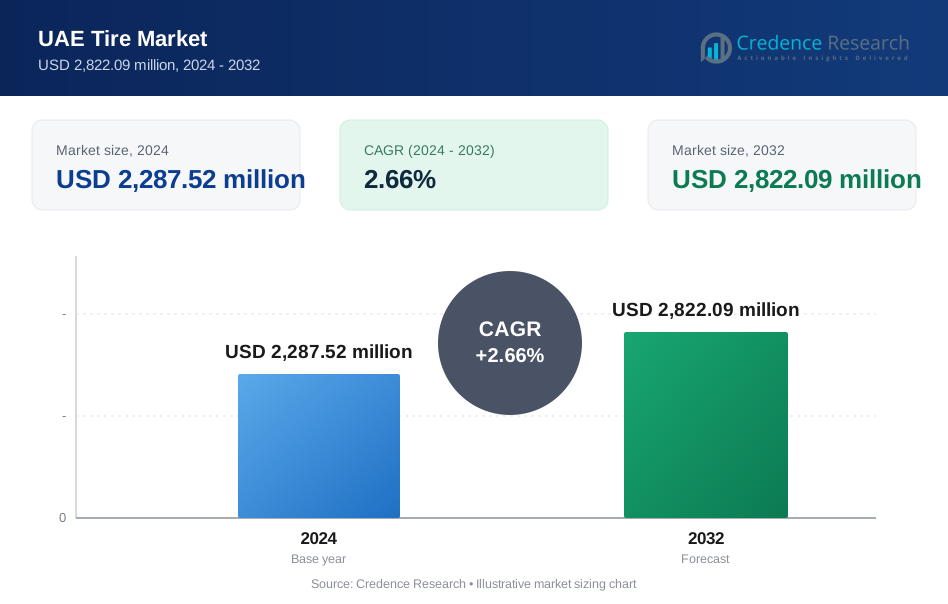
United Arab Emirates (UAE) Tire market size was valued at USD 2,287.52 million in 2024 and is anticipated to reach USD 2,822.09 million by 2032, at a CAGR of 2.66% during the forecast period (2024-2032).
The UAE tire market is experiencing growth due to several key drivers and trends. Rising vehicle sales, particularly in the passenger car and commercial vehicle segments, are fueling the demand for tires. Infrastructure development and urbanization, supported by government initiatives like Expo 2020, also contribute to this growth, as more vehicles are required for transportation. Additionally, there is an increasing demand for high-performance tires, driven by a focus on vehicle safety and fuel efficiency. The growing adoption of e-commerce platforms for tire sales enhances accessibility and convenience for consumers. Furthermore, the growing awareness of tire maintenance and the need for replacement tires at regular intervals are fueling market demand. Trends toward eco-friendly tires and innovations such as run-flat and smart tires are gaining traction as consumers seek more sustainable and technologically advanced solutions. These factors collectively support the market's expansion over the forecast period.
The UAE tire market is geographically diverse, with key regions like Abu Dhabi, Dubai, and Sharjah driving significant demand. Abu Dhabi, with its industrial base and large vehicle fleet, particularly influences the demand for commercial and heavy-duty tires. Dubai, a global business and tourism hub, experiences high demand for luxury and high-performance tires. Sharjah, with its growing industrial sector, sees steady demand for truck and bus tires. Other emirates like Ajman, Fujairah, Ras Al Khaimah, and Umm Al Quwain contribute to the market with a focus on passenger and light commercial vehicles. Key players in the UAE tire market include Al Dobowi Group, Zafco, Al Masaood Tyres, Batteries & Accessories (TBA), Emirates for Universal Tyres (EUT), and PitStopArabia, among others. These companies play a vital role in both the supply and distribution of tires, meeting the diverse needs of the UAE’s automotive industry.
Market Insights
- The UAE tire market was valued at USD 2,287.52 million in 2024 and is expected to reach USD 2,822.09 million by 2032, growing at a CAGR of 2.66% from 2024 to 2032.
- The global tire market was valued at USD 3,29,521.50 million in 2024 and is projected to reach USD 4,62,900.23 million by 2032, growing at a CAGR of 4.34% during the forecast period.
- Increasing vehicle ownership and the growing automotive industry in the UAE are major drivers of market growth.
- Technological advancements, such as smart tires and eco-friendly innovations, are shaping market trends.
- The rise in e-commerce and online tire sales is transforming consumer purchasing behavior in the region.
- Strong competition among local and international tire manufacturers, such as Al Dobowi Group and Zafco, is pushing innovation and driving product differentiation.
- Market restraints include supply chain disruptions due to global dependencies and the rising costs of raw materials.
- Regional demand is concentrated in Abu Dhabi, Dubai, and Sharjah, with each region showing distinct demand trends based on vehicle types and industrial growth.
Report Scope
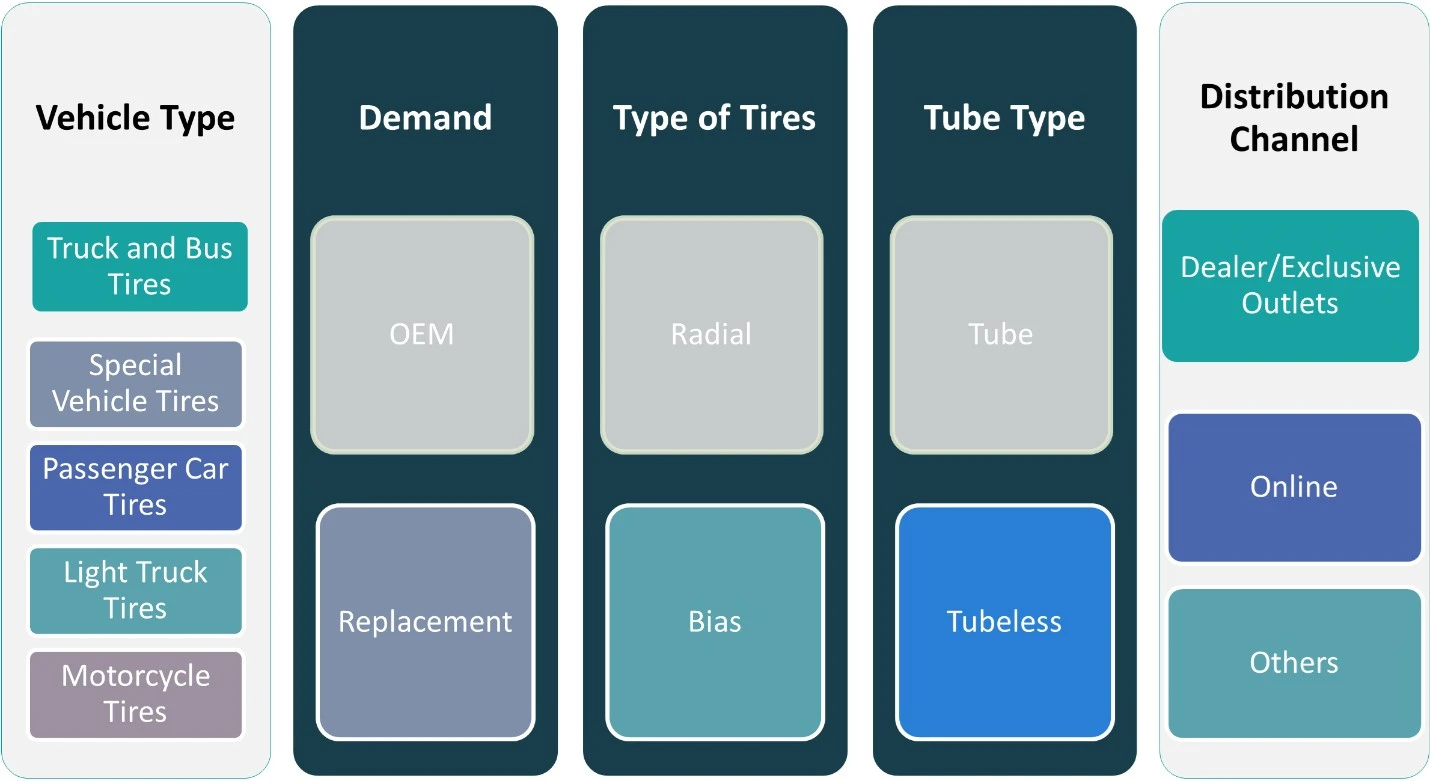
This report segments the United Arab Emirates (UAE) Tire Market as follows:
Market Drivers
Rising Vehicle Sales and Fleet Expansion
The increasing sales of vehicles, particularly in the passenger car and commercial vehicle segments, are one of the key drivers behind the growth of the UAE tire market. The country's robust automotive industry, bolstered by a growing population and rising disposable incomes, continues to drive demand for tires. For instance, the UAE tire market is experiencing substantial growth, driven by the rising number of vehicles on the road and increased consumer demand for high-performance tires. The UAE's strategic location as a hub for trade and commerce also supports the expansion of its fleet of commercial vehicles. Additionally, the rapid growth of the tourism industry has resulted in a higher number of rental cars, further boosting tire sales. This uptick in vehicle ownership directly translates to a greater need for replacement tires, contributing to the overall market growth.
Infrastructure Development and Urbanization
Infrastructure development and urbanization are major contributors to the tire market’s growth in the UAE. The government's ambitious vision for infrastructural expansion, especially in light of events like Expo 2020, has resulted in increased construction and transportation needs. For instance, the UAE government’s focus on infrastructure development, particularly through initiatives like UAE Vision 2021, has spurred growth in logistics and transportation sectors, further boosting tire demand. The expansion of roads, highways, and public transport systems across the country creates higher demand for commercial and construction vehicles, which in turn drives the need for durable and high-quality tires. Additionally, urbanization and population growth are increasing the number of vehicles on the road, further stimulating demand for tires. As new residential and commercial areas continue to develop, the demand for transportation and logistics solutions rises, significantly benefiting the tire industry.
Technological Advancements in Tires
Technological advancements in tire design and performance are playing an increasingly important role in the UAE's tire market. Consumers are now seeking more advanced tire solutions, such as fuel-efficient, low-maintenance, and high-performance tires. Innovations like run-flat tires, which allow vehicles to continue operating even after a puncture, and smart tires, equipped with sensors to monitor tire pressure and performance, are gaining popularity. The growing demand for eco-friendly tires, made from sustainable materials, is also contributing to the market's evolution. As consumers become more aware of the benefits of these innovations, there is a notable shift towards premium tire products, boosting demand for technologically advanced solutions in the UAE market.
Growing Awareness of Tire Maintenance and Safety
Rising awareness regarding vehicle maintenance and safety is another important driver for the UAE tire market. The importance of regular tire replacement for both safety and vehicle performance is increasingly recognized by consumers. With the rising awareness of the consequences of underinflated or worn-out tires, there is a heightened demand for timely tire replacements and maintenance services. This trend is supported by government campaigns and automotive workshops emphasizing tire care, tire pressure monitoring, and proper tire rotation practices. Consumers are more proactive about tire maintenance, contributing to the frequent replacement cycle and, consequently, higher demand for tires. The enhanced focus on vehicle safety and longevity further fuels the market’s growth, as consumers prioritize quality tires that improve safety, performance, and fuel efficiency.
Market Trends
Technological Advancements in Tire Design
The tire market in the UAE is undergoing significant transformations driven by technological advancements. One of the major trends is the increasing adoption of smart tire technology. These tires are equipped with sensors that monitor key parameters such as tire pressure, tread wear, and temperature, providing real-time data to drivers. This information helps prevent accidents caused by under-inflated or over-heated tires and improves overall vehicle performance. For instance, the UAE tire market is witnessing strong growth, fueled by the increase in vehicle ownership and emerging trends such as a preference for environmentally friendly tires. Moreover, innovations like run-flat tires, which allow vehicles to continue driving even after a puncture, and self-sealing tires are gaining popularity for their added convenience and safety. These technological advancements are closely aligned with the UAE's forward-thinking approach to the automotive industry, which places a strong emphasis on safety, performance, and environmental sustainability. As these technologies become more mainstream, they are expected to enhance the demand for high-tech, reliable tire solutions across the UAE market.
Preference for High-Performance and Specialty Tires
As the UAE’s automotive culture continues to evolve, there is a noticeable shift towards high-performance and specialty tires. This trend is primarily driven by the growing demand for luxury, sports, and off-road vehicles, which require tires with superior performance characteristics. For instance, the UAE tire market is experiencing a notable shift toward premium and ultra-high-performance tires, particularly among SUV and luxury vehicle owners. High-performance tires are designed to offer better handling, improved traction, and enhanced durability, making them the preferred choice for sports car owners and driving enthusiasts in the UAE. Furthermore, the popularity of off-road activities and adventure tourism, particularly in desert terrains, has fueled the demand for specialty tires designed for extreme conditions. These tires are engineered to provide better grip and durability in rough and sandy environments, catering to the increasing number of individuals participating in off-roading activities. This trend reflects the UAE’s dynamic and diverse automotive market, where consumers are increasingly looking for tires that can enhance both their driving experience and vehicle performance, whether on highways or rugged landscapes.
Expansion of E-Commerce and Online Tire Sales
The rise of e-commerce is reshaping the way consumers purchase tires in the UAE. Online tire sales are becoming increasingly popular as consumers are drawn to the convenience of browsing a wide range of tire options from the comfort of their homes. E-commerce platforms allow customers to compare tire prices, read customer reviews, and choose the best tire brands based on their needs. In addition, many online retailers offer added services such as home delivery and installation, making the purchasing process much easier. The UAE’s high internet penetration and tech-savvy population further support the growth of this trend. The shift toward online tire shopping is also driven by the increasing demand for more transparent pricing and customer-centric experiences. As consumers become more comfortable with digital platforms, online tire sales are expected to continue growing, contributing to a more streamlined and efficient tire purchasing process in the UAE.
Demand for Eco-Friendly and Sustainable Tires
Environmental sustainability is becoming an important consideration in the UAE tire market, reflecting a global shift towards more eco-friendly products. In response to growing consumer awareness of environmental issues, manufacturers are increasingly focusing on producing tires with reduced rolling resistance. These tires help improve fuel efficiency and reduce carbon emissions, contributing to a greener driving experience. Additionally, the use of sustainable materials in tire production, such as recycled rubber, bio-based compounds, and natural fibers, is gaining traction. These innovations align with the UAE’s vision of promoting sustainability and reducing its carbon footprint. As part of its commitment to environmental stewardship, the UAE government has been encouraging eco-friendly initiatives, which is likely to drive further demand for tires that are not only high-performing but also more environmentally responsible. Consumers are increasingly looking for products that are both efficient and environmentally conscious, which is shaping the future of the tire market.
Market Challenges Analysis
High Import Dependence and Supply Chain Disruptions
One of the significant challenges facing the UAE tire market is its heavy reliance on tire imports. The majority of tires available in the UAE are imported from international manufacturers, which makes the market vulnerable to global supply chain disruptions. Fluctuations in the availability of raw materials, such as rubber and petroleum-based products, can impact production schedules and increase costs. Moreover, geopolitical tensions, trade barriers, and transportation issues can lead to delays in tire shipments, causing supply shortages. These disruptions may result in higher prices for tires, affecting both consumers and businesses. The reliance on foreign suppliers also limits the local industry’s ability to quickly adapt to changes in consumer demand, further complicating market dynamics.
Regulatory Challenges and Environmental Concerns
Another challenge facing the UAE tire market is the increasing pressure to adhere to stricter environmental regulations. As the UAE moves towards sustainability goals, there is a growing demand for tire manufacturers to develop more eco-friendly products, such as tires made from recycled materials or low rolling-resistance options. For instance, the UAE government has imposed rigorous regulations to mitigate the environmental impact of rubber tires, including restrictions on tire disposal and recycling. However, meeting these environmental standards can increase production costs, making it difficult for manufacturers to balance sustainability with profitability. Additionally, the disposal of used tires remains an ongoing environmental concern. Inadequate recycling infrastructure in the region means that large quantities of tires often end up in landfills, contributing to pollution. Regulatory changes aimed at reducing waste and promoting recycling may require significant investment in new technologies and processes, which could be a financial burden for both manufacturers and retailers. These challenges highlight the need for innovative solutions that meet environmental standards while ensuring market stability.
Market Opportunities
The UAE tire market presents several opportunities for growth driven by emerging trends in technology, sustainability, and consumer demand. As the automotive industry continues to expand, there is a growing opportunity for the introduction of advanced tire technologies such as smart tires and run-flat tires. These products, which offer enhanced safety, real-time monitoring, and convenience, are becoming increasingly attractive to consumers in the UAE, particularly in the luxury and performance vehicle segments. Furthermore, the expansion of e-commerce platforms for tire sales provides a unique opportunity for businesses to tap into a more digitally engaged consumer base. Online retailing offers convenience and transparency, making it easier for customers to compare prices and services, thereby contributing to the growth of the tire market.
Additionally, there is a clear opportunity for the development and adoption of eco-friendly tire solutions in response to the growing demand for sustainability. With the UAE's focus on environmental preservation and reducing its carbon footprint, consumers and manufacturers are increasingly prioritizing tires that offer lower rolling resistance and are made from recycled or sustainable materials. This shift towards environmentally conscious products opens avenues for manufacturers to innovate and cater to this emerging demand. Moreover, the growing interest in off-road and adventure tourism in the UAE presents a niche market for specialized tires designed for rugged terrains, further expanding the market potential. By capitalizing on these trends, tire manufacturers and retailers can position themselves for long-term growth in the UAE market, responding to both technological advancements and the increasing demand for sustainable products.
Market Segmentation Analysis:
By Vehicle Type:
The UAE tire market is segmented by vehicle type, catering to a wide array of transportation needs. Passenger car tires dominate the market, driven by the high number of personal vehicles and a growing preference for quality, performance-oriented tires. This segment benefits from the increasing urbanization and rising disposable income among consumers. Light truck tires are also a significant segment, driven by the growth in the light commercial vehicle market, which includes delivery vehicles and small businesses requiring reliable transportation. Additionally, the demand for truck and bus tires remains strong due to the UAE’s strategic position as a transportation hub and the increasing demand for goods and services. Special vehicle tires cater to niche markets, including construction, mining, and off-road vehicles, which benefit from the country’s ongoing infrastructure development. The rising popularity of off-road and adventure tourism further boosts the demand for these tires, making them a key growth area in the market. Motorcycle tires, while smaller in volume, also contribute to the market due to the increasing popularity of motorcycles for both leisure and commercial purposes.
By Demand:
The UAE tire market is further segmented by demand into OEM (Original Equipment Manufacturer) and replacement tires. The OEM segment has a steady share, driven by the strong sales of new vehicles, particularly luxury cars, commercial vehicles, and specialized off-road vehicles. As the automotive industry in the UAE continues to grow, particularly with the influx of high-end models, the demand for OEM tires from vehicle manufacturers remains robust. However, the replacement tire segment accounts for the majority of the market, as vehicles require frequent tire changes for maintenance and safety. This segment is largely driven by vehicle age, with consumers replacing tires after wear or damage. The replacement market is bolstered by the growing awareness of tire maintenance, enhanced by government initiatives and automotive workshops focusing on vehicle safety and longevity. Both segments present strong opportunities for tire manufacturers, with the replacement segment offering greater volume potential due to regular consumer demand.
Segments:
Based on Vehicle Type:
- Truck and Bus Tires
- Special Vehicle Tires
- Passenger Car Tires
- Light Truck Tires
- Motorcycle Tires
Based on Demand:
- OEM
- Replacement
Based on Type of Tires:
- Radial
- Bias
Based on Tube Type
- Tube
- Tubeless
Based on Distribution Channel:
- Dealer/Exclusive Outlets
- Online
- Others
Based on the Geography:
- Abu Dhabi
- Dubai
- Sharjah
- Ajman
- Fujairah
- Ras Al Khaimah
- Umm Al Quwain
Regional Analysis
Abu Dhabi
Abu Dhabi, the capital, holds a dominant position in the UAE tire market, accounting for approximately 35% of the market share. This can be attributed to its strong industrial and commercial base, which includes the construction, transportation, and oil sectors. The city’s expansive infrastructure projects, coupled with a high number of commercial and passenger vehicles, drive the demand for both replacement and OEM tires. Furthermore, the presence of large shipping and logistics hubs increases the demand for heavy-duty tires, including those for trucks and buses.
Dubai
Dubai follows closely, contributing around 30% to the overall market share. As a global business hub with a high influx of luxury vehicles and a booming tourism industry, Dubai’s demand for high-performance and specialty tires is notable. The emirate’s well-developed road network, coupled with its position as a key trade and logistics center, stimulates demand for both light truck and passenger car tires. The growth in e-commerce and digital tire sales has also been a significant factor in Dubai’s tire market, aligning with its highly urbanized, tech-savvy population. Additionally, Dubai’s focus on sustainable development and green technologies has pushed the market towards more eco-friendly tire solutions, opening new avenues for growth.
Sharjah
Sharjah, which accounts for around 15% of the tire market, is another key region with a rapidly growing demand for tires, particularly in the commercial sector. The emirate's strong industrial base and the presence of a large number of small and medium enterprises (SMEs) that rely on commercial vehicles contribute to the steady demand for truck and bus tires. Moreover, Sharjah’s proximity to Dubai and its significant vehicle fleet further enhance its position as a crucial market for replacement tires. Its strategic location also plays a vital role in cross-border trade, contributing to the demand for tires for transport vehicles.
Ajman, Fujairah, Ras Al Khaimah, and Umm Al Quwain
The remaining regions, including Ajman, Fujairah, Ras Al Khaimah, and Umm Al Quwain, together account for the remaining 20% of the market share. While each of these emirates contributes modestly to the overall tire market, their demand is still significant, primarily driven by the local vehicle population and infrastructure development projects. Ras Al Khaimah and Fujairah have seen steady growth in tire demand due to their expanding industrial and construction sectors. These regions increasingly require specialized and durable tires for off-road and commercial applications. Meanwhile, Ajman and Umm Al Quwain, with their smaller populations, see demand primarily for passenger car and light truck tires, reflecting their more residential-focused markets. Overall, the UAE’s tire market is balanced across various regions, with Abu Dhabi and Dubai maintaining the largest market share due to their economic significance and urban development.
Key Player Analysis
- Al Dobowi Group
- Zafco
- Al Masaood Tyres, Batteries & Accessories (TBA)
- Emirates for Universal Tyres (EUT)
- PitStopArabia
Competitive Analysis
The UAE tire market is highly competitive, with several leading players dominating the landscape. Al Dobowi Group, Zafco, Al Masaood Tyres, Batteries & Accessories (TBA), Emirates for Universal Tyres (EUT), and PitStopArabia are among the most prominent companies in the region. These players leverage their strong distribution networks, extensive product portfolios, and established brand reputations to maintain a significant presence in the market. The competition is driven by factors such as brand reputation, product quality, customer service, and after-sales support. In addition to traditional tire sales, many players are expanding into the digital space, offering online platforms for tire selection, installation, and maintenance services. This shift towards e-commerce has enabled companies to tap into the growing demand for convenience, especially among tech-savvy consumers. Furthermore, companies are increasingly investing in advanced tire technologies, including smart tires and eco-friendly options, to stay competitive in a market that is becoming more focused on sustainability and innovation. Companies are also exploring partnerships with OEMs and distribution networks to enhance their market reach. Price competition remains a significant factor, but there is a notable emphasis on providing value-added services, such as tire maintenance and installation, to build customer loyalty. Overall, the competitive landscape is dynamic, with firms continually adapting to meet the evolving demands of the UAE’s automotive industry.
Recent Developments
- In May 2025,Continental reported its best Q1 earnings since 2021, with adjusted group earnings of €586 million, driven by cost reductions and a rebound in tire replacement demand. The company is undergoing a major overhaul, spinning off its automotive unit and planning to divest the ContiTech industrial division to focus on its profitable tires business.
- In March 2025, Bridgestone announced its 2025 motorsports plan, continuing support for professional and grassroots motorsports globally. The company is emphasizing sustainable motorsport as a "mobile laboratory" to refine technologies for commercial tire development. Bridgestone remains the exclusive tire supplier for major race series, including Japan’s SUPER GT and North America’s NTT INDYCAR® SERIES.
- In March 2025, Michelin was named one of the world's 100 most innovative companies by Clarivate, recognizing its strong R&D capabilities. The company also launched the MICHELIN City Touring tire for bicycles, emphasizing safety and sustainability.
- In February 2025,Goodyear announced a capacity expansion at its Lawton, Oklahoma facility, targeting production of 10 million additional premium tires annually, especially larger rim sizes and higher-margin segments.
- In January 2025,Apollo highlighted double-digit growth in commercial vehicle and farm tires, high single-digit growth in passenger car tires, and continued investment in R&D and AI-driven efficiency. The company is also investing in natural rubber cultivation in India to address commodity challenges.
Market Concentration & Characteristics
The UAE tire market exhibits moderate concentration, with a few major players commanding a significant share, while numerous smaller companies cater to niche segments. The market is characterized by intense competition among both local and international brands, driving innovation in product offerings and customer services. Larger companies tend to dominate the premium tire segment, while smaller players focus on budget-friendly and value-oriented products. The market is also marked by a growing shift towards online tire sales, allowing businesses to reach a wider customer base with increased convenience. Additionally, the demand for eco-friendly and technologically advanced tires is on the rise, as consumers become more environmentally conscious and prioritize safety and performance. With a strong focus on after-sales services, such as installation and maintenance, companies differentiate themselves through customer loyalty programs and enhanced value propositions, further shaping the market's competitive dynamics.
Report Coverage
The research report offers an in-depth analysis based on Vehicle Type, Demand, Type of Tires, Tube Type, Distribution Channel and Geography. It details leading market players, providing an overview of their business, product offerings, investments, revenue streams, and key applications. Additionally, the report includes insights into the competitive environment, SWOT analysis, current market trends, as well as the primary drivers and constraints. Furthermore, it discusses various factors that have driven market expansion in recent years. The report also explores market dynamics, regulatory scenarios, and technological advancements that are shaping the industry. It assesses the impact of external factors and global economic changes on market growth. Lastly, it provides strategic recommendations for new entrants and established companies to navigate the complexities of the market.
Future Outlook
- The UAE tire market is expected to continue its steady growth due to increasing vehicle ownership and demand for high-quality tires.
- Technological advancements such as smart tires, run-flat tires, and tire pressure monitoring systems will gain traction in the market.
- The shift towards eco-friendly and sustainable tire solutions will grow as consumers become more environmentally conscious.
- Online tire retailing and digital platforms will expand, offering greater convenience and competitive pricing for consumers.
- Demand for high-performance tires will rise, driven by the increasing number of luxury and premium vehicle sales in the region.
- The rise in e-commerce will fuel the growth of home delivery and tire installation services, making tire purchasing more accessible.
- The market will see continued growth in the commercial vehicle sector, increasing demand for truck and bus tires.
- Replacement tires will continue to dominate the market, driven by vehicle maintenance and the need for regular tire replacements.
- There will be an increase in demand for off-road and specialty tires due to the growing popularity of adventure tourism and outdoor activities.
- Companies will focus on expanding their product portfolios with more varied offerings to cater to diverse consumer needs across different vehicle types.
Request a Free Sample
Fill in your details and we'll send you a free sample report.
- Sample data tables & charts
- Research methodology
Need a Custom Version of This Report?
Tailor the scope, geography, or segments to your exact requirements.
- Custom geography or segment scope
- Direct access to our analyst team
Frequently Asked Questions
What is the current size of the United Arab Emirates (UAE) Tire?
What factors are driving the growth of the United Arab Emirates (UAE) Tire?
What are some challenges faced by the United Arab Emirates (UAE) Tire?
Who are the major players in the United Arab Emirates (UAE) Tire?
Table of Content
Chapter 1. Report Introduction
- 1.1 Report Description & Purpose
- 1.1.1 Report Title & Market Definition
- 1.1.2 Unique Selling Propositions (USP) & Key Differentiators
- 1.1.3 Value Proposition for Stakeholders
- 1.2 Research Objectives
- 1.2.1 Market Sizing Objectives (Volume & Revenue) (Volume Where Applicable)
- 1.2.2 Segmentation Objectives
- 1.2.3 Competitive Intelligence Objectives
- 1.2.4 Forecast & Scenario Objectives
- 1.3 Report Scope
- 1.3.1 UAE Tire Scope – Segments & Subsegments Covered
- 1.3.2 Geographic Scope – Selected Country & Subnational Markets Covered
- 1.3.3 Historical Period, Base Year & Forecast Period (2024; forecast to 2032)
- 1.3.4 Inclusions & Exclusions
- 1.4 Industry Classification & Applicable Codes
- 1.5 Currency, Measurement Units & Valuation Basis
- 1.6 Target Stakeholders
- 1.7 Limitations & Assumptions
Chapter 2. Executive Summary
- 2.1 UAE Tire Snapshot
- 2.1.1 Market Size – Historical (2024) & Forecast (2024-2032) (2024: USD 2,287.52 million → 2032: USD 2,822.09 million)
- 2.1.2 Volume & Revenue – National Totals (Volume Where Applicable)
- 2.1.3 Key Market Highlights – Top Five Facts
- 2.2 UAE Tire Segmentation Snapshot
- 2.2.1 Market Split by Subnational Area – 2024 vs. 2032
- 2.3 Competitive Snapshot
- 2.3.1 Top 10 Players by Revenue Share – 2024
- 2.3.2 Top 10 Players by Volume Share – 2024 (Volume Where Applicable)
- 2.3.3 Recent Strategic Developments (18-Month Summary)
- 2.4 Key Investment Highlights & Strategic Conclusions
Chapter 3. UAE Tire Dynamics & Industry Analysis
- 3.1 Market Overview & Context
- 3.1.1 UAE Tire Position in the Broader Industry Value Chain
- 3.1.2 Demand Structure & Purchasing Dynamics
- 3.1.3 Market Maturity & Development Stage Across Domestic Markets
- 3.2 UAE Tire Drivers
- 3.3 UAE Tire Restraints & Challenges
- 3.4 UAE Tire Opportunities
- 3.5 Porter's Five Forces Analysis
- 3.5.1 Threat of New Entrants
- 3.5.2 Bargaining Power of Suppliers
- 3.5.3 Bargaining Power of Buyers
- 3.5.4 Threat of Substitutes
- 3.5.5 Competitive Rivalry – Intensity Assessment
- 3.6 UAE Tire Value Chain Analysis
- 3.6.1 Upstream – Key Inputs, Resources & Suppliers
- 3.6.1.1 Key Input/Resource 1
- 3.6.1.2 Key Input/Resource 2
- 3.6.1.3 Key Input/Resource 3
- 3.6.2 Midstream – Core Operations & Value Creation
- 3.6.2.1 Operating Model & Process Overview
- 3.6.2.2 Key Operating Locations & Capabilities by Company
- 3.6.3 Downstream – Market Channels & End Users
- 3.6.3.1 Direct Sales & Customer Engagement Channels
- 3.6.3.2 Indirect Sales, Intermediaries & Partner Channels
- 3.6.4 Value Chain Profitability Analysis
- 3.6.1 Upstream – Key Inputs, Resources & Suppliers
- 3.7 PESTEL Analysis
- 3.7.1 Political Factors
- 3.7.2 Economic Factors
- 3.7.3 Social Factors
- 3.7.4 Technological Factors
- 3.7.5 Environmental Factors
- 3.7.6 Legal Factors
- 3.8 UAE Tire Supply Chain Analysis
- 3.8.1 Critical Input & Resource Availability Risk Assessment
- 3.8.2 Supplier & Operational Concentration Risk (Geographic Exposure)
- 3.8.3 Supply & Service Disruption Impact Analysis
- 3.9 National & Subnational Regulatory Landscape
Note: The regulatory and policy landscape section covers regulations based on their applicability to the market, UAE Tire category, geography, and scope of the study. Only regulatory frameworks with a material impact on operations, compliance, trade, sustainability, or market access are analyzed in detail.
Chapter 4. Key Investment Pockets & Opportunity Analysis
- 4.1 UAE Tire Attractiveness Analysis
- 4.1.1 By Subnational Area – Investment Attractiveness Matrix (Market Size × CAGR)
- 4.2 Absolute Revenue Growth Opportunity
- 4.2.1 By Subnational Area – Absolute Revenue Growth Through 2032
- 4.3 Incremental Demand Opportunity
- 4.3.1 By Subnational Area – Incremental Demand Through 2032
- 4.3.2 Segment – Incremental Demand
- 4.4 Emerging Submarket Opportunity Deep Dive (Subject to Applicability)
- 4.5 Priority Domestic Market Opportunity Scorecards
- 4.5.1 Priority Domestic Market 1
- 4.5.2 Priority Domestic Market 2
- 4.5.3 Priority Domestic Market 3
- 4.5.4 Priority Domestic Market 4
Note: Domestic market scorecards cover relevant states, provinces, territories, cities, or economic zones within the selected country. Numbered entries are populated with market names suited to the national administrative structure and research scope. Geographic share tables use one consistent, nonoverlapping set of areas.
Chapter 5. UAE Tire Cross-Border Trade & Market Access Analysis
- 5.1 National Trade & International Partner Overview
- 5.1.1 Export Value by Destination Country (2024)
- 5.1.2 Export Volume by Destination Country (2024) (Where Applicable)
- 5.1.3 Import Value by Source Country (2024)
- 5.1.4 Import Volume by Source Country (2024) (Where Applicable)
- 5.1.5 National & Partner-Country Trade Balances (2024)
- 5.2 Export Analysis – Segment
- 5.2.1 Category 1 (Applicable Classification Code)
- 5.2.2 Category 2 (Applicable Classification Code)
- 5.2.3 Category 3 (Applicable Classification Code)
- 5.2.4 Category 4 (Applicable Classification Code)
- 5.2.5 Category 5 (Applicable Classification Code)
- 5.3 Import Analysis – Segment
- 5.3.1 Category 1 (Applicable Classification Code)
- 5.3.2 Category 2 (Applicable Classification Code)
- 5.3.3 Category 3 (Applicable Classification Code)
- 5.3.4 Category 4 (Applicable Classification Code)
- 5.3.5 Category 5 (Applicable Classification Code)
- 5.4 Cross-Border Pricing & Transaction Benchmarks
- 5.4.1 Export Pricing – Segment & Destination Country
- 5.4.2 Import Pricing – Segment & Source Country
- 5.4.3 Price Trends (2024)
- 5.5 Key Cross-Border Trade & Delivery Routes
- 5.5.1 Cross-Border Trade/Delivery Route 1
- 5.5.2 Cross-Border Trade/Delivery Route 2
- 5.5.3 Cross-Border Trade/Delivery Route 3
- 5.5.4 Cross-Border Trade/Delivery Route 4
- 5.5.5 Cross-Border Trade/Delivery Route 5
- 5.6 Trade Policy & Market Access Impact Assessment
- 5.6.1 Tariff & Non-Tariff Barriers
- 5.6.2 National Participation in Regional Trade & Economic Frameworks
- 5.6.3 Bilateral & Multilateral Trade Agreements
- 5.6.4 Cross-Border Operating, Licensing & Localization Requirements
Note: This chapter covers international trade relevant to UAE Tire in the selected country. Exports are analyzed by destination and imports by source. Domestic interregional flows are excluded from international trade totals. Goods, services, and digital offerings use applicable classifications; volume and route analyses apply only where meaningful.
Chapter 6. Competitive Landscape & Company Benchmarking
- 6.1 UAE Tire Concentration & Structure
- 6.1.1 Herfindahl-Hirschman Index (HHI) – vs. 2024
- 6.1.2 Leading, Mid-Sized & Emerging Player Structure
- 6.1.3 Multinational, National & Local Player Dynamics
- 6.2 UAE Tire Share Analysis – 2024
- 6.2.1 National Revenue Share by Company
- 6.2.2 National Volume Share by Company (Volume Where Applicable)
- 6.2.3 Company Revenue Share by Subnational Area
- 6.2.4 Market Share Evolution ( vs. 2024)
- 6.2.5 Company Market Share by Key Segment
- 6.2.6 Company Market Share by Customer Group
- 6.3 Operating Scale, Capacity & Infrastructure Analysis
- 6.3.1 National Operating Scale & Supply Capacity
- 6.3.2 Resource Utilization & Operating Efficiency
- 6.3.3 Output, Service Delivery & Activity Metrics
- 6.3.4 Operating Footprint & Infrastructure Map
- 6.3.5 Planned Operational & Capacity Expansion
- 6.4 UAE Tire Competitive Benchmarking Matrix
- 6.4.1 Revenue, Growth, Profitability & Operating Metric Comparison
- 6.4.2 Channel Revenue Mix
- 6.4.3 Revenue Exposure Across Domestic Markets
- 6.4.4 R&D Intensity
- 6.4.5 Sustainability Maturity
- 6.5 Strategic Developments in UAE Tire (Last 24 Months)
- 6.5.1 Mergers, Acquisitions & Divestments
- 6.5.2 New Products, Services & Solutions in UAE Tire
- 6.5.3 Operational & Infrastructure Expansions
- 6.5.4 Strategic Alliances, Joint Ventures & Partnerships
- 6.5.5 Distribution Expansion & Market Entry
- 6.5.6 Sustainability & ESG Initiatives
- 6.6 Competitive Strategy Mapping
- 6.6.1 Leader, Challenger, Follower & Niche Classification
- 6.6.2 Pricing Strategy Comparison
- 6.6.3 Channel Strategy Matrix
Note: Strategic developments are included based on their materiality and the availability of reliable information.
Chapter 7. UAE Tire – By Sales & Delivery Channel
- 7.1 Segment Overview
- 7.1.1 Volume & Revenue Split by Channel (2024 & 2032) (Volume Where Applicable)
- 7.1.2 Channel Mix Evolution (2024-2032)
Chapter 8. Subnational Market Analysis – Country Overview
- 8.1 Domestic Geographic Market Overview
- 8.1.1 Subnational Volume Share (Where Applicable)
- 8.1.2 Subnational Revenue Share
- 8.1.3 Market Volume by Subnational Area (Where Applicable)
- 8.1.4 Market Revenue by Subnational Area
- 8.1.5 Subnational Forecasts Through 2032
- 8.2 Cross-Area Segment Analysis Within the Country
- 8.2.1 By Sales & Delivery Channel
- 8.2.2 By Competitive Positioning & Price Tier
Chapter 9. UAE Tire – Priority Domestic Market 1
Chapter 10. UAE Tire – Priority Domestic Market 2
Chapter 11. UAE Tire – Priority Domestic Market 3
Chapter 12. UAE Tire – Priority Domestic Market 4
Chapter 13. UAE Tire Company Profiles
- 13.1 [Company 01]
- 13.1.1 Company Overview
- 13.1.2 Key Management Personnel
- 13.1.3 Products & Services Portfolio
- 13.1.4 Financial Performance
- 13.1.5 Domestic Market Focus & Local Operating Presence
- 13.1.6 Recent Developments & Strategic Initiatives
Note: The company profile list is preliminary and may change based on research findings, market developments, data availability, and client requirements.
Chapter 14. Appendices
- Appendix A – List of Abbreviations & Acronyms
- Appendix B – Industry Classification Code Reference – Full Series
- Appendix C – Supply, Output & Operating Capacity Data Tables
- Appendix D – End-Use & Demand Base Tables
- Appendix E – Demand, Adoption & Usage Assumptions
- Appendix F – Pricing & Revenue Metric Reference Tables
- Appendix G – Company Operations & Infrastructure Database
- Appendix H – Cross-Border Trade & Activity Data Tables (Where Applicable)
- Appendix I – Regulatory Summary Tables
- Appendix J – Primary Research Participant List (Anonymized)
- Appendix K – Primary Research Questionnaire Framework
- Appendix L – Data Sources & Bibliography
- Appendix M – Market Size Divergence & Source Comparison
Chapter 15. Research Methodology
- 15.1 Research Framework & Philosophy
- 15.2 Secondary Research – Sources, Hierarchy & Data Extraction
- 15.3 Data Modeling – National Market Sizing & Subnational Allocation
- 15.4 Primary Research – Stakeholder Framework, LOI & Sample Sizes
- 15.5 Forecast Methodology – Regression, Scenario & Sensitivity Analysis
- 15.6 Quality Control – Four-Layer Validation Framework
- 15.7 Limitations & Standard Assumptions
- 15.8 Disclaimer
