Market Overview
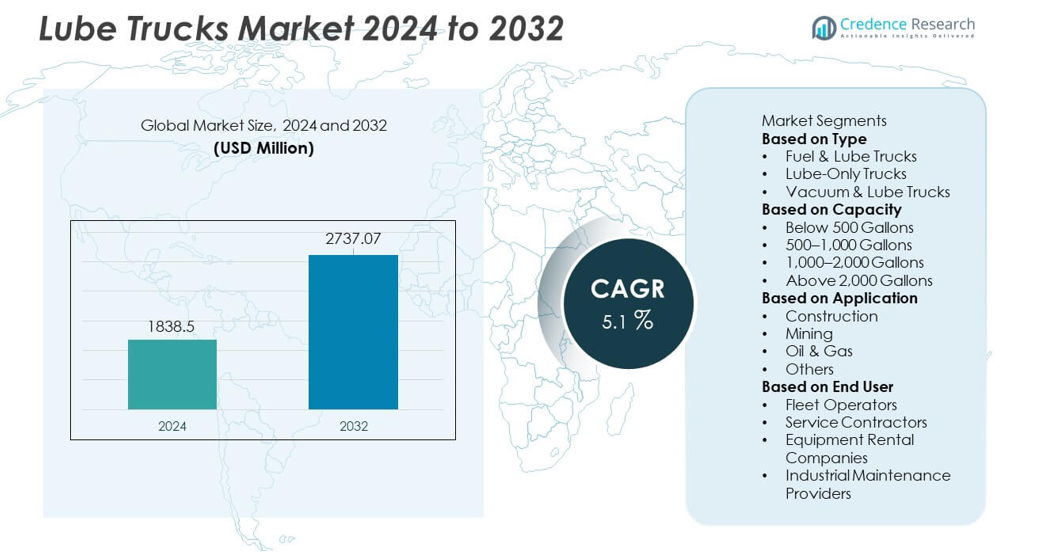
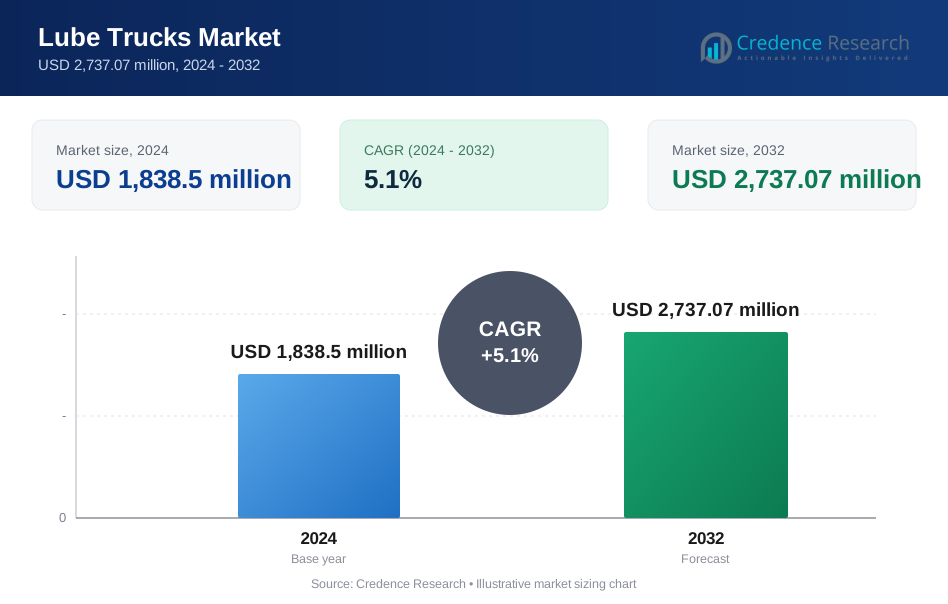
The Lube Trucks market was valued at USD 1,838.5 million in 2024 and is projected to reach USD 2,737.07 million by 2032, expanding at a CAGR of 5.1% during the forecast period.
| REPORT ATTRIBUTE | DETAILS |
|---|---|
| Historical Period | 2020-2023 |
| Base Year | 2024 |
| Forecast Period | 2025-2032 |
| Lube Trucks Market Size 2024 | USD 1,838.5 million |
| Lube Trucks Market, CAGR | 5.1% |
| Lube Trucks Market Size 2032 | USD 2,737.07 million |
The top players in the Lube Trucks market include Taylor Pump & Lift, Maintainer Corporation, Schwarze Industries, Service Trucks International, Amthor International, Knapheide Manufacturing Company, NFE, Summit Truck Bodies, Curry Supply Co., and Valew Quality Truck Bodies. These manufacturers expand their market presence through advanced lubrication systems, multi-compartment tank designs, and robust service truck configurations tailored for construction, mining, and oilfield applications. Asia Pacific leads the global market with a 34% share, driven by rapid infrastructure growth and high machinery deployment. North America follows with a 31% share, supported by strong demand in construction and oil & gas sectors, while Europe holds a 22% share due to stringent maintenance standards and steady industrial activity.
Market Insights
- The Lube Trucks market reached USD 1,838.5 million in 2024 and is projected to reach USD 2,737.07 million by 2032, growing at a CAGR of 5.1% during the forecast period.
- Market growth is driven by rising construction and mining activity, growing demand for onsite equipment servicing, and increased adoption of mobile maintenance fleets, with fuel & lube trucks leading the type segment with a 54% share.
- Key trends include advancements in multi-fluid dispensing systems, rising integration of telematics, and growing use of lightweight, corrosion-resistant materials to enhance durability and efficiency.
- Competitive dynamics intensify as major players invest in modular designs, high-capacity tanks, and advanced pumping systems while expanding dealer networks to strengthen global market reach.
- Asia Pacific leads the regional landscape with a 34% share, followed by North America at 31% and Europe at 22%, supported by infrastructure development, heavy machinery usage, and increased reliance on mobile service trucks across key sectors.
Market Segmentation Analysis:
By Type
Fuel & lube trucks dominate the segment with a 54% market share, supported by strong adoption across construction, mining, and heavy-equipment service fleets. These trucks offer integrated fuel delivery and lubrication systems that reduce downtime and enhance onsite maintenance efficiency. Their ability to support multiple service tasks in remote and high-demand environments drives wider usage across industries with large equipment fleets. Lube-only trucks serve lighter operations but grow slower due to limited functionality, while vacuum & lube trucks retain demand in sectors requiring fluid recovery. Rising emphasis on mobile servicing continues to strengthen demand for fuel & lube units.
- For instance, Taylor Pump & Lift develops and custom-builds a variety of mobile lube systems designed for servicing heavy equipment in the mining, construction, and logging industries, with configurations available such as four 85-gallon oil tanks.
By Capacity
The 1,000–2,000-gallon capacity segment leads with a 47% market share, driven by its suitability for medium to large fleets operating in construction, mining, and oilfield environments. These trucks offer optimal storage for both fuel and lubricants, enabling longer service intervals and efficient deployment across dispersed equipment sites. Units below 500 gallons support compact operations but see limited scalability, while above 2,000-gallon models cater to heavy industrial and large mining sites with higher logistical needs. Increasing project sizes and the need for high-volume mobile servicing continue to propel demand for 1,000–2,000-gallon lube trucks.
- For instance, Maintainer Corporation manufactures custom service trucks that integrate various fluid systems for field maintenance of heavy equipment. These vehicles are designed to support high-pressure grease applications and power multiple fluid reels simultaneously to service machinery like haul trucks and drilling units efficiently.
By Application
Construction applications hold the largest share at 42%, driven by widespread need for onsite servicing of earthmoving machines, loaders, and road-building equipment. Frequent maintenance requirements on busy job sites make mobile lube trucks essential for reducing equipment downtime and improving fleet productivity. Mining operations follow closely, benefiting from large-capacity trucks capable of handling demanding terrain and continuous operations. Oil & gas applications contribute steady demand due to remote field servicing needs. Expanding infrastructure projects and rising equipment utilization strengthen the dominant position of the construction segment in the market.
Key Growth Drivers
Expansion of Construction and Infrastructure Projects
Rapid growth in construction and infrastructure development drives strong demand for lube trucks, as heavy equipment fleets require frequent onsite servicing to maintain productivity. Large project sites rely on mobile lubrication units to reduce downtime, extend equipment life, and streamline maintenance workflows. Governments and private developers continue to invest in road building, mining expansions, and urban development, boosting deployment of high-capacity service trucks. This expansion strengthens the adoption of versatile fuel and lube trucks, especially in regions with growing machinery fleets and remote project locations that depend on mobile maintenance solutions.
- For instance, Curry Supply Co. introduced a service truck platform equipped with a 1,000-gallon fuel tank and a 150-gallon multi-lube system featuring six independent product tanks. The unit also integrates a 20 GPM hydraulic pump that supports rapid servicing of excavators, dozers, and haul trucks across large construction corridors.
Increasing Equipment Utilization in Mining and Oilfield Operations
Mining and oilfield industries operate large, high-value machinery under demanding conditions, creating consistent need for reliable fluid management and lubrication services. Lube trucks support continuous operations by delivering essential fluids directly to remote sites, improving equipment uptime and operational efficiency. Rising extraction activities and expanding drilling operations accelerate demand for high-capacity, heavy-duty service trucks. Companies prioritize mobile servicing to reduce equipment failure risks and extend component life. The push toward productivity optimization and preventive maintenance continues to fuel market growth across mining and oil & gas sectors.
- For instance, Service Trucks International (STI) is a truck dealer that specializes in custom service trucks, including heavy-duty lube truck configurations designed for field servicing of large equipment like mining shovels and drill rigs.
Growing Adoption of Mobile Maintenance Solutions
Industries increasingly shift to mobile maintenance models to minimize equipment downtime and reduce dependency on fixed service facilities. Lube trucks enable onsite servicing of mixed equipment fleets, offering integrated fuel, oil, coolant, and grease delivery capabilities. This shift is driven by the need for faster turnaround times and cost-effective servicing, especially in remote or large operational zones. Fleet operators recognize the value of mobile lubrication units in improving workflow efficiency and maintaining consistent maintenance schedules. The rising complexity of modern machinery further strengthens the demand for specialized mobile service trucks.
Key Trends & Opportunities
Advancements in Customizable and High-Capacity Truck Designs
Manufacturers offer more flexible and customizable lube truck configurations to support diverse industry needs, including multi-product tanks, automated dispensing, and advanced filtration systems. High-capacity models see strong demand in mining and oilfield operations, while mid-sized units support construction and fleet management companies. Technological improvements in pumping systems, metering accuracy, and onboard diagnostics create new opportunities for efficiency-focused buyers. Lightweight materials and corrosion-resistant components further enhance durability. The market benefits from growing interest in modular designs that allow operators to tailor trucks for specific service requirements.
- For instance, Amthor International manufactures a range of highly customizable lube bodies with multi-compartment tank designs, superior pumping systems, and various hose reel options.
Integration of Telematics and Remote Monitoring Systems
A rising trend involves integrating telematics, GPS tracking, and digital fluid monitoring systems into lube trucks to improve service accuracy and maintenance planning. These technologies enable real-time tracking of fluid usage, service intervals, and equipment performance, helping operators enhance operational transparency. Remote monitoring supports predictive maintenance and reduces service delays, especially in distributed work environments. Digitalized workflow management systems allow better coordination between service trucks and heavy-equipment operators. This technological shift presents significant opportunities for manufacturers offering smart, data-enabled service solutions.
- For instance, Knapheide Manufacturing Company integrated a telematics suite that logs over 40 onboard data points, including pump cycles, tank levels, and engine diagnostics.
Key Challenges
High Initial Investment and Operating Costs
Lube trucks require substantial upfront investment due to specialized components such as multi-section tanks, pumping systems, and metering equipment. Maintenance costs, fuel expenses, and compliance-related upgrades further increase ownership costs for fleet operators. Smaller contractors and rental companies often face financial barriers to adopting high-capacity units. These cost constraints limit market penetration in price-sensitive regions. Operators must balance long-term efficiency benefits with high capital requirements, which can slow overall market growth.
Operational Challenges in Remote and Harsh Environments
Lube trucks operating in mining sites, oilfields, and rugged construction zones face harsh conditions that impact vehicle performance and service reliability. Extreme temperatures, rough terrain, and limited access routes increase wear on pumping systems and onboard components. Ensuring consistent fluid delivery in remote environments requires advanced equipment durability and skilled operators. These environmental challenges push manufacturers to enhance truck strength and reliability, but they also raise operational costs and complicate maintenance efforts.
Regional Analysis
orth America
North America holds a 31% market share, supported by strong demand from construction, mining, and oilfield operations that rely heavily on mobile maintenance fleets. The United States leads usage due to extensive infrastructure development and high equipment utilization across large project sites. Fleet operators adopt lube trucks to reduce downtime and improve service efficiency for heavy machinery. The region’s robust rental equipment market also contributes to steady adoption. Investments in shale exploration and expansion of large civil works projects continue to reinforce demand, positioning North America as a key contributor to global market growth.
Europe
Europe accounts for a 22% market share, driven by the region’s well-established construction sector, strict equipment maintenance standards, and high adoption of advanced service vehicles. Countries such as Germany, the United Kingdom, and France exhibit strong demand due to ongoing infrastructure upgrades and large-scale industrial projects. Fleet operators prioritize high-efficiency lube trucks equipped with advanced pumping and metering systems to meet operational and regulatory requirements. Growing focus on environmental compliance boosts preference for modern units with spill-control features. Continuous investment in road development and industrial maintenance strengthens Europe’s position in the global market.
Asia Pacific
Asia Pacific dominates the market with a 34% share, supported by rapid urbanization, large mining operations, and extensive construction activity across China, India, and Southeast Asia. Heavy machinery usage continues to rise due to large-scale infrastructure projects, prompting strong adoption of mobile lubrication solutions. Mining regions in Australia and Indonesia further drive demand for high-capacity lube trucks designed for harsh conditions. The expansion of oil & gas exploration, industrial corridors, and public infrastructure enhances market growth. Increasing equipment rental activity and modernization of maintenance practices solidify Asia Pacific’s leadership in the global landscape.
Latin America
Latin America holds a 7% market share, driven by mining-intensive economies such as Brazil, Chile, and Peru, where large off-road equipment requires frequent onsite servicing. Construction projects across Mexico and Colombia also contribute to rising adoption of lube trucks to support heavy machinery uptime. The oil & gas sector provides additional momentum through demand for mobile maintenance in remote drilling regions. Although investment cycles fluctuate with economic conditions, modernization of fleet operations and the growth of contract mining services support steady long-term demand across the region.
Middle East & Africa
The Middle East & Africa region accounts for a 6% market share, supported by strong oilfield activity, mining operations, and construction projects across Saudi Arabia, the UAE, South Africa, and Oman. Harsh environmental conditions increase the need for durable and high-capacity lube trucks that can support remote field service operations. Major infrastructure development programs and expansion of industrial hubs reinforce the requirement for reliable mobile maintenance units. The region’s focus on equipment uptime and operational efficiency continues to drive adoption, despite varying investment levels across different economies.
Market Segmentations:
By Type
- Fuel & Lube Trucks
- Lube-Only Trucks
- Vacuum & Lube Trucks
By Capacity
- Below 500 Gallons
- 500–1,000 Gallons
- 1,000–2,000 Gallons
- Above 2,000 Gallons
By Application
- Construction
- Mining
- Oil & Gas
- Others
By End User
- Fleet Operators
- Service Contractors
- Equipment Rental Companies
- Industrial Maintenance Providers
By Geography
- North America
- U.S.
- Canada
- Mexico
- Europe
- Germany
- France
- U.K.
- Italy
- Spain
- Rest of Europe
- Asia Pacific
- China
- Japan
- India
- South Korea
- South-east Asia
- Rest of Asia Pacific
- Latin America
- Brazil
- Argentina
- Rest of Latin America
- Middle East & Africa
- GCC Countries
- South Africa
- Rest of the Middle East and Africa
Competitive Landscape
The competitive landscape includes major players such as Taylor Pump & Lift, Maintainer Corporation, Schwarze Industries, Service Trucks International, Amthor International, Knapheide Manufacturing Company, NFE, Summit Truck Bodies, Curry Supply Co., and Valew Quality Truck Bodies. These companies strengthen their market presence through advanced lube truck designs that integrate multi-fluid tanks, high-pressure pumping systems, precision metering, and spill-control features. Manufacturers focus on customization to meet the diverse needs of construction, mining, oilfield, and fleet maintenance operations. Strategic expansions in fabrication facilities and dealer networks support faster delivery and wider geographical coverage. Many players invest in lightweight materials, corrosion-resistant components, and automation-ready configurations to enhance durability and operational efficiency. Partnerships with heavy-equipment OEMs and rental fleet operators help expand service-ready truck offerings. Continuous innovation in ergonomics, safety features, and modular layouts enables companies to maintain strong competitiveness in the global lube trucks market.\
Key Player Analysis
- Taylor Pump & Lift
- Maintainer Corporation
- Schwarze Industries
- Service Trucks International
- Amthor International
- Knapheide Manufacturing Company
- NFE (North Frontenac Equipment)
- Summit Truck Bodies
- Curry Supply Co.
- Valew Quality Truck Bodies
Recent Developments
- In July 2025, Taylor Pump & Lift began a series of blog posts, continuing through to at least November 2025, highlighting how lube trucks and related equipment can help mining operations and save costs for construction operators.
- In 2025, Taylor Pump & Lift offered “2025 Lube Bodies” with custom build-to-order options - both enclosed or open bodies, and choices of air or hydraulic pump systems.
Report Coverage
The research report offers an in-depth analysis based on Type, Capacity, Application, End User and Geography. It details leading market players, providing an overview of their business, product offerings, investments, revenue streams, and key applications. Additionally, the report includes insights into the competitive environment, SWOT analysis, current market trends, as well as the primary drivers and constraints. Furthermore, it discusses various factors that have driven market expansion in recent years. The report also explores market dynamics, regulatory scenarios, and technological advancements that are shaping the industry. It assesses the impact of external factors and global economic changes on market growth. Lastly, it provides strategic recommendations for new entrants and established companies to navigate the complexities of the market.
Future Outlook
- Demand for lube trucks will rise as construction and mining fleets expand worldwide.
- Mobile maintenance solutions will gain traction to reduce equipment downtime on remote sites.
- High-capacity and multi-fluid truck designs will see stronger adoption across heavy industries.
- Integration of telematics and digital fluid monitoring will become standard for fleet optimization.
- Lightweight and corrosion-resistant materials will improve truck durability and performance.
- Oil & gas field operations will increase deployment of lube trucks for safer and faster servicing.
- Equipment rental companies will expand service truck fleets to meet customer maintenance needs.
- Customizable lube truck configurations will create new opportunities for specialized applications.
- Asia Pacific will strengthen its lead due to rapid infrastructure growth and mining expansion.
- Manufacturers will focus on ergonomic designs and advanced safety systems to enhance operator efficiency.
Request a Free Sample
Fill in your details and we'll send you a free sample report.
- Sample data tables & charts
- Research methodology
Market Dynamics
Expansion of Construction and Infrastructure Projects
Rapid growth in construction and infrastructure development increases the need for onsite servicing of heavy equipment, driving demand for lube trucks that reduce downtime and extend machinery life on large project sites.
Increasing Equipment Utilization in Mining and Oilfield Operations
Mining and oilfield sectors operate high-value machinery in remote and demanding environments, creating consistent demand for mobile lube trucks to deliver essential fluids and support continuous operations.
Growing Adoption of Mobile Maintenance Solutions
Industries are shifting toward mobile maintenance models to minimize equipment downtime and reduce reliance on fixed service facilities, making lube trucks essential for efficient onsite servicing of mixed equipment fleets.
Advancements in Customizable and High-Capacity Truck Designs
Manufacturers are offering more flexible, high-capacity, and modular lube truck configurations with advanced fluid management systems, meeting the diverse needs of construction, mining, and oilfield operators and enabling longer service intervals.
Integration of Telematics and Remote Monitoring
The adoption of telematics, GPS tracking, and digital fluid monitoring in lube trucks enhances service accuracy, predictive maintenance, and operational transparency, making these vehicles more attractive to fleet operators seeking efficiency and data-driven management.
Need a Custom Version of This Report?
Tailor the scope, geography, or segments to your exact requirements.
- Custom geography or segment scope
- Direct access to our analyst team
Frequently Asked Questions
What is the current market size for the Lube Trucks market, and what is its projected size in 2032?
At what Compound Annual Growth Rate is the Lube Trucks market projected to grow between 2025 and 2032?
Which is the leading region of the market for lube trucks?
What are the key drivers for the growth of the lube truck market?
Which is the major segment in the lube trucks market by application?
Who are the leading companies in the Lube Trucks market?
Table of Content
Chapter 1 Market Segmentation
- 1.1 Segmentation Framework
- 1.1.1 Product and Service Classification
- 1.1.2 Application and End-Use Classification
- 1.1.3 Technology and Solution Classification
- 1.1.4 Customer and Distribution Channel Classification
- 1.1.5 Geographic Segmentation
- 1.1.6 Market Segment Definitions and Boundaries
- 1.2 By Type
- 1.2.1 Fuel & Lube Trucks
- 1.2.2 Lube-Only Trucks
- 1.2.3 Vacuum & Lube Trucks
- 1.3 By Capacity
- 1.3.1 Below 500 Gallons
- 1.3.2 500–1,000 Gallons
- 1.3.3 1,000–2,000 Gallons
- 1.3.4 Above 2,000 Gallons
- 1.4 By End User
- 1.4.1 Fleet Operators
- 1.4.2 Service Contractors
- 1.4.3 Equipment Rental Companies
- 1.4.4 Industrial Maintenance Providers
- 1.5 By Application
- 1.5.1 Construction
- 1.5.2 Mining
- 1.5.3 Oil & Gas
- 1.5.4 Others
Chapter 2 Introduction
- 2.1 Report Objectives and Scope
- 2.2 Product Definition and Industry Terminology
- 2.3 Market Inclusions and Exclusions
- 2.4 Research Process
- 2.4.1 Primary Research and Expert Interviews
- 2.4.2 Secondary Research and Source Review
- 2.4.3 Top-Down and Bottom-Up Estimation
- 2.4.4 Data Triangulation and Verification
- 2.5 Market Size Measurement Basis
- 2.5.1 2024: USD 1,838.5 million → 2032: USD 2,737.07 million
- 2.6 Historical and Forecast Reference Periods
- 2.6.1 Base Year: 2024
- 2.6.2 Forecast Period: 2024-2032
- 2.7 Research Assumptions and Limitations
Chapter 3 Executive Summary
- 3.1 Market Snapshot and Key Findings
- 3.2 Base-Year Market Size, 2024
- 3.3 Forecast Market Size, 2032
- 3.4 Revenue and Volume Growth Outlook
- 3.5 Key Demand and Supply Indicators
- 3.6 Leading Market Segments
- 3.7 Fastest-Growing Market Opportunities
- 3.8 Regional Performance Highlights
- 3.9 Technology and Industry Transformation
- 3.10 Competitive Landscape Summary
- 3.11 Analyst View and Strategic Implications
Chapter 4 Global Lube Trucks Market Trends and Developments
- 4.1 Historical Industry Development
- 4.2 Recent Market Trends and Developments
- 4.3 Demand and Customer Behavior Trends
- 4.4 Technology and Product Innovation
- 4.5 Artificial Intelligence, Automation and Digitalization
- 4.6 Local Manufacturing and Supply Chain Realignment
- 4.7 Industry Partnerships, Mergers and Acquisitions
- 4.8 Sustainability and Circular Economy Developments
- 4.9 Government and Private Sector Investment Trends
- 4.10 Emerging Business Models and Commercialization
- 4.11 Industry Developments and Announcements
Chapter 5 Global Lube Trucks Market Production, Supply and Demand Analysis
- 5.1 Demand Trend and Consumption Analysis
- 5.2 Demand Forecast, 2024-2032
- 5.3 Production and Output Trend
- 5.4 Production and Output Forecast, 2024-2032
- 5.5 Installed Capacity and Capacity Utilization
- 5.6 Company-Wise Production Plants and Statistics
- 5.6.1 Installed Production Capacity
- 5.6.2 Actual Production
- 5.6.3 Planned Capacity and Expansion Targets
- 5.7 Supply Chain Structure and Procurement Trends
- 5.8 Supply-Demand Gap and Bottlenecks
- 5.9 Import Dependence and Sourcing Structure
- 5.10 Contract Manufacturing and Outsourcing
- 5.11 Regional Supply and Demand Concentration
Chapter 6 Global Lube Trucks Market Pricing Analysis
- 6.1 Pricing Structure and Measurement
- 6.2 Historical Pricing Trends
- 6.3 Pricing Outlook, 2024-2032
- 6.4 Average Selling Price and Unit Economics
- 6.5 Pricing by Product and Market Segment
- 6.6 Geographic Pricing Differences
- 6.7 Key Input, Energy, Labor and Logistics Costs
- 6.8 Contract Pricing and Purchasing Models
- 6.9 Pricing Sensitivity and Competitive Positioning
- 6.10 Price, Margin and Profitability Implications
Chapter 7 Global Lube Trucks Market Dynamics
- 7.1 Market Growth Drivers
- 7.1.1 Demand-Side Drivers
- 7.1.2 Technology and Innovation Drivers
- 7.1.3 Infrastructure and Investment Drivers
- 7.1.4 Regulatory and Policy Drivers
- 7.2 Market Restraints
- 7.2.1 Cost and Affordability Constraints
- 7.2.2 Technology and Adoption Barriers
- 7.2.3 Supply Chain and Operational Constraints
- 7.3 Market Challenges
- 7.3.1 Competitive Pressure and Margin Erosion
- 7.3.2 Skills, Infrastructure and Implementation Gaps
- 7.4 Emerging Market Opportunities
- 7.5 Market Dynamics Impact and Time-Horizon Assessment
Chapter 8 Global Lube Trucks Value Chain Analysis
- 8.1 Industry Value Chain Overview
- 8.2 Upstream Suppliers and Critical Inputs
- 8.3 Technology and Component Providers
- 8.4 Manufacturing or Service Delivery
- 8.5 Distribution, Channel Partners and Integrators
- 8.6 Downstream Applications and End Users
- 8.7 Value Addition and Profit Pools
- 8.8 Vertical Integration and Outsourcing
- 8.9 Supplier Concentration and Risk
- 8.10 Supply Chain Localization and Resilience
Chapter 9 Global Lube Trucks Market Regulations and Policies
- 9.1 Relevant Laws, Standards and Compliance Frameworks
- 9.2 Product, Service, Safety and Quality Requirements
- 9.3 Government Policies, Incentives and Subsidies
- 9.4 Imports, Exports and Trade Barriers
- 9.5 Public Procurement and Local Content Requirements
- 9.6 Environmental and Sustainability Compliance
- 9.7 Upcoming Policy Changes and Market Implications
Chapter 10 Global Lube Trucks Market Hotspots and Opportunities
- 10.1 Market Opportunity Mapping and Growth Hotspots
- 10.2 High-Growth Applications and Customer Groups
- 10.3 Underserved Markets and White-Space Opportunities
- 10.4 Emerging Technology and Product Opportunities
- 10.5 New Capacity and Investment Hotspots
- 10.6 Market Entry and Expansion Opportunities
- 10.7 Distribution and Partnership Opportunities
- 10.8 Near-Term and Long-Term Commercial Potential
- 10.9 Opportunity Attractiveness and Execution Risks
Chapter 11 Global Lube Trucks Market Outlook, 2024-2032
- 11.1 Market Size and Analysis
- 11.1.1 Revenue (Market Measurement: 2024: USD 1,838.5 million → 2032: USD 2,737.07 million)
- 11.1.2 Market Volume and Quantity Sold
- 11.1.3 Historical Market Size
- 11.1.4 Base-Year Market Size, 2024
- 11.2 Market Forecast, 2024-2032
- 11.2.1 Revenue Forecast to 2032
- 11.2.2 Volume Forecast to 2032
- 11.2.3 CAGR and Year-on-Year Growth
- 11.2.4 Incremental Revenue Opportunity
- 11.3 Forecast Assumptions and Scenario Analysis
- 11.3.1 Base-Case Forecast
- 11.3.2 Optimistic and Conservative Scenarios
- 11.3.3 Technology, Pricing and Policy Sensitivities
- 11.4 Market Attractiveness and Growth Outlook
Chapter 12 Global Lube Trucks Market Segmentation and Outlook
- 12.1 Segmentation Summary and Market Shares, 2024
- 12.2 Largest and Fastest-Growing Segments
- 12.3 By Type - Market Size and Forecast, 2024-2032
- 12.3.1 Segment Definition and Scope
- 12.3.2 Historical Market Size
- 12.3.3 Revenue Forecast, 2024-2032
- 12.3.4 Volume Forecast, 2024-2032
- 12.3.5 Base-Year Market Share, 2024
- 12.3.6 Segment CAGR and Growth Drivers
- 12.3.7 Subsegment Market Size and Forecast
- 12.3.7.1 Fuel & Lube Trucks
- 12.3.7.2 Lube-Only Trucks
- 12.3.7.3 Vacuum & Lube Trucks
- 12.3.8 Subsegment Pricing and Adoption Trends
- 12.3.9 Leading Suppliers and Competition
- 12.3.10 Regional Demand and Opportunities
- 12.4 By Capacity - Market Size and Forecast, 2024-2032
- 12.4.1 Segment Definition and Scope
- 12.4.2 Historical Market Size
- 12.4.3 Revenue Forecast, 2024-2032
- 12.4.4 Volume Forecast, 2024-2032
- 12.4.5 Base-Year Market Share, 2024
- 12.4.6 Segment CAGR and Growth Drivers
- 12.4.7 Subsegment Market Size and Forecast
- 12.4.7.1 Below 500 Gallons
- 12.4.7.2 500–1,000 Gallons
- 12.4.7.3 1,000–2,000 Gallons
- 12.4.7.4 Above 2,000 Gallons
- 12.4.8 Subsegment Pricing and Adoption Trends
- 12.4.9 Leading Suppliers and Competition
- 12.4.10 Regional Demand and Opportunities
- 12.5 By End User - Market Size and Forecast, 2024-2032
- 12.5.1 Segment Definition and Scope
- 12.5.2 Historical Market Size
- 12.5.3 Revenue Forecast, 2024-2032
- 12.5.4 Volume Forecast, 2024-2032
- 12.5.5 Base-Year Market Share, 2024
- 12.5.6 Segment CAGR and Growth Drivers
- 12.5.7 Subsegment Market Size and Forecast
- 12.5.7.1 Fleet Operators
- 12.5.7.2 Service Contractors
- 12.5.7.3 Equipment Rental Companies
- 12.5.7.4 Industrial Maintenance Providers
- 12.5.8 Subsegment Pricing and Adoption Trends
- 12.5.9 Leading Suppliers and Competition
- 12.5.10 Regional Demand and Opportunities
- 12.6 By Application - Market Size and Forecast, 2024-2032
- 12.6.1 Segment Definition and Scope
- 12.6.2 Historical Market Size
- 12.6.3 Revenue Forecast, 2024-2032
- 12.6.4 Volume Forecast, 2024-2032
- 12.6.5 Base-Year Market Share, 2024
- 12.6.6 Segment CAGR and Growth Drivers
- 12.6.7 Subsegment Market Size and Forecast
- 12.6.7.1 Construction
- 12.6.7.2 Mining
- 12.6.7.3 Oil & Gas
- 12.6.7.4 Others
- 12.6.8 Subsegment Pricing and Adoption Trends
- 12.6.9 Leading Suppliers and Competition
- 12.6.10 Regional Demand and Opportunities
- 12.7 Segment Growth Comparison
- 12.8 Segment Attractiveness and Priority Matrix
Chapter 13 Global Lube Trucks End-Use and Application Market Outlook
- 13.1 End-Use Industry and Customer Demand Structure
- 13.2 Leading Applications and Customer Groups
- 13.3 End-Use Market Size, Share and Forecast
- 13.4 Major End-Use Industry Deep Dives
- 13.4.1 Customer Requirements and Use Cases
- 13.4.2 Demand and Replacement Cycles
- 13.4.3 Technical and Regulatory Considerations
- 13.4.4 Purchasing and Procurement Models
- 13.4.5 Leading Vendors and Distribution Channels
- 13.4.6 Forecast and Commercial Opportunities
- 13.5 Emerging Applications and Cross-Segment Demand
- 13.6 End-Use Industry Investment Priorities
Chapter 14 Global Lube Trucks Geographic Market Outlook, 2024-2032
- 14.1 Regional Market Size and Share, 2024
- 14.2 Regional Market Forecast, 2024-2032
- 14.3 Regional Pricing, Production and Demand Differences
- 14.4 North America
- 14.4.1 United States
- 14.4.2 Canada
- 14.4.3 Mexico
- 14.5 Europe
- 14.5.1 Germany
- 14.5.2 France
- 14.5.3 Italy
- 14.5.4 United Kingdom
- 14.5.5 Spain
- 14.5.6 Poland
- 14.5.7 Russia
- 14.5.8 Netherlands
- 14.5.9 Belgium
- 14.5.10 Sweden
- 14.5.11 Denmark
- 14.5.12 Norway
- 14.5.13 Rest of Europe
- 14.6 Asia Pacific
- 14.6.1 China
- 14.6.2 India
- 14.6.3 Japan
- 14.6.4 South Korea
- 14.6.5 Thailand
- 14.6.6 Indonesia
- 14.6.7 Vietnam
- 14.6.8 Malaysia
- 14.6.9 Australia
- 14.6.10 Rest of Asia Pacific
- 14.7 Latin America
- 14.7.1 Brazil
- 14.7.2 Argentina
- 14.7.3 Colombia
- 14.7.4 Chile
- 14.7.5 Rest of Latin America
- 14.8 Middle East
- 14.8.1 Saudi Arabia
- 14.8.2 United Arab Emirates
- 14.8.3 Turkey
- 14.8.4 Israel
- 14.8.5 Iran
- 14.8.6 Rest of the Middle East
- 14.9 Africa
- 14.9.1 South Africa
- 14.9.2 Egypt
- 14.9.3 Nigeria
- 14.9.4 Morocco
- 14.9.5 Rest of Africa
- 14.10 Regional Investment, Policy and Supply Chain Differences
- 14.11 Regional Competitive Landscape
- 14.12 Geographic Growth Hotspots
Chapter 15 Global Lube Trucks Technology, Innovation and Sustainability Outlook
- 15.1 Technology Landscape and Maturity
- 15.2 Product, Process and Service Innovation
- 15.3 AI, Automation and Digital Tools in the Industry
- 15.4 Technology Adoption and Performance Benchmarking
- 15.5 Innovation Pipeline and R&D Investment
- 15.6 Patent and Intellectual Property Trends
- 15.7 Energy Efficiency and Resource Management
- 15.8 Sustainability, Recycling and Circularity
- 15.9 Technology Roadmap, 2024-2032
- 15.10 Risks of Obsolescence and Technology Substitution
Chapter 16 Global Lube Trucks Market Key Strategic Imperatives
- 16.1 Growth and Market Entry Priorities
- 16.2 High-Return Products and Segments
- 16.3 Pricing, Profitability and Cost Optimization
- 16.4 Technology Investment and Product Differentiation
- 16.5 Supply Chain Localization and Resilience
- 16.6 Distribution and Customer Acquisition
- 16.7 Partnership, Acquisition and Capacity Strategy
- 16.8 Regional Expansion Priorities
- 16.9 Short-, Medium- and Long-Term Actions
Chapter 17 Competition Outlook
- 17.1 Industry Competition Characteristics
- 17.2 Market Structure and Concentration
- 17.3 Market Share and Competitive Positioning, 2024
- 17.4 Company-Wise Revenue and Product Benchmarking
- 17.5 Production and Service Capacity Benchmarking
- 17.6 Technology, Pricing and Differentiation
- 17.7 Regional Footprint and Distribution Strength
- 17.8 Mergers, Acquisitions and Strategic Alliances
- 17.9 New Entrants and Competitive Threats
- 17.10 Porter's Five Forces and Industry Attractiveness
- 17.11 Competitive Outlook, 2024-2032
Chapter 18 Company Profiles
- 18.1 Company Coverage and Selection Criteria
- 18.2 Taylor Pump & Lift
- 18.2.1 Business Description
- 18.2.2 Company Ownership and Geographic Presence
- 18.2.3 Product and Service Portfolio
- 18.2.4 Manufacturing and Operating Footprint
- 18.2.5 Production Capacity and Expansion Plans
- 18.2.6 Financial Performance and Investment
- 18.2.7 Market Share and Competitive Position
- 18.2.8 Technology and Innovation Capabilities
- 18.2.9 Strategic Alliances or Partnerships
- 18.2.10 Recent Developments
- 18.2.11 Growth Strategy and Outlook
- 18.3 Maintainer Corporation
- 18.4 Schwarze Industries
- 18.5 Service Trucks International
- 18.6 Amthor International
- 18.7 Knapheide Manufacturing Company
- 18.8 NFE (North Frontenac Equipment)
- 18.9 Summit Truck Bodies
- 18.10 Curry Supply Co.
- 18.11 Valew Quality Truck Bodies
- 18.12 Other Relevant Market Participants
Note: Every listed company is profiled on the structure shown under the first company. The company list is preliminary and may change based on research findings, market developments, data availability and client requirements.
Chapter 19 Disclaimer
- 19.1 Research and Forecast Disclaimer
- 19.2 Data Source and Estimation Limitations
Note: The depth of individual sections depends on data availability for this market. Volume, capacity, trade and other unit-based metrics are included where applicable.