
Market Overview:
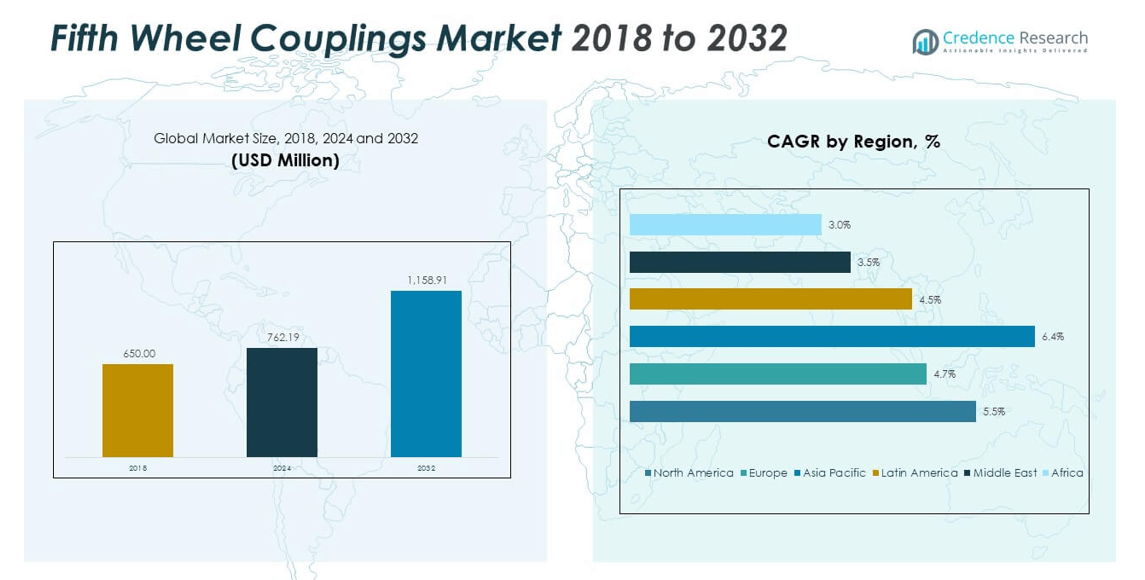
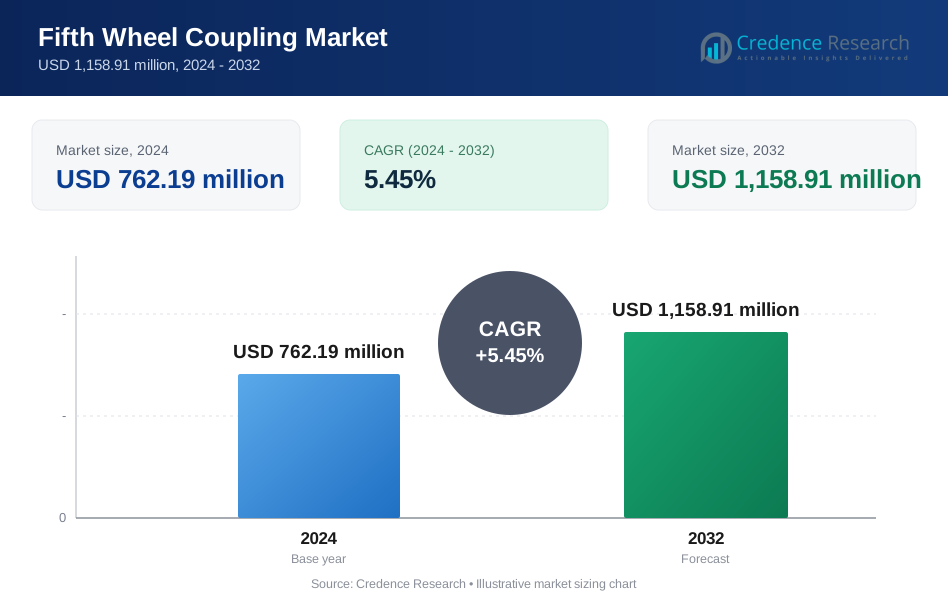
The Fifth Wheel Coupling Market size was valued at USD 650.00 million in 2018 to USD 762.19 million in 2024 and is anticipated to reach USD 1,158.91 million by 2032, at a CAGR of 5.45% during the forecast period.
| REPORT ATTRIBUTE | DETAILS |
|---|---|
| Historical Period | 2020-2023 |
| Base Year | 2024 |
| Forecast Period | 2025-2032 |
| Fifth Wheel Coupling Market Size 2024 | USD 53,989.35 million |
| Fifth Wheel Coupling Market, CAGR | 5.45% |
| Fifth Wheel Coupling Market Size 2032 | USD 1,158.91 million |
Strong demand for heavy-duty freight transport and logistics expansion drives steady growth in the market. Manufacturers design advanced coupling systems that enhance safety, load stability, and driver efficiency. Rising e-commerce and cross-border trade increase the need for durable components across large fleets. Companies adopt lightweight, high-strength materials to improve fuel performance and reduce maintenance costs. Regulatory focus on transport safety encourages use of standardized and certified couplings. Automation in coupling mechanisms further boosts operational convenience and uptime.
North America leads the market with strong trucking networks and established logistics infrastructure. Europe maintains consistent demand supported by strict safety standards and heavy industrial transport use. Asia Pacific emerges as the fastest-growing region with expanding construction, trade, and e-commerce activities in China and India. Latin America and the Middle East show stable adoption due to infrastructure upgrades, while Africa progresses gradually through regional logistics investments.
Market Insights:
- The Fifth Wheel Coupling Market was valued at USD 650.00 million in 2018, reached USD 762.19 million in 2024, and is projected to achieve USD 1,158.91 million by 2032, growing at a CAGR of 5.45% during the forecast period.
- Asia Pacific leads with a 36% market share, supported by expanding logistics, e-commerce, and infrastructure growth across China and India.
- North America holds about 28.5% share, driven by strong freight transport and established truck manufacturing networks, while Europe follows with 24% share supported by strict safety standards and industrial trade activity.
- Asia Pacific is also the fastest-growing region at a CAGR of 6.4%, benefiting from rising industrialization, high vehicle production, and increasing fleet modernization initiatives.
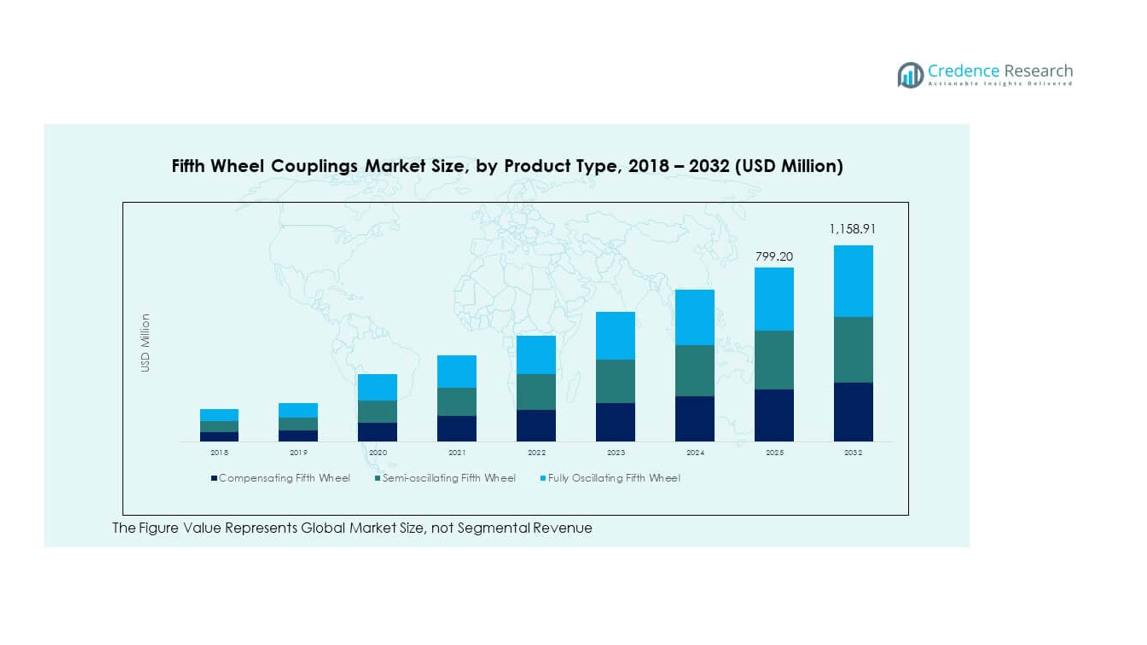
- By product segmentation, Compensating Fifth Wheel leads with 42% share, followed by Semi-Oscillating Fifth Wheel at 34%, while Fully Oscillating Fifth Wheel captures 24%, reflecting diverse adoption across heavy-duty and off-road applications.
Market Drivers
Rising Freight Transportation Demand Strengthening Global Market Expansion
Expanding trade and logistics networks increase the demand for efficient heavy-duty trucks, boosting the Fifth Wheel Coupling Market. It supports secure connection between tractors and trailers, which enhances safety and stability in freight movement. The rapid growth in e-commerce and international shipping requires more trucks for long-distance hauling. This trend pushes manufacturers to design durable coupling systems that sustain high loads and extended travel. Fleet owners invest in advanced couplings that ensure reliable operation across challenging terrains. Fuel efficiency concerns drive the use of lightweight materials without sacrificing strength. Increasing replacement cycles due to high vehicle usage further accelerate adoption. This steady rise in road freight creates continuous growth potential for the market.
Integration of Advanced Safety and Automation Technologies
Growing emphasis on vehicle safety encourages integration of automated locking mechanisms, sensors, and remote monitoring in coupling systems. These upgrades reduce the risk of trailer separation, improving operational safety standards. It ensures better driver convenience through easy coupling and uncoupling functions. Fleet operators adopt automation to lower human errors and downtime. Regulatory focus on load stability pushes companies to comply with strict safety certifications. Manufacturers expand R&D to develop electronically controlled couplings compatible with intelligent transport systems. Smart technology improves inspection accuracy, reducing maintenance intervals and enhancing reliability. This trend supports stronger global acceptance across logistics and commercial vehicle industries.
- For instance, JOST's fifth wheels incorporate no-slack technology with locking mechanisms tested to 300,000 cycles, reducing separation risks. These upgrades reduce the risk of trailer separation, improving operational safety standards.
Shift Toward Lightweight and Fuel-Efficient Materials
Sustainability drives the preference for high-strength steel and composite alloys in coupling production. It helps reduce overall truck weight, improving fuel efficiency and cutting emissions. Transport companies favor lightweight solutions to meet carbon targets and reduce operational costs. Material innovation strengthens mechanical durability while maintaining ease of maintenance. Suppliers test corrosion-resistant coatings for longer product life in tough environments. These advancements align with global goals for energy conservation and emission reduction. Demand for eco-friendly and high-performance couplings continues to increase across developed markets. The focus on material efficiency propels continuous innovation among leading manufacturers.
- For instance, Fontaine’s No-Slack 6000 Series fifth wheels are built from high-strength stamped steel, offering improved durability and reduced weight compared to earlier steel models. The design enhances coupling precision and long-term performance for heavy-duty trucking operations.
Expansion of Logistics Infrastructure and Fleet Modernization
Rapid urbanization and industrialization fuel investment in new logistics hubs and highways, increasing trailer volumes. It boosts demand for modern coupling systems compatible with larger fleets. Governments fund infrastructure upgrades to improve road freight capacity, encouraging fleet modernization. Truck manufacturers collaborate with coupling suppliers for standardized mounting systems and faster assembly. Replacement of old fleets with high-capacity vehicles improves operational reliability. Long-distance cargo transport in emerging economies further strengthens the market outlook. Companies focus on supply chain expansion to address rising transportation needs. This infrastructure development keeps the Fifth Wheel Coupling Market on a steady growth trajectory.
Market Trends
Adoption of Smart and Connected Coupling Technologies
Integration of IoT-enabled components transforms the Fifth Wheel Coupling Market toward real-time monitoring and predictive maintenance. Smart couplings equipped with sensors detect locking accuracy, wear levels, and alignment status. Fleet operators use this data to reduce breakdown risks and improve uptime. It enhances operational efficiency by predicting servicing needs before failures occur. Manufacturers introduce Bluetooth-enabled systems that transmit safety alerts to control centers. This trend fits with the broader shift toward digital fleet management. Continuous connectivity creates opportunities for data-driven optimization and improved asset utilization. Smart technology integration strengthens product reliability and fleet safety globally.
Rising Popularity of Modular and Customizable Coupling Designs
Flexible coupling configurations are gaining traction to meet varied trailer sizes and operating conditions. It allows manufacturers to provide modular systems that simplify maintenance and reduce downtime. Logistics operators demand tailor-made designs compatible with different truck models and regional standards. Compact and adjustable couplings improve maneuverability for urban deliveries. Manufacturers adopt modular production to streamline assembly and reduce material waste. The focus on design flexibility improves global standardization and aftermarket service. Customization supports wider industry adoption among mixed fleets. This ongoing trend reinforces innovation and enhances market competitiveness.
- For instance, JOST’s JSK 37 C Series features built-in sensors providing real-time data for secure connections, available in multiple height options like 160 mm and 190 mm pedestals.
Growing Demand for Aftermarket Replacement and Servicing Solutions
Heavy vehicle wear and frequent coupling disconnections increase demand for aftermarket products and maintenance kits. It encourages suppliers to establish global service networks with faster part availability. Operators prefer certified replacement systems to ensure compliance with safety norms. Rising freight volumes create consistent replacement opportunities across aging fleets. Manufacturers expand warranty and maintenance programs to retain customer loyalty. Specialized workshops provide on-site inspection and repair services, reducing downtime. Aftermarket sales become a stable revenue source for global players. The emphasis on performance and reliability drives steady aftermarket expansion.
- For instance, JOST’s KKS automatic coupling system integrates replaceable wear plates in models like JSK52, supporting a D-Value of 400 kN and an imposed load of 75 t for extended service life.
Increased Focus on Sustainability and Emission Reduction Initiatives
Environmental policies encourage low-emission trucking technologies and eco-friendly manufacturing. It pushes producers to design lightweight and recyclable coupling materials. Governments promote sustainable transportation systems, prompting adoption of energy-efficient equipment. Trucking companies adopt green logistics standards, including fuel-efficient trailers and couplings. New coatings reduce friction losses, improving overall energy use. The focus on circular manufacturing models promotes material recovery and reuse. Market players strengthen sustainability credentials through innovation in design and process efficiency. These practices enhance brand value and long-term industry growth.
Market Challenges Analysis
High Maintenance Costs and Complex Operational Requirements
Maintenance complexity remains a significant barrier for smaller logistics companies operating under cost pressure. It requires skilled technicians and regular inspection to ensure mechanical safety and locking reliability. High wear rates in extreme conditions increase service costs and downtime. Smaller operators struggle with parts availability, affecting operational continuity. Regulations demanding frequent checks raise overall maintenance expenses. It limits adoption among older fleets with limited budgets. Equipment malfunction can lead to cargo delays or safety issues, raising liability risks. Managing operational consistency across diverse fleet sizes poses an ongoing challenge for the Fifth Wheel Coupling Market.
Impact of Volatile Raw Material Prices and Supply Chain Disruptions
Fluctuating costs of steel and alloy components affect manufacturer profit margins. It makes long-term pricing strategies difficult to maintain. Global supply chain interruptions delay production schedules and increase logistics expenses. Manufacturers depend on imported parts, which can face transport delays and tariff fluctuations. Rising energy costs also raise manufacturing overheads. The pandemic-driven shortages highlighted vulnerability in component sourcing networks. Companies seek local suppliers to reduce dependency but face higher regional costs. Balancing profitability with quality assurance remains a major challenge for the global market.
Market Opportunities
Expansion in Emerging Economies and Fleet Electrification Growth
Rising logistics demand in Asia-Pacific, Latin America, and Africa creates vast opportunities for market growth. Expanding infrastructure and new industrial zones increase trailer movement across developing economies. It promotes adoption of modern, reliable coupling systems in new truck fleets. Growing interest in electric and hybrid trucks opens new product development avenues. Manufacturers design couplings compatible with next-generation vehicles and smart control systems. Governments support transport modernization with favorable import and investment policies. These opportunities strengthen market penetration and revenue diversification worldwide.
Technological Advancements Supporting Safety and Automation Integration
Ongoing R&D investments drive innovation in automated locking and electronic coupling control. It improves driver safety and reduces coupling failure incidents. Advanced sensors and data analytics support predictive maintenance and faster diagnostics. Manufacturers focus on user-friendly operation and reduced manual handling. Digital technologies allow remote monitoring and performance evaluation across fleets. Adoption of such innovations improves compliance with safety standards. Continuous advancement in automation presents strong opportunities for growth in the Fifth Wheel Coupling Market.
Market Segmentation Analysis:
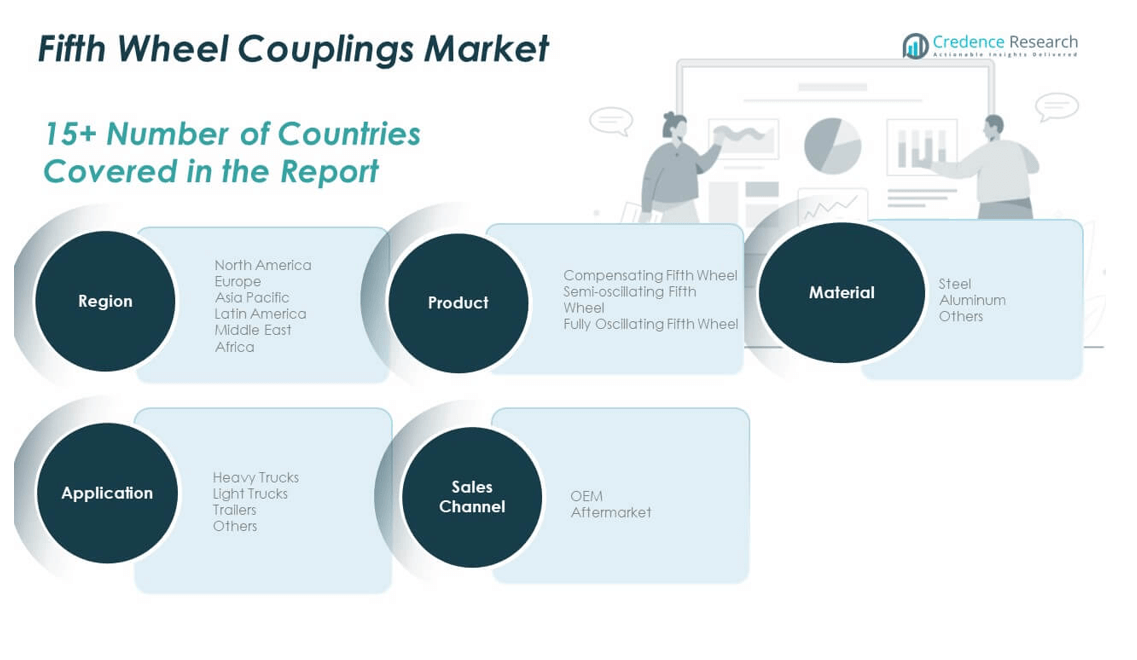
The Fifth Wheel Coupling Market is segmented by product type, material, application, and sales channel.
By product type, compensating fifth wheels hold a major share due to their superior load distribution and ability to handle uneven road conditions. Semi-oscillating models are gaining traction among long-haul carriers for their stability and easy alignment, while fully oscillating fifth wheels find use in off-road and heavy-duty applications that demand flexible movement and safety under extreme conditions.
- For instance, SAF-HOLLAND's FW351-E model features a maximum vertical load of 23,000 kg and D-value of 210 kN, supporting precise load transfer in standard to heavy-duty operations.
By material, steel dominates the segment because of its high strength, durability, and cost-efficiency across industrial fleets. It ensures reliable performance under heavy loads and extended usage cycles. Aluminum variants are growing in demand among modern fleets focusing on fuel efficiency and weight reduction. Other materials, including hybrid alloys, are emerging for specialized transport applications where corrosion resistance and lightness are key.
- For instance, HOLLAND's FW35 series cast steel fifth wheel offers a maximum vertical load of 55,000 lbs (25,000 kg) and drawbar pull of 150,000 lbs (68,000 kg).
By application, heavy trucks remain the largest segment driven by expanding freight and logistics activity. Light trucks and trailers contribute to consistent growth through commercial and utility transport demand. The “others” category includes military and construction vehicles that require robust coupling systems.
By sales channel, OEMs lead due to steady supply partnerships with major truck manufacturers, ensuring high-quality installation and compliance with safety standards. The aftermarket segment grows through replacement demand, especially from aging fleets and regional transport operators. It benefits from easy availability, competitive pricing, and frequent servicing needs, strengthening overall market expansion across global freight networks.
Segmentation:
By Product Type
- Compensating Fifth Wheel
- Semi-Oscillating Fifth Wheel
- Fully Oscillating Fifth Wheel
By Material
- Steel
- Aluminum
- Others
By Application
- Heavy Trucks
- Light Trucks
- Trailers
- Others
By Sales Channel
- OEM
- Aftermarket
By Region
- North America
- U.S.
- Canada
- Mexico
- Europe
- Germany
- France
- U.K.
- Italy
- Spain
- Rest of Europe
- Asia Pacific
- China
- Japan
- India
- South Korea
- South-east Asia
- Rest of Asia Pacific
- Latin America
- Brazil
- Argentina
- Rest of Latin America
- Middle East & Africa
- GCC Countries
- South Africa
- Rest of the Middle East and Africa
Regional Analysis:
North America
The North America Fifth Wheel Coupling Market size was valued at USD 187.85 million in 2018 to USD 216.91 million in 2024 and is anticipated to reach USD 329.25 million by 2032, at a CAGR of 5.5% during the forecast period. North America holds around 28.5% share of the global market. Strong logistics networks and high freight movement across the U.S., Canada, and Mexico drive demand for advanced coupling systems. It benefits from modern truck fleets and strict regulatory compliance emphasizing vehicle safety. Key manufacturers expand their local presence through OEM collaborations and advanced product launches. Rising replacement needs in heavy trucks boost aftermarket demand. Investments in autonomous and electric trucks push for innovative coupling solutions. Consistent infrastructure growth supports fleet modernization. Strong focus on efficiency and durability keeps the region dominant in the Fifth Wheel Coupling Market.
Europe
The Europe Fifth Wheel Coupling Market size was valued at USD 164.45 million in 2018 to USD 185.04 million in 2024 and is anticipated to reach USD 265.10 million by 2032, at a CAGR of 4.7% during the forecast period. Europe accounts for nearly 24% of the total market share. It benefits from the presence of major automotive OEMs and a robust regulatory framework ensuring vehicle safety standards. Demand rises from long-haul and cross-border logistics operations across Germany, France, and the UK. Manufacturers focus on lightweight and corrosion-resistant materials to meet EU emission norms. Growing adoption of digital fleet management supports smart coupling systems. Aftermarket sales increase due to aging vehicle fleets in Western Europe. Research on automated fifth-wheel couplings continues to advance efficiency. Europe remains a mature yet innovation-driven region for the market.
Asia Pacific
The Asia Pacific Fifth Wheel Coupling Market size was valued at USD 226.85 million in 2018 to USD 274.27 million in 2024 and is anticipated to reach USD 447.69 million by 2032, at a CAGR of 6.4% during the forecast period. The region holds the largest market share of around 36%. It is driven by rapid industrialization, rising trade activities, and large-scale logistics expansion. China and India lead production and consumption due to growing commercial vehicle fleets. Domestic manufacturers focus on cost-efficient yet durable couplings to meet regional freight demand. Rising infrastructure investment boosts demand for heavy trucks. OEM partnerships with global brands strengthen technology adoption. Growing urbanization fuels trailer transport for e-commerce and construction sectors. Strong manufacturing capacity keeps Asia Pacific the key growth hub for the Fifth Wheel Coupling Market.
Latin America
The Latin America Fifth Wheel Coupling Market size was valued at USD 39.65 million in 2018 to USD 46.03 million in 2024 and is anticipated to reach USD 64.75 million by 2032, at a CAGR of 4.5% during the forecast period. Latin America contributes about 6% share of the global market. Expanding mining, construction, and agricultural sectors increase the use of heavy trucks. Brazil remains the dominant country supported by a growing logistics network and domestic truck manufacturing. It benefits from regional OEM partnerships and expanding aftermarket channels. Fleet operators invest in replacement couplings to improve safety and reliability. Rising vehicle production supports component demand. Economic recovery and infrastructure investment boost freight activities. The region shows gradual but steady progress in market penetration.
Middle East
The Middle East Fifth Wheel Coupling Market size was valued at USD 17.55 million in 2018 to USD 18.74 million in 2024 and is anticipated to reach USD 24.46 million by 2032, at a CAGR of 3.5% during the forecast period. The region represents about 3.2% of the global market. Demand is led by GCC countries with large-scale logistics and oil sector transportation. Modernization of freight fleets and adoption of international standards drive market development. It gains traction in heavy-duty trucks used for construction and energy projects. Import dependency remains high, but local assembly and service support are growing. Governments invest in road network expansion to support inter-regional trade. Replacement cycles are slower due to smaller fleet volumes. Overall, the region is positioned for gradual growth in coupling adoption.
Africa
The Africa Fifth Wheel Coupling Market size was valued at USD 13.65 million in 2018 to USD 21.19 million in 2024 and is anticipated to reach USD 27.66 million by 2032, at a CAGR of 3.0% during the forecast period. Africa holds around 2.3% share of the global market. Growth is driven by increased transport infrastructure projects and expanding mining operations. South Africa remains the key hub for production and distribution. The market benefits from demand for cost-effective and durable coupling systems. OEM and aftermarket players explore partnerships to expand local availability. Import reliance limits rapid growth but opens opportunities for regional assembly units. Rising logistics activity between ports and industrial centers sustains product demand. The region is gradually emerging as a niche market with long-term potential.
Key Player Analysis:
- JOST Werke AG
- SAF-Holland S.A.
- Fontaine Fifth Wheel
- Holland Hitch
- Guangdong Fuwa Engineering Group Co., Ltd.
- Zhenjiang Baohua Semi-Trailer Parts Co., Ltd.
- Tulga Fifth Wheel Co.
- K. Industries
- Shandong Fuhua Axle Co., Ltd.
- Xiamen Wondee Autoparts Co., Ltd.
- VBG Group Truck Equipment AB
- Titanium Transport Inc.
- Tianjin DLT Commercial Co., Ltd.
- Tianjin Tongjie Sci-Tech Development Co., Ltd.
- Shandong Yuncheng Xinya Trailer Manufacturing Co., Ltd.
Competitive Analysis:
Leading firms in the Fifth Wheel Coupling Market compete on product quality, innovation, and regional reach. JOST Werke AG holds a strong global position with advanced coupling solutions and wide portfolio presence. SAF-Holland S.A. invests in modular coupling systems and targets commercial fleets needing versatility. Fontaine Fifth Wheel and Tulga Fifth Wheel Co. focus on specialized heavy-duty and aftermarket segments, addressing niche customer needs. Several regional players from Asia diversify supply by offering cost-competitive couplings for emerging markets. Some firms emphasize technological differentiation—automated locking, improved materials, better wear resistance—to stand out. Others rely on regional manufacturing advantage and strong OEM relationships to secure long-term contracts. This competitive mix drives consolidation, innovation and downward pressure on prices. The market environment encourages strategic partnerships, product upgrades and expansion into under-penetrated regions to stay competitive.
Recent Developments:
- In December 2025, JOST Werke AG completed the sale of its crane business to Mutares, a strategic move to focus more intensely on its core heavy vehicle equipment segments, including fifth wheel couplings.
Report Coverage:
The research report offers an in-depth analysis based on product type, material, application, and sales channel. It details leading market players, providing an overview of their business, product offerings, investments, revenue streams, and key applications. Additionally, the report includes insights into the competitive environment, SWOT analysis, current market trends, as well as the primary drivers and constraints. Furthermore, it discusses various factors that have driven market expansion in recent years. The report also explores market dynamics, regulatory scenarios, and technological advancements that are shaping the industry. It assesses the impact of external factors and global economic changes on market growth. Lastly, it provides strategic recommendations for new entrants and established companies to navigate the complexities of the market.
Future Outlook:
- Rising logistics and trade volumes will keep demand high for advanced coupling systems across global freight operations.
- Manufacturers will emphasize automation, incorporating sensors and digital controls for enhanced safety and operational efficiency.
- Lightweight composite materials will gain preference to improve fuel efficiency and align with sustainability goals.
- Expanding electric and hybrid truck fleets will create demand for couplings compatible with next-generation vehicle architectures.
- OEM collaborations will strengthen to integrate couplings with smart fleet management and telematics platforms.
- Emerging economies will experience faster adoption due to large infrastructure projects and growing industrial output.
- Regulatory standards will evolve toward stricter safety compliance, encouraging innovation in locking and load-bearing systems.
- Aftermarket services will expand as fleets require regular maintenance and replacement of high-wear components.
- Technological advancements will reduce coupling installation time and improve mechanical durability under heavy-duty operations.
- The Fifth Wheel Coupling Market will continue evolving toward digitalized, energy-efficient, and globally standardized designs supporting sustainable logistics.
Request a Free Sample
Fill in your details and we'll send you a free sample report.
- Sample data tables & charts
- Research methodology
Need a Custom Version of This Report?
Tailor the scope, geography, or segments to your exact requirements.
- Custom geography or segment scope
- Direct access to our analyst team
Frequently Asked Questions
What is the current size of the Fifth Wheel Coupling Market?
At what Compound Annual Growth Rate is the Fifth Wheel Coupling Market projected to grow between 2024 and 2032?
What factors are driving the growth of the Fifth Wheel Coupling Market?
What are the key segments within the Fifth Wheel Coupling Market?
What are some challenges faced by the Fifth Wheel Coupling Market?
Who are the major players in the Fifth Wheel Coupling Market?
Who are the leading companies in the Fifth Wheel Coupling Market?
Table of Content
Chapter 1. Report Introduction
- 1.1 Report Description & Purpose
- 1.1.1 Report Title & Market Definition
- 1.1.2 Unique Selling Propositions (USP) & Key Differentiators
- 1.1.3 Value Proposition for Stakeholders
- 1.2 Research Objectives
- 1.2.1 Market Sizing Objectives (Volume & Revenue)
- 1.2.2 Segmentation Objectives
- 1.2.3 Competitive Intelligence Objectives
- 1.2.4 Forecast & Scenario Objectives
- 1.3 Report Scope
- 1.3.1 Fifth Wheel Coupling Scope – Types & Subtypes Covered
- 1.3.2 Geographic Scope – Regions & Countries Covered
- 1.3.3 Historical Period, Base Year & Forecast Period (2024; forecast to 2032)
- 1.3.4 Inclusions & Exclusions
- 1.4 HS Code & Classification Framework
- 1.5 Currency, Units & Pricing Basis
- 1.6 Target Stakeholders
- 1.7 Limitations & Assumptions
Chapter 2. Executive Summary
- 2.1 Global Fifth Wheel Coupling Market Snapshot
- 2.1.1 Market Size – Historical (2024) & Forecast (2024-2032) (2024: USD 762.19 million → 2032: USD 1,158.91 million)
- 2.1.2 Volume & Revenue – Global Totals
- 2.1.3 Key Market Highlights – Top Five Facts
- 2.2 Fifth Wheel Coupling Market Segmentation Snapshot
- 2.2.1 Market Split by Region – 2024 vs. 2032
- 2.3 Competitive Snapshot
- 2.3.1 Top 10 Players by Revenue Share – 2024
- 2.3.2 Top 10 Players by Volume Share – 2024
- 2.3.3 Recent Strategic Developments (18-Month Summary)
- 2.4 Key Investment Highlights & Strategic Conclusions
Chapter 3. Fifth Wheel Coupling Market Dynamics & Industry Analysis
- 3.1 Market Overview & Context
- 3.1.1 Fifth Wheel Coupling Market Position in the Broader Automotive Value Chain
- 3.1.2 OEM vs. Replacement Market Dynamics
- 3.1.3 Market Maturity & Development Stage by Region
- 3.2 Fifth Wheel Coupling Market Drivers
- 3.3 Fifth Wheel Coupling Market Restraints & Challenges
- 3.4 Fifth Wheel Coupling Market Opportunities
- 3.5 Porter's Five Forces Analysis
- 3.5.1 Threat of New Entrants
- 3.5.2 Bargaining Power of Suppliers
- 3.5.3 Bargaining Power of Buyers
- 3.5.4 Threat of Substitutes
- 3.5.5 Competitive Rivalry – Intensity Assessment
- 3.6 Fifth Wheel Coupling Value Chain Analysis
- 3.6.1 Upstream – Raw Material/Input Suppliers
- 3.6.1.1 Raw Material/Input 1
- 3.6.1.2 Raw Material/Input 2
- 3.6.1.3 Raw Material/Input 3
- 3.6.2 Midstream – Production/Manufacturing/Service Delivery
- 3.6.2.1 Production/Process Overview
- 3.6.2.2 Key Facility Locations & Capacity by Manufacturer
- 3.6.3 Downstream – Distribution & End Consumer
- 3.6.3.1 Primary Channel – B2B/OEM
- 3.6.3.2 Secondary Channels – Dealer, Retail, Online, Direct
- 3.6.4 Value Chain Profitability Analysis
- 3.6.1 Upstream – Raw Material/Input Suppliers
- 3.7 PESTEL Analysis
- 3.7.1 Political Factors
- 3.7.2 Economic Factors
- 3.7.3 Social Factors
- 3.7.4 Technological Factors
- 3.7.5 Environmental Factors
- 3.7.6 Legal Factors
- 3.8 Fifth Wheel Coupling Supply Chain Analysis
- 3.8.1 Raw Material/Input Supply Risk Assessment
- 3.8.2 Manufacturing Concentration Risk (Geographic Exposure)
- 3.8.3 Trade Disruption Impact Analysis
- 3.9 Regulatory & Policy Landscape
Note: The regulatory and policy landscape section covers regulations based on their applicability to the market, Fifth Wheel Coupling category, geography, and scope of the study. Only regulatory frameworks with a material impact on operations, compliance, trade, sustainability, or market access are analyzed in detail.
Chapter 4. Key Investment Pockets & Opportunity Analysis
- 4.1 Fifth Wheel Coupling Market Attractiveness Analysis
- 4.1.1 By Region – Investment Attractiveness Matrix (Volume × CAGR)
- 4.2 Absolute Revenue Growth Opportunity
- 4.2.1 By Region – Absolute USD Growth Through 2032
- 4.3 Incremental Volume Opportunity
- 4.3.1 By Region – Incremental Volume Through 2032
- 4.3.2 Segment – Incremental Volume
- 4.4 Emerging Submarket Opportunity Deep Dive (Subject to Applicability)
- 4.5 Emerging Market Opportunity Scorecards
- 4.5.1 United States
- 4.5.2 Europe
- 4.5.3 Asia
- 4.5.4 Middle East & Africa
Note: Emerging Market Opportunity Scorecards will be included based on relevance and strategic importance. Regions listed are indicative and may vary depending on data availability and market dynamics.
Chapter 5. Fifth Wheel Coupling Import-Export Analysis & Trade Flows
- 5.1 Global Trade Overview
- 5.1.1 Global Export Value by Country (2024)
- 5.1.2 Global Export Volume by Country (2024)
- 5.1.3 Global Import Value by Country (2024)
- 5.1.4 Global Import Volume by Country (2024)
- 5.1.5 Net Trade Balance by Country (2024)
- 5.2 Export Analysis – Segment
- 5.2.1 Type 1 (HS Code)
- 5.2.2 Type 2 (HS Code)
- 5.2.3 Type 3 (HS Code)
- 5.2.4 Type 4 (HS Code)
- 5.2.5 Type 5 (HS Code)
- 5.3 Import Analysis – Segment
- 5.3.1 Type 1 (HS Code)
- 5.3.2 Type 2 (HS Code)
- 5.3.3 Type 3 (HS Code)
- 5.3.4 Type 4 (HS Code)
- 5.3.5 Type 5 (HS Code)
- 5.4 Average Unit Trade Prices
- 5.4.1 Average Export Price – Segment & Country
- 5.4.2 Average Import Price – Segment & Source Country
- 5.4.3 Price Trends (2024)
- 5.5 Key Trade Route Analysis
- 5.5.1 Trade Route 1
- 5.5.2 Trade Route 2
- 5.5.3 Trade Route 3
- 5.5.4 Trade Route 4
- 5.5.5 Trade Route 5
- 5.6 Trade Policy Impact Assessment
- 5.6.1 US Anti-Dumping & Section 301 Tariffs
- 5.6.2 EU Customs Union Impact
- 5.6.3 Major Free Trade Agreements
- 5.6.4 USMCA Rules of Origin
Note: Trade policy analysis will be included only where relevant to the Fifth Wheel Coupling market.
Chapter 6. Competitive Landscape & Company Benchmarking
- 6.1 Fifth Wheel Coupling Market Concentration & Structure
- 6.1.1 Herfindahl-Hirschman Index (HHI) – vs. 2024
- 6.1.2 Tier 1, Tier 2 & Tier 3 Market Structure
- 6.1.3 Global, Regional & Local Player Dynamics
- 6.2 Fifth Wheel Coupling Market Share Analysis – 2024
- 6.2.1 Global Revenue Share by Company
- 6.2.2 Global Volume Share by Company
- 6.2.3 Regional Revenue Share
- 6.2.4 Market Share Evolution ( vs. 2024)
- 6.2.5 OEM Segment Share by Company
- 6.2.6 Replacement Segment Share by Company
- 6.3 Production/Delivery Capacity & Facility Analysis
- 6.3.1 Global Installed Capacity
- 6.3.2 Capacity Utilization Rates
- 6.3.3 Production/Output Volume
- 6.3.4 Facility Locations & Capacity Map
- 6.3.5 Planned Capacity Additions
- 6.4 Fifth Wheel Coupling Competitive Benchmarking Matrix
- 6.4.1 Revenue, Volume, CAGR & Profitability Comparison
- 6.4.2 Channel Revenue Mix
- 6.4.3 Geographic Revenue Exposure
- 6.4.4 R&D Intensity
- 6.4.5 Sustainability Maturity
- 6.5 Strategic Developments in Fifth Wheel Coupling (Last 24 Months)
- 6.5.1 Mergers, Acquisitions & Divestments
- 6.5.2 New Fifth Wheel Coupling Launches
- 6.5.3 Facility Expansions
- 6.5.4 Strategic Alliances, Joint Ventures & Partnerships
- 6.5.5 Distribution Expansion & Market Entry
- 6.5.6 Sustainability & ESG Initiatives
- 6.6 Competitive Strategy Mapping
- 6.6.1 Leader, Challenger, Follower & Niche Classification
- 6.6.2 Pricing Strategy Comparison
- 6.6.3 Channel Strategy Matrix
Note: Strategic developments are included based on their materiality and the availability of reliable information.
Chapter 7. Global Fifth Wheel Coupling Market – By Distribution Channel
- 7.1 Segment Overview
- 7.1.1 Volume & Revenue Split by Channel (2024 & 2032)
- 7.1.2 Channel Mix Evolution (2024-2032)
Chapter 8. Regional Market Analysis – Global Overview
- 8.1 Global Regional Overview
- 8.1.1 Regional Volume Share
- 8.1.2 Regional Revenue Share
- 8.1.3 Regional Volume by Region
- 8.1.4 Regional Revenue by Region
- 8.1.5 Regional Forecast Through 2032
- 8.2 Cross-Regional Segment Analysis
- 8.2.1 By Distribution Channel
- 8.2.2 By Brand/Price Tier
Chapter 9. North America Fifth Wheel Coupling Market
- 9.1 United States
- 9.2 Canada
- 9.3 Mexico
Chapter 10. Europe Fifth Wheel Coupling Market
- 10.1 Germany
- 10.2 France
- 10.3 Italy
- 10.4 United Kingdom
- 10.5 Spain
- 10.6 Poland
- 10.7 Russia
- 10.8 Netherlands
- 10.9 Belgium
- 10.10 Sweden
- 10.11 Denmark
- 10.12 Norway
- 10.13 Rest of Europe
Chapter 11. Asia Pacific Fifth Wheel Coupling Market
- 11.1 China
- 11.2 India
- 11.3 Japan
- 11.4 South Korea
- 11.5 Thailand
- 11.6 Indonesia
- 11.7 Vietnam
- 11.8 Malaysia
- 11.9 Australia
- 11.10 Rest of Asia Pacific
Chapter 12. Latin America Fifth Wheel Coupling Market
- 12.1 Brazil
- 12.2 Argentina
- 12.3 Colombia
- 12.4 Chile
- 12.5 Rest of Latin America
Chapter 13. Middle East Fifth Wheel Coupling Market
- 13.1 Saudi Arabia
- 13.2 United Arab Emirates
- 13.3 Turkey
- 13.4 Israel
- 13.5 Iran
- 13.6 Rest of the Middle East
Chapter 14. Africa Fifth Wheel Coupling Market
- 14.1 South Africa
- 14.2 Egypt
- 14.3 Nigeria
- 14.4 Morocco
- 14.5 Rest of Africa
Chapter 15. Fifth Wheel Coupling Company Profiles
- 15.1 [Company 01]
- 15.1.1 Company Overview
- 15.1.2 Key Management Personnel
- 15.1.3 Products & Services Portfolio
- 15.1.4 Financial Performance
- 15.1.5 Key Market Focus & Geographic Presence
- 15.1.6 Recent Developments & Strategic Initiatives
Note: The company profile list is preliminary and may change based on research findings, market developments, data availability, and client requirements.
Chapter 16. Appendices
- Appendix A – List of Abbreviations & Acronyms
- Appendix B – Industry Classification Code Reference – Full Series
- Appendix C – Production & Capacity Data Tables
- Appendix D – End-Use & Demand Base Tables
- Appendix E – Consumption & Replacement Rate Assumptions
- Appendix F – ASP Reference Tables
- Appendix G – Manufacturing & Facility Database
- Appendix H – Import-Export Data Tables
- Appendix I – Regulatory Summary Tables
- Appendix J – Primary Research Participant List (Anonymized)
- Appendix K – Primary Research Questionnaire Framework
- Appendix L – Data Sources & Bibliography
- Appendix M – Market Size Divergence & Source Comparison
Chapter 17. Research Methodology
- 17.1 Research Framework & Philosophy
- 17.2 Secondary Research – Sources, Hierarchy & Data Extraction
- 17.3 Data Modeling – Bottom-Up & Top-Down Market Sizing
- 17.4 Primary Research – Stakeholder Framework, LOI & Sample Sizes
- 17.5 Forecast Methodology – Regression, Scenario & Sensitivity Analysis
- 17.6 Quality Control – Four-Layer Validation Framework
- 17.7 Limitations & Standard Assumptions
- 17.8 Disclaimer
