
Market Overview
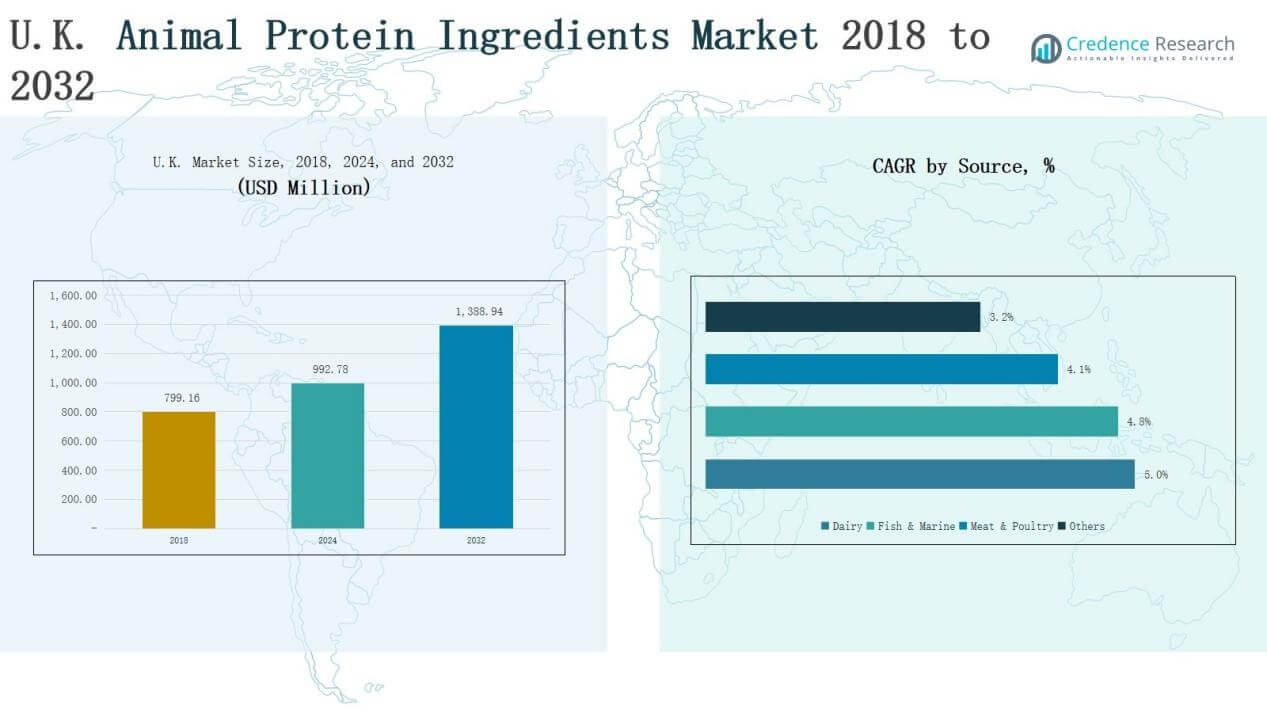
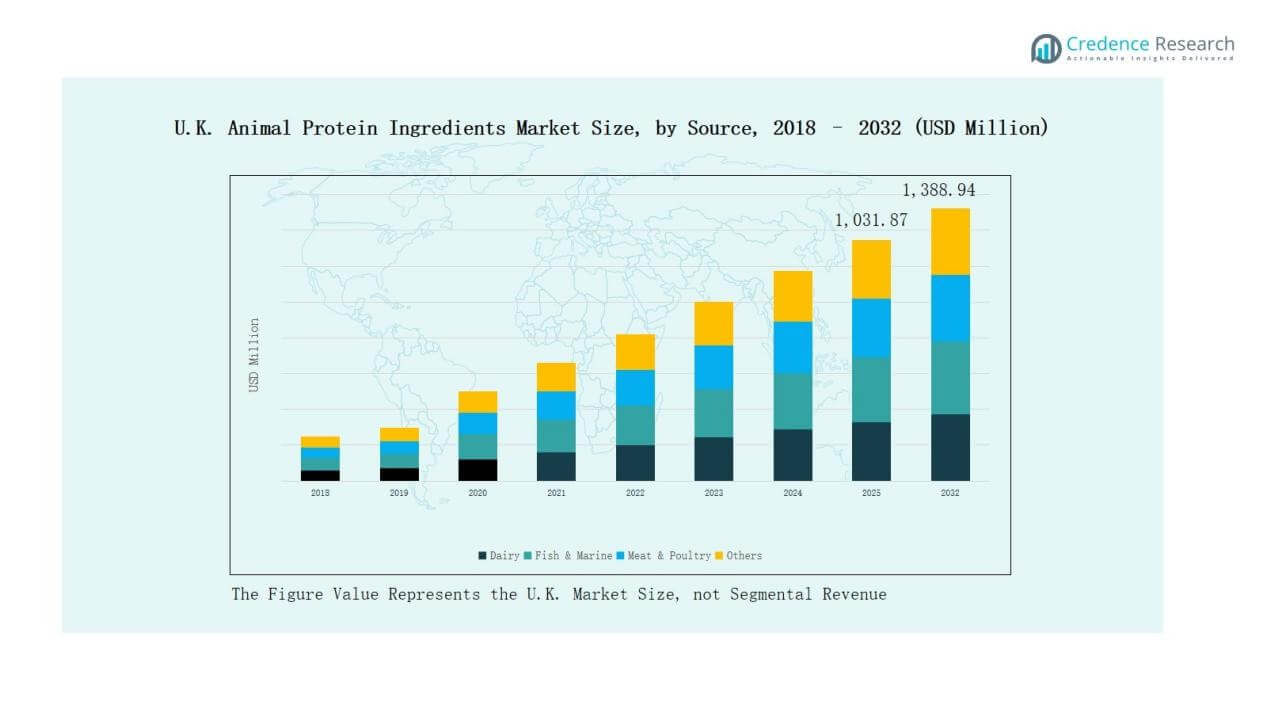
U.K. Animal Protein Ingredients Market size was valued at USD 799.16 million in 2018, rising to USD 992.78 million in 2024, and is anticipated to reach USD 1,388.94 million by 2032, at a CAGR of 4.21% during the forecast period (2024–2032).
| REPORT ATTRIBUTE | DETAILS |
|---|---|
| Historical Period | 2020-2023 |
| Base Year | 2024 |
| Forecast Period | 2025-2032 |
| U.K. Animal Protein Ingredients Market Size 2024 | USD 992.78 Million |
| U.K. Animal Protein Ingredients Market, CAGR | 4.21% |
| U.K. Animal Protein Ingredients Market Size 2032 | USD 1,388.94 Million |
The U.K. Animal Protein Ingredients Market is shaped by a mix of global leaders and regional specialists focusing on product innovation, diversified portfolios, and sustainability. Key players include Cargill, Tyson Foods, Kemin Industries, ADM Animal Nutrition, Prinova, Saria Ltd, BHJ UK Ltd, Nutraferma LLC, Kookaburra Limited, and NCC Food Ingredients. These companies strengthen competitiveness through advanced processing technologies, clinical and sports nutrition offerings, and premium pet food applications. England emerged as the leading region in 2024 with 58% market share, supported by its robust consumer base, advanced food processing infrastructure, and strong demand for functional and clinical nutrition products.
 Market Insights
- The U.K. Animal Protein Ingredients Market was valued at USD 799.16 million in 2018, reaching USD 992.78 million in 2024, and projected at USD 1,388.94 million by 2032, growing at 4.21%.
- Dairy dominated the source segment with 41% share in 2024, driven by strong demand in clinical and sports nutrition, while fish & marine proteins grew through aquafeed and supplements.
- Powders led the form segment with 52% share in 2024, supported by stability, transport convenience, and integration in supplements and medical formulations, followed by granules and flakes.
- Sports & active nutrition was the largest application with 34% share in 2024, fueled by rising consumption of protein powders and beverages, with clinical nutrition and pet food following closely.
- England led regionally with 58% share in 2024, supported by advanced food processing, strong retail networks, and robust demand for functional and clinical protein products.
Market Segment Insights
By Source
Dairy dominates the U.K. animal protein ingredients market, holding 41% share in 2024. Its leadership stems from strong demand in clinical and sports nutrition, driven by high protein diets and functional formulations. Fish & marine proteins follow, supported by rising use in aquafeed and supplements, while meat & poultry proteins gain traction in pet food. Other sources, though smaller, serve niche applications in specialty products.
For instance, BioMar Group incorporated marine protein hydrolysates into its SmartCare feed health concept to enhance fish growth and immune support in aquaculture.
By Form
Powders lead the market with 52% share in 2024, reflecting their stability, ease of transport, and wide integration in dietary supplements, sports powders, and medical formulations. Granules and flakes account for a moderate share, driven by their application in livestock feed and pet nutrition. Liquids and pastes, holding a smaller portion, remain essential for ready-to-use formulations and food processing applications.
For instance, FrieslandCampina Ingredients introduced a Biotis® protein blend in powder format for maternal and active nutrition, highlighting convenience and transport stability.
By Application
Sports & active nutrition represents the largest application segment, capturing 34% share in 2024, driven by growing consumer adoption of protein powders and functional beverages. Clinical & medical nutrition follows, supported by demand for specialized diets in hospitals and elderly care. Pet food also shows strong growth, as premium and protein-rich diets become mainstream. Aquafeed and livestock feed retain steady demand, while other applications contribute through niche uses across food innovation.
Key Growth Drivers
Rising Demand for High-Protein Diets
The growing consumer focus on health and wellness fuels strong demand for high-protein food and supplements in the U.K. Dairy-based ingredients, particularly whey and casein, remain popular in sports and clinical nutrition. Expanding gym culture and awareness of protein’s role in weight management and muscle development strengthen consumption. Food companies increasingly integrate protein-enriched ingredients into mainstream products, creating additional growth momentum across retail and online channels.
For instance, Quest Nutrition introduced Quest Protein Milkshakes with a leading 45 grams of protein per bottle, targeting consumers seeking convenient, high-protein ready-to-drink products.
Expanding Pet Food and Animal Nutrition Sector
The U.K. pet food industry significantly contributes to protein ingredient demand, with protein-rich diets becoming a standard preference among pet owners. Rising adoption of premium formulations, especially those emphasizing natural and functional protein sources, accelerates the use of meat and marine proteins. Livestock and aquafeed sectors also rely on animal protein ingredients for improving animal health and productivity. This dual growth in companion animal nutrition and feed applications provides consistent revenue streams.
For instance, in 2025, the U.K. became the first European country to approve lab-grown meat for pet food, reflecting innovation and rising demand for sustainable protein ingredients.
Strong Focus on Clinical and Medical Nutrition
The U.K.’s aging population and rising prevalence of chronic diseases strengthen the role of animal protein ingredients in medical applications. Clinical nutrition products, including protein-based supplements and therapeutic diets, see increased adoption across hospitals, elderly care facilities, and homecare. Dairy proteins, with their digestibility and amino acid profile, dominate this space. Government support for healthcare quality and nutrition programs further enhances demand, creating long-term opportunities in specialized nutrition categories.
 Key Trends & Opportunities
Sustainability and Ethical Sourcing
Sustainability has become a central trend in the U.K. animal protein ingredients market. Companies are investing in eco-friendly sourcing methods, waste reduction, and circular processing solutions. Ethical considerations, including traceability and responsible animal farming practices, influence consumer choices. This creates opportunities for firms that can demonstrate low-carbon production and compliance with U.K. and EU sustainability frameworks while meeting rising demand for ethically produced protein ingredients.
For instance, Roquette unveiled a new plant-based protein ingredient derived from peas and rice with full traceability and sustainable certification aligned with U.K. and EU environmental standards, responding to growing demand for ethically sourced proteins.
Innovation in Functional and Specialty Applications
Expanding use of animal protein ingredients in functional foods and beverages presents strong opportunities. Beyond sports and clinical nutrition, proteins are now used in fortified snacks, ready-to-drink products, and meal replacements. Innovations in protein blends and formulations enhance taste, solubility, and functionality, broadening consumer appeal. Companies investing in R&D for tailored applications, such as collagen-based supplements or marine-derived proteins, are positioned to capture emerging growth niches.
For instance, Gelita expanded collagen peptide formulations for functional supplements, focusing on skin health and joint support, with tailored hydrolyzed proteins enabling improved solubility and bioavailability in liquid and powdered formats.
Key Challenges
Rising Competition from Plant-Based Alternatives
The accelerating popularity of plant-based proteins poses a direct challenge to animal protein ingredient producers in the U.K. Growing vegan and flexitarian populations reduce dependency on traditional animal-derived proteins. Food manufacturers increasingly diversify into pea, soy, and other plant-based options, which are marketed as sustainable and ethical. This trend pressures animal protein suppliers to differentiate through innovation, nutritional advantages, and sustainable sourcing practices.
Strict Regulatory and Food Safety Standards
The U.K. animal protein ingredients market operates under stringent food safety and regulatory frameworks. Compliance with labeling, traceability, and sustainability requirements increases operational costs. Companies face additional scrutiny regarding sourcing practices, antibiotic use, and environmental impact. Failure to comply can lead to restricted market access and reputational damage, making continuous investment in certifications and audits a necessity for maintaining competitiveness.
Volatility in Raw Material Supply and Prices
Supply chain challenges and fluctuating prices of dairy, meat, and marine raw materials create uncertainty for manufacturers. Factors such as global trade disruptions, feed cost inflation, and climate-driven changes in livestock productivity influence input availability and pricing. These fluctuations affect profit margins and complicate long-term planning. Companies must adopt hedging strategies, diversified sourcing, and technological efficiency to mitigate supply risks.
Regional Analysis
England
England held the largest share of the U.K. Animal Protein Ingredients Market in 2024 with 58%. It benefits from a strong consumer base, advanced food processing facilities, and a well-developed retail sector. Demand for sports nutrition and clinical protein products is especially strong, supported by fitness culture and aging demographics. Leading manufacturers focus on dairy and meat proteins, aligning with evolving consumer preferences. Innovation in sustainable sourcing strengthens market positioning. It remains the central hub for distribution and exports within the U.K.
Scotland
Scotland accounted for 18% of the market share in 2024. The region relies heavily on fish and marine proteins, supported by its strong aquaculture sector. Demand for aquafeed ingredients and marine-derived proteins drives growth. Scotland also shows increasing uptake of dairy proteins for health and wellness applications. Companies emphasize traceability and sustainability to meet regulatory and consumer expectations. It serves as a key supplier of marine-based ingredients to both domestic and export markets.
Wales
Wales represented 13% of the U.K. market share in 2024. The region’s dairy industry provides a solid base for protein ingredient production. Small and medium-scale manufacturers contribute to steady supply for food, clinical, and pet nutrition applications. Growing interest in functional proteins supports adoption across retail and healthcare channels. Meat and poultry proteins also find strong demand in pet food formulations. It continues to attract investment in processing infrastructure to enhance competitiveness.
Northern Ireland
Northern Ireland held 11% of the market share in 2024. Its strong livestock base underpins steady production of meat and poultry proteins. Dairy proteins also contribute significantly, supported by well-established farming practices. Export-oriented supply chains connect Northern Ireland’s production with European markets. Companies focus on quality and regulatory compliance to ensure competitiveness. It is building stronger integration of animal protein ingredients in livestock feed and functional food segments.
Market Segmentations:
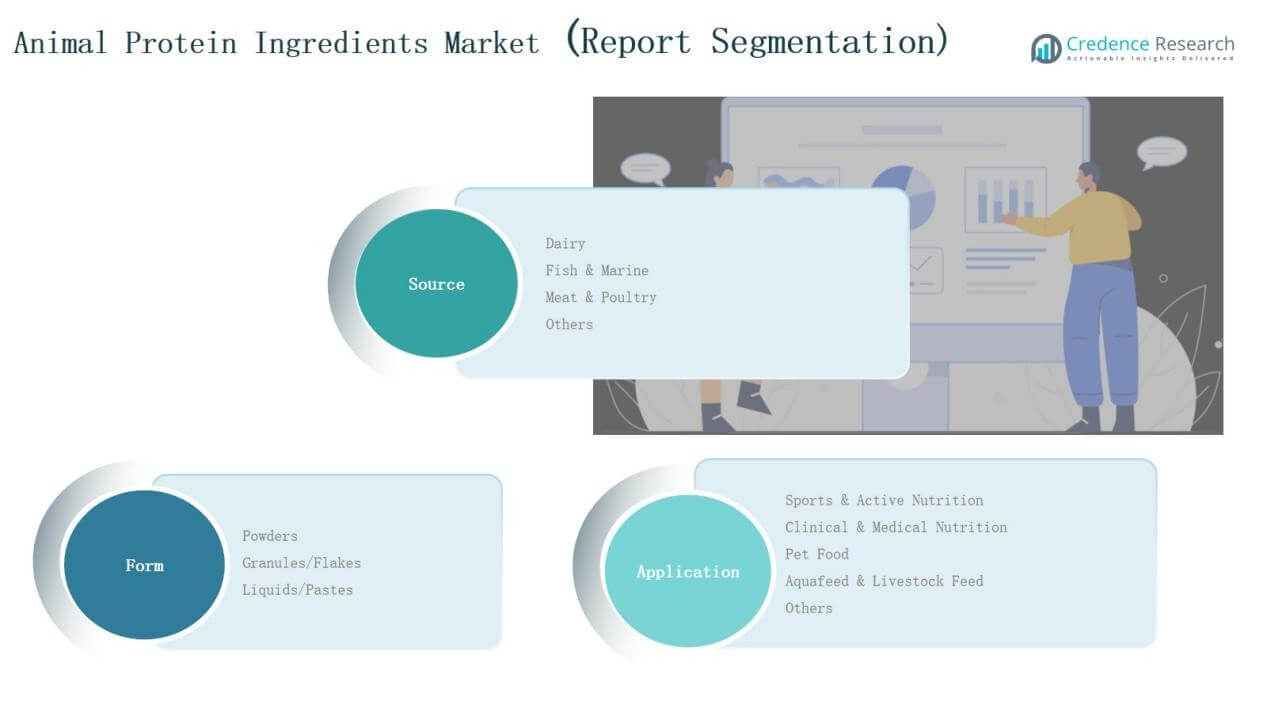
By Source
- Dairy
- Fish & Marine
- Meat & Poultry
- Others
By Form
- Powders
- Granules/Flakes
- Liquids/Pastes
By Application
- Sports & Active Nutrition
- Clinical & Medical Nutrition
- Pet Food
- Aquafeed & Livestock Feed
- Others
By Region
- England
- Scotland
- Wales
- Northern Ireland
Competitive Landscape
The U.K. Animal Protein Ingredients Market is characterized by strong competition among global and regional players, each leveraging product innovation, strategic partnerships, and distribution expansion to strengthen their positions. Leading companies such as Cargill, Tyson Foods, Kemin Industries, ADM Animal Nutrition, and Prinova focus on advanced processing technologies and diversified portfolios spanning dairy, marine, and meat-based proteins. Regional firms including Saria Ltd, BHJ UK Ltd, and Kookaburra Limited add depth by targeting niche applications and emphasizing traceability and sustainable sourcing. Multinationals dominate clinical and sports nutrition, while local producers cater to pet food and aquafeed demand. The market rewards companies that can balance efficiency, sustainability, and compliance with evolving U.K. and EU food safety standards. Rising competition from plant-based alternatives further intensifies the need for differentiation through functional ingredients, premium formulations, and eco-friendly practices. Continuous R&D and alignment with consumer health trends remain central to long-term competitiveness.
Key Players
- Nutraferma LLC
- Saria Ltd
- BHJ UK Ltd
- Kookaburra Limited
- Cargill
- Kemin Industries
- Prinova
- ADM Animal Nutrition
- NCC Food Ingredients
- Tyson Foods
- Other Key Players
Recent Developments
- In February 2025, Meatly partnered with Pets at Home to launch “Chick Bites,” a cultivated chicken and plant-based dog treat, marking the U.K.’s first lab-grown pet food.
- In April 2024, Arla Foods Ingredients acquired Volac’s Whey Nutrition division to strengthen its position in performance and sports nutrition within the U.K. protein ingredients market.
- In May 2025, Prefera Petfood acquired British alt-protein startup The Pack, strengthening its sustainable and premium pet food offerings in the U.K. market.
- In April 2025, German brand More Nutrition entered the U.K. market, introducing its high-protein snacks, collagen, whey & casein blends, clear whey isolate and other functional food items.
Report Coverage
The research report offers an in-depth analysis based on Type, Distribution Channel and Region. It details leading market players, providing an overview of their business, product offerings, investments, revenue streams, and key applications. Additionally, the report includes insights into the competitive environment, SWOT analysis, current market trends, as well as the primary drivers and constraints. Furthermore, it discusses various factors that have driven market expansion in recent years. The report also explores market dynamics, regulatory scenarios, and technological advancements that are shaping the industry. It assesses the impact of external factors and global economic changes on market growth. Lastly, it provides strategic recommendations for new entrants and established companies to navigate the complexities of the market.
Future Outlook
- Demand for dairy proteins will continue to lead due to strong use in clinical and sports nutrition.
- Fish and marine proteins will see rising uptake with growth in aquafeed and health supplements.
- Meat and poultry proteins will expand further in premium pet food and functional diets.
- Powders will remain the most preferred form, supported by convenience and product stability.
- Liquids and pastes will gain niche adoption in ready-to-use food and beverage formulations.
- Sports and active nutrition will drive the largest application share with lifestyle-focused consumption.
- Clinical nutrition will advance as hospitals and elderly care centers adopt protein-based therapies.
- Pet food will witness strong demand as owners prioritize protein-rich and premium formulations.
- Sustainability and ethical sourcing will shape purchasing decisions and company strategies.
- Innovation in specialty proteins and blended formulations will open new growth opportunities.

Request a Free Sample
Fill in your details and we'll send you a free sample report.
- Sample data tables & charts
- Research methodology
Market Dynamics
High-Protein Diet and Wellness Trends
The U.K. consumer focus on health, fitness, and wellness is driving demand for animal protein ingredients, especially in sports and clinical nutrition products. The popularity of high-protein diets and functional foods is boosting the use of dairy, meat, and marine proteins in mainstream and specialty products.
Expansion of Premium Pet Food and Animal Nutrition
The growing pet ownership and preference for protein-rich, premium pet food formulations are increasing the use of animal protein ingredients, particularly meat and marine proteins. The livestock and aquafeed sectors also contribute to steady demand for these ingredients to improve animal health and productivity.
Growth in Clinical and Medical Nutrition
An aging population and rising incidence of chronic diseases in the U.K. are fueling the adoption of protein-based clinical nutrition products. Hospitals, elderly care, and homecare settings are increasingly utilizing dairy and other animal proteins for therapeutic diets and supplements.
Sustainability and Ethical Sourcing Initiatives
Consumer and regulatory emphasis on sustainability, traceability, and ethical sourcing is shaping purchasing decisions and company strategies. Firms investing in eco-friendly production, responsible sourcing, and compliance with U.K. and EU standards are gaining competitive advantage and market share.
Product Innovation and Functional Applications
Ongoing R&D in protein blends, specialty formulations, and new applications - such as collagen peptides and marine hydrolysates - are expanding the market. Innovations that improve taste, solubility, and functionality are opening new growth opportunities in sports, clinical, and functional food segments.
Need a Custom Version of This Report?
Tailor the scope, geography, or segments to your exact requirements.
- Custom geography or segment scope
- Direct access to our analyst team
Frequently Asked Questions
What is the current market size for U.K. Animal Protein Ingredients Market, and what is its projected size in 2032?
At what Compound Annual Growth Rate is the U.K. Animal Protein Ingredients Market projected to grow between 2025 and 2032?
Which U.K. Animal Protein Ingredients Market segment held the largest share in 2024?
What are the primary factors fueling the growth of the U.K. Animal Protein Ingredients Market?
Who are the leading companies in the U.K. Animal Protein Ingredients Market?
Which region commanded the largest share of the U.K. Animal Protein Ingredients Market in 2024?
Table of Content
Chapter 1 Market Segmentation
- 1.1 Segmentation Framework
- 1.1.1 Product and Service Classification
- 1.1.2 Application and End-Use Classification
- 1.1.3 Technology and Solution Classification
- 1.1.4 Customer and Distribution Channel Classification
- 1.1.5 Geographic Segmentation
- 1.1.6 Market Segment Definitions and Boundaries
- 1.2 By Form
- 1.2.1 Powders
- 1.2.2 Granules/Flakes
- 1.2.3 Liquids/Pastes
- 1.3 By Source
- 1.3.1 Dairy
- 1.3.2 Fish & Marine
- 1.3.3 Meat & Poultry
- 1.3.4 Others
- 1.4 By Application
- 1.4.1 Sports & Active Nutrition
- 1.4.2 Clinical & Medical Nutrition
- 1.4.3 Pet Food
- 1.4.4 Aquafeed & Livestock Feed
- 1.4.5 Others
Chapter 2 Introduction
- 2.1 Report Objectives and Scope
- 2.2 Product Definition and Industry Terminology
- 2.3 Market Inclusions and Exclusions
- 2.4 Research Process
- 2.4.1 Primary Research and Expert Interviews
- 2.4.2 Secondary Research and Source Review
- 2.4.3 Top-Down and Bottom-Up Estimation
- 2.4.4 Data Triangulation and Verification
- 2.5 Market Size Measurement Basis
- 2.5.1 2024: USD 992.78 million → 2032: USD 1,388.94 million
- 2.6 Historical and Forecast Reference Periods
- 2.6.1 Base Year: 2024
- 2.6.2 Forecast Period: 2024-2032
- 2.7 Research Assumptions and Limitations
Chapter 3 Executive Summary
- 3.1 Market Snapshot and Key Findings
- 3.2 Base-Year Market Size, 2024
- 3.3 Forecast Market Size, 2032
- 3.4 Revenue and Volume Growth Outlook
- 3.5 Key Demand and Supply Indicators
- 3.6 Leading Market Segments
- 3.7 Fastest-Growing Market Opportunities
- 3.8 Regional Performance Highlights
- 3.9 Technology and Industry Transformation
- 3.10 Competitive Landscape Summary
- 3.11 Analyst View and Strategic Implications
Chapter 4 U.K. Animal Protein Ingredients Market Trends and Developments
- 4.1 Historical Industry Development
- 4.2 Recent Market Trends and Developments
- 4.3 Demand and Customer Behavior Trends
- 4.4 Technology and Product Innovation
- 4.5 Artificial Intelligence, Automation and Digitalization
- 4.6 Local Manufacturing and Supply Chain Realignment
- 4.7 Industry Partnerships, Mergers and Acquisitions
- 4.8 Sustainability and Circular Economy Developments
- 4.9 Government and Private Sector Investment Trends
- 4.10 Emerging Business Models and Commercialization
- 4.11 Industry Developments and Announcements
Chapter 5 U.K. Animal Protein Ingredients Market Production, Supply and Demand Analysis
- 5.1 Demand Trend and Consumption Analysis
- 5.2 Demand Forecast, 2024-2032
- 5.3 Production and Output Trend
- 5.4 Production and Output Forecast, 2024-2032
- 5.5 Installed Capacity and Capacity Utilization
- 5.6 Company-Wise Production Plants and Statistics
- 5.6.1 Installed Production Capacity
- 5.6.2 Actual Production
- 5.6.3 Planned Capacity and Expansion Targets
- 5.7 Supply Chain Structure and Procurement Trends
- 5.8 Supply-Demand Gap and Bottlenecks
- 5.9 Import Dependence and Sourcing Structure
- 5.10 Contract Manufacturing and Outsourcing
- 5.11 Regional Supply and Demand Concentration
Chapter 6 U.K. Animal Protein Ingredients Market Pricing Analysis
- 6.1 Pricing Structure and Measurement
- 6.2 Historical Pricing Trends
- 6.3 Pricing Outlook, 2024-2032
- 6.4 Average Selling Price and Unit Economics
- 6.5 Pricing by Product and Market Segment
- 6.6 Geographic Pricing Differences
- 6.7 Key Input, Energy, Labor and Logistics Costs
- 6.8 Contract Pricing and Purchasing Models
- 6.9 Pricing Sensitivity and Competitive Positioning
- 6.10 Price, Margin and Profitability Implications
Chapter 7 U.K. Animal Protein Ingredients Market Dynamics
- 7.1 Market Growth Drivers
- 7.1.1 Demand-Side Drivers
- 7.1.2 Technology and Innovation Drivers
- 7.1.3 Infrastructure and Investment Drivers
- 7.1.4 Regulatory and Policy Drivers
- 7.2 Market Restraints
- 7.2.1 Cost and Affordability Constraints
- 7.2.2 Technology and Adoption Barriers
- 7.2.3 Supply Chain and Operational Constraints
- 7.3 Market Challenges
- 7.3.1 Competitive Pressure and Margin Erosion
- 7.3.2 Skills, Infrastructure and Implementation Gaps
- 7.4 Emerging Market Opportunities
- 7.5 Market Dynamics Impact and Time-Horizon Assessment
Chapter 8 U.K. Animal Protein Ingredients Value Chain Analysis
- 8.1 Industry Value Chain Overview
- 8.2 Upstream Suppliers and Critical Inputs
- 8.3 Technology and Component Providers
- 8.4 Manufacturing or Service Delivery
- 8.5 Distribution, Channel Partners and Integrators
- 8.6 Downstream Applications and End Users
- 8.7 Value Addition and Profit Pools
- 8.8 Vertical Integration and Outsourcing
- 8.9 Supplier Concentration and Risk
- 8.10 Supply Chain Localization and Resilience
Chapter 9 U.K. Animal Protein Ingredients Market Regulations and Policies
- 9.1 Relevant Laws, Standards and Compliance Frameworks
- 9.2 Product, Service, Safety and Quality Requirements
- 9.3 Government Policies, Incentives and Subsidies
- 9.4 Imports, Exports and Trade Barriers
- 9.5 Public Procurement and Local Content Requirements
- 9.6 Environmental and Sustainability Compliance
- 9.7 Upcoming Policy Changes and Market Implications
Chapter 10 U.K. Animal Protein Ingredients Market Hotspots and Opportunities
- 10.1 Market Opportunity Mapping and Growth Hotspots
- 10.2 High-Growth Applications and Customer Groups
- 10.3 Underserved Markets and White-Space Opportunities
- 10.4 Emerging Technology and Product Opportunities
- 10.5 New Capacity and Investment Hotspots
- 10.6 Market Entry and Expansion Opportunities
- 10.7 Distribution and Partnership Opportunities
- 10.8 Near-Term and Long-Term Commercial Potential
- 10.9 Opportunity Attractiveness and Execution Risks
Chapter 11 U.K. Animal Protein Ingredients Market Outlook, 2024-2032
- 11.1 Market Size and Analysis
- 11.1.1 Revenue (Market Measurement: 2024: USD 992.78 million → 2032: USD 1,388.94 million)
- 11.1.2 Market Volume and Quantity Sold
- 11.1.3 Historical Market Size
- 11.1.4 Base-Year Market Size, 2024
- 11.2 Market Forecast, 2024-2032
- 11.2.1 Revenue Forecast to 2032
- 11.2.2 Volume Forecast to 2032
- 11.2.3 CAGR and Year-on-Year Growth
- 11.2.4 Incremental Revenue Opportunity
- 11.3 Forecast Assumptions and Scenario Analysis
- 11.3.1 Base-Case Forecast
- 11.3.2 Optimistic and Conservative Scenarios
- 11.3.3 Technology, Pricing and Policy Sensitivities
- 11.4 Market Attractiveness and Growth Outlook
Chapter 12 U.K. Animal Protein Ingredients Market Segmentation and Outlook
- 12.1 Segmentation Summary and Market Shares, 2024
- 12.2 Largest and Fastest-Growing Segments
- 12.3 By Form - Market Size and Forecast, 2024-2032
- 12.3.1 Segment Definition and Scope
- 12.3.2 Historical Market Size
- 12.3.3 Revenue Forecast, 2024-2032
- 12.3.4 Volume Forecast, 2024-2032
- 12.3.5 Base-Year Market Share, 2024
- 12.3.6 Segment CAGR and Growth Drivers
- 12.3.7 Subsegment Market Size and Forecast
- 12.3.7.1 Powders
- 12.3.7.2 Granules/Flakes
- 12.3.7.3 Liquids/Pastes
- 12.3.8 Subsegment Pricing and Adoption Trends
- 12.3.9 Leading Suppliers and Competition
- 12.3.10 Regional Demand and Opportunities
- 12.4 By Source - Market Size and Forecast, 2024-2032
- 12.4.1 Segment Definition and Scope
- 12.4.2 Historical Market Size
- 12.4.3 Revenue Forecast, 2024-2032
- 12.4.4 Volume Forecast, 2024-2032
- 12.4.5 Base-Year Market Share, 2024
- 12.4.6 Segment CAGR and Growth Drivers
- 12.4.7 Subsegment Market Size and Forecast
- 12.4.7.1 Dairy
- 12.4.7.2 Fish & Marine
- 12.4.7.3 Meat & Poultry
- 12.4.7.4 Others
- 12.4.8 Subsegment Pricing and Adoption Trends
- 12.4.9 Leading Suppliers and Competition
- 12.4.10 Regional Demand and Opportunities
- 12.5 By Application - Market Size and Forecast, 2024-2032
- 12.5.1 Segment Definition and Scope
- 12.5.2 Historical Market Size
- 12.5.3 Revenue Forecast, 2024-2032
- 12.5.4 Volume Forecast, 2024-2032
- 12.5.5 Base-Year Market Share, 2024
- 12.5.6 Segment CAGR and Growth Drivers
- 12.5.7 Subsegment Market Size and Forecast
- 12.5.7.1 Sports & Active Nutrition
- 12.5.7.2 Clinical & Medical Nutrition
- 12.5.7.3 Pet Food
- 12.5.7.4 Aquafeed & Livestock Feed
- 12.5.7.5 Others
- 12.5.8 Subsegment Pricing and Adoption Trends
- 12.5.9 Leading Suppliers and Competition
- 12.5.10 Regional Demand and Opportunities
- 12.6 Segment Growth Comparison
- 12.7 Segment Attractiveness and Priority Matrix
Chapter 13 U.K. Animal Protein Ingredients End-Use and Application Market Outlook
- 13.1 End-Use Industry and Customer Demand Structure
- 13.2 Leading Applications and Customer Groups
- 13.3 End-Use Market Size, Share and Forecast
- 13.4 Major End-Use Industry Deep Dives
- 13.4.1 Customer Requirements and Use Cases
- 13.4.2 Demand and Replacement Cycles
- 13.4.3 Technical and Regulatory Considerations
- 13.4.4 Purchasing and Procurement Models
- 13.4.5 Leading Vendors and Distribution Channels
- 13.4.6 Forecast and Commercial Opportunities
- 13.5 Emerging Applications and Cross-Segment Demand
- 13.6 End-Use Industry Investment Priorities
Chapter 14 U.K. Animal Protein Ingredients Geographic Market Outlook, 2024-2032
- 14.1 Domestic Market Distribution and Demand Clusters
- 14.2 State- or Province-Wise Market Size and Forecast, 2024-2032
- 14.3 City and Metropolitan Market Outlook
- 14.4 Industrial, Manufacturing and Commercial Clusters
- 14.5 Geographic Concentration of Key End Users
- 14.6 Local Pricing and Purchasing Differences
- 14.7 Domestic Production Facilities and Capacity Map
- 14.8 Local Infrastructure and Project Pipeline
- 14.9 State-Level Policy and Incentive Differences
- 14.10 Subnational Investment Hotspots and Opportunities
- 14.11 Distribution and Logistics Networks
- 14.12 Domestic Competitive Footprint
Chapter 15 U.K. Animal Protein Ingredients Technology, Innovation and Sustainability Outlook
- 15.1 Technology Landscape and Maturity
- 15.2 Product, Process and Service Innovation
- 15.3 AI, Automation and Digital Tools in the Industry
- 15.4 Technology Adoption and Performance Benchmarking
- 15.5 Innovation Pipeline and R&D Investment
- 15.6 Patent and Intellectual Property Trends
- 15.7 Energy Efficiency and Resource Management
- 15.8 Sustainability, Recycling and Circularity
- 15.9 Technology Roadmap, 2024-2032
- 15.10 Risks of Obsolescence and Technology Substitution
Chapter 16 U.K. Animal Protein Ingredients Market Key Strategic Imperatives
- 16.1 Growth and Market Entry Priorities
- 16.2 High-Return Products and Segments
- 16.3 Pricing, Profitability and Cost Optimization
- 16.4 Technology Investment and Product Differentiation
- 16.5 Supply Chain Localization and Resilience
- 16.6 Distribution and Customer Acquisition
- 16.7 Partnership, Acquisition and Capacity Strategy
- 16.8 Regional Expansion Priorities
- 16.9 Short-, Medium- and Long-Term Actions
Chapter 17 Competition Outlook
- 17.1 Industry Competition Characteristics
- 17.2 Market Structure and Concentration
- 17.3 Market Share and Competitive Positioning, 2024
- 17.4 Company-Wise Revenue and Product Benchmarking
- 17.5 Production and Service Capacity Benchmarking
- 17.6 Technology, Pricing and Differentiation
- 17.7 Regional Footprint and Distribution Strength
- 17.8 Mergers, Acquisitions and Strategic Alliances
- 17.9 New Entrants and Competitive Threats
- 17.10 Porter's Five Forces and Industry Attractiveness
- 17.11 Competitive Outlook, 2024-2032
Chapter 18 Company Profiles
- 18.1 Company Coverage and Selection Criteria
- 18.2 Cargill
- 18.2.1 Business Description
- 18.2.2 Company Ownership and Geographic Presence
- 18.2.3 Product and Service Portfolio
- 18.2.4 Manufacturing and Operating Footprint
- 18.2.5 Production Capacity and Expansion Plans
- 18.2.6 Financial Performance and Investment
- 18.2.7 Market Share and Competitive Position
- 18.2.8 Technology and Innovation Capabilities
- 18.2.9 Strategic Alliances or Partnerships
- 18.2.10 Recent Developments
- 18.2.11 Growth Strategy and Outlook
- 18.3 Tyson Foods
- 18.4 Kemin Industries
- 18.5 ADM Animal Nutrition
- 18.6 Prinova
- 18.7 Saria Ltd
- 18.8 BHJ UK Ltd
- 18.9 Nutraferma LLC
- 18.10 Kookaburra Limited
- 18.11 NCC Food Ingredients
- 18.12 Other Relevant Market Participants
Note: Every listed company is profiled on the structure shown under the first company. The company list is preliminary and may change based on research findings, market developments, data availability and client requirements.
Chapter 19 Disclaimer
- 19.1 Research and Forecast Disclaimer
- 19.2 Data Source and Estimation Limitations
Note: The depth of individual sections depends on data availability for this market. Volume, capacity, trade and other unit-based metrics are included where applicable.

