
Market Overview:
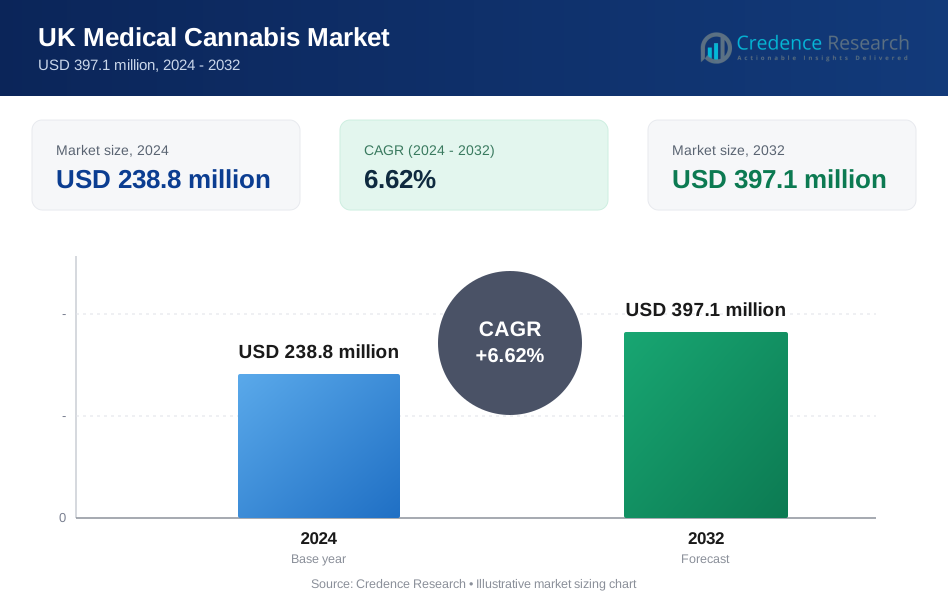
The UK Medical Cannabis Market size was valued at USD 169.8 million in 2018 to USD 238.8 million in 2024 and is anticipated to reach USD 397.1 million by 2032, at a CAGR of 6.62% during the forecast period.
| REPORT ATTRIBUTE | DETAILS |
|---|---|
| Historical Period | 2020-2023 |
| Base Year | 2024 |
| Forecast Period | 2025-2032 |
| UK Medical Cannabis Market Size 2024 | USD 169.8 million |
| UK Medical Cannabis Market, CAGR | 6.62% |
| UK Medical Cannabis Market Size 2032 | USD 397.1 million |
Market growth is driven by wider specialist prescribing access and improving regulatory clarity. Physicians gain confidence through clinical evidence for chronic pain, epilepsy, and multiple sclerosis care. Patient awareness rises through advocacy and specialist consultations. Private clinics expand faster than public pathways, supporting quicker treatment access. Pharmaceutical distributors strengthen compliant supply chains. Standardized products improve safety and prescribing comfort. Digital consultations enable regular follow-ups and dose adjustments. These factors collectively support steady prescription growth.
Regionally, England leads adoption due to higher clinic density and patient awareness. Major urban centers host most private prescribers and pharmacies. Scotland emerges steadily through structured health board pathways and specialist oversight. Wales shows gradual growth with improving access in cities. Northern Ireland remains smaller due to limited private infrastructure. Regional differences reflect healthcare access, clinician familiarity, and policy interpretation across the UK.

Market Insights
- The UK Medical Cannabis Market was valued at USD 169.8 million in 2018, reached USD 238.8 million in 2024, and is projected to hit USD 397.1 million by 2032, expanding at a CAGR of 6.62%, reflecting steady prescription growth and private clinic expansion.
- England leads with about 72% share, followed by Scotland at nearly 15% and Wales at around 8%, driven by higher specialist density, better clinic access, and clearer prescribing practices in these regions.
- Scotland is the fastest-growing subregion with roughly 15% share, supported by structured health board pathways, neurologist-led prescribing, and improving clinician familiarity with cannabis-based therapies.
- By active ingredients, cannabidiol shows the strongest growth profile with a 6.4% CAGR, followed by tetrahydrocannabinol at 6.1%, while other cannabinoids trail at about 5.6% due to narrower clinical use.
- By patient type, adult patients account for an estimated 65–70% share of the UK Medical Cannabis Market, while pediatric patients represent about 30–35%, reflecting strict pediatric controls and broader adult chronic pain demand.
Market Drivers:
Expanding Specialist Prescribing Access And Clinical Confidence
The UK Medical Cannabis Market gains momentum through wider specialist prescribing access across private clinics. Regulatory clarity supports neurologists and pain consultants during treatment decisions. Clinical guidelines now reference cannabis-based medicines for unmet needs. Physicians rely on real-world evidence from approved patient cohorts. It supports confidence in long-term symptom management outcomes. Medical education programs improve awareness of dosing protocols. Prescription volumes rise through structured follow-up care models. These factors strengthen physician trust and patient adherence.
- For instance, Sapphire Medical Clinics reported treating over 30,000 UK patients by 2024, supported by clinician training programs and standardized prescribing pathways.
Rising Chronic Disease Burden And Unmet Therapeutic Needs
The UK Medical Cannabis Market benefits from a growing chronic disease population nationwide. Neuropathic pain cases increase across aging demographics. Epilepsy patients seek alternatives after limited response to standard drugs. Multiple sclerosis symptoms require long-term symptom control options. It addresses spasticity and pain where other therapies fail. Specialists pursue individualized treatment pathways for complex conditions. Patient advocacy groups encourage dialogue with clinicians. Demand grows where conventional therapies show limits.
Private Healthcare Expansion And Faster Treatment Access
The UK Medical Cannabis Market advances through private healthcare system expansion. Long NHS waiting times push patients toward private consultations. Specialized clinics offer faster diagnosis and prescription cycles. It enables continuity of care through digital follow-ups. Integrated pharmacy services support repeat dispensing needs. Patients value predictable access and structured monitoring. Clinics scale operations across major urban regions. This model sustains prescription growth momentum.
- For instance, Mamedica expanded its clinic network across England and reported year-on-year patient growth exceeding 100%, supported by teleconsultation platforms and in-house dispensing partnerships.
Improved Supply Chain Compliance And Product Standardization
The UK Medical Cannabis Market strengthens through regulated supply chain improvements. Licensed importers ensure consistent pharmaceutical-grade quality. Product standardization aligns with UK prescribing requirements. It reduces variability across formulations and batches. Compliance frameworks improve traceability and safety oversight. Distributors invest in secure storage and logistics. Reliable availability supports clinician confidence in prescriptions. Stable supply underpins long-term market growth.
Market Trends:
Shift Toward Formulated Oils And Precise Dosage Control
The UK Medical Cannabis Market shows a clear shift toward oil-based formulations. Clinicians prefer measured dosing for safety and consistency. It allows precise titration for sensitive patient groups. Oils suit long-term therapy plans across chronic conditions. Capsules and oral solutions gain controlled adoption. Standardized formats simplify patient education efforts. Pharmacies align dispensing practices with prescription guidelines. This trend supports predictable therapeutic outcomes.
- For instance, GW Pharmaceuticals developed Epidyolex as a standardized cannabidiol oral solution with fixed concentration dosing, supporting consistent administration across epilepsy patients in UK clinical settings
Digital Consultations And Remote Patient Monitoring Adoption
The UK Medical Cannabis Market reflects rising use of digital consultation platforms. Telemedicine reduces geographic access barriers for patients. It enables frequent review without physical clinic visits. Clinicians monitor treatment response through structured digital check-ins. Remote systems support dosage adjustments with clinical oversight. Patients value privacy and convenience through secure portals. Providers expand reach beyond major cities. Digital care models reshape service delivery.
Growing Emphasis On Real-World Evidence Generation
The UK Medical Cannabis Market increasingly relies on real-world data collection. Clinics document patient outcomes across approved indications. It supports future guideline refinement and prescriber confidence. Data registries track efficacy and side effects. Pharmaceutical firms collaborate with research institutions. Evidence supports payer and regulator discussions. Structured reporting improves transparency standards. This trend strengthens clinical legitimacy.
- For instance, Project Twenty21, supported by Drug Science, has enrolled several thousand UK patients to collect real-world evidence on medical cannabis outcomes across pain, anxiety, and neurological conditions.
Product Portfolio Diversification Within Regulatory Limits
The UK Medical Cannabis Market trends toward broader approved product portfolios. Suppliers introduce varied cannabinoid ratios for tailored care. It supports personalized treatment approaches. Clinicians match formulations to symptom profiles. Innovation focuses on consistency rather than novelty. Regulatory alignment remains central to portfolio design. Patients gain more choice within approved frameworks. Controlled diversification enhances therapy precision.

Market Challenges Analysis:
Restrictive NHS Adoption And Limited Public Reimbursement
The UK Medical Cannabis Market faces challenges from limited NHS adoption. Public reimbursement pathways remain highly restricted. Clinicians within NHS settings hesitate to prescribe. It limits patient access through public healthcare channels. Evidence thresholds differ between private and public systems. Budget pressures constrain wider NHS acceptance. Patients rely heavily on private payment models. This imbalance slows nationwide penetration.
Stigma, Awareness Gaps, And Prescriber Hesitation
The UK Medical Cannabis Market encounters persistent stigma concerns. Some clinicians associate cannabis with recreational misuse. It affects prescribing comfort despite regulatory approval. Patient awareness varies across regions and age groups. Education gaps slow informed decision-making. Media narratives influence public perception unevenly. Training programs remain uneven across specialties. These factors restrain broader adoption rates.
Market Opportunities:
Expansion Of Domestic Cultivation And Local Manufacturing
The UK Medical Cannabis Market presents opportunities in domestic production expansion. Local cultivation reduces reliance on imports. It improves supply security and cost predictability. Manufacturers align processes with UK quality standards. Domestic operations support faster regulatory oversight. Employment generation strengthens political support. Localized production enhances product traceability. This opportunity supports long-term resilience.
Broader Indication Research And Clinical Trial Progress
The UK Medical Cannabis Market offers growth through expanded clinical research. Trials explore new therapeutic indications under strict protocols. It builds stronger evidence for prescriber confidence. Research partnerships link clinics and academic institutions. Successful trials may influence future guideline updates. Patients gain access to structured study programs. Innovation stays within regulatory boundaries. Clinical progress unlocks new demand pathways.
Market Segmentation Analysis
By Type
The UK Medical Cannabis Market shows clear differentiation by cannabinoid type. Cannabidiol dominates prescriptions due to non-psychoactive properties and broader clinical comfort. It supports long-term management of pain and neurological symptoms. Tetrahydrocannabinol serves complex cases under strict supervision. Other cannabinoids remain limited to niche or emerging therapeutic use.
- For instance, Jazz Pharmaceuticals’ Epidyolex demonstrated a median seizure reduction of 39% in Phase III trials involving more than 500 epilepsy patients, supporting its widespread UK clinical adoption.
By Form The UK Medical Cannabis Market reflects strong preference for controlled dosage forms. Oils and tinctures lead due to flexible dosing and faster onset control. Capsules attract patients seeking consistency and ease of use. Tablets align with conventional pharmaceutical practices. Other forms address specific patient needs and prescribing preferences.
By Patient Type
The UK Medical Cannabis Market is primarily driven by adult patients managing chronic and degenerative conditions. This group accounts for most prescriptions through specialist clinics. Pediatric use remains limited and highly regulated. It focuses on severe epilepsy and rare neurological disorders under consultant oversight.
By Application
The UK Medical Cannabis Market gains demand from multiple therapeutic applications. Chronic pain management represents the largest use case across adults. Epilepsy and seizure disorders drive pediatric prescriptions. Multiple sclerosis treatment supports steady uptake. Other applications include anxiety and palliative care within approved pathways.
- For instance, Project Twenty21 enrolled over 4,000 UK patients, with chronic pain representing the largest indication group, followed by neurological conditions and multiple sclerosis.
By Distribution Channel
The UK Medical Cannabis Market relies on regulated pharmacy-led distribution. Hospital pharmacies support specialist prescribing and complex cases. Retail pharmacies expand access through private prescriptions. Online stores facilitate repeat dispensing and follow-up care. Other channels play a minor supporting role.
Segmentation
By Type
- Cannabidiol (CBD)
- Tetrahydrocannabinol
- Others
By Form
- Oil & Tinctures
- Capsule
- Tablet
- Others
By Patient Type
- Adult Patients
- Pediatric Patients
By Application
- Chronic Pain Management
- Epilepsy & Seizure Disorders
- Multiple Sclerosis
- Others
By Distribution Channel
- Hospital Pharmacy
- Retail Pharmacy
- Online Stores
- Others

Regional Analysis
England accounts for nearly 72% of total demand within the UK Medical Cannabis Market. Major cities such as London, Manchester, and Birmingham host most specialist clinics and private prescribers. It benefits from higher patient awareness and faster access to private healthcare. Specialist density supports consistent prescription growth across chronic pain and neurological treatments. Regulatory interpretation remains clearer among English prescribers. Supply chains also remain more mature in this subregion.
Scotland represents around 15% of market share and shows steady expansion. Health boards support cautious adoption under defined clinical pathways. It benefits from structured pain management programs and neurologist-led prescribing. Urban centers such as Glasgow and Edinburgh drive most demand. Prescriber education initiatives improve acceptance levels. Rural access still limits faster uptake.
Wales and Northern Ireland together contribute nearly 13% of total share. Wales holds about 8%, supported by improving specialist access in urban areas. Northern Ireland accounts for roughly 5%, reflecting slower regulatory alignment and fewer clinics. It faces access challenges due to limited private infrastructure. Awareness continues to improve through patient advocacy. Gradual policy clarity can support future regional balance.
Key Player Analysis
- Jazz Pharmaceuticals
- Ananda Pharma
- Montu
- Northern Leaf
- Curaleaf Laboratories
- Celadon Pharmaceutical
- Grow Group
- Other Key Players
Competitive Analysis
The UK Medical Cannabis Market features moderate competition with strong regulatory oversight. Established pharmaceutical players lead through approved cannabinoid-based medicines and clinical credibility. It favors companies with compliance expertise and strong pharmacovigilance systems. Import-focused firms dominate supply due to limited domestic cultivation. Vertical integration remains limited but shows gradual progress. Private clinic networks influence competitive positioning by guiding product selection. Companies partner with clinics to secure prescription volumes. Brand trust depends on consistency, safety, and clinician support. Product portfolios focus on standardized oils and capsules rather than broad experimentation. Pricing competition remains controlled due to regulatory costs. Smaller players compete through niche formulations and patient-focused services. It allows differentiation through education, digital support tools, and service reliability. Strategic expansions target urban regions with high patient density. Mergers and partnerships strengthen distribution reach. Competitive intensity remains stable under strict market entry barriers.
Recent Developments
- In November 2025, Curaleaf Laboratories entered a strategic partnership with Australian Natural Therapeutics Group (ANTG) to manufacture and distribute pharmaceutical-grade medicinal cannabis products, with initial availability for prescription starting that month.
- In September 2025, Mamedica, a leading UK medical cannabis clinic, secured a £4.5 million funding round led by US-based Casa Verde Capital to accelerate patient access and expansion amid rapid market growth.
Report Coverage
The research report offers an in-depth analysis based on Type, Form, Patient Type, Application and Distribution Channel. It details leading market players, providing an overview of their business, product offerings, investments, revenue streams, and key applications. Additionally, the report includes insights into the competitive environment, SWOT analysis, current market trends, as well as the primary drivers and constraints. Furthermore, it discusses various factors that have driven market expansion in recent years. The report also explores market dynamics, regulatory scenarios, and technological advancements that are shaping the industry. It assesses the impact of external factors and global economic changes on market growth. Lastly, it provides strategic recommendations for new entrants and established companies to navigate the complexities of the market.
Future Outlook
- Regulatory clarity will improve prescribing confidence among specialists across multiple therapeutic areas.
- Private clinics will expand faster than public pathways, supporting wider patient access.
- Physician education will deepen, leading to more consistent treatment protocols nationwide.
- Product portfolios will focus on standardized formulations aligned with UK clinical norms.
- Digital consultations will strengthen follow-up care and long-term patient management.
- Real-world evidence collection will shape future clinical guidance and acceptance.
- Domestic cultivation and manufacturing will attract policy and investment interest.
- Supply chains will mature with stronger compliance, traceability, and quality assurance.
- Awareness among patients will rise through advocacy and specialist-led communication.
- Regional adoption gaps will narrow as access improves outside major urban centers.
Request a Free Sample
Fill in your details and we'll send you a free sample report.
- Sample data tables & charts
- Research methodology
Market Dynamics
Expanding Specialist Prescribing Access and Clinical Confidence
Wider specialist prescribing access, especially in private clinics, and growing clinical evidence for chronic pain, epilepsy, and multiple sclerosis are increasing physician confidence and driving prescription growth.
Rising Chronic Disease Burden and Unmet Therapeutic Needs
An increasing population with chronic pain, epilepsy, and neurological disorders is fueling demand for medical cannabis as patients seek alternatives where conventional therapies are insufficient.
Private Healthcare Expansion and Faster Treatment Access
Growth of private clinics and telemedicine platforms is enabling faster diagnosis, prescription, and follow-up, attracting patients frustrated by long NHS waiting times and supporting steady market expansion.
Improved Supply Chain Compliance and Product Standardization
Enhanced regulatory oversight, standardized product formulations, and reliable pharmaceutical-grade supply chains are boosting clinician trust and patient safety, supporting broader adoption.
Digital Consultations and Real-World Evidence Generation
The adoption of digital consultations and structured real-world data collection is improving patient monitoring, supporting evidence-based practice, and shaping future clinical guidelines.
Need a Custom Version of This Report?
Tailor the scope, geography, or segments to your exact requirements.
- Custom geography or segment scope
- Direct access to our analyst team
Frequently Asked Questions
What is the current market size for UK Medical Cannabis Market, and what is its projected size in 2032?
At what Compound Annual Growth Rate is the UK Medical Cannabis Market projected to grow between 2024 and 2032?
Which UK Medical Cannabis Market segment held the largest share in 2024?
What are the primary factors fueling the growth of the UK Medical Cannabis Market?
Who are the leading companies in the UK Medical Cannabis Market?
Which region commanded the largest share of the UK Medical Cannabis Market in 2024?
Table of Content
Chapter 1 Market Segmentation
- 1.1 Segmentation Framework
- 1.1.1 Product and Service Classification
- 1.1.2 Application and End-Use Classification
- 1.1.3 Technology and Solution Classification
- 1.1.4 Customer and Distribution Channel Classification
- 1.1.5 Geographic Segmentation
- 1.1.6 Market Segment Definitions and Boundaries
- 1.2 By Form
- 1.2.1 Oil & Tinctures
- 1.2.2 Capsule
- 1.2.3 Tablet
- 1.2.4 Others
- 1.3 By Type
- 1.3.1 Cannabidiol (CBD)
- 1.3.2 Tetrahydrocannabinol (THC)
- 1.3.3 Others
- 1.4 By Application
- 1.4.1 Chronic Pain Management
- 1.4.2 Epilepsy & Seizure Disorders
- 1.4.3 Multiple Sclerosis
- 1.4.4 Others
- 1.5 By Patient Type
- 1.5.1 Adult Patients
- 1.5.2 Pediatric Patients
Chapter 2 Introduction
- 2.1 Report Objectives and Scope
- 2.2 Product Definition and Industry Terminology
- 2.3 Market Inclusions and Exclusions
- 2.4 Research Process
- 2.4.1 Primary Research and Expert Interviews
- 2.4.2 Secondary Research and Source Review
- 2.4.3 Top-Down and Bottom-Up Estimation
- 2.4.4 Data Triangulation and Verification
- 2.5 Market Size Measurement Basis
- 2.5.1 2024: USD 238.8 million → 2032: USD 397.1 million
- 2.6 Historical and Forecast Reference Periods
- 2.6.1 Base Year: 2024
- 2.6.2 Forecast Period: 2024-2032
- 2.7 Research Assumptions and Limitations
Chapter 3 Executive Summary
- 3.1 Market Snapshot and Key Findings
- 3.2 Base-Year Market Size, 2024
- 3.3 Forecast Market Size, 2032
- 3.4 Revenue and Volume Growth Outlook
- 3.5 Key Demand and Supply Indicators
- 3.6 Leading Market Segments
- 3.7 Fastest-Growing Market Opportunities
- 3.8 Regional Performance Highlights
- 3.9 Technology and Industry Transformation
- 3.10 Competitive Landscape Summary
- 3.11 Analyst View and Strategic Implications
Chapter 4 UK Medical Cannabis Market Trends and Developments
- 4.1 Historical Industry Development
- 4.2 Recent Market Trends and Developments
- 4.3 Demand and Customer Behavior Trends
- 4.4 Technology and Product Innovation
- 4.5 Artificial Intelligence, Automation and Digitalization
- 4.6 Local Manufacturing and Supply Chain Realignment
- 4.7 Industry Partnerships, Mergers and Acquisitions
- 4.8 Sustainability and Circular Economy Developments
- 4.9 Government and Private Sector Investment Trends
- 4.10 Emerging Business Models and Commercialization
- 4.11 Industry Developments and Announcements
Chapter 5 UK Medical Cannabis Market Production, Supply and Demand Analysis
- 5.1 Demand Trend and Consumption Analysis
- 5.2 Demand Forecast, 2024-2032
- 5.3 Production and Output Trend
- 5.4 Production and Output Forecast, 2024-2032
- 5.5 Installed Capacity and Capacity Utilization
- 5.6 Company-Wise Production Plants and Statistics
- 5.6.1 Installed Production Capacity
- 5.6.2 Actual Production
- 5.6.3 Planned Capacity and Expansion Targets
- 5.7 Supply Chain Structure and Procurement Trends
- 5.8 Supply-Demand Gap and Bottlenecks
- 5.9 Import Dependence and Sourcing Structure
- 5.10 Contract Manufacturing and Outsourcing
- 5.11 Regional Supply and Demand Concentration
Chapter 6 UK Medical Cannabis Market Pricing Analysis
- 6.1 Pricing Structure and Measurement
- 6.2 Historical Pricing Trends
- 6.3 Pricing Outlook, 2024-2032
- 6.4 Average Selling Price and Unit Economics
- 6.5 Pricing by Product and Market Segment
- 6.6 Geographic Pricing Differences
- 6.7 Key Input, Energy, Labor and Logistics Costs
- 6.8 Contract Pricing and Purchasing Models
- 6.9 Pricing Sensitivity and Competitive Positioning
- 6.10 Price, Margin and Profitability Implications
Chapter 7 UK Medical Cannabis Market Dynamics
- 7.1 Market Growth Drivers
- 7.1.1 Demand-Side Drivers
- 7.1.2 Technology and Innovation Drivers
- 7.1.3 Infrastructure and Investment Drivers
- 7.1.4 Regulatory and Policy Drivers
- 7.2 Market Restraints
- 7.2.1 Cost and Affordability Constraints
- 7.2.2 Technology and Adoption Barriers
- 7.2.3 Supply Chain and Operational Constraints
- 7.3 Market Challenges
- 7.3.1 Competitive Pressure and Margin Erosion
- 7.3.2 Skills, Infrastructure and Implementation Gaps
- 7.4 Emerging Market Opportunities
- 7.5 Market Dynamics Impact and Time-Horizon Assessment
Chapter 8 UK Medical Cannabis Value Chain Analysis
- 8.1 Industry Value Chain Overview
- 8.2 Upstream Suppliers and Critical Inputs
- 8.3 Technology and Component Providers
- 8.4 Manufacturing or Service Delivery
- 8.5 Distribution, Channel Partners and Integrators
- 8.6 Downstream Applications and End Users
- 8.7 Value Addition and Profit Pools
- 8.8 Vertical Integration and Outsourcing
- 8.9 Supplier Concentration and Risk
- 8.10 Supply Chain Localization and Resilience
Chapter 9 UK Medical Cannabis Market Regulations and Policies
- 9.1 Relevant Laws, Standards and Compliance Frameworks
- 9.2 Product, Service, Safety and Quality Requirements
- 9.3 Government Policies, Incentives and Subsidies
- 9.4 Imports, Exports and Trade Barriers
- 9.5 Public Procurement and Local Content Requirements
- 9.6 Environmental and Sustainability Compliance
- 9.7 Upcoming Policy Changes and Market Implications
Chapter 10 UK Medical Cannabis Market Hotspots and Opportunities
- 10.1 Market Opportunity Mapping and Growth Hotspots
- 10.2 High-Growth Applications and Customer Groups
- 10.3 Underserved Markets and White-Space Opportunities
- 10.4 Emerging Technology and Product Opportunities
- 10.5 New Capacity and Investment Hotspots
- 10.6 Market Entry and Expansion Opportunities
- 10.7 Distribution and Partnership Opportunities
- 10.8 Near-Term and Long-Term Commercial Potential
- 10.9 Opportunity Attractiveness and Execution Risks
Chapter 11 UK Medical Cannabis Market Outlook, 2024-2032
- 11.1 Market Size and Analysis
- 11.1.1 Revenue (Market Measurement: 2024: USD 238.8 million → 2032: USD 397.1 million)
- 11.1.2 Market Volume and Quantity Sold
- 11.1.3 Historical Market Size
- 11.1.4 Base-Year Market Size, 2024
- 11.2 Market Forecast, 2024-2032
- 11.2.1 Revenue Forecast to 2032
- 11.2.2 Volume Forecast to 2032
- 11.2.3 CAGR and Year-on-Year Growth
- 11.2.4 Incremental Revenue Opportunity
- 11.3 Forecast Assumptions and Scenario Analysis
- 11.3.1 Base-Case Forecast
- 11.3.2 Optimistic and Conservative Scenarios
- 11.3.3 Technology, Pricing and Policy Sensitivities
- 11.4 Market Attractiveness and Growth Outlook
Chapter 12 UK Medical Cannabis Market Segmentation and Outlook
- 12.1 Segmentation Summary and Market Shares, 2024
- 12.2 Largest and Fastest-Growing Segments
- 12.3 By Form - Market Size and Forecast, 2024-2032
- 12.3.1 Segment Definition and Scope
- 12.3.2 Historical Market Size
- 12.3.3 Revenue Forecast, 2024-2032
- 12.3.4 Volume Forecast, 2024-2032
- 12.3.5 Base-Year Market Share, 2024
- 12.3.6 Segment CAGR and Growth Drivers
- 12.3.7 Subsegment Market Size and Forecast
- 12.3.7.1 Oil & Tinctures
- 12.3.7.2 Capsule
- 12.3.7.3 Tablet
- 12.3.7.4 Others
- 12.3.8 Subsegment Pricing and Adoption Trends
- 12.3.9 Leading Suppliers and Competition
- 12.3.10 Regional Demand and Opportunities
- 12.4 By Type - Market Size and Forecast, 2024-2032
- 12.4.1 Segment Definition and Scope
- 12.4.2 Historical Market Size
- 12.4.3 Revenue Forecast, 2024-2032
- 12.4.4 Volume Forecast, 2024-2032
- 12.4.5 Base-Year Market Share, 2024
- 12.4.6 Segment CAGR and Growth Drivers
- 12.4.7 Subsegment Market Size and Forecast
- 12.4.7.1 Cannabidiol (CBD)
- 12.4.7.2 Tetrahydrocannabinol (THC)
- 12.4.7.3 Others
- 12.4.8 Subsegment Pricing and Adoption Trends
- 12.4.9 Leading Suppliers and Competition
- 12.4.10 Regional Demand and Opportunities
- 12.5 By Application - Market Size and Forecast, 2024-2032
- 12.5.1 Segment Definition and Scope
- 12.5.2 Historical Market Size
- 12.5.3 Revenue Forecast, 2024-2032
- 12.5.4 Volume Forecast, 2024-2032
- 12.5.5 Base-Year Market Share, 2024
- 12.5.6 Segment CAGR and Growth Drivers
- 12.5.7 Subsegment Market Size and Forecast
- 12.5.7.1 Chronic Pain Management
- 12.5.7.2 Epilepsy & Seizure Disorders
- 12.5.7.3 Multiple Sclerosis
- 12.5.7.4 Others
- 12.5.8 Subsegment Pricing and Adoption Trends
- 12.5.9 Leading Suppliers and Competition
- 12.5.10 Regional Demand and Opportunities
- 12.6 By Patient Type - Market Size and Forecast, 2024-2032
- 12.6.1 Segment Definition and Scope
- 12.6.2 Historical Market Size
- 12.6.3 Revenue Forecast, 2024-2032
- 12.6.4 Volume Forecast, 2024-2032
- 12.6.5 Base-Year Market Share, 2024
- 12.6.6 Segment CAGR and Growth Drivers
- 12.6.7 Subsegment Market Size and Forecast
- 12.6.7.1 Adult Patients
- 12.6.7.2 Pediatric Patients
- 12.6.8 Subsegment Pricing and Adoption Trends
- 12.6.9 Leading Suppliers and Competition
- 12.6.10 Regional Demand and Opportunities
- 12.7 Segment Growth Comparison
- 12.8 Segment Attractiveness and Priority Matrix
Chapter 13 UK Medical Cannabis End-Use and Application Market Outlook
- 13.1 End-Use Industry and Customer Demand Structure
- 13.2 Leading Applications and Customer Groups
- 13.3 End-Use Market Size, Share and Forecast
- 13.4 Major End-Use Industry Deep Dives
- 13.4.1 Customer Requirements and Use Cases
- 13.4.2 Demand and Replacement Cycles
- 13.4.3 Technical and Regulatory Considerations
- 13.4.4 Purchasing and Procurement Models
- 13.4.5 Leading Vendors and Distribution Channels
- 13.4.6 Forecast and Commercial Opportunities
- 13.5 Emerging Applications and Cross-Segment Demand
- 13.6 End-Use Industry Investment Priorities
Chapter 14 UK Medical Cannabis Geographic Market Outlook, 2024-2032
- 14.1 Domestic Market Distribution and Demand Clusters
- 14.2 State- or Province-Wise Market Size and Forecast, 2024-2032
- 14.3 City and Metropolitan Market Outlook
- 14.4 Industrial, Manufacturing and Commercial Clusters
- 14.5 Geographic Concentration of Key End Users
- 14.6 Local Pricing and Purchasing Differences
- 14.7 Domestic Production Facilities and Capacity Map
- 14.8 Local Infrastructure and Project Pipeline
- 14.9 State-Level Policy and Incentive Differences
- 14.10 Subnational Investment Hotspots and Opportunities
- 14.11 Distribution and Logistics Networks
- 14.12 Domestic Competitive Footprint
Chapter 15 UK Medical Cannabis Technology, Innovation and Sustainability Outlook
- 15.1 Technology Landscape and Maturity
- 15.2 Product, Process and Service Innovation
- 15.3 AI, Automation and Digital Tools in the Industry
- 15.4 Technology Adoption and Performance Benchmarking
- 15.5 Innovation Pipeline and R&D Investment
- 15.6 Patent and Intellectual Property Trends
- 15.7 Energy Efficiency and Resource Management
- 15.8 Sustainability, Recycling and Circularity
- 15.9 Technology Roadmap, 2024-2032
- 15.10 Risks of Obsolescence and Technology Substitution
Chapter 16 UK Medical Cannabis Market Key Strategic Imperatives
- 16.1 Growth and Market Entry Priorities
- 16.2 High-Return Products and Segments
- 16.3 Pricing, Profitability and Cost Optimization
- 16.4 Technology Investment and Product Differentiation
- 16.5 Supply Chain Localization and Resilience
- 16.6 Distribution and Customer Acquisition
- 16.7 Partnership, Acquisition and Capacity Strategy
- 16.8 Regional Expansion Priorities
- 16.9 Short-, Medium- and Long-Term Actions
Chapter 17 Competition Outlook
- 17.1 Industry Competition Characteristics
- 17.2 Market Structure and Concentration
- 17.3 Market Share and Competitive Positioning, 2024
- 17.4 Company-Wise Revenue and Product Benchmarking
- 17.5 Production and Service Capacity Benchmarking
- 17.6 Technology, Pricing and Differentiation
- 17.7 Regional Footprint and Distribution Strength
- 17.8 Mergers, Acquisitions and Strategic Alliances
- 17.9 New Entrants and Competitive Threats
- 17.10 Porter's Five Forces and Industry Attractiveness
- 17.11 Competitive Outlook, 2024-2032
Chapter 18 Company Profiles
- 18.1 Company Coverage and Selection Criteria
- 18.2 Jazz Pharmaceuticals
- 18.2.1 Business Description
- 18.2.2 Company Ownership and Geographic Presence
- 18.2.3 Product and Service Portfolio
- 18.2.4 Manufacturing and Operating Footprint
- 18.2.5 Production Capacity and Expansion Plans
- 18.2.6 Financial Performance and Investment
- 18.2.7 Market Share and Competitive Position
- 18.2.8 Technology and Innovation Capabilities
- 18.2.9 Strategic Alliances or Partnerships
- 18.2.10 Recent Developments
- 18.2.11 Growth Strategy and Outlook
- 18.3 Ananda Pharma
- 18.4 Montu
- 18.5 Northern Leaf
- 18.6 Curaleaf Laboratories
- 18.7 Celadon Pharmaceutical
- 18.8 Grow Group
- 18.9 Mamedica
- 18.10 GW Pharmaceuticals
- 18.11 Sapphire Medical Clinics
- 18.12 Other Relevant Market Participants
Note: Every listed company is profiled on the structure shown under the first company. The company list is preliminary and may change based on research findings, market developments, data availability and client requirements.
Chapter 19 Disclaimer
- 19.1 Research and Forecast Disclaimer
- 19.2 Data Source and Estimation Limitations
Note: The depth of individual sections depends on data availability for this market. Volume, capacity, trade and other unit-based metrics are included where applicable.

