
Market Overview
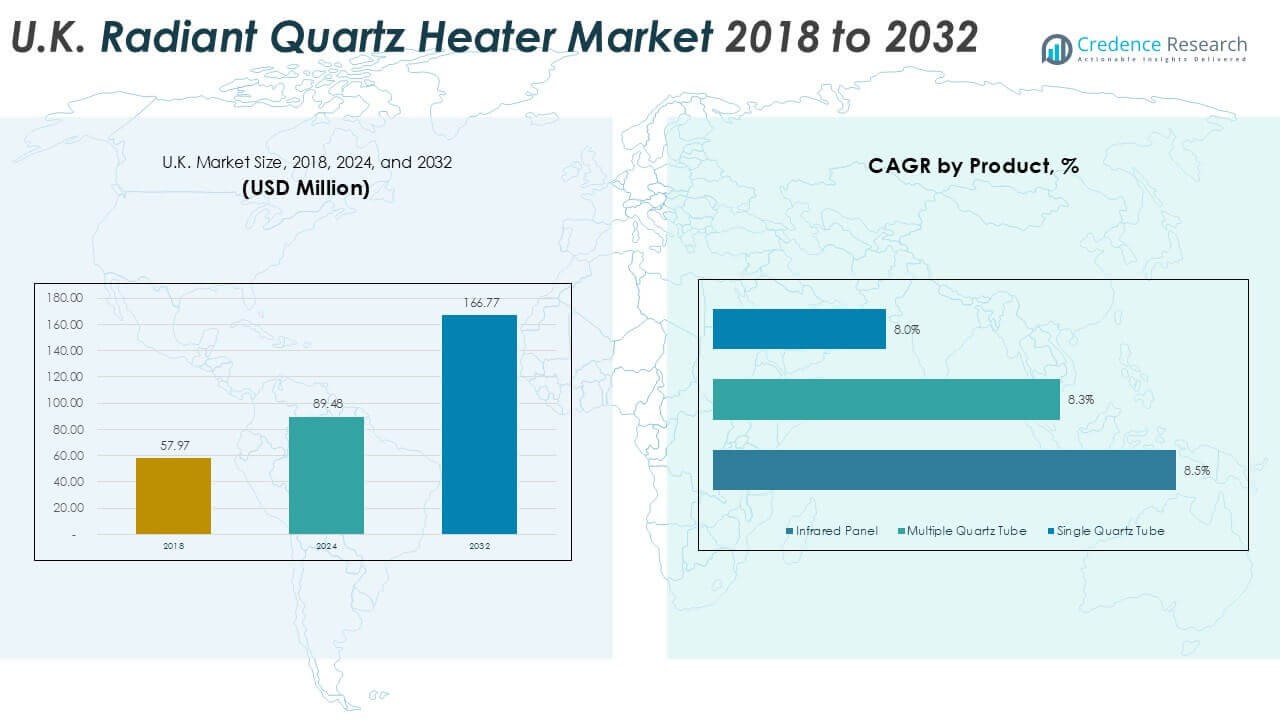
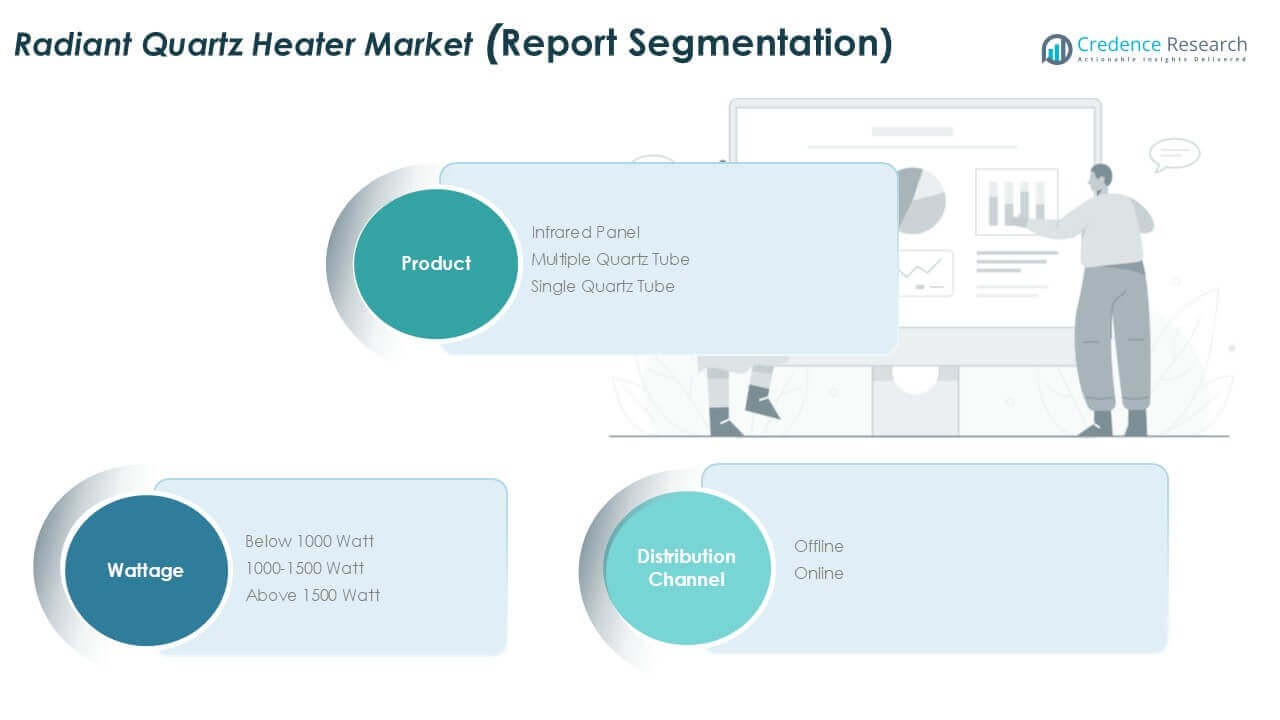
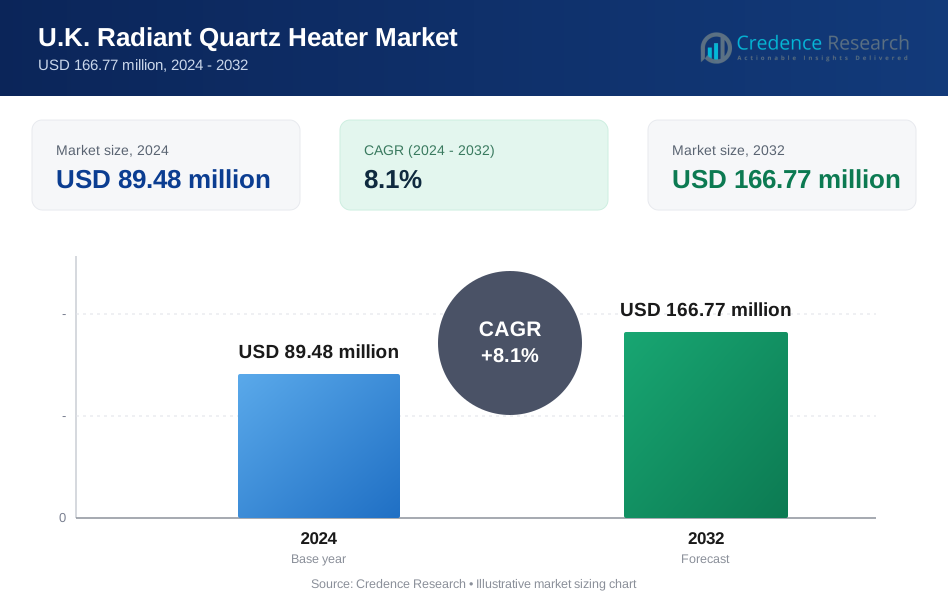
U.K. Radiant Quartz Heater market size was valued at USD 57.97 million in 2018 to USD 89.48 million in 2024 and is anticipated to reach USD 166.77 million by 2032, at a CAGR of 8.1% during the forecast period.
| REPORT ATTRIBUTE | DETAILS |
|---|---|
| Historical Period | 2020-2023 |
| Base Year | 2024 |
| Forecast Period | 2025-2032 |
| U.K. Radiant Quartz Heater Market Size 2024 | USD 89.48 Million |
| U.K. Radiant Quartz Heater Market, CAGR | 8.1% |
| U.K. Radiant Quartz Heater Market Size 2032 | USD 166.77 Million |
The U.K. radiant quartz heater market features a mix of global and regional manufacturers competing across residential and commercial segments. Key players include Honeywell International Inc., Lasko Products, LLC, TPI Corporation, Pelonis Technologies, Inc., Duraflame, Inc., Red Rad, Convectronics, Tempco Electric Heater Corporation, SPACE-RAY, and Clarke International. These companies compete on energy efficiency, safety features, pricing, and distribution reach. England, including Greater London and the South East, leads the market with an exact share of 46%, driven by dense urban housing, high rental activity, and strong retail penetration. Scotland and Northern England follow with 24% share due to colder climates. Regional demand patterns strongly influence competitive positioning and sales strategies.
Market Insights
- The U.K. radiant quartz heater market grew from USD 57.97 million in 2018 to USD 89.48 million in 2024 and is projected to reach USD 166.77 million by 2032, registering a CAGR of 8.1% during the forecast period.
- Rising energy costs and demand for energy-efficient space heating drive market growth, as consumers prefer portable heaters for zone heating and reduced electricity consumption during winter months.
- Multiple quartz tube heaters dominate the product segment with about 42% share, while the 1000–1500-watt range leads the wattage segment with nearly 46% share due to balanced heat output and efficiency.
- The market remains competitive, with players such as Honeywell, Lasko, Duraflame, and Red Rad competing on safety features, pricing, and strong offline and online distribution networks.
- England leads regional demand with around 46% market share, followed by Scotland and Northern England at 24%, Wales and West Midlands at 17%, and other regions contributing the remaining 13%.
Market Segmentation Analysis:
By Product
The product segment shows clear dominance of multiple quartz tube heaters in the U.K. market. This sub-segment holds about 42% market share due to higher heat output and faster room coverage. Multiple tube designs suit living rooms and medium-sized spaces. Infrared panel heaters follow, driven by slim design and wall-mount use in modern homes. Single quartz tube heaters retain demand in low-cost and portable use cases. Rising preference for efficient zone heating and compact designs supports steady growth across all product categories
- For instance, Dimplex’s QXD1500E quartz heater uses a single quartz heating tube (ruby lamp element), operates at 1,500 watts, and is designed to provide localized radiant heat suitable for living rooms and shared spaces.
By Wattage Segment
The 1000–1500 watt category dominates the wattage segment with nearly 46% market share. This range balances energy use and heating performance for typical U.K. households. Consumers favor this wattage for bedrooms and living areas. Below 1000 watt heaters serve small rooms and personal heating needs. Above 1500 watt units target garages and large open spaces. Growth drivers include rising energy awareness and demand for heaters that deliver comfort without high electricity bills during winter months.
- For instance, Clearline's QH1000 quartz heater operates at 1,000 watts, weighs approximately 0.80 kilograms, and includes two heat settings (500 watts or 1,000 watts), supporting efficient use in small rooms without circuit overload.
By Distribution Channel
Offline channels lead the U.K. market with around 61% share, supported by DIY stores and appliance retailers. Buyers prefer in-store checks for safety features and build quality. Seasonal promotions and staff guidance strengthen offline sales. Online channels grow faster, driven by price comparison and home delivery convenience. E-commerce benefits from winter demand spikes and digital marketing. The channel mix reflects consumer trust in physical retail alongside growing comfort with online appliance purchases.
Key Growth Drivers
Rising Demand for Energy-Efficient Space Heating
Energy efficiency remains a core growth driver in the U.K. radiant quartz heater market. Households face rising electricity tariffs and volatile energy bills. Consumers actively seek heating solutions that reduce overall power use. Radiant quartz heaters provide direct heat without warming unused air. This feature improves efficiency in single rooms and zones. Renters and homeowners value lower operating costs during winter months. Government focus on energy conservation also shapes buying behavior. Compact heaters support selective heating rather than whole-home systems. This shift favors portable and wall-mounted quartz models. Manufacturers highlight fast heat delivery and low standby losses. These benefits support replacement demand across urban homes. Energy-aware consumers continue to drive steady volume growth.
- For instance, Dimplex’s QXD1500E quartz heater operates at 1,500 watts, uses a single quartz heating element, and reaches full radiant output in under 30 seconds, supporting efficient zone heating in single rooms.
Growth in Urban Living and Smaller Housing Units
Urbanization strongly supports demand for radiant quartz heaters across the U.K. Cities show rising apartment and studio housing density. Smaller homes require compact and flexible heating options. Quartz heaters fit well in limited spaces. The products deliver quick warmth without permanent installation. Young professionals and renters prefer portable heaters for flexibility. Many urban homes lack centralized heating upgrades. Radiant heaters act as secondary or backup solutions. Easy storage and mobility improve product appeal. High adoption appears in London and major metro areas. Urban lifestyle trends support repeats seasonal purchases. This driver sustains long-term residential demand growth.
- For instance, Glen Dimplex's Creda CPHT10T portable panel heater operates at 1,000 watts, weighs 3.8 kilograms, and includes multiple settings controlled by a 7-day programmable timer and electronic thermostat, making it suitable for studios and rental flats.
Seasonal Climate Variability and Backup Heating Needs
Unpredictable winter temperatures drive consistent demand for supplementary heating. Cold spells often strain central heating systems. Consumers seek fast-acting backup solutions. Radiant quartz heaters deliver instant warmth during peak cold periods. Households use these products during early winter and sudden temperature drops. The U.K.’s damp climate increases perceived cold discomfort indoors. Portable heaters address short-term heating gaps effectively. Retail sales surge during seasonal cold events. Emergency heating needs also support demand. This behavior strengthens repeat purchases across years. Seasonal variability remains a stable market growth driver.
Key Trends & Opportunities
Shift Toward Smart and Safety-Enhanced Heaters
Smart features create strong opportunities in the U.K. market. Consumers increasingly value safety and control features. Tip-over protection and overheat shutoff drive purchase decisions. Digital thermostats improve temperature management. Some models integrate timers and remote controls. These features reduce energy waste and improve comfort. Smart functionality supports premium pricing strategies. Urban households show higher adoption of feature-rich heaters. Retailers highlight safety certifications to build trust. Aging populations also prefer safer heating solutions. Innovation in controls strengthens brand differentiation and margin growth.
- For instance, the Dimplex QXD1500E quartz heater is a high-output, wall-mounted appliance that operates at 1,500 watts. It includes essential safety features such as automatic overheat protection, enhancing safety when installed correctly according to the manufacturer's guidelines.
Expansion of Online Retail and Direct-to-Consumer Sales
Online channels present major growth opportunities for radiant quartz heaters. E-commerce offers price transparency and product comparisons. Consumers rely on reviews and ratings before purchase. Seasonal discounts drive strong online sales volumes. Direct-to-consumer models improve brand visibility. Home delivery supports bulky appliance purchases. Younger buyers prefer online shopping convenience. Digital platforms enable rapid response to weather-driven demand spikes. Manufacturers invest in online marketing and content. Online expansion supports wider geographic reach across the U.K.
- For instance, Klarstein’s infrared quartz heaters sold through U.K. e-commerce platforms list full specifications, including a 600-watt output, 60 x 100 cm panel size, and IP24 splash protection, supporting informed online purchases.
Key Challenges
Price Sensitivity and Intense Brand Competition
Price pressure remains a key challenge in the U.K. market. Many products compete in similar wattage ranges. Low differentiation increases price-based competition. Imported low-cost models intensify rivalry. Consumers often compare prices across retailers. Margin pressure affects mid-range brands the most. Promotional discounting impacts profitability during peak seasons. Retailers demand competitive wholesale pricing. Smaller brands struggle to sustain marketing spend. Managing costs while maintaining quality remains difficult. This challenge limits pricing power across the market.
Safety Regulations and Compliance Requirements
Regulatory compliance creates operational challenges for manufacturers. The U.K. enforces strict electrical safety standards. Products must meet certification and testing requirements. Compliance increases production and testing costs. Delays in certification can affect product launches. Retailers demand full regulatory documentation. Non-compliant products risk recalls or bans. Safety expectations also continue to rise. Brands must invest in quality control systems. Smaller suppliers face higher compliance burdens. Regulatory pressure remains a barrier to easy market entry.
Regional Analysis
England (Including Greater London & South East)
England dominates the U.K. radiant quartz heater market, accounting for about 46% market share. Greater London and the South East drive demand due to dense urban housing and high rental activity. Apartments and smaller homes favor compact, portable heaters. Higher disposable income supports sales of mid-range and premium models. Frequent replacement demand appears during winter seasons. Retail concentration and strong e-commerce penetration further support volume growth. Energy-efficient heaters gain traction as electricity costs rise. This region remains the primary revenue contributor.
Scotland & Northern England
Scotland and Northern England hold nearly 24% of the U.K. market share. Colder and longer winters sustain strong heating demand. Households often use radiant quartz heaters as secondary heating solutions. Rural and suburban homes drive steady seasonal purchases. Energy efficiency and quick heat output remain key buying factors. Offline retail remains important in smaller towns. Demand for higher-wattage models is relatively strong. Weather severity and seasonal temperature drops continue to support stable regional growth.
Wales & West Midlands
Wales and the West Midlands represent around 17% market share. The region shows balanced demand across residential segments. Mixed housing types support use of portable and wall-mounted heaters. Consumers focus on value-for-money products. Mid-wattage quartz heaters dominate due to moderate room sizes. Retail chains and local appliance stores play a major role. Online adoption is rising among younger households. Seasonal promotions strongly influence purchasing decisions. Steady urban development supports consistent market expansion.
Northern Ireland, East Midlands & Other Regions
Northern Ireland, the East Midlands, and other regions account for about 13% market share. Demand remains stable but lower than major urban areas. Detached and semi-detached homes support supplementary heater usage. Consumers favor reliable and affordable models. Offline channels dominate due to limited e-commerce penetration in some areas. Heating needs peak during cold spells rather than full winters. Replacement demand drives most sales. Gradual urban growth and retail access support moderate market growth.
Market Segmentations:
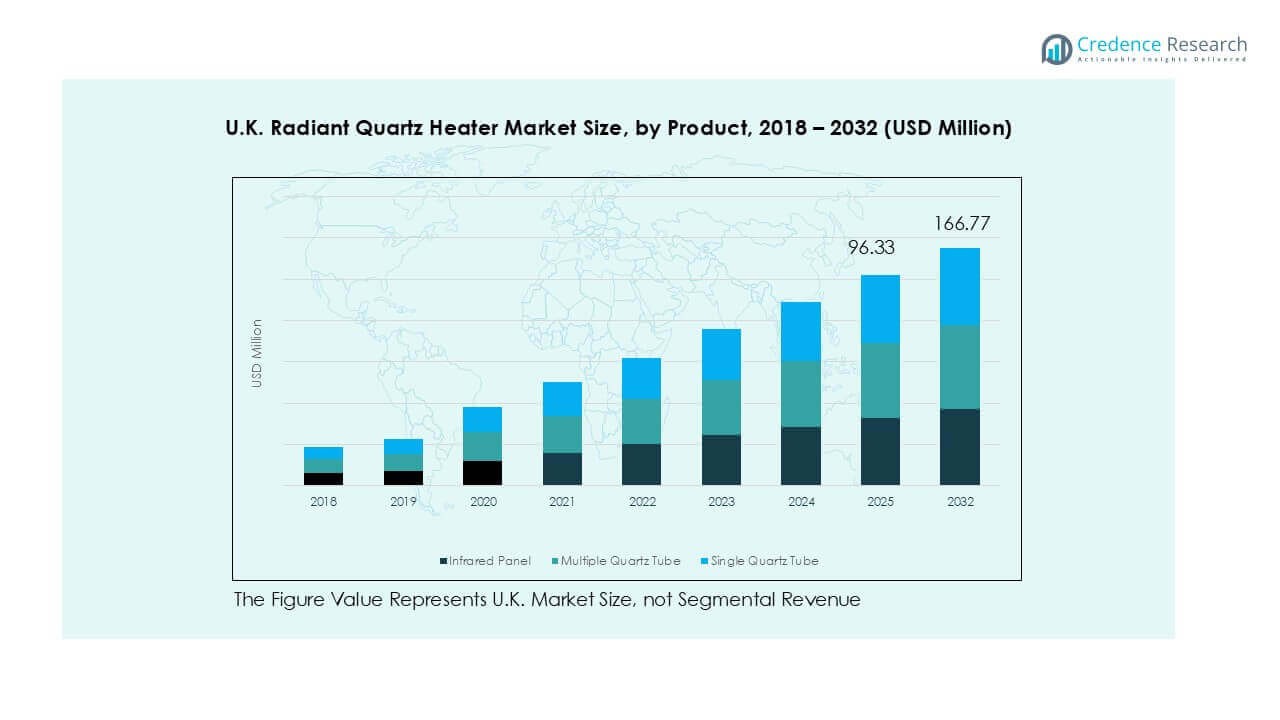
By Product
- Infrared Panel
- Multiple Quartz Tube
- Single Quartz Tube
By Wattage Segment
- Below 1000 Watt
- 1000–1500 Watt
- Above 1500 Watt
By Distribution Channel
- Offline
- Online
By Geography
- England (including Greater London & South East)
- Scotland & Northern England
- Wales & West Midlands
- Northern Ireland, East Midlands & Other Regions
Competitive Landscape
The competitive landscape in the U.K. radiant quartz heater market remains fragmented with global and regional players competing on features, price, and distribution. Leading brands such as Red Rad, Honeywell International Inc., and Lasko Products, LLC leverage strong distribution networks across online and offline channels. Mid-sized companies like Convectronics and TPI Corporation focus on niche segments with energy-efficient and safety-enhanced models. Pelonis Technologies and Duraflame invest in product innovation to differentiate on performance and design. SPACE-RAY and CLARKE INTERNATIONAL maintain presence through strong aftermarket support and regional partnerships. Tempco Electric Heater Corporation targets industrial and commercial applications. Competitive drivers include smart features, compliance with U.K. safety standards, and responsive pricing strategies. Brands prioritize promotional offers during peak winter demand to capture market share. Overall, performance, brand reputation, and channel reach shape market positioning and growth.
Key Player Analysis
- Red Rad
- Convectronics
- Tempco Electric Heater Corporation
- Honeywell International Inc.
- Lasko Products, LLC
- TPI Corporation
- Pelonis Technologies, Inc.
- Duraflame, Inc.
- SPACE-RAY
- CLARKE INTERNATIONAL
Recent Developments
- In June 2023, The European Union revised its overarching Energy Efficiency Directive, and new, stricter Ecodesign standards for local space heaters, including radiant heaters, were adopted in April 2024 and will apply from July 1, 2025.
- In January 2023, Honeywell announced a new line of smart radiant quartz heaters with integrated Wi-Fi capabilities.
Report Coverage
The research report offers an in-depth analysis based on Product, Wattage Segment, Distribution Channel and Geography. It details leading market players, providing an overview of their business, product offerings, investments, revenue streams, and key applications. Additionally, the report includes insights into the competitive environment, SWOT analysis, current market trends, as well as the primary drivers and constraints. Furthermore, it discusses various factors that have driven market expansion in recent years. The report also explores market dynamics, regulatory scenarios, and technological advancements that are shaping the industry. It assesses the impact of external factors and global economic changes on market growth. Lastly, it provides strategic recommendations for new entrants and established companies to navigate the complexities of the market.
Future Outlook
- The market will benefit from rising demand for energy-efficient and targeted space heating solutions.
- Urban housing growth will continue to support sales of compact and portable quartz heaters.
- Smart controls and enhanced safety features will gain wider adoption across product ranges.
- Online sales channels will expand faster than traditional retail formats.
- Manufacturers will focus on mid-wattage models to balance comfort and energy use.
- Seasonal demand patterns will continue to shape inventory and pricing strategies.
- Product design and aesthetics will play a larger role in consumer choice.
- Compliance with safety and energy standards will influence product development.
- Competition will intensify, leading to frequent promotional activity during winter months.
- Regional demand will remain strongest in England, with steady growth across other U.K. regions.
Request a Free Sample
Fill in your details and we'll send you a free sample report.
- Sample data tables & charts
- Research methodology
Need a Custom Version of This Report?
Tailor the scope, geography, or segments to your exact requirements.
- Custom geography or segment scope
- Direct access to our analyst team
Frequently Asked Questions
What is the current market size for the U.K. Radiant Quartz Heater market, and what is its projected size in 2032?
At what Compound Annual Growth Rate is the U.K. Radiant Quartz Heater market projected to grow between 2024 and 2032?
Which U.K. Radiant Quartz Heater market segment held the largest share in 2024?
What are the primary factors fueling the growth of the U.K. Radiant Quartz Heater market?
Who are the leading companies in the U.K. Radiant Quartz Heater market?
Which region commanded the largest share of the U.K. Radiant Quartz Heater market in 2024?
Table of Content
Chapter 1. Report Introduction
- 1.1 Report Description & Purpose
- 1.1.1 Report Title & Market Definition
- 1.1.2 Unique Selling Propositions (USP) & Key Differentiators
- 1.1.3 Value Proposition for Stakeholders
- 1.2 Research Objectives
- 1.2.1 Market Sizing Objectives (Volume & Revenue)
- 1.2.2 Segmentation Objectives
- 1.2.3 Competitive Intelligence Objectives
- 1.2.4 Forecast & Scenario Objectives
- 1.3 Report Scope
- 1.3.1 U.K. Radiant Quartz Heater Scope – Types & Subtypes Covered
- 1.3.2 Geographic Scope – Regions & Countries Covered
- 1.3.3 Historical Period, Base Year & Forecast Period (2024; forecast to 2032)
- 1.3.4 Inclusions & Exclusions
- 1.4 HS Code & Classification Framework
- 1.5 Currency, Units & Pricing Basis
- 1.6 Target Stakeholders
- 1.7 Limitations & Assumptions
Chapter 2. Executive Summary
- 2.1 Global U.K. Radiant Quartz Heater Market Snapshot
- 2.1.1 Market Size – Historical (2024) & Forecast (2024-2032) (2024: USD 89.48 million → 2032: USD 166.77 million)
- 2.1.2 Volume & Revenue – Global Totals
- 2.1.3 Key Market Highlights – Top Five Facts
- 2.2 U.K. Radiant Quartz Heater Market Segmentation Snapshot
- 2.2.1 Market Split by Region – 2024 vs. 2032
- 2.3 Competitive Snapshot
- 2.3.1 Top 10 Players by Revenue Share – 2024
- 2.3.2 Top 10 Players by Volume Share – 2024
- 2.3.3 Recent Strategic Developments (18-Month Summary)
- 2.4 Key Investment Highlights & Strategic Conclusions
Chapter 3. U.K. Radiant Quartz Heater Market Dynamics & Industry Analysis
- 3.1 Market Overview & Context
- 3.1.1 U.K. Radiant Quartz Heater Market Position in the Broader Automotive Value Chain
- 3.1.2 OEM vs. Replacement Market Dynamics
- 3.1.3 Market Maturity & Development Stage by Region
- 3.2 U.K. Radiant Quartz Heater Market Drivers
- 3.3 U.K. Radiant Quartz Heater Market Restraints & Challenges
- 3.4 U.K. Radiant Quartz Heater Market Opportunities
- 3.5 Porter's Five Forces Analysis
- 3.5.1 Threat of New Entrants
- 3.5.2 Bargaining Power of Suppliers
- 3.5.3 Bargaining Power of Buyers
- 3.5.4 Threat of Substitutes
- 3.5.5 Competitive Rivalry – Intensity Assessment
- 3.6 U.K. Radiant Quartz Heater Value Chain Analysis
- 3.6.1 Upstream – Raw Material/Input Suppliers
- 3.6.1.1 Raw Material/Input 1
- 3.6.1.2 Raw Material/Input 2
- 3.6.1.3 Raw Material/Input 3
- 3.6.2 Midstream – Production/Manufacturing/Service Delivery
- 3.6.2.1 Production/Process Overview
- 3.6.2.2 Key Facility Locations & Capacity by Manufacturer
- 3.6.3 Downstream – Distribution & End Consumer
- 3.6.3.1 Primary Channel – B2B/OEM
- 3.6.3.2 Secondary Channels – Dealer, Retail, Online, Direct
- 3.6.4 Value Chain Profitability Analysis
- 3.6.1 Upstream – Raw Material/Input Suppliers
- 3.7 PESTEL Analysis
- 3.7.1 Political Factors
- 3.7.2 Economic Factors
- 3.7.3 Social Factors
- 3.7.4 Technological Factors
- 3.7.5 Environmental Factors
- 3.7.6 Legal Factors
- 3.8 U.K. Radiant Quartz Heater Supply Chain Analysis
- 3.8.1 Raw Material/Input Supply Risk Assessment
- 3.8.2 Manufacturing Concentration Risk (Geographic Exposure)
- 3.8.3 Trade Disruption Impact Analysis
- 3.9 Regulatory & Policy Landscape
Note: The regulatory and policy landscape section covers regulations based on their applicability to the market, U.K. Radiant Quartz Heater category, geography, and scope of the study. Only regulatory frameworks with a material impact on operations, compliance, trade, sustainability, or market access are analyzed in detail.
Chapter 4. Key Investment Pockets & Opportunity Analysis
- 4.1 U.K. Radiant Quartz Heater Market Attractiveness Analysis
- 4.1.1 By Region – Investment Attractiveness Matrix (Volume × CAGR)
- 4.2 Absolute Revenue Growth Opportunity
- 4.2.1 By Region – Absolute USD Growth Through 2032
- 4.3 Incremental Volume Opportunity
- 4.3.1 By Region – Incremental Volume Through 2032
- 4.3.2 Segment – Incremental Volume
- 4.4 Emerging Submarket Opportunity Deep Dive (Subject to Applicability)
- 4.5 Emerging Market Opportunity Scorecards
- 4.5.1 United States
- 4.5.2 Europe
- 4.5.3 Asia
- 4.5.4 Middle East & Africa
Note: Emerging Market Opportunity Scorecards will be included based on relevance and strategic importance. Regions listed are indicative and may vary depending on data availability and market dynamics.
Chapter 5. U.K. Radiant Quartz Heater Import-Export Analysis & Trade Flows
- 5.1 Global Trade Overview
- 5.1.1 Global Export Value by Country (2024)
- 5.1.2 Global Export Volume by Country (2024)
- 5.1.3 Global Import Value by Country (2024)
- 5.1.4 Global Import Volume by Country (2024)
- 5.1.5 Net Trade Balance by Country (2024)
- 5.2 Export Analysis – Segment
- 5.2.1 Type 1 (HS Code)
- 5.2.2 Type 2 (HS Code)
- 5.2.3 Type 3 (HS Code)
- 5.2.4 Type 4 (HS Code)
- 5.2.5 Type 5 (HS Code)
- 5.3 Import Analysis – Segment
- 5.3.1 Type 1 (HS Code)
- 5.3.2 Type 2 (HS Code)
- 5.3.3 Type 3 (HS Code)
- 5.3.4 Type 4 (HS Code)
- 5.3.5 Type 5 (HS Code)
- 5.4 Average Unit Trade Prices
- 5.4.1 Average Export Price – Segment & Country
- 5.4.2 Average Import Price – Segment & Source Country
- 5.4.3 Price Trends (2024)
- 5.5 Key Trade Route Analysis
- 5.5.1 Trade Route 1
- 5.5.2 Trade Route 2
- 5.5.3 Trade Route 3
- 5.5.4 Trade Route 4
- 5.5.5 Trade Route 5
- 5.6 Trade Policy Impact Assessment
- 5.6.1 US Anti-Dumping & Section 301 Tariffs
- 5.6.2 EU Customs Union Impact
- 5.6.3 Major Free Trade Agreements
- 5.6.4 USMCA Rules of Origin
Note: Trade policy analysis will be included only where relevant to the U.K. Radiant Quartz Heater market.
Chapter 6. Competitive Landscape & Company Benchmarking
- 6.1 U.K. Radiant Quartz Heater Market Concentration & Structure
- 6.1.1 Herfindahl-Hirschman Index (HHI) – vs. 2024
- 6.1.2 Tier 1, Tier 2 & Tier 3 Market Structure
- 6.1.3 Global, Regional & Local Player Dynamics
- 6.2 U.K. Radiant Quartz Heater Market Share Analysis – 2024
- 6.2.1 Global Revenue Share by Company
- 6.2.2 Global Volume Share by Company
- 6.2.3 Regional Revenue Share
- 6.2.4 Market Share Evolution ( vs. 2024)
- 6.2.5 OEM Segment Share by Company
- 6.2.6 Replacement Segment Share by Company
- 6.3 Production/Delivery Capacity & Facility Analysis
- 6.3.1 Global Installed Capacity
- 6.3.2 Capacity Utilization Rates
- 6.3.3 Production/Output Volume
- 6.3.4 Facility Locations & Capacity Map
- 6.3.5 Planned Capacity Additions
- 6.4 U.K. Radiant Quartz Heater Competitive Benchmarking Matrix
- 6.4.1 Revenue, Volume, CAGR & Profitability Comparison
- 6.4.2 Channel Revenue Mix
- 6.4.3 Geographic Revenue Exposure
- 6.4.4 R&D Intensity
- 6.4.5 Sustainability Maturity
- 6.5 Strategic Developments in U.K. Radiant Quartz Heater (Last 24 Months)
- 6.5.1 Mergers, Acquisitions & Divestments
- 6.5.2 New U.K. Radiant Quartz Heater Launches
- 6.5.3 Facility Expansions
- 6.5.4 Strategic Alliances, Joint Ventures & Partnerships
- 6.5.5 Distribution Expansion & Market Entry
- 6.5.6 Sustainability & ESG Initiatives
- 6.6 Competitive Strategy Mapping
- 6.6.1 Leader, Challenger, Follower & Niche Classification
- 6.6.2 Pricing Strategy Comparison
- 6.6.3 Channel Strategy Matrix
Note: Strategic developments are included based on their materiality and the availability of reliable information.
Chapter 7. Global U.K. Radiant Quartz Heater Market – By Distribution Channel
- 7.1 Segment Overview
- 7.1.1 Volume & Revenue Split by Channel (2024 & 2032)
- 7.1.2 Channel Mix Evolution (2024-2032)
Chapter 8. Regional Market Analysis – Global Overview
- 8.1 Global Regional Overview
- 8.1.1 Regional Volume Share
- 8.1.2 Regional Revenue Share
- 8.1.3 Regional Volume by Region
- 8.1.4 Regional Revenue by Region
- 8.1.5 Regional Forecast Through 2032
- 8.2 Cross-Regional Segment Analysis
- 8.2.1 By Distribution Channel
- 8.2.2 By Brand/Price Tier
Chapter 9. North America U.K. Radiant Quartz Heater Market
- 9.1 United States
- 9.2 Canada
- 9.3 Mexico
Chapter 10. Europe U.K. Radiant Quartz Heater Market
- 10.1 Germany
- 10.2 France
- 10.3 Italy
- 10.4 United Kingdom
- 10.5 Spain
- 10.6 Poland
- 10.7 Russia
- 10.8 Netherlands
- 10.9 Belgium
- 10.10 Sweden
- 10.11 Denmark
- 10.12 Norway
- 10.13 Rest of Europe
Chapter 11. Asia Pacific U.K. Radiant Quartz Heater Market
- 11.1 China
- 11.2 India
- 11.3 Japan
- 11.4 South Korea
- 11.5 Thailand
- 11.6 Indonesia
- 11.7 Vietnam
- 11.8 Malaysia
- 11.9 Australia
- 11.10 Rest of Asia Pacific
Chapter 12. Latin America U.K. Radiant Quartz Heater Market
- 12.1 Brazil
- 12.2 Argentina
- 12.3 Colombia
- 12.4 Chile
- 12.5 Rest of Latin America
Chapter 13. Middle East U.K. Radiant Quartz Heater Market
- 13.1 Saudi Arabia
- 13.2 United Arab Emirates
- 13.3 Turkey
- 13.4 Israel
- 13.5 Iran
- 13.6 Rest of the Middle East
Chapter 14. Africa U.K. Radiant Quartz Heater Market
- 14.1 South Africa
- 14.2 Egypt
- 14.3 Nigeria
- 14.4 Morocco
- 14.5 Rest of Africa
Chapter 15. U.K. Radiant Quartz Heater Company Profiles
- 15.1 [Company 01]
- 15.1.1 Company Overview
- 15.1.2 Key Management Personnel
- 15.1.3 Products & Services Portfolio
- 15.1.4 Financial Performance
- 15.1.5 Key Market Focus & Geographic Presence
- 15.1.6 Recent Developments & Strategic Initiatives
Note: The company profile list is preliminary and may change based on research findings, market developments, data availability, and client requirements.
Chapter 16. Appendices
- Appendix A – List of Abbreviations & Acronyms
- Appendix B – Industry Classification Code Reference – Full Series
- Appendix C – Production & Capacity Data Tables
- Appendix D – End-Use & Demand Base Tables
- Appendix E – Consumption & Replacement Rate Assumptions
- Appendix F – ASP Reference Tables
- Appendix G – Manufacturing & Facility Database
- Appendix H – Import-Export Data Tables
- Appendix I – Regulatory Summary Tables
- Appendix J – Primary Research Participant List (Anonymized)
- Appendix K – Primary Research Questionnaire Framework
- Appendix L – Data Sources & Bibliography
- Appendix M – Market Size Divergence & Source Comparison
Chapter 17. Research Methodology
- 17.1 Research Framework & Philosophy
- 17.2 Secondary Research – Sources, Hierarchy & Data Extraction
- 17.3 Data Modeling – Bottom-Up & Top-Down Market Sizing
- 17.4 Primary Research – Stakeholder Framework, LOI & Sample Sizes
- 17.5 Forecast Methodology – Regression, Scenario & Sensitivity Analysis
- 17.6 Quality Control – Four-Layer Validation Framework
- 17.7 Limitations & Standard Assumptions
- 17.8 Disclaimer
