Market Overview:
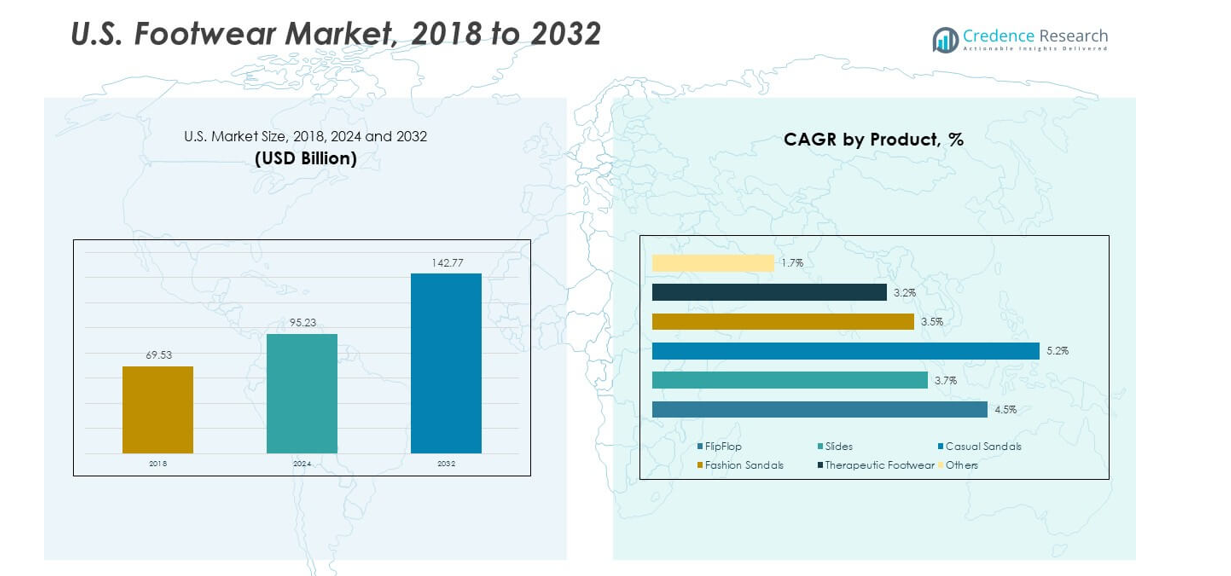
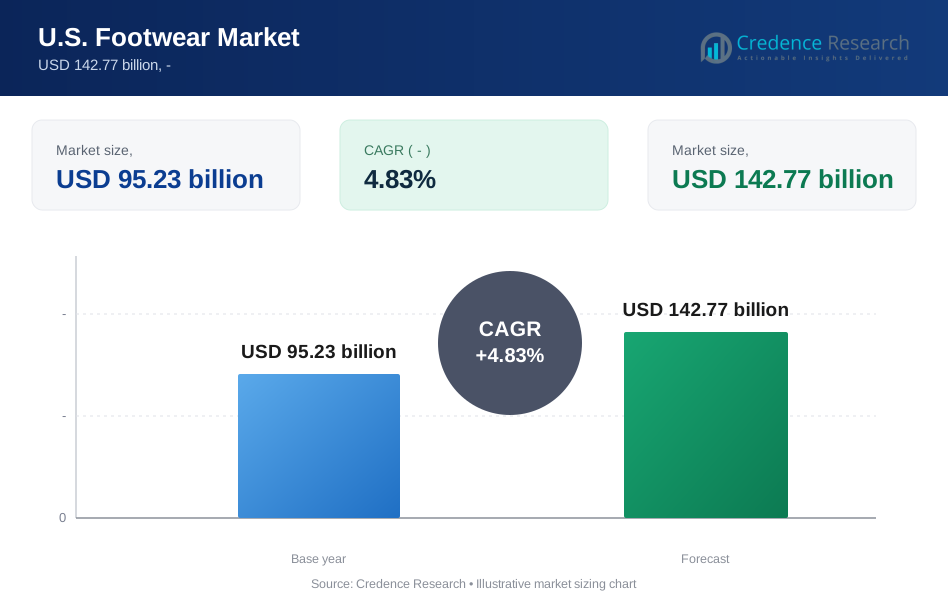
The U.S. Footwear Market size was valued at USD 69.53 billion in 2018 to USD 95.23 billion in 2024 and is anticipated to reach USD 142.77 billion by 2032, at a CAGR of 4.83% during the forecast period.
| REPORT ATTRIBUTE | DETAILS |
|---|---|
| Historical Period | 2020-2023 |
| Base Year | 2024 |
| Forecast Period | 2025-2032 |
| U.S. Footwear Market Size 2024 | USD 95.23 billion |
| U.S. Footwear Market, CAGR | 4.83% |
| U.S. Footwear Market Size 2032 | USD 142.77 billion |
The U.S. footwear market grows due to strong consumer spending and lifestyle shifts. Active lifestyles increase demand for athletic and casual footwear. Sports participation and fitness trends support steady volume growth. Fashion cycles drive frequent product replacement across age groups. Brands invest in comfort technologies and sustainable materials. E-commerce expands product access and brand visibility nationwide. Direct-to-consumer channels improve margins and customer engagement. Celebrity endorsements influence buying decisions. Seasonal demand patterns support consistent sales across categories.
The U.S. footwear market shows strong regional variation by population and income. The West and Northeast lead due to fashion focus and urban density. California drives demand through sports, outdoor, and lifestyle footwear. The Northeast benefits from premium and designer brand adoption. The Midwest shows stable demand tied to family spending patterns. Southern states emerge with faster growth from population inflows. Texas and Florida gain importance due to urban expansion. Climate diversity supports broad product mixes across regions.
Market Insights:
- The U.S. Footwear Market expanded from USD 69.53 billion in 2018 to USD 95.23 billion in 2024 and is projected to reach USD 142.77 billion by 2032, growing at a CAGR of 4.83% due to steady replacement demand, lifestyle shifts, and strong brand penetration.
- The West leads with about 34% share driven by sports culture, outdoor lifestyles, and premium brand adoption, followed by the South at nearly 30% supported by population growth and warm climate demand, while the Northeast holds around 22% due to urban density and higher fashion-led spending.
- The South stands out as the fastest-growing region with close to 30% share, supported by strong migration into Texas and Florida, expanding urban centers, and rising demand for casual and sandal footwear formats.
- By product type, casual sandals account for the largest share at roughly 32%, followed by slides at about 24%, reflecting strong demand for everyday comfort, ease of wear, and multi-use footwear across age groups.
- Fashion sandals and therapeutic footwear together represent nearly 30% of the market, with fashion sandals at around 18% driven by style refresh cycles and therapeutic footwear near 12% supported by aging consumers and foot health awareness.
Market Drivers:
Rising Consumer Focus On Comfort, Performance, And Daily Wear Versatility
The U.S. Footwear Market benefits from strong demand for comfort-focused products that support long daily wear across work and leisure use. Consumers prioritize cushioning, arch support, and lightweight construction when making purchase decisions. Athletic-inspired footwear gains adoption beyond sports activities into everyday routines. Brands invest in ergonomic design to address foot health concerns across age groups. Lifestyle changes increase preference for casual and hybrid footwear styles. Product comfort supports repeat purchases across categories. This focus strengthens long-term brand loyalty nationwide.
- For instance, Skechers integrates Arch Fit insoles developed from more than 120,000 foot scans collected over 20 years. Lifestyle changes increase preference for casual and hybrid footwear styles. Product comfort supports repeat purchases across categories.
Expansion Of Sports, Fitness, And Outdoor Participation Across Age Groups
The U.S. Footwear Market gains momentum from rising participation in sports and fitness activities. Running, training, and walking routines increase demand for performance-oriented footwear. Outdoor recreation supports steady uptake of trail and hiking shoes. Schools and colleges sustain consistent sports footwear consumption. Parents prioritize durable shoes for youth sports programs. Product innovation focuses on grip, stability, and material strength. Performance credibility influences consumer trust and brand selection.
- For instance, Brooks reports that its DNA Loft midsole technology reduces pressure on joints by distributing impact forces more evenly across the foot. Outdoor recreation supports steady uptake of trail and hiking shoes.
Growth Of E-Commerce And Direct-To-Consumer Brand Strategies
The U.S. Footwear Market expands through strong adoption of digital retail channels. Online platforms widen access to brands and product assortments nationwide. Direct-to-consumer strategies improve pricing control and customer data use. Virtual fitting tools support informed buying decisions. Fast delivery improves customer satisfaction and repeat purchases. Brands reduce reliance on physical retail networks. Digital reach supports rapid product launches and limited collections.
Influence Of Fashion Cycles And Brand-Led Product Refresh Strategies
The U.S. Footwear Market responds strongly to fast fashion cycles and frequent design updates. Seasonal trends encourage product replacement across demographics. Brand collaborations create urgency and premium appeal. Celebrity endorsements shape buying behavior in urban markets. Social media accelerates trend awareness and adoption. Design refresh strategies maintain consumer interest across categories. Style-driven demand reinforces brand differentiation in competitive segments.
Market Trends:
Rising Adoption Of Sustainable Materials And Responsible Manufacturing Practices
The U.S. Footwear Market shows growing interest in sustainable product offerings. Consumers value recycled and bio-based materials in footwear designs. Brands emphasize reduced environmental impact in product positioning. Ethical sourcing influences purchasing decisions among younger buyers. Transparency strengthens trust across retail channels. Limited eco-focused collections test broader market acceptance. Sustainability initiatives support long-term brand equity growth.
- For instance, Adidas confirms that its PRIMEBLUE footwear incorporates Parley Ocean Plastic, and as of 2025, the brand has successfully replaced virgin polyester with recycled material in 99% of its entire product range. Brands continue to emphasize reduced environmental impact in product positioning to meet increasing consumer demand for sustainable goods.
Increased Customization And Personalization Through Digital Platforms
The U.S. Footwear Market trends toward personalized product experiences through digital tools. Online platforms allow customization of colors, materials, and finishes. Personal design options strengthen emotional connection with brands. Customized fit improves overall comfort satisfaction. Data insights guide targeted recommendations and promotions. Limited custom runs create exclusivity and premium perception. Personalization enhances customer retention across online channels.
- For instance, Nike By You enables customers to personalize multiple design zones per shoe model ranging from approximately 10 to over 15 areas depending on the silhouette through its digital platform. Offering these personal design options strengthens the emotional connection with the brand by transforming consumers into active creators of their own products.
Growing Demand For Slip-On, Hands-Free, And Convenience-Oriented Designs
The U.S. Footwear Market reflects rising demand for ease-of-use designs. Hands-free footwear attracts working professionals and older consumers. Slip-on formats support fast-paced daily routines. Simple construction increases cross-age adoption rates. Brands integrate flexible materials to improve ease of wear. Convenience features align with commuting and travel needs. Functional simplicity drives repeat purchasing behavior.
Shift Toward Multi-Use Footwear Blending Style And Utility
The U.S. Footwear Market favors versatile designs that suit multiple settings. Consumers seek shoes that transition between work, leisure, and social use. Hybrid footwear reduces the need for multiple pairs. Urban lifestyles support demand for adaptable products. Balanced design between style and function gains importance. Neutral aesthetics improve wardrobe compatibility. Versatility enhances perceived value and product longevity.
Market Challenges Analysis:
Intense Price Competition And Margin Pressure Across Mass And Premium Segments
The U.S. Footwear Market faces intense price competition across retail segments. Frequent discounting pressures brand profitability. Private labels challenge established brands on price positioning. Promotions reduce perceived product value over time. Rising input and logistics costs strain margin stability. Retail partners demand competitive wholesale pricing. Cost control remains a critical focus for long-term sustainability.
Supply Chain Complexity And Dependence On Global Manufacturing Networks
The U.S. Footwear Market relies heavily on global sourcing and production networks. Overseas manufacturing increases exposure to disruptions and delays. Logistics challenges affect product availability across seasons. Tariff changes influence sourcing and pricing decisions. Inventory planning grows complex with demand fluctuations. Brands explore nearshoring to reduce operational risk. Supply chain resilience requires ongoing investment and coordination.
Market Opportunities:
Expansion Of Smart Footwear And Technology-Integrated Product Lines
The U.S. Footwear Market presents growth opportunities through technology-integrated products. Smart footwear incorporates sensors for activity and performance tracking. Connected features appeal to fitness-focused consumers. Health monitoring functions attract niche user segments. Brands partner with technology firms to accelerate innovation. Premium positioning supports higher margins. Technology differentiation strengthens competitive positioning.
Growth Potential In Emerging Urban Centers And Demographic Shifts
The U.S. Footwear Market benefits from population growth in emerging urban centers. Secondary cities show rising consumer spending power. Younger demographics drive faster adoption of new styles. Migration patterns support regional demand expansion. Retail footprints extend beyond traditional coastal hubs. Localized assortments improve regional relevance. Demographic diversity supports long-term volume growth.
Market Segmentation Analysis:
By Type
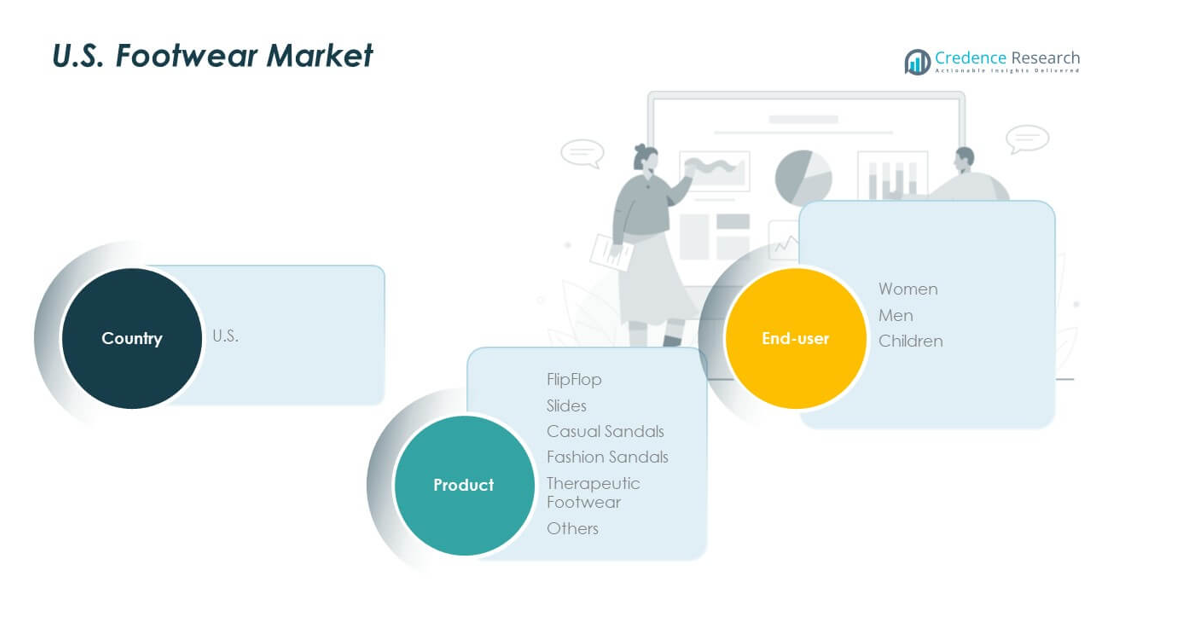
The U.S. Footwear Market shows clear differentiation across product types based on usage and lifestyle needs. FlipFlops hold strong demand for casual and seasonal wear, driven by affordability and comfort. Slides gain traction for home, leisure, and quick outdoor use due to ease of wear. Casual sandals maintain steady demand across everyday activities and travel use. Fashion sandals benefit from design updates and brand-driven styling, supporting higher value perception. Therapeutic footwear addresses foot health needs, supported by an aging population and medical recommendations. Others include specialty and niche products that serve outdoor, safety, or occupational requirements. It reflects a broad product mix that supports consistent category demand.
- For instance, Vionic develops orthotic sandals validated by podiatrists and aligned with American Podiatric Medical Association guidelines. Others include specialty products serving outdoor or occupational use.
By End-User
The U.S. Footwear Market demonstrates varied demand patterns across end-user groups. Men’s footwear demand centers on durability, comfort, and multi-use designs across work and casual settings. Women’s footwear leads in style diversity, seasonal refresh cycles, and fashion-driven purchases. Kids’ footwear demand remains stable due to frequent size changes and school-related needs. Parents prioritize comfort, safety, and durability for children. Brand trust plays a strong role across all end-user segments. It supports steady replacement cycles and recurring purchase behavior. End-user diversity strengthens overall market stability.
- For instance, Stride Rite uses dual-fit sock systems to improve sizing accuracy for growing feet. Brand trust plays a strong role across all end-user segments.
Segmentation:
- By Type
- FlipFlops
- Slides
- Casual Sandals
- Fashion Sandals
- Therapeutic Footwear
- Others
- By End-User
- Men
- Women
- Kids
- By Region (U.S.)
- Northeast
- Midwest
- South
- West
Regional Analysis:
West Region Leadership Driven by Lifestyle, Sports, and Brand Adoption
The U.S. Footwear Market sees the West region holding the largest share at around 34%. California anchors regional demand through strong sports culture and outdoor lifestyles. Urban centers support premium, athletic, and casual footwear categories. Brand innovation and early trend adoption strengthen regional leadership. High fitness participation supports performance footwear sales. Strong retail presence and e-commerce usage improve product access. It benefits from higher discretionary spending levels.
South Region Expansion Supported by Population Growth and Climate Factors
The U.S. Footwear Market positions the South as the second-largest region with nearly 30% share. Population inflows into Texas and Florida boost footwear consumption. Warm climate supports steady demand for sandals, slides, and casual footwear. Expanding urban areas increase retail footprint and online penetration. Family-oriented demographics drive consistent replacement cycles. Value-focused brands perform well across suburban markets. It shows strong volume-led growth dynamics.
Northeast and Midwest Contribution Through Urban Density and Stable Demand
The U.S. Footwear Market records the Northeast with about 22% market share. Dense urban populations support premium, fashion, and work footwear demand. Higher brand consciousness influences purchasing decisions. Seasonal variation supports diverse product categories. The Midwest accounts for nearly 14% share with stable demand patterns. Family households prioritize durability and value-based purchases. It maintains steady demand supported by consistent consumer spending behavior.
Key Player Analysis:
- Nike, Inc.
- Deckers Outdoor Corporation
- Skechers U.S.A., Inc.
- Crocs, Inc.
- Foot Locker, Inc.
Competitive Analysis:
The U.S. Footwear Market remains highly competitive with strong presence from global brands and domestic specialists. Leading players compete on brand strength, product innovation, and retail reach. Athletic and lifestyle brands dominate volume through wide portfolios and strong marketing. Comfort-focused players gain share through casual and therapeutic categories. Private labels increase pressure in value segments across mass retail channels. Companies invest in direct-to-consumer platforms to strengthen margins and data access. Product refresh cycles support differentiation across seasons. It reflects a balance between premium branding and price-led competition.
Recent Developments:
- In November 2025, Crocs promoted Rupert Campbell, an Adidas veteran with over a decade of leadership experience, to President of HeyDude. Campbell's appointment signals the company's commitment to turning around the struggling brand through enhanced commercial and marketing strategy. Despite these efforts, HeyDude reported revenues of $160 million in Q3 2025, representing a 22% decline compared to the same period in the prior year, though this was partly driven by deliberate marketplace cleanup efforts in the wholesale channel.
- In late September 2025, Crocs, Inc. announced a new advertising campaign for its HeyDude footwear line featuring actress Sydney Sweeney. This celebrity collaboration represents a significant marketing effort to enhance brand recognition among younger demographics and revitalize the HeyDude collection following recent sales challenges. The campaign utilizes both video and print media to reach Gen Z and Millennial consumers. Additionally, in January 2025, HeyDude launched a nostalgic collaboration with Hasbro and the beloved toy icon FURBY, featuring a colorful collection of playful footwear with Furby-inspired designs. The Furby collection included two unique silhouettes: the Wendy Slip Furby Rainbow ($69.99) and the Wendy Furby ($74.99).
- In February 2025, Nike, Inc. partnered with Kim Kardashian's shapewear company Skims to launch a new women-focused activewear brand called NikeSKIMS. This strategic collaboration marks a significant move for Nike to reclaim market share lost to emerging competitors in the women's activewear segment. The partnership was officially announced on February 18, 2025. The new brand will feature training apparel, footwear, and accessories designed specifically for women athletes, combining Nike's athletic performance expertise with Skims' focus on body confidence and design. The inaugural collection of NikeSKIMS launched in select retail locations across the U.S. and on its official website during spring 2025, with plans to expand into more retail stores and the wholesale market by 2026. This collaboration represents Nike's commitment to diversifying its product range under new CEO Elliott Hill, addressing concerns about innovation and helping the company compete with rivals like Lululemon, Alo Yoga, and Vuori in the high-margin women's activewear market.
Report Coverage:
The research report offers an in-depth analysis based on type, end-user, and region segments. It details leading market players, providing an overview of their business, product offerings, investments, revenue streams, and key applications. Additionally, the report includes insights into the competitive environment, SWOT analysis, current market trends, as well as the primary drivers and constraints. Furthermore, it discusses various factors that have driven market expansion in recent years. The report also explores market dynamics, regulatory scenarios, and technological advancements that are shaping the industry. It assesses the impact of external factors and global economic changes on market growth. Lastly, it provides strategic recommendations for new entrants and established companies to navigate the complexities of the market.
Future Outlook:
- Consumer preference for comfort-focused footwear will shape product design strategies.
- Casual and hybrid footwear will gain stronger acceptance across age groups.
- Digital retail channels will drive faster brand-to-consumer engagement.
- Sustainability themes will influence material selection and sourcing practices.
- Customization features will enhance brand differentiation and loyalty.
- Slip-on and hands-free designs will expand across lifestyle categories.
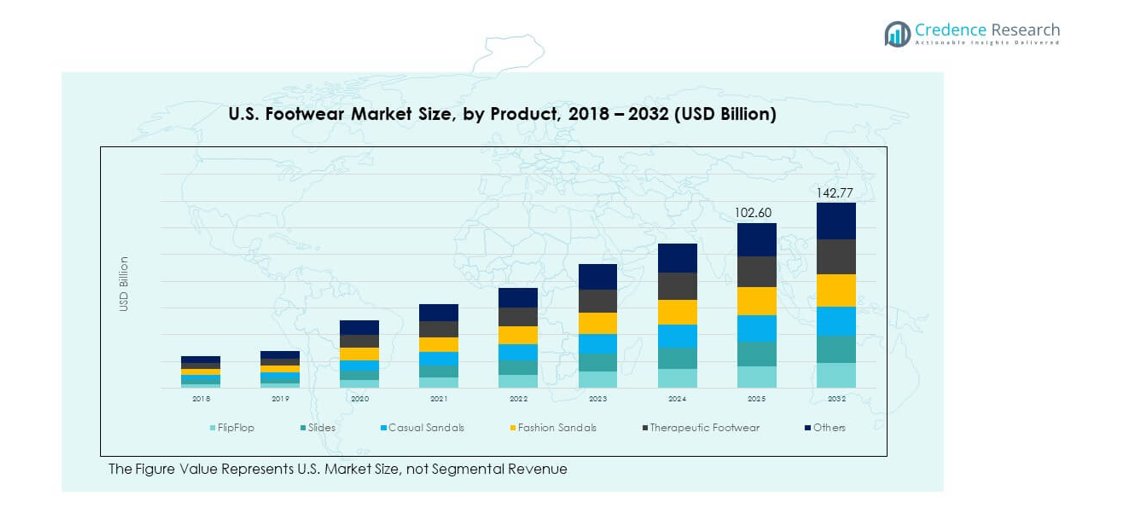
- Regional demand will grow in high-migration urban centers.
- Kids’ footwear will benefit from steady replacement cycles.
- Brand collaborations will support premium positioning efforts.
- Technology-enabled footwear will open niche growth pathways.
Request a Free Sample
Fill in your details and we'll send you a free sample report.
- Sample data tables & charts
- Research methodology
Need a Custom Version of This Report?
Tailor the scope, geography, or segments to your exact requirements.
- Custom geography or segment scope
- Direct access to our analyst team
Frequently Asked Questions
At what Compound Annual Growth Rate is the U.S. Footwear Market projected to grow between 2024 and 2032?
Which U.S. Footwear Market segment held the largest share in 2024?
What are the primary factors fueling the growth of the U.S. Footwear Market?
Who are the leading companies in the U.S. Footwear Market?
Which region commanded the largest share of the U.S. Footwear Market in 2024
Table of Content
Chapter 1 Market Segmentation
- 1.1 Segmentation Framework
- 1.1.1 Product and Service Classification
- 1.1.2 Application and End-Use Classification
- 1.1.3 Technology and Solution Classification
- 1.1.4 Customer and Distribution Channel Classification
- 1.1.5 Geographic Segmentation
- 1.1.6 Market Segment Definitions and Boundaries
Chapter 2 Introduction
- 2.1 Report Objectives and Scope
- 2.2 Product Definition and Industry Terminology
- 2.3 Market Inclusions and Exclusions
- 2.4 Research Process
- 2.4.1 Primary Research and Expert Interviews
- 2.4.2 Secondary Research and Source Review
- 2.4.3 Top-Down and Bottom-Up Estimation
- 2.4.4 Data Triangulation and Verification
- 2.5 Market Size Measurement Basis
- 2.5.1 2018: USD 95.23 billion → 2032: USD 142.77 billion
- 2.6 Historical and Forecast Reference Periods
- 2.6.1 Base Year: 2018
- 2.6.2 Forecast Period: 2018-2032
- 2.7 Research Assumptions and Limitations
Chapter 3 Executive Summary
- 3.1 Market Snapshot and Key Findings
- 3.2 Base-Year Market Size, 2018
- 3.3 Forecast Market Size, 2032
- 3.4 Revenue and Volume Growth Outlook
- 3.5 Key Demand and Supply Indicators
- 3.6 Leading Market Segments
- 3.7 Fastest-Growing Market Opportunities
- 3.8 Regional Performance Highlights
- 3.9 Technology and Industry Transformation
- 3.10 Competitive Landscape Summary
- 3.11 Analyst View and Strategic Implications
Chapter 4 U.S. Footwear Market Trends and Developments
- 4.1 Historical Industry Development
- 4.2 Recent Market Trends and Developments
- 4.3 Demand and Customer Behavior Trends
- 4.4 Technology and Product Innovation
- 4.5 Artificial Intelligence, Automation and Digitalization
- 4.6 Local Manufacturing and Supply Chain Realignment
- 4.7 Industry Partnerships, Mergers and Acquisitions
- 4.8 Sustainability and Circular Economy Developments
- 4.9 Government and Private Sector Investment Trends
- 4.10 Emerging Business Models and Commercialization
- 4.11 Industry Developments and Announcements
Chapter 5 U.S. Footwear Market Production, Supply and Demand Analysis
- 5.1 Demand Trend and Consumption Analysis
- 5.2 Demand Forecast, 2018-2032
- 5.3 Production and Output Trend
- 5.4 Production and Output Forecast, 2018-2032
- 5.5 Installed Capacity and Capacity Utilization
- 5.6 Company-Wise Production Plants and Statistics
- 5.6.1 Installed Production Capacity
- 5.6.2 Actual Production
- 5.6.3 Planned Capacity and Expansion Targets
- 5.7 Supply Chain Structure and Procurement Trends
- 5.8 Supply-Demand Gap and Bottlenecks
- 5.9 Import Dependence and Sourcing Structure
- 5.10 Contract Manufacturing and Outsourcing
- 5.11 Regional Supply and Demand Concentration
Chapter 6 U.S. Footwear Market Pricing Analysis
- 6.1 Pricing Structure and Measurement
- 6.2 Historical Pricing Trends
- 6.3 Pricing Outlook, 2018-2032
- 6.4 Average Selling Price and Unit Economics
- 6.5 Pricing by Product and Market Segment
- 6.6 Geographic Pricing Differences
- 6.7 Key Input, Energy, Labor and Logistics Costs
- 6.8 Contract Pricing and Purchasing Models
- 6.9 Pricing Sensitivity and Competitive Positioning
- 6.10 Price, Margin and Profitability Implications
Chapter 7 U.S. Footwear Market Dynamics
- 7.1 Market Growth Drivers
- 7.1.1 Demand-Side Drivers
- 7.1.2 Technology and Innovation Drivers
- 7.1.3 Infrastructure and Investment Drivers
- 7.1.4 Regulatory and Policy Drivers
- 7.2 Market Restraints
- 7.2.1 Cost and Affordability Constraints
- 7.2.2 Technology and Adoption Barriers
- 7.2.3 Supply Chain and Operational Constraints
- 7.3 Market Challenges
- 7.3.1 Competitive Pressure and Margin Erosion
- 7.3.2 Skills, Infrastructure and Implementation Gaps
- 7.4 Emerging Market Opportunities
- 7.5 Market Dynamics Impact and Time-Horizon Assessment
Chapter 8 U.S. Footwear Value Chain Analysis
- 8.1 Industry Value Chain Overview
- 8.2 Upstream Suppliers and Critical Inputs
- 8.3 Technology and Component Providers
- 8.4 Manufacturing or Service Delivery
- 8.5 Distribution, Channel Partners and Integrators
- 8.6 Downstream Applications and End Users
- 8.7 Value Addition and Profit Pools
- 8.8 Vertical Integration and Outsourcing
- 8.9 Supplier Concentration and Risk
- 8.10 Supply Chain Localization and Resilience
Chapter 9 U.S. Footwear Market Regulations and Policies
- 9.1 Relevant Laws, Standards and Compliance Frameworks
- 9.2 Product, Service, Safety and Quality Requirements
- 9.3 Government Policies, Incentives and Subsidies
- 9.4 Imports, Exports and Trade Barriers
- 9.5 Public Procurement and Local Content Requirements
- 9.6 Environmental and Sustainability Compliance
- 9.7 Upcoming Policy Changes and Market Implications
Chapter 10 U.S. Footwear Market Hotspots and Opportunities
- 10.1 Market Opportunity Mapping and Growth Hotspots
- 10.2 High-Growth Applications and Customer Groups
- 10.3 Underserved Markets and White-Space Opportunities
- 10.4 Emerging Technology and Product Opportunities
- 10.5 New Capacity and Investment Hotspots
- 10.6 Market Entry and Expansion Opportunities
- 10.7 Distribution and Partnership Opportunities
- 10.8 Near-Term and Long-Term Commercial Potential
- 10.9 Opportunity Attractiveness and Execution Risks
Chapter 11 U.S. Footwear Market Outlook, 2018-2032
- 11.1 Market Size and Analysis
- 11.1.1 Revenue (Market Measurement: 2018: USD 95.23 billion → 2032: USD 142.77 billion)
- 11.1.2 Market Volume and Quantity Sold
- 11.1.3 Historical Market Size
- 11.1.4 Base-Year Market Size, 2018
- 11.2 Market Forecast, 2018-2032
- 11.2.1 Revenue Forecast to 2032
- 11.2.2 Volume Forecast to 2032
- 11.2.3 CAGR and Year-on-Year Growth
- 11.2.4 Incremental Revenue Opportunity
- 11.3 Forecast Assumptions and Scenario Analysis
- 11.3.1 Base-Case Forecast
- 11.3.2 Optimistic and Conservative Scenarios
- 11.3.3 Technology, Pricing and Policy Sensitivities
- 11.4 Market Attractiveness and Growth Outlook
Chapter 12 U.S. Footwear Market Segmentation and Outlook
- 12.1 Segmentation Summary and Market Shares, 2018
- 12.2 Largest and Fastest-Growing Segments
- 12.3 Segment Growth Comparison
- 12.4 Segment Attractiveness and Priority Matrix
Chapter 13 U.S. Footwear Geographic Market Outlook, 2018-2032
- 13.1 Domestic Market Distribution and Demand Clusters
- 13.2 State- or Province-Wise Market Size and Forecast, 2018-2032
- 13.3 City and Metropolitan Market Outlook
- 13.4 Industrial, Manufacturing and Commercial Clusters
- 13.5 Geographic Concentration of Key End Users
- 13.6 Local Pricing and Purchasing Differences
- 13.7 Domestic Production Facilities and Capacity Map
- 13.8 Local Infrastructure and Project Pipeline
- 13.9 State-Level Policy and Incentive Differences
- 13.10 Subnational Investment Hotspots and Opportunities
- 13.11 Distribution and Logistics Networks
- 13.12 Domestic Competitive Footprint
Chapter 14 U.S. Footwear Technology, Innovation and Sustainability Outlook
- 14.1 Technology Landscape and Maturity
- 14.2 Product, Process and Service Innovation
- 14.3 AI, Automation and Digital Tools in the Industry
- 14.4 Technology Adoption and Performance Benchmarking
- 14.5 Innovation Pipeline and R&D Investment
- 14.6 Patent and Intellectual Property Trends
- 14.7 Energy Efficiency and Resource Management
- 14.8 Sustainability, Recycling and Circularity
- 14.9 Technology Roadmap, 2018-2032
- 14.10 Risks of Obsolescence and Technology Substitution
Chapter 15 U.S. Footwear Market Key Strategic Imperatives
- 15.1 Growth and Market Entry Priorities
- 15.2 High-Return Products and Segments
- 15.3 Pricing, Profitability and Cost Optimization
- 15.4 Technology Investment and Product Differentiation
- 15.5 Supply Chain Localization and Resilience
- 15.6 Distribution and Customer Acquisition
- 15.7 Partnership, Acquisition and Capacity Strategy
- 15.8 Regional Expansion Priorities
- 15.9 Short-, Medium- and Long-Term Actions
Chapter 16 Competition Outlook
- 16.1 Industry Competition Characteristics
- 16.2 Market Structure and Concentration
- 16.3 Market Share and Competitive Positioning, 2018
- 16.4 Company-Wise Revenue and Product Benchmarking
- 16.5 Production and Service Capacity Benchmarking
- 16.6 Technology, Pricing and Differentiation
- 16.7 Regional Footprint and Distribution Strength
- 16.8 Mergers, Acquisitions and Strategic Alliances
- 16.9 New Entrants and Competitive Threats
- 16.10 Porter's Five Forces and Industry Attractiveness
- 16.11 Competitive Outlook, 2018-2032
Chapter 17 Company Profiles
- 17.1 Company Coverage and Selection Criteria
- 17.2 Leading Market Participants – Standard Profile Structure
- 17.2.1 Business Description
- 17.2.2 Company Ownership and Geographic Presence
- 17.2.3 Product and Service Portfolio
- 17.2.4 Manufacturing and Operating Footprint
- 17.2.5 Production Capacity and Expansion Plans
- 17.2.6 Financial Performance and Investment
- 17.2.7 Market Share and Competitive Position
- 17.2.8 Technology and Innovation Capabilities
- 17.2.9 Strategic Alliances or Partnerships
- 17.2.10 Recent Developments
- 17.2.11 Growth Strategy and Outlook
- 17.3 Other Relevant Market Participants
Note: Every listed company is profiled on the structure shown under the first company. The company list is preliminary and may change based on research findings, market developments, data availability and client requirements.
Chapter 18 Disclaimer
- 18.1 Research and Forecast Disclaimer
- 18.2 Data Source and Estimation Limitations
Note: The depth of individual sections depends on data availability for this market. Volume, capacity, trade and other unit-based metrics are included where applicable.