
Market Overview
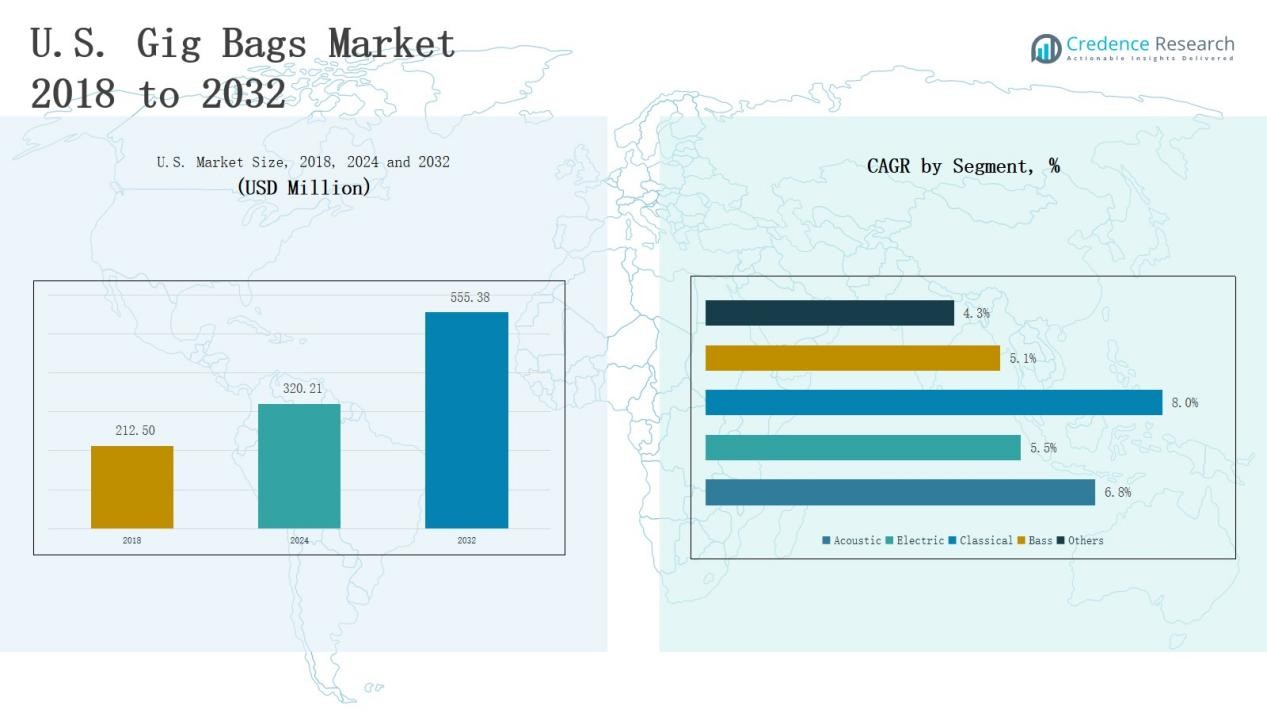
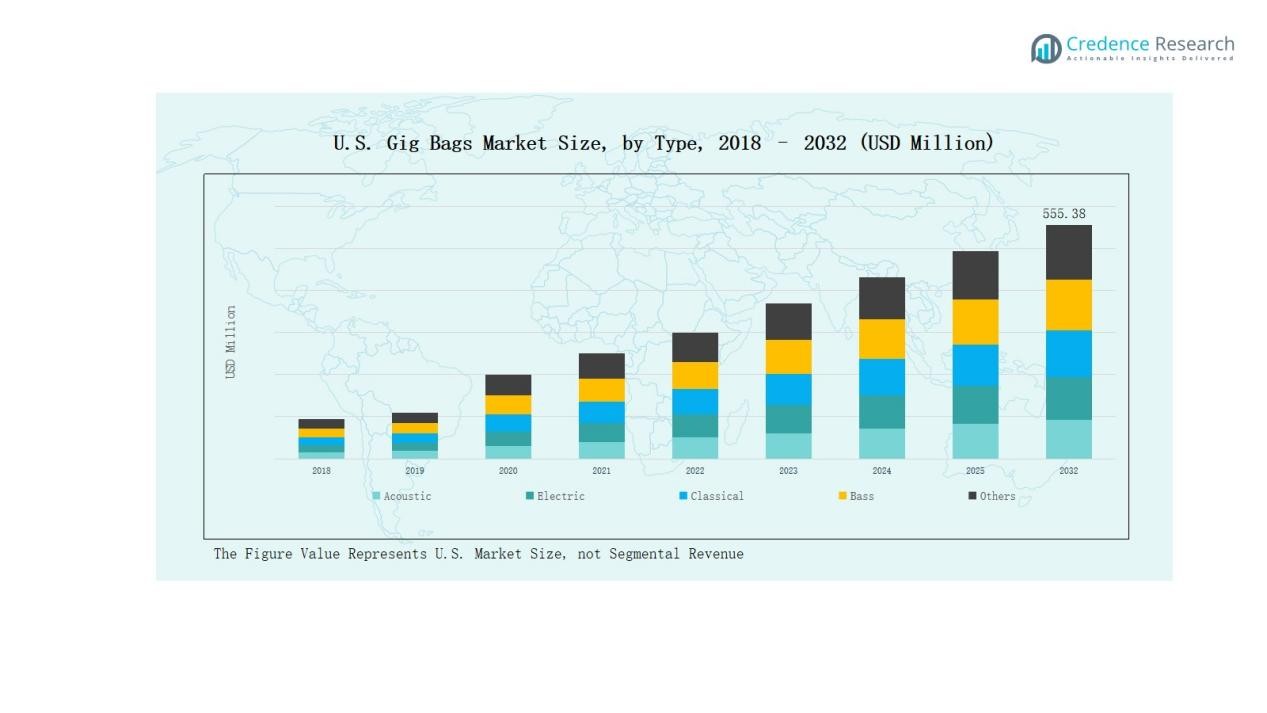
U.S. Gig Bags Market size was valued at USD 212.50 million in 2018 to USD 320.21 million in 2024 and is anticipated to reach USD 555.38 million by 2032, at a CAGR of 7.14% during the forecast period.
| REPORT ATTRIBUTE | DETAILS |
|---|---|
| Historical Period | 2020-2024 |
| Base Year | 2024 |
| Forecast Period | 2025-2032 |
| U.S. Gig Bags Market Size 2024 | USD 320.21 Million |
| U.S. Gig Bags Market , CAGR | 7.14% |
| U.S. Gig Bags Market Size 2032 | USD 555.38 Million |
The U.S. Gig Bags Market is dominated by leading manufacturers such as Gator Cases, SKB Corporation, Levy’s Leathers, Reunion Blues, and MONO Creators, which maintain strong competitive positions through durable materials, innovative designs, and extensive distribution networks. These companies cater to a wide spectrum of musicians, offering gig bags for acoustic, electric, classical, and bass guitars, as well as other instruments. Within the U.S., the market is heavily concentrated in states with vibrant music industries and retail infrastructure, with the leading region accounting for approximately 68.4% of total market revenue in 2024, driven by high consumer demand, robust distribution channels, and an active professional and amateur musician base.
Market Insights
- The U.S. Gig Bags Market is projected to grow strongly, supported by established brands offering durable, innovative designs across acoustic, electric, classical, and bass guitar segments.
- Rising musical instrument ownership, influenced by music education programs and popular culture, continues to drive demand for protective and functional gig bags.
- Expanding e-commerce channels enhance accessibility, enabling competitive pricing, customization options, and broader market reach for both large and niche players.
- Product innovation and customization, including lightweight materials, weather resistance, and personalized designs, remain key differentiators attracting both professionals and casual users.
- Regional demand is led by the South, followed by the West, Northeast, and Midwest, each shaped by unique music cultures, distribution networks, and consumer preferences.
Market Segment Insights
By Type
In the U.S. Gig Bags Market, the electric gig bags segment emerges as the leading category, driven by the strong popularity of electric guitars among both professional and amateur musicians. Demand is supported by a vibrant live performance culture, active participation in music education programs, and the growing influence of contemporary music genres. Manufacturers enhance the appeal of this segment by offering lightweight, durable, and ergonomically designed products with features such as reinforced padding, weather resistance, and additional storage. Continuous innovation in design and materials further strengthens its position in the market.
- For instance, Fender offers electric gig bags featuring reinforced padding and weather-resistant materials that cater to touring professionals and students alike.
By Application
The personal application segment holds the dominant position in the U.S. Gig Bags Market, fueled by increasing individual ownership of musical instruments and the rising popularity of music as a leisure activity. Growth in this segment is supported by expanding online retail channels, which provide easy access to a wide range of styles, designs, and price points. Consumers in this category value portability, comfort, and visual appeal, prompting manufacturers to introduce customizable designs, diverse material options, and enhanced protective features.
- For instance, SKB Cases has developed rugged, weather-resistant designs catering to musicians who prioritize instrument safety during travel, reflecting the demand for versatile and protective options fueled by expanding online retail availability.
Key Growth Drivers
Rising Musical Instrument Ownership
The U.S. Gig Bags Market benefits from a steady increase in musical instrument ownership, particularly guitars, across diverse age groups. This growth is driven by expanding music education programs, the influence of popular music culture, and greater accessibility to instruments through retail and online platforms. As more consumers invest in instruments, the demand for protective and functional gig bags rises. Manufacturers respond by offering a wide range of designs, materials, and price points to cater to different customer segments, reinforcing steady market expansion.
- For instance, Fender reported that 16 million Americans picked up a guitar in the last two years, with 72% of new players aged between 13 to 34, many influenced by online content and social media platforms like TikTok.
Expansion of E-Commerce Channels
The rapid growth of e-commerce significantly boosts gig bag sales in the U.S., offering consumers convenient access to a wide product selection and competitive pricing. Online platforms provide detailed product descriptions, reviews, and customization options, enabling informed purchase decisions. For manufacturers and retailers, e-commerce opens opportunities to reach niche and geographically dispersed markets without heavy investment in physical stores. The ability to launch limited editions, bundle offers, and targeted marketing campaigns online further enhances sales potential, making digital retail a critical growth driver.
- For instance, brand-specific e-commerce platforms like Michael Kors and TUMI have experienced increased traffic and sales due to enhanced user-friendly features such as easy returns and multiple payment options.
Focus on Product Innovation and Customization
Innovation in gig bag design, materials, and features serves as a major growth catalyst for the U.S. market. Manufacturers integrate lightweight yet durable fabrics, improved padding, and weather-resistant coatings to enhance protection and portability. Customization options such as personalized embroidery, color choices, and modular compartments cater to consumer preferences for unique, functional products. These innovations appeal to both professional musicians seeking performance-ready solutions and casual users prioritizing style, helping brands strengthen customer loyalty and capture higher-value segments.
Key Trends & Opportunities
Sustainable and Eco-Friendly Materials
A growing emphasis on environmental responsibility is influencing gig bag production in the U.S. Manufacturers increasingly adopt recycled fabrics, biodegradable components, and low-impact manufacturing processes. Consumers, especially younger demographics, show strong preference for sustainable products without compromising durability or aesthetics. This trend creates opportunities for brands to differentiate themselves through eco-friendly offerings, supported by transparent supply chain practices and sustainability certifications, appealing to an environmentally conscious customer base.
- For instance, Sudarshan Addpack, a U.S. bulk bag manufacturer, uses recycled polypropylene that can be recycled again after use, significantly reducing waste and environmental impact.
The integration of technology into gig bags is emerging as an opportunity in the U.S. market. Features such as GPS tracking, built-in digital tuners, and charging ports are gaining attention among tech-savvy musicians. These smart additions enhance functionality, security, and convenience, particularly for touring artists and frequent travelers. As the adoption of connected devices grows, manufacturers that incorporate innovative, user-friendly technology can attract a premium audience and establish a strong competitive advantage.
- For instance, Samsara Luggage offers smart suitcases featuring real-time GPS tracking and built-in charging ports, helping musicians and travelers keep their gear secure and powered throughout their journeys.
Key Challenges
Intense Market Competition
The U.S. Gig Bags Market faces high competition from both established brands and low-cost imports, pressuring companies to differentiate through quality, design, and pricing strategies. The abundance of options can lead to price sensitivity among consumers, limiting premium segment growth. To remain competitive, brands must balance cost efficiency with innovation and maintain strong marketing efforts to sustain brand recognition in a crowded marketplace.
Fluctuating Raw Material Costs
Variations in the prices of fabrics, padding materials, and hardware components impact manufacturing costs and profit margins for gig bag producers. External factors such as supply chain disruptions, currency fluctuations, and changes in trade policies can exacerbate these challenges. Manufacturers often face the dilemma of absorbing cost increases or passing them on to consumers, risking reduced demand in price-sensitive segments.
Shifts in Consumer Preferences
Rapid changes in design trends, musical styles, and lifestyle needs present a challenge for gig bag manufacturers. Consumers increasingly seek multifunctional products that combine style with protection, forcing brands to frequently update their product lines. Failing to adapt quickly to evolving preferences can result in inventory obsolescence and loss of market share. Continuous market research and agile product development are essential to address these shifts effectively.
Regional Analysis
Northeast
The Northeast holds 22% of the U.S. Gig Bags Market, driven by professional musicians, music schools, and active performance venues in cities like New York and Boston. Demand centers on premium, durable designs suited for frequent travel and varied climates. Strong retail presence, music festivals, and educational programs sustain steady sales, making it a key region for established brands.
Midwest
The Midwest captures 19% of the U.S. Gig Bags Market, supported by school music programs, community bands, and regional touring artists. Consumers value affordable, durable gig bags for educational and personal use. Seasonal conditions increase demand for reinforced materials. Expanding online retail access strengthens distribution, creating opportunities for mid-range offerings targeting students, hobbyists, and emerging local performers.
South
The South leads with 34% of the U.S. Gig Bags Market, fueled by diverse music genres and hubs like Nashville and Austin. Demand spans electric and acoustic gig bags, with touring musicians favoring comfort and style. Strong retail networks and active live events drive sales. It remains a priority market for brands seeking high-volume and premium product growth.
West
The West holds 25% of the U.S. Gig Bags Market, led by California’s strong entertainment industry and consumer preference for innovative designs. Outdoor festivals and high mobility needs drive demand for weather-resistant, functional gig bags. E-commerce penetration and proximity to distribution hubs support growth. The region attracts brands blending durability, portability, and contemporary aesthetics for varied customer segments.
Market Segmentations:
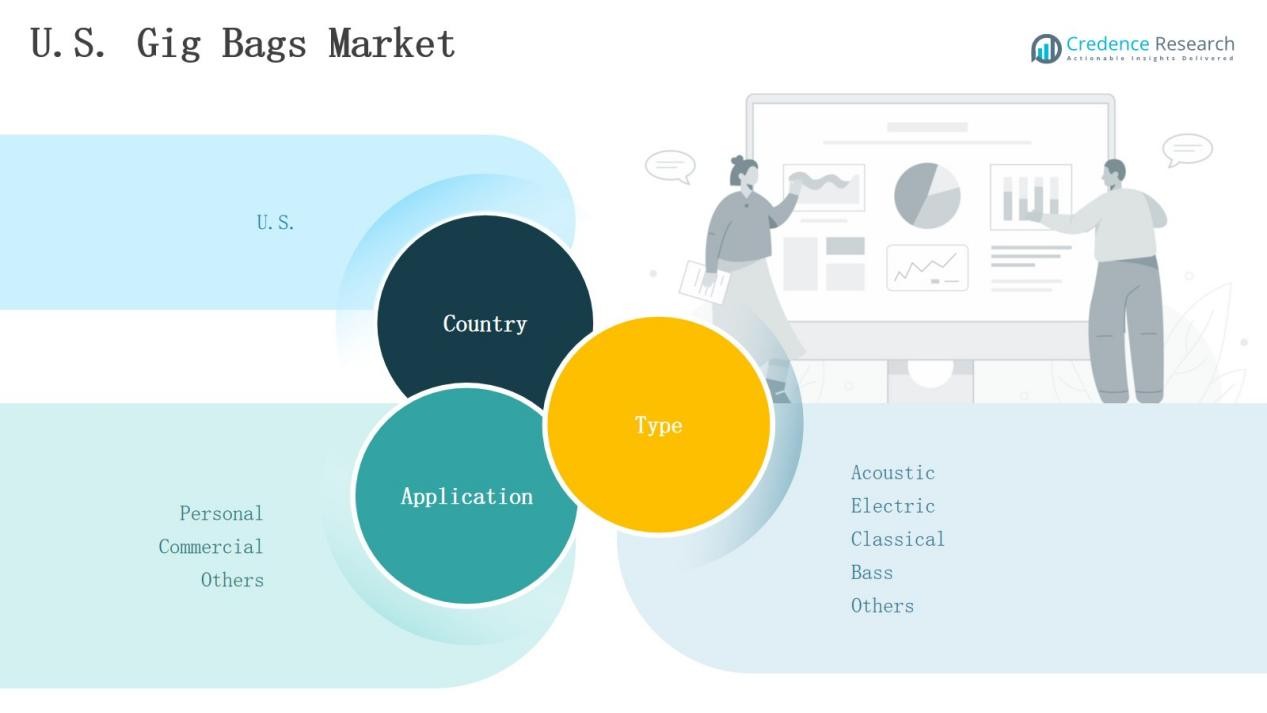
By Type
- Acoustic
- Electric
- Classical
- Bass
- Others
By Application
- Personal
- Commercial
- Others
By Region
- Northeast
- Midwest
- South
- West
Competitive Landscape
The competitive landscape of the U.S. Gig Bags Market is defined by a mix of established brands and emerging players competing through product quality, innovation, and distribution reach. Leading companies such as Gator Cases, Levy’s Leathers, Mono Creators, SKB Cases, and Reunion Blues maintain strong market positions by offering a diverse range of gig bags tailored to electric, acoustic, classical, and bass guitars. These brands leverage durable materials, ergonomic designs, and advanced protective features to appeal to both professional and amateur musicians. Competition is further intensified by smaller manufacturers and low-cost imports that target price-sensitive segments. E-commerce platforms have expanded accessibility, enabling direct-to-consumer sales and greater brand visibility. Product differentiation, customization options, and brand reputation play critical roles in capturing market share. With the growing emphasis on style, portability, and functional enhancements, companies continue to invest in design upgrades and marketing strategies to strengthen their competitive advantage in the evolving market.
Key Players
- Gator Cases
- Levy’s Leathers
- Mono (MONO Creators
- SKB Cases
- TKL Products
- Reunion Blues
- Kaces
- Couch Guitar Straps
- Protec
- Tough Traveler
Recent Developments
- In 2025, Fender expanded its gig bag lineup for guitars and basses, enhancing portability and protection options across its current U.S. catalog.
- In April 2025, Quantum Industries announced the relaunch of its Hachiman Collection guitar bags, with production scheduled to resume in mid-April 2025.
- In January 2025, Gator Cases introduced the ICON Take Two Series gig bags, designed to carry two electric guitars or basses with enhanced padding, compact form, and travel-friendly features.
- In 2025, Michael Kelly Guitar Co. launched its custom electric bass guitar gig bag, a lightweight, padded design now available for pre-order in the U.S.
Market Concentration & Characteristics
The U.S. Gig Bags Market exhibits a moderately concentrated structure, with a few leading brands accounting for a significant share of total sales. It is characterized by strong brand loyalty, driven by consistent product quality, innovative designs, and effective distribution networks. Established players dominate the premium and mid-range segments, while smaller manufacturers and imports compete in price-sensitive categories. The market features a wide variety of products tailored to specific instruments and user needs, from professional touring gear to casual-use bags. Product differentiation through material quality, ergonomic features, and aesthetic appeal is a key competitive factor. E-commerce plays an essential role in expanding reach and enabling niche players to compete with established brands. It continues to evolve with increasing demand for customization, sustainable materials, and multifunctional designs, encouraging companies to adapt quickly to shifting consumer preferences while maintaining strong market positioning.
Report Coverage
The research report offers an in-depth analysis based on Type, Application and Region. It details leading market players, providing an overview of their business, product offerings, investments, revenue streams, and key applications. Additionally, the report includes insights into the competitive environment, SWOT analysis, current market trends, as well as the primary drivers and constraints. Furthermore, it discusses various factors that have driven market expansion in recent years. The report also explores market dynamics, regulatory scenarios, and technological advancements that are shaping the industry. It assesses the impact of external factors and global economic changes on market growth. Lastly, it provides strategic recommendations for new entrants and established companies to navigate the complexities of the market.
Future Outlook
- Demand for gig bags will rise with growing musical instrument ownership across varied age groups.
- E-commerce expansion will strengthen direct-to-consumer sales and brand visibility.
- Product innovation will focus on lightweight, durable, and weather-resistant materials.
- Customization options will gain traction among style-conscious consumers.
- Sustainable materials will become a stronger selling point for eco-aware buyers.
- Smart features such as GPS tracking will attract tech-savvy musicians.
- Premium segments will expand with rising demand from touring professionals.
- Mid-range offerings will see growth through increased student and hobbyist purchases.
- Regional music hubs will continue to influence design and distribution strategies.
- Competition will intensify, pushing brands to differentiate through quality and design innovation.

Request a Free Sample
Fill in your details and we'll send you a free sample report.
- Sample data tables & charts
- Research methodology
Market Dynamics
Rising Musical Instrument Ownership
Increasing ownership of guitars and other musical instruments, driven by music education programs and the influence of popular culture, is expanding the customer base for gig bags. As more individuals purchase instruments, the need for protective and functional carrying solutions grows, directly boosting gig bag sales.
Expansion of E-Commerce Channels
The growth of online retail platforms has made gig bags more accessible to a wider audience, offering competitive pricing, customization options, and convenient purchasing. E-commerce enables brands to reach niche and geographically dispersed markets, supporting overall market expansion.
Product Innovation and Customization
Manufacturers are differentiating their offerings through lightweight, durable materials, weather resistance, and customizable designs. These innovations attract both professional and casual musicians, increasing the appeal and value proposition of gig bags.
Sustainable and Eco-Friendly Materials
A growing consumer preference for environmentally responsible products is encouraging manufacturers to use recycled and biodegradable materials. This trend not only appeals to eco-conscious buyers but also helps brands stand out in a competitive market.
Integration of Smart Features
The addition of technology such as GPS tracking, built-in tuners, and charging ports is attracting tech-savvy musicians who value enhanced functionality and security. These smart features help brands target premium segments and differentiate their products.
Need a Custom Version of This Report?
Tailor the scope, geography, or segments to your exact requirements.
- Custom geography or segment scope
- Direct access to our analyst team
Frequently Asked Questions
What is the current market size for the U.S. Gig Bags Market, and what is its projected size in 2032?
At what Compound Annual Growth Rate is the U.S. Gig Bags Market projected to grow between 2025 and 2032?
Which U.S. Gig Bags Market segment held the largest share in 2024?
What are the primary factors fueling the growth of the U.S. Gig Bags Market?
Who are the leading companies in the U.S. Gig Bags Market?
Which region commanded the largest share of the U.S. Gig Bags Market in 2024?
Table of Content
Chapter 1 Market Segmentation
- 1.1 Segmentation Framework
- 1.1.1 Product and Service Classification
- 1.1.2 Application and End-Use Classification
- 1.1.3 Technology and Solution Classification
- 1.1.4 Customer and Distribution Channel Classification
- 1.1.5 Geographic Segmentation
- 1.1.6 Market Segment Definitions and Boundaries
- 1.2 By Type
- 1.2.1 Acoustic
- 1.2.2 Electric
- 1.2.3 Classical
- 1.2.4 Bass
- 1.2.5 Others
- 1.3 By Application
- 1.3.1 Personal
- 1.3.2 Commercial
- 1.3.3 Others
Chapter 2 Introduction
- 2.1 Report Objectives and Scope
- 2.2 Product Definition and Industry Terminology
- 2.3 Market Inclusions and Exclusions
- 2.4 Research Process
- 2.4.1 Primary Research and Expert Interviews
- 2.4.2 Secondary Research and Source Review
- 2.4.3 Top-Down and Bottom-Up Estimation
- 2.4.4 Data Triangulation and Verification
- 2.5 Market Size Measurement Basis
- 2.5.1 2024: USD 320.21 million → 2032: USD 555.38 million
- 2.6 Historical and Forecast Reference Periods
- 2.6.1 Base Year: 2024
- 2.6.2 Forecast Period: 2024-2032
- 2.7 Research Assumptions and Limitations
Chapter 3 Executive Summary
- 3.1 Market Snapshot and Key Findings
- 3.2 Base-Year Market Size, 2024
- 3.3 Forecast Market Size, 2032
- 3.4 Revenue and Volume Growth Outlook
- 3.5 Key Demand and Supply Indicators
- 3.6 Leading Market Segments
- 3.7 Fastest-Growing Market Opportunities
- 3.8 Regional Performance Highlights
- 3.9 Technology and Industry Transformation
- 3.10 Competitive Landscape Summary
- 3.11 Analyst View and Strategic Implications
Chapter 4 U.S. Gig Bags Market Trends and Developments
- 4.1 Historical Industry Development
- 4.2 Recent Market Trends and Developments
- 4.3 Demand and Customer Behavior Trends
- 4.4 Technology and Product Innovation
- 4.5 Artificial Intelligence, Automation and Digitalization
- 4.6 Local Manufacturing and Supply Chain Realignment
- 4.7 Industry Partnerships, Mergers and Acquisitions
- 4.8 Sustainability and Circular Economy Developments
- 4.9 Government and Private Sector Investment Trends
- 4.10 Emerging Business Models and Commercialization
- 4.11 Industry Developments and Announcements
Chapter 5 U.S. Gig Bags Market Production, Supply and Demand Analysis
- 5.1 Demand Trend and Consumption Analysis
- 5.2 Demand Forecast, 2024-2032
- 5.3 Production and Output Trend
- 5.4 Production and Output Forecast, 2024-2032
- 5.5 Installed Capacity and Capacity Utilization
- 5.6 Company-Wise Production Plants and Statistics
- 5.6.1 Installed Production Capacity
- 5.6.2 Actual Production
- 5.6.3 Planned Capacity and Expansion Targets
- 5.7 Supply Chain Structure and Procurement Trends
- 5.8 Supply-Demand Gap and Bottlenecks
- 5.9 Import Dependence and Sourcing Structure
- 5.10 Contract Manufacturing and Outsourcing
- 5.11 Regional Supply and Demand Concentration
Chapter 6 U.S. Gig Bags Market Pricing Analysis
- 6.1 Pricing Structure and Measurement
- 6.2 Historical Pricing Trends
- 6.3 Pricing Outlook, 2024-2032
- 6.4 Average Selling Price and Unit Economics
- 6.5 Pricing by Product and Market Segment
- 6.6 Geographic Pricing Differences
- 6.7 Key Input, Energy, Labor and Logistics Costs
- 6.8 Contract Pricing and Purchasing Models
- 6.9 Pricing Sensitivity and Competitive Positioning
- 6.10 Price, Margin and Profitability Implications
Chapter 7 U.S. Gig Bags Market Dynamics
- 7.1 Market Growth Drivers
- 7.1.1 Demand-Side Drivers
- 7.1.2 Technology and Innovation Drivers
- 7.1.3 Infrastructure and Investment Drivers
- 7.1.4 Regulatory and Policy Drivers
- 7.2 Market Restraints
- 7.2.1 Cost and Affordability Constraints
- 7.2.2 Technology and Adoption Barriers
- 7.2.3 Supply Chain and Operational Constraints
- 7.3 Market Challenges
- 7.3.1 Competitive Pressure and Margin Erosion
- 7.3.2 Skills, Infrastructure and Implementation Gaps
- 7.4 Emerging Market Opportunities
- 7.5 Market Dynamics Impact and Time-Horizon Assessment
Chapter 8 U.S. Gig Bags Value Chain Analysis
- 8.1 Industry Value Chain Overview
- 8.2 Upstream Suppliers and Critical Inputs
- 8.3 Technology and Component Providers
- 8.4 Manufacturing or Service Delivery
- 8.5 Distribution, Channel Partners and Integrators
- 8.6 Downstream Applications and End Users
- 8.7 Value Addition and Profit Pools
- 8.8 Vertical Integration and Outsourcing
- 8.9 Supplier Concentration and Risk
- 8.10 Supply Chain Localization and Resilience
Chapter 9 U.S. Gig Bags Market Regulations and Policies
- 9.1 Relevant Laws, Standards and Compliance Frameworks
- 9.2 Product, Service, Safety and Quality Requirements
- 9.3 Government Policies, Incentives and Subsidies
- 9.4 Imports, Exports and Trade Barriers
- 9.5 Public Procurement and Local Content Requirements
- 9.6 Environmental and Sustainability Compliance
- 9.7 Upcoming Policy Changes and Market Implications
Chapter 10 U.S. Gig Bags Market Hotspots and Opportunities
- 10.1 Market Opportunity Mapping and Growth Hotspots
- 10.2 High-Growth Applications and Customer Groups
- 10.3 Underserved Markets and White-Space Opportunities
- 10.4 Emerging Technology and Product Opportunities
- 10.5 New Capacity and Investment Hotspots
- 10.6 Market Entry and Expansion Opportunities
- 10.7 Distribution and Partnership Opportunities
- 10.8 Near-Term and Long-Term Commercial Potential
- 10.9 Opportunity Attractiveness and Execution Risks
Chapter 11 U.S. Gig Bags Market Outlook, 2024-2032
- 11.1 Market Size and Analysis
- 11.1.1 Revenue (Market Measurement: 2024: USD 320.21 million → 2032: USD 555.38 million)
- 11.1.2 Market Volume and Quantity Sold
- 11.1.3 Historical Market Size
- 11.1.4 Base-Year Market Size, 2024
- 11.2 Market Forecast, 2024-2032
- 11.2.1 Revenue Forecast to 2032
- 11.2.2 Volume Forecast to 2032
- 11.2.3 CAGR and Year-on-Year Growth
- 11.2.4 Incremental Revenue Opportunity
- 11.3 Forecast Assumptions and Scenario Analysis
- 11.3.1 Base-Case Forecast
- 11.3.2 Optimistic and Conservative Scenarios
- 11.3.3 Technology, Pricing and Policy Sensitivities
- 11.4 Market Attractiveness and Growth Outlook
Chapter 12 U.S. Gig Bags Market Segmentation and Outlook
- 12.1 Segmentation Summary and Market Shares, 2024
- 12.2 Largest and Fastest-Growing Segments
- 12.3 By Type - Market Size and Forecast, 2024-2032
- 12.3.1 Segment Definition and Scope
- 12.3.2 Historical Market Size
- 12.3.3 Revenue Forecast, 2024-2032
- 12.3.4 Volume Forecast, 2024-2032
- 12.3.5 Base-Year Market Share, 2024
- 12.3.6 Segment CAGR and Growth Drivers
- 12.3.7 Subsegment Market Size and Forecast
- 12.3.7.1 Acoustic
- 12.3.7.2 Electric
- 12.3.7.3 Classical
- 12.3.7.4 Bass
- 12.3.7.5 Others
- 12.3.8 Subsegment Pricing and Adoption Trends
- 12.3.9 Leading Suppliers and Competition
- 12.3.10 Regional Demand and Opportunities
- 12.4 By Application - Market Size and Forecast, 2024-2032
- 12.4.1 Segment Definition and Scope
- 12.4.2 Historical Market Size
- 12.4.3 Revenue Forecast, 2024-2032
- 12.4.4 Volume Forecast, 2024-2032
- 12.4.5 Base-Year Market Share, 2024
- 12.4.6 Segment CAGR and Growth Drivers
- 12.4.7 Subsegment Market Size and Forecast
- 12.4.7.1 Personal
- 12.4.7.2 Commercial
- 12.4.7.3 Others
- 12.4.8 Subsegment Pricing and Adoption Trends
- 12.4.9 Leading Suppliers and Competition
- 12.4.10 Regional Demand and Opportunities
- 12.5 Segment Growth Comparison
- 12.6 Segment Attractiveness and Priority Matrix
Chapter 13 U.S. Gig Bags End-Use and Application Market Outlook
- 13.1 End-Use Industry and Customer Demand Structure
- 13.2 Leading Applications and Customer Groups
- 13.3 End-Use Market Size, Share and Forecast
- 13.4 Major End-Use Industry Deep Dives
- 13.4.1 Customer Requirements and Use Cases
- 13.4.2 Demand and Replacement Cycles
- 13.4.3 Technical and Regulatory Considerations
- 13.4.4 Purchasing and Procurement Models
- 13.4.5 Leading Vendors and Distribution Channels
- 13.4.6 Forecast and Commercial Opportunities
- 13.5 Emerging Applications and Cross-Segment Demand
- 13.6 End-Use Industry Investment Priorities
Chapter 14 U.S. Gig Bags Geographic Market Outlook, 2024-2032
- 14.1 Domestic Market Distribution and Demand Clusters
- 14.2 State- or Province-Wise Market Size and Forecast, 2024-2032
- 14.3 City and Metropolitan Market Outlook
- 14.4 Industrial, Manufacturing and Commercial Clusters
- 14.5 Geographic Concentration of Key End Users
- 14.6 Local Pricing and Purchasing Differences
- 14.7 Domestic Production Facilities and Capacity Map
- 14.8 Local Infrastructure and Project Pipeline
- 14.9 State-Level Policy and Incentive Differences
- 14.10 Subnational Investment Hotspots and Opportunities
- 14.11 Distribution and Logistics Networks
- 14.12 Domestic Competitive Footprint
Chapter 15 U.S. Gig Bags Technology, Innovation and Sustainability Outlook
- 15.1 Technology Landscape and Maturity
- 15.2 Product, Process and Service Innovation
- 15.3 AI, Automation and Digital Tools in the Industry
- 15.4 Technology Adoption and Performance Benchmarking
- 15.5 Innovation Pipeline and R&D Investment
- 15.6 Patent and Intellectual Property Trends
- 15.7 Energy Efficiency and Resource Management
- 15.8 Sustainability, Recycling and Circularity
- 15.9 Technology Roadmap, 2024-2032
- 15.10 Risks of Obsolescence and Technology Substitution
Chapter 16 U.S. Gig Bags Market Key Strategic Imperatives
- 16.1 Growth and Market Entry Priorities
- 16.2 High-Return Products and Segments
- 16.3 Pricing, Profitability and Cost Optimization
- 16.4 Technology Investment and Product Differentiation
- 16.5 Supply Chain Localization and Resilience
- 16.6 Distribution and Customer Acquisition
- 16.7 Partnership, Acquisition and Capacity Strategy
- 16.8 Regional Expansion Priorities
- 16.9 Short-, Medium- and Long-Term Actions
Chapter 17 Competition Outlook
- 17.1 Industry Competition Characteristics
- 17.2 Market Structure and Concentration
- 17.3 Market Share and Competitive Positioning, 2024
- 17.4 Company-Wise Revenue and Product Benchmarking
- 17.5 Production and Service Capacity Benchmarking
- 17.6 Technology, Pricing and Differentiation
- 17.7 Regional Footprint and Distribution Strength
- 17.8 Mergers, Acquisitions and Strategic Alliances
- 17.9 New Entrants and Competitive Threats
- 17.10 Porter's Five Forces and Industry Attractiveness
- 17.11 Competitive Outlook, 2024-2032
Chapter 18 Company Profiles
- 18.1 Company Coverage and Selection Criteria
- 18.2 Gator Cases
- 18.2.1 Business Description
- 18.2.2 Company Ownership and Geographic Presence
- 18.2.3 Product and Service Portfolio
- 18.2.4 Manufacturing and Operating Footprint
- 18.2.5 Production Capacity and Expansion Plans
- 18.2.6 Financial Performance and Investment
- 18.2.7 Market Share and Competitive Position
- 18.2.8 Technology and Innovation Capabilities
- 18.2.9 Strategic Alliances or Partnerships
- 18.2.10 Recent Developments
- 18.2.11 Growth Strategy and Outlook
- 18.3 Levy’s Leathers
- 18.4 Mono Creators
- 18.5 SKB Cases
- 18.6 TKL Products
- 18.7 Reunion Blues
- 18.8 Kaces
- 18.9 Couch Guitar Straps
- 18.10 Protec
- 18.11 Tough Traveler
- 18.12 Other Relevant Market Participants
Note: Every listed company is profiled on the structure shown under the first company. The company list is preliminary and may change based on research findings, market developments, data availability and client requirements.
Chapter 19 Disclaimer
- 19.1 Research and Forecast Disclaimer
- 19.2 Data Source and Estimation Limitations
Note: The depth of individual sections depends on data availability for this market. Volume, capacity, trade and other unit-based metrics are included where applicable.

