
Market Overview:
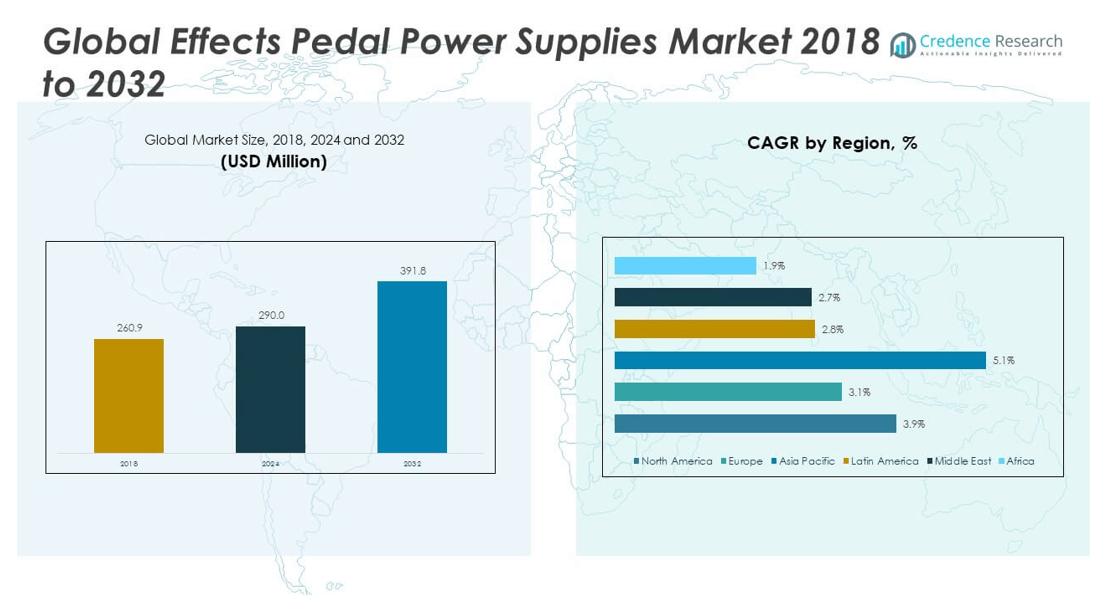
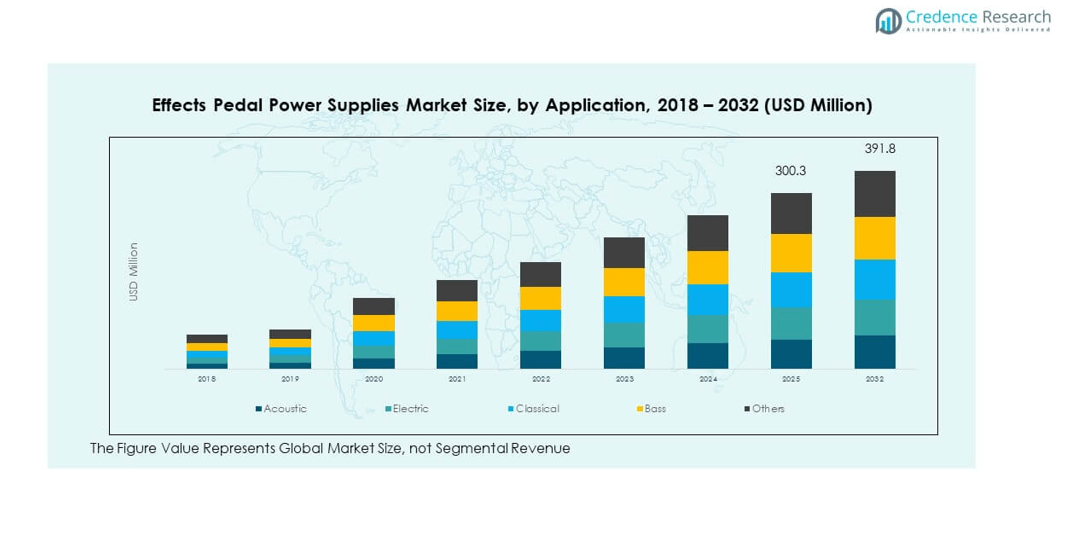
The Global Effects Pedal Power Supplies Market size was valued at USD 260.9 million in 2018 to USD 290.0 million in 2024 and is anticipated to reach USD 391.8 million by 2032, at a CAGR of 3.9% during the forecast period.
| REPORT ATTRIBUTE | DETAILS |
|---|---|
| Historical Period | 2020-2023 |
| Base Year | 2024 |
| Forecast Period | 2025-2032 |
| Effects Pedal Power Supplies Market Size 2024 | USD 290.0 million |
| Effects Pedal Power Supplies Market, CAGR | 3.9% |
| Effects Pedal Power Supplies Market Size 2032 | USD 391.8 million |
The growth of the effects pedal power supplies market is being driven by the rising adoption of electric guitars and bass instruments in professional and amateur music. Musicians increasingly demand reliable, noise-free, and multi-output power solutions to enhance performance and recording quality. The popularity of live concerts, studio recordings, and home-based music production has created a need for efficient power management tools. Furthermore, ongoing innovations in compact, lightweight, and energy-efficient pedal power supplies are further stimulating demand, as players seek portability without compromising sound quality.
Regionally, North America dominates the market, supported by its well-established music industry, presence of leading equipment manufacturers, and widespread adoption among professional musicians. Europe follows closely, driven by a strong culture of live music events and growing demand for advanced pedal systems. Meanwhile, the Asia-Pacific region is emerging as a high-potential market due to the increasing influence of Western music, rising disposable incomes, and rapid growth in urban youth populations who are driving demand for musical instruments and accessories. Latin America and the Middle East & Africa are gradually expanding as rising music festivals and local band culture fuel adoption.
Market Insights:
- The Global Effects Pedal Power Supplies Market was valued at USD 290.0 million in 2024 and is projected to reach USD 391.8 million by 2032, growing at a CAGR of 3.9%.
- Rising demand for reliable, noise-free, and multi-output power supplies is driving strong adoption among professional and amateur musicians.
- Growth in live performances, festivals, and home studio setups continues to fuel market expansion across both entry-level and premium product ranges.
- Market restraints include competition from low-cost alternatives and the presence of counterfeit products that dilute consumer trust.
- North America led the market in 2024 with nearly 38% share, supported by a mature music industry and early adoption of advanced products.
- Asia Pacific is emerging as the fastest-growing region due to rising disposable incomes, youth-driven music culture, and increasing online retail access.
- Europe maintains steady growth through strong festival culture, boutique product adoption, and emphasis on sustainable manufacturing practices.
Market Drivers:
Rising Demand for Reliable Power Solutions in Music Equipment
The Global Effects Pedal Power Supplies Market is propelled by the growing requirement for reliable, noise-free power solutions among professional and amateur musicians. It is witnessing a surge in demand due to the popularity of electric guitars, bass instruments, and pedalboards in both live and studio environments. The rising participation in live concerts, music festivals, and online music production has created a consistent need for multi-output power solutions. Consumers prefer power supplies that can handle multiple pedals simultaneously without sound distortion. Compact and portable designs attract younger musicians who value convenience and mobility. Product innovations focus on stability, durability, and improved energy efficiency. Strong demand from hobbyists and professionals alike makes power supplies an integral part of modern music setups.
- For instance, Voodoo Lab’s Pedal Power 3+ provides 12 isolated DC outputs, each delivering up to 500mA, allowing musicians to power high-current digital pedals without added noise – a standard that directly addresses the need for clean, reliable energy distribution in complex pedalboards.
Influence of Expanding Entertainment Industry on Music Accessories
The entertainment industry has significantly contributed to the growth of the Global Effects Pedal Power Supplies Market by supporting increased adoption of electric instruments. It benefits from the rising number of concerts, recording sessions, and digital content production activities. Musicians require dependable accessories that can deliver consistent energy to multiple pedals. Growth in streaming platforms has intensified competition among artists, pushing them to invest in quality sound tools. The market benefits from rising consumer spending on high-quality music gear. It is also fueled by artists seeking enhanced tonal control during live performances. Continuous advancements in the live performance sector create opportunities for robust demand. Broad accessibility of music equipment further strengthens product adoption.
- For instance, Strymon’s Zuma power supply is designed with 9 high-current, individually isolated outputs each capable of 500mA and dual-stage topology to maintain consistent voltage under demanding live performance conditions, making it a preferred choice for touring musicians performing at major entertainment events.
Growing Consumer Preference for Compact and Portable Devices
Consumer preference for lightweight and compact devices has emerged as a powerful driver for the Global Effects Pedal Power Supplies Market. It has created opportunities for manufacturers to introduce streamlined products suitable for travel and live performance needs. Portability plays a critical role for musicians who frequently move between practice, recording, and stage settings. Brands now focus on offering smaller power supply units that maintain high output capacity. Increased urbanization and rising disposable incomes influence purchase behavior, especially among younger musicians. Affordability and ease of use strengthen consumer loyalty toward established brands. Product durability and user-friendly design further increase adoption. It is clear that market demand is moving toward space-saving and efficient solutions.
Technological Innovations Shaping Product Reliability and Performance
Technological innovation has become a defining factor in driving the Global Effects Pedal Power Supplies Market forward. It emphasizes noise reduction, heat management, and advanced circuitry for consistent voltage distribution. Manufacturers are integrating smart features to enhance control and adaptability. Energy-efficient solutions help reduce power wastage while ensuring maximum performance. Consumer expectations around sound clarity and equipment longevity push companies to improve designs. Competition among leading players accelerates the pace of new launches with advanced functionalities. Product differentiation has become critical for sustaining leadership in the market. Growing attention to eco-friendly manufacturing also supports technological development.
Market Trends:
Rising Integration of Smart Features in Pedal Power Supplies
The Global Effects Pedal Power Supplies Market is experiencing a trend toward integrating smart and digital control features. It has encouraged manufacturers to introduce power supplies with programmable voltage outputs and monitoring functions. Musicians can customize pedal configurations for both practice and live sessions. These features enhance reliability by ensuring consistent power distribution across devices. Demand for digital integration reflects the evolving expectations of modern musicians. Compact designs with advanced smart circuits enable a balance between performance and convenience. Growing interest in hybrid setups combining analog and digital gear is also influencing design priorities. This trend reflects the increasing value placed on precision and adaptability.
Rising Popularity of Boutique and Custom Pedal Power Systems
Boutique and custom pedal power solutions are gaining attention in the Global Effects Pedal Power Supplies Market. It reflects the trend of musicians seeking personalized equipment tailored to unique sound requirements. Specialized products are developed for musicians using unconventional pedal setups. Customization enhances brand loyalty by offering distinct features that mass-market products may lack. Growth in independent music production has fueled demand for niche equipment. Rising investments in boutique gear also demonstrate consumer preference for premium quality. Small manufacturers leverage this trend by offering unique designs and superior craftsmanship. It highlights a shift toward exclusivity and individuality in equipment selection.
- For instance, Strymon’s Zuma R300 delivers 5 fully isolated outputs with 500mA of current per output, enabling users to power demanding digital pedals a design choice that appeals to boutique users who prioritize noise-free, high-headroom power distribution for complex signal chains.
Expanding E-Commerce Channels Transforming Product Accessibility
The expansion of e-commerce has emerged as a defining trend in the Global Effects Pedal Power Supplies Market. It has reshaped how musicians purchase and evaluate their gear. Online platforms provide access to a wide variety of power supply models with detailed specifications and reviews. Musicians can compare products globally, creating a competitive marketplace. E-commerce facilitates international sales for smaller brands seeking wider reach. Digital platforms offer promotional opportunities and targeted marketing campaigns. Consumer trust in online music equipment purchases continues to rise. The convenience of doorstep delivery combined with easy returns strengthens this channel. It has firmly established online retail as a critical distribution route.
Sustainability and Eco-Friendly Manufacturing Practices in Focus
Sustainability has emerged as a prominent trend influencing the Global Effects Pedal Power Supplies Market. It focuses on energy-efficient designs, recyclable materials, and low-emission production methods. Consumers increasingly value brands that demonstrate environmental responsibility. Manufacturers are adapting by using eco-conscious packaging and renewable resources. This shift aligns with global awareness regarding environmental conservation. Products emphasizing energy-saving features gain greater consumer acceptance. Regulatory frameworks promoting sustainable manufacturing also encourage innovation. It strengthens the position of companies investing in green practices. The trend illustrates how ecological responsibility is shaping long-term market direction.
- For instance, Cioks’ DC7 power supply features a slim profile at just one-inch-thick and weighs approximately 1.1 pounds, making it one of the lightest high-performance units in its category. It employs a two-stage switch-mode power supply topology with advanced multi-stage filtering, delivering seven isolated high-current outlets with selectable voltages while maintaining noise-free performance.
Market Challenges Analysis:
Competition from Low-Cost Alternatives Impacting Profitability
The Global Effects Pedal Power Supplies Market faces strong challenges from the rising influx of low-cost alternatives. It is impacted by manufacturers producing affordable units that compromise on durability and sound quality. Such products appeal to entry-level musicians, creating competitive pressure on premium brands. Market leaders must continuously balance pricing strategies while preserving product integrity. Intense competition reduces profit margins for established players. Counterfeit products further dilute consumer trust and weaken brand reputation. Companies must adopt protective strategies through innovation and awareness campaigns. Addressing these issues requires strong quality assurance and consumer education.
Technical Complexity and Evolving Consumer Expectations
Rapid technological advancements create another layer of challenge for the Global Effects Pedal Power Supplies Market. It struggles with balancing advanced circuitry with user-friendly operation. Complex designs may discourage beginners, limiting adoption in certain segments. Constant upgrades in pedal technology require compatible power solutions. Consumer expectations for compact size, portability, and multifunctionality add to design complexity. Manufacturers must ensure stable performance across different voltage requirements. Rising demand for eco-friendly solutions adds further cost pressure. Ensuring long-term reliability while meeting these evolving needs requires significant investment in R&D.
Market Opportunities:
Rising Demand in Emerging Music Communities and Independent Artists
Emerging music communities and independent artists are creating new opportunities for the Global Effects Pedal Power Supplies Market. It benefits from increased music production across small studios, online platforms, and home-based setups. Independent musicians prioritize affordable yet professional-grade equipment to enhance their sound quality. Growth in online streaming platforms has encouraged experimentation with advanced pedal systems. Rising exposure to global music trends strengthens demand in emerging economies. Manufacturers can capitalize on this by offering mid-range, versatile, and portable units. Expanding consumer bases in youth-driven markets open new sales avenues.
Product Differentiation Through Innovation and Sustainability Practices
Product innovation and sustainability provide strong opportunities for the Global Effects Pedal Power Supplies Market. It gains advantage when manufacturers introduce noise-free, energy-efficient, and eco-conscious designs. Sustainability initiatives can build consumer trust and strengthen brand positioning. Smart technologies integrated into compact products attract both professionals and hobbyists. Growing consumer focus on reliability and environmental responsibility supports long-term growth. Offering solutions that balance performance and eco-friendliness can secure wider adoption. Differentiation through unique features will help companies build competitive strength.
Market Segmentation Analysis:
By application, the Global Effects Pedal Power Supplies Market demonstrates significant diversity across application segments. Electric applications account for a substantial share due to the widespread adoption of electric guitars and bass instruments in professional and amateur music. Acoustic and classical segments hold steady demand, supported by artists incorporating pedal effects to enhance tonal variations. Bass applications represent a growing niche, with specialized power supplies designed for low-frequency performance. The “Others” category captures emerging experimentation in hybrid and digital setups, reinforcing the role of power supplies as essential components in varied musical contexts.
- For instance, Fender’s 2023 launch of the Tone Master Pro integrated multi-effects processor included 4 dedicated effects loop channels and over 100 amp models, demonstrating the growing demand in the electric application segment,
By end-user, the market reflects distinct purchasing patterns. The light segment dominates due to its affordability and appeal to beginner and casual musicians. Custom light holds growing importance, catering to musicians who seek tailored solutions that combine portability with reliable performance. The “Others” category includes professional users, independent artists, and studio setups that demand higher power stability for multiple pedals. The Global Effects Pedal Power Supplies Market benefits from this segmentation by aligning product innovations with user-specific requirements, strengthening its ability to address both mass-market demand and specialized applications.
- For instance, Harley Benton’s PowerPlant ISO-2 Pro offers eight isolated, filtered outputs two switchable between 9/12/18 V at up to 500 mA and six fixed 9 V outputs at 300 mA while weighing only 200 g and priced affordably around €69. Its noise-eliminating design and accessible price point make it popular among entry-level and budget-conscious musicians.
Segmentation:
By Application
- Acoustic
- Electric
- Classical
- Bass
- Others
By End-User
- Light
- Custom Light
- Others
By Region
- North America
- U.S.
- Canada
- Mexico
- Europe
- UK
- France
- Germany
- Italy
- Spain
- Russia
- Belgium
- Netherlands
- Austria
- Sweden
- Poland
- Denmark
- Switzerland
- Rest of Europe
- Asia Pacific
- China
- Japan
- South Korea
- India
- Australia
- Thailand
- Indonesia
- Vietnam
- Malaysia
- Philippines
- Taiwan
- Rest of Asia Pacific
- Latin America
- Brazil
- Argentina
- Peru
- Chile
- Colombia
- Rest of Latin America
- Middle East
- UAE
- KSA
- Israel
- Turkey
- Iran
- Rest of Middle East
- Africa
- Egypt
- Nigeria
- Algeria
- Morocco
- Rest of Africa
Regional Analysis:
North America
The North America Global Effects Pedal Power Supplies Market size was valued at USD 100.4 million in 2018 to USD 110.4 million in 2024 and is anticipated to reach USD 148.8 million by 2032, at a CAGR of 3.9% during the forecast period. North America represents nearly 38% of the global market share in 2024, making it the leading regional contributor. The region benefits from a well-established music industry and a high concentration of professional musicians and recording studios. It is supported by strong demand from live performances, concerts, and festivals across the U.S. and Canada. Consumer spending on high-quality gear is reinforced by a culture that values musical expression and advanced sound equipment. Leading manufacturers have strong distribution networks across this region. Demand is also enhanced by younger musicians investing in compact, durable, and portable devices. The Global Effects Pedal Power Supplies Market in North America maintains dominance through innovation and early adoption of advanced technologies.
Europe
The Europe Global Effects Pedal Power Supplies Market size was valued at USD 66.8 million in 2018 to USD 71.3 million in 2024 and is anticipated to reach USD 90.8 million by 2032, at a CAGR of 3.1% during the forecast period. Europe contributes around 24% of the global market share in 2024, reflecting its strong musical heritage and active live performance culture. Countries such as the UK, Germany, and France drive significant demand with their thriving music scenes. The popularity of festivals and cultural events supports steady sales of pedal power supplies. It benefits from growing interest in boutique and custom power supply solutions. The region also emphasizes sustainability, prompting companies to adopt eco-conscious designs. Independent musicians and bands fuel purchases of versatile products suited for varied sound setups. The Global Effects Pedal Power Supplies Market in Europe continues to expand with a balance of tradition and modern innovation.
Asia Pacific
The Asia Pacific Global Effects Pedal Power Supplies Market size was valued at USD 63.4 million in 2018 to USD 73.6 million in 2024 and is anticipated to reach USD 109.5 million by 2032, at a CAGR of 5.1% during the forecast period. Asia Pacific accounts for nearly 25% of the global market share in 2024, positioning it as a fast-growing region. It is supported by rising disposable incomes and expanding interest in Western music trends among urban youth. Countries such as Japan, South Korea, and China demonstrate significant adoption of advanced power supply systems. Growing online retail platforms improve accessibility to international brands across the region. Independent music scenes in India and Southeast Asia add momentum to demand. Compact and affordable solutions find high acceptance among younger demographics. The Global Effects Pedal Power Supplies Market in Asia Pacific reflects strong growth potential driven by cultural adaptation and technological adoption.
Latin America
The Latin America Global Effects Pedal Power Supplies Market size was valued at USD 14.1 million in 2018 to USD 15.5 million in 2024 and is anticipated to reach USD 19.2 million by 2032, at a CAGR of 2.8% during the forecast period. Latin America contributes nearly 5% of the global market share in 2024, supported by its rising music festivals and strong cultural orientation toward live music. Brazil leads regional demand, followed by Argentina and Mexico. Independent bands and emerging artists create demand for mid-range and affordable solutions. Local distributors play a significant role in improving product availability. It faces challenges such as economic fluctuations that limit consumer spending in some countries. However, steady adoption in urban centers sustains the market. The Global Effects Pedal Power Supplies Market in Latin America continues to expand at a measured pace, supported by a passionate music community.
Middle East
The Middle East Global Effects Pedal Power Supplies Market size was valued at USD 11.0 million in 2018 to USD 11.6 million in 2024 and is anticipated to reach USD 14.3 million by 2032, at a CAGR of 2.7% during the forecast period. The region holds about 4% of the global market share in 2024, reflecting modest but steady growth. Rising music culture in GCC countries and Israel contributes to demand. Independent music events and regional festivals provide opportunities for adoption of pedal power supplies. Availability of international brands through online channels supports accessibility. The market is gradually shaped by younger consumers seeking modern and portable solutions. It faces limitations from cultural and regulatory constraints in certain countries. Nevertheless, technological imports and rising exposure to Western music trends maintain its upward trajectory. The Global Effects Pedal Power Supplies Market in the Middle East remains a niche but expanding opportunity.
Africa
The Africa Global Effects Pedal Power Supplies Market size was valued at USD 5.17 million in 2018 to USD 7.72 million in 2024 and is anticipated to reach USD 9.25 million by 2032, at a CAGR of 1.9% during the forecast period. Africa accounts for nearly 3% of the global market share in 2024, marking it as the smallest regional contributor. Growth is supported by emerging urban music scenes in South Africa, Nigeria, and Egypt. It is constrained by limited purchasing power in many areas, restricting access to premium gear. Local artists often rely on affordable and compact power supplies. Global e-commerce platforms are improving accessibility to branded products. Rising participation in local music festivals strengthens awareness of advanced equipment. The Global Effects Pedal Power Supplies Market in Africa grows at a slow pace but holds potential in selected urban markets.
Key Player Analysis:
- Voodoo Labs
- Ernie Ball
- Dunlop
- Strymon
- Mooer
- Mission Engineering
- Walrus Audio
- T-Rex
Competitive Analysis:
The Global Effects Pedal Power Supplies Market features intense competition shaped by established brands and emerging players striving for product differentiation. Leading companies such as Voodoo Labs, Ernie Ball, Dunlop, Strymon, Mooer, Mission Engineering, Walrus Audio, and T-Rex emphasize innovation in noise reduction, compact design, and energy efficiency. It is influenced by the demand for multi-output, reliable, and portable solutions that appeal to professional musicians and hobbyists. Companies pursue strategies including product launches, partnerships, and regional expansion to strengthen market presence. Smaller players target niche segments with boutique offerings, while larger firms focus on global reach and scalability. Competitive intensity drives continuous advancements, pushing brands to enhance performance, reliability, and sustainability.
Recent Developments:
- In May 2025, Strymon launched the Cloudburst Ambient Reverb Plugin, converting their award-winning hardware pedal into a DAW plugin, which features orchestral-inspired pads and a versatile reverb engine. Available for $79, this product launch enables musicians to achieve rich, synthetic pads and high-quality reverb in digital productions, broadening Strymon’s offering beyond hardware and into software for producers.
- In January 2025, Boss announced several new products at NAMM 2025, including the VG-800 V-Guitar Processor, the GX-10 Guitar Effects Processor, and the WAZA Tube Amp Expander Core, marking a significant expansion in their pedal and power supply offerings for both professional and amateur musicians.
- In September 2024, Walrus Audio unveiled the updated Mako MkII series pedals, now featuring OLED displays and improved control options. This enhancement reflects Walrus Audio’s commitment to advancing user interface and performance within its effects pedal portfolio.
- In Jan 2024, Mooer Audio introduced the GE1000 multi-effects pedal (and GE1000Li with battery) featuring a 5" touchscreen and AI-powered auto-EQ at NAMM 2024. This flagship upgrade gives guitarists expanded effects options, 255 presets, and innovative AI-driven EQ functionality for a highly customizable playing experience.
Market Concentration & Characteristics:
The Global Effects Pedal Power Supplies Market is moderately concentrated, with a mix of well-established global brands and specialized boutique manufacturers. It is characterized by strong brand loyalty among musicians who prioritize reliability and tonal quality. Large companies dominate through wide distribution networks, advanced R&D capabilities, and consistent innovation in power stability and compact design. Smaller players carve space through custom and premium solutions tailored to specific artistic needs. The market reflects fragmented demand, spanning casual users, independent artists, and professionals, each requiring varying price and performance ranges. Competitive rivalry is sustained by the rapid pace of product upgrades, noise-free innovations, and the shift toward energy-efficient and eco-conscious designs. It is further shaped by the balance between affordability and premium quality, with e-commerce strengthening global accessibility. This structure ensures continuous pressure on companies to differentiate their offerings while addressing the diverse expectations of a broad consumer base.
Report Coverage:
The research report offers an in-depth analysis based on Application and End-User. It details leading market players, providing an overview of their business, product offerings, investments, revenue streams, and key applications. Additionally, the report includes insights into the competitive environment, SWOT analysis, current market trends, as well as the primary drivers and constraints. Furthermore, it discusses various factors that have driven market expansion in recent years. The report also explores market dynamics, regulatory scenarios, and technological advancements that are shaping the industry. It assesses the impact of external factors and global economic changes on market growth. Lastly, it provides strategic recommendations for new entrants and established companies to navigate the complexities of the market.
Future Outlook:
- The Global Effects Pedal Power Supplies Market is expected to advance with rising adoption of compact, multi-output solutions tailored for modern pedalboards.
- Growing participation in live performances and festivals will sustain strong demand for reliable and noise-free power supplies.
- Expanding online retail channels will enhance global accessibility and create opportunities for smaller and boutique brands.
- Increasing integration of smart features and digital monitoring will redefine performance standards for advanced users.
- Rising influence of independent artists and home-based studios will drive consistent sales across entry and mid-range products.
- Environmental considerations will push manufacturers toward energy-efficient designs and eco-friendly production practices.
- Continuous product innovation will intensify competition among established and emerging players seeking market share.
- Regional growth in Asia Pacific will strengthen due to rising youth-driven music adoption and urban cultural expansion.
- Customization and premium-grade solutions will gain traction among professionals seeking tailored sound management.
- Strategic partnerships, new product launches, and distribution expansions will shape the competitive dynamics of the market.

Request a Free Sample
Fill in your details and we'll send you a free sample report.
- Sample data tables & charts
- Research methodology
Market Dynamics
Adoption of Electric Guitars and Bass Instruments
The increasing popularity of electric guitars and bass instruments in both professional and amateur music settings is driving demand for reliable effects pedal power supplies, as musicians require stable and noise-free power for their pedalboards.
Growth in Live Performances and Home Studios
The rise in live concerts, music festivals, and home-based music production has created a sustained need for multi-output, portable, and efficient power supplies, supporting market expansion across both entry-level and premium segments.
Technological Innovation in Power Supply Design
Ongoing advancements in compact, lightweight, and energy-efficient pedal power supplies are attracting musicians who seek portability without sacrificing sound quality, further stimulating market growth.
Expansion of E-Commerce and Global Accessibility
The proliferation of online retail channels has made a wide variety of pedal power supplies accessible to musicians worldwide, enabling smaller and boutique brands to reach new markets and fueling overall market growth.
Rising Demand for Customization and Boutique Solutions
Musicians are increasingly seeking customized and boutique power supply solutions tailored to their unique sound and pedal configurations, driving innovation and premium product adoption in the market.
Need a Custom Version of This Report?
Tailor the scope, geography, or segments to your exact requirements.
- Custom geography or segment scope
- Direct access to our analyst team
Frequently Asked Questions
What is the current market size for Global Effects Pedal Power Supplies Market, and what is its projected size in 2032?
Which Global Effects Pedal Power Supplies Market segment held the largest share in 2024?
What are the primary factors fueling the growth of the Global Effects Pedal Power Supplies Market?
Who are the leading companies in the Global Effects Pedal Power Supplies Market?
Table of Content
Chapter 1 Market Segmentation
- 1.1 Segmentation Framework
- 1.1.1 Product and Service Classification
- 1.1.2 Application and End-Use Classification
- 1.1.3 Technology and Solution Classification
- 1.1.4 Customer and Distribution Channel Classification
- 1.1.5 Geographic Segmentation
- 1.1.6 Market Segment Definitions and Boundaries
- 1.2 By End-User
- 1.2.1 Light
- 1.2.2 Custom Light
- 1.2.3 Others
- 1.3 By Application
- 1.3.1 Acoustic
- 1.3.2 Electric
- 1.3.3 Classical
- 1.3.4 Bass
- 1.3.5 Others
Chapter 2 Introduction
- 2.1 Report Objectives and Scope
- 2.2 Product Definition and Industry Terminology
- 2.3 Market Inclusions and Exclusions
- 2.4 Research Process
- 2.4.1 Primary Research and Expert Interviews
- 2.4.2 Secondary Research and Source Review
- 2.4.3 Top-Down and Bottom-Up Estimation
- 2.4.4 Data Triangulation and Verification
- 2.5 Market Size Measurement Basis
- 2.5.1 2024: USD 290.0 million → 2032: USD 391.8 million
- 2.6 Historical and Forecast Reference Periods
- 2.6.1 Base Year: 2024
- 2.6.2 Forecast Period: 2024-2032
- 2.7 Research Assumptions and Limitations
Chapter 3 Executive Summary
- 3.1 Market Snapshot and Key Findings
- 3.2 Base-Year Market Size, 2024
- 3.3 Forecast Market Size, 2032
- 3.4 Revenue and Volume Growth Outlook
- 3.5 Key Demand and Supply Indicators
- 3.6 Leading Market Segments
- 3.7 Fastest-Growing Market Opportunities
- 3.8 Regional Performance Highlights
- 3.9 Technology and Industry Transformation
- 3.10 Competitive Landscape Summary
- 3.11 Analyst View and Strategic Implications
Chapter 4 Global Effects Pedal Power Supplies Market Trends and Developments
- 4.1 Historical Industry Development
- 4.2 Recent Market Trends and Developments
- 4.3 Demand and Customer Behavior Trends
- 4.4 Technology and Product Innovation
- 4.5 Artificial Intelligence, Automation and Digitalization
- 4.6 Local Manufacturing and Supply Chain Realignment
- 4.7 Industry Partnerships, Mergers and Acquisitions
- 4.8 Sustainability and Circular Economy Developments
- 4.9 Government and Private Sector Investment Trends
- 4.10 Emerging Business Models and Commercialization
- 4.11 Industry Developments and Announcements
Chapter 5 Global Effects Pedal Power Supplies Market Production, Supply and Demand Analysis
- 5.1 Demand Trend and Consumption Analysis
- 5.2 Demand Forecast, 2024-2032
- 5.3 Production and Output Trend
- 5.4 Production and Output Forecast, 2024-2032
- 5.5 Installed Capacity and Capacity Utilization
- 5.6 Company-Wise Production Plants and Statistics
- 5.6.1 Installed Production Capacity
- 5.6.2 Actual Production
- 5.6.3 Planned Capacity and Expansion Targets
- 5.7 Supply Chain Structure and Procurement Trends
- 5.8 Supply-Demand Gap and Bottlenecks
- 5.9 Import Dependence and Sourcing Structure
- 5.10 Contract Manufacturing and Outsourcing
- 5.11 Regional Supply and Demand Concentration
Chapter 6 Global Effects Pedal Power Supplies Market Pricing Analysis
- 6.1 Pricing Structure and Measurement
- 6.2 Historical Pricing Trends
- 6.3 Pricing Outlook, 2024-2032
- 6.4 Average Selling Price and Unit Economics
- 6.5 Pricing by Product and Market Segment
- 6.6 Geographic Pricing Differences
- 6.7 Key Input, Energy, Labor and Logistics Costs
- 6.8 Contract Pricing and Purchasing Models
- 6.9 Pricing Sensitivity and Competitive Positioning
- 6.10 Price, Margin and Profitability Implications
Chapter 7 Global Effects Pedal Power Supplies Market Dynamics
- 7.1 Market Growth Drivers
- 7.1.1 Demand-Side Drivers
- 7.1.2 Technology and Innovation Drivers
- 7.1.3 Infrastructure and Investment Drivers
- 7.1.4 Regulatory and Policy Drivers
- 7.2 Market Restraints
- 7.2.1 Cost and Affordability Constraints
- 7.2.2 Technology and Adoption Barriers
- 7.2.3 Supply Chain and Operational Constraints
- 7.3 Market Challenges
- 7.3.1 Competitive Pressure and Margin Erosion
- 7.3.2 Skills, Infrastructure and Implementation Gaps
- 7.4 Emerging Market Opportunities
- 7.5 Market Dynamics Impact and Time-Horizon Assessment
Chapter 8 Global Effects Pedal Power Supplies Value Chain Analysis
- 8.1 Industry Value Chain Overview
- 8.2 Upstream Suppliers and Critical Inputs
- 8.3 Technology and Component Providers
- 8.4 Manufacturing or Service Delivery
- 8.5 Distribution, Channel Partners and Integrators
- 8.6 Downstream Applications and End Users
- 8.7 Value Addition and Profit Pools
- 8.8 Vertical Integration and Outsourcing
- 8.9 Supplier Concentration and Risk
- 8.10 Supply Chain Localization and Resilience
Chapter 9 Global Effects Pedal Power Supplies Market Regulations and Policies
- 9.1 Relevant Laws, Standards and Compliance Frameworks
- 9.2 Product, Service, Safety and Quality Requirements
- 9.3 Government Policies, Incentives and Subsidies
- 9.4 Imports, Exports and Trade Barriers
- 9.5 Public Procurement and Local Content Requirements
- 9.6 Environmental and Sustainability Compliance
- 9.7 Upcoming Policy Changes and Market Implications
Chapter 10 Global Effects Pedal Power Supplies Market Hotspots and Opportunities
- 10.1 Market Opportunity Mapping and Growth Hotspots
- 10.2 High-Growth Applications and Customer Groups
- 10.3 Underserved Markets and White-Space Opportunities
- 10.4 Emerging Technology and Product Opportunities
- 10.5 New Capacity and Investment Hotspots
- 10.6 Market Entry and Expansion Opportunities
- 10.7 Distribution and Partnership Opportunities
- 10.8 Near-Term and Long-Term Commercial Potential
- 10.9 Opportunity Attractiveness and Execution Risks
Chapter 11 Global Effects Pedal Power Supplies Market Outlook, 2024-2032
- 11.1 Market Size and Analysis
- 11.1.1 Revenue (Market Measurement: 2024: USD 290.0 million → 2032: USD 391.8 million)
- 11.1.2 Market Volume and Quantity Sold
- 11.1.3 Historical Market Size
- 11.1.4 Base-Year Market Size, 2024
- 11.2 Market Forecast, 2024-2032
- 11.2.1 Revenue Forecast to 2032
- 11.2.2 Volume Forecast to 2032
- 11.2.3 CAGR and Year-on-Year Growth
- 11.2.4 Incremental Revenue Opportunity
- 11.3 Forecast Assumptions and Scenario Analysis
- 11.3.1 Base-Case Forecast
- 11.3.2 Optimistic and Conservative Scenarios
- 11.3.3 Technology, Pricing and Policy Sensitivities
- 11.4 Market Attractiveness and Growth Outlook
Chapter 12 Global Effects Pedal Power Supplies Market Segmentation and Outlook
- 12.1 Segmentation Summary and Market Shares, 2024
- 12.2 Largest and Fastest-Growing Segments
- 12.3 By End-User - Market Size and Forecast, 2024-2032
- 12.3.1 Segment Definition and Scope
- 12.3.2 Historical Market Size
- 12.3.3 Revenue Forecast, 2024-2032
- 12.3.4 Volume Forecast, 2024-2032
- 12.3.5 Base-Year Market Share, 2024
- 12.3.6 Segment CAGR and Growth Drivers
- 12.3.7 Subsegment Market Size and Forecast
- 12.3.7.1 Light
- 12.3.7.2 Custom Light
- 12.3.7.3 Others
- 12.3.8 Subsegment Pricing and Adoption Trends
- 12.3.9 Leading Suppliers and Competition
- 12.3.10 Regional Demand and Opportunities
- 12.4 By Application - Market Size and Forecast, 2024-2032
- 12.4.1 Segment Definition and Scope
- 12.4.2 Historical Market Size
- 12.4.3 Revenue Forecast, 2024-2032
- 12.4.4 Volume Forecast, 2024-2032
- 12.4.5 Base-Year Market Share, 2024
- 12.4.6 Segment CAGR and Growth Drivers
- 12.4.7 Subsegment Market Size and Forecast
- 12.4.7.1 Acoustic
- 12.4.7.2 Electric
- 12.4.7.3 Classical
- 12.4.7.4 Bass
- 12.4.7.5 Others
- 12.4.8 Subsegment Pricing and Adoption Trends
- 12.4.9 Leading Suppliers and Competition
- 12.4.10 Regional Demand and Opportunities
- 12.5 Segment Growth Comparison
- 12.6 Segment Attractiveness and Priority Matrix
Chapter 13 Global Effects Pedal Power Supplies End-Use and Application Market Outlook
- 13.1 End-Use Industry and Customer Demand Structure
- 13.2 Leading Applications and Customer Groups
- 13.3 End-Use Market Size, Share and Forecast
- 13.4 Major End-Use Industry Deep Dives
- 13.4.1 Customer Requirements and Use Cases
- 13.4.2 Demand and Replacement Cycles
- 13.4.3 Technical and Regulatory Considerations
- 13.4.4 Purchasing and Procurement Models
- 13.4.5 Leading Vendors and Distribution Channels
- 13.4.6 Forecast and Commercial Opportunities
- 13.5 Emerging Applications and Cross-Segment Demand
- 13.6 End-Use Industry Investment Priorities
Chapter 14 Global Effects Pedal Power Supplies Geographic Market Outlook, 2024-2032
- 14.1 Regional Market Size and Share, 2024
- 14.2 Regional Market Forecast, 2024-2032
- 14.3 Regional Pricing, Production and Demand Differences
- 14.4 North America
- 14.4.1 United States
- 14.4.2 Canada
- 14.4.3 Mexico
- 14.5 Europe
- 14.5.1 Germany
- 14.5.2 France
- 14.5.3 Italy
- 14.5.4 United Kingdom
- 14.5.5 Spain
- 14.5.6 Poland
- 14.5.7 Russia
- 14.5.8 Netherlands
- 14.5.9 Belgium
- 14.5.10 Sweden
- 14.5.11 Denmark
- 14.5.12 Norway
- 14.5.13 Rest of Europe
- 14.6 Asia Pacific
- 14.6.1 China
- 14.6.2 India
- 14.6.3 Japan
- 14.6.4 South Korea
- 14.6.5 Thailand
- 14.6.6 Indonesia
- 14.6.7 Vietnam
- 14.6.8 Malaysia
- 14.6.9 Australia
- 14.6.10 Rest of Asia Pacific
- 14.7 Latin America
- 14.7.1 Brazil
- 14.7.2 Argentina
- 14.7.3 Colombia
- 14.7.4 Chile
- 14.7.5 Rest of Latin America
- 14.8 Middle East
- 14.8.1 Saudi Arabia
- 14.8.2 United Arab Emirates
- 14.8.3 Turkey
- 14.8.4 Israel
- 14.8.5 Iran
- 14.8.6 Rest of the Middle East
- 14.9 Africa
- 14.9.1 South Africa
- 14.9.2 Egypt
- 14.9.3 Nigeria
- 14.9.4 Morocco
- 14.9.5 Rest of Africa
- 14.10 Regional Investment, Policy and Supply Chain Differences
- 14.11 Regional Competitive Landscape
- 14.12 Geographic Growth Hotspots
Chapter 15 Global Effects Pedal Power Supplies Technology, Innovation and Sustainability Outlook
- 15.1 Technology Landscape and Maturity
- 15.2 Product, Process and Service Innovation
- 15.3 AI, Automation and Digital Tools in the Industry
- 15.4 Technology Adoption and Performance Benchmarking
- 15.5 Innovation Pipeline and R&D Investment
- 15.6 Patent and Intellectual Property Trends
- 15.7 Energy Efficiency and Resource Management
- 15.8 Sustainability, Recycling and Circularity
- 15.9 Technology Roadmap, 2024-2032
- 15.10 Risks of Obsolescence and Technology Substitution
Chapter 16 Global Effects Pedal Power Supplies Market Key Strategic Imperatives
- 16.1 Growth and Market Entry Priorities
- 16.2 High-Return Products and Segments
- 16.3 Pricing, Profitability and Cost Optimization
- 16.4 Technology Investment and Product Differentiation
- 16.5 Supply Chain Localization and Resilience
- 16.6 Distribution and Customer Acquisition
- 16.7 Partnership, Acquisition and Capacity Strategy
- 16.8 Regional Expansion Priorities
- 16.9 Short-, Medium- and Long-Term Actions
Chapter 17 Competition Outlook
- 17.1 Industry Competition Characteristics
- 17.2 Market Structure and Concentration
- 17.3 Market Share and Competitive Positioning, 2024
- 17.4 Company-Wise Revenue and Product Benchmarking
- 17.5 Production and Service Capacity Benchmarking
- 17.6 Technology, Pricing and Differentiation
- 17.7 Regional Footprint and Distribution Strength
- 17.8 Mergers, Acquisitions and Strategic Alliances
- 17.9 New Entrants and Competitive Threats
- 17.10 Porter's Five Forces and Industry Attractiveness
- 17.11 Competitive Outlook, 2024-2032
Chapter 18 Company Profiles
- 18.1 Company Coverage and Selection Criteria
- 18.2 Voodoo Lab
- 18.2.1 Business Description
- 18.2.2 Company Ownership and Geographic Presence
- 18.2.3 Product and Service Portfolio
- 18.2.4 Manufacturing and Operating Footprint
- 18.2.5 Production Capacity and Expansion Plans
- 18.2.6 Financial Performance and Investment
- 18.2.7 Market Share and Competitive Position
- 18.2.8 Technology and Innovation Capabilities
- 18.2.9 Strategic Alliances or Partnerships
- 18.2.10 Recent Developments
- 18.2.11 Growth Strategy and Outlook
- 18.3 Ernie Ball
- 18.4 Dunlop
- 18.5 Strymon
- 18.6 Mooer
- 18.7 Mission Engineering
- 18.8 Walrus Audio
- 18.9 T-Rex
- 18.10 Boss
- 18.11 Cioks
- 18.12 Other Relevant Market Participants
Note: Every listed company is profiled on the structure shown under the first company. The company list is preliminary and may change based on research findings, market developments, data availability and client requirements.
Chapter 19 Disclaimer
- 19.1 Research and Forecast Disclaimer
- 19.2 Data Source and Estimation Limitations
Note: The depth of individual sections depends on data availability for this market. Volume, capacity, trade and other unit-based metrics are included where applicable.

