Mature fields and a 2026 digital mandate set the spending
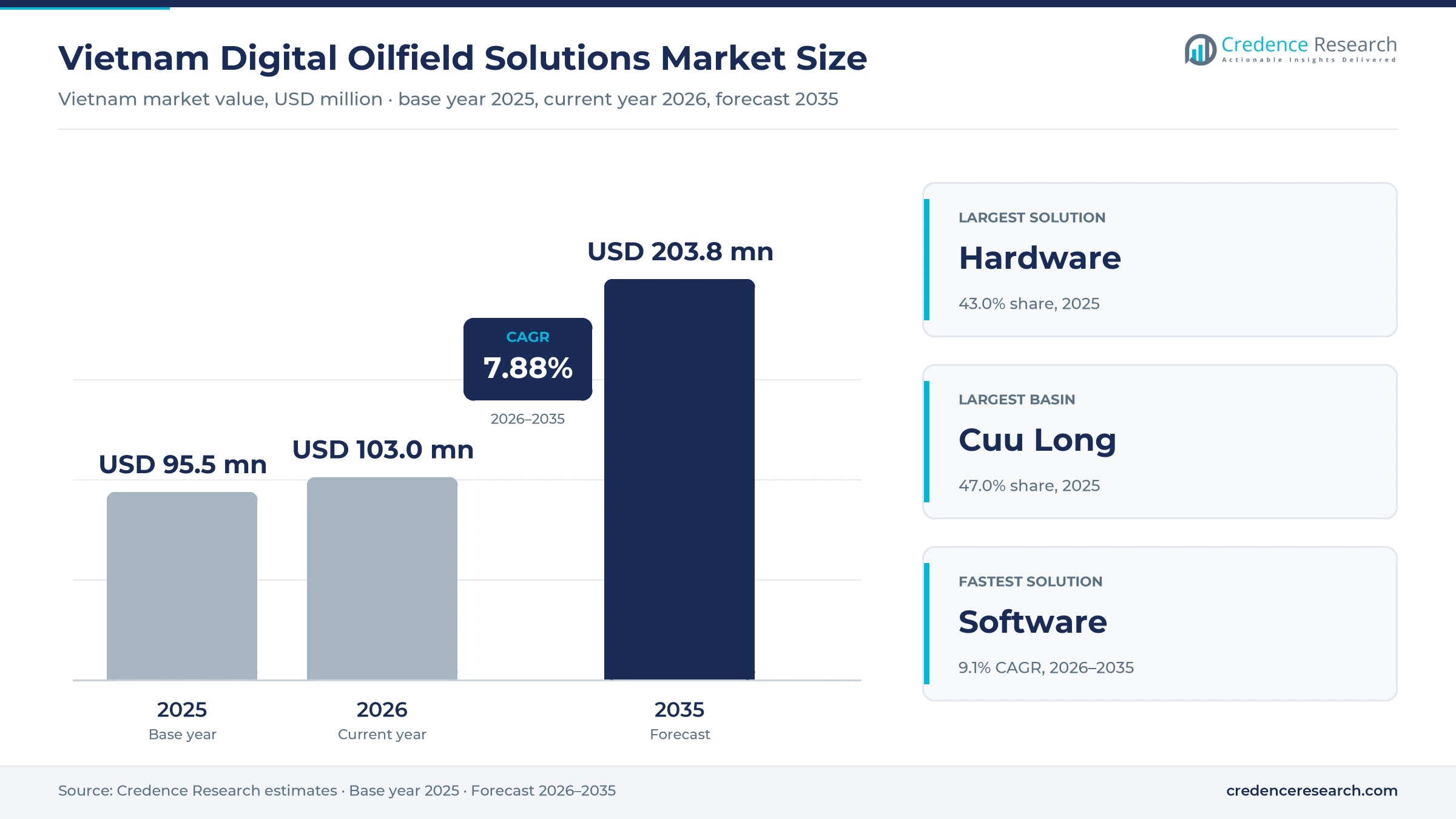
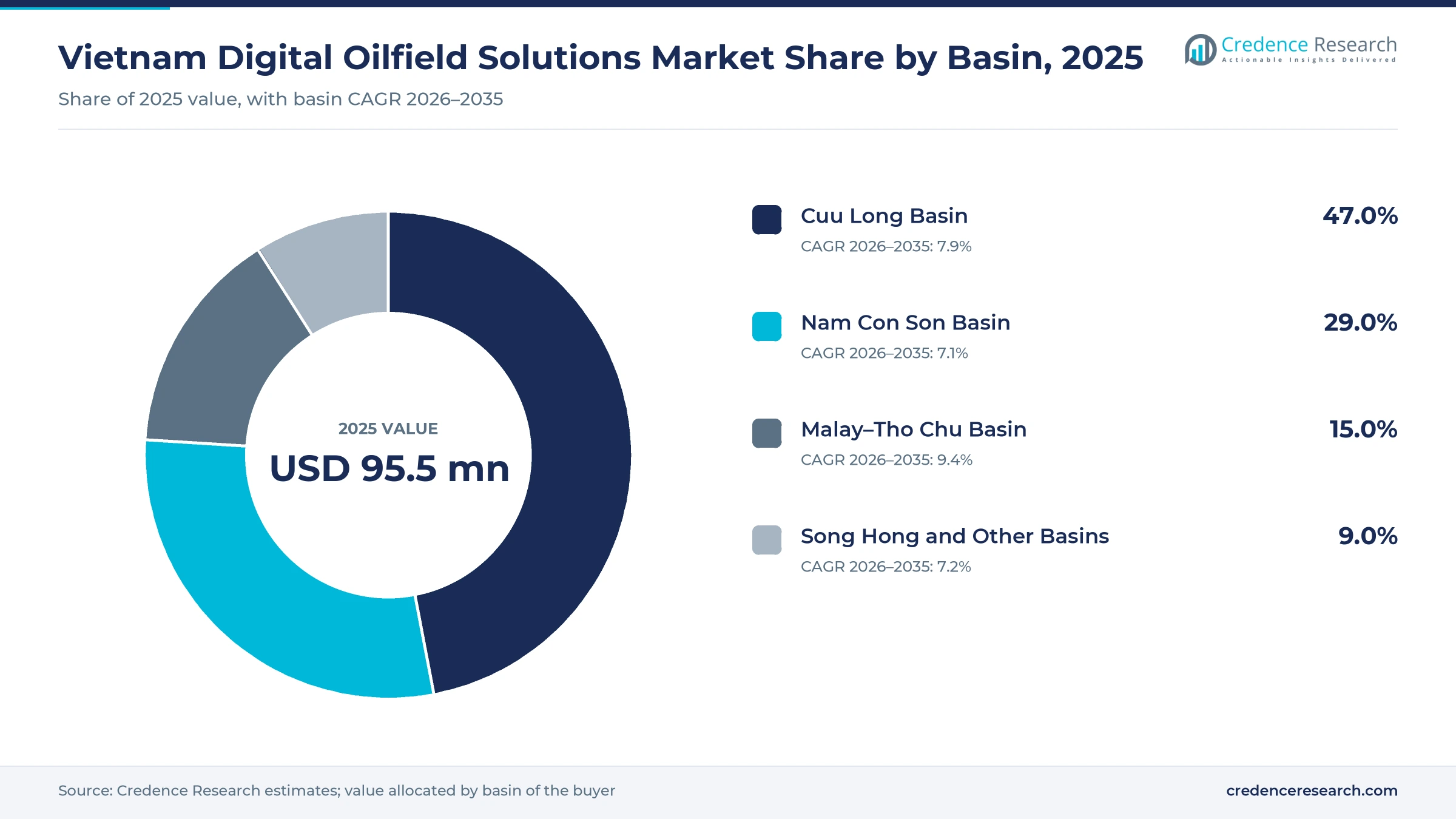
The Vietnam digital oilfield solutions market was valued at USD 95.5 million in 2025 and is projected to increase from USD 103.0 million in 2026 to USD 203.8 million by 2035, registering a CAGR of 7.88% during 2026–2035. Buyers are Petrovietnam units, chiefly PVEP and the Vietsovpetro joint venture, together with foreign operators such as Murphy Oil and Zarubezhneft, which buy sensors, control systems, reservoir and drilling software and integration services to slow decline at aging offshore fields and to bring new ones online. Cuu Long Basin held the largest share, 47.0% in 2025, because the White Tiger field and the newer Murphy discoveries sit there. Malay–Tho Chu Basin grows fastest at 9.4% a year, as the Block B gas project moves toward first gas. The main policy change is the Petrovietnam goal that every member company completes digital transformation from 2026, under Politburo Resolution 57.
Offshore operators buy data, control and modeling tools
The market counts field instrumentation, control and communication hardware, reservoir, drilling and production software, and the integration, consulting and managed services that connect them at producing and developing oil and gas fields in Vietnam. Operators buy most systems inside field development contracts and the rest through framework agreements with service companies and domestic integrators.
Refinery, petrochemical and fertilizer plant digitalization sits outside this market, even where Petrovietnam units use the same partners, and so do drilling rigs, vessels and platform steel themselves. Corporate ERP, retail fuel systems and general office IT are excluded, so the value stays tied to upstream wells, platforms and subsurface work.
Vietnam Digital Oilfield Solutions Market Insights
- The Vietnam digital oilfield solutions market was valued at USD 95.5 million in 2025 and is projected to reach USD 203.8 million by 2035, growing at a 7.88% CAGR during 2026–2035.
- Cuu Long Basin held 47.0% of 2025 value, because the White Tiger field and Murphy Oil's Lac Da Vang development sit there.
- Hardware held 43.0% of 2025 value, because new wellhead platforms and aging facilities both need sensors, controllers and data links.
- Vietsovpetro plans 53 new White Tiger wells between 2025 and 2028, which lifts demand for drilling planning and well monitoring tools.
- Software grows fastest among solutions at 9.1% a year during 2026–2035, as Vietsovpetro and PVEP carry out digital roadmaps.
Hardware leads as drilling software and cloud tools gain
Hardware leads while software grows fastest
Based on solution, the market is categorized into hardware, software and services. Hardware led with 43.0% of 2025 value because every new platform needs sensors, controllers and links before any analytics run, and Vietsovpetro's White Tiger plan installs two unmanned wellhead platforms, BK-10A and BK-26, that depend on remote monitoring. Software grows fastest at 9.1% a year, as the Vietsovpetro plan completed with FPT-Petrosouth lists 23 digital initiatives across geology, drilling, extraction and field development. Services keep a large share because domestic integrators configure and support imported systems.
Offshore fields take almost all spending
Based on application, the market is categorized into onshore and offshore. Offshore led with 96.0% of 2025 value and also grows fastest at 7.9% a year, because Vietnamese oil and gas production comes from offshore basins, and Murphy's Lac Da Trang North-1X well, for example, was drilled in about 45 meters of water. Onshore value comes mainly from shore-based monitoring and control rooms, such as the SVODKA VSP operations center, which collects real-time technical data from Vietsovpetro's offshore facilities and transmits it to shore, according to Viet Nam News. That onshore spend stays small, because most hardware and software sits on platforms and rigs at sea.
Production optimization leads as drilling tools gain
Based on process, the market is categorized into reservoir optimization, production optimization and drilling optimization. Production Optimization led with a 45.0% share of 2025 value because output now runs at roughly half its 2004 peak and White Tiger has produced for about 40 years, Viet Nam News reported, so operators pay to hold flow from aging wells and to tune the dosing of production chemicals. Drilling Optimization grows fastest at 8.5% a year, as PV Drilling trials the NOVOS automation system on three jackups and new well campaigns start across Cuu Long and Nam Con Son.
On-premises systems lead under strict data rules
Based on deployment, the market is categorized into on-premises and cloud-based. On-Premises led with 71.0% of 2025 value because Vietnam's Law on Data, in force since July 1, 2025, tightens transfers of core and important data abroad and limits data platform services to public institutions and state-owned enterprises, KPMG Vietnam notes. Cloud-Based grows fastest at 8.9% a year, as Petrovietnam works with Viettel, VNPT and FPT on a group-wide digital ecosystem hosted on domestic data center capacity. Foreign software vendors must therefore offer local hosting to win cloud contracts.
| Segment Group | Leading Sub-segment | Share, 2025 | Fastest-growing Sub-segment | CAGR, 2026–2035 |
|---|---|---|---|---|
| By Solution | Hardware | 43.0% | Software | 9.1% |
| By Application | Offshore | 96.0% | Offshore | 7.9% |
| By Process | Production Optimization | 45.0% | Drilling Optimization | 8.5% |
| By Deployment | On-Premises | 71.0% | Cloud-Based | 8.9% |
Project scope and day rates set what operators pay
Vietnamese operators buy most digital systems inside field development or drilling contracts, so price is set per platform, per rig or per software seat rather than through public list prices. No Vietnamese contract values for digital work have been published, which is an evidence gap, and the ranges below are Credence Research estimates. Platform count, unmanned design and the share of imported hardware move most of the cost. Day-rate pressure on drilling contractors limits what they pay for automation, while software and support contracts give suppliers recurring margin.
| Offer or scope | Typical price or fee | Basis |
|---|---|---|
| Instrumentation, control and data link package for a new unmanned wellhead platform | USD 2 million to 6 million per platform | Credence Research estimate from platform scope and imported equipment costs |
| Drilling automation and real-time monitoring layer on a jackup rig | USD 0.4 million to 1.0 million per rig a year | Credence Research estimate from rig software and support scope |
| Reservoir modeling and simulation software license | USD 30,000 to 80,000 per seat a year | Credence Research estimate from subsurface software pricing |
| Shore-based monitoring and operations center build | USD 3 million to 8 million per center | Credence Research estimate from control room and integration scope |
Request a Free Sample
Fill in your details and we'll send you a free sample report.
- Sample data tables & charts
- Research methodology
Field decline, new wells and Block B lift technology budgets
A group-wide mandate turns digital plans into budgets
State ownership turns digital policy into procurement, because Petrovietnam units carry out group targets rather than wait for each operator to build its own business case. Petrovietnam aims for all member companies to complete digital transformation from 2026 under Politburo Resolution 57, with Viettel, VNPT and FPT named as partners and an ERP system already running at the parent company. PVEP launched a digital transformation consulting project with FPT on Dec. 26, 2024, to build a 2025 to 2030 roadmap within six months, FPT Digital reports. PVEP extracted 3.05 million tons of oil equivalent in 2024, so its roadmap governs a large share of group output. Integrators that already hold roadmap mandates are best placed for the follow-on system contracts.
Mature-field decline raises the value of each barrel saved
Falling output makes production optimization a priority, because each barrel kept flowing from existing wells costs far less than a barrel from a new field. The industry ministry projects crude output of 5.8 million to 8.0 million metric tons a year for 2026 to 2030, against an average of 8.6 million tons over the past five years, Offshore Engineer reported in March 2026, citing Reuters. Vietsovpetro still added 2.304 million tons of oil reserves in 2025 through reservoir management work, which shows what optimization can still recover. Suppliers of well surveillance and artificial lift analytics gain most from this pressure.
A development drilling wave lifts well planning demand
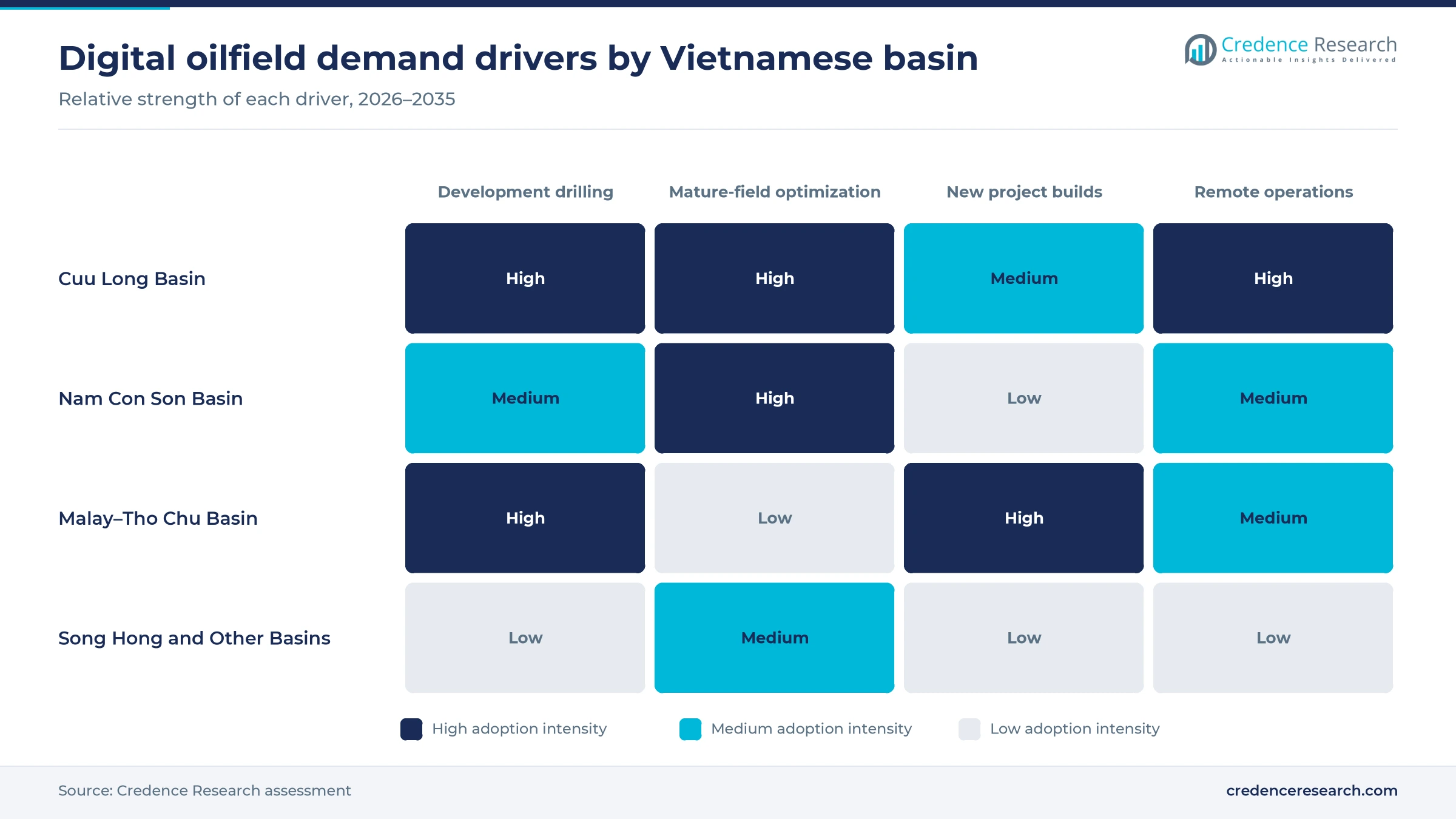
New drilling expands the installed base for well planning, drilling automation and real-time monitoring, because each well adds sensors, data streams and models that operators keep paying to maintain. Vietsovpetro plans VND 12.5 trillion, about USD 483.6 million, for White Tiger, including USD 419.7 million for drilling 53 new wells that come online between 2025 and 2028, The Investor reported in June 2025. PV Drilling, which completed the first jackup restart done entirely in Vietnam in 2025, also won a 104-day, two-well campaign for PVEP–Cuu Long starting in July 2026. Drilling software and services suppliers gain recurring work across these campaigns.
New gas developments are built with digital systems
Greenfield projects buy digital systems at the design stage, which raises the value per project well above retrofits on older platforms. The Block B field holds an estimated 107 billion cubic meters of gas and should supply about 5 billion cubic meters a year to the O Mon power plants, with first gas scheduled for the third quarter of 2027, The Investor reported in October 2025. Vietcombank signed a USD 1 billion loan for the upstream and pipeline projects on Oct. 7, 2025. The operator, Phu Quoc Petroleum Operating Co., awarded Kabal a logistics software contract in August 2025 to digitize its development drilling. Suppliers of control systems and logistics software gain early positions on the project.
Rig automation and remote platforms reshape offshore work
Drilling contractors are shifting to rig automation layers
PV Drilling is shifting toward standardized rig automation to make operations consistent across its fleet, creating openings for drilling control software and data services across development campaigns. The company is trialing NOVOS, the NOV drilling automation platform, on PV Drilling VI, VIII and IX, and it plans fleet-wide expansion only after the trial validates results, with a target before 2030. PV Drilling VIII, rated for 400 feet of water and drilling depths up to 30,000 feet, was upgraded in Vung Tau in 2025 to the standard of jackups built since 2016. PV Drilling cites connection-time cuts of more than 50% from comparable systems abroad, but no Vietnamese trial data have been published. Suppliers whose systems already run on these rigs hold an advantage if the trial succeeds.
Operators are moving monitoring and control to shore
Vietsovpetro is shifting toward unmanned platforms and shore-based monitoring to address cost pressure at small fields, creating openings for remote operation systems and data links across White Tiger and nearby blocks. Its SVODKA VSP center already brings real-time data from offshore facilities to shore, and the two new wellhead platforms in its White Tiger plan are designed to run unmanned. The BK-24 platform, described by Petrovietnam as a small marginal field developed at optimized cost, started production 65 days ahead of schedule in October 2025. Vietsovpetro's total oil and condensate output reached 3.012 million tons in 2025, up 2%. Suppliers of remote operations systems gain as more platforms run without crews on board.
Marginal field terms open demand for low-cost digital kits
Marginal fields are an opening for low-cost digital packages, because small reservoirs only pay back when operators cut staffing, visits and well interventions. The National Assembly passed a new Petroleum Law on Aug. 23, 2026, which takes effect on March 1, 2027, and replaces the 2022 law, Viet Nam News reported. The framework may give marginal fields a 25% corporate income tax rate, a 5% export tax rate and full cost recovery, according to a member of the Economic and Financial Committee. Interconnected offshore and onshore projects will also fall under a single integrated approval process. Vendors with standard, unmanned platform packages gain the most from these terms.
New Cuu Long discoveries open hub and tieback demand
New discoveries in the Cuu Long Basin are an opening for subsea monitoring, flow assurance software and production management systems, because operators plan hubs that tie several fields into one facility. Murphy Oil started production at Lac Da Vang on Sept. 27, 2026, and expects net peak output of 10,000 to 15,000 barrels of oil equivalent a day in 2028 to 2029, World Oil reports. Its nearby Lac Da Trang North-1X well found 131 feet of net oil pay, a candidate for a subsea tieback. Murphy said on Jan. 7, 2026, that appraisal had lifted the high end of the Hai Su Vang primary reservoir estimate above 430 million barrels of oil equivalent, World Oil reported. Suppliers of tieback controls and production software stand to gain.
Low oil prices, data rules and cyber risk slow adoption
Low oil prices squeeze discretionary technology budgets
Lower oil prices cut the cash that operators release for projects without a direct production gain. Brent averaged USD 69 a barrel in 2025, the lowest annual average since 2020, the U.S. Energy Information Administration reports. Vietnam's state budget revenue from crude oil fell 18.2% to nearly VND 48.0 trillion in 2025, the National Statistics Office says. Vendors selling analytics with long payback are most exposed, while tools tied to output gains keep funding.
Data residency rules complicate cloud deployment
Data rules raise the cost of cloud platforms run from abroad. The Law on Data, passed on Nov. 30, 2024, and in force since July 1, 2025, requires owners to sort data into core, important and other tiers, and subsurface and production data from state-owned fields may fall into the stricter tiers. Detailed government guidelines are still due, which leaves buyers unsure of what can leave Vietnam. Foreign subscription software vendors are most exposed, and they must add local hosting or partner with domestic providers to bid.
Cyber incidents raise the cost of connecting assets
Linking field control systems to corporate networks raises the risk that an IT breach reaches operations. PVOIL, the Petrovietnam fuel retailer, was hit by ransomware on April 2, 2024, which shut down its website, email, payment application and electronic invoices, The Investor reported. The attack hit retail systems rather than fields, but it shows the group's exposure. Operators therefore add network segmentation and security audits before connecting platforms, which lengthens projects and favors suppliers with certified industrial security offerings.
A shrinking production base caps the addressable spend
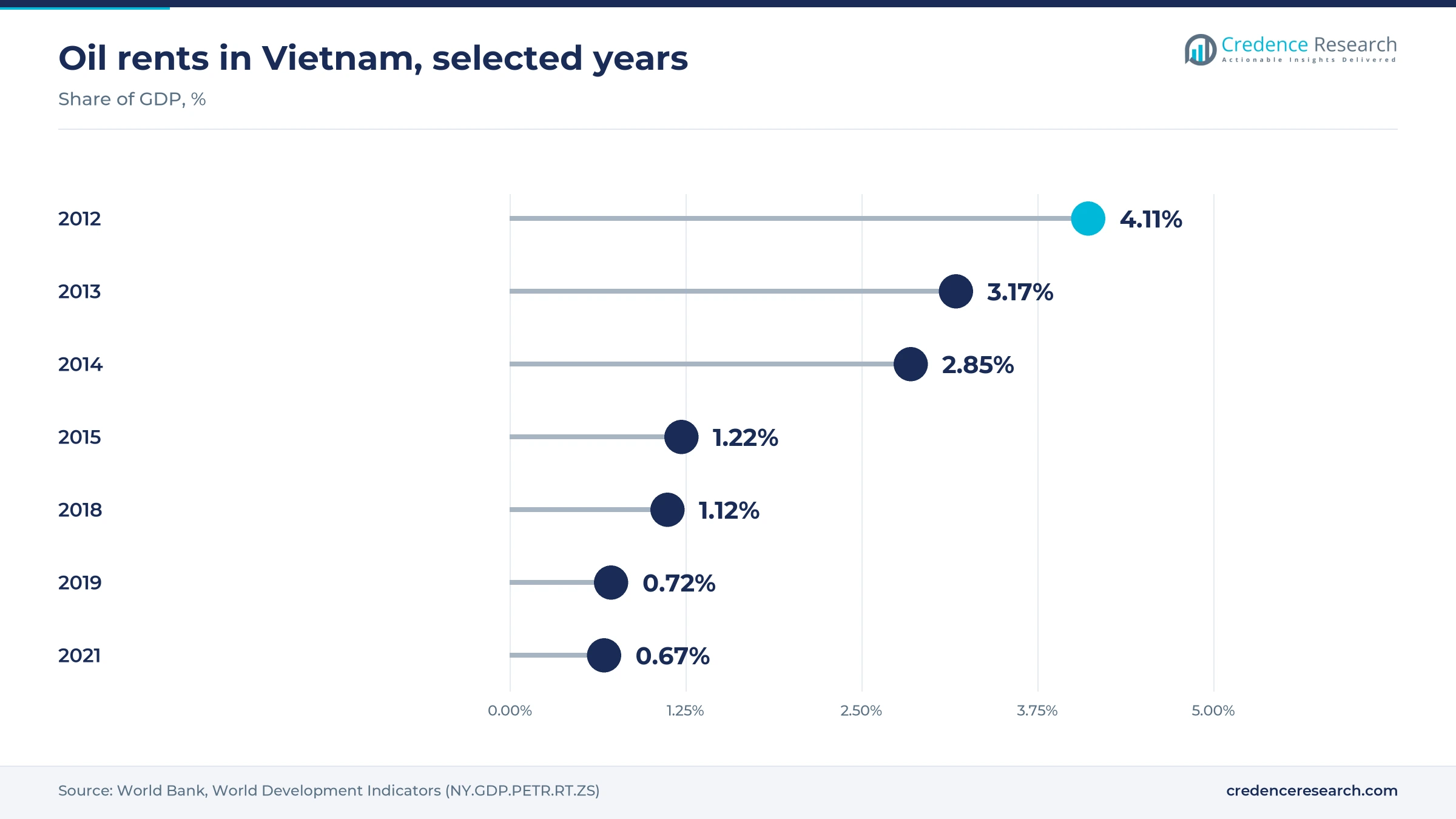
Oil now weighs less in Vietnam's economy, which limits how much the state allocates to upstream technology. Oil rents fell from 4.11% of GDP in 2012 to 0.67% in 2021, World Bank data show. Mining and quarrying output fell 6.3% in 2024 and rose only 0.5% in 2025, the National Statistics Office reports. Vendors that price licenses per well or per platform are most exposed, while those selling decline management tools hold up better.
Cuu Long leads while Block B makes Malay–Tho Chu fastest
| Basin | Value, 2025 (USD million) | Share, 2025 | CAGR, 2026–2035 |
|---|---|---|---|
| Cuu Long Basin | 44.9 | 47.0% | 7.9% |
| Nam Con Son Basin | 27.7 | 29.0% | 7.1% |
| Malay–Tho Chu Basin | 14.3 | 15.0% | 9.4% |
| Song Hong and Other Basins | 8.6 | 9.0% | 7.2% |
Cuu Long leads on White Tiger and Murphy fields
Cuu Long Basin held a 47.0% share of 2025 value and grows at 7.9% a year. White Tiger in Block 09-1 reached its 2.7 million-ton production target on Dec. 13, 2025, 18 days early, VietnamPlus reported, while the nearby Kinh Ngu Trang–Kinh Ngu Trang Nam field in Block 09-2/09 began commercial production in August 2025. The Murphy discoveries described above add new development work in the same basin. This concentration of old and new fields keeps the basin the largest buyer of both optimization and drilling tools.
Malay–Tho Chu grows fastest as Block B is built
Malay–Tho Chu Basin held a 15.0% share of 2025 value and grows fastest at 9.4% a year. PTSC South East Asia, a PTSC and Yinson joint venture, took over the lease and operation of a new floating storage and offloading unit for Block B on July 28, 2025, with 350,000 barrels of condensate storage in about 80 meters of water, PTSC says. Development drilling, platform controls and gas metering all start from zero here. Suppliers that win the first Block B packages gain the reference site for later gas clusters in the basin.
Nam Con Son adds work through gas and oil campaigns
Nam Con Son Basin held a 29.0% share of 2025 value and grows at 7.1% a year. PV Drilling won a 160-day development drilling campaign for Zarubezhneft EP Vietnam at the Thien Nga–Hai Au field in Block 12/11, starting in October 2026, Offshore magazine reported in May 2026. The basin's gas fields are older, and domestic gas output has fallen at about 5% a year since 2013, The Investor reported in June 2025. Spending here therefore leans toward production surveillance and compression monitoring rather than new builds.
Song Hong and other basins stay small
Song Hong and Other Basins held a 9.0% share of 2025 value and grow at 7.2% a year. The zone covers northern and central waters, where producing fields are fewer and smaller than in the south. Public production and spending data by basin are not published, so this share is the most assumption-heavy Credence Research estimate in the report. Larger gas projects that Petrovietnam lists as priorities, such as Ca Voi Xanh, have no published development timetable, so they are not counted in the base case.
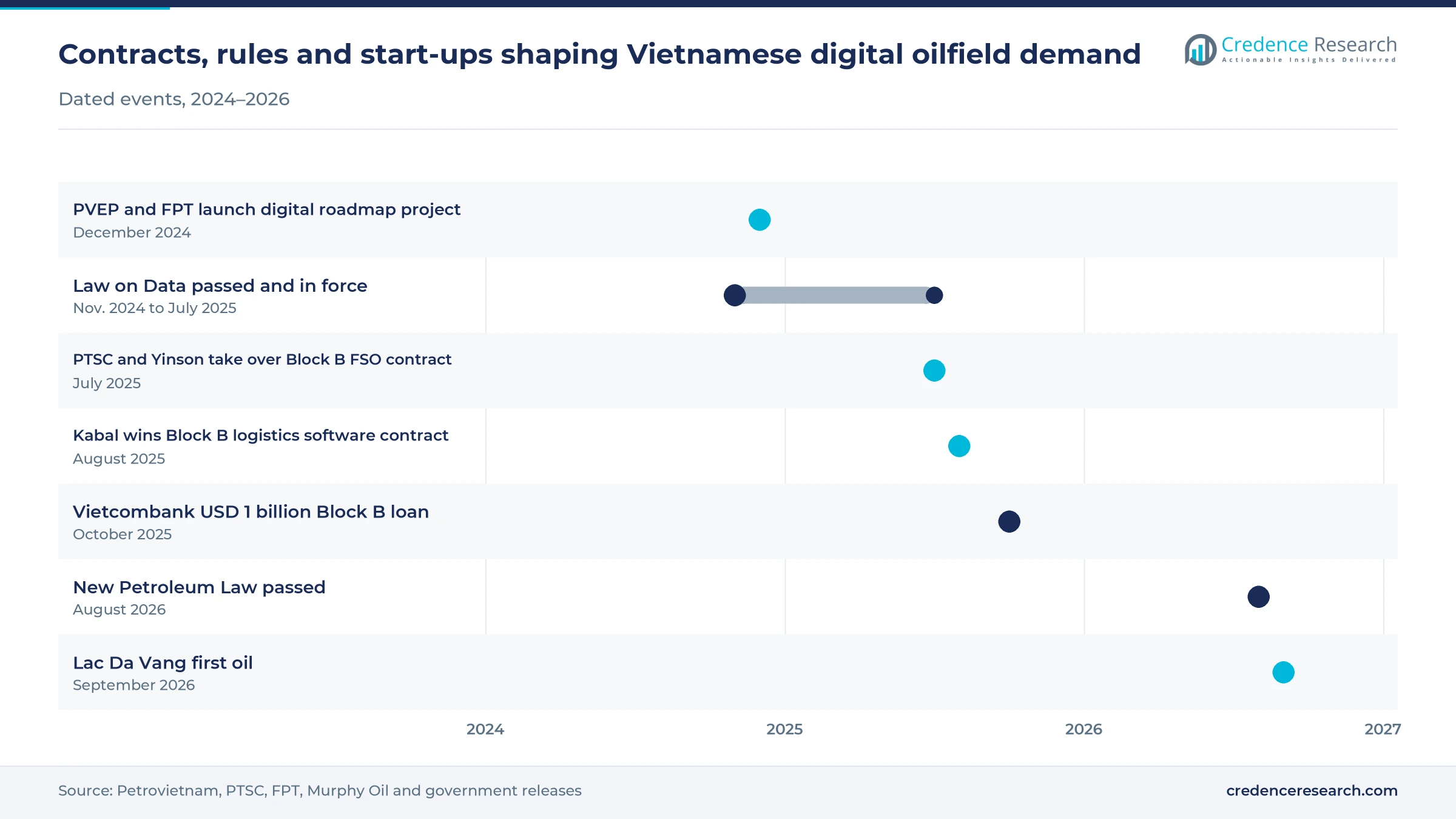
Contracts, first oil and a new petroleum law, 2024 to 2026
| Development | Status and market relevance |
|---|---|
| In December 2024, PVEP and FPT launched a digital transformation consulting project to build a 2025 to 2030 roadmap. | Launched engagement of about six months; it sets the system priorities that later procurement at PVEP will follow. |
| In July 2025, PTSC and Yinson's joint venture took over the Block B floating storage and offloading lease and operation contract. | Signed contract novation; the 14-year term ties a domestic contractor to the project's offshore operations. |
| In August 2025, Phu Quoc Petroleum Operating Co. awarded Kabal a contract to digitize Block B drilling logistics. | Contract award; it is the first published digital software award on the Block B development. |
| In August 2026, the National Assembly passed a new Petroleum Law that takes effect on March 1, 2027. | Approved law; implementing decrees are still pending, so marginal field terms are not yet final. |
| In September 2026, Murphy Oil started production at the Lac Da Vang field in Block 15-1/05. | Operational launch; more wells come online through 2028, adding production monitoring and well management work. |
Real-time links, rig control layers and models set value
- Real-time offshore data links carry pressure, flow and equipment data from platforms to shore over fiber, radio or satellite, which allows unmanned wellhead platforms and smaller offshore crews.
- Drilling control layers coordinate pipe handling, hoisting and pumps through preset sequences, which PV Drilling is now testing on three jackups to make connections more consistent.
- Reservoir modeling software turns seismic, log and well test data into development plans, which matters most for new discoveries, hub designs and infill wells at old fields.
- Predictive maintenance analytics flag failing pumps, compressors and valves early, which cuts unplanned downtime and spare-part costs on aging platforms.
Need a Custom Version of This Report?
Tailor the scope, geography, or segments to your exact requirements.
- Custom geography or segment scope
- Direct access to our analyst team
Global service firms compete with domestic integrators
Competition turns on offshore references, local support and the ability to work inside Petrovietnam's digital roadmaps. SLB, Halliburton, Baker Hughes and Weatherford compete on subsurface, drilling and production software tied to their field services. NOV supplies the NOVOS drilling automation platform that PV Drilling is trialing on three jackups. Honeywell, Yokogawa, ABB and Siemens compete on platform control, safety and automation systems, where replacement cycles on older facilities drive orders. FPT is the leading domestic integrator, having launched the PVEP roadmap project and completed the Vietsovpetro digital plan with FPT-Petrosouth, and it has also built a digital twin at the Phu My fertilizer plant. Global vendors increasingly partner with domestic firms, because data rules and local content expectations favor work delivered in Vietnam.
A few state buyers and global vendors shape supply
Demand is concentrated, because Petrovietnam units such as PVEP, Vietsovpetro and the Block B operator account for most upstream spending, and Murphy Oil and Zarubezhneft add a handful of foreign buyers. Global service companies supply subsurface and drilling software, automation vendors supply control systems, and domestic firms such as FPT win consulting and integration work. PTSC and PV Drilling, both Petrovietnam units, carry local content into most projects. Entry barriers are high, because buyers need proven offshore references and local support. The best margins sit with software licenses and long-term support contracts.
Ten suppliers that Vietnamese operators shortlist
| Company | Type | Role in the market |
|---|---|---|
| SLB | Full-line supplier | Subsurface, drilling and production software with field services |
| Halliburton Company | Full-line supplier | Drilling, reservoir and production software and services |
| Baker Hughes Company | Full-line supplier | Production optimization software, monitoring and equipment services |
| Weatherford International plc | Specialist | Production automation, artificial lift optimization and well services |
| NOV Inc. | Specialist | NOVOS drilling automation platform on trial with PV Drilling |
| Honeywell International Inc. | Automation supplier | Platform control, safety and process automation systems |
| Yokogawa Electric Corporation | Automation supplier | Control systems, instrumentation and operations software |
| ABB Ltd. | Automation supplier | Control, electrification and remote operations systems for offshore assets |
| Siemens AG | Automation supplier | Automation, industrial software and digital twin tools |
| FPT Corporation | Domestic integrator | Digital roadmaps, integration and software for PVEP and Vietsovpetro |
Value shifts toward drilling software and remote operations
Credence Research's view is that value in Vietnam is moving from platform hardware toward drilling software, remote operations and support contracts, because new wells and unmanned platforms create recurring data work. The group-wide mandate gives procurement a clear timetable, but buyers will reward suppliers that prove production gains on aging fields. Vendors that bundle subsurface data management with local hosting will meet both procurement and data rules. Block B and the Cuu Long discoveries are the largest single opportunities through 2030.
Project disclosures and output data anchor the estimates
The Vietnam digital oilfield solutions estimates use 2025 as the base year and 2026 to 2035 as the forecast period. Market values come from the Credence Research model, checked against industry ministry output projections, Petrovietnam and operator project disclosures, drilling campaign awards, National Statistics Office data and World Bank and U.S. Energy Information Administration statistics. Basin, solution, application, process and deployment splits are Credence Research estimates built from these public sources. The estimates do not rely on interviews or surveys conducted by Credence Research, and no official statistics on upstream digital spending exist.
New fields and gas developments carry demand to 2035
Value rises from USD 103.0 million in 2026 to USD 203.8 million by 2035, with software and services taking a growing share. Cuu Long keeps the largest base as White Tiger drilling and the Murphy fields advance, while Malay–Tho Chu adds the fastest growth once Block B gas flows. Cloud-based deployment rises fastest at 8.9% a year, the quickest pace of any deployment mode through 2035, if local hosting satisfies data rules. Oil prices, the timing of Block B and the marginal field decrees will decide where growth lands within the scenario range.
Block B timing and drilling pace decide the range
The base case assumes that Block B reaches first gas in 2027, White Tiger drilling runs to plan and Petrovietnam units carry out their digital roadmaps. The downside follows if oil stays near 2025 prices, Block B slips again and data rules delay cloud projects. The upside requires final marginal field terms under the new Petroleum Law, a successful rig automation trial and an early development decision at Hai Su Vang. In the base case, value compounds at 7.88% a year from the 2026 base.
| Scenario | CAGR, 2026–2035 | Value, 2035 | What has to hold |
|---|---|---|---|
| Downside | 6.3% | USD 178.2 million | Oil stays near 2025 prices, Block B slips again and cloud projects stall |
| Base | 7.88% | USD 203.8 million | Block B first gas in 2027 and White Tiger drilling on plan |
| Upside | 9.3% | USD 228.9 million | Marginal field terms finalized, rig automation scaled and Hai Su Vang sanctioned early |
Frequently Asked Questions
How big is the Vietnam digital oilfield solutions market?
Who buys digital oilfield systems in Vietnam?
Which solution type leads the market?
Which basin spends the most on digital oilfield tools?
How is Vietnam's oil production changing?
How much does a digital package for an offshore platform cost?
Does Vietnam's Law on Data affect cloud use in oil and gas?
What limits growth in Vietnamese digital oilfield spending?
Table of Content
Chapter 1 Market Segmentation
- 1.1 Segmentation Framework
- 1.1.1 Product and Service Classification
- 1.1.2 Application and End-Use Classification
- 1.1.3 Technology and Solution Classification
- 1.1.4 Customer and Distribution Channel Classification
- 1.1.5 Geographic Segmentation
- 1.1.6 Market Segment Definitions and Boundaries
- 1.2 By Solution
- 1.2.1 Hardware
- 1.2.2 Software
- 1.2.3 Services
- 1.3 By Application
- 1.3.1 Onshore
- 1.3.2 Offshore
- 1.4 By Process
- 1.4.1 Reservoir Optimization
- 1.4.2 Production Optimization
- 1.4.3 Drilling Optimization
- 1.5 By Deployment
- 1.5.1 On-Premises
- 1.5.2 Cloud-Based
- 1.6 By Basin
- 1.6.1 Cuu Long Basin
- 1.6.2 Nam Con Son Basin
- 1.6.3 Malay–Tho Chu Basin
- 1.6.4 Song Hong and Other Basins
Chapter 2 Introduction
- 2.1 Report Objectives and Scope
- 2.2 Product Definition and Industry Terminology
- 2.3 Market Inclusions and Exclusions
- 2.4 Research Process
- 2.4.1 Primary Research and Expert Interviews
- 2.4.2 Secondary Research and Source Review
- 2.4.3 Top-Down and Bottom-Up Estimation
- 2.4.4 Data Triangulation and Verification
- 2.5 Market Size Measurement Basis
- 2.5.1 2025: USD 95.5 million → 2035: USD 203.8 million
- 2.6 Historical and Forecast Reference Periods
- 2.6.1 Historical Period: 2018-2025
- 2.6.2 Base Year: 2025
- 2.6.3 Forecast Period: 2025-2035
- 2.7 Research Assumptions and Limitations
Chapter 3 Executive Summary
- 3.1 Market Snapshot and Key Findings
- 3.2 Base-Year Market Size, 2025
- 3.3 Forecast Market Size, 2035
- 3.4 Revenue and Volume Growth Outlook
- 3.5 Key Demand and Supply Indicators
- 3.6 Leading Market Segments
- 3.7 Fastest-Growing Market Opportunities
- 3.8 Regional Performance Highlights
- 3.9 Technology and Industry Transformation
- 3.10 Competitive Landscape Summary
- 3.11 Analyst View and Strategic Implications
Chapter 4 Vietnam Digital Oilfield Solutions Market Trends and Developments
- 4.1 Historical Industry Development, 2018-2025
- 4.2 Recent Market Trends and Developments
- 4.3 Demand and Customer Behavior Trends
- 4.4 Technology and Product Innovation
- 4.5 Artificial Intelligence, Automation and Digitalization
- 4.6 Local Manufacturing and Supply Chain Realignment
- 4.7 Industry Partnerships, Mergers and Acquisitions
- 4.8 Sustainability and Circular Economy Developments
- 4.9 Government and Private Sector Investment Trends
- 4.10 Emerging Business Models and Commercialization
- 4.11 Industry Developments and Announcements
Chapter 5 Vietnam Digital Oilfield Solutions Market Production, Supply and Demand Analysis
- 5.1 Demand Trend and Consumption Analysis, 2018-2025
- 5.2 Demand Forecast, 2025-2035
- 5.3 Production and Output Trend, 2018-2025
- 5.4 Production and Output Forecast, 2025-2035
- 5.5 Installed Capacity and Capacity Utilization
- 5.6 Company-Wise Production Plants and Statistics
- 5.6.1 Installed Production Capacity
- 5.6.2 Actual Production
- 5.6.3 Planned Capacity and Expansion Targets
- 5.7 Supply Chain Structure and Procurement Trends
- 5.8 Supply-Demand Gap and Bottlenecks
- 5.9 Import Dependence and Sourcing Structure
- 5.10 Contract Manufacturing and Outsourcing
- 5.11 Regional Supply and Demand Concentration
Chapter 6 Vietnam Digital Oilfield Solutions Market Pricing Analysis
- 6.1 Pricing Structure and Measurement
- 6.2 Historical Pricing Trends, 2018-2025
- 6.3 Pricing Outlook, 2025-2035
- 6.4 Average Selling Price and Unit Economics
- 6.5 Pricing by Product and Market Segment
- 6.6 Geographic Pricing Differences
- 6.7 Key Input, Energy, Labor and Logistics Costs
- 6.8 Contract Pricing and Purchasing Models
- 6.9 Pricing Sensitivity and Competitive Positioning
- 6.10 Price, Margin and Profitability Implications
Chapter 7 Vietnam Digital Oilfield Solutions Market Dynamics
- 7.1 Market Growth Drivers
- 7.1.1 Demand-Side Drivers
- 7.1.2 Technology and Innovation Drivers
- 7.1.3 Infrastructure and Investment Drivers
- 7.1.4 Regulatory and Policy Drivers
- 7.2 Market Restraints
- 7.2.1 Cost and Affordability Constraints
- 7.2.2 Technology and Adoption Barriers
- 7.2.3 Supply Chain and Operational Constraints
- 7.3 Market Challenges
- 7.3.1 Competitive Pressure and Margin Erosion
- 7.3.2 Skills, Infrastructure and Implementation Gaps
- 7.4 Emerging Market Opportunities
- 7.5 Market Dynamics Impact and Time-Horizon Assessment
Chapter 8 Vietnam Digital Oilfield Solutions Value Chain Analysis
- 8.1 Industry Value Chain Overview
- 8.2 Upstream Suppliers and Critical Inputs
- 8.3 Technology and Component Providers
- 8.4 Manufacturing or Service Delivery
- 8.5 Distribution, Channel Partners and Integrators
- 8.6 Downstream Applications and End Users
- 8.7 Value Addition and Profit Pools
- 8.8 Vertical Integration and Outsourcing
- 8.9 Supplier Concentration and Risk
- 8.10 Supply Chain Localization and Resilience
Chapter 9 Vietnam Digital Oilfield Solutions Market Regulations and Policies
- 9.1 Relevant Laws, Standards and Compliance Frameworks
- 9.2 Product, Service, Safety and Quality Requirements
- 9.3 Government Policies, Incentives and Subsidies
- 9.4 Imports, Exports and Trade Barriers
- 9.5 Public Procurement and Local Content Requirements
- 9.6 Environmental and Sustainability Compliance
- 9.7 Upcoming Policy Changes and Market Implications
Chapter 10 Vietnam Digital Oilfield Solutions Market Hotspots and Opportunities
- 10.1 Market Opportunity Mapping and Growth Hotspots
- 10.2 High-Growth Applications and Customer Groups
- 10.3 Underserved Markets and White-Space Opportunities
- 10.4 Emerging Technology and Product Opportunities
- 10.5 New Capacity and Investment Hotspots
- 10.6 Market Entry and Expansion Opportunities
- 10.7 Distribution and Partnership Opportunities
- 10.8 Near-Term and Long-Term Commercial Potential
- 10.9 Opportunity Attractiveness and Execution Risks
Chapter 11 Vietnam Digital Oilfield Solutions Market Outlook, 2025-2035
- 11.1 Market Size and Analysis
- 11.1.1 Revenue (Market Measurement: 2025: USD 95.5 million → 2035: USD 203.8 million)
- 11.1.2 Market Volume and Quantity Sold
- 11.1.3 Historical Market Size, 2018-2025
- 11.1.4 Base-Year Market Size, 2025
- 11.2 Market Forecast, 2025-2035
- 11.2.1 Revenue Forecast to 2035
- 11.2.2 Volume Forecast to 2035
- 11.2.3 CAGR and Year-on-Year Growth
- 11.2.4 Incremental Revenue Opportunity
- 11.3 Forecast Assumptions and Scenario Analysis
- 11.3.1 Base-Case Forecast
- 11.3.2 Optimistic and Conservative Scenarios
- 11.3.3 Technology, Pricing and Policy Sensitivities
- 11.4 Market Attractiveness and Growth Outlook
Chapter 12 Vietnam Digital Oilfield Solutions Market Segmentation and Outlook
- 12.1 Segmentation Summary and Market Shares, 2025
- 12.2 Largest and Fastest-Growing Segments
- 12.3 By Solution - Market Size and Forecast, 2025-2035
- 12.3.1 Segment Definition and Scope
- 12.3.2 Historical Market Size, 2018-2025
- 12.3.3 Revenue Forecast, 2025-2035
- 12.3.4 Volume Forecast, 2025-2035
- 12.3.5 Base-Year Market Share, 2025
- 12.3.6 Segment CAGR and Growth Drivers
- 12.3.7 Subsegment Market Size and Forecast
- 12.3.7.1 Hardware
- 12.3.7.2 Software
- 12.3.7.3 Services
- 12.3.8 Subsegment Pricing and Adoption Trends
- 12.3.9 Leading Suppliers and Competition
- 12.3.10 Regional Demand and Opportunities
- 12.4 By Application - Market Size and Forecast, 2025-2035
- 12.4.1 Segment Definition and Scope
- 12.4.2 Historical Market Size, 2018-2025
- 12.4.3 Revenue Forecast, 2025-2035
- 12.4.4 Volume Forecast, 2025-2035
- 12.4.5 Base-Year Market Share, 2025
- 12.4.6 Segment CAGR and Growth Drivers
- 12.4.7 Subsegment Market Size and Forecast
- 12.4.7.1 Onshore
- 12.4.7.2 Offshore
- 12.4.8 Subsegment Pricing and Adoption Trends
- 12.4.9 Leading Suppliers and Competition
- 12.4.10 Regional Demand and Opportunities
- 12.5 By Process - Market Size and Forecast, 2025-2035
- 12.5.1 Segment Definition and Scope
- 12.5.2 Historical Market Size, 2018-2025
- 12.5.3 Revenue Forecast, 2025-2035
- 12.5.4 Volume Forecast, 2025-2035
- 12.5.5 Base-Year Market Share, 2025
- 12.5.6 Segment CAGR and Growth Drivers
- 12.5.7 Subsegment Market Size and Forecast
- 12.5.7.1 Reservoir Optimization
- 12.5.7.2 Production Optimization
- 12.5.7.3 Drilling Optimization
- 12.5.8 Subsegment Pricing and Adoption Trends
- 12.5.9 Leading Suppliers and Competition
- 12.5.10 Regional Demand and Opportunities
- 12.6 By Deployment - Market Size and Forecast, 2025-2035
- 12.6.1 Segment Definition and Scope
- 12.6.2 Historical Market Size, 2018-2025
- 12.6.3 Revenue Forecast, 2025-2035
- 12.6.4 Volume Forecast, 2025-2035
- 12.6.5 Base-Year Market Share, 2025
- 12.6.6 Segment CAGR and Growth Drivers
- 12.6.7 Subsegment Market Size and Forecast
- 12.6.7.1 On-Premises
- 12.6.7.2 Cloud-Based
- 12.6.8 Subsegment Pricing and Adoption Trends
- 12.6.9 Leading Suppliers and Competition
- 12.6.10 Regional Demand and Opportunities
- 12.7 By Basin - Market Size and Forecast, 2025-2035
- 12.7.1 Segment Definition and Scope
- 12.7.2 Historical Market Size, 2018-2025
- 12.7.3 Revenue Forecast, 2025-2035
- 12.7.4 Volume Forecast, 2025-2035
- 12.7.5 Base-Year Market Share, 2025
- 12.7.6 Segment CAGR and Growth Drivers
- 12.7.7 Subsegment Market Size and Forecast
- 12.7.7.1 Cuu Long Basin
- 12.7.7.2 Nam Con Son Basin
- 12.7.7.3 Malay–Tho Chu Basin
- 12.7.7.4 Song Hong and Other Basins
- 12.7.8 Subsegment Pricing and Adoption Trends
- 12.7.9 Leading Suppliers and Competition
- 12.7.10 Regional Demand and Opportunities
- 12.8 Segment Growth Comparison
- 12.9 Segment Attractiveness and Priority Matrix
Chapter 13 Vietnam Digital Oilfield Solutions End-Use and Application Market Outlook
- 13.1 End-Use Industry and Customer Demand Structure
- 13.2 Leading Applications and Customer Groups
- 13.3 End-Use Market Size, Share and Forecast
- 13.4 Major End-Use Industry Deep Dives
- 13.4.1 Customer Requirements and Use Cases
- 13.4.2 Demand and Replacement Cycles
- 13.4.3 Technical and Regulatory Considerations
- 13.4.4 Purchasing and Procurement Models
- 13.4.5 Leading Vendors and Distribution Channels
- 13.4.6 Forecast and Commercial Opportunities
- 13.5 Emerging Applications and Cross-Segment Demand
- 13.6 End-Use Industry Investment Priorities
Chapter 14 Vietnam Digital Oilfield Solutions Geographic Market Outlook, 2025-2035
- 14.1 Domestic Market Distribution and Demand Clusters
- 14.2 State- or Province-Wise Market Size and Forecast, 2025-2035
- 14.3 City and Metropolitan Market Outlook
- 14.4 Industrial, Manufacturing and Commercial Clusters
- 14.5 Geographic Concentration of Key End Users
- 14.6 Local Pricing and Purchasing Differences
- 14.7 Domestic Production Facilities and Capacity Map
- 14.8 Local Infrastructure and Project Pipeline
- 14.9 State-Level Policy and Incentive Differences
- 14.10 Subnational Investment Hotspots and Opportunities
- 14.11 Distribution and Logistics Networks
- 14.12 Domestic Competitive Footprint
Chapter 15 Vietnam Digital Oilfield Solutions Technology, Innovation and Sustainability Outlook
- 15.1 Technology Landscape and Maturity
- 15.2 Product, Process and Service Innovation
- 15.3 AI, Automation and Digital Tools in the Industry
- 15.4 Technology Adoption and Performance Benchmarking
- 15.5 Innovation Pipeline and R&D Investment
- 15.6 Patent and Intellectual Property Trends
- 15.7 Energy Efficiency and Resource Management
- 15.8 Sustainability, Recycling and Circularity
- 15.9 Technology Roadmap, 2025-2035
- 15.10 Risks of Obsolescence and Technology Substitution
Chapter 16 Vietnam Digital Oilfield Solutions Market Key Strategic Imperatives
- 16.1 Growth and Market Entry Priorities
- 16.2 High-Return Products and Segments
- 16.3 Pricing, Profitability and Cost Optimization
- 16.4 Technology Investment and Product Differentiation
- 16.5 Supply Chain Localization and Resilience
- 16.6 Distribution and Customer Acquisition
- 16.7 Partnership, Acquisition and Capacity Strategy
- 16.8 Regional Expansion Priorities
- 16.9 Short-, Medium- and Long-Term Actions
Chapter 17 Competition Outlook
- 17.1 Industry Competition Characteristics
- 17.2 Market Structure and Concentration
- 17.3 Market Share and Competitive Positioning, 2025
- 17.4 Company-Wise Revenue and Product Benchmarking
- 17.5 Production and Service Capacity Benchmarking
- 17.6 Technology, Pricing and Differentiation
- 17.7 Regional Footprint and Distribution Strength
- 17.8 Mergers, Acquisitions and Strategic Alliances
- 17.9 New Entrants and Competitive Threats
- 17.10 Porter's Five Forces and Industry Attractiveness
- 17.11 Competitive Outlook, 2025-2035
Chapter 18 Company Profiles
- 18.1 Company Coverage and Selection Criteria
- 18.2 SLB
- 18.2.1 Business Description
- 18.2.2 Company Ownership and Geographic Presence
- 18.2.3 Product and Service Portfolio
- 18.2.4 Manufacturing and Operating Footprint
- 18.2.5 Production Capacity and Expansion Plans
- 18.2.6 Financial Performance and Investment
- 18.2.7 Market Share and Competitive Position
- 18.2.8 Technology and Innovation Capabilities
- 18.2.9 Strategic Alliances or Partnerships
- 18.2.10 Recent Developments
- 18.2.11 Growth Strategy and Outlook
- 18.3 Halliburton Company
- 18.4 Baker Hughes Company
- 18.5 Weatherford International plc
- 18.6 NOV Inc.
- 18.7 Honeywell International Inc.
- 18.8 Yokogawa Electric Corporation
- 18.9 ABB Ltd.
- 18.10 Siemens AG
- 18.11 FPT Corporation
- 18.12 Other Relevant Market Participants
Note: Every listed company is profiled on the structure shown under the first company. The company list is preliminary and may change based on research findings, market developments, data availability and client requirements.
Chapter 19 Disclaimer
- 19.1 Research and Forecast Disclaimer
- 19.2 Data Source and Estimation Limitations
Note: The depth of individual sections depends on data availability for this market. Volume, capacity, trade and other unit-based metrics are included where applicable.