
| REPORT ATTRIBUTE | DETAILS |
|---|---|
| Historical Period | 2020-2023 |
| Base Year | 2024 |
| Forecast Period | 2025-2032 |
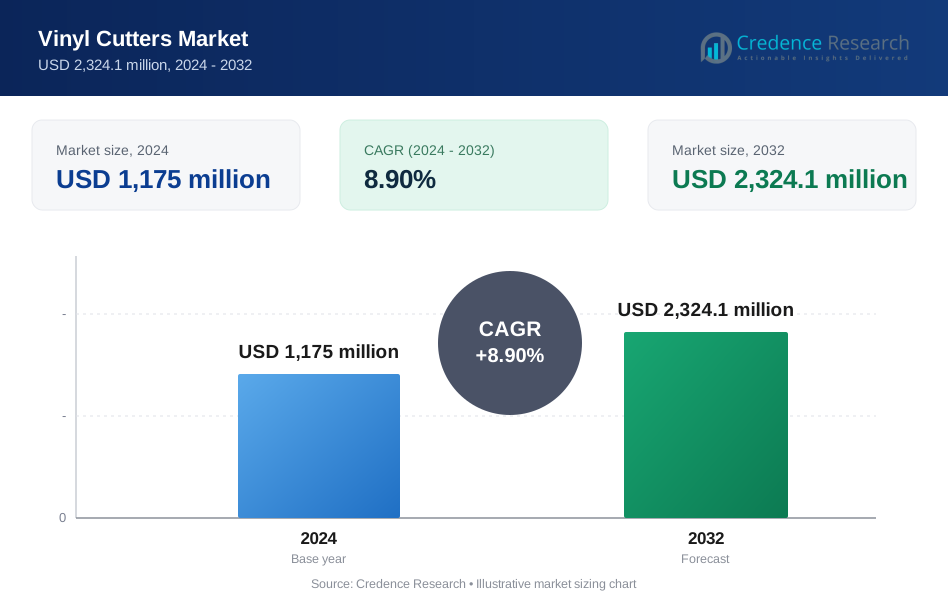
| Vinyl Cutters Market Size 2024 | USD 1175 Million |
| Vinyl Cutters Market, CAGR | 8.9% |
| Vinyl Cutters Market Size 2032 | USD 2324.1 Million |
Market Overview:
Vinyl Cutters Market size was valued at USD 1175 million in 2024 and is anticipated to reach USD 2324.1 million by 2032, at a CAGR of 8.9% during the forecast period (2024-2032). Several factors are driving the growth of the vinyl cutters market. The increasing need for digitally printed and personalized products in retail and promotional industries has created strong demand for efficient and precise cutting tools. Innovations such as improved blade designs, automated cutting processes, and compatibility with a wide range of materials have broadened the applications of vinyl cutters. Growth in small and medium-sized enterprises within creative industries-including fashion, signage, and home décor-has also contributed to market expansion. Furthermore, a growing emphasis on environmentally friendly and sustainable materials compatible with vinyl cutters is encouraging wider adoption. The surge of e-commerce platforms offering customizable products additionally fuels the requirement for reliable vinyl cutting solutions. Regionally, North America commands a substantial share of the vinyl cutters market, supported by its mature advertising, textile, and automotive sectors, and a high rate of adoption for advanced cutting technologies. Europe maintains steady growth with its well-established creative industries and increasing demand for personalized goods. The Asia-Pacific region is emerging as the fastest-growing market, driven by rapid industrialization, the rise of small businesses, and escalating investments in digital printing and signage, especially in China, India, and Japan. Latin America and the Middle East & Africa are witnessing gradual growth fueled by expanding retail and promotional activities. This regional diversity highlights the global relevance and expanding footprint of vinyl cutters across industries.Market Insights:
- The Vinyl Cutters Market was valued at USD 1,175 million in 2024 and is projected to grow significantly by 2032, driven by strong demand across industries.
- Rising demand for digitally printed and personalized products in retail and promotional sectors fuels the need for precise and efficient vinyl cutting tools.
- Technological innovations, including improved blade designs, automated cutting, and broad material compatibility, expand vinyl cutters’ applications and efficiency.
- Small and medium enterprises (SMEs) in creative industries like fashion, signage, and home décor drive market growth by adopting versatile and cost-effective cutting solutions.
- Increasing focus on eco-friendly and sustainable materials encourages wider adoption of vinyl cutters aligned with global environmental goals.
- North America leads the market with 38% share, supported by mature advertising, textile, and automotive industries with high technology adoption.
- Asia-Pacific emerges as the fastest-growing region, fueled by rapid industrialization, SME growth, investments in digital printing, and expanding e-commerce platforms.
Market Drivers:
Increasing Demand for Customized and Personalized Products Driving Market Expansion The growing consumer preference for customized and personalized products has significantly boosted the demand for vinyl cutters. Industries such as retail, fashion, and promotional advertising rely heavily on vinyl cutting technology to produce unique and tailored designs. Vinyl cutters enable precise and efficient cutting of various materials, allowing manufacturers to meet diverse customer requirements quickly. This demand pushes companies to invest in advanced vinyl cutters that offer better accuracy and flexibility. It also opens opportunities for small and medium enterprises to enter niche markets with customized offerings. The ability to create intricate designs enhances product appeal, strengthening brand loyalty and market penetration. Technological Advancements Enhancing Efficiency and Versatility in Vinyl Cutters Continuous improvements in vinyl cutter technology have expanded its applications across multiple sectors. Modern machines offer automated cutting processes, improved blade quality, and compatibility with a wide range of materials, including eco-friendly options. These advancements reduce operational time and increase productivity, making it easier for businesses to meet tight deadlines and high-volume demands. The integration of user-friendly software simplifies design input and cutting precision, attracting new users. It also lowers the learning curve for operators, facilitating broader adoption. Enhanced connectivity options support seamless integration with digital printing and design workflows, boosting operational efficiency.- For instance, Roland DG’s CAMM-1 GR2 series vinyl cutters are equipped with advanced software integration and automated material detection, which allow users to cut up to 1,485 mm width rolls with minimal manual intervention, directly connecting with cloud-based design platforms for streamlined production.
- For instance, Deepgrooves Vinyl Pressing Plant operates its entire facility using renewable solar and wind energy and produces each vinyl record order following a certified eco-friendly protocol, with one factory fully powered by green energy and a 100% circular recycling and waste management system.
Market Trends:
Integration of Advanced Digital Technologies Transforming Vinyl Cutters Market Operations The Vinyl Cutters Market increasingly incorporates advanced digital technologies to enhance precision, speed, and user experience. Manufacturers develop machines equipped with automated blade adjustment, real-time monitoring, and improved software compatibility for seamless design-to-production workflows. It allows users to execute complex designs with minimal manual intervention, improving efficiency and reducing errors. The adoption of cloud-based platforms supports remote access and collaboration, expanding operational flexibility for businesses. Enhanced connectivity with other digital printing and cutting equipment creates integrated production systems that streamline processes. These technological upgrades meet the growing demand for faster turnaround times and high-quality output, strengthening market competitiveness.- For instance, the Graphtec FC9000 Series vinyl cutter features a dual Automatic Registration Mark Sensor (ARMS) system, achieves cutting speeds up to 1,485 mm/s, and offers a maximum cutting width of 74 inches, illustrating the integration of advanced technology for high-volume, precise production.
- For instance, the Graphtec CE7000 Series vinyl cutter can cut materials up to 15 inches (CE7000-40) to 64 inches (CE7000-160) wide, processes vinyl, heat transfer, and reflective films, and is equipped with an Automatic Registration Mark Sensor for precise contour cutting across various substrates.
Market Challenges Analysis:
High Initial Investment and Maintenance Costs Limiting Wider Adoption in Vinyl Cutters Market The Vinyl Cutters Market faces challenges related to the substantial upfront cost of advanced cutting machines, which can deter small businesses and startups from investing. High capital expenditure restricts accessibility, especially in developing regions where budget constraints are more pronounced. It requires regular maintenance and replacement of specialized blades and components to ensure optimal performance, increasing the total cost of ownership. Limited availability of skilled technicians in certain markets complicates maintenance efforts and may lead to operational downtime. These financial and operational barriers hinder rapid market penetration and slow adoption among potential users.- For instance, Roland DG’s VersaSTUDIO devices come with a full year’s warranty at no extra cost, and extended warranty options are available, ensuring immediate access to experienced engineers and minimizing downtime for new business owners.
Market Opportunities:
Growing Demand for Customized and Eco-Friendly Products Creating New Revenue Streams in Vinyl Cutters Market The Vinyl Cutters Market benefits from increasing consumer preference for personalized and sustainable products across various industries. Manufacturers can capitalize on this trend by developing cutters that accommodate eco-friendly materials and complex, customized designs. It allows businesses to offer differentiated products that meet evolving environmental regulations and consumer expectations. The expanding e-commerce sector provides further avenues for growth by enabling small and medium enterprises to reach niche markets with customized offerings. Investment in research and development focused on sustainability and precision cutting technology can unlock new market segments and drive revenue growth. Expansion into Emerging Markets and Integration with Digital Printing Solutions Enhancing Market Potential Emerging economies present significant growth opportunities for the Vinyl Cutters Market due to rapid industrialization and the rise of small businesses in creative sectors. Increasing investments in digital printing and signage infrastructure in these regions support the adoption of vinyl cutting technology. It enables companies to tap into growing demand for advertising, textiles, and automotive customization. Collaboration with digital printing solution providers offers potential for integrated product offerings, streamlining workflows and improving operational efficiency. Expanding training and support services in emerging markets can also facilitate wider acceptance and sustained market growth.Market Segmentation Analysis:
By Product Type The Vinyl Cutters Market segments into desktop and industrial vinyl cutters based on product type. Desktop cutters target small businesses and individual users needing compact, affordable machines for light-duty and personalized projects. Industrial vinyl cutters serve large-scale manufacturing with higher precision, faster cutting speeds, and compatibility with diverse materials. It meets the needs of industries such as automotive, signage, and textiles where volume and accuracy are paramount. This segmentation enables manufacturers to customize offerings that suit varied customer requirements and drive wider adoption. By Application The market divides by application into signage, textile & apparel, automotive customization, and packaging. Signage leads the segment due to growing demand for customizable advertising and display solutions. Textile and apparel applications leverage vinyl cutters for intricate fabric designs, supporting fast fashion cycles. Automotive customization uses vinyl cutting for vehicle wraps and decals, providing personalization and protective functions. Packaging increasingly employs vinyl cutting to produce branded and visually appealing packaging components, enhancing product appeal and market differentiation. By End-User End-users include small and medium enterprises (SMEs), large enterprises, and individual consumers. SMEs drive demand by adopting versatile, cost-effective vinyl cutters to produce customized products efficiently. Large enterprises depend on industrial cutters to handle high-volume production with consistent quality. Individual consumers, such as hobbyists and freelancers, use desktop cutters primarily for personal or small-scale commercial projects. This segmentation reflects the market’s flexibility in addressing diverse user scales and requirements, fostering sustained growth.Segmentations:
By Product Type:- Desktop Vinyl Cutters
- Industrial Vinyl Cutters
- Signage
- Textile & Apparel
- Automotive Customization
- Packaging
- Small and Medium Enterprises (SMEs)
- Large Enterprises
- Individual Consumers
- Direct Sales (Manufacturers & Dealers)
- Online Sales
- Specialty Stores
- Authorized Distributors
- North America
- U.S.
- Canada
- Mexico
- Europe
- UK
- France
- Germany
- Italy
- Spain
- Russia
- Rest of Europe
- Asia Pacific
- China
- Japan
- South Korea
- India
- Australia
- Southeast Asia
- Rest of Asia Pacific
- Latin America
- Brazil
- Argentina
- Rest of Latin America
- Middle East
- GCC Countries
- Israel
- Turkey
- Rest of Middle East
- Africa
- South Africa
- Egypt
- Rest of Africa
Regional Analysis:
North America Leads with Strong Industrial and Creative Sector Foundations North America commands 38% of the global Vinyl Cutters Market, supported by its robust advertising, automotive, and textile manufacturing industries. The region benefits from widespread adoption of advanced cutting technologies and a mature digital printing infrastructure. It hosts numerous small and medium enterprises that leverage vinyl cutters for customized and high-quality product offerings. Significant investments in research and development drive continuous innovation, resulting in machines with enhanced precision and operational efficiency. Regulatory standards emphasize the importance of eco-friendly solutions, which further stimulate market demand. The presence of major market players headquartered in North America consolidates its leadership position globally. Europe Drives Growth Through Creative Industries and Sustainability Initiatives Europe holds 28% of the Vinyl Cutters Market, propelled by its strong creative sectors including fashion, interior décor, and promotional advertising. The region places a high priority on sustainability, encouraging the use of recyclable and eco-friendly materials compatible with vinyl cutters. It motivates manufacturers to develop cutting technologies aligned with stringent environmental regulations and consumer preferences. Demand for personalized products continues to grow across commercial and residential applications, fostering steady market expansion. Well-developed distribution networks and technical support services enable widespread adoption. Efforts in skill development and training enhance user proficiency, supporting deeper market penetration across Europe. Asia-Pacific Emerges as a Fast-Growing Region Driven by Industrialization and SMEs Asia-Pacific accounts for 24% of the Vinyl Cutters Market, fueled by rapid industrialization and the growth of small and medium enterprises in key countries like China, India, and Japan. The region experiences increasing investments in digital printing, signage, and textile sectors, which drive demand for versatile vinyl cutting solutions. It benefits from a growing consumer base interested in customized, innovative products that boost market expansion. E-commerce growth provides SMEs with broader access to customers, accelerating the adoption of vinyl cutters. Improvements in infrastructure and supportive government policies enhance market development. Collaborations and partnerships facilitate technology transfer, improving access to advanced vinyl cutting equipment throughout the region.Key Player Analysis:
- Graphtec Corporation
- Mimaki Engineering Co., Ltd.
- Silhouette America, Inc.
- USCutter, Inc.
- Brother International Corporation
- Secabo GmbH
- Summa NV
- GCC (Great Computer Corporation)
- KNK Force
- Vevor
- Skycut
- Cricut, Inc.
- Sizzix
Competitive Analysis:
The Vinyl Cutters Market features a competitive landscape dominated by established manufacturers and innovative newcomers focused on technological advancement and customer-centric solutions. Leading companies prioritize research and development to introduce machines with enhanced precision, faster cutting speeds, and improved software integration. It drives product differentiation and strengthens brand loyalty. Strategic partnerships and expanded distribution networks enable key players to increase their market reach globally. Price competitiveness and after-sales service quality also play critical roles in influencing customer decisions. Emerging players target niche segments with affordable, user-friendly models to capture growing demand among small businesses and individual users. Continuous innovation and responsiveness to evolving market requirements maintain the dynamic competition within the Vinyl Cutters Market, pushing companies to enhance product performance and operational efficiency consistently.Recent Developments:
- In February 2025, Mimaki announced the launch of the "Tx330-1800" and "Tx330-1800B" direct textile inkjet printers, offering waterless textile printing for the textile and apparel market.
- In March 2025, Mimaki USA announced a partnership with EngView Systems to integrate packaging CAD software with Mimaki’s CFX Series flatbed cutters, streamlining design-to-production workflows for packaging and display producers.
- In September 2024, Silhouette America launched the Silhouette cloChé, a compact heat press for hobbyists, alongside the Silhouette CAMEO PRO MK-II, Leather Carving Knife, Power Engraver Super-Fine, Heat Pen Super-Fine, a major software update (Silhouette Studio 5), and Silhouette WEB.
Market Concentration & Characteristics:
The Vinyl Cutters Market exhibits a moderately concentrated structure, with a handful of key players holding significant market shares through advanced technology and extensive distribution networks. It balances the presence of large, well-established manufacturers alongside numerous smaller firms that cater to niche segments and regional demands. The market characteristics include rapid technological innovation, increasing demand for customized solutions, and a growing focus on eco-friendly materials. It favors companies that can offer versatile, high-precision products supported by strong customer service and training. Market dynamics encourage continuous product enhancement and competitive pricing to maintain and expand market presence. This concentration fosters healthy competition while allowing room for new entrants targeting emerging opportunities.Report Coverage:
The research report offers an in-depth analysis based on Product Type, Application, End-User, Distribution Channel and Region. It details leading market players, providing an overview of their business, product offerings, investments, revenue streams, and key applications. Additionally, the report includes insights into the competitive environment, SWOT analysis, current market trends, as well as the primary drivers and constraints. Furthermore, it discusses various factors that have driven market expansion in recent years. The report also explores market dynamics, regulatory scenarios, and technological advancements that are shaping the industry. It assesses the impact of external factors and global economic changes on market growth. Lastly, it provides strategic recommendations for new entrants and established companies to navigate the complexities of the market.Future Outlook:
- Advancements in AI and automation will enhance cutting precision and reduce manual intervention.
- Integration of IoT capabilities will enable real-time monitoring and predictive maintenance.
- Increased demand for customized products across various industries will drive market growth.
- Expansion of e-commerce platforms will provide broader access to vinyl cutting solutions.
- Emerging markets, particularly in Asia-Pacific, will present significant growth opportunities.
- Sustainability trends will push for eco-friendly materials and energy-efficient machines.
- Collaborations between vinyl cutter manufacturers and software developers will lead to more integrated solutions.
- Training and support services will become increasingly important to ensure effective machine operation.
- The rise of DIY culture will expand the consumer base for desktop vinyl cutters.
- Continuous innovation in design and functionality will cater to diverse market needs.
Request a Free Sample
Fill in your details and we'll send you a free sample report.
- Sample data tables & charts
- Research methodology
Need a Custom Version of This Report?
Tailor the scope, geography, or segments to your exact requirements.
- Custom geography or segment scope
- Direct access to our analyst team
Frequently Asked Questions
What is the current size of the Vinyl Cutters Market?
How much is the Vinyl Cutters Market expected to grow by 2032?
What factors are driving the growth of the Vinyl Cutters Market?
Which regions lead the Vinyl Cutters Market?
Why is the Asia-Pacific region growing fast in this market?
Table of Content
Chapter 1. Report Introduction
- 1.1 Report Description & Purpose
- 1.1.1 Report Title & Market Definition
- 1.1.2 Unique Selling Propositions (USP) & Key Differentiators
- 1.1.3 Value Proposition for Stakeholders
- 1.2 Research Objectives
- 1.2.1 Market Sizing Objectives (Volume & Revenue)
- 1.2.2 Segmentation Objectives
- 1.2.3 Competitive Intelligence Objectives
- 1.2.4 Forecast & Scenario Objectives
- 1.3 Report Scope
- 1.3.1 Vinyl Cutters Scope – Types & Subtypes Covered
- 1.3.2 Geographic Scope – Regions & Countries Covered
- 1.3.3 Historical Period, Base Year & Forecast Period (2024; forecast to 2032)
- 1.3.4 Inclusions & Exclusions
- 1.4 HS Code & Classification Framework
- 1.5 Currency, Units & Pricing Basis
- 1.6 Target Stakeholders
- 1.7 Limitations & Assumptions
Chapter 2. Executive Summary
- 2.1 Global Vinyl Cutters Market Snapshot
- 2.1.1 Market Size – Historical (2024) & Forecast (2024-2032) (2024: USD 1,175 million → 2032: USD 2,324.1 million)
- 2.1.2 Volume & Revenue – Global Totals
- 2.1.3 Key Market Highlights – Top Five Facts
- 2.2 Vinyl Cutters Market Segmentation Snapshot
- 2.2.1 Market Split by Region – 2024 vs. 2032
- 2.3 Competitive Snapshot
- 2.3.1 Top 10 Players by Revenue Share – 2024
- 2.3.2 Top 10 Players by Volume Share – 2024
- 2.3.3 Recent Strategic Developments (18-Month Summary)
- 2.4 Key Investment Highlights & Strategic Conclusions
Chapter 3. Vinyl Cutters Market Dynamics & Industry Analysis
- 3.1 Market Overview & Context
- 3.1.1 Vinyl Cutters Market Position in the Broader Automotive Value Chain
- 3.1.2 OEM vs. Replacement Market Dynamics
- 3.1.3 Market Maturity & Development Stage by Region
- 3.2 Vinyl Cutters Market Drivers
- 3.3 Vinyl Cutters Market Restraints & Challenges
- 3.4 Vinyl Cutters Market Opportunities
- 3.5 Porter's Five Forces Analysis
- 3.5.1 Threat of New Entrants
- 3.5.2 Bargaining Power of Suppliers
- 3.5.3 Bargaining Power of Buyers
- 3.5.4 Threat of Substitutes
- 3.5.5 Competitive Rivalry – Intensity Assessment
- 3.6 Vinyl Cutters Value Chain Analysis
- 3.6.1 Upstream – Raw Material/Input Suppliers
- 3.6.1.1 Raw Material/Input 1
- 3.6.1.2 Raw Material/Input 2
- 3.6.1.3 Raw Material/Input 3
- 3.6.2 Midstream – Production/Manufacturing/Service Delivery
- 3.6.2.1 Production/Process Overview
- 3.6.2.2 Key Facility Locations & Capacity by Manufacturer
- 3.6.3 Downstream – Distribution & End Consumer
- 3.6.3.1 Primary Channel – B2B/OEM
- 3.6.3.2 Secondary Channels – Dealer, Retail, Online, Direct
- 3.6.4 Value Chain Profitability Analysis
- 3.6.1 Upstream – Raw Material/Input Suppliers
- 3.7 PESTEL Analysis
- 3.7.1 Political Factors
- 3.7.2 Economic Factors
- 3.7.3 Social Factors
- 3.7.4 Technological Factors
- 3.7.5 Environmental Factors
- 3.7.6 Legal Factors
- 3.8 Vinyl Cutters Supply Chain Analysis
- 3.8.1 Raw Material/Input Supply Risk Assessment
- 3.8.2 Manufacturing Concentration Risk (Geographic Exposure)
- 3.8.3 Trade Disruption Impact Analysis
- 3.9 Regulatory & Policy Landscape
Note: The regulatory and policy landscape section covers regulations based on their applicability to the market, Vinyl Cutters category, geography, and scope of the study. Only regulatory frameworks with a material impact on operations, compliance, trade, sustainability, or market access are analyzed in detail.
Chapter 4. Key Investment Pockets & Opportunity Analysis
- 4.1 Vinyl Cutters Market Attractiveness Analysis
- 4.1.1 By Region – Investment Attractiveness Matrix (Volume × CAGR)
- 4.2 Absolute Revenue Growth Opportunity
- 4.2.1 By Region – Absolute USD Growth Through 2032
- 4.3 Incremental Volume Opportunity
- 4.3.1 By Region – Incremental Volume Through 2032
- 4.3.2 Segment – Incremental Volume
- 4.4 Emerging Submarket Opportunity Deep Dive (Subject to Applicability)
- 4.5 Emerging Market Opportunity Scorecards
- 4.5.1 United States
- 4.5.2 Europe
- 4.5.3 Asia
- 4.5.4 Middle East & Africa
Note: Emerging Market Opportunity Scorecards will be included based on relevance and strategic importance. Regions listed are indicative and may vary depending on data availability and market dynamics.
Chapter 5. Vinyl Cutters Import-Export Analysis & Trade Flows
- 5.1 Global Trade Overview
- 5.1.1 Global Export Value by Country (2024)
- 5.1.2 Global Export Volume by Country (2024)
- 5.1.3 Global Import Value by Country (2024)
- 5.1.4 Global Import Volume by Country (2024)
- 5.1.5 Net Trade Balance by Country (2024)
- 5.2 Export Analysis – Segment
- 5.2.1 Type 1 (HS Code)
- 5.2.2 Type 2 (HS Code)
- 5.2.3 Type 3 (HS Code)
- 5.2.4 Type 4 (HS Code)
- 5.2.5 Type 5 (HS Code)
- 5.3 Import Analysis – Segment
- 5.3.1 Type 1 (HS Code)
- 5.3.2 Type 2 (HS Code)
- 5.3.3 Type 3 (HS Code)
- 5.3.4 Type 4 (HS Code)
- 5.3.5 Type 5 (HS Code)
- 5.4 Average Unit Trade Prices
- 5.4.1 Average Export Price – Segment & Country
- 5.4.2 Average Import Price – Segment & Source Country
- 5.4.3 Price Trends (2024)
- 5.5 Key Trade Route Analysis
- 5.5.1 Trade Route 1
- 5.5.2 Trade Route 2
- 5.5.3 Trade Route 3
- 5.5.4 Trade Route 4
- 5.5.5 Trade Route 5
- 5.6 Trade Policy Impact Assessment
- 5.6.1 US Anti-Dumping & Section 301 Tariffs
- 5.6.2 EU Customs Union Impact
- 5.6.3 Major Free Trade Agreements
- 5.6.4 USMCA Rules of Origin
Note: Trade policy analysis will be included only where relevant to the Vinyl Cutters market.
Chapter 6. Competitive Landscape & Company Benchmarking
- 6.1 Vinyl Cutters Market Concentration & Structure
- 6.1.1 Herfindahl-Hirschman Index (HHI) – vs. 2024
- 6.1.2 Tier 1, Tier 2 & Tier 3 Market Structure
- 6.1.3 Global, Regional & Local Player Dynamics
- 6.2 Vinyl Cutters Market Share Analysis – 2024
- 6.2.1 Global Revenue Share by Company
- 6.2.2 Global Volume Share by Company
- 6.2.3 Regional Revenue Share
- 6.2.4 Market Share Evolution ( vs. 2024)
- 6.2.5 OEM Segment Share by Company
- 6.2.6 Replacement Segment Share by Company
- 6.3 Production/Delivery Capacity & Facility Analysis
- 6.3.1 Global Installed Capacity
- 6.3.2 Capacity Utilization Rates
- 6.3.3 Production/Output Volume
- 6.3.4 Facility Locations & Capacity Map
- 6.3.5 Planned Capacity Additions
- 6.4 Vinyl Cutters Competitive Benchmarking Matrix
- 6.4.1 Revenue, Volume, CAGR & Profitability Comparison
- 6.4.2 Channel Revenue Mix
- 6.4.3 Geographic Revenue Exposure
- 6.4.4 R&D Intensity
- 6.4.5 Sustainability Maturity
- 6.5 Strategic Developments in Vinyl Cutters (Last 24 Months)
- 6.5.1 Mergers, Acquisitions & Divestments
- 6.5.2 New Vinyl Cutters Launches
- 6.5.3 Facility Expansions
- 6.5.4 Strategic Alliances, Joint Ventures & Partnerships
- 6.5.5 Distribution Expansion & Market Entry
- 6.5.6 Sustainability & ESG Initiatives
- 6.6 Competitive Strategy Mapping
- 6.6.1 Leader, Challenger, Follower & Niche Classification
- 6.6.2 Pricing Strategy Comparison
- 6.6.3 Channel Strategy Matrix
Note: Strategic developments are included based on their materiality and the availability of reliable information.
Chapter 7. Global Vinyl Cutters Market – By Distribution Channel
- 7.1 Segment Overview
- 7.1.1 Volume & Revenue Split by Channel (2024 & 2032)
- 7.1.2 Channel Mix Evolution (2024-2032)
Chapter 8. Regional Market Analysis – Global Overview
- 8.1 Global Regional Overview
- 8.1.1 Regional Volume Share
- 8.1.2 Regional Revenue Share
- 8.1.3 Regional Volume by Region
- 8.1.4 Regional Revenue by Region
- 8.1.5 Regional Forecast Through 2032
- 8.2 Cross-Regional Segment Analysis
- 8.2.1 By Distribution Channel
- 8.2.2 By Brand/Price Tier
Chapter 9. North America Vinyl Cutters Market
- 9.1 United States
- 9.2 Canada
- 9.3 Mexico
Chapter 10. Europe Vinyl Cutters Market
- 10.1 Germany
- 10.2 France
- 10.3 Italy
- 10.4 United Kingdom
- 10.5 Spain
- 10.6 Poland
- 10.7 Russia
- 10.8 Netherlands
- 10.9 Belgium
- 10.10 Sweden
- 10.11 Denmark
- 10.12 Norway
- 10.13 Rest of Europe
Chapter 11. Asia Pacific Vinyl Cutters Market
- 11.1 China
- 11.2 India
- 11.3 Japan
- 11.4 South Korea
- 11.5 Thailand
- 11.6 Indonesia
- 11.7 Vietnam
- 11.8 Malaysia
- 11.9 Australia
- 11.10 Rest of Asia Pacific
Chapter 12. Latin America Vinyl Cutters Market
- 12.1 Brazil
- 12.2 Argentina
- 12.3 Colombia
- 12.4 Chile
- 12.5 Rest of Latin America
Chapter 13. Middle East Vinyl Cutters Market
- 13.1 Saudi Arabia
- 13.2 United Arab Emirates
- 13.3 Turkey
- 13.4 Israel
- 13.5 Iran
- 13.6 Rest of the Middle East
Chapter 14. Africa Vinyl Cutters Market
- 14.1 South Africa
- 14.2 Egypt
- 14.3 Nigeria
- 14.4 Morocco
- 14.5 Rest of Africa
Chapter 15. Vinyl Cutters Company Profiles
- 15.1 [Company 01]
- 15.1.1 Company Overview
- 15.1.2 Key Management Personnel
- 15.1.3 Products & Services Portfolio
- 15.1.4 Financial Performance
- 15.1.5 Key Market Focus & Geographic Presence
- 15.1.6 Recent Developments & Strategic Initiatives
Note: The company profile list is preliminary and may change based on research findings, market developments, data availability, and client requirements.
Chapter 16. Appendices
- Appendix A – List of Abbreviations & Acronyms
- Appendix B – Industry Classification Code Reference – Full Series
- Appendix C – Production & Capacity Data Tables
- Appendix D – End-Use & Demand Base Tables
- Appendix E – Consumption & Replacement Rate Assumptions
- Appendix F – ASP Reference Tables
- Appendix G – Manufacturing & Facility Database
- Appendix H – Import-Export Data Tables
- Appendix I – Regulatory Summary Tables
- Appendix J – Primary Research Participant List (Anonymized)
- Appendix K – Primary Research Questionnaire Framework
- Appendix L – Data Sources & Bibliography
- Appendix M – Market Size Divergence & Source Comparison
Chapter 17. Research Methodology
- 17.1 Research Framework & Philosophy
- 17.2 Secondary Research – Sources, Hierarchy & Data Extraction
- 17.3 Data Modeling – Bottom-Up & Top-Down Market Sizing
- 17.4 Primary Research – Stakeholder Framework, LOI & Sample Sizes
- 17.5 Forecast Methodology – Regression, Scenario & Sensitivity Analysis
- 17.6 Quality Control – Four-Layer Validation Framework
- 17.7 Limitations & Standard Assumptions
- 17.8 Disclaimer
