
Market Overview
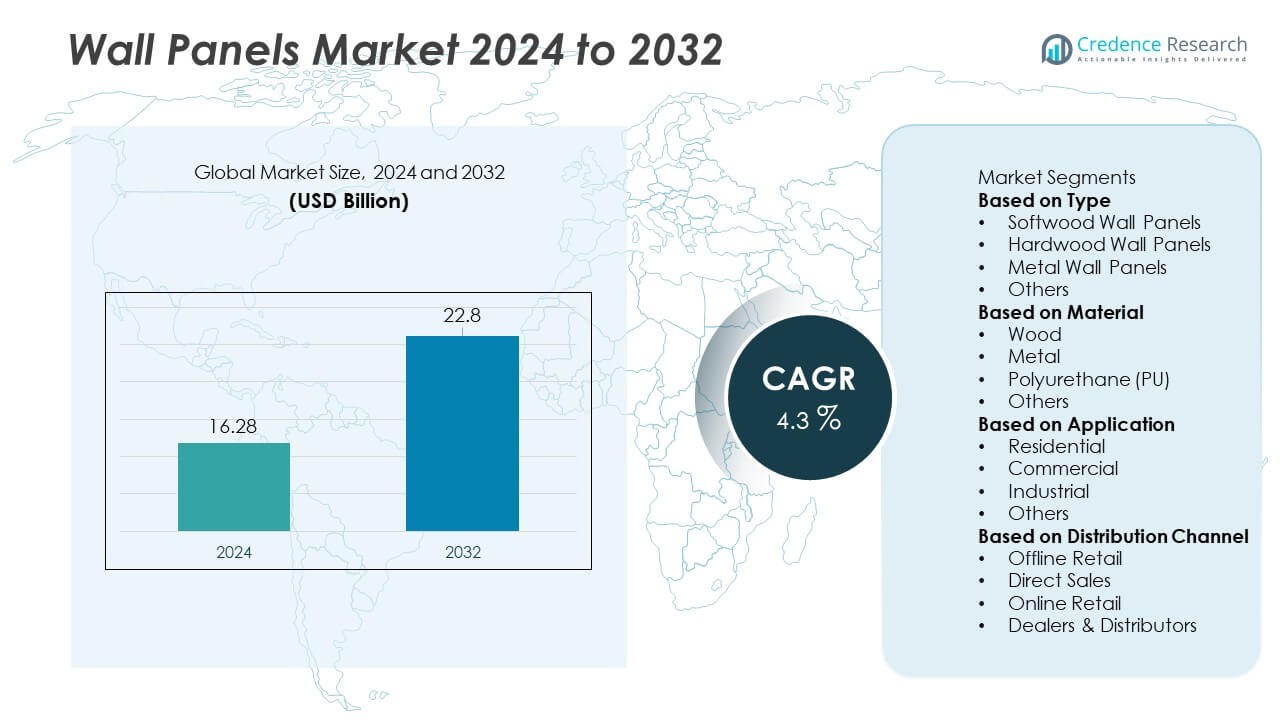
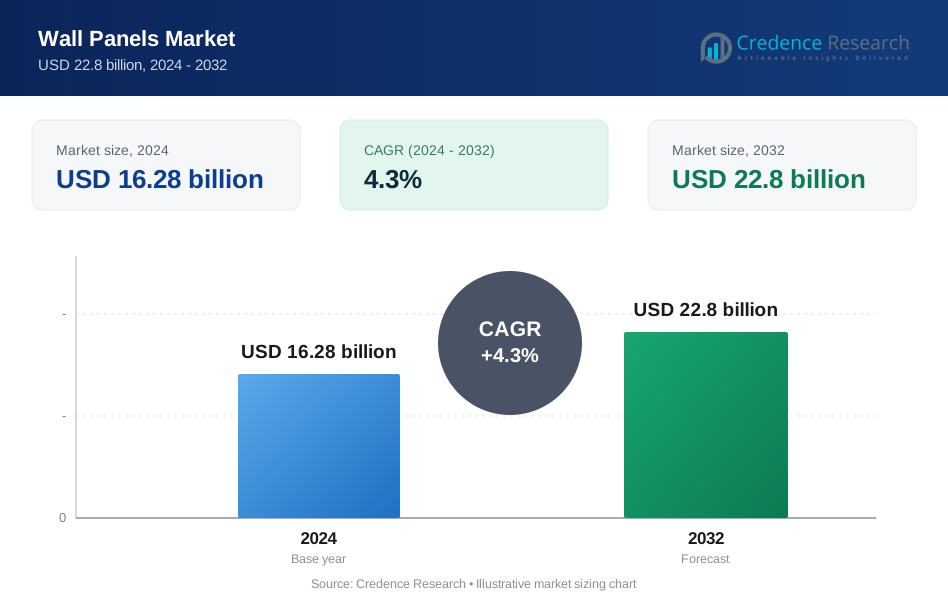
The Wall Panels market was valued at USD 16.28 billion in 2024 and is projected to reach USD 22.8 billion by 2032, expanding at a CAGR of 4.3% during the forecast period.
| REPORT ATTRIBUTE | DETAILS |
|---|---|
| Historical Period | 2020-2023 |
| Base Year | 2024 |
| Forecast Period | 2025-2032 |
| Wall Panels Market Size 2024 | USD 16.28 Billion |
| Wall Panels Market, CAGR | 4.3% |
| Wall Panels Market Size 2032 | USD 22.8 Billion |
The Wall Panels market is supported by key players including Armstrong World Industries, USG Corporation, Kingspan Group, Nichiha Corporation, Pfleiderer Group, ATAS International, Kajaria Ceramics, AICA Kogyo Co., Ltd., Daiken Corporation, and Murphy Wall Beds & Panels. These companies strengthen market growth through advanced manufacturing technologies, sustainable material development, and expanded product portfolios for residential, commercial, and industrial applications. Asia Pacific leads the global market with a 39% share, driven by rapid urban construction and rising demand for modular interiors. North America follows with a 28% share, supported by strong renovation activity, while Europe holds a 26% share, driven by strict building standards and high adoption of energy-efficient wall systems.
Market Insights
- The Wall Panels market reached USD 16.28 billion in 2024 and will rise to USD 22.8 billion by 2032 at a CAGR of 4.3%.
- Demand grows as renovation activities increase and softwood wall panels lead the type segment with 41% share, driven by lightweight design and strong residential adoption.
- Key trends include rising use of wood materials holding 44% share, along with growing demand for digitally printed, customizable, and moisture-resistant surfaces across commercial interiors.
- Competition intensifies as Armstrong World Industries, USG, Kingspan, Nichiha, Pfleiderer, AICA Kogyo, ATAS International, Kajaria Ceramics, Daiken, and Murphy Wall Panels expand sustainable product lines and modular installation systems.
- Asia Pacific leads with a 39% share, followed by North America at 28% and Europe at 26%, while the residential application segment dominates with 46% share due to strong home décor and interior modernization trends.
Market Segmentation Analysis:
By Type
Softwood wall panels lead the type segment with a 41% market share, driven by their versatility, lightweight structure, and strong adoption in residential interiors. These panels offer cost-effective installation and meet rising demand for natural aesthetics in modern home décor. Hardwood panels gain traction in premium interior projects due to their durability and high-end appearance, while metal panels expand use in industrial and commercial spaces for fire resistance and structural strength. Other materials, including composite and hybrid panels, support niche applications where moisture and impact resistance are essential. Growing renovation activities and interior upgrades continue to reinforce demand for softwood wall panels.
- For instance, Armstrong World Industries produces wood fiber panels made from rapidly renewable aspen softwood fibers that can achieve a 0.70 NRC acoustic rating (or higher, depending on the mounting method), supporting performance in a variety of commercial spaces such as schools, offices, and libraries.
By Material
Wood dominates the material segment with a 44% market share, supported by its strong preference in residential and commercial interiors for aesthetic appeal, insulation, and design flexibility. The rise in sustainable construction further drives adoption of engineered wood and MDF-based wall panels. Metal panels hold steady demand in industrial and high-traffic environments due to their long life, corrosion resistance, and robust structural properties. Polyurethane (PU) panels gain momentum for their thermal performance, lightweight design, and suitability for energy-efficient buildings. Other materials serve specialized needs in acoustics, hygiene-sensitive spaces, and modern architectural facades.
- For instance, Kingspan Group manufactures PU-insulated architectural panels achieving thermal conductivity as low as 0.022 W/m·K, improving energy efficiency.
By Application
The residential segment leads with a 46% market share, driven by rising home renovation projects, modular interior trends, and consumer preference for decorative and easy-to-install wall solutions. Wood-based and PVC-coated designs remain popular in living rooms, bedrooms, and kitchens due to their durability and aesthetic versatility. The commercial segment follows as offices, retail stores, and hospitality spaces invest in modular panels that support soundproofing and modern interior themes. Industrial applications prioritize metal and PU panels for fire resistance, hygiene compliance, and long-term wear. Growing urban development and improved construction spending continue to strengthen adoption in the residential sector.
Key Growth Drivers
Rising Demand for Interior Renovation and Aesthetic Upgrades
Growing interest in modern interior décor drives strong demand for wall panels, especially in residential and commercial spaces seeking faster and cleaner installation. Consumers prefer panels for their aesthetic flexibility, sound insulation, and long-lasting finish. Renovation activities increase with urban housing development and rising disposable income. Modular interior concepts and the shift toward low-maintenance materials further support adoption. As homeowners and businesses prioritize visually appealing and durable surfaces, the market experiences steady expansion across both new construction and retrofit applications.
- For instance, DAIKEN Corporation manufactures high-density fiberboard (HDF) and medium-density fiberboard (MDF) panels that offer excellent dimensional stability and water resistance, enhancing durability in premium home upgrades.
Growth in Commercial Construction and Infrastructure Projects
The commercial sector increases use of wall panels due to rising construction of offices, hospitality spaces, retail outlets, and institutional buildings. Panels offer efficient installation, structural strength, and enhanced fire and moisture resistance, making them suitable for high-traffic environments. Developers choose wood, metal, and PU-based panels to improve acoustics and energy efficiency. Government infrastructure investments and refurbishment of public buildings also contribute to market growth. As businesses adopt modern architectural themes and sustainable materials, the demand for durable and design-oriented wall panels continues to rise.
- For instance, Nichiha Corporation manufactures fiber cement panels offering superior dimensional stability in humid commercial environments.
Increasing Focus on Sustainable and Energy-Efficient Materials
Sustainability trends accelerate demand for eco-friendly wall panels produced from engineered wood, recycled fibers, and low-emission materials. PU-based insulated panels gain popularity due to their thermal performance and reduced energy consumption. Manufacturers adopt greener production processes and certification standards to meet regulatory requirements and consumer expectations. Sustainable construction practices and green-building certifications boost adoption across residential and commercial projects. As environmental awareness rises, the shift toward lightweight, recyclable, and thermally efficient wall panels becomes a major growth driver.
Key Trends & Opportunities
Adoption of Lightweight and Modular Panel Designs
Lightweight and modular wall panels gain strong traction as builders and interior designers seek quicker installation and reduced labor costs. Panels with click-and-lock mechanisms, pre-finished surfaces, and customizable textures support greater design flexibility. Demand rises for materials offering moisture resistance, acoustic performance, and fire-rated properties. Modular construction in offices, healthcare, and hospitality sectors expands opportunities for advanced panel systems. This trend supports faster project timelines and encourages wider use in retrofit applications where minimal downtime is critical.
- For instance, ATAS International manufactures aluminum wall panels with panel gauge thickness reaching 0.032 inches, allowing low-weight installation without compromising strength.
Expansion of Digital Printing and Customizable Architectural Finishes
Digital printing technology allows manufacturers to offer customized textures, patterns, and high-definition finishes that replicate stone, wood, and metal surfaces. Designers increasingly adopt customizable panels to achieve premium aesthetics without high material costs. Commercial spaces benefit from brand-specific or theme-based wall designs. Technological advancements enhance surface durability, scratch resistance, and fade protection. The trend creates opportunities for product differentiation and expands the market for decorative and premium-grade wall panels across multiple end-use industries.
- For instance, Kajaria Ceramics applies high-definition digital printing technology that ensures accurate reproduction of natural wood and stone textures with enhanced visual depth and minimal shade variation.
Key Challenges
Fluctuating Raw Material Prices and Supply Chain Constraints
The wall panels market faces cost pressures due to volatile prices of wood, metal, PU, and resin-based materials. Global supply chain disruptions and inconsistent availability of quality raw materials increase production challenges. Manufacturers experience rising transportation and procurement costs, affecting pricing and profit margins. These fluctuations limit adoption in cost-sensitive markets and force companies to adjust sourcing strategies. Stabilizing raw material supply remains crucial for long-term market sustainability.
Competition from Low-Cost Alternatives and Limited Awareness in Emerging Markets
Low-cost wall coverings such as wallpapers, paints, and basic cladding materials compete directly with wall panels, especially in developing regions. Limited consumer awareness of benefits like durability, insulation, and moisture resistance restricts adoption. Budget-sensitive residential buyers often choose cheaper alternatives despite shorter lifespan. Market penetration remains slow in rural and low-income areas due to lack of distribution networks and installation expertise. Expanding education, marketing, and dealer networks is essential to overcome this challenge.
Regional Analysis
North America
North America holds a market share of 28%, driven by strong demand for wall panels in residential remodeling, commercial interiors, and institutional construction. The U.S. leads adoption due to rising preference for modern décor, improved acoustic performance, and energy-efficient building materials. Developers increasingly choose engineered wood, PU, and metal panels for durable and low-maintenance applications. Growth in office renovations, hospitality upgrades, and healthcare infrastructure further supports demand. The region also benefits from robust distribution networks and high consumer awareness. Continued investment in green buildings and premium interior solutions strengthens long-term market expansion.
Europe
Europe accounts for a market share of 26%, supported by advanced construction standards, widespread adoption of sustainable materials, and growing emphasis on energy-efficient wall systems. Countries such as Germany, the U.K., France, and Italy drive strong demand for wood-based and PU-insulated panels in commercial and residential spaces. The region prioritizes environmentally certified products, boosting the use of low-emission and recyclable materials. Renovation of aging infrastructure and expansion of modern office spaces contribute to steady growth. Europe’s architectural focus on aesthetic, durable, and modular interiors further enhances demand for high-quality wall panels.
Asia Pacific
Asia Pacific leads the global market with a market share of 39%, fueled by rapid urbanization, rising middle-class income, and expanding construction across China, India, Japan, and Southeast Asia. Residential projects increase demand for affordable and decorative wall panels, while commercial developments adopt PU, metal, and MDF panels for structural performance and design flexibility. Large-scale infrastructure investments and smart-city initiatives further accelerate growth. The region also benefits from strong manufacturing capabilities and competitive pricing. Increasing adoption of modular interiors and digital-print decorative panels continues to drive market expansion in Asia Pacific.
Latin America
Latin America holds a market share of 5%, driven by growing construction activity and rising interest in cost-effective, aesthetic, and lightweight wall solutions. Brazil, Mexico, and Argentina lead adoption, especially in residential upgrades and commercial interiors. The region experiences increasing use of MDF and PVC panels due to affordability and easy installation. Demand grows as urbanization accelerates and property renovations become more frequent. Despite economic fluctuations, expanding retail and hospitality sectors contribute to market growth. Improvements in supply chains and rising awareness of modern interior materials support steady adoption across key countries.
Middle East & Africa
The Middle East & Africa region accounts for a market share of 4%, influenced by rising construction in hospitality, commercial complexes, and premium residential developments. The UAE, Saudi Arabia, and South Africa drive adoption with strong demand for decorative and thermally efficient wall systems. Harsh climatic conditions increase preference for PU-insulated and metal panels. Large-scale infrastructure projects, shopping malls, and luxury real estate developments contribute to market expansion. Although adoption is concentrated in high-income zones, increasing urban development and modern interior trends support gradual growth across emerging markets in the region.
Market Segmentations:
By Type
- Softwood Wall Panels
- Hardwood Wall Panels
- Metal Wall Panels
- Others
By Material
- Wood
- Metal
- Polyurethane (PU)
- Others
By Application
- Residential
- Commercial
- Industrial
- Others
By Distribution Channel
- Offline Retail
- Direct Sales
- Online Retail
- Dealers & Distributors
By Geography
- North America
- U.S.
- Canada
- Mexico
- Europe
- Germany
- France
- U.K.
- Italy
- Spain
- Rest of Europe
- Asia Pacific
- China
- Japan
- India
- South Korea
- South-east Asia
- Rest of Asia Pacific
- Latin America
- Brazil
- Argentina
- Rest of Latin America
- Middle East & Africa
- GCC Countries
- South Africa
- Rest of the Middle East and Africa
Competitive Landscape
The competitive landscape features major players such as Armstrong World Industries, USG Corporation, Kingspan Group, Nichiha Corporation, Murphy Wall Beds & Panels, Pfleiderer Group, ATAS International, Kajaria Ceramics, AICA Kogyo Co., Ltd., and Daiken Corporation. These companies compete by expanding their product portfolios with advanced wood, metal, fiberboard, and polyurethane-based wall panels tailored for residential, commercial, and industrial applications. Manufacturers prioritize innovations such as high-definition digital printing, moisture-resistant coatings, fire-rated designs, and modular installation systems to enhance durability and aesthetics. Strategic partnerships with builders, architects, and distributors strengthen market reach, while investments in sustainable materials support green-building trends. Leading brands also focus on lightweight, customizable, and acoustic-enhanced panels to address diverse design requirements. As competition intensifies, companies differentiate through quality consistency, expanded retail networks, and strong after-sales support to capture growing demand across global construction and interior renovation markets.
Key Player Analysis
- Armstrong World Industries, Inc.
- USG Corporation
- Kingspan Group
- Nichiha Corporation
- Murphy Wall Beds & Panels
- Pfleiderer Group
- ATAS International, Inc.
- Kajaria Ceramics
- AICA Kogyo Co., Ltd.
- Daiken Corporation
Recent Developments
- In November 2025, Armstrong World Industries, Inc. expanded its CASTWORKS Walls lineup by launching six new designer wall-panel profiles made from glass-fiber reinforced gypsum (GRG/GFRG).
- In September 2025, Armstrong World Industries, Inc. acquired Canadian manufacturer Geometrik Manufacturing Inc. to strengthen its wood-panel product offerings.
Report Coverage
The research report offers an in-depth analysis based on Type, Material, Application, Distribution Channel and Geography. It details leading market players, providing an overview of their business, product offerings, investments, revenue streams, and key applications. Additionally, the report includes insights into the competitive environment, SWOT analysis, current market trends, as well as the primary drivers and constraints. Furthermore, it discusses various factors that have driven market expansion in recent years. The report also explores market dynamics, regulatory scenarios, and technological advancements that are shaping the industry. It assesses the impact of external factors and global economic changes on market growth. Lastly, it provides strategic recommendations for new entrants and established companies to navigate the complexities of the market.
Future Outlook
- Demand for decorative and modular wall panels will rise as renovation activities expand.
- Adoption of digitally printed and customizable designs will increase across residential and commercial interiors.
- Sustainable and low-emission materials will gain stronger preference in green-building projects.
- Lightweight and moisture-resistant panels will see higher use in high-humidity environments.
- Industrial and commercial sectors will adopt more fire-rated and acoustic wall panel systems.
- Energy-efficient PU-insulated wall panels will gain traction in modern construction.
- Manufacturers will expand product lines with advanced coatings and durable surface finishes.
- Distribution through online channels will grow as buyers prefer easy comparison and quick delivery.
- Asia Pacific will remain a major growth region due to rapid urbanization and rising interior upgrades.
- Partnerships with architects and builders will increase to drive adoption of premium and design-focused wall panels.
Request a Free Sample
Fill in your details and we'll send you a free sample report.
- Sample data tables & charts
- Research methodology
Need a Custom Version of This Report?
Tailor the scope, geography, or segments to your exact requirements.
- Custom geography or segment scope
- Direct access to our analyst team
Frequently Asked Questions
What is the current market size for Wall Panels market, and what is its projected size in 2032?
At what Compound Annual Growth Rate is the Wall Panels market projected to grow between 2025 and 2032?
Which Wall Panels market segment held the largest share in 2024?
What are the primary factors fueling the growth of the Wall Panels market?
Who are the leading companies in the Wall Panels market?
Which region commanded the largest share of the Wall Panels market in 2024?
Table of Content
Chapter 1. Report Introduction
- 1.1 Report Description & Purpose
- 1.1.1 Report Title & Market Definition
- 1.1.2 Unique Selling Propositions (USP) & Key Differentiators
- 1.1.3 Value Proposition for Stakeholders
- 1.2 Research Objectives
- 1.2.1 Market Sizing Objectives (Volume & Revenue)
- 1.2.2 Segmentation Objectives
- 1.2.3 Competitive Intelligence Objectives
- 1.2.4 Forecast & Scenario Objectives
- 1.3 Report Scope
- 1.3.1 Wall Panels Scope – Types & Subtypes Covered
- 1.3.2 Geographic Scope – Regions & Countries Covered
- 1.3.3 Historical Period, Base Year & Forecast Period (2024; forecast to 2032)
- 1.3.4 Inclusions & Exclusions
- 1.4 HS Code & Classification Framework
- 1.5 Currency, Units & Pricing Basis
- 1.6 Target Stakeholders
- 1.7 Limitations & Assumptions
Chapter 2. Executive Summary
- 2.1 Global Wall Panels Market Snapshot
- 2.1.1 Market Size – Historical (2024) & Forecast (2024-2032) (2024: USD 16.28 billion → 2032: USD 22.8 billion)
- 2.1.2 Volume & Revenue – Global Totals
- 2.1.3 Key Market Highlights – Top Five Facts
- 2.2 Wall Panels Market Segmentation Snapshot
- 2.2.1 Market Split by Region – 2024 vs. 2032
- 2.3 Competitive Snapshot
- 2.3.1 Top 10 Players by Revenue Share – 2024
- 2.3.2 Top 10 Players by Volume Share – 2024
- 2.3.3 Recent Strategic Developments (18-Month Summary)
- 2.4 Key Investment Highlights & Strategic Conclusions
Chapter 3. Wall Panels Market Dynamics & Industry Analysis
- 3.1 Market Overview & Context
- 3.1.1 Wall Panels Market Position in the Broader Automotive Value Chain
- 3.1.2 OEM vs. Replacement Market Dynamics
- 3.1.3 Market Maturity & Development Stage by Region
- 3.2 Wall Panels Market Drivers
- 3.3 Wall Panels Market Restraints & Challenges
- 3.4 Wall Panels Market Opportunities
- 3.5 Porter's Five Forces Analysis
- 3.5.1 Threat of New Entrants
- 3.5.2 Bargaining Power of Suppliers
- 3.5.3 Bargaining Power of Buyers
- 3.5.4 Threat of Substitutes
- 3.5.5 Competitive Rivalry – Intensity Assessment
- 3.6 Wall Panels Value Chain Analysis
- 3.6.1 Upstream – Raw Material/Input Suppliers
- 3.6.1.1 Raw Material/Input 1
- 3.6.1.2 Raw Material/Input 2
- 3.6.1.3 Raw Material/Input 3
- 3.6.2 Midstream – Production/Manufacturing/Service Delivery
- 3.6.2.1 Production/Process Overview
- 3.6.2.2 Key Facility Locations & Capacity by Manufacturer
- 3.6.3 Downstream – Distribution & End Consumer
- 3.6.3.1 Primary Channel – B2B/OEM
- 3.6.3.2 Secondary Channels – Dealer, Retail, Online, Direct
- 3.6.4 Value Chain Profitability Analysis
- 3.6.1 Upstream – Raw Material/Input Suppliers
- 3.7 PESTEL Analysis
- 3.7.1 Political Factors
- 3.7.2 Economic Factors
- 3.7.3 Social Factors
- 3.7.4 Technological Factors
- 3.7.5 Environmental Factors
- 3.7.6 Legal Factors
- 3.8 Wall Panels Supply Chain Analysis
- 3.8.1 Raw Material/Input Supply Risk Assessment
- 3.8.2 Manufacturing Concentration Risk (Geographic Exposure)
- 3.8.3 Trade Disruption Impact Analysis
- 3.9 Regulatory & Policy Landscape
Note: The regulatory and policy landscape section covers regulations based on their applicability to the market, Wall Panels category, geography, and scope of the study. Only regulatory frameworks with a material impact on operations, compliance, trade, sustainability, or market access are analyzed in detail.
Chapter 4. Key Investment Pockets & Opportunity Analysis
- 4.1 Wall Panels Market Attractiveness Analysis
- 4.1.1 By Region – Investment Attractiveness Matrix (Volume × CAGR)
- 4.2 Absolute Revenue Growth Opportunity
- 4.2.1 By Region – Absolute USD Growth Through 2032
- 4.3 Incremental Volume Opportunity
- 4.3.1 By Region – Incremental Volume Through 2032
- 4.3.2 Segment – Incremental Volume
- 4.4 Emerging Submarket Opportunity Deep Dive (Subject to Applicability)
- 4.5 Emerging Market Opportunity Scorecards
- 4.5.1 United States
- 4.5.2 Europe
- 4.5.3 Asia
- 4.5.4 Middle East & Africa
Note: Emerging Market Opportunity Scorecards will be included based on relevance and strategic importance. Regions listed are indicative and may vary depending on data availability and market dynamics.
Chapter 5. Wall Panels Import-Export Analysis & Trade Flows
- 5.1 Global Trade Overview
- 5.1.1 Global Export Value by Country (2024)
- 5.1.2 Global Export Volume by Country (2024)
- 5.1.3 Global Import Value by Country (2024)
- 5.1.4 Global Import Volume by Country (2024)
- 5.1.5 Net Trade Balance by Country (2024)
- 5.2 Export Analysis – Segment
- 5.2.1 Type 1 (HS Code)
- 5.2.2 Type 2 (HS Code)
- 5.2.3 Type 3 (HS Code)
- 5.2.4 Type 4 (HS Code)
- 5.2.5 Type 5 (HS Code)
- 5.3 Import Analysis – Segment
- 5.3.1 Type 1 (HS Code)
- 5.3.2 Type 2 (HS Code)
- 5.3.3 Type 3 (HS Code)
- 5.3.4 Type 4 (HS Code)
- 5.3.5 Type 5 (HS Code)
- 5.4 Average Unit Trade Prices
- 5.4.1 Average Export Price – Segment & Country
- 5.4.2 Average Import Price – Segment & Source Country
- 5.4.3 Price Trends (2024)
- 5.5 Key Trade Route Analysis
- 5.5.1 Trade Route 1
- 5.5.2 Trade Route 2
- 5.5.3 Trade Route 3
- 5.5.4 Trade Route 4
- 5.5.5 Trade Route 5
- 5.6 Trade Policy Impact Assessment
- 5.6.1 US Anti-Dumping & Section 301 Tariffs
- 5.6.2 EU Customs Union Impact
- 5.6.3 Major Free Trade Agreements
- 5.6.4 USMCA Rules of Origin
Note: Trade policy analysis will be included only where relevant to the Wall Panels market.
Chapter 6. Competitive Landscape & Company Benchmarking
- 6.1 Wall Panels Market Concentration & Structure
- 6.1.1 Herfindahl-Hirschman Index (HHI) – vs. 2024
- 6.1.2 Tier 1, Tier 2 & Tier 3 Market Structure
- 6.1.3 Global, Regional & Local Player Dynamics
- 6.2 Wall Panels Market Share Analysis – 2024
- 6.2.1 Global Revenue Share by Company
- 6.2.2 Global Volume Share by Company
- 6.2.3 Regional Revenue Share
- 6.2.4 Market Share Evolution ( vs. 2024)
- 6.2.5 OEM Segment Share by Company
- 6.2.6 Replacement Segment Share by Company
- 6.3 Production/Delivery Capacity & Facility Analysis
- 6.3.1 Global Installed Capacity
- 6.3.2 Capacity Utilization Rates
- 6.3.3 Production/Output Volume
- 6.3.4 Facility Locations & Capacity Map
- 6.3.5 Planned Capacity Additions
- 6.4 Wall Panels Competitive Benchmarking Matrix
- 6.4.1 Revenue, Volume, CAGR & Profitability Comparison
- 6.4.2 Channel Revenue Mix
- 6.4.3 Geographic Revenue Exposure
- 6.4.4 R&D Intensity
- 6.4.5 Sustainability Maturity
- 6.5 Strategic Developments in Wall Panels (Last 24 Months)
- 6.5.1 Mergers, Acquisitions & Divestments
- 6.5.2 New Wall Panels Launches
- 6.5.3 Facility Expansions
- 6.5.4 Strategic Alliances, Joint Ventures & Partnerships
- 6.5.5 Distribution Expansion & Market Entry
- 6.5.6 Sustainability & ESG Initiatives
- 6.6 Competitive Strategy Mapping
- 6.6.1 Leader, Challenger, Follower & Niche Classification
- 6.6.2 Pricing Strategy Comparison
- 6.6.3 Channel Strategy Matrix
Note: Strategic developments are included based on their materiality and the availability of reliable information.
Chapter 7. Global Wall Panels Market – By Distribution Channel
- 7.1 Segment Overview
- 7.1.1 Volume & Revenue Split by Channel (2024 & 2032)
- 7.1.2 Channel Mix Evolution (2024-2032)
Chapter 8. Regional Market Analysis – Global Overview
- 8.1 Global Regional Overview
- 8.1.1 Regional Volume Share
- 8.1.2 Regional Revenue Share
- 8.1.3 Regional Volume by Region
- 8.1.4 Regional Revenue by Region
- 8.1.5 Regional Forecast Through 2032
- 8.2 Cross-Regional Segment Analysis
- 8.2.1 By Distribution Channel
- 8.2.2 By Brand/Price Tier
Chapter 9. North America Wall Panels Market
- 9.1 United States
- 9.2 Canada
- 9.3 Mexico
Chapter 10. Europe Wall Panels Market
- 10.1 Germany
- 10.2 France
- 10.3 Italy
- 10.4 United Kingdom
- 10.5 Spain
- 10.6 Poland
- 10.7 Russia
- 10.8 Netherlands
- 10.9 Belgium
- 10.10 Sweden
- 10.11 Denmark
- 10.12 Norway
- 10.13 Rest of Europe
Chapter 11. Asia Pacific Wall Panels Market
- 11.1 China
- 11.2 India
- 11.3 Japan
- 11.4 South Korea
- 11.5 Thailand
- 11.6 Indonesia
- 11.7 Vietnam
- 11.8 Malaysia
- 11.9 Australia
- 11.10 Rest of Asia Pacific
Chapter 12. Latin America Wall Panels Market
- 12.1 Brazil
- 12.2 Argentina
- 12.3 Colombia
- 12.4 Chile
- 12.5 Rest of Latin America
Chapter 13. Middle East Wall Panels Market
- 13.1 Saudi Arabia
- 13.2 United Arab Emirates
- 13.3 Turkey
- 13.4 Israel
- 13.5 Iran
- 13.6 Rest of the Middle East
Chapter 14. Africa Wall Panels Market
- 14.1 South Africa
- 14.2 Egypt
- 14.3 Nigeria
- 14.4 Morocco
- 14.5 Rest of Africa
Chapter 15. Wall Panels Company Profiles
- 15.1 [Company 01]
- 15.1.1 Company Overview
- 15.1.2 Key Management Personnel
- 15.1.3 Products & Services Portfolio
- 15.1.4 Financial Performance
- 15.1.5 Key Market Focus & Geographic Presence
- 15.1.6 Recent Developments & Strategic Initiatives
Note: The company profile list is preliminary and may change based on research findings, market developments, data availability, and client requirements.
Chapter 16. Appendices
- Appendix A – List of Abbreviations & Acronyms
- Appendix B – Industry Classification Code Reference – Full Series
- Appendix C – Production & Capacity Data Tables
- Appendix D – End-Use & Demand Base Tables
- Appendix E – Consumption & Replacement Rate Assumptions
- Appendix F – ASP Reference Tables
- Appendix G – Manufacturing & Facility Database
- Appendix H – Import-Export Data Tables
- Appendix I – Regulatory Summary Tables
- Appendix J – Primary Research Participant List (Anonymized)
- Appendix K – Primary Research Questionnaire Framework
- Appendix L – Data Sources & Bibliography
- Appendix M – Market Size Divergence & Source Comparison
Chapter 17. Research Methodology
- 17.1 Research Framework & Philosophy
- 17.2 Secondary Research – Sources, Hierarchy & Data Extraction
- 17.3 Data Modeling – Bottom-Up & Top-Down Market Sizing
- 17.4 Primary Research – Stakeholder Framework, LOI & Sample Sizes
- 17.5 Forecast Methodology – Regression, Scenario & Sensitivity Analysis
- 17.6 Quality Control – Four-Layer Validation Framework
- 17.7 Limitations & Standard Assumptions
- 17.8 Disclaimer
