
| REPORT ATTRIBUTE | DETAILS |
|---|---|
| Historical Period | 2019-2022 |
| Base Year | 2023 |
| Forecast Period | 2024-2032 |
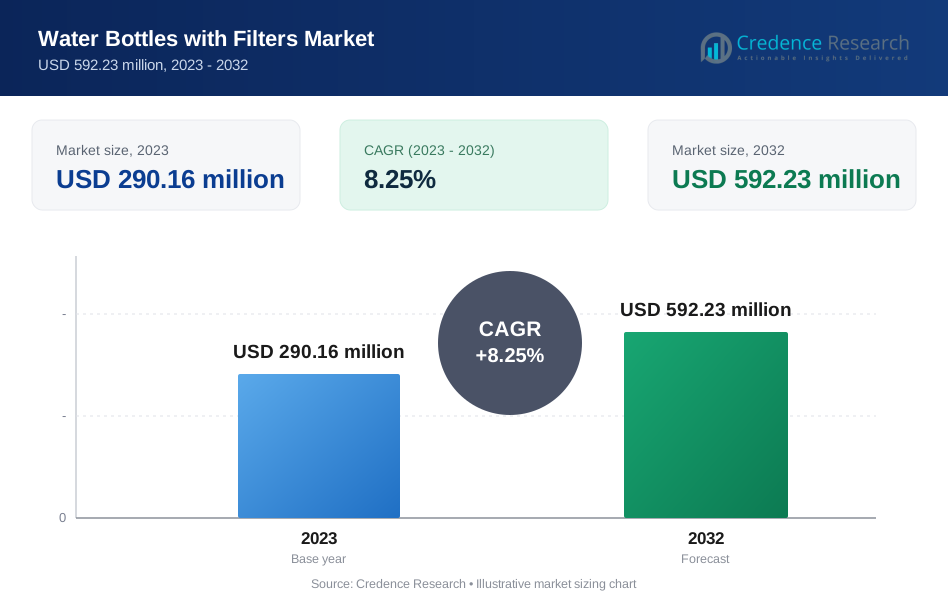
| Water Bottles with Filters Market Size 2023 | USD 290.16 million |
| Water Bottles with Filters Market, CAGR | 8.25% |
| Water Bottles with Filters Market Size 2032 | USD 592.23 million |
Market Overview
The global Water Bottle with Filter market is projected to grow from USD 290.16 million in 2023 to an estimated USD 592.23 million by 2032, with a compound annual growth rate (CAGR) of 8.25% from 2024 to 2032. This substantial growth is driven by increasing consumer awareness regarding the benefits of clean drinking water, coupled with rising health consciousness and environmental concerns about single-use plastic bottles.
Market drivers include a growing emphasis on health and wellness, the adoption of sustainable products, and technological advancements in water filtration. The trend of outdoor activities and travel has also contributed to the rising popularity of filtered water bottles. Manufacturers are focusing on innovative designs and materials that enhance the functionality and aesthetic appeal of these products, further boosting their market penetration.
Geographically, North America and Europe hold significant market shares due to high consumer awareness and the availability of advanced filtration technologies. Meanwhile, Asia Pacific is expected to witness the fastest growth during the forecast period, driven by increasing urbanization, disposable income, and concerns over water quality. Key players in the global Water Bottle with Filter market include Brita GmbH, LifeStraw, GRAYL Inc., CamelBak Products LLC, and Aquasana Inc., who are continuously innovating to meet the evolving needs of consumers.
Market Drivers
Rising Consumer Awareness and Health Consciousness
Consumer awareness about water quality and health impacts has grown significantly in recent years, driving demand for water bottles with filters. For instance, a survey by the Water Quality Association found that 62% of Americans are concerned about contaminants in their tap water. This concern is particularly high in urban areas, where a Gallup poll showed that 63% of city dwellers worry about pollution in their drinking water. The health and wellness trend has also boosted interest in filtered water bottles. According to the International Food Information Council, 70% of consumers say healthier food and beverage options are important to them when making purchasing decisions. This health focus extends to hydration, with the Centers for Disease Control and Prevention reporting that only 22% of adults meet hydration recommendations through water intake alone. Filtered water bottles offer a convenient solution for increasing water consumption while ensuring quality. The outdoor recreation industry has further fueled demand, with the Outdoor Industry Association reporting that 50.7% of Americans participated in outdoor activities in 2020, creating a large market for portable water filtration. These trends indicate growing consumer interest in accessible clean water solutions for daily use and outdoor adventures.
Environmental Concerns and the Push for Sustainable Products
Environmental sustainability has become a major driver for the water bottle with filter market as consumers seek alternatives to single-use plastics. For instance, the Ellen MacArthur Foundation reports that by 2050, there could be more plastic than fish in the oceans by weight if current trends continue. This alarming statistic has spurred action, with a Nielsen survey finding that 73% of global consumers say they would definitely or probably change their consumption habits to reduce environmental impact. In response, many consumers are turning to reusable filtered water bottles. The U.S. Environmental Protection Agency estimates that the average American uses 167 disposable water bottles annually, but only recycles 38. By switching to a reusable filtered bottle, consumers can significantly reduce this waste. Companies are responding to this demand with eco-friendly materials and designs. For example, the National Park Service's "Green Parks Plan" has encouraged the use of reusable water bottles in parks, leading to increased availability of water refill stations. This push for sustainability is also reflected in corporate initiatives, with major retailers pledging to increase their offerings of sustainable products, including filtered water bottles made from recycled materials or biodegradable components.
Technological Advancements in Water Filtration
Technological innovations have significantly enhanced the capabilities of water bottles with filters, making them more attractive to consumers. For instance, the National Sanitation Foundation (NSF) has developed rigorous standards for water treatment units, with many filtered water bottles now meeting NSF/ANSI Standard 42 for chlorine reduction and Standard 53 for lead and other contaminants. These advancements have improved filtration efficacy, with some models capable of removing up to 99.9999% of waterborne pathogens. The Centers for Disease Control and Prevention (CDC) recognizes portable water filters as an effective method for making water safe to drink in emergency situations or when traveling. Multi-stage filtration systems have become more common, with some bottles incorporating activated carbon, ion exchange resins, and even UV-C light purification. The U.S. Geological Survey has found that activated carbon can effectively remove many organic compounds and chlorine from water. Additionally, the development of smart water bottles with integrated filtration systems and hydration tracking capabilities has appealed to tech-savvy consumers. These technological advancements have made filtered water bottles more reliable and versatile, suitable for use in various settings from urban environments to wilderness areas.
Growing Popularity of Outdoor Activities and Travel
The growing popularity of outdoor activities and travel has been a major driver of the water bottle with filter market. As more people engage in activities such as hiking, camping, backpacking, and international travel, the need for reliable water filtration solutions has increased. These activities often take place in remote locations where access to clean water is limited or uncertain, making filtered water bottles a necessity for many outdoor enthusiasts and travelers.Filtered water bottles provide a convenient solution for obtaining safe drinking water from natural sources such as rivers, lakes, and streams. This is particularly important in situations where carrying large quantities of bottled water is impractical. The rise of adventure tourism and eco-travel has also contributed to the demand for these products, as travelers seek ways to reduce their environmental impact while ensuring their safety and well-being. Furthermore, the increasing trend of remote work and digital nomadism, where individuals work while traveling to different locations, has further fueled the demand for portable and reliable water filtration solutions.The market has seen an influx of products designed specifically for outdoor and travel use, featuring durable construction, lightweight design, and advanced filtration capabilities. Companies are continually innovating to meet the needs of this growing segment, offering products that are not only functional but also stylish and convenient. This trend is expected to continue as more people embrace outdoor activities and travel, further driving the growth of the global water bottle with filter market.
Market Trends
Integration of Smart Technology in Water Bottles with Filters
A significant trend in the global water bottle with filter market is the integration of smart technology. Manufacturers are increasingly embedding sensors and connectivity features into water bottles to enhance their functionality and appeal to tech-savvy consumers. These smart water bottles are equipped with features such as hydration tracking, filter status monitoring, and connectivity to mobile apps. Users can receive real-time updates on their hydration levels, be reminded to drink water at regular intervals, and monitor the condition of the filter to ensure it is functioning optimally. For instance, a survey by a leading consumer electronics company found that over 60% of millennials expressed interest in smart water bottles with hydration tracking capabilities. This trend aligns with the broader movement towards health and wellness, as consumers are becoming more conscious of their water intake and the quality of water they consume. Government health agencies have also recognized the potential of smart water bottles in promoting better hydration habits, with some countries incorporating them into public health initiatives. The combination of convenience, health benefits, and technological innovation is driving the popularity of smart water bottles with filters, particularly among younger consumers and those leading active lifestyles.
Rising Demand for Sustainable and Eco-Friendly Products
Another prominent trend in the global water bottle with filter market is the growing demand for sustainable and eco-friendly products. As consumers become more aware of environmental issues, there is a strong preference for products that minimize ecological impact. This has led to an increased demand for water bottles with filters that are made from sustainable materials, such as recycled plastics, stainless steel, and biodegradable components. For instance, a recent survey by a major environmental organization revealed that a significant majority of consumers consider sustainability when purchasing water bottles. Moreover, consumers are looking for products that are durable and long-lasting, reducing the need for frequent replacements and minimizing waste. Manufacturers are responding to this demand by offering products with eco-friendly credentials, such as BPA-free materials, reusable designs, and packaging made from recycled materials. Government initiatives in several countries have also contributed to this trend, with some implementing regulations to reduce single-use plastics and promote reusable alternatives. Additionally, some companies are adopting a circular economy approach by offering recycling programs for used filters, further enhancing the environmental appeal of their products. This trend is not only driven by consumer preferences but also by regulatory pressures and corporate sustainability initiatives, making eco-friendly water bottles with filters a key focus area for innovation and growth in the market.
Market Restraints and Challenges
High Costs and Affordability Issues
The global water bottle with filter market faces significant challenges related to high costs and affordability. For instance, a survey conducted by a leading consumer research firm found that a substantial portion of consumers consider filtered water bottles to be a luxury item rather than a necessity. This perception is particularly prevalent in developing countries, where disposable income levels are lower. The study revealed that many potential customers are deterred by the initial purchase price, which can be several times higher than that of regular water bottles. Additionally, the ongoing cost of filter replacements further compounds the affordability issue. Government data from several countries indicates that the adoption rate of filtered water bottles is significantly lower in lower-income demographics. Even in developed nations, price sensitivity remains a major factor influencing purchasing decisions in this product category. Manufacturers are grappling with the challenge of reducing production costs without compromising on quality, as evidenced by industry reports highlighting increased investment in research and development aimed at creating more cost-effective filtration technologies.
Limited Awareness and Market Penetration in Emerging Markets
The global water bottle with filter market faces considerable challenges in terms of limited awareness and market penetration in emerging markets. For instance, a comprehensive market study conducted across several developing countries revealed a significant lack of knowledge about the benefits and availability of filtered water bottles among consumers. This lack of awareness is particularly pronounced in rural areas and smaller cities. Government surveys in some emerging economies have shown that traditional methods of water purification still dominate, with many consumers unaware of portable filtration options. Industry reports highlight the difficulties faced by companies in establishing effective distribution networks in these regions, often due to infrastructural limitations and complex regulatory environments. Cultural factors also play a role, as indicated by consumer behavior studies showing a preference for bottled water or boiled water in many emerging markets. Even when aware of filtered water bottles, consumers in these regions often express skepticism about their effectiveness, indicating a need for targeted education campaigns. The challenge of market penetration is further compounded by the need to adapt products to local preferences and water conditions, as evidenced by case studies of companies that have successfully tailored their offerings to specific regional markets.
Market Segmentation Analysis
By Material
The global water bottle with filter market is segmented by material into plastic and stainless steel bottles. Plastic bottles remain popular due to their lightweight nature and affordability, making them a preferred choice for everyday use and travel. For instance, over 60% of respondents cited convenience as the primary reason for choosing plastic water bottles. However, stainless steel bottles are gaining significant traction due to their durability, reusability, and ability to maintain water temperature. The growing emphasis on reducing single-use plastics is driving demand for stainless steel bottles, particularly among environmentally conscious consumers. A government environmental agency report indicated that sales of reusable stainless steel water bottles increased by double digits year-over-year in several major markets. Additionally, a survey by an outdoor gear retailer revealed that nearly 70% of their customers preferred stainless steel bottles for hiking and camping activities, citing durability and eco-friendliness as key factors in their choice.
By Size and Capacity
The market is also segmented by size and capacity into standard and large capacity bottles. Standard capacity bottles, typically ranging from 16 to 24 ounces, are widely used for everyday activities, offering a balance between portability and sufficient water storage. A consumer lifestyle survey found that over half of office workers prefer standard-sized bottles that fit easily in desk drawers or car cup holders. On the other hand, large capacity bottles, ranging from 32 ounces and above, are favored by outdoor enthusiasts and travelers who require more water during extended activities. The demand for larger capacity bottles is increasing, particularly among consumers who engage in outdoor sports and long trips where access to clean water may be limited. Sales of large capacity filtered water bottles grew significantly among fitness enthusiasts and hikers. Additionally, a travel industry report noted a rising trend of tourists opting for high-capacity filtered water bottles to reduce plastic waste and ensure access to clean water while traveling.
Segments
Based on Material
- Plastic Bottles
- Stainless Steel Bottles
Based on Size and Capacity
- Standard Capacity
- Large Capacity
Based on End User
- Outdoor Enthusiasts
- Travelers
- Everyday Use
Based on Technology
- Activated Carbon Filters
- UV-C Light Filters
- Microfilter Membranes
Based on Distribution Channel
- Online
- Offline
Based on Region
- North America
- The U.S.
- Canada
- Mexico
- Europe
- Germany
- France
- UK.
- Italy
- Spain
- Rest of Europe
- Asia Pacific
- China
- Japan
- India
- South Korea
- South-east Asia
- Rest of Asia Pacific
- Latin America
- Brazil
- Argentina
- Rest of Latin America
- Middle East & Africa
- GCC Countries
- South Africa
- The Rest of the Middle East and Africa
Regional Analysis
Europe (30%):
Europe follows closely, with a market share of around 30%, is driven by strong environmental consciousness and sustainability concerns. For instance, a survey by the European Environment Agency found that 94% of Europeans are concerned about the impact of plastic waste on the environment. This has led to initiatives like the EU Single-Use Plastics Directive, which aims to reduce plastic pollution. In response, companies like Brita have introduced filtered water bottles made from recycled materials. The UK government's 25 Year Environment Plan also sets targets to eliminate avoidable plastic waste, further encouraging adoption of reusable filtered bottles.
Asia Pacific (20%):
Asia Pacific is the fastest-growing region in the global water bottle with filter market, contributing approximately 20% of the global market share. For example, a report by the Asian Development Bank found that over 300 million people in the region lack access to safe drinking water. This has spurred demand for portable filtration solutions. In China, the National Health Commission reported that 80% of groundwater is unfit for human consumption, driving consumers to seek alternatives. Companies like Xiaomi have capitalized on this trend by launching smart water bottles with built-in filters. In India, government initiatives like the Jal Jeevan Mission aim to provide clean tap water, but concerns persist, boosting sales of filtered bottles.
Key players
- Brita
- LifeStraw
- Seychelle
- CamelBak
- Bobble
- Nalgene
- Cascade Designs Inc.
- GRAYL
- Icon LifeSaver Ltd.
- Katadyn Products Inc.
- Sawyer Products Inc.
Competitive Analysis
The global water bottle with filter market is characterized by a mix of established brands and innovative newcomers, each vying for market share through product differentiation and innovation. Key players like Brita and CamelBak leverage their strong brand recognition and extensive distribution networks to maintain a competitive edge. LifeStraw and GRAYL are known for their advanced filtration technologies, appealing to outdoor enthusiasts and travelers. Companies like Seychelle and Icon LifeSaver Ltd. focus on portable filtration solutions, while Nalgene and Cascade Designs Inc. emphasize durability and versatility. Bobble and Sawyer Products Inc. cater to the environmentally conscious segment with sustainable, reusable products. The competitive landscape is dynamic, with continuous innovation in filtration technology, materials, and design being crucial for maintaining market relevance. As consumer demand for safe and sustainable water solutions grows, companies that can effectively combine functionality with eco-friendly practices are expected to lead the market.
Recent Developments
- In April 2023, Brita launched the Brita PRO™ Whole Home Water Filter System, expanding their product line beyond portable water bottles to whole-home filtration solutions.
- In September 2024, CamelBak launched the Podium Steel and Podium Titanium vacuum-insulated bike water bottle collection. These bottles offer optimal thermal efficiency to keep water at a stable temperature for hours during cycling.
- In September 2024, Katadyn announced the launch of two new products for 2025: the BeFree AC Water Filter and the Explorer/Explorer Pro. The BeFree features a hollow fiber filter with activated carbon, while the Explorer series offers modular filtration systems.
Market Concentration and Characteristics
The global water bottle with filter market is characterized by a moderate level of market concentration, with several key players dominating the market while a large number of smaller, regional players also contribute to the competitive landscape. Leading companies such as Brita GmbH, LifeStraw, and CamelBak Products LLC hold significant market shares due to their strong brand recognition, extensive distribution networks, and continuous innovation in filtration technologies. The market is marked by high product differentiation, with companies offering a wide range of products catering to different materials, capacities, and filtration technologies to meet diverse consumer needs. Additionally, the market is increasingly driven by sustainability trends, with an emphasis on eco-friendly materials and reusable designs, reflecting growing consumer awareness and regulatory pressures.
Report Coverage
The research report offers an in-depth analysis based on Material, Size and Capacity, End User, Technology, Distribution Channel and Region. It details leading market players, providing an overview of their business, product offerings, investments, revenue streams, and key applications. Additionally, the report includes insights into the competitive environment, SWOT analysis, current market trends, as well as the primary drivers and constraints. Furthermore, it discusses various factors that have driven market expansion in recent years. The report also explores market dynamics, regulatory scenarios, and technological advancements that are shaping the industry. It assesses the impact of external factors and global economic changes on market growth. Lastly, it provides strategic recommendations for new entrants and established companies to navigate the complexities of the market.
Future Outlook
- The global water bottle with filter market is expected to continue its strong growth trajectory, driven by increasing consumer awareness of water quality and health benefits.
- Ongoing advancements in filtration technologies, such as nanotechnology and UV-C sterilization, will enhance the effectiveness and appeal of water bottles with filters.
- Emerging markets in Asia Pacific, Latin America, and Africa will witness significant growth as awareness of clean drinking water solutions rises and disposable incomes increase.
- The demand for eco-friendly and reusable water bottles will grow, driven by heightened environmental concerns and regulatory pressures aimed at reducing plastic waste.
- Manufacturers will increasingly offer customizable options, allowing consumers to select filters, materials, and designs that cater to their specific needs and preferences.
- The integration of smart technology, including hydration tracking and filter status monitoring, will become more prevalent, appealing to tech-savvy and health-conscious consumers.
- The market will see increased competition as new entrants introduce innovative products, while established brands expand their product lines to capture a larger share of the market.
- The online distribution channel will continue to grow, driven by the convenience of online shopping and the availability of a wider range of products at competitive prices.
- The outdoor and travel segments will remain key drivers of market growth, as consumers seek reliable filtration solutions for remote and unfamiliar environments.
- Stricter regulations regarding water quality standards and plastic usage will drive innovation and encourage the adoption of filtered water bottles as a safer and more sustainable alternative to single-use plastics.
Request a Free Sample
Fill in your details and we'll send you a free sample report.
- Sample data tables & charts
- Research methodology
Need a Custom Version of This Report?
Tailor the scope, geography, or segments to your exact requirements.
- Custom geography or segment scope
- Direct access to our analyst team
Frequently Asked Questions
What is the market size of the global water bottle with filter market in 2023, and what is it projected to reach by 2032?
What are the main drivers of growth in the global water bottle with filter market?
Which regions dominate the global water bottle with filter market?
What technological advancements are shaping the water bottle with filter market?
Table of Content
Chapter 1. Report Introduction
- 1.1 Report Description & Purpose
- 1.1.1 Report Title & Market Definition
- 1.1.2 Unique Selling Propositions (USP) & Key Differentiators
- 1.1.3 Value Proposition for Stakeholders
- 1.2 Research Objectives
- 1.2.1 Market Sizing Objectives (Volume & Revenue) (Volume Where Applicable)
- 1.2.2 Segmentation Objectives
- 1.2.3 Competitive Intelligence Objectives
- 1.2.4 Forecast & Scenario Objectives
- 1.3 Report Scope
- 1.3.1 Water Bottles with Filters Scope – Segments & Subsegments Covered
- 1.3.2 Geographic Scope – Regions & Countries Covered
- 1.3.3 Historical Period, Base Year & Forecast Period (2023; forecast to 2032)
- 1.3.4 Inclusions & Exclusions
- 1.4 Industry Classification & Applicable Codes
- 1.5 Currency, Measurement Units & Valuation Basis
- 1.6 Target Stakeholders
- 1.7 Limitations & Assumptions
Chapter 2. Executive Summary
- 2.1 Global Water Bottles with Filters Market Snapshot
- 2.1.1 Market Size – Historical (2023) & Forecast (2023-2032) (2023: USD 290.16 million → 2032: USD 592.23 million)
- 2.1.2 Volume & Revenue – Global Totals (Volume Where Applicable)
- 2.1.3 Key Market Highlights – Top Five Facts
- 2.2 Water Bottles with Filters Market Segmentation Snapshot
- 2.2.1 Market Split by Region – 2023 vs. 2032
- 2.3 Competitive Snapshot
- 2.3.1 Top 10 Players by Revenue Share – 2023
- 2.3.2 Top 10 Players by Volume Share – 2023 (Volume Where Applicable)
- 2.3.3 Recent Strategic Developments (18-Month Summary)
- 2.4 Key Investment Highlights & Strategic Conclusions
Chapter 3. Water Bottles with Filters Market Dynamics & Industry Analysis
- 3.1 Market Overview & Context
- 3.1.1 Water Bottles with Filters Market Position in the Broader Industry Value Chain
- 3.1.2 Demand Structure & Purchasing Dynamics
- 3.1.3 Market Maturity & Development Stage by Region
- 3.2 Water Bottles with Filters Market Drivers
- 3.3 Water Bottles with Filters Market Restraints & Challenges
- 3.4 Water Bottles with Filters Market Opportunities
- 3.5 Porter's Five Forces Analysis
- 3.5.1 Threat of New Entrants
- 3.5.2 Bargaining Power of Suppliers
- 3.5.3 Bargaining Power of Buyers
- 3.5.4 Threat of Substitutes
- 3.5.5 Competitive Rivalry – Intensity Assessment
- 3.6 Water Bottles with Filters Value Chain Analysis
- 3.6.1 Upstream – Key Inputs, Resources & Suppliers
- 3.6.1.1 Key Input/Resource 1
- 3.6.1.2 Key Input/Resource 2
- 3.6.1.3 Key Input/Resource 3
- 3.6.2 Midstream – Core Operations & Value Creation
- 3.6.2.1 Operating Model & Process Overview
- 3.6.2.2 Key Operating Locations & Capabilities by Company
- 3.6.3 Downstream – Market Channels & End Users
- 3.6.3.1 Direct Sales & Customer Engagement Channels
- 3.6.3.2 Indirect Sales, Intermediaries & Partner Channels
- 3.6.4 Value Chain Profitability Analysis
- 3.6.1 Upstream – Key Inputs, Resources & Suppliers
- 3.7 PESTEL Analysis
- 3.7.1 Political Factors
- 3.7.2 Economic Factors
- 3.7.3 Social Factors
- 3.7.4 Technological Factors
- 3.7.5 Environmental Factors
- 3.7.6 Legal Factors
- 3.8 Water Bottles with Filters Supply Chain Analysis
- 3.8.1 Critical Input & Resource Availability Risk Assessment
- 3.8.2 Supplier & Operational Concentration Risk (Geographic Exposure)
- 3.8.3 Supply & Service Disruption Impact Analysis
- 3.9 Regulatory & Policy Landscape
Note: The regulatory and policy landscape section covers regulations based on their applicability to the market, Water Bottles with Filters category, geography, and scope of the study. Only regulatory frameworks with a material impact on operations, compliance, trade, sustainability, or market access are analyzed in detail.
Chapter 4. Key Investment Pockets & Opportunity Analysis
- 4.1 Water Bottles with Filters Market Attractiveness Analysis
- 4.1.1 By Region – Investment Attractiveness Matrix (Market Size × CAGR)
- 4.2 Absolute Revenue Growth Opportunity
- 4.2.1 By Region – Absolute Revenue Growth Through 2032
- 4.3 Incremental Demand Opportunity
- 4.3.1 By Region – Incremental Demand Through 2032
- 4.3.2 Segment – Incremental Demand
- 4.4 Emerging Submarket Opportunity Deep Dive (Subject to Applicability)
- 4.5 Priority Market Opportunity Scorecards
- 4.5.1 United States
- 4.5.2 Europe
- 4.5.3 Asia
- 4.5.4 Middle East & Africa
Note: Priority market opportunity scorecards reflect the geographic scope and strategic relevance of the study. Listed markets are indicative and may be adapted to the industry.
Chapter 5. Water Bottles with Filters Cross-Border Trade & Market Access Analysis
- 5.1 International Trade & Cross-Border Activity Overview
- 5.1.1 Global Export Value by Country (2023)
- 5.1.2 Global Export Volume by Country (2023) (Volume Where Applicable)
- 5.1.3 Global Import Value by Country (2023)
- 5.1.4 Global Import Volume by Country (2023) (Volume Where Applicable)
- 5.1.5 Net Trade Balance by Country (2023)
- 5.2 Export Analysis – Segment
- 5.2.1 Category 1 (Applicable Classification Code)
- 5.2.2 Category 2 (Applicable Classification Code)
- 5.2.3 Category 3 (Applicable Classification Code)
- 5.2.4 Category 4 (Applicable Classification Code)
- 5.2.5 Category 5 (Applicable Classification Code)
- 5.3 Import Analysis – Segment
- 5.3.1 Category 1 (Applicable Classification Code)
- 5.3.2 Category 2 (Applicable Classification Code)
- 5.3.3 Category 3 (Applicable Classification Code)
- 5.3.4 Category 4 (Applicable Classification Code)
- 5.3.5 Category 5 (Applicable Classification Code)
- 5.4 Cross-Border Pricing & Transaction Benchmarks
- 5.4.1 Export Pricing – Segment & Country
- 5.4.2 Import Pricing – Segment & Source Country
- 5.4.3 Price Trends (2023)
- 5.5 Key Cross-Border Trade & Delivery Routes
- 5.5.1 Cross-Border Trade/Delivery Route 1
- 5.5.2 Cross-Border Trade/Delivery Route 2
- 5.5.3 Cross-Border Trade/Delivery Route 3
- 5.5.4 Cross-Border Trade/Delivery Route 4
- 5.5.5 Cross-Border Trade/Delivery Route 5
- 5.6 Trade Policy & Market Access Impact Assessment
- 5.6.1 Tariff & Non-Tariff Barriers
- 5.6.2 Regional Trade & Economic Integration Frameworks
- 5.6.3 Bilateral & Multilateral Trade Agreements
- 5.6.4 Cross-Border Operating, Licensing & Localization Requirements
Note: This chapter applies where cross-border trade or delivery is relevant to Water Bottles with Filters. Goods, services, and digital offerings are assessed using applicable classifications and transaction measures. Import-export volumes, trade balances, and route analyses are included only where meaningful to the market.
Chapter 6. Competitive Landscape & Company Benchmarking
- 6.1 Water Bottles with Filters Market Concentration & Structure
- 6.1.1 Herfindahl-Hirschman Index (HHI) – vs. 2023
- 6.1.2 Leading, Mid-Sized & Emerging Player Structure
- 6.1.3 Global, Regional & Local Player Dynamics
- 6.2 Water Bottles with Filters Market Share Analysis – 2023
- 6.2.1 Global Revenue Share by Company
- 6.2.2 Global Volume Share by Company (Volume Where Applicable)
- 6.2.3 Regional Revenue Share
- 6.2.4 Market Share Evolution ( vs. 2023)
- 6.2.5 Company Market Share by Key Segment
- 6.2.6 Company Market Share by Customer Group
- 6.3 Operating Scale, Capacity & Infrastructure Analysis
- 6.3.1 Global Operating Scale & Supply Capacity
- 6.3.2 Resource Utilization & Operating Efficiency
- 6.3.3 Output, Service Delivery & Activity Metrics
- 6.3.4 Operating Footprint & Infrastructure Map
- 6.3.5 Planned Operational & Capacity Expansion
- 6.4 Water Bottles with Filters Competitive Benchmarking Matrix
- 6.4.1 Revenue, Growth, Profitability & Operating Metric Comparison
- 6.4.2 Channel Revenue Mix
- 6.4.3 Geographic Revenue Exposure
- 6.4.4 R&D Intensity
- 6.4.5 Sustainability Maturity
- 6.5 Strategic Developments in Water Bottles with Filters (Last 24 Months)
- 6.5.1 Mergers, Acquisitions & Divestments
- 6.5.2 New Products, Services & Solutions in Water Bottles with Filters
- 6.5.3 Operational & Infrastructure Expansions
- 6.5.4 Strategic Alliances, Joint Ventures & Partnerships
- 6.5.5 Distribution Expansion & Market Entry
- 6.5.6 Sustainability & ESG Initiatives
- 6.6 Competitive Strategy Mapping
- 6.6.1 Leader, Challenger, Follower & Niche Classification
- 6.6.2 Pricing Strategy Comparison
- 6.6.3 Channel Strategy Matrix
Note: Strategic developments are included based on their materiality and the availability of reliable information.
Chapter 7. Global Water Bottles with Filters Market – By Sales & Delivery Channel
- 7.1 Segment Overview
- 7.1.1 Volume & Revenue Split by Channel (2023 & 2032) (Volume Where Applicable)
- 7.1.2 Channel Mix Evolution (2023-2032)
Chapter 8. Regional Market Analysis – Global Overview
- 8.1 Global Regional Overview
- 8.1.1 Regional Volume Share (Volume Where Applicable)
- 8.1.2 Regional Revenue Share
- 8.1.3 Regional Volume by Region (Volume Where Applicable)
- 8.1.4 Regional Revenue by Region
- 8.1.5 Regional Forecast Through 2032
- 8.2 Cross-Regional Segment Analysis
- 8.2.1 By Sales & Delivery Channel
- 8.2.2 By Competitive Positioning & Price Tier
Chapter 9. North America Water Bottles with Filters Market
- 9.1 United States
- 9.2 Canada
- 9.3 Mexico
Chapter 10. Europe Water Bottles with Filters Market
- 10.1 Germany
- 10.2 France
- 10.3 Italy
- 10.4 United Kingdom
- 10.5 Spain
- 10.6 Poland
- 10.7 Russia
- 10.8 Netherlands
- 10.9 Belgium
- 10.10 Sweden
- 10.11 Denmark
- 10.12 Norway
- 10.13 Rest of Europe
Chapter 11. Asia Pacific Water Bottles with Filters Market
- 11.1 China
- 11.2 India
- 11.3 Japan
- 11.4 South Korea
- 11.5 Thailand
- 11.6 Indonesia
- 11.7 Vietnam
- 11.8 Malaysia
- 11.9 Australia
- 11.10 Rest of Asia Pacific
Chapter 12. Latin America Water Bottles with Filters Market
- 12.1 Brazil
- 12.2 Argentina
- 12.3 Colombia
- 12.4 Chile
- 12.5 Rest of Latin America
Chapter 13. Middle East Water Bottles with Filters Market
- 13.1 Saudi Arabia
- 13.2 United Arab Emirates
- 13.3 Turkey
- 13.4 Israel
- 13.5 Iran
- 13.6 Rest of the Middle East
Chapter 14. Africa Water Bottles with Filters Market
- 14.1 South Africa
- 14.2 Egypt
- 14.3 Nigeria
- 14.4 Morocco
- 14.5 Rest of Africa
Chapter 15. Water Bottles with Filters Company Profiles
- 15.1 [Company 01]
- 15.1.1 Company Overview
- 15.1.2 Key Management Personnel
- 15.1.3 Products & Services Portfolio
- 15.1.4 Financial Performance
- 15.1.5 Key Market Focus & Geographic Presence
- 15.1.6 Recent Developments & Strategic Initiatives
Note: The company profile list is preliminary and may change based on research findings, market developments, data availability, and client requirements.
Chapter 16. Appendices
- Appendix A – List of Abbreviations & Acronyms
- Appendix B – Industry Classification Code Reference – Full Series
- Appendix C – Supply, Output & Operating Capacity Data Tables
- Appendix D – End-Use & Demand Base Tables
- Appendix E – Demand, Adoption & Usage Assumptions
- Appendix F – Pricing & Revenue Metric Reference Tables
- Appendix G – Company Operations & Infrastructure Database
- Appendix H – Cross-Border Trade & Activity Data Tables (Where Applicable)
- Appendix I – Regulatory Summary Tables
- Appendix J – Primary Research Participant List (Anonymized)
- Appendix K – Primary Research Questionnaire Framework
- Appendix L – Data Sources & Bibliography
- Appendix M – Market Size Divergence & Source Comparison
Chapter 17. Research Methodology
- 17.1 Research Framework & Philosophy
- 17.2 Secondary Research – Sources, Hierarchy & Data Extraction
- 17.3 Data Modeling – Bottom-Up & Top-Down Market Sizing
- 17.4 Primary Research – Stakeholder Framework, LOI & Sample Sizes
- 17.5 Forecast Methodology – Regression, Scenario & Sensitivity Analysis
- 17.6 Quality Control – Four-Layer Validation Framework
- 17.7 Limitations & Standard Assumptions
- 17.8 Disclaimer
