
Wind Turbine Blade Repair Material Market Overview:
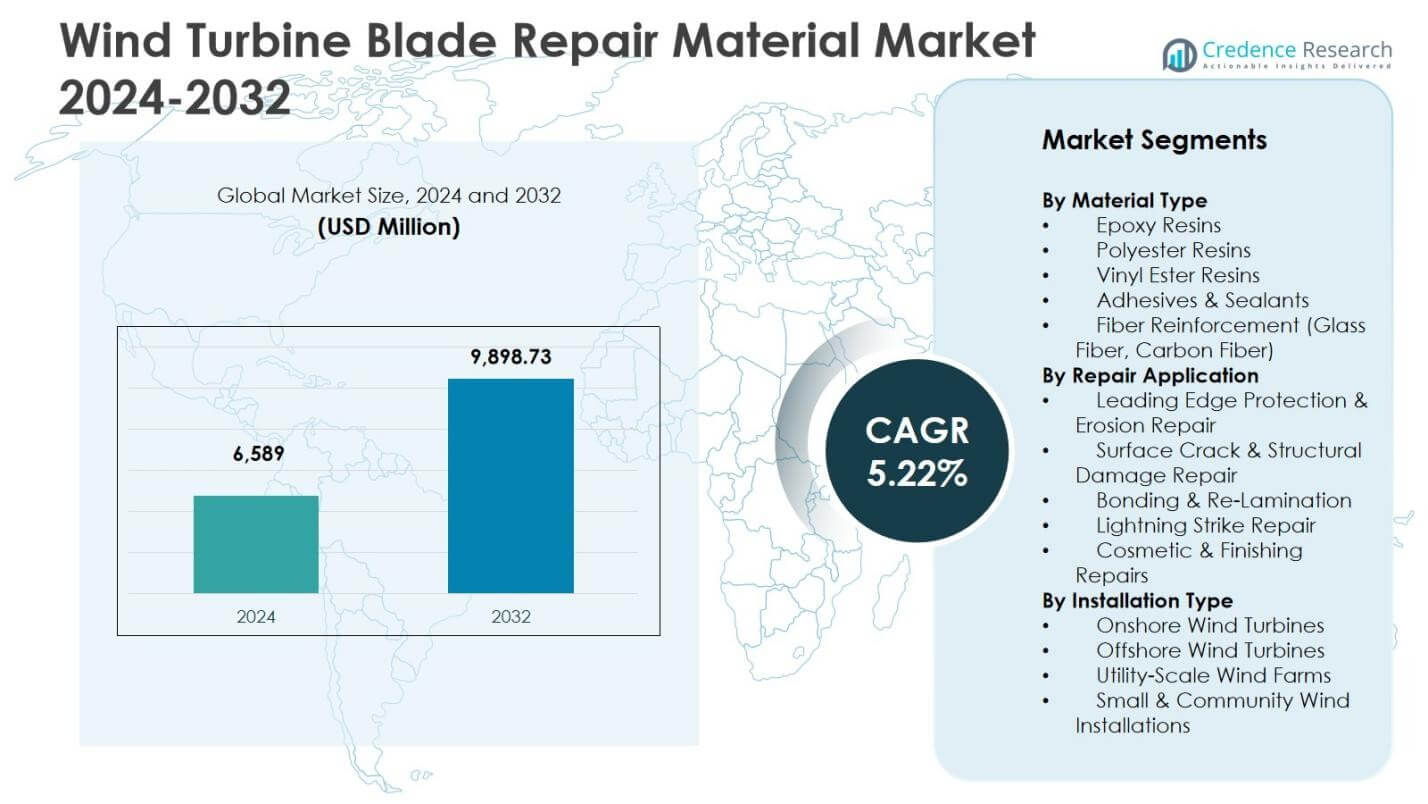
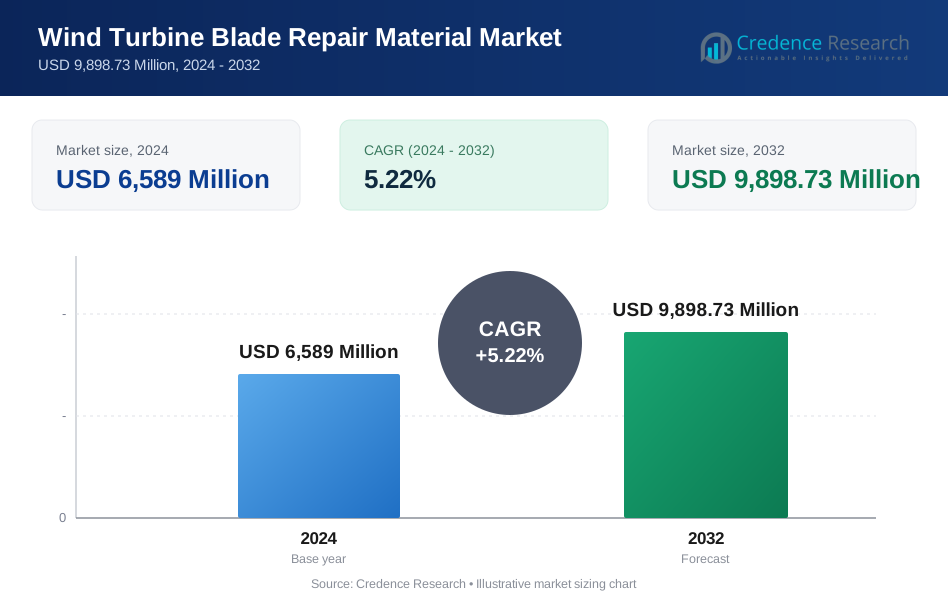
Wind Turbine Blade Repair Material Market size was valued USD 6,589 Million in 2024 and is anticipated to reach USD 9,898.73 Million by 2032, at a CAGR of 5.22% during the forecast period.
| REPORT ATTRIBUTE | DETAILS |
|---|---|
| Historical Period | 2020-2023 |
| Base Year | 2024 |
| Forecast Period | 2025-2032 |
| Wind Turbine Blade Repair Material Market Size 2024 | USD 6,589 million |
| Wind Turbine Blade Repair Material Market, CAGR | 5.22% |
| Wind Turbine Blade Repair Material Market Size 2032 | USD 9,898.73 million |
Wind Turbine Blade Repair Material Market Insights
- The market is driven by rising repair and refurbishment activities across aging turbine fleets, increasing focus on asset life-extension, and the growing adoption of epoxy resins and fiber-reinforcement materials that enhance durability and structural reliability in blade restoration applications.
- Key trends include the rising use of fast-curing adhesive systems, nano-enhanced coatings, and erosion-resistant materials, along with the increasing integration of predictive maintenance, drone inspections, and digital monitoring tools to optimize repair cycles and reduce downtime.
- Major players focus on material innovation, performance efficiency, and partnerships with wind farm operators and service providers, strengthening their presence across onshore and offshore maintenance ecosystems while expanding portfolios in epoxy, sealants, and reinforcement solutions
- Europe leads the market with 31.4% share in 2024, followed by North America with 28.6% share and Asia-Pacific with 26.9% share, while epoxy resins remain the dominant material segment with 38.6% share supported by strong structural bonding performance.
Wind Turbine Blade Repair Material Market Segmentation Analysis:
By Material Type
The Wind Turbine Blade Repair Material Market by material type is led by epoxy resins, which accounted for 38.6% share in 2024, driven by their strong bonding ability, durability, and resistance to fatigue in structural blade repairs. Polyester resins and vinyl ester resins collectively support cost-efficient maintenance solutions, while adhesives and sealants gain traction in bonding and crack-sealing operations. Fiber reinforcement materials, including glass and carbon fiber, play a critical role in structural strengthening and edge-repair reinforcement. Growth is driven by increasing turbine aging fleets, demand for extended service life, and emphasis on cost-effective composite repair technologies.
- For instance, Bergolin and Fibre Glast developed UV-cured polyester resin systems like BergoLED Speed-Resin for rapid lamination and infusion, enabling blade repairs in cold weather where standard resins fail to cure.
By Repair Application
Based on repair application, leading edge protection and erosion repair dominated the market with a 41.2% share in 2024, supported by rising surface erosion caused by high-speed wind flow, rain impact, and particulate abrasion in coastal and desert environments. Surface crack and structural damage repair remains essential for preventing aerodynamic efficiency loss, while bonding and re-lamination solutions support composite integrity restoration. Lightning strike repair and cosmetic finishing repairs contribute to turbine reliability and performance optimization. Market growth is fueled by higher maintenance frequency, aging turbine fleets, offshore expansion, and the industry’s shift toward preventive maintenance strategies.
- For instance, Vestas Wind Systems adopted automated Leading Edge Repair (LER) systems for its onshore fleet maintenance in Texas, targeting improved efficiency and minimizing technician risk
By Installation Type
By installation type, onshore wind turbines accounted for a 57.4% share of the Wind Turbine Blade Repair Material Market in 2024, supported by the large installed base of onshore wind farms and higher frequency of repair cycles due to environmental exposure and continuous operation. Offshore wind turbines represent a rapidly growing segment as harsher marine conditions accelerate blade erosion and structural fatigue. Utility-scale wind farms drive large-volume repair material consumption, while small and community wind installations contribute niche demand. Growth across segments is driven by turbine life-extension programs, O&M cost optimization, and increasing investment in renewable power infrastructure.
Key Growth Drivers
Aging Wind Turbine Fleet and Increasing Repair Demand
The Wind Turbine Blade Repair Material Market is experiencing strong growth as a large share of the global wind turbine fleet reaches mid-life and end-of-life operating phases, resulting in higher wear, erosion, cracking, and structural degradation of composite blades. Operators increasingly prioritize repair and refurbishment over full blade replacement to reduce downtime and extend asset life, which significantly boosts demand for epoxy systems, adhesives, fiber reinforcement materials, and erosion-protection solutions. This driver is further strengthened by the expansion of long-term O&M contracts, rising focus on lifecycle cost optimization, and accelerating investments in wind farm modernization programs.
- For instance, BladeStar Renewables repaired chordways cracks on LM 45.3P blades for EDF Renewables using high-performance epoxy resins, composite patching, and precision curing, restoring structural integrity and optimal performance while minimizing downtime.
Expansion of Offshore Wind Projects and Harsh Environmental Exposure
Rapid development of offshore wind farms is creating a substantial need for specialized blade repair materials capable of withstanding extreme marine environments, salt corrosion, continuous high-speed wind flow, and heavy moisture exposure. Offshore blades experience faster leading-edge erosion and fatigue stress, driving demand for high-performance coatings, structural reinforcement fibers, sealants, and vinyl ester systems. The shift toward larger turbine capacities and longer blades further increases material consumption for preventive maintenance. Government-backed offshore wind targets, long-term decarbonization initiatives, and operator focus on performance reliability continue to position offshore expansion as a major growth catalyst for this market.
- For instance, Swire Renewable Energy conducted leading edge protection (LEP) installation on 102 SWT 3.6-107/120 blades at Ørsted's Walney offshore wind farm in 2023. The project involved drone inspections, IRATA-certified rope access repairs, vessel chartering, and full project management to combat erosion and enhance performance.
Growing Emphasis on Performance Efficiency and Asset Life Extension
Wind farm owners and service providers are increasingly adopting performance-driven maintenance strategies to reduce aerodynamic losses, improve turbine output, and maximize annual energy production. Blade repair materials play a critical role in restoring structural integrity, minimizing erosion-induced drag, and preventing crack propagation, which supports higher operational efficiency and longer service lifespans. The rising adoption of predictive maintenance, digital inspection tools, and drone-based monitoring systems accelerates repair scheduling and material utilization. This strategic shift toward proactive maintenance and lifecycle reliability is fueling sustained demand for advanced composite repair materials across global wind power installations.
Key Trends & Opportunities
Transition Toward Advanced Composite and Nano-Enhanced Repair Materials
A key trend shaping the Wind Turbine Blade Repair Material Market is the transition toward high-performance composite repair systems, including nano-enhanced coatings, UV-resistant epoxy formulations, hybrid resins, and carbon-fiber reinforcement solutions. These next-generation materials enable superior strength-to-weight performance, faster curing, greater fatigue resistance, and enhanced bonding durability under extreme operating conditions. Manufacturers are investing in material innovation to support longer inspection intervals and reduce maintenance costs. This trend also creates significant opportunities for technology partnerships, customized blade-repair solutions, and the integration of smart protective coatings designed to withstand high-velocity particulate erosion.
- For instance, Sika's Sikadur® Blade Repair is a fast-curing 2-component epoxy resin system for repairing small laminate defects and dry spots on wind turbine blades. It achieves cure times as quick as 30 minutes even at temperatures down to 5°C, with DNV GL approval and optimized packaging for on-site use to reduce turbine downtime.
Increasing Shift Toward Sustainable and Maintenance-Optimized Repair Solutions
The growing industry focus on sustainability and circular lifecycle management is creating strong opportunities for environmentally responsible blade repair materials and low-emission resin systems. Market participants are developing recyclable composite repair solutions, bio-based adhesives, and low-VOC formulations to comply with ESG goals and evolving environmental regulations. At the same time, service models are shifting toward modular repair systems and rapid-application technologies that minimize turbine downtime and labor intensity. This trend is accelerating innovation in prefabricated reinforcement patches, automated application processes, and mobile repair kits that enhance operational efficiency and field-service productivity.
- For instance, Siemens Gamesa launched RecyclableBlade, an 81-meter offshore wind turbine blade using a specialized resin that enables efficient separation of fiberglass, plastic, wood, and metals via a mild acidic solution at end-of-life for reuse in other industries.
Key Challenges
High Repair Complexity and Skilled Workforce Shortage
One of the major challenges in the Wind Turbine Blade Repair Material Market is the high technical complexity associated with composite blade repair, which requires specialized expertise in structural bonding, resin application, fiber reinforcement layering, and aerodynamic surface restoration. Many regions face a shortage of trained repair technicians, leading to longer maintenance cycles and increased service costs. Variability in blade design, material compatibility constraints, and the need for climate-controlled curing environments further complicate repair execution. These operational barriers limit material utilization efficiency and can delay repair schedules, especially in remote onshore and offshore locations.
Environmental Exposure Risks and High Maintenance Logistics Costs
Harsh environmental conditions, including sand abrasion, saltwater corrosion, thermal fluctuations, and lightning-induced structural stress, accelerate blade damage and increase maintenance frequency, creating logistical and cost-related challenges for repair operations. Offshore and remote wind farms face high transportation, access, and safety-compliance costs, which significantly raise total maintenance expenditure and influence material selection decisions. Weather-dependent work windows and turbine height-related safety risks also constrain repair efficiency. These factors collectively present ongoing challenges for market growth, as operators must balance performance reliability with operational risk management and cost optimization across diverse installation environments.
Regional Analysis
North America
North America holds a significant position in the Wind Turbine Blade Repair Material Market, driven by a large installed base of wind farms in the United States and Canada and rising focus on life-extension programs for aging turbines. The region accounted for 28.6% share in 2024, supported by strong O&M investments, frequent leading-edge erosion repairs in high-wind corridors, and the expansion of independent service providers. Policy support for renewable energy and repowering initiatives continues to accelerate repair demand, while offshore wind developments along the Atlantic coast further enhance material consumption for structural reinforcement and erosion-protection applications.
Europe
Europe remains one of the most mature and maintenance-intensive regions in the Wind Turbine Blade Repair Material Market, reflecting its long operational history of large-scale wind installations across countries such as Germany, Denmark, Spain, and the United Kingdom. The region captured 31.4% share in 2024, driven by strict reliability standards, well-established O&M frameworks, and accelerated offshore wind deployment in the North Sea. The prevalence of aging turbine fleets and advanced predictive maintenance programs strengthens the need for epoxy systems, fiber reinforcements, and protective coatings, while sustainability-focused repair practices further promote the adoption of long-life composite repair materials.
Asia-Pacific
Asia-Pacific represents the fastest-growing regional market as countries such as China, India, Japan, South Korea, and Australia continue expanding large onshore and emerging offshore wind projects. The region accounted for 26.9% share in 2024, supported by rapid capacity additions, cost-sensitive repair strategies, and rising investments in turbine performance optimization. Increasing blade erosion across coastal and desert environments drives demand for leading-edge protection materials and structural repair resins. Government-backed renewable expansion programs and the scaling of local repair service ecosystems further strengthen market growth, positioning Asia-Pacific as a key destination for high-volume repair material consumption.
Latin America
Latin America is steadily strengthening its presence in the Wind Turbine Blade Repair Material Market, supported by growing wind power deployment in Brazil, Mexico, Chile, and Argentina and the gradual expansion of utility-scale installations. The region accounted for 7.8% share in 2024, driven by increasing emphasis on maintenance cost optimization and the adoption of refurbishment programs for operational turbines exposed to variable climatic conditions. Rising participation of regional O&M contractors and the integration of fiber reinforcement and adhesive bonding solutions in structural repairs support market expansion, while future capacity additions are expected to further stimulate material demand.
Middle East & Africa
The Middle East and Africa region is emerging as a developing market in the Wind Turbine Blade Repair Material Market, driven by new wind project installations in South Africa, Morocco, Egypt, Saudi Arabia, and emerging Gulf economies. The region recorded 5.3% share in 2024, supported by rising investment in renewable diversification strategies and increasing maintenance requirements for turbines operating in sand, heat, and desert abrasion environments. Growing reliance on international service partners, development of specialized erosion-resistant materials, and gradual expansion of regional repair capabilities are strengthening market opportunities, although infrastructure and skill-availability gaps continue to influence repair timelines.
Market Segmentations:
By Material Type
- Epoxy Resins
- Polyester Resins
- Vinyl Ester Resins
- Adhesives & Sealants
- Fiber Reinforcement (Glass Fiber, Carbon Fiber)
By Repair Application
- Leading Edge Protection & Erosion Repair
- Surface Crack & Structural Damage Repair
- Bonding & Re-Lamination
- Lightning Strike Repair
- Cosmetic & Finishing Repairs
By Installation Type
- Onshore Wind Turbines
- Offshore Wind Turbines
- Utility-Scale Wind Farms
- Small & Community Wind Installations
By Geography
- North America
- U.S.
- Canada
- Mexico
- Europe
- Germany
- France
- U.K.
- Italy
- Spain
- Rest of Europe
- Asia Pacific
- China
- Japan
- India
- South Korea
- South-east Asia
- Rest of Asia Pacific
- Latin America
- Brazil
- Argentina
- Rest of Latin America
- Middle East & Africa
- GCC Countries
- South Africa
- Rest of the Middle East and Africa
Competitive Landscape
Competitive landscape in the Wind Turbine Blade Repair Material Market is shaped by leading players such as Akzo Nobel N.V., PPG Industries Inc., The Sherwin-Williams Company, Henkel AG & Co. KGaA, 3M Company, Hempel A/S, Jotun A/S, Sika AG, Teknos Group Oy, and Gurit Holding AG. The market features strong competition driven by product innovation, durability performance, and application efficiency across epoxy systems, adhesives, coatings, and fiber-reinforcement solutions. Companies focus on developing high-strength, fast-curing, and erosion-resistant materials tailored for both onshore and offshore repair environments, while partnerships with wind farm operators and O&M service providers enhance aftermarket presence. Sustainability initiatives, including low-VOC resins and recyclable composite repair solutions, are gaining strategic importance. Players also invest in region-specific distribution networks, technical support services, and digital inspection integration to improve repair productivity and lifecycle performance. Ongoing R&D investment, portfolio expansion, and capability alignment with large turbine platforms continue to define the competitive growth outlook of this market.
Key Player Analysis
- Akzo Nobel N.V.
- PPG Industries Inc.
- The Sherwin-Williams Company
- Henkel AG & Co. KGaA
- 3M Company
- Jotun A/S
- Hempel A/S
- Teknos Group Oy
- Sika AG
- Gurit Holding AG
Recent Developments
- In November 2024, RES acquired Bladena, a Danish wind turbine blade engineering specialist, to enhance digital wind farm solutions and blade maintenance capabilities.
- In 2024, Sunrez Corporation launched the 7355 vinyl ester resin system, a non-styrenated, VOC-free UV-cured prepreg material designed specifically for wind turbine blade repairs.
- In September 2025, ONYX Insight acquired wind blade specialist ELEVEN-I to strengthen its blade monitoring and structural health capabilities, enhancing predictive maintenance for turbine repair operations.
Report Coverage
The research report offers an in-depth analysis based on Material Type, Repair Application, Installation Type and Geography. It details leading market players, providing an overview of their business, product offerings, investments, revenue streams, and key applications. Additionally, the report includes insights into the competitive environment, SWOT analysis, current market trends, as well as the primary drivers and constraints. Furthermore, it discusses various factors that have driven market expansion in recent years. The report also explores market dynamics, regulatory scenarios, and technological advancements that are shaping the industry. It assesses the impact of external factors and global economic changes on market growth. Lastly, it provides strategic recommendations for new entrants and established companies to navigate the complexities of the market.
Future Outlook
- The market will grow as wind turbine operators increasingly prioritize life-extension, refurbishment, and preventive maintenance activities.
- Demand for advanced epoxy systems, adhesives, coatings, and fiber-reinforcement materials will rise with the expansion of aging turbine fleets.
- Offshore wind development will drive higher consumption of specialized erosion-resistant and marine-grade repair materials.
- Digital inspection technologies, drones, and predictive maintenance platforms will enhance repair scheduling and material utilization efficiency.
- Manufacturers will invest more in fast-curing, high-strength, and climate-tolerant repair formulations to reduce downtime.
- Sustainability initiatives will encourage the adoption of recyclable composites and low-emission repair material solutions.
- Global collaboration between repair contractors, OEMs, and material suppliers will strengthen service standardization and quality control.
- Regional localization of manufacturing and repair services will improve supply resilience and cost efficiency.
- Training programs and workforce development initiatives will address skill-gap challenges in blade repair operations.
- Continued innovation in nano-enhanced coatings and hybrid composite systems will expand performance and reliability outcomes.
Request a Free Sample
Fill in your details and we'll send you a free sample report.
- Sample data tables & charts
- Research methodology
Need a Custom Version of This Report?
Tailor the scope, geography, or segments to your exact requirements.
- Custom geography or segment scope
- Direct access to our analyst team
Frequently Asked Questions
What is the current market size for Wind Turbine Blade Repair Material Market, and what is its projected size in 2032?
At what Compound Annual Growth Rate is the Wind Turbine Blade Repair Material Market projected to grow between 2024 and 2032?
Which Wind Turbine Blade Repair Material Market segment held the largest share in 2024?
What are the primary factors fueling the growth of the Wind Turbine Blade Repair Material Market?
Who are the leading companies in the Wind Turbine Blade Repair Material Market?
Which region commanded the largest share of the Wind Turbine Blade Repair Material Market in 2024?
Table of Content
Chapter 1. Report Introduction
- 1.1 Report Description & Purpose
- 1.1.1 Report Title & Market Definition
- 1.1.2 Unique Selling Propositions (USP) & Key Differentiators
- 1.1.3 Value Proposition for Stakeholders
- 1.2 Research Objectives
- 1.2.1 Market Sizing Objectives (Volume & Revenue)
- 1.2.2 Segmentation Objectives
- 1.2.3 Competitive Intelligence Objectives
- 1.2.4 Forecast & Scenario Objectives
- 1.3 Report Scope
- 1.3.1 Wind Turbine Blade Repair Material Scope – Types & Subtypes Covered
- 1.3.2 Geographic Scope – Regions & Countries Covered
- 1.3.3 Historical Period, Base Year & Forecast Period (2024; forecast to 2032)
- 1.3.4 Inclusions & Exclusions
- 1.4 HS Code & Classification Framework
- 1.5 Currency, Units & Pricing Basis
- 1.6 Target Stakeholders
- 1.7 Limitations & Assumptions
Chapter 2. Executive Summary
- 2.1 Global Wind Turbine Blade Repair Material Market Snapshot
- 2.1.1 Market Size – Historical (2024) & Forecast (2024-2032) (2024: USD 6,589 Million → 2032: USD 9,898.73 Million)
- 2.1.2 Volume & Revenue – Global Totals
- 2.1.3 Key Market Highlights – Top Five Facts
- 2.2 Wind Turbine Blade Repair Material Market Segmentation Snapshot
- 2.2.1 Market Split by Region – 2024 vs. 2032
- 2.3 Competitive Snapshot
- 2.3.1 Top 10 Players by Revenue Share – 2024
- 2.3.2 Top 10 Players by Volume Share – 2024
- 2.3.3 Recent Strategic Developments (18-Month Summary)
- 2.4 Key Investment Highlights & Strategic Conclusions
Chapter 3. Wind Turbine Blade Repair Material Market Dynamics & Industry Analysis
- 3.1 Market Overview & Context
- 3.1.1 Wind Turbine Blade Repair Material Market Position in the Broader Automotive Value Chain
- 3.1.2 OEM vs. Replacement Market Dynamics
- 3.1.3 Market Maturity & Development Stage by Region
- 3.2 Wind Turbine Blade Repair Material Market Drivers
- 3.3 Wind Turbine Blade Repair Material Market Restraints & Challenges
- 3.4 Wind Turbine Blade Repair Material Market Opportunities
- 3.5 Porter's Five Forces Analysis
- 3.5.1 Threat of New Entrants
- 3.5.2 Bargaining Power of Suppliers
- 3.5.3 Bargaining Power of Buyers
- 3.5.4 Threat of Substitutes
- 3.5.5 Competitive Rivalry – Intensity Assessment
- 3.6 Wind Turbine Blade Repair Material Value Chain Analysis
- 3.6.1 Upstream – Raw Material/Input Suppliers
- 3.6.1.1 Raw Material/Input 1
- 3.6.1.2 Raw Material/Input 2
- 3.6.1.3 Raw Material/Input 3
- 3.6.2 Midstream – Production/Manufacturing/Service Delivery
- 3.6.2.1 Production/Process Overview
- 3.6.2.2 Key Facility Locations & Capacity by Manufacturer
- 3.6.3 Downstream – Distribution & End Consumer
- 3.6.3.1 Primary Channel – B2B/OEM
- 3.6.3.2 Secondary Channels – Dealer, Retail, Online, Direct
- 3.6.4 Value Chain Profitability Analysis
- 3.6.1 Upstream – Raw Material/Input Suppliers
- 3.7 PESTEL Analysis
- 3.7.1 Political Factors
- 3.7.2 Economic Factors
- 3.7.3 Social Factors
- 3.7.4 Technological Factors
- 3.7.5 Environmental Factors
- 3.7.6 Legal Factors
- 3.8 Wind Turbine Blade Repair Material Supply Chain Analysis
- 3.8.1 Raw Material/Input Supply Risk Assessment
- 3.8.2 Manufacturing Concentration Risk (Geographic Exposure)
- 3.8.3 Trade Disruption Impact Analysis
- 3.9 Regulatory & Policy Landscape
Note: The regulatory and policy landscape section covers regulations based on their applicability to the market, Wind Turbine Blade Repair Material category, geography, and scope of the study. Only regulatory frameworks with a material impact on operations, compliance, trade, sustainability, or market access are analyzed in detail.
Chapter 4. Key Investment Pockets & Opportunity Analysis
- 4.1 Wind Turbine Blade Repair Material Market Attractiveness Analysis
- 4.1.1 By Region – Investment Attractiveness Matrix (Volume × CAGR)
- 4.2 Absolute Revenue Growth Opportunity
- 4.2.1 By Region – Absolute USD Growth Through 2032
- 4.3 Incremental Volume Opportunity
- 4.3.1 By Region – Incremental Volume Through 2032
- 4.3.2 Segment – Incremental Volume
- 4.4 Emerging Submarket Opportunity Deep Dive (Subject to Applicability)
- 4.5 Emerging Market Opportunity Scorecards
- 4.5.1 United States
- 4.5.2 Europe
- 4.5.3 Asia
- 4.5.4 Middle East & Africa
Note: Emerging Market Opportunity Scorecards will be included based on relevance and strategic importance. Regions listed are indicative and may vary depending on data availability and market dynamics.
Chapter 5. Wind Turbine Blade Repair Material Import-Export Analysis & Trade Flows
- 5.1 Global Trade Overview
- 5.1.1 Global Export Value by Country (2024)
- 5.1.2 Global Export Volume by Country (2024)
- 5.1.3 Global Import Value by Country (2024)
- 5.1.4 Global Import Volume by Country (2024)
- 5.1.5 Net Trade Balance by Country (2024)
- 5.2 Export Analysis – Segment
- 5.2.1 Type 1 (HS Code)
- 5.2.2 Type 2 (HS Code)
- 5.2.3 Type 3 (HS Code)
- 5.2.4 Type 4 (HS Code)
- 5.2.5 Type 5 (HS Code)
- 5.3 Import Analysis – Segment
- 5.3.1 Type 1 (HS Code)
- 5.3.2 Type 2 (HS Code)
- 5.3.3 Type 3 (HS Code)
- 5.3.4 Type 4 (HS Code)
- 5.3.5 Type 5 (HS Code)
- 5.4 Average Unit Trade Prices
- 5.4.1 Average Export Price – Segment & Country
- 5.4.2 Average Import Price – Segment & Source Country
- 5.4.3 Price Trends (2024)
- 5.5 Key Trade Route Analysis
- 5.5.1 Trade Route 1
- 5.5.2 Trade Route 2
- 5.5.3 Trade Route 3
- 5.5.4 Trade Route 4
- 5.5.5 Trade Route 5
- 5.6 Trade Policy Impact Assessment
- 5.6.1 US Anti-Dumping & Section 301 Tariffs
- 5.6.2 EU Customs Union Impact
- 5.6.3 Major Free Trade Agreements
- 5.6.4 USMCA Rules of Origin
Note: Trade policy analysis will be included only where relevant to the Wind Turbine Blade Repair Material market.
Chapter 6. Competitive Landscape & Company Benchmarking
- 6.1 Wind Turbine Blade Repair Material Market Concentration & Structure
- 6.1.1 Herfindahl-Hirschman Index (HHI) – vs. 2024
- 6.1.2 Tier 1, Tier 2 & Tier 3 Market Structure
- 6.1.3 Global, Regional & Local Player Dynamics
- 6.2 Wind Turbine Blade Repair Material Market Share Analysis – 2024
- 6.2.1 Global Revenue Share by Company
- 6.2.2 Global Volume Share by Company
- 6.2.3 Regional Revenue Share
- 6.2.4 Market Share Evolution ( vs. 2024)
- 6.2.5 OEM Segment Share by Company
- 6.2.6 Replacement Segment Share by Company
- 6.3 Production/Delivery Capacity & Facility Analysis
- 6.3.1 Global Installed Capacity
- 6.3.2 Capacity Utilization Rates
- 6.3.3 Production/Output Volume
- 6.3.4 Facility Locations & Capacity Map
- 6.3.5 Planned Capacity Additions
- 6.4 Wind Turbine Blade Repair Material Competitive Benchmarking Matrix
- 6.4.1 Revenue, Volume, CAGR & Profitability Comparison
- 6.4.2 Channel Revenue Mix
- 6.4.3 Geographic Revenue Exposure
- 6.4.4 R&D Intensity
- 6.4.5 Sustainability Maturity
- 6.5 Strategic Developments in Wind Turbine Blade Repair Material (Last 24 Months)
- 6.5.1 Mergers, Acquisitions & Divestments
- 6.5.2 New Wind Turbine Blade Repair Material Launches
- 6.5.3 Facility Expansions
- 6.5.4 Strategic Alliances, Joint Ventures & Partnerships
- 6.5.5 Distribution Expansion & Market Entry
- 6.5.6 Sustainability & ESG Initiatives
- 6.6 Competitive Strategy Mapping
- 6.6.1 Leader, Challenger, Follower & Niche Classification
- 6.6.2 Pricing Strategy Comparison
- 6.6.3 Channel Strategy Matrix
Note: Strategic developments are included based on their materiality and the availability of reliable information.
Chapter 7. Global Wind Turbine Blade Repair Material Market – By Distribution Channel
- 7.1 Segment Overview
- 7.1.1 Volume & Revenue Split by Channel (2024 & 2032)
- 7.1.2 Channel Mix Evolution (2024-2032)
Chapter 8. Regional Market Analysis – Global Overview
- 8.1 Global Regional Overview
- 8.1.1 Regional Volume Share
- 8.1.2 Regional Revenue Share
- 8.1.3 Regional Volume by Region
- 8.1.4 Regional Revenue by Region
- 8.1.5 Regional Forecast Through 2032
- 8.2 Cross-Regional Segment Analysis
- 8.2.1 By Distribution Channel
- 8.2.2 By Brand/Price Tier
Chapter 9. North America Wind Turbine Blade Repair Material Market
- 9.1 United States
- 9.2 Canada
- 9.3 Mexico
Chapter 10. Europe Wind Turbine Blade Repair Material Market
- 10.1 Germany
- 10.2 France
- 10.3 Italy
- 10.4 United Kingdom
- 10.5 Spain
- 10.6 Poland
- 10.7 Russia
- 10.8 Netherlands
- 10.9 Belgium
- 10.10 Sweden
- 10.11 Denmark
- 10.12 Norway
- 10.13 Rest of Europe
Chapter 11. Asia Pacific Wind Turbine Blade Repair Material Market
- 11.1 China
- 11.2 India
- 11.3 Japan
- 11.4 South Korea
- 11.5 Thailand
- 11.6 Indonesia
- 11.7 Vietnam
- 11.8 Malaysia
- 11.9 Australia
- 11.10 Rest of Asia Pacific
Chapter 12. Latin America Wind Turbine Blade Repair Material Market
- 12.1 Brazil
- 12.2 Argentina
- 12.3 Colombia
- 12.4 Chile
- 12.5 Rest of Latin America
Chapter 13. Middle East Wind Turbine Blade Repair Material Market
- 13.1 Saudi Arabia
- 13.2 United Arab Emirates
- 13.3 Turkey
- 13.4 Israel
- 13.5 Iran
- 13.6 Rest of the Middle East
Chapter 14. Africa Wind Turbine Blade Repair Material Market
- 14.1 South Africa
- 14.2 Egypt
- 14.3 Nigeria
- 14.4 Morocco
- 14.5 Rest of Africa
Chapter 15. Wind Turbine Blade Repair Material Company Profiles
- 15.1 [Company 01]
- 15.1.1 Company Overview
- 15.1.2 Key Management Personnel
- 15.1.3 Products & Services Portfolio
- 15.1.4 Financial Performance
- 15.1.5 Key Market Focus & Geographic Presence
- 15.1.6 Recent Developments & Strategic Initiatives
Note: The company profile list is preliminary and may change based on research findings, market developments, data availability, and client requirements.
Chapter 16. Appendices
- Appendix A – List of Abbreviations & Acronyms
- Appendix B – Industry Classification Code Reference – Full Series
- Appendix C – Production & Capacity Data Tables
- Appendix D – End-Use & Demand Base Tables
- Appendix E – Consumption & Replacement Rate Assumptions
- Appendix F – ASP Reference Tables
- Appendix G – Manufacturing & Facility Database
- Appendix H – Import-Export Data Tables
- Appendix I – Regulatory Summary Tables
- Appendix J – Primary Research Participant List (Anonymized)
- Appendix K – Primary Research Questionnaire Framework
- Appendix L – Data Sources & Bibliography
- Appendix M – Market Size Divergence & Source Comparison
Chapter 17. Research Methodology
- 17.1 Research Framework & Philosophy
- 17.2 Secondary Research – Sources, Hierarchy & Data Extraction
- 17.3 Data Modeling – Bottom-Up & Top-Down Market Sizing
- 17.4 Primary Research – Stakeholder Framework, LOI & Sample Sizes
- 17.5 Forecast Methodology – Regression, Scenario & Sensitivity Analysis
- 17.6 Quality Control – Four-Layer Validation Framework
- 17.7 Limitations & Standard Assumptions
- 17.8 Disclaimer
