
Styrene Butadiene Latex Market Overview:
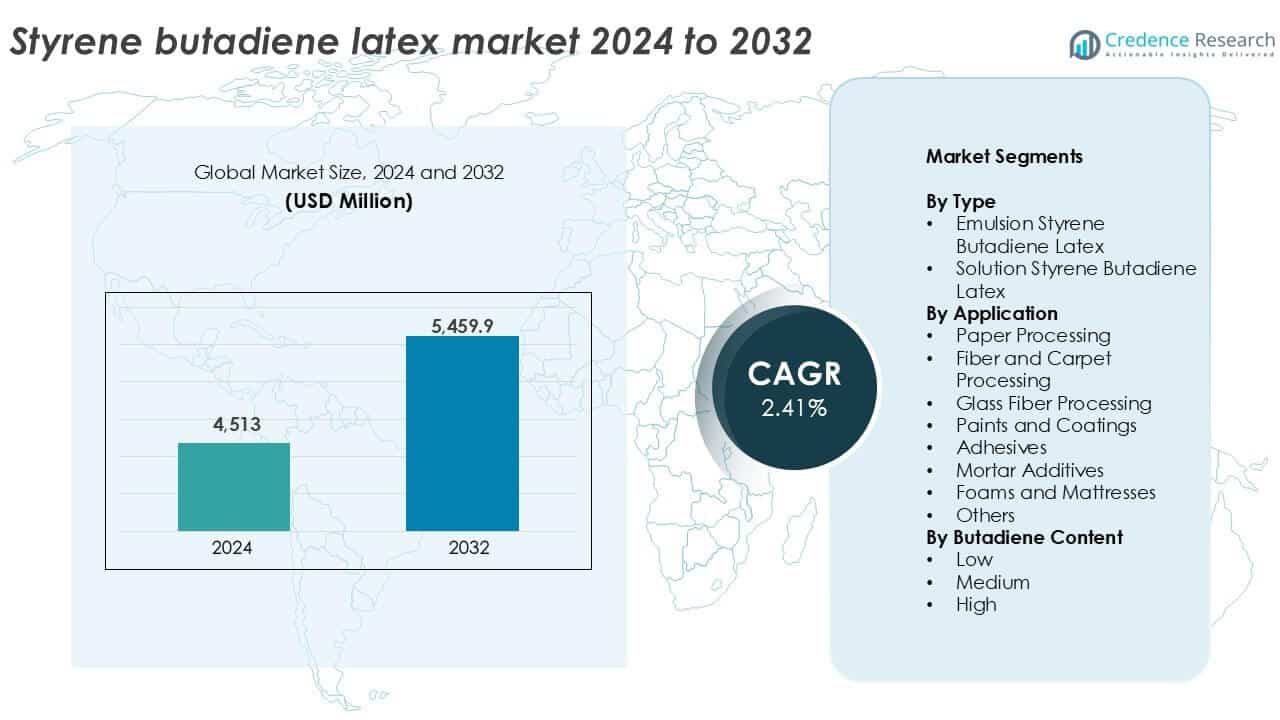
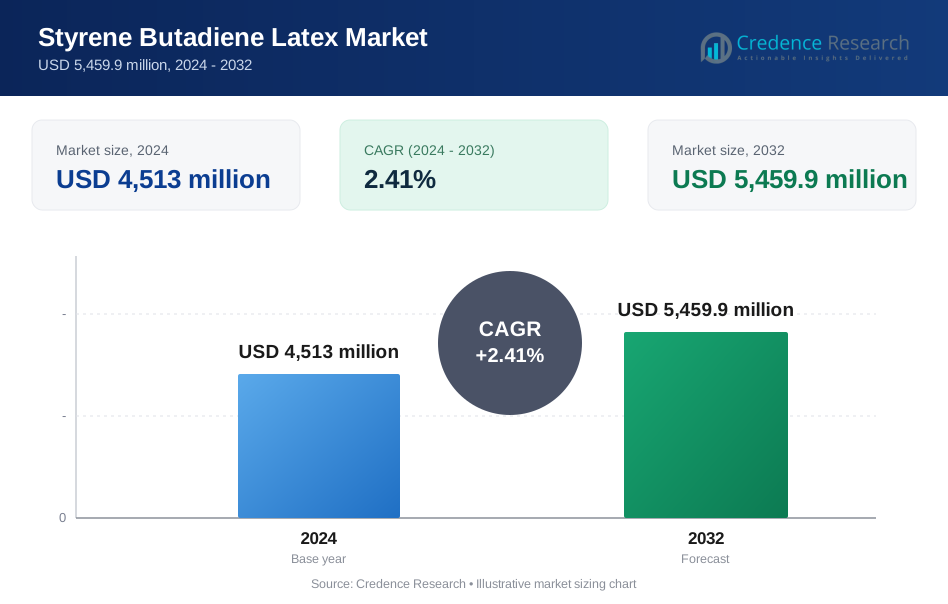
The Styrene Butadiene Latex market size was valued at USD 4,513 million in 2024 and is anticipated to reach USD 5,459.9 million by 2032, at a CAGR of 2.41% during the forecast period.
| REPORT ATTRIBUTE | DETAILS |
|---|---|
| Historical Period | 2020-2023 |
| Base Year | 2024 |
| Forecast Period | 2025-2032 |
| Styrene Butadiene Latex Market Size 2024 | USD 4,513 million |
| Styrene Butadiene Latex Market, CAGR | 2.41% |
| Styrene Butadiene Latex Market Size 2032 | USD 5,459.9 million |
Top players in the styrene butadiene latex market include BASF SE, LG Chem Ltd., Dow Chemical Company, Synthomer plc, Trinseo (Styron LLC), and Kumho Petrochemical Co., Ltd., all of which lead through diversified portfolios and strong global distribution networks. These companies focus on sustainable formulations and high-performance latex products to meet evolving industry needs. Asia-Pacific stands out as the leading region, holding over 43% of the global market share in 2024, driven by robust demand from China, India, and South Korea across paper, construction, and textile sectors. North America and Europe follow, supported by mature manufacturing ecosystems and stringent environmental standards that promote the adoption of water-based latex solutions.
Styrene Butadiene Latex Market Insights
- The styrene butadiene latex market was valued at USD 4,513 million in 2024 and is projected to reach USD 5,459.9 million by 2032, growing at a CAGR of 2.41% during the forecast period.
- Rising demand from the paper processing industry and carpet manufacturing remains a key growth driver due to the latex’s strong binding and water-resistant properties.
- Trends indicate growing adoption of water-based, eco-friendly latex in paints, adhesives, and coatings, driven by tightening environmental regulations and sustainability goals.
- The market is moderately consolidated with key players like BASF SE, LG Chem Ltd., and Synthomer plc focusing on R&D and regional expansion, while facing competition from acrylic and natural rubber alternatives.
- Asia-Pacific leads the global market with over 43% share, followed by Europe at 21% and North America at 18%; among applications, paper processing holds the dominant segment share with over 35% in 2024.
Styrene Butadiene Latex Market Segmentation Analysis:
By Type
Emulsion styrene butadiene latex dominates the market by type, accounting for over 70% share in 2024. This segment benefits from its low cost, high binding strength, and easy applicability in paper and textile industries. Emulsion types are widely preferred in coatings and carpet backing due to their water-based composition and environmental compliance. In contrast, solution-based latex offers better flexibility and aging resistance but remains niche due to higher production costs. The growing demand for eco-friendly formulations in packaging and carpet manufacturing continues to drive the emulsion segment’s growth in both developed and emerging markets.
- For instance, Trinseo produces emulsion SBR latex at its Rheinmünster site with annual capacity exceeding 450,000 metric tons, serving paper coating and carpet backing customers.
By Application
Paper processing leads the application segment with over 35% market share in 2024, driven by its large-scale use in coated and specialty papers. Styrene butadiene latex enhances printability, smoothness, and water resistance in paper products. Demand for high-gloss paper in commercial printing and packaging sustains this dominance. Other high-growth applications include paints and coatings, adhesives, and glass fiber processing, where latex improves elasticity and bonding. Fiber and carpet processing segments also show steady growth, especially in Asia-Pacific, supported by construction and furnishing demand. Foams and mattresses contribute to niche usage, with rising applications in premium bedding products.
By Butadiene Content
Medium butadiene content styrene butadiene latex dominates the market with nearly 60% share in 2024. This type balances flexibility, durability, and mechanical performance, making it ideal for paper, coating, and carpet applications. High butadiene content variants offer superior softness and are used in foam and bedding, though they account for a smaller share. Low butadiene latex types suit applications needing higher stiffness and thermal stability, such as certain adhesives and glass fiber processing. The medium-content segment continues to benefit from its broad usability, especially in industries seeking cost-effective yet performance-driven formulations.
Styrene Butadiene Latex Market Key Growth Drivers
Rising Demand from the Paper Processing Industry
The paper processing industry remains a primary growth driver for the styrene butadiene latex market. Styrene butadiene latex is widely used in coated and specialty papers for enhancing printability, surface gloss, and water resistance. As global packaging needs grow driven by e-commerce, food delivery, and FMCG sectors the demand for high-performance paper coatings rises sharply. Developing countries are also investing in expanding their domestic paper industries to reduce imports, further increasing latex consumption. Sustainability efforts have accelerated the shift toward recyclable and water-based coatings, where styrene butadiene latex plays a critical role. Additionally, demand for graphic paper, labels, and flexible packaging continues to rise in Asia-Pacific, boosting regional consumption. The low-cost, water-based, and environmentally safer properties of this latex type make it a top choice for manufacturers replacing solvent-based options, especially amid growing environmental regulations across Europe and North America.
- For instance, Trinseo reports that its paper and board latex grades enable fully recyclable coating systems used by global packaging producers. Expanding paper capacity in Asia-Pacific further increases consumption.
Expanding Construction and Carpets Sector
The styrene butadiene latex market benefits significantly from expansion in the construction and flooring sectors. In fiber and carpet processing, latex enhances tuft lock, durability, and backing strength. As construction activities pick up pace, particularly in Asia-Pacific, the Middle East, and parts of Africa, the demand for flooring materials like carpets, rugs, and resilient floor coverings grows. Rapid urbanization and residential developments fuel this demand, while public infrastructure and hospitality projects further accelerate consumption. Styrene butadiene latex is also used in mortar additives and adhesives, improving bonding and mechanical strength in concrete applications. Its compatibility with a wide range of building materials and ease of formulation give it an edge over substitutes. Furthermore, the rising interest in interior aesthetics, energy-efficient flooring, and noise insulation materials bolsters the use of latex-backed carpets and mats. This trend continues to strengthen its position as a preferred polymer binder in construction materials.
- For instance, Arkema provides styrene butadiene latex for cement mortars and tile adhesives designed to meet EN 12004 bonding standards. Interior comfort needs raise demand for latex-backed flooring.
Cost-Effective and Eco-Friendly Polymer Alternative
Styrene butadiene latex offers a strong cost-to-performance ratio compared to alternative binders such as acrylics and natural rubber. Its water-based nature enables lower VOC emissions, making it environmentally safer and compliant with evolving global environmental standards. Regulatory bodies across North America and Europe are encouraging reduced use of solvent-based systems, prompting industries to adopt water-based latex formulations. The ease of formulation, high mechanical stability, and good film-forming characteristics further boost its utility across diverse applications including textiles, paper, and paints. Manufacturers benefit from lower production costs and simpler processing, making SBL a favored option in price-sensitive markets. Additionally, growing awareness among end-users about sustainable sourcing and green manufacturing practices positions styrene butadiene latex as a viable eco-friendly solution. Its ability to be tailored for specific performance metrics such as flexibility, abrasion resistance, and adhesion without the high price tag of alternatives supports its long-term market penetration.
Styrene Butadiene Latex Market Key Trends & Opportunities
Growing Adoption in Eco-Friendly Coatings and Adhesives
Environmental regulations are pushing industries toward low-emission, water-based solutions creating a favorable environment for styrene butadiene latex in coatings and adhesives. As regulatory bodies restrict the use of volatile organic compounds (VOCs), manufacturers are shifting from solvent-based to water-based chemistries. Styrene butadiene latex fits well into this trend due to its ability to deliver strong adhesion, flexibility, and durability with minimal environmental impact. In the paints and coatings industry, it helps formulate high-performance emulsions used in interior wall paints, roof coatings, and primers. In adhesives, it is used for pressure-sensitive and construction-grade solutions, especially where flexibility and bond strength are crucial. Additionally, innovation in green building materials opens new opportunities for latex formulations that align with LEED certifications and sustainability goals. This trend is particularly visible in Europe and North America, where eco-labeling and corporate ESG mandates influence buying behavior.
- For instance, Synthomer produces styrene butadiene latex grades used in pressure-sensitive adhesives with peel strength above 10 N/cm under ASTM D3330 testing.
Technological Advancements in Polymer Modification
Recent advancements in polymer technology have opened new frontiers for styrene butadiene latex, enabling higher customization and broader functionality. Modified latex variants now exhibit improved weather resistance, thermal stability, and mechanical strength—making them suitable for demanding industrial uses. Nano-enhanced latex formulations are under research for high-barrier coatings and filtration media, creating potential value-added applications. Companies are also focusing on hybrid emulsions that blend styrene butadiene latex with other polymers to meet niche market requirements, such as enhanced UV resistance for outdoor coatings or increased tensile strength for technical textiles. Automation and process improvements in latex manufacturing also enable better control over particle size distribution, viscosity, and shelf-life—factors critical for downstream applications. As R&D spending increases in chemical and materials science, newer formulations of SBL are expected to serve advanced applications in electronics, automotive interiors, and specialty packaging.
Styrene Butadiene Latex Market Key Challenges
Volatile Raw Material Prices and Supply Chain Disruptions
The styrene butadiene latex market is heavily reliant on petrochemical feedstocks such as styrene and butadiene, both of which are subject to high price volatility. Global crude oil fluctuations, refinery turnarounds, and geopolitical tensions directly impact raw material availability and costs. This instability affects profit margins and pricing strategies for manufacturers and downstream users. Furthermore, supply chain disruptions—such as those caused by COVID-19, port congestions, or trade restrictions—have made it difficult for producers to maintain consistent supply and delivery timelines. Small and mid-sized manufacturers are particularly vulnerable, as they lack the financial cushion to absorb such shocks. The challenge is compounded when feedstock shortages coincide with surging demand from sectors like paper or construction, leading to procurement bottlenecks and delayed production schedules. Long-term contracts and supplier diversification strategies are being adopted to mitigate such risks, but price instability remains a core concern.
Competition from Substitute Materials
The growing availability and performance of alternative materials such as acrylic latex, polyurethane dispersions, and natural rubber latex present a competitive challenge to styrene butadiene latex. Acrylics offer superior weather and UV resistance, making them more attractive in exterior coatings and sealants. Polyurethane dispersions outperform SBL in flexibility and durability for high-performance applications, though at a higher cost. Meanwhile, natural rubber latex remains preferred in applications requiring extreme elasticity, such as gloves and foams. These alternatives also benefit from increasing R&D support and marketing by global chemical players. In some regions, preference for biobased or non-petroleum-derived materials puts additional pressure on styrene butadiene latex, which is petrochemical-based. The challenge for SBL producers lies in maintaining cost competitiveness while enhancing product features to match or exceed substitute performance. Strategic partnerships, product innovation, and differentiation remain critical to preserving market relevance in a shifting competitive landscape.
Styrene Butadiene Latex Market Regional Analysis
North America
North America holds around 18% market share in the styrene butadiene latex market in 2024. The region’s demand is led by the U.S., where strong applications in paper coatings, adhesives, and carpets drive growth. Regulatory focus on low-VOC and water-based materials boosts the adoption of SBL in paints and coatings. Ongoing investments in infrastructure, housing renovation, and automotive interiors further support usage. The U.S. and Canada also benefit from advancements in eco-friendly latex formulations and consistent R&D investments. However, the region faces rising competition from acrylic alternatives, making innovation and product upgrades critical for sustained market position.
Europe
Europe accounts for nearly 21% of the global styrene butadiene latex market in 2024. The region emphasizes sustainability, driving high demand for water-based latex in paints, adhesives, and paper. Countries like Germany, France, and Italy lead consumption due to strong manufacturing and automotive sectors. Strict EU regulations around VOCs and chemical emissions push manufacturers to adopt environmentally compliant SBL formulations. Rising paperboard and carton packaging needs, driven by e-commerce and food sectors, also fuel demand. The region’s strong focus on circular economy and bio-based products encourages investment in upgraded latex technologies, despite rising raw material and energy costs.
Asia-Pacific
Asia-Pacific dominates the global styrene butadiene latex market with over 43% share in 2024. China, India, Japan, and South Korea are key contributors, supported by large-scale manufacturing, construction, and packaging industries. High paper production and exports from China and India elevate SBL consumption in coated paper. Rapid urbanization drives fiber and carpet processing needs, especially in residential and commercial flooring. Local latex production hubs and availability of feedstock strengthen regional cost competitiveness. Increasing government focus on cleaner industrial practices promotes water-based SBL use. Asia-Pacific remains the fastest-growing region due to its expanding end-user base and favorable industrial policies.
Latin America
Latin America holds nearly 7% market share in the styrene butadiene latex market in 2024. Brazil and Mexico lead regional demand, supported by growing paper manufacturing and construction sectors. Demand for adhesives and fiber-based products continues to rise with increased consumer goods production. Infrastructure upgrades and public housing investments also support carpet and mortar additive applications. However, the market faces challenges from economic instability and fluctuating raw material supply. Imports fulfill a sizable portion of regional demand, especially for specialty latex types. The region presents moderate growth potential, driven by gradual industrial recovery and expanding local manufacturing capacity.
Middle East & Africa (MEA)
The Middle East & Africa region captures around 5% share in the styrene butadiene latex market in 2024. Construction activities across the UAE, Saudi Arabia, and South Africa drive demand for latex in carpets, adhesives, and mortar additives. Water-based SBL use is growing in paints and coatings due to regulatory shifts and rising sustainability awareness. Limited local production capacity leads to dependency on imports, especially for high-grade latex variants. The paper and packaging industry remains underdeveloped but shows gradual growth potential. Government-led infrastructure and tourism development projects offer future opportunities for SBL expansion across adhesives and coatings applications.
Styrene Butadiene Latex Market Segmentations:
By Type
- Emulsion Styrene Butadiene Latex
- Solution Styrene Butadiene Latex
By Application
- Paper Processing
- Fiber and Carpet Processing
- Glass Fiber Processing
- Paints and Coatings
- Adhesives
- Mortar Additives
- Foams and Mattresses
- Others
By Butadiene Content
- Low
- Medium
- High
By Geography
- North America
- U.S.
- Canada
- Mexico
- Europe
- Germany
- France
- U.K.
- Italy
- Spain
- Rest of Europe
- Asia Pacific
- China
- Japan
- India
- South Korea
- South-east Asia
- Rest of Asia Pacific
- Latin America
- Brazil
- Argentina
- Rest of Latin America
- Middle East & Africa
- GCC Countries
- South Africa
- Rest of the Middle East and Africa
Competitive Landscape
The competitive landscape of the styrene butadiene latex market is moderately consolidated, with key players focusing on capacity expansion, product innovation, and regional penetration to maintain market share. Major companies such as BASF SE, LG Chem Ltd., Dow Chemical Company, Synthomer plc, and Trinseo (Styron LLC) dominate the market through integrated supply chains and broad application portfolios. These firms emphasize R&D to develop eco-friendly and performance-enhanced latex variants that align with environmental regulations and end-user demands. Strategic mergers, acquisitions, and joint ventures are common, particularly in Asia-Pacific, where demand growth is fastest. Regional players like Kumho Petrochemical and Daelim Industrial strengthen their positions through cost-effective production and strong domestic networks. Companies are also investing in digital platforms and customer support tools to offer technical assistance and build long-term partnerships. The competition continues to intensify with new entrants offering niche solutions and innovations tailored for packaging, coatings, and carpet processing applications.
Key Player Analysis
- LG Chem Ltd.
- Wacker Chemie AG
- Kumho Petrochemical Co., Ltd.
- Synthomer plc
- Styron LLC (Trinseo)
- Zeon Corporation
- Arkema S.A.
- Omnova Solutions Inc.
- JSR Corporation
- Daelim Industrial Co., Ltd.
- Eastman Chemical Company
- Dow Chemical Company
- LANXESS AG
- Sibur International GmbH
- BASF SE
Recent Developments
- In March 2024, Buckman Laboratories Inc. produced formula for fire resistant styrene butadiene resin made through Flamebloc technology. This strategic product development has boosted the adoption of fire-resistant styrene butadiene across high-temperature applications in various end-use sectors.
- In May 2023, researchers from India have developed unique high molecular weight styrene butadiene latex made from nano emulsion process. This novel product possess various special properties as compared to conventional styrene butadiene latex, thus, increasing the utilization of high molecular weight styrene butadiene latex for specialty purposes.
Report Coverage
The research report offers an in-depth analysis based on Type, Application, Butadiene Content and Geography. It details leading market players, providing an overview of their business, product offerings, investments, revenue streams, and key applications. Additionally, the report includes insights into the competitive environment, SWOT analysis, current market trends, as well as the primary drivers and constraints. Furthermore, it discusses various factors that have driven market expansion in recent years. The report also explores market dynamics, regulatory scenarios, and technological advancements that are shaping the industry. It assesses the impact of external factors and global economic changes on market growth. Lastly, it provides strategic recommendations for new entrants and established companies to navigate the complexities of the market.
Future Outlook
- Demand will grow steadily due to rising use in paper, carpet, and construction sectors.
- Eco-friendly, water-based latex will replace solvent-based alternatives in coatings and adhesives.
- Asia-Pacific will maintain its lead, driven by industrial expansion and high consumption.
- Europe will see steady demand backed by green regulations and packaging needs.
- New latex formulations will improve flexibility, UV resistance, and durability.
- Players will invest in R&D to meet diverse application requirements across regions.
- Supply chain localization will gain importance to reduce raw material cost risks.
- Competition from acrylic and natural rubber latex will challenge pricing strategies.
- Growth in the automotive and bedding sectors will support niche latex applications.
- Strategic mergers and regional expansions will shape the competitive landscape.
Request a Free Sample
Fill in your details and we'll send you a free sample report.
- Sample data tables & charts
- Research methodology
Need a Custom Version of This Report?
Tailor the scope, geography, or segments to your exact requirements.
- Custom geography or segment scope
- Direct access to our analyst team
Frequently Asked Questions
What is the current market size for the Styrene butadiene latex market, and what is its projected size in 2032?
At what Compound Annual Growth Rate is the Styrene butadiene latex market projected to grow between 2024 and 2032?
Which Styrene butadiene latex market segment held the largest share in 2024?
What are the primary factors fueling the growth of the Styrene butadiene latex market?
Who are the leading companies in the Styrene butadiene latex market?
Which region commanded the largest share of the Styrene butadiene latex market in 2024?
Table of Content
Chapter 1. Report Introduction
- 1.1 Report Description & Purpose
- 1.1.1 Report Title & Market Definition
- 1.1.2 Unique Selling Propositions (USP) & Key Differentiators
- 1.1.3 Value Proposition for Stakeholders
- 1.2 Research Objectives
- 1.2.1 Market Sizing Objectives (Volume & Revenue)
- 1.2.2 Segmentation Objectives
- 1.2.3 Competitive Intelligence Objectives
- 1.2.4 Forecast & Scenario Objectives
- 1.3 Report Scope
- 1.3.1 Styrene Butadiene Latex Scope – Types & Subtypes Covered
- 1.3.2 Geographic Scope – Regions & Countries Covered
- 1.3.3 Historical Period, Base Year & Forecast Period (2024; forecast to 2032)
- 1.3.4 Inclusions & Exclusions
- 1.4 HS Code & Classification Framework
- 1.5 Currency, Units & Pricing Basis
- 1.6 Target Stakeholders
- 1.7 Limitations & Assumptions
Chapter 2. Executive Summary
- 2.1 Global Styrene Butadiene Latex Market Snapshot
- 2.1.1 Market Size – Historical (2024) & Forecast (2024-2032) (2024: USD 4,513 million → 2032: USD 5,459.9 million)
- 2.1.2 Volume & Revenue – Global Totals
- 2.1.3 Key Market Highlights – Top Five Facts
- 2.2 Styrene Butadiene Latex Market Segmentation Snapshot
- 2.2.1 Market Split by Region – 2024 vs. 2032
- 2.3 Competitive Snapshot
- 2.3.1 Top 10 Players by Revenue Share – 2024
- 2.3.2 Top 10 Players by Volume Share – 2024
- 2.3.3 Recent Strategic Developments (18-Month Summary)
- 2.4 Key Investment Highlights & Strategic Conclusions
Chapter 3. Styrene Butadiene Latex Market Dynamics & Industry Analysis
- 3.1 Market Overview & Context
- 3.1.1 Styrene Butadiene Latex Market Position in the Broader Automotive Value Chain
- 3.1.2 OEM vs. Replacement Market Dynamics
- 3.1.3 Market Maturity & Development Stage by Region
- 3.2 Styrene Butadiene Latex Market Drivers
- 3.3 Styrene Butadiene Latex Market Restraints & Challenges
- 3.4 Styrene Butadiene Latex Market Opportunities
- 3.5 Porter's Five Forces Analysis
- 3.5.1 Threat of New Entrants
- 3.5.2 Bargaining Power of Suppliers
- 3.5.3 Bargaining Power of Buyers
- 3.5.4 Threat of Substitutes
- 3.5.5 Competitive Rivalry – Intensity Assessment
- 3.6 Styrene Butadiene Latex Value Chain Analysis
- 3.6.1 Upstream – Raw Material/Input Suppliers
- 3.6.1.1 Raw Material/Input 1
- 3.6.1.2 Raw Material/Input 2
- 3.6.1.3 Raw Material/Input 3
- 3.6.2 Midstream – Production/Manufacturing/Service Delivery
- 3.6.2.1 Production/Process Overview
- 3.6.2.2 Key Facility Locations & Capacity by Manufacturer
- 3.6.3 Downstream – Distribution & End Consumer
- 3.6.3.1 Primary Channel – B2B/OEM
- 3.6.3.2 Secondary Channels – Dealer, Retail, Online, Direct
- 3.6.4 Value Chain Profitability Analysis
- 3.6.1 Upstream – Raw Material/Input Suppliers
- 3.7 PESTEL Analysis
- 3.7.1 Political Factors
- 3.7.2 Economic Factors
- 3.7.3 Social Factors
- 3.7.4 Technological Factors
- 3.7.5 Environmental Factors
- 3.7.6 Legal Factors
- 3.8 Styrene Butadiene Latex Supply Chain Analysis
- 3.8.1 Raw Material/Input Supply Risk Assessment
- 3.8.2 Manufacturing Concentration Risk (Geographic Exposure)
- 3.8.3 Trade Disruption Impact Analysis
- 3.9 Regulatory & Policy Landscape
Note: The regulatory and policy landscape section covers regulations based on their applicability to the market, Styrene Butadiene Latex category, geography, and scope of the study. Only regulatory frameworks with a material impact on operations, compliance, trade, sustainability, or market access are analyzed in detail.
Chapter 4. Key Investment Pockets & Opportunity Analysis
- 4.1 Styrene Butadiene Latex Market Attractiveness Analysis
- 4.1.1 By Region – Investment Attractiveness Matrix (Volume × CAGR)
- 4.2 Absolute Revenue Growth Opportunity
- 4.2.1 By Region – Absolute USD Growth Through 2032
- 4.3 Incremental Volume Opportunity
- 4.3.1 By Region – Incremental Volume Through 2032
- 4.3.2 Segment – Incremental Volume
- 4.4 Emerging Submarket Opportunity Deep Dive (Subject to Applicability)
- 4.5 Emerging Market Opportunity Scorecards
- 4.5.1 United States
- 4.5.2 Europe
- 4.5.3 Asia
- 4.5.4 Middle East & Africa
Note: Emerging Market Opportunity Scorecards will be included based on relevance and strategic importance. Regions listed are indicative and may vary depending on data availability and market dynamics.
Chapter 5. Styrene Butadiene Latex Import-Export Analysis & Trade Flows
- 5.1 Global Trade Overview
- 5.1.1 Global Export Value by Country (2024)
- 5.1.2 Global Export Volume by Country (2024)
- 5.1.3 Global Import Value by Country (2024)
- 5.1.4 Global Import Volume by Country (2024)
- 5.1.5 Net Trade Balance by Country (2024)
- 5.2 Export Analysis – Segment
- 5.2.1 Type 1 (HS Code)
- 5.2.2 Type 2 (HS Code)
- 5.2.3 Type 3 (HS Code)
- 5.2.4 Type 4 (HS Code)
- 5.2.5 Type 5 (HS Code)
- 5.3 Import Analysis – Segment
- 5.3.1 Type 1 (HS Code)
- 5.3.2 Type 2 (HS Code)
- 5.3.3 Type 3 (HS Code)
- 5.3.4 Type 4 (HS Code)
- 5.3.5 Type 5 (HS Code)
- 5.4 Average Unit Trade Prices
- 5.4.1 Average Export Price – Segment & Country
- 5.4.2 Average Import Price – Segment & Source Country
- 5.4.3 Price Trends (2024)
- 5.5 Key Trade Route Analysis
- 5.5.1 Trade Route 1
- 5.5.2 Trade Route 2
- 5.5.3 Trade Route 3
- 5.5.4 Trade Route 4
- 5.5.5 Trade Route 5
- 5.6 Trade Policy Impact Assessment
- 5.6.1 US Anti-Dumping & Section 301 Tariffs
- 5.6.2 EU Customs Union Impact
- 5.6.3 Major Free Trade Agreements
- 5.6.4 USMCA Rules of Origin
Note: Trade policy analysis will be included only where relevant to the Styrene Butadiene Latex market.
Chapter 6. Competitive Landscape & Company Benchmarking
- 6.1 Styrene Butadiene Latex Market Concentration & Structure
- 6.1.1 Herfindahl-Hirschman Index (HHI) – vs. 2024
- 6.1.2 Tier 1, Tier 2 & Tier 3 Market Structure
- 6.1.3 Global, Regional & Local Player Dynamics
- 6.2 Styrene Butadiene Latex Market Share Analysis – 2024
- 6.2.1 Global Revenue Share by Company
- 6.2.2 Global Volume Share by Company
- 6.2.3 Regional Revenue Share
- 6.2.4 Market Share Evolution ( vs. 2024)
- 6.2.5 OEM Segment Share by Company
- 6.2.6 Replacement Segment Share by Company
- 6.3 Production/Delivery Capacity & Facility Analysis
- 6.3.1 Global Installed Capacity
- 6.3.2 Capacity Utilization Rates
- 6.3.3 Production/Output Volume
- 6.3.4 Facility Locations & Capacity Map
- 6.3.5 Planned Capacity Additions
- 6.4 Styrene Butadiene Latex Competitive Benchmarking Matrix
- 6.4.1 Revenue, Volume, CAGR & Profitability Comparison
- 6.4.2 Channel Revenue Mix
- 6.4.3 Geographic Revenue Exposure
- 6.4.4 R&D Intensity
- 6.4.5 Sustainability Maturity
- 6.5 Strategic Developments in Styrene Butadiene Latex (Last 24 Months)
- 6.5.1 Mergers, Acquisitions & Divestments
- 6.5.2 New Styrene Butadiene Latex Launches
- 6.5.3 Facility Expansions
- 6.5.4 Strategic Alliances, Joint Ventures & Partnerships
- 6.5.5 Distribution Expansion & Market Entry
- 6.5.6 Sustainability & ESG Initiatives
- 6.6 Competitive Strategy Mapping
- 6.6.1 Leader, Challenger, Follower & Niche Classification
- 6.6.2 Pricing Strategy Comparison
- 6.6.3 Channel Strategy Matrix
Note: Strategic developments are included based on their materiality and the availability of reliable information.
Chapter 7. Global Styrene Butadiene Latex Market – By Distribution Channel
- 7.1 Segment Overview
- 7.1.1 Volume & Revenue Split by Channel (2024 & 2032)
- 7.1.2 Channel Mix Evolution (2024-2032)
Chapter 8. Regional Market Analysis – Global Overview
- 8.1 Global Regional Overview
- 8.1.1 Regional Volume Share
- 8.1.2 Regional Revenue Share
- 8.1.3 Regional Volume by Region
- 8.1.4 Regional Revenue by Region
- 8.1.5 Regional Forecast Through 2032
- 8.2 Cross-Regional Segment Analysis
- 8.2.1 By Distribution Channel
- 8.2.2 By Brand/Price Tier
Chapter 9. North America Styrene Butadiene Latex Market
- 9.1 United States
- 9.2 Canada
- 9.3 Mexico
Chapter 10. Europe Styrene Butadiene Latex Market
- 10.1 Germany
- 10.2 France
- 10.3 Italy
- 10.4 United Kingdom
- 10.5 Spain
- 10.6 Poland
- 10.7 Russia
- 10.8 Netherlands
- 10.9 Belgium
- 10.10 Sweden
- 10.11 Denmark
- 10.12 Norway
- 10.13 Rest of Europe
Chapter 11. Asia Pacific Styrene Butadiene Latex Market
- 11.1 China
- 11.2 India
- 11.3 Japan
- 11.4 South Korea
- 11.5 Thailand
- 11.6 Indonesia
- 11.7 Vietnam
- 11.8 Malaysia
- 11.9 Australia
- 11.10 Rest of Asia Pacific
Chapter 12. Latin America Styrene Butadiene Latex Market
- 12.1 Brazil
- 12.2 Argentina
- 12.3 Colombia
- 12.4 Chile
- 12.5 Rest of Latin America
Chapter 13. Middle East Styrene Butadiene Latex Market
- 13.1 Saudi Arabia
- 13.2 United Arab Emirates
- 13.3 Turkey
- 13.4 Israel
- 13.5 Iran
- 13.6 Rest of the Middle East
Chapter 14. Africa Styrene Butadiene Latex Market
- 14.1 South Africa
- 14.2 Egypt
- 14.3 Nigeria
- 14.4 Morocco
- 14.5 Rest of Africa
Chapter 15. Styrene Butadiene Latex Company Profiles
- 15.1 [Company 01]
- 15.1.1 Company Overview
- 15.1.2 Key Management Personnel
- 15.1.3 Products & Services Portfolio
- 15.1.4 Financial Performance
- 15.1.5 Key Market Focus & Geographic Presence
- 15.1.6 Recent Developments & Strategic Initiatives
Note: The company profile list is preliminary and may change based on research findings, market developments, data availability, and client requirements.
Chapter 16. Appendices
- Appendix A – List of Abbreviations & Acronyms
- Appendix B – Industry Classification Code Reference – Full Series
- Appendix C – Production & Capacity Data Tables
- Appendix D – End-Use & Demand Base Tables
- Appendix E – Consumption & Replacement Rate Assumptions
- Appendix F – ASP Reference Tables
- Appendix G – Manufacturing & Facility Database
- Appendix H – Import-Export Data Tables
- Appendix I – Regulatory Summary Tables
- Appendix J – Primary Research Participant List (Anonymized)
- Appendix K – Primary Research Questionnaire Framework
- Appendix L – Data Sources & Bibliography
- Appendix M – Market Size Divergence & Source Comparison
Chapter 17. Research Methodology
- 17.1 Research Framework & Philosophy
- 17.2 Secondary Research – Sources, Hierarchy & Data Extraction
- 17.3 Data Modeling – Bottom-Up & Top-Down Market Sizing
- 17.4 Primary Research – Stakeholder Framework, LOI & Sample Sizes
- 17.5 Forecast Methodology – Regression, Scenario & Sensitivity Analysis
- 17.6 Quality Control – Four-Layer Validation Framework
- 17.7 Limitations & Standard Assumptions
- 17.8 Disclaimer
