
Spray Nozzle Market Overview:
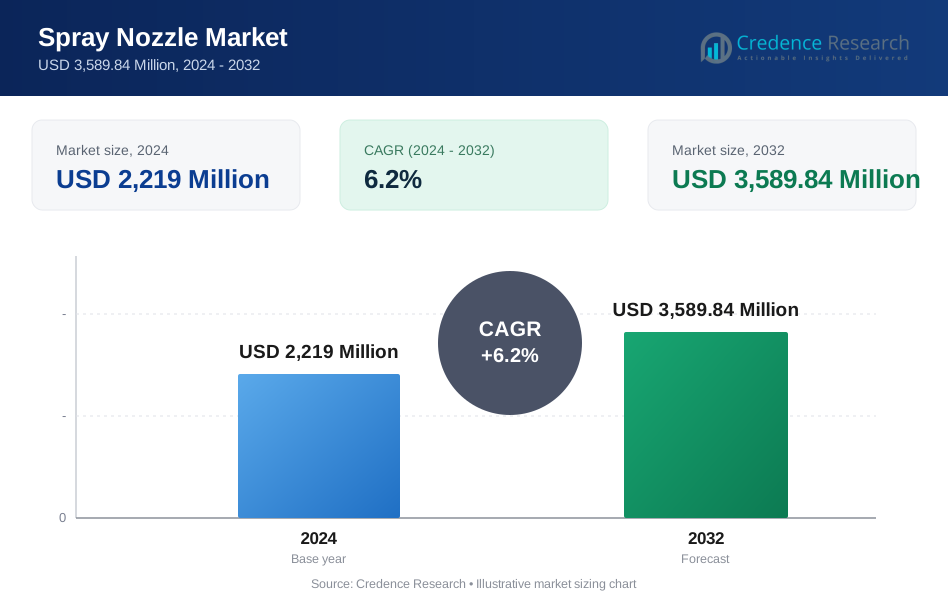
Spray Nozzle Market size was valued USD 2,219 Million in 2024 and is anticipated to reach USD 3,589.84 Million by 2032, at a CAGR of 6.2% during the forecast period.
| REPORT ATTRIBUTE | DETAILS |
|---|---|
| Historical Period | 2020-2023 |
| Base Year | 2024 |
| Forecast Period | 2025-2032 |
| Spray Nozzle Market Size 2024 | USD 2,219 million |
| Spray Nozzle Market, CAGR | 6.2% |
| Spray Nozzle Market Size 2032 | USD 3,589.84 million |
Spray Nozzle Market Insights
- Market overview highlights strong demand from manufacturing, agriculture, chemicals, food processing, and oil and gas sectors, with Industrial Manufacturing leading the end-user segment with 36.2% share in 2024 due to extensive use in cooling, coating, cleaning, and surface-treatment processes.
- Markets driver focuses on automation, precision spraying, environmental compliance, and efficiency-driven production operations, supported by the adoption of advanced hydraulic and flat-fan nozzle technologies across industrial and agricultural applications.
- Markets trends and analysis indicate technology upgrades, durability-enhanced materials, and product innovation among key players, who focus on customization capability and application-specific spray performance to strengthen market positioning.
- Regional analysis shows Asia-Pacific as the leading region with 38.7% share in 2024, followed by North America with 24.5% and Europe with 22.3%, driven by industrial expansion, process modernization, and increased mechanized agriculture usage across major economies.
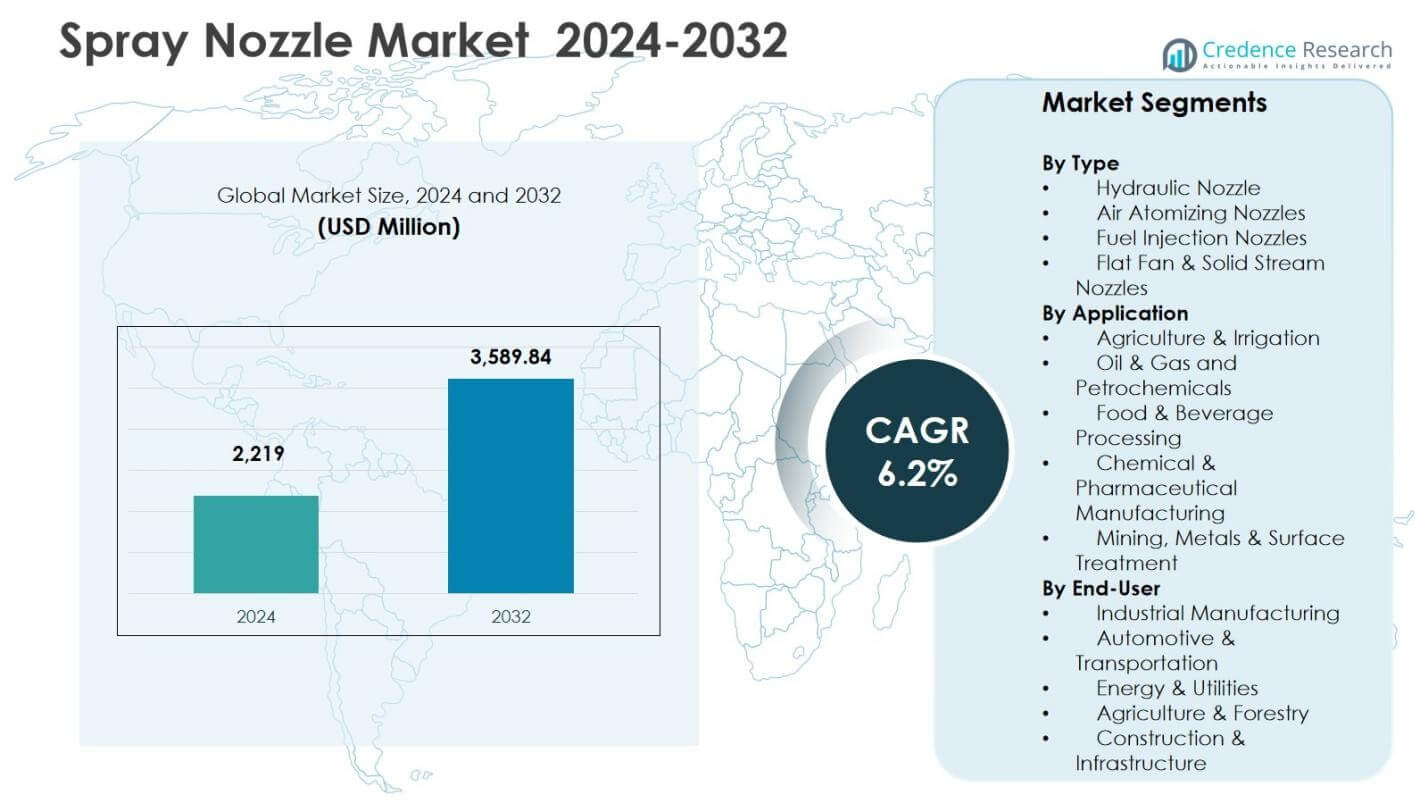
Spray Nozzle Market Segmentation Analysis:
By Type:
The Spray Nozzle Market shows strong diversification across hydraulic, air-atomizing, fuel-injection, and flat fan & solid stream designs; however, Hydraulic Nozzles dominated the segment with a 34.6% market share in 2024, driven by their reliability, lower operating cost, and widespread suitability for industrial washing, cooling, and coating operations. Air-atomizing nozzles gained demand in precision spraying, while fuel-injection nozzles advanced with engine efficiency initiatives. Flat fan and solid stream nozzles expanded adoption in cleaning and surface-treatment applications, supported by process automation and productivity-enhancement requirements across manufacturing environments.
- For instance, Lechler provides hydraulic atomizing nozzles like VarioSpray HP for petrochemical cooling towers, enabling variable flow rates and uniform droplet sizes across viscosities for consistent heat transfer.
By Application:
The market recorded broad deployment across agriculture, oil & gas, food processing, chemicals, and metals processing, with Agriculture & Irrigation emerging as the dominant application segment, accounting for 28.9% market share in 2024. Growth is driven by the increasing use of precision spraying, drip-irrigation upgrades, and crop-protection chemical application. Oil & gas and petrochemicals benefited from higher safety and fire-suppression requirements, while food & beverage processing relied on hygienic spray technologies. Chemical and pharmaceutical manufacturing, along with mining and surface-treatment operations, accelerated adoption to improve coating uniformity and process efficiency.
- For instance, TeeJet Technologies provides precision spraying solutions like the DynaJet system, featuring nozzles, valves, and control systems that optimize chemical application, reduce waste, and minimize environmental impact.
By End-User:
Adoption remains strong across multiple industries, led by Industrial Manufacturing, which held a dominant 36.2% market share in 2024, supported by rising demand for spray systems in cooling, coating, cleaning, lubrication, and surface finishing. Automotive and transportation users expanded nozzle deployment in paint shops and component treatment, while energy & utilities leveraged spraying solutions in gas-scrubbing and cooling towers. Agriculture & forestry contributed through crop-spray machinery usage, and construction & infrastructure applications grew due to demand for dust-suppression, curing, and material-treatment processes across large-scale project environments.
Key Growth Drivers
Rising Industrial Automation and Process Optimization
The Spray Nozzle Market experiences strong growth as industries increasingly automate production lines and optimize fluid-handling processes. Automated spraying systems enhance accuracy in coating, cooling, washing, lubrication, and surface treatment, reducing material waste and energy consumption. Manufacturers adopt precision-engineered nozzles to improve throughput, maintain consistent product quality, and meet stringent process-control standards across automotive, electronics, metals, and food processing sectors. The growing preference for smart factories and digitally monitored spraying operations further accelerates adoption, as companies prioritize operational efficiency, cost reduction, and resource optimization in high-volume manufacturing environments.
- For instance, Xin Hou supplies custom spray systems for automotive lubrication, enabling uniform application of even wax-based lubes to minimize coating consumption and enhance sustainability.
Expansion of Agriculture and Crop Protection Practices
Agriculture remains a major demand contributor as modern farming adopts advanced spraying technologies for irrigation, pesticide delivery, and nutrient application. Precision agriculture encourages the use of specialized spray nozzles that ensure uniform droplet distribution, reduced chemical drift, and optimized field coverage. Governments promote sustainable farming practices, and farmers invest in high-efficiency spraying equipment to improve crop yields and minimize environmental impact. The expansion of mechanized farming in developing regions, combined with increasing global food demand and the shift toward controlled spraying systems, significantly strengthens market growth across agricultural applications.
- For instance, John Deere's See & Spray Ultimate system uses 36 cameras across the boom to detect weeds in real time, activating nozzles spaced every 20 inches for targeted spraying on crops like corn and soybeans.
Growth in Environmental Compliance and Industrial Safety Standards
The market benefits from tightening environmental and workplace safety regulations across industries such as chemicals, oil and gas, pharmaceuticals, and mining. Spray nozzles support emission control, dust suppression, gas scrubbing, fire suppression, and hazardous material handling, helping plants comply with regulatory frameworks and occupational safety mandates. Industries adopt advanced nozzle systems to improve containment efficiency, reduce pollutant discharge, and enhance worker protection in sensitive processing environments. The emphasis on sustainability, cleaner production practices, and risk-mitigation strategies fuels continuous upgrades and replacement demand for high-performance and corrosion-resistant spray nozzle solutions.
Key Trends & Opportunities
Integration of Smart Spray Technologies and Digital Monitoring
A major trend shaping the Spray Nozzle Market is the integration of smart monitoring systems and digitally controlled spraying technologies. Industries increasingly deploy automated flow-control units, pressure sensors, and IoT-enabled spray systems to achieve real-time performance tracking, fault detection, and predictive maintenance. Digital calibration enhances spraying precision, reduces downtime, and ensures consistent droplet dispersion across applications such as cooling towers, painting systems, and chemical processing. The transition toward Industry 4.0 environments creates significant opportunities for intelligent spray platforms, adaptive nozzle configurations, and software-driven spray optimization for high-complexity industrial operations.
- For instance, Lechler offers a rotation monitoring sensor for its tank cleaning nozzles, such as the XactClean HP 2 series. The sensor records liquid flow over its tip to track nozzle performance, with software adjustments for tank size, pressure, and nozzle specifics, enabling fault detection and maintenance alerts.
Rising Demand for Specialty and Application-Specific Nozzle Designs
The market witnesses expanding opportunities through the development of customized and application-specific spray nozzle solutions. Industries increasingly require specialized droplet patterns, flow rates, and material compatibility for niche processes such as micro-coating, pharmaceutical sterilization, food sanitation, and high-temperature metallurgy. Manufacturers invest in advanced materials such as ceramics, stainless steel alloys, and engineered polymers to improve wear resistance and chemical durability. The shift toward tailored spray performance, combined with the growth of additive manufacturing for complex nozzle geometries, enables greater design flexibility and supports innovation across industrial and agricultural spraying applications.
- For instance, ARCI engineered energy-efficient De-Laval nozzles using air as process gas for cold spraying Ni-Cr alloy coatings in high-temperature applications, achieving dense coatings that endured 1000 hours of thermal cycling at 1100°C with superior oxidation resistance.
Key Challenges
Fluctuating Raw Material Costs and Manufacturing Complexity
The Spray Nozzle Market faces challenges due to volatility in raw material prices, particularly stainless steel, alloys, engineered plastics, and ceramic composites used in precision nozzle manufacturing. High-accuracy production requirements increase machining, testing, and quality-control costs, impacting profit margins and limiting affordability for cost-sensitive users. Smaller manufacturers struggle to balance material quality with price competitiveness, while supply chain disruptions create lead-time uncertainties. The need for technically skilled labor, combined with stringent production tolerances and certification standards, further increases operational complexity and poses hurdles to large-scale manufacturing expansion.
Maintenance Sensitivity and Performance Reliability Issues
Operational performance of spray nozzles depends heavily on proper maintenance, calibration, and cleaning, which presents challenges in harsh industrial and agricultural environments. Blockages, wear, corrosion, and chemical residue buildup can degrade spray patterns, increase fluid consumption, and reduce application efficiency. Users often face downtime due to nozzle replacement or frequent servicing, especially in sectors involving abrasive fluids or particulate-laden processes. Limited awareness of maintenance best practices in developing markets further affects lifecycle performance and drives higher operational costs, compelling end-users to trade off between reliability, longevity, and budget constraints.
Regional Analysis
North America
North America holds a significant position in the Spray Nozzle Market, driven by strong adoption across industrial manufacturing, automotive coating, food processing, and oil and gas operations. The region benefits from advanced automation infrastructure, high technology penetration, and strong compliance with environmental and safety regulations that encourage the use of precision spraying systems. Demand is further supported by investments in smart factories and process-optimization projects across the United States and Canada. In 2024, North America accounted for 24.5% market share, reflecting its strong industrial base and continuous upgrades in production and emission-control applications.
Europe
Europe demonstrates steady growth in the Spray Nozzle Market, supported by strong regulatory emphasis on energy efficiency, sustainability, and emissions reduction across process industries. The region witnesses high adoption in chemicals, pharmaceuticals, food and beverage hygiene applications, and metal finishing operations, particularly in Germany, Italy, France, and the United Kingdom. Ongoing modernization of water treatment, agricultural spraying, and environmental management systems further strengthens demand for precision-engineered nozzles. Manufacturers in the region also focus on material innovation and high-performance spray technologies. Europe accounted for 22.3% market share in 2024, reflecting its technologically advanced industrial ecosystem and quality-driven production standards.
Asia-Pacific
Asia-Pacific represents the fastest-expanding region in the Spray Nozzle Market, supported by rapid industrialization, large-scale manufacturing expansion, and increasing mechanized agriculture adoption across China, India, Japan, and Southeast Asia. Growing investments in electronics, automotive production, chemicals, mining, and infrastructure construction drive strong deployment of spraying solutions for coating, cooling, dust suppression, and process efficiency improvement. The region also benefits from government-led industrial development initiatives and rising adoption of precision spraying in crop protection and irrigation. In 2024, Asia-Pacific emerged as the leading regional market with 38.7% market share, reflecting its strong production capacities and expanding industrial value chain.
Latin America
Latin America shows stable growth in the Spray Nozzle Market, supported by increasing application across agriculture, mining, food processing, and petrochemical operations in countries such as Brazil, Mexico, Argentina, and Chile. Rising mechanized farming practices and expanding agribusiness activities contribute to higher demand for crop-spraying and irrigation nozzles. Industrial modernization projects in metals, pulp and paper, and chemical processing further strengthen adoption. The region continues to transition toward efficiency-focused spraying technologies, although investment cycles remain influenced by economic conditions. Latin America accounted for 7.8% market share in 2024, reflecting gradual expansion supported by agricultural and industrial process upgrades.
Middle East & Africa
The Middle East & Africa region records increasing demand in the Spray Nozzle Market, driven by expanding oil and gas operations, water treatment initiatives, mining activities, and infrastructure development programs. Industrial users adopt spraying technologies for gas scrubbing, fire protection, cooling, cleaning, and dust-suppression processes across refineries, utilities, and construction projects. Growing investments in food processing and desalination facilities also support market growth, alongside the gradual adoption of modern irrigation practices in select agricultural areas. In 2024, the Middle East & Africa region accounted for 6.7% market share, reflecting emerging industrial activity and ongoing process-efficiency enhancements across key sectors.
Spray Nozzle Market Segmentations:
By Type
- Hydraulic Nozzle
- Air Atomizing Nozzles
- Fuel Injection Nozzles
- Flat Fan & Solid Stream Nozzles
By Application
- Agriculture & Irrigation
- Oil & Gas and Petrochemicals
- Food & Beverage Processing
- Chemical & Pharmaceutical Manufacturing
- Mining, Metals & Surface Treatment
By End-User
- Industrial Manufacturing
- Automotive & Transportation
- Energy & Utilities
- Agriculture & Forestry
- Construction & Infrastructure
By Geography
- North America
- U.S.
- Canada
- Mexico
- Europe
- Germany
- France
- U.K.
- Italy
- Spain
- Rest of Europe
- Asia Pacific
- China
- Japan
- India
- South Korea
- South-east Asia
- Rest of Asia Pacific
- Latin America
- Brazil
- Argentina
- Rest of Latin America
- Middle East & Africa
- GCC Countries
- South Africa
- Rest of the Middle East and Africa
Competitive Landscape
Spraying Systems Co., BETE, Lechler Inc., H.IKEUCHI & Co., Ltd., Delavan, TeeJet Technologies, Hunter Industries (Senninger), Viking Group Inc., MISUMI Corporation, and Pneumadyne lead the Spray Nozzle Market, shaping innovation, product development, and global supply networks. The market reflects a mix of specialized engineering firms and diversified industrial manufacturers that compete through precision performance, material durability, customization capability, and application-specific design portfolios. Companies strengthen their positions by expanding smart spraying systems, corrosion-resistant materials, and energy-efficient nozzle technologies to meet stringent process-quality and environmental-compliance requirements across manufacturing, agriculture, chemicals, and oil and gas sectors. Strategic investments in automation-ready spray systems, digital monitoring, and advanced droplet-control mechanisms support product differentiation, while partnerships with equipment OEMs and distributors enhance global market reach. Overall, the landscape is defined by technological expertise, continuous product enhancement, and strong after-sales support focused on performance reliability and lifecycle efficiency.
Key Player Analysis
- Spraying Systems Co.
- BETE
- Lechler Inc.
- H.IKEUCHI & Co., Ltd.
- Delavan (Beckett Company)
- Hunter Industries (Senninger)
- TeeJet Technologies
- Viking Group Inc.
- Pneumadyne
- MISUMI Corporation
Recent Developments
- In December 2025, Hunter Industries introduced its Pro High-Efficiency Adjustable Nozzles, which won the 2025 New Product Contest award for delivering uniform coverage and water savings in irrigation applications.
- In September 2025, Lechler GmbH launched the PopUp Whirly Air nozzle, a high-efficiency cleaning nozzle designed for optimized cleaning with reduced air consumption, unveiled at POWTECH TECHNOPHARM in Nuremberg, Germany.
- In October 2025, SuperKlean launched NozzlePro, a new division offering industrial spray nozzles with improved availability and support for food processing and industrial plants.
Report Coverage
The research report offers an in-depth analysis based on Type, Application, End User and Geography. It details leading market players, providing an overview of their business, product offerings, investments, revenue streams, and key applications. Additionally, the report includes insights into the competitive environment, SWOT analysis, current market trends, as well as the primary drivers and constraints. Furthermore, it discusses various factors that have driven market expansion in recent years. The report also explores market dynamics, regulatory scenarios, and technological advancements that are shaping the industry. It assesses the impact of external factors and global economic changes on market growth. Lastly, it provides strategic recommendations for new entrants and established companies to navigate the complexities of the market.
Future Outlook
- The market will grow as industries adopt precision spraying solutions to improve process efficiency and product quality.
- Demand will increase with the expansion of automated manufacturing and digitally controlled spray systems.
- Agriculture will continue to generate strong adoption through mechanized spraying and precision crop-protection practices.
- Environmental regulations will drive the use of nozzles for emission control, dust suppression, and wastewater treatment.
- Manufacturers will invest in advanced materials and wear-resistant designs to enhance durability and lifecycle performance.
- Smart, sensor-enabled spray technologies will gain traction across automotive, chemical, and electronics applications.
- Custom and application-specific nozzle engineering will expand to meet niche industrial and high-precision process needs.
- Replacement and retrofit demand will rise as industries upgrade aging spraying equipment and adopt efficiency-focused systems.
- Emerging economies will strengthen market growth through industrialization, infrastructure development, and agricultural modernization.
- Collaboration between nozzle manufacturers and equipment OEMs will support innovation and broaden application coverage across end-use sectors.
Request a Free Sample
Fill in your details and we'll send you a free sample report.
- Sample data tables & charts
- Research methodology
Need a Custom Version of This Report?
Tailor the scope, geography, or segments to your exact requirements.
- Custom geography or segment scope
- Direct access to our analyst team
Frequently Asked Questions
What is the current market size for Spray Nozzle Market, and what is its projected size in 2032?
At what Compound Annual Growth Rate is the Spray Nozzle Market projected to grow between 2024 and 2032?
Which Spray Nozzle Market segment held the largest share in 2024?
What are the primary factors fueling the growth of the Spray Nozzle Market?
Who are the leading companies in the Spray Nozzle Market?
Which region commanded the largest share of the Spray Nozzle Market in 2024?
Table of Content
Chapter 1. Report Introduction
- 1.1 Report Description & Purpose
- 1.1.1 Report Title & Market Definition
- 1.1.2 Unique Selling Propositions (USP) & Key Differentiators
- 1.1.3 Value Proposition for Stakeholders
- 1.2 Research Objectives
- 1.2.1 Market Sizing Objectives (Volume & Revenue) (Volume Where Applicable)
- 1.2.2 Segmentation Objectives
- 1.2.3 Competitive Intelligence Objectives
- 1.2.4 Forecast & Scenario Objectives
- 1.3 Report Scope
- 1.3.1 Spray Nozzle Scope – Segments & Subsegments Covered
- 1.3.2 Geographic Scope – Regions & Countries Covered
- 1.3.3 Historical Period, Base Year & Forecast Period (2024; forecast to 2032)
- 1.3.4 Inclusions & Exclusions
- 1.4 Industry Classification & Applicable Codes
- 1.5 Currency, Measurement Units & Valuation Basis
- 1.6 Target Stakeholders
- 1.7 Limitations & Assumptions
Chapter 2. Executive Summary
- 2.1 Global Spray Nozzle Market Snapshot
- 2.1.1 Market Size – Historical (2024) & Forecast (2024-2032) (2024: USD 2,219 Million → 2032: USD 3,589.84 Million)
- 2.1.2 Volume & Revenue – Global Totals (Volume Where Applicable)
- 2.1.3 Key Market Highlights – Top Five Facts
- 2.2 Spray Nozzle Market Segmentation Snapshot
- 2.2.1 Market Split by Region – 2024 vs. 2032
- 2.3 Competitive Snapshot
- 2.3.1 Top 10 Players by Revenue Share – 2024
- 2.3.2 Top 10 Players by Volume Share – 2024 (Volume Where Applicable)
- 2.3.3 Recent Strategic Developments (18-Month Summary)
- 2.4 Key Investment Highlights & Strategic Conclusions
Chapter 3. Spray Nozzle Market Dynamics & Industry Analysis
- 3.1 Market Overview & Context
- 3.1.1 Spray Nozzle Market Position in the Broader Industry Value Chain
- 3.1.2 Demand Structure & Purchasing Dynamics
- 3.1.3 Market Maturity & Development Stage by Region
- 3.2 Spray Nozzle Market Drivers
- 3.3 Spray Nozzle Market Restraints & Challenges
- 3.4 Spray Nozzle Market Opportunities
- 3.5 Porter's Five Forces Analysis
- 3.5.1 Threat of New Entrants
- 3.5.2 Bargaining Power of Suppliers
- 3.5.3 Bargaining Power of Buyers
- 3.5.4 Threat of Substitutes
- 3.5.5 Competitive Rivalry – Intensity Assessment
- 3.6 Spray Nozzle Value Chain Analysis
- 3.6.1 Upstream – Key Inputs, Resources & Suppliers
- 3.6.1.1 Key Input/Resource 1
- 3.6.1.2 Key Input/Resource 2
- 3.6.1.3 Key Input/Resource 3
- 3.6.2 Midstream – Core Operations & Value Creation
- 3.6.2.1 Operating Model & Process Overview
- 3.6.2.2 Key Operating Locations & Capabilities by Company
- 3.6.3 Downstream – Market Channels & End Users
- 3.6.3.1 Direct Sales & Customer Engagement Channels
- 3.6.3.2 Indirect Sales, Intermediaries & Partner Channels
- 3.6.4 Value Chain Profitability Analysis
- 3.6.1 Upstream – Key Inputs, Resources & Suppliers
- 3.7 PESTEL Analysis
- 3.7.1 Political Factors
- 3.7.2 Economic Factors
- 3.7.3 Social Factors
- 3.7.4 Technological Factors
- 3.7.5 Environmental Factors
- 3.7.6 Legal Factors
- 3.8 Spray Nozzle Supply Chain Analysis
- 3.8.1 Critical Input & Resource Availability Risk Assessment
- 3.8.2 Supplier & Operational Concentration Risk (Geographic Exposure)
- 3.8.3 Supply & Service Disruption Impact Analysis
- 3.9 Regulatory & Policy Landscape
Note: The regulatory and policy landscape section covers regulations based on their applicability to the market, Spray Nozzle category, geography, and scope of the study. Only regulatory frameworks with a material impact on operations, compliance, trade, sustainability, or market access are analyzed in detail.
Chapter 4. Key Investment Pockets & Opportunity Analysis
- 4.1 Spray Nozzle Market Attractiveness Analysis
- 4.1.1 By Region – Investment Attractiveness Matrix (Market Size × CAGR)
- 4.2 Absolute Revenue Growth Opportunity
- 4.2.1 By Region – Absolute Revenue Growth Through 2032
- 4.3 Incremental Demand Opportunity
- 4.3.1 By Region – Incremental Demand Through 2032
- 4.3.2 Segment – Incremental Demand
- 4.4 Emerging Submarket Opportunity Deep Dive (Subject to Applicability)
- 4.5 Priority Market Opportunity Scorecards
- 4.5.1 United States
- 4.5.2 Europe
- 4.5.3 Asia
- 4.5.4 Middle East & Africa
Note: Priority market opportunity scorecards reflect the geographic scope and strategic relevance of the study. Listed markets are indicative and may be adapted to the industry.
Chapter 5. Spray Nozzle Cross-Border Trade & Market Access Analysis
- 5.1 International Trade & Cross-Border Activity Overview
- 5.1.1 Global Export Value by Country (2024)
- 5.1.2 Global Export Volume by Country (2024) (Volume Where Applicable)
- 5.1.3 Global Import Value by Country (2024)
- 5.1.4 Global Import Volume by Country (2024) (Volume Where Applicable)
- 5.1.5 Net Trade Balance by Country (2024)
- 5.2 Export Analysis – Segment
- 5.2.1 Category 1 (Applicable Classification Code)
- 5.2.2 Category 2 (Applicable Classification Code)
- 5.2.3 Category 3 (Applicable Classification Code)
- 5.2.4 Category 4 (Applicable Classification Code)
- 5.2.5 Category 5 (Applicable Classification Code)
- 5.3 Import Analysis – Segment
- 5.3.1 Category 1 (Applicable Classification Code)
- 5.3.2 Category 2 (Applicable Classification Code)
- 5.3.3 Category 3 (Applicable Classification Code)
- 5.3.4 Category 4 (Applicable Classification Code)
- 5.3.5 Category 5 (Applicable Classification Code)
- 5.4 Cross-Border Pricing & Transaction Benchmarks
- 5.4.1 Export Pricing – Segment & Country
- 5.4.2 Import Pricing – Segment & Source Country
- 5.4.3 Price Trends (2024)
- 5.5 Key Cross-Border Trade & Delivery Routes
- 5.5.1 Cross-Border Trade/Delivery Route 1
- 5.5.2 Cross-Border Trade/Delivery Route 2
- 5.5.3 Cross-Border Trade/Delivery Route 3
- 5.5.4 Cross-Border Trade/Delivery Route 4
- 5.5.5 Cross-Border Trade/Delivery Route 5
- 5.6 Trade Policy & Market Access Impact Assessment
- 5.6.1 Tariff & Non-Tariff Barriers
- 5.6.2 Regional Trade & Economic Integration Frameworks
- 5.6.3 Bilateral & Multilateral Trade Agreements
- 5.6.4 Cross-Border Operating, Licensing & Localization Requirements
Note: This chapter applies where cross-border trade or delivery is relevant to Spray Nozzle. Goods, services, and digital offerings are assessed using applicable classifications and transaction measures. Import-export volumes, trade balances, and route analyses are included only where meaningful to the market.
Chapter 6. Competitive Landscape & Company Benchmarking
- 6.1 Spray Nozzle Market Concentration & Structure
- 6.1.1 Herfindahl-Hirschman Index (HHI) – vs. 2024
- 6.1.2 Leading, Mid-Sized & Emerging Player Structure
- 6.1.3 Global, Regional & Local Player Dynamics
- 6.2 Spray Nozzle Market Share Analysis – 2024
- 6.2.1 Global Revenue Share by Company
- 6.2.2 Global Volume Share by Company (Volume Where Applicable)
- 6.2.3 Regional Revenue Share
- 6.2.4 Market Share Evolution ( vs. 2024)
- 6.2.5 Company Market Share by Key Segment
- 6.2.6 Company Market Share by Customer Group
- 6.3 Operating Scale, Capacity & Infrastructure Analysis
- 6.3.1 Global Operating Scale & Supply Capacity
- 6.3.2 Resource Utilization & Operating Efficiency
- 6.3.3 Output, Service Delivery & Activity Metrics
- 6.3.4 Operating Footprint & Infrastructure Map
- 6.3.5 Planned Operational & Capacity Expansion
- 6.4 Spray Nozzle Competitive Benchmarking Matrix
- 6.4.1 Revenue, Growth, Profitability & Operating Metric Comparison
- 6.4.2 Channel Revenue Mix
- 6.4.3 Geographic Revenue Exposure
- 6.4.4 R&D Intensity
- 6.4.5 Sustainability Maturity
- 6.5 Strategic Developments in Spray Nozzle (Last 24 Months)
- 6.5.1 Mergers, Acquisitions & Divestments
- 6.5.2 New Products, Services & Solutions in Spray Nozzle
- 6.5.3 Operational & Infrastructure Expansions
- 6.5.4 Strategic Alliances, Joint Ventures & Partnerships
- 6.5.5 Distribution Expansion & Market Entry
- 6.5.6 Sustainability & ESG Initiatives
- 6.6 Competitive Strategy Mapping
- 6.6.1 Leader, Challenger, Follower & Niche Classification
- 6.6.2 Pricing Strategy Comparison
- 6.6.3 Channel Strategy Matrix
Note: Strategic developments are included based on their materiality and the availability of reliable information.
Chapter 7. Global Spray Nozzle Market – By Sales & Delivery Channel
- 7.1 Segment Overview
- 7.1.1 Volume & Revenue Split by Channel (2024 & 2032) (Volume Where Applicable)
- 7.1.2 Channel Mix Evolution (2024-2032)
Chapter 8. Regional Market Analysis – Global Overview
- 8.1 Global Regional Overview
- 8.1.1 Regional Volume Share (Volume Where Applicable)
- 8.1.2 Regional Revenue Share
- 8.1.3 Regional Volume by Region (Volume Where Applicable)
- 8.1.4 Regional Revenue by Region
- 8.1.5 Regional Forecast Through 2032
- 8.2 Cross-Regional Segment Analysis
- 8.2.1 By Sales & Delivery Channel
- 8.2.2 By Competitive Positioning & Price Tier
Chapter 9. North America Spray Nozzle Market
- 9.1 United States
- 9.2 Canada
- 9.3 Mexico
Chapter 10. Europe Spray Nozzle Market
- 10.1 Germany
- 10.2 France
- 10.3 Italy
- 10.4 United Kingdom
- 10.5 Spain
- 10.6 Poland
- 10.7 Russia
- 10.8 Netherlands
- 10.9 Belgium
- 10.10 Sweden
- 10.11 Denmark
- 10.12 Norway
- 10.13 Rest of Europe
Chapter 11. Asia Pacific Spray Nozzle Market
- 11.1 China
- 11.2 India
- 11.3 Japan
- 11.4 South Korea
- 11.5 Thailand
- 11.6 Indonesia
- 11.7 Vietnam
- 11.8 Malaysia
- 11.9 Australia
- 11.10 Rest of Asia Pacific
Chapter 12. Latin America Spray Nozzle Market
- 12.1 Brazil
- 12.2 Argentina
- 12.3 Colombia
- 12.4 Chile
- 12.5 Rest of Latin America
Chapter 13. Middle East Spray Nozzle Market
- 13.1 Saudi Arabia
- 13.2 United Arab Emirates
- 13.3 Turkey
- 13.4 Israel
- 13.5 Iran
- 13.6 Rest of the Middle East
Chapter 14. Africa Spray Nozzle Market
- 14.1 South Africa
- 14.2 Egypt
- 14.3 Nigeria
- 14.4 Morocco
- 14.5 Rest of Africa
Chapter 15. Spray Nozzle Company Profiles
- 15.1 [Company 01]
- 15.1.1 Company Overview
- 15.1.2 Key Management Personnel
- 15.1.3 Products & Services Portfolio
- 15.1.4 Financial Performance
- 15.1.5 Key Market Focus & Geographic Presence
- 15.1.6 Recent Developments & Strategic Initiatives
Note: The company profile list is preliminary and may change based on research findings, market developments, data availability, and client requirements.
Chapter 16. Appendices
- Appendix A – List of Abbreviations & Acronyms
- Appendix B – Industry Classification Code Reference – Full Series
- Appendix C – Supply, Output & Operating Capacity Data Tables
- Appendix D – End-Use & Demand Base Tables
- Appendix E – Demand, Adoption & Usage Assumptions
- Appendix F – Pricing & Revenue Metric Reference Tables
- Appendix G – Company Operations & Infrastructure Database
- Appendix H – Cross-Border Trade & Activity Data Tables (Where Applicable)
- Appendix I – Regulatory Summary Tables
- Appendix J – Primary Research Participant List (Anonymized)
- Appendix K – Primary Research Questionnaire Framework
- Appendix L – Data Sources & Bibliography
- Appendix M – Market Size Divergence & Source Comparison
Chapter 17. Research Methodology
- 17.1 Research Framework & Philosophy
- 17.2 Secondary Research – Sources, Hierarchy & Data Extraction
- 17.3 Data Modeling – Bottom-Up & Top-Down Market Sizing
- 17.4 Primary Research – Stakeholder Framework, LOI & Sample Sizes
- 17.5 Forecast Methodology – Regression, Scenario & Sensitivity Analysis
- 17.6 Quality Control – Four-Layer Validation Framework
- 17.7 Limitations & Standard Assumptions
- 17.8 Disclaimer
