
Envelope Sealing Machines Market Overview:
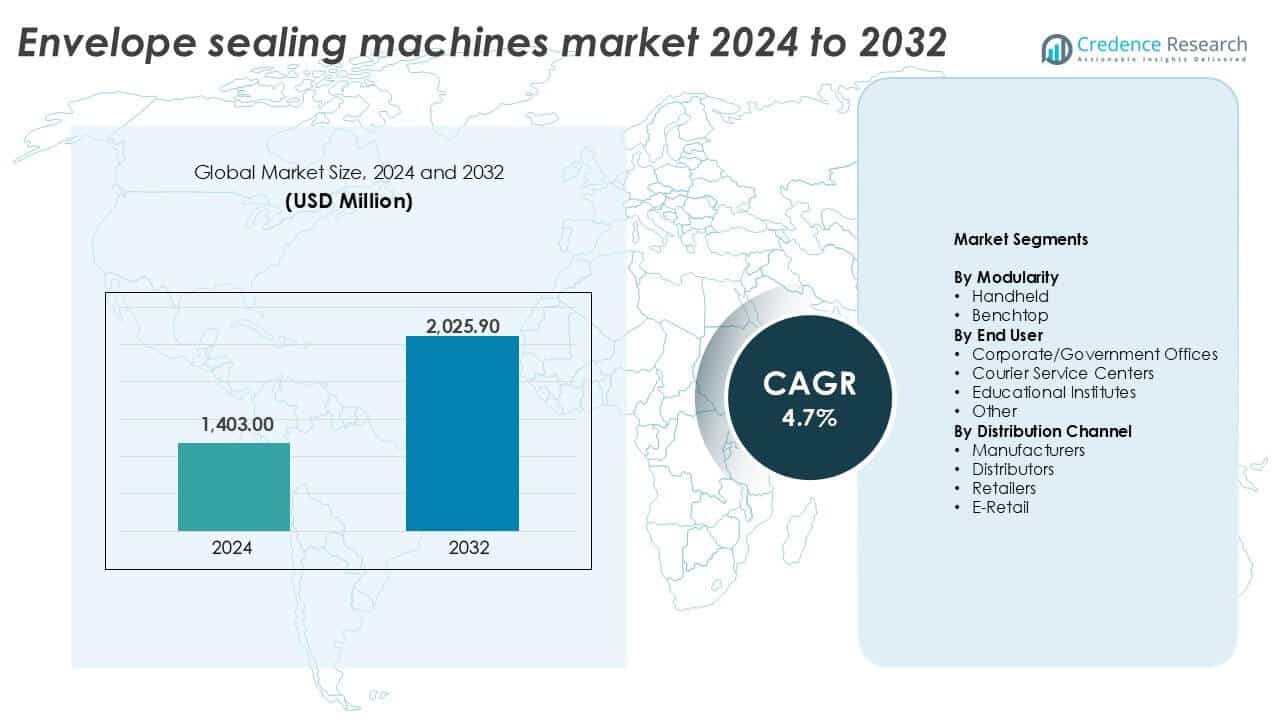
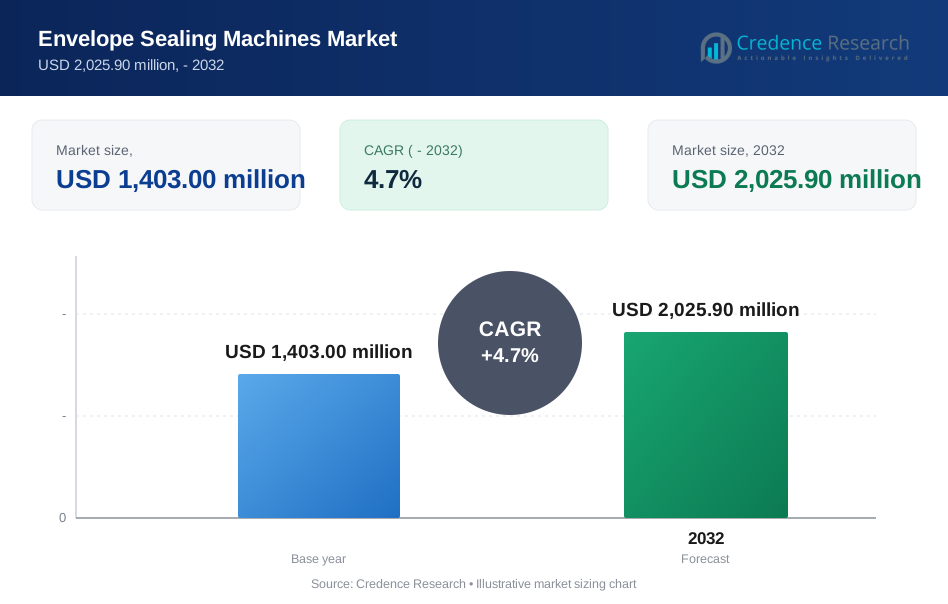
The Envelope Sealing Machines Market was valued at USD 1,403.00 million in 2024 and is anticipated to reach USD 2,025.90 million by 2032, growing at a CAGR of 4.7% during the forecast period.
| REPORT ATTRIBUTE | DETAILS |
|---|---|
| Historical Period | 2020-2024 |
| Base Year | 2025 |
| Forecast Period | 2026-2032 |
| Envelope Sealing Machines Market Size 2024 | USD 1,403.00 million |
| Envelope Sealing Machines Market, CAGR | 4.7% |
| Envelope Sealing Machines Market Size 2032 | USD 2,025.90million |
Envelope Sealing Machines Market Insights
- Rising demand for mailroom automation across government, logistics, and corporate sectors is a key driver supporting machine adoption.
- Integration of sealing machines with digital mailing systems and growing SME adoption through e-retail channels are notable market trends.
- Competitive intensity increases with companies like Postmatic, MAAG MERCURE AG, and DSY Packaging Machinery offering product innovations and strong distributor support.
- North America holds the largest share at 32%, followed by Europe at 27% and Asia Pacific at 22%, while benchtop modularity leads with a 58% segment share due to its efficiency in high-volume operations.
Envelope Sealing Machines Market Segmentation Analysis:
By Modularity
The benchtop segment holds the largest share in the envelope sealing machines market, accounting for over 58% in 2024. Organizations with high-volume mailing operations prefer benchtop models for faster output and higher throughput. These machines support bulk processing and improve mailing efficiency in administrative hubs. Handheld models find niche use in low-volume or mobile settings, such as field service applications or small offices. However, limited capacity and slower speed restrict their adoption. Market demand remains strong for benchtop units due to their durability, automation features, and compatibility with integrated mailing systems.
- For example, FP Mailing Solutions' PostBase Vision Advanced model processes up to 140 letters per minute, making it ideal for high-throughput applications.
By End User
Corporate and government offices dominate the market with a share of around 46% in 2024, driven by daily high-volume mail handling needs. These institutions benefit from envelope sealing machines for secure, quick, and consistent sealing across mass correspondence. Courier service centers follow as a major user group, leveraging automation to manage large mail and parcel flows efficiently. Educational institutes contribute moderate demand, primarily for administrative purposes and admissions-related communication. Other users include legal and healthcare offices, where confidentiality and productivity drive the use of envelope sealing equipment.
- For example, DHL deployed automated envelope and label sealing units across over 300 service hubs in Europe by 2023.
By Distribution Channel
Distributors lead the market with a 38% share in 2024, acting as primary intermediaries between manufacturers and end-users. Their regional presence and after-sales support encourage procurement through this channel. E-retail is growing rapidly due to broader product visibility, ease of comparison, and competitive pricing. Manufacturers also engage in direct sales, especially for customized or large-volume orders. Retailers maintain a smaller share, mainly serving small businesses and walk-in buyers. The shift toward digital procurement supports the rising penetration of online channels in this equipment category.
Key Growth Drivers
Rising Mailroom Automation Across Organizations
Organizations across sectors increasingly adopt mailroom automation to reduce labor costs and enhance operational speed. Envelope sealing machines play a key role in automating document dispatch, improving mail handling efficiency in government, banking, legal, and educational institutions. High-volume correspondence processes benefit from reduced manual workload and improved sealing consistency. Demand grows in large offices and logistics hubs where speed and accuracy are critical. Firms aim to reduce mailing errors, boost staff productivity, and standardize output across branches. Technological advancements in sealing machines such as programmable settings, higher throughput rates, and integration with mailing software further drive adoption. This shift supports long-term cost savings and ensures data security in sensitive mail handling, reinforcing the value of automation.
- For instance, Pitney Bowes’ SendPro MailCenter line supports over 200 letters per minute and integrates directly with cloud-based postage software used in Fortune 500 firms.
Growing Demand from Courier and Logistics Providers
Envelope sealing machines find growing relevance in courier and logistics companies as e-commerce expansion drives package and document volume. Service providers rely on fast, accurate sealing for secure delivery of official papers, contracts, invoices, and sensitive records. These machines help speed up order processing and reduce tampering risks in B2B and B2C transactions. Leading courier hubs automate mail dispatch functions to meet service-level agreements and maintain consistent output under high workloads. With cross-border documentation and compliance needs increasing, demand for reliable sealing equipment grows. Integration with barcode labeling and tracking software enhances workflow efficiency. This trend contributes to greater operational throughput in logistics chains and expands the machine's relevance beyond traditional office use.
- For instance, FP Mailing Solutions reported steady growth of 13.7% in its SaaS-based digital solutions in 2023, despite a challenging economic environment that led to a slight decline in overall revenue for its Mailing and Digital Business
Expansion of Educational and Public Sector Infrastructure
Expansion of educational institutions, municipal facilities, and public sector infrastructure contributes significantly to market growth. These institutions regularly manage administrative tasks like enrollment communication, testing notices, and official certificates. Reliable, secure, and bulk envelope sealing systems become necessary to support rising document flow across departments. Governments also modernize legacy mailing systems, triggering procurement of automated sealing solutions. Public tenders increasingly include mailroom equipment, especially in developing economies upgrading civic service delivery. This growth is further supported by initiatives to digitize recordkeeping and improve administrative turnaround time. Sealing machines assist in maintaining operational security while ensuring large-scale communication remains uninterrupted during admissions, elections, or policy outreach programs.
Key Trends & Opportunities
Integration with Digital Mailing Systems
A major trend shaping the envelope sealing machines market is the integration with digital and smart mailing systems. Businesses demand systems that combine printing, folding, sealing, and tracking into unified platforms. Sealing machines now feature programmable interfaces, touchscreen controls, and compatibility with enterprise software. This supports seamless bulk mail management and document authentication. Vendors offer modular upgrades, allowing businesses to scale functionality. The integration reduces time-to-mail and enhances document tracking. The rising use of hybrid mail where physical letters are generated from digital instructions further boosts this trend. Opportunities exist for manufacturers to innovate smart sealing solutions with IoT, cloud connectivity, and real-time monitoring features.
- For instance, Pitney Bowes’ SendPro C Auto series supports address validation, postage tracking, and cloud diagnostics, and is deployed in over 10,000 U.S. government offices.
Growth in E-Retail and SME Adoption
Small and medium enterprises (SMEs) increasingly adopt compact and cost-effective sealing solutions to streamline communication and improve professionalism. Many of these businesses operate on lean staff structures and benefit from machines that automate manual tasks. E-retail platforms expand product reach, enabling SMEs to access diverse models at competitive pricing. This shift also allows sealing machine vendors to offer direct-to-customer models and remote tech support. Online tutorials, bundled servicing, and performance warranties build trust with small business buyers. As SME formation rises across developing countries, the need for scalable office infrastructure presents strong growth opportunities for entry-level sealing machines.
Key Challenges
Shift Toward Paperless Communication
The global shift toward paperless workflows remains a primary challenge for the envelope sealing machines market. Many enterprises reduce physical mailing due to rising digital transformation, e-invoicing, and document management systems. Customer communication, billing, and records increasingly move to email and cloud platforms, cutting demand for physical envelopes. Government agencies also promote electronic documentation to reduce costs and enhance accessibility. While certain legal and regulatory functions still require physical documents, the overall volume has declined. This trend poses a long-term threat to the market, especially in highly digitized economies. Manufacturers must counter this with multi-functionality and integration with hybrid mail setups.
High Maintenance and Operational Downtime
Another critical challenge involves equipment maintenance and downtime risks, especially in high-volume environments. Envelope sealing machines involve moving parts and adhesives that may clog, jam, or wear out with extended use. Frequent servicing and cleaning add to operational costs. Unplanned breakdowns in critical sectors like legal, logistics, or government can disrupt communication workflows. Many users lack in-house technical support and rely on vendor maintenance contracts, increasing service dependency. Inconsistent sealing or machine calibration issues also affect output quality. As businesses seek high uptime performance, vendors face pressure to offer more reliable and low-maintenance machines, along with strong after-sales support.
Regional Analysis
North America
North America leads the envelope sealing machines market with a share of approximately 32% in 2024. High adoption of mailroom automation in government, legal, and corporate sectors drives demand. The U.S. dominates the region due to its large administrative infrastructure and logistics networks. Courier companies and public institutions favor high-speed benchtop models for secure document handling. Growing e-commerce activities support the integration of sealing machines in last-mile delivery hubs. Canada also contributes through public sector investments and digitization of civic services. The region benefits from strong vendor presence and advanced equipment availability across distribution channels.
Europe
Europe holds around 27% market share, supported by widespread use of mailing equipment across public administration and financial institutions. Germany, France, and the UK lead demand due to organized corporate ecosystems and compliance-driven mail processes. Legal documentation and customer correspondence remain high in volume, supporting consistent demand. Government procurement and tenders for mailroom automation further accelerate adoption. Postal reforms and the modernization of public services encourage the shift from manual sealing to automated systems. The presence of global and regional manufacturers improves product accessibility, while sustainability regulations push for energy-efficient and compact machine designs.
Asia Pacific
Asia Pacific accounts for nearly 22% of the envelope sealing machines market in 2024 and is the fastest-growing region. Expansion of public sector infrastructure, particularly in India, China, and Southeast Asia, drives demand. Educational institutions, administrative offices, and courier networks invest in cost-effective sealing solutions to improve document handling. SMEs show growing interest in compact benchtop models sold via e-retail platforms. Japan and South Korea contribute steady demand through tech-enabled mailing workflows. Rising awareness of workplace automation and growing logistics operations support long-term regional growth. The region presents opportunities for mid-range and entry-level equipment vendors.
Latin America
Latin America holds a modest market share of about 9%, with Brazil and Mexico leading regional demand. Government offices, healthcare institutions, and educational bodies are key buyers of sealing machines. The region’s demand stems from the need to improve manual document handling and reduce processing delays. Vendors see opportunities through distributor networks offering localized service support. Economic recovery efforts post-pandemic push investments in office efficiency tools. While automation adoption is slower than developed regions, growing urbanization and expanding administrative functions contribute to gradual market growth. Cost-sensitive buyers prefer affordable, low-maintenance models.
Middle East & Africa (MEA)
The Middle East & Africa region represents roughly 10% of the envelope sealing machines market. GCC countries, especially the UAE and Saudi Arabia, invest in mailroom equipment as part of digital government initiatives. Administrative hubs and courier operations demand reliable sealing systems for official communication. Africa’s adoption remains limited but shows potential through international aid agencies, universities, and expanding postal services. The market is driven by efforts to modernize civic infrastructure and improve documentation processes. Limited local manufacturing creates dependency on imports, making distributor support and maintenance services crucial for long-term adoption.
Envelope Sealing Machines Market Segmentations:
By Modularity
- Handheld
- Benchtop
By End User
- Corporate/Government Offices
- Courier Service Centers
- Educational Institutes
- Other
By Distribution Channel
- Manufacturers
- Distributors
- Retailers
- E-Retail
By Geography
- North America
- U.S.
- Canada
- Mexico
- Europe
- Germany
- France
- U.K.
- Italy
- Spain
- Rest of Europe
- Asia Pacific
- China
- Japan
- India
- South Korea
- South-east Asia
- Rest of Asia Pacific
- Latin America
- Brazil
- Argentina
- Rest of Latin America
- Middle East & Africa
- GCC Countries
- South Africa
- Rest of the Middle East and Africa
Competitive Landscape
The envelope sealing machines market features a moderately fragmented competitive landscape with a mix of global manufacturers and specialized regional players. Companies compete based on machine speed, automation features, durability, and after-sales service. Key players such as Postmatic, MAAG MERCURE AG, and Mailing Machines focus on high-performance benchtop systems catering to large-scale mailrooms and logistics hubs. Chinese manufacturers like DSY Packaging Machinery Co., Ltd. and Wenzhou Caishun Packing Machinery Co., Ltd. gain traction with cost-effective models aimed at SMEs and developing markets. Innovation remains critical, with firms integrating smart controls, compact footprints, and energy-efficient designs. Partnerships with distributors and e-retail platforms expand geographic reach, especially in Asia and Latin America. Aftermarket services and maintenance support influence customer retention. As digital transformation pressures paper-based workflows, leading vendors diversify offerings into multifunctional mailroom solutions to sustain relevance. Competitive intensity is expected to rise as automation demand grows across public and private sectors.
Key Player Analysis
- Postmatic
- DSY Packaging Machinery Co., Ltd.
- Mailing Machines
- MAAG MERCURE AG
- Jialida Industry Company
- Wenzhou Caishun Packing Machinery Co., Ltd.
- YIWU INNOVO PRINTING MACHINERY CO., LTD.
- Addressing & Mailing Solutions Ltd.
- TyPac Inc.
Report Coverage
The research report offers an in-depth analysis based on Modularity, End-User, Distribution Channel and Geography. It details leading market players, providing an overview of their business, product offerings, investments, revenue streams, and key applications. Additionally, the report includes insights into the competitive environment, SWOT analysis, current market trends, as well as the primary drivers and constraints. Furthermore, it discusses various factors that have driven market expansion in recent years. The report also explores market dynamics, regulatory scenarios, and technological advancements that are shaping the industry. It assesses the impact of external factors and global economic changes on market growth. Lastly, it provides strategic recommendations for new entrants and established companies to navigate the complexities of the market.
Future Outlook
- Demand will grow steadily with rising adoption of automated mailing systems in public and private sectors.
- Integration of sealing machines with digital and hybrid mail solutions will become more common.
- Courier and logistics sectors will drive strong machine replacement and upgrade cycles.
- Compact and energy-efficient models will see increased demand among small and mid-sized enterprises.
- Manufacturers will focus on offering multi-functional sealing systems with programmable features.
- Online distribution channels will gain more traction, especially in emerging markets.
- North America will maintain dominance due to strong logistics infrastructure and mail volume.
- Asia Pacific will grow fastest as administrative and institutional capacities expand.
- Cost-sensitive models from regional manufacturers will challenge premium international brands.
- Shifts toward paperless communication will push vendors to diversify product offerings.
Request a Free Sample
Fill in your details and we'll send you a free sample report.
- Sample data tables & charts
- Research methodology
Need a Custom Version of This Report?
Tailor the scope, geography, or segments to your exact requirements.
- Custom geography or segment scope
- Direct access to our analyst team
Frequently Asked Questions
What is the current market size for Envelope sealing machines market, and what is its projected size in 2032?
At what Compound Annual Growth Rate is the Envelope sealing machines market projected to grow between 2024 and 2032?
Which Envelope sealing machines market segment held the largest share in 2024?
What are the primary factors fueling the growth of the Envelope sealing machines market?
Who are the leading companies in the Envelope sealing machines market?
Which region commanded the largest share of the Envelope sealing machines market in 2024?
Table of Content
Chapter 1. Report Introduction
- 1.1 Report Description & Purpose
- 1.1.1 Report Title & Market Definition
- 1.1.2 Unique Selling Propositions (USP) & Key Differentiators
- 1.1.3 Value Proposition for Stakeholders
- 1.2 Research Objectives
- 1.2.1 Market Sizing Objectives (Volume & Revenue) (Volume Where Applicable)
- 1.2.2 Segmentation Objectives
- 1.2.3 Competitive Intelligence Objectives
- 1.2.4 Forecast & Scenario Objectives
- 1.3 Report Scope
- 1.3.1 Envelope Sealing Machines Scope – Segments & Subsegments Covered
- 1.3.2 Geographic Scope – Regions & Countries Covered
- 1.3.3 Historical Period, Base Year & Forecast Period (the historical period; forecast to 2032)
- 1.3.4 Inclusions & Exclusions
- 1.4 Industry Classification & Applicable Codes
- 1.5 Currency, Measurement Units & Valuation Basis
- 1.6 Target Stakeholders
- 1.7 Limitations & Assumptions
Chapter 2. Executive Summary
- 2.1 Global Envelope Sealing Machines Market Snapshot
- 2.1.1 Market Size – Historical (the historical period) & Forecast (2032) (base year: USD 1,403.00 million → 2032: USD 2,025.90 million)
- 2.1.2 Volume & Revenue – Global Totals (Volume Where Applicable)
- 2.1.3 Key Market Highlights – Top Five Facts
- 2.2 Envelope Sealing Machines Market Segmentation Snapshot
- 2.2.1 Market Split by Region – vs. 2032
- 2.3 Competitive Snapshot
- 2.3.1 Top 10 Players by Revenue Share –
- 2.3.2 Top 10 Players by Volume Share – (Volume Where Applicable)
- 2.3.3 Recent Strategic Developments (18-Month Summary)
- 2.4 Key Investment Highlights & Strategic Conclusions
Chapter 3. Envelope Sealing Machines Market Dynamics & Industry Analysis
- 3.1 Market Overview & Context
- 3.1.1 Envelope Sealing Machines Market Position in the Broader Industry Value Chain
- 3.1.2 Demand Structure & Purchasing Dynamics
- 3.1.3 Market Maturity & Development Stage by Region
- 3.2 Envelope Sealing Machines Market Drivers
- 3.3 Envelope Sealing Machines Market Restraints & Challenges
- 3.4 Envelope Sealing Machines Market Opportunities
- 3.5 Porter's Five Forces Analysis
- 3.5.1 Threat of New Entrants
- 3.5.2 Bargaining Power of Suppliers
- 3.5.3 Bargaining Power of Buyers
- 3.5.4 Threat of Substitutes
- 3.5.5 Competitive Rivalry – Intensity Assessment
- 3.6 Envelope Sealing Machines Value Chain Analysis
- 3.6.1 Upstream – Key Inputs, Resources & Suppliers
- 3.6.1.1 Key Input/Resource 1
- 3.6.1.2 Key Input/Resource 2
- 3.6.1.3 Key Input/Resource 3
- 3.6.2 Midstream – Core Operations & Value Creation
- 3.6.2.1 Operating Model & Process Overview
- 3.6.2.2 Key Operating Locations & Capabilities by Company
- 3.6.3 Downstream – Market Channels & End Users
- 3.6.3.1 Direct Sales & Customer Engagement Channels
- 3.6.3.2 Indirect Sales, Intermediaries & Partner Channels
- 3.6.4 Value Chain Profitability Analysis
- 3.6.1 Upstream – Key Inputs, Resources & Suppliers
- 3.7 PESTEL Analysis
- 3.7.1 Political Factors
- 3.7.2 Economic Factors
- 3.7.3 Social Factors
- 3.7.4 Technological Factors
- 3.7.5 Environmental Factors
- 3.7.6 Legal Factors
- 3.8 Envelope Sealing Machines Supply Chain Analysis
- 3.8.1 Critical Input & Resource Availability Risk Assessment
- 3.8.2 Supplier & Operational Concentration Risk (Geographic Exposure)
- 3.8.3 Supply & Service Disruption Impact Analysis
- 3.9 Regulatory & Policy Landscape
Note: The regulatory and policy landscape section covers regulations based on their applicability to the market, Envelope Sealing Machines category, geography, and scope of the study. Only regulatory frameworks with a material impact on operations, compliance, trade, sustainability, or market access are analyzed in detail.
Chapter 4. Key Investment Pockets & Opportunity Analysis
- 4.1 Envelope Sealing Machines Market Attractiveness Analysis
- 4.1.1 By Region – Investment Attractiveness Matrix (Market Size × CAGR)
- 4.2 Absolute Revenue Growth Opportunity
- 4.2.1 By Region – Absolute Revenue Growth Through 2032
- 4.3 Incremental Demand Opportunity
- 4.3.1 By Region – Incremental Demand Through 2032
- 4.3.2 Segment – Incremental Demand
- 4.4 Emerging Submarket Opportunity Deep Dive (Subject to Applicability)
- 4.5 Priority Market Opportunity Scorecards
- 4.5.1 United States
- 4.5.2 Europe
- 4.5.3 Asia
- 4.5.4 Middle East & Africa
Note: Priority market opportunity scorecards reflect the geographic scope and strategic relevance of the study. Listed markets are indicative and may be adapted to the industry.
Chapter 5. Envelope Sealing Machines Cross-Border Trade & Market Access Analysis
- 5.1 International Trade & Cross-Border Activity Overview
- 5.1.1 Global Export Value by Country (the historical period)
- 5.1.2 Global Export Volume by Country (the historical period) (Volume Where Applicable)
- 5.1.3 Global Import Value by Country (the historical period)
- 5.1.4 Global Import Volume by Country (the historical period) (Volume Where Applicable)
- 5.1.5 Net Trade Balance by Country (the historical period)
- 5.2 Export Analysis – Segment
- 5.2.1 Category 1 (Applicable Classification Code)
- 5.2.2 Category 2 (Applicable Classification Code)
- 5.2.3 Category 3 (Applicable Classification Code)
- 5.2.4 Category 4 (Applicable Classification Code)
- 5.2.5 Category 5 (Applicable Classification Code)
- 5.3 Import Analysis – Segment
- 5.3.1 Category 1 (Applicable Classification Code)
- 5.3.2 Category 2 (Applicable Classification Code)
- 5.3.3 Category 3 (Applicable Classification Code)
- 5.3.4 Category 4 (Applicable Classification Code)
- 5.3.5 Category 5 (Applicable Classification Code)
- 5.4 Cross-Border Pricing & Transaction Benchmarks
- 5.4.1 Export Pricing – Segment & Country
- 5.4.2 Import Pricing – Segment & Source Country
- 5.4.3 Price Trends (the historical period)
- 5.5 Key Cross-Border Trade & Delivery Routes
- 5.5.1 Cross-Border Trade/Delivery Route 1
- 5.5.2 Cross-Border Trade/Delivery Route 2
- 5.5.3 Cross-Border Trade/Delivery Route 3
- 5.5.4 Cross-Border Trade/Delivery Route 4
- 5.5.5 Cross-Border Trade/Delivery Route 5
- 5.6 Trade Policy & Market Access Impact Assessment
- 5.6.1 Tariff & Non-Tariff Barriers
- 5.6.2 Regional Trade & Economic Integration Frameworks
- 5.6.3 Bilateral & Multilateral Trade Agreements
- 5.6.4 Cross-Border Operating, Licensing & Localization Requirements
Note: This chapter applies where cross-border trade or delivery is relevant to Envelope Sealing Machines. Goods, services, and digital offerings are assessed using applicable classifications and transaction measures. Import-export volumes, trade balances, and route analyses are included only where meaningful to the market.
Chapter 6. Competitive Landscape & Company Benchmarking
- 6.1 Envelope Sealing Machines Market Concentration & Structure
- 6.1.1 Herfindahl-Hirschman Index (HHI) – vs.
- 6.1.2 Leading, Mid-Sized & Emerging Player Structure
- 6.1.3 Global, Regional & Local Player Dynamics
- 6.2 Envelope Sealing Machines Market Share Analysis –
- 6.2.1 Global Revenue Share by Company
- 6.2.2 Global Volume Share by Company (Volume Where Applicable)
- 6.2.3 Regional Revenue Share
- 6.2.4 Market Share Evolution ( vs. )
- 6.2.5 Company Market Share by Key Segment
- 6.2.6 Company Market Share by Customer Group
- 6.3 Operating Scale, Capacity & Infrastructure Analysis
- 6.3.1 Global Operating Scale & Supply Capacity
- 6.3.2 Resource Utilization & Operating Efficiency
- 6.3.3 Output, Service Delivery & Activity Metrics
- 6.3.4 Operating Footprint & Infrastructure Map
- 6.3.5 Planned Operational & Capacity Expansion
- 6.4 Envelope Sealing Machines Competitive Benchmarking Matrix
- 6.4.1 Revenue, Growth, Profitability & Operating Metric Comparison
- 6.4.2 Channel Revenue Mix
- 6.4.3 Geographic Revenue Exposure
- 6.4.4 R&D Intensity
- 6.4.5 Sustainability Maturity
- 6.5 Strategic Developments in Envelope Sealing Machines (Last 24 Months)
- 6.5.1 Mergers, Acquisitions & Divestments
- 6.5.2 New Products, Services & Solutions in Envelope Sealing Machines
- 6.5.3 Operational & Infrastructure Expansions
- 6.5.4 Strategic Alliances, Joint Ventures & Partnerships
- 6.5.5 Distribution Expansion & Market Entry
- 6.5.6 Sustainability & ESG Initiatives
- 6.6 Competitive Strategy Mapping
- 6.6.1 Leader, Challenger, Follower & Niche Classification
- 6.6.2 Pricing Strategy Comparison
- 6.6.3 Channel Strategy Matrix
Note: Strategic developments are included based on their materiality and the availability of reliable information.
Chapter 7. Global Envelope Sealing Machines Market – By Sales & Delivery Channel
- 7.1 Segment Overview
- 7.1.1 Volume & Revenue Split by Channel ( & 2032) (Volume Where Applicable)
- 7.1.2 Channel Mix Evolution (2032)
Chapter 8. Regional Market Analysis – Global Overview
- 8.1 Global Regional Overview
- 8.1.1 Regional Volume Share (Volume Where Applicable)
- 8.1.2 Regional Revenue Share
- 8.1.3 Regional Volume by Region (Volume Where Applicable)
- 8.1.4 Regional Revenue by Region
- 8.1.5 Regional Forecast Through 2032
- 8.2 Cross-Regional Segment Analysis
- 8.2.1 By Sales & Delivery Channel
- 8.2.2 By Competitive Positioning & Price Tier
Chapter 9. North America Envelope Sealing Machines Market
- 9.1 United States
- 9.2 Canada
- 9.3 Mexico
Chapter 10. Europe Envelope Sealing Machines Market
- 10.1 Germany
- 10.2 France
- 10.3 Italy
- 10.4 United Kingdom
- 10.5 Spain
- 10.6 Poland
- 10.7 Russia
- 10.8 Netherlands
- 10.9 Belgium
- 10.10 Sweden
- 10.11 Denmark
- 10.12 Norway
- 10.13 Rest of Europe
Chapter 11. Asia Pacific Envelope Sealing Machines Market
- 11.1 China
- 11.2 India
- 11.3 Japan
- 11.4 South Korea
- 11.5 Thailand
- 11.6 Indonesia
- 11.7 Vietnam
- 11.8 Malaysia
- 11.9 Australia
- 11.10 Rest of Asia Pacific
Chapter 12. Latin America Envelope Sealing Machines Market
- 12.1 Brazil
- 12.2 Argentina
- 12.3 Colombia
- 12.4 Chile
- 12.5 Rest of Latin America
Chapter 13. Middle East Envelope Sealing Machines Market
- 13.1 Saudi Arabia
- 13.2 United Arab Emirates
- 13.3 Turkey
- 13.4 Israel
- 13.5 Iran
- 13.6 Rest of the Middle East
Chapter 14. Africa Envelope Sealing Machines Market
- 14.1 South Africa
- 14.2 Egypt
- 14.3 Nigeria
- 14.4 Morocco
- 14.5 Rest of Africa
Chapter 15. Envelope Sealing Machines Company Profiles
- 15.1 [Company 01]
- 15.1.1 Company Overview
- 15.1.2 Key Management Personnel
- 15.1.3 Products & Services Portfolio
- 15.1.4 Financial Performance
- 15.1.5 Key Market Focus & Geographic Presence
- 15.1.6 Recent Developments & Strategic Initiatives
Note: The company profile list is preliminary and may change based on research findings, market developments, data availability, and client requirements.
Chapter 16. Appendices
- Appendix A – List of Abbreviations & Acronyms
- Appendix B – Industry Classification Code Reference – Full Series
- Appendix C – Supply, Output & Operating Capacity Data Tables
- Appendix D – End-Use & Demand Base Tables
- Appendix E – Demand, Adoption & Usage Assumptions
- Appendix F – Pricing & Revenue Metric Reference Tables
- Appendix G – Company Operations & Infrastructure Database
- Appendix H – Cross-Border Trade & Activity Data Tables (Where Applicable)
- Appendix I – Regulatory Summary Tables
- Appendix J – Primary Research Participant List (Anonymized)
- Appendix K – Primary Research Questionnaire Framework
- Appendix L – Data Sources & Bibliography
- Appendix M – Market Size Divergence & Source Comparison
Chapter 17. Research Methodology
- 17.1 Research Framework & Philosophy
- 17.2 Secondary Research – Sources, Hierarchy & Data Extraction
- 17.3 Data Modeling – Bottom-Up & Top-Down Market Sizing
- 17.4 Primary Research – Stakeholder Framework, LOI & Sample Sizes
- 17.5 Forecast Methodology – Regression, Scenario & Sensitivity Analysis
- 17.6 Quality Control – Four-Layer Validation Framework
- 17.7 Limitations & Standard Assumptions
- 17.8 Disclaimer
