
Market Overview:
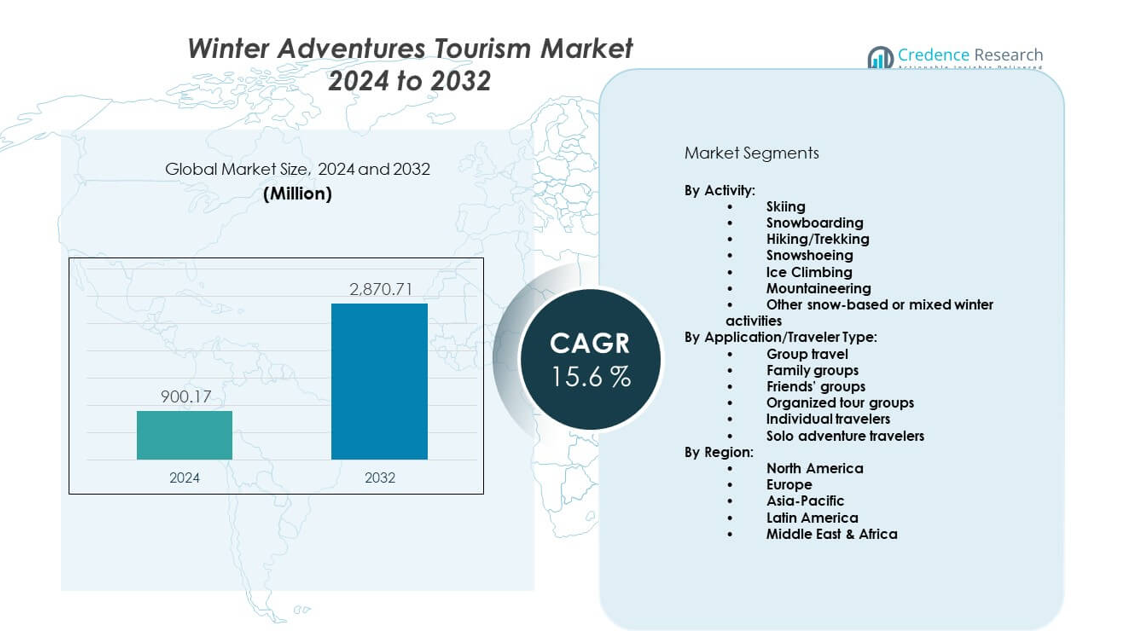
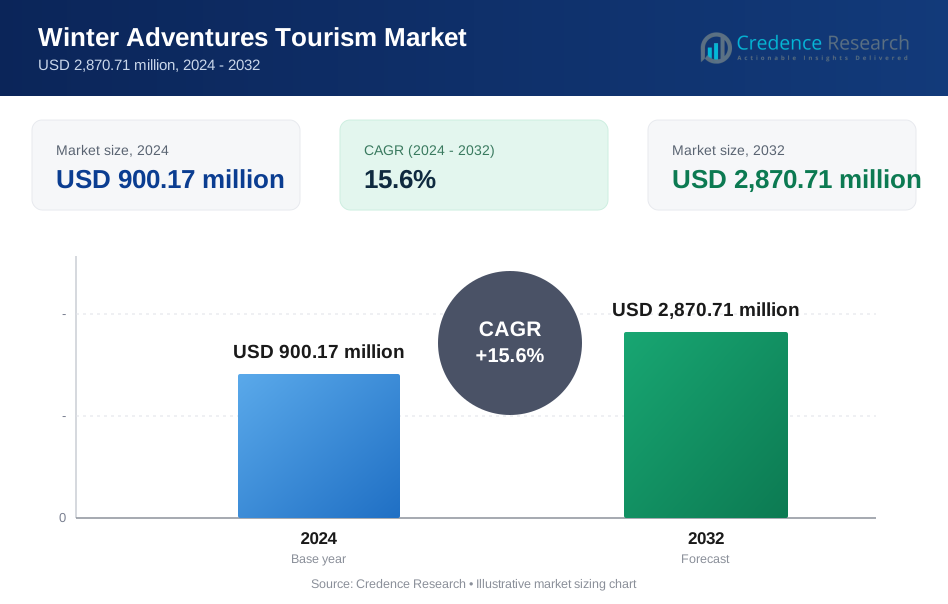
The Winter Adventures Tourism Market is projected to grow from USD 900.17 million in 2024 to an estimated USD 2,870.71 million by 2032, with a compound annual growth rate (CAGR) of 15.6% from 2024 to 2032.
| REPORT ATTRIBUTE | DETAILS |
|---|---|
| Historical Period | 2020-2023 |
| Base Year | 2024 |
| Forecast Period | 2025-2032 |
| Winter Adventures Tourism Market Size 2024 | USD 900.17 million |
| Winter Adventures Tourism Market, CAGR | 15.6% |
| Winter Adventures Tourism Market Size 2032 | USD 2,870.71 million |
Growing demand comes from travelers who prefer unique cold-season experiences across diverse terrains. Adventure operators expand service quality by offering guided trails, safer gear, and flexible packages. Winter sports gain wide attention due to social media visibility and rising wellness travel habits. Younger groups choose snow trekking, ice climbing, and ski training due to higher access to equipment rentals. Tour agencies design bundled packages that include lodging, local culture, and transport support. It helps travelers explore remote landscapes with structured safety standards. Rising interest in seasonal events also boosts global bookings.
North America leads due to strong ski infrastructure, established winter resorts, and high adventure participation. Europe follows with Alpine destinations that attract global visitors seeking premium snow activities and guided expeditions. Asia Pacific emerges due to rapid development of mountain sports hubs and rising interest among young travelers in countries like Japan, China, and South Korea. Latin America shows growing traction with expanding adventure zones in southern regions. The Middle East and Africa gain attention through niche cold-climate destinations and curated travel packages that support experiential tourism growth.
Market Insights:
- The Winter Adventures Tourism Market is projected to grow from USD 900.17 million in 2024 to USD 2,870.71 million by 2032, registering a strong CAGR of 15.6% driven by rising demand for seasonal, experience-focused winter travel.
- North America (38–40%), Europe (32–34%), and Asia-Pacific (18–20%) hold the highest shares due to advanced ski infrastructure, strong Alpine tourism, and rapid development of mountain sports hubs.
- Asia-Pacific, with an 18–20% share, stands as the fastest-growing region due to youth-driven interest, expanding winter resorts, and rising participation in snow sports.
- Skiing leads activity distribution with an estimated 40–42% share, supported by mature global resort networks and structured training programs.
- Group travel dominates traveler type distribution with a 45–48% share, driven by family, friends, and organized tour groups seeking guided and safe winter adventure packages.
Market Drivers:
Growing Demand for Experiential and Adventure-Focused Travel Experiences
The Winter Adventures Tourism Market grows through rising interest in unique winter experiences that attract young and seasoned travelers. People seek fresh outdoor challenges that create stronger emotional value. Many travelers prefer winter sports because these activities offer skill development and personal achievement. Tour operators respond by upgrading safety gear across major adventure routes. Resort owners design immersive programs that appeal to beginners and advanced users. Social media exposure strengthens global curiosity around winter escapes. It pushes travelers to explore remote destinations that feature snow trails and guided expeditions. Strong global travel intent supports steady business expansion.
- For instance, the Black Diamond JetForce Pro avalanche airbag uses a 200-liter deployable balloon. The system's jet-fan inflates the airbag to 100% capacity in approximately 3.5 seconds and then runs continuously for a total of 9 seconds before cycling periodically for three minutes to ensure the bag stays fully inflated and can recover from potential tears.
Rising Influence of Wellness, Fitness, and Outdoor Lifestyle Engagement
Growing focus on wellness encourages more travelers to join winter fitness activities that improve stamina and balance. People follow healthier lifestyles and want active holidays that deliver clear physical benefits. Resorts expand wellness sessions to support recovery after intense winter sports. Guided snow trails help users gain confidence while learning controlled movement. Many travelers seek nature immersion to escape crowded city environments. Rising awareness around mental health supports interest in calm winter landscapes. It attracts groups that choose slow adventure formats for better relaxation. The Winter Adventures Tourism Market benefits from broader leisure goals that promote active living.
- For instance, Vail Resorts integrates MyFitness technology across training centers, tracking heart-rate zones with sensors accurate to ±1 bpm. Guided snow trails help users gain confidence while learning controlled movement.
Improved Infrastructure Development Across Winter Destinations and Adventure Routes
Governments and private developers invest in modern resorts that enhance visitor flow and experience. New lift systems reduce wait times and improve access to high-altitude trails. Resorts upgrade snow-making machines to ensure stable activity schedules despite weather shifts. Better transport networks help travelers reach remote adventure spots faster. Operators improve lodging facilities for safe, warm, and comfortable stays. Investment in rescue technology increases traveler trust during demanding activities. It boosts participation among first-time users who need strong support systems. The Winter Adventures Tourism Market gains momentum through reliable infrastructure growth.
Growing Adoption of Digital Platforms That Improve Trip Planning and Adventure Safety
Digital tools improve booking accuracy and support smooth travel planning for winter trips. Apps display trail conditions, resort updates, and gear availability in real time. Travelers use online guides to compare skill-based activities before selecting winter packages. Safety platforms share quick alerts that help people manage sudden weather changes. GPS-enabled mapping tools support navigation across long snow routes. Interactive content increases traveler confidence by offering stepwise adventure guidance. It helps service providers engage users with tailored itineraries. Wider digital reach expands access for new adventure seekers.
Market Trends:
Rising Popularity of Hybrid Winter Experiences That Blend Culture, Food, and Adventure Activities
Travelers want winter experiences that blend sport activities with cultural events. Local cuisine tours add depth to winter itineraries by offering regional flavor. Resorts plan hybrid programs that mix night trails with heritage festivals. Younger travelers prefer multi-theme trips that expand their exposure to new traditions. It drives demand for curated packages that link adventure with culture. Many destinations market local crafts to elevate traveler interest. Communities support unique events that highlight regional identity. The Winter Adventures Tourism Market gains new visibility through these layered offerings.
- For instance, Norway’s Røros Winter Festival records annual attendance above 25,000 visitors, merging cultural showcases with outdoor winter experiences. The Winter Adventures Tourism Market gains new visibility through these layered offerings.
Expansion of Sustainable Tourism Practices and Low-Impact Winter Adventure Models
Environmental awareness pushes operators to design low-impact adventure formats that reduce land stress. Resorts adopt renewable energy systems to power lifts and support base camps. Waste-control programs ensure cleaner mountain zones during peak winter use. Refillable gear stations reduce plastic consumption across adventure hubs. Many travelers prefer eco-certified trails that protect natural habitats. It motivates operators to follow strict sustainability rules. Climate-sensitive management shapes new business plans across winter zones. Sustainable practices support long-term market appeal.
- For instance, Aspen Skiing Company runs its Elk Creek Mine methane-to-energy plant generating 3 MW of clean power annually. Waste-control programs ensure cleaner mountain zones during peak winter use.
Growing Demand for Technology-Enhanced Adventure Experiences and Smart Gear Adoption
Smart gear improves performance tracking and safety during winter activities. Wearable devices measure speed, altitude, and heart rate during ski sessions. Travelers adopt safety sensors that alert teams during sudden route changes. Interactive goggles stream navigation guidance to help users manage steep paths. Virtual training tools allow beginners to learn technique before real-world practice. It improves participation among new users who fear injury. Resorts promote intelligent gear packages that support advanced learning. The Winter Adventures Tourism Market embraces tech integration to elevate experience quality.
Increasing Interest in Niche Winter Sports and Lifestyle-Driven Micro-Adventure Segments
Niche sports gain attention from travelers who want uncommon winter challenges. Ice climbing attracts users who seek high-skill environments. Snowshoe trails appeal to people who want calm walks across remote areas. Fat biking gains traction in cold regions that support stable snow surfaces. Winter running events attract fitness groups that follow endurance goals. It builds community interest in compact travel formats. Destinations use these niche categories to stand out in a competitive space. Rising micro-adventure culture expands seasonal activity choices.
Market Challenges Analysis:
Weather Variability, Safety Concerns, and Uneven Infrastructure Development Across Winter Regions
Climate uncertainty disrupts winter schedules and reduces predictable sport conditions. Many regions face shorter snow cycles that limit organized activities. Resorts struggle to maintain snow cover without heavy infrastructure support. Safety concerns rise when conditions shift faster than expected. Travelers hesitate when routes lack proper rescue systems. Operators face high investment needs to match global safety standards. It creates operational pressure during peak travel months. The Winter Adventures Tourism Market must manage these weather and safety gaps with stronger planning.
High Travel Costs, Limited Accessibility, and Strong Season Dependency Across Key Destinations
Rising travel costs reduce access for budget travelers seeking winter activities. Remote adventure zones need long transport routes that increase spending. Limited airport access restricts visitor flow across high-altitude regions. Strong season dependency leads to revenue variation across the year. Operators struggle to maintain full-time staff outside peak months. It affects training cycles and service quality during early winter. Supply chains face stress during heavy snowfall periods. Many regions need new policies to support wider accessibility.
Market Opportunities:
Expansion of Experiential Tourism Programs and Wider Participation in Skill-Based Winter Activities
Destinations can develop structured training modules that attract new adventure groups. Resorts can add tiered skill paths that support steady learning and repeat visits. Guided programs can target families, solo travelers, and corporate groups. Cultural add-ons can elevate visitor time spent at winter hubs. It helps operators build loyalty across diverse traveler types. The Winter Adventures Tourism Market can unlock new revenue streams through these curated offerings. Many regions can introduce winter festivals to strengthen engagement. Cross-season programming can grow demand for off-peak periods.
Advancement of Digital Connectivity, Smart Gear Ecosystems, and Sustainable Tourism Models
Digital tools can expand reach by supporting real-time guidance and quick booking features. Smart gear can help travelers explore advanced trails without fear. Data-supported safety systems can improve rescue response times. Sustainable development can attract eco-focused travelers who prefer clean tourism models. It allows regions to promote long-term value creation. Resorts can shift toward renewable energy to strengthen brand appeal. Green certifications can build trust among global travelers. The Winter Adventures Tourism Market can scale through these future-ready models.
Market Segmentation Analysis:
By Activity
The Winter Adventures Tourism Market expands through strong participation across core winter activities. Skiing leads due to established resort ecosystems and structured training programs. Snowboarding attracts younger travelers who prefer freestyle terrains and flexible learning styles. Hiking and trekking across winter trails gain traction among groups that seek scenic exploration. Snowshoeing supports broader adoption because this activity suits various fitness levels. Ice climbing appeals to skilled users who want technical challenges. Mountaineering draws adventure travelers who favor multi-day expeditions. Other mixed winter activities help operators design diverse packages that fit changing traveler goals.
By Application/Traveler Type
Traveler diversity shapes steady growth across key categories in the Winter Adventures Tourism Market. Group travel remains dominant because families and friends prefer shared experiences during winter holidays. Family groups select safer guided routes and structured programs. Friends’ groups choose adventure-focused itineraries that offer stronger engagement. Organized tour groups depend on fixed schedules that simplify planning. Individual travelers explore flexible routes that match personal pace. Solo adventure travelers rely on guided safety systems while seeking independence. It supports broader market reach by meeting varied travel preferences across regions.
- For instance, G Adventures’ small-group format caps departures at 12–16 travelers to ensure guided support for solo users. It supports broader market reach by meeting varied travel preferences across regions.
Segmentation:
By Activity:
- Skiing
- Snowboarding
- Hiking/Trekking
- Snowshoeing
- Ice Climbing
- Mountaineering
- Other snow-based or mixed winter activities
By Application/Traveler Type:
- Group travel
- Family groups
- Friends’ groups
- Organized tour groups
- Individual travelers
- Solo adventure travelers
By Region:
- North America
- U.S.
- Canada
- Mexico
- Europe
- Germany
- France
- U.K.
- Italy
- Spain
- Rest of Europe
- Asia Pacific
- China
- Japan
- India
- South Korea
- South-east Asia
- Rest of Asia Pacific
- Latin America
- Brazil
- Argentina
- Rest of Latin America
- Middle East & Africa
- GCC Countries
- South Africa
- Rest of the Middle East and Africa
Regional Analysis:
North America
North America holds the largest share of the Winter Adventures Tourism Market with an estimated 40% share. Strong ski infrastructure supports heavy participation across major resort clusters. Canada and the United States attract travelers who seek structured winter programs and guided expeditions. Advanced safety systems improve trust among international visitors. Stable demand across family and group travel segments shapes consistent seasonal traffic. It benefits from broad domestic interest in winter sports and high spending on adventure travel. Regional operators invest in digital tools that support booking and trail updates.
Europe
Europe accounts for roughly 34% of global share due to its established Alpine destinations. Countries such as France, Switzerland, Austria, and Italy lead with world-class resorts and strong snow reliability. Cultural tourism blends with winter sports to attract long-stay travelers. Multi-country access across the Schengen region supports easy movement for adventure seekers. It benefits from dense ski towns that offer structured programs for all skill levels. Growing demand from Nordic regions strengthens interest in snowshoeing, cross-country trails, and niche winter sports. Tour operators expand curated packages that mix sport, tradition, and lifestyle experiences.
Asia-Pacific, Latin America, and Middle East & Africa
Asia-Pacific holds an emerging share of 20% supported by rapid infrastructure growth in Japan, China, and South Korea. Rising youth participation drives demand for snowboarding, trekking, and winter photography trails. Latin America maintains a smaller share of 5%, led by Chile and Argentina with strong Andean adventure routes. Middle East & Africa capture roughly 4%, driven by niche cold-climate destinations that appeal to premium travelers. It gains traction in developing markets where interest in seasonal experiences continues to rise. Regional governments promote winter adventure zones to diversify tourism. The Winter Adventures Tourism Market strengthens global reach through expanding access across new winter corridors.
Key Player Analysis:
- Mountain Travel Sobek
- Much Better Adventures
- Exodus Travels
- KE Adventure Travel
- G Adventures
- Norrøna Adventure
- Backroads
- Intrepid Travel
- Swoop Adventures
- Haka Tours
Competitive Analysis:
The Winter Adventures Tourism Market features strong competition among global and regional operators that specialize in guided tours, resort-based activities, and multi-day expeditions. Companies expand service portfolios to attract diverse travelers seeking ski sessions, cultural events, and hybrid winter experiences. Many operators invest in digital tools that improve booking accuracy and enhance route planning. Partnerships with local communities strengthen access to remote trails. It gains value from firms that integrate sustainability practices into travel programs. Market leaders differentiate through safety systems, skilled guides, and curated adventure packages. Strong brand credibility helps operators secure repeat travelers and long-stay bookings.
Recent Developments:
- In June 2025, Mountain Travel Sobek appointed Seth Heald as its new CEO. Heald brings over 20 years of entrepreneurial and operational experience, including founding Arizona Outback Adventures and leading REI's North America adventure operations. He succeeded Massimo Prioreschi, who guided MT Sobek through a transformative era. Additionally, in January 2025, MT Sobek capitalized on REI Adventures' exit from the adventure travel market by offering to accommodate rebooking customers, presenting itself as a trusted alternative with risk-free booking until January 31, 2025.
- In February 2025, Intrepid Travel acquired leading Dutch tour operator Sawadee Reizen from Travelopia in a landmark acquisition that completed on January 31, 2025. The deal added $100 million (€60 million) in revenue and an additional 20,000 customers a year to Intrepid, boosting EBITDA by an extra $5 million (€3 million). Additionally, in August 2025, Intrepid Travel fully acquired 100% of New Zealand-based Haka Tours, completing its acquisition which was initially announced in October 2021. Haka Tours now operates as Intrepid DMC New Zealand Limited, with Simon Mckearney appointed as Intrepid's first New Zealand Country Manager.
- In September 2024, Exodus Adventure Travels announced a strategic partnership with Priority Pass, making it the first adventure travel company to provide travelers with complimentary Priority Pass lounge access benefits at major North American airports. North American travelers who book guided Exodus Adventure Travels hiking, biking, cultural, or wildlife trips receive a complimentary one-year Priority Pass membership, including two complimentary visits to Priority Pass' 1,600+ airport lounges. Exodus also launched partnerships with Byway, the first 100 percent flight-free travel platform, as part of its climate action plan.
Report Coverage:
The research report offers an in-depth analysis based on By Activity and By Application/Traveler Type. It details leading market players, providing an overview of their business, product offerings, investments, revenue streams, and key applications. Additionally, the report includes insights into the competitive environment, SWOT analysis, current market trends, as well as the primary drivers and constraints. Furthermore, it discusses various factors that have driven market expansion in recent years. The report also explores market dynamics, regulatory scenarios, and technological advancements that are shaping the industry. It assesses the impact of external factors and global economic changes on market growth. Lastly, it provides strategic recommendations for new entrants and established companies to navigate the complexities of the market. [replace all segments in report coverage].
Future Outlook:
- Demand for multi-activity winter programs will increase across major adventure destinations.
- Digital tools will enhance booking speed and route planning for global travelers.
- Safety technologies will support higher participation from beginner-level users.
- Sustainable tourism models will attract eco-focused travelers seeking low-impact trips.
- Resorts will expand hybrid cultural and winter sports programs for wider appeal.
- Group travel will remain strong due to family-oriented and social travel behavior.
- Solo travel demand will grow among young adventure seekers with flexible schedules.
- Operators will add niche sports to diversify winter activity portfolios.
- Partnerships with local communities will expand access to remote trails.
- The Winter Adventures Tourism Market will benefit from stronger global promotion of seasonal adventure experiences.
Request a Free Sample
Fill in your details and we'll send you a free sample report.
- Sample data tables & charts
- Research methodology
Need a Custom Version of This Report?
Tailor the scope, geography, or segments to your exact requirements.
- Custom geography or segment scope
- Direct access to our analyst team
Frequently Asked Questions
What is the current market size for the Winter Adventures Tourism Market, and what is its projected size in 2032?
At what Compound Annual Growth Rate is the Winter Adventures Tourism Market projected to grow between 2025 and 2032?
Who are the key participants in the market for winter adventure tourism globally?
What are the leading market factors driving the winter adventures tourism sector?
What main market challenges prevent the winter adventures tourism sector from growing?
What are the leading market opportunities for the winter adventures tourism sector?
Who are the leading companies in the Winter Adventures Tourism Market?
Table of Content
Chapter 1. Report Introduction
- 1.1 Report Description & Purpose
- 1.1.1 Report Title & Market Definition
- 1.1.2 Unique Selling Propositions (USP) & Key Differentiators
- 1.1.3 Value Proposition for Stakeholders
- 1.2 Research Objectives
- 1.2.1 Market Sizing Objectives (Volume & Revenue)
- 1.2.2 Segmentation Objectives
- 1.2.3 Competitive Intelligence Objectives
- 1.2.4 Forecast & Scenario Objectives
- 1.3 Report Scope
- 1.3.1 Winter Adventures Tourism Scope – Types & Subtypes Covered
- 1.3.2 Geographic Scope – Regions & Countries Covered
- 1.3.3 Historical Period, Base Year & Forecast Period (2024; forecast to 2032)
- 1.3.4 Inclusions & Exclusions
- 1.4 HS Code & Classification Framework
- 1.5 Currency, Units & Pricing Basis
- 1.6 Target Stakeholders
- 1.7 Limitations & Assumptions
Chapter 2. Executive Summary
- 2.1 Global Winter Adventures Tourism Market Snapshot
- 2.1.1 Market Size – Historical (2024) & Forecast (2024-2032) (2024: USD 900.17 million → 2032: USD 2,870.71 million)
- 2.1.2 Volume & Revenue – Global Totals
- 2.1.3 Key Market Highlights – Top Five Facts
- 2.2 Winter Adventures Tourism Market Segmentation Snapshot
- 2.2.1 Market Split by Region – 2024 vs. 2032
- 2.3 Competitive Snapshot
- 2.3.1 Top 10 Players by Revenue Share – 2024
- 2.3.2 Top 10 Players by Volume Share – 2024
- 2.3.3 Recent Strategic Developments (18-Month Summary)
- 2.4 Key Investment Highlights & Strategic Conclusions
Chapter 3. Winter Adventures Tourism Market Dynamics & Industry Analysis
- 3.1 Market Overview & Context
- 3.1.1 Winter Adventures Tourism Market Position in the Broader Automotive Value Chain
- 3.1.2 OEM vs. Replacement Market Dynamics
- 3.1.3 Market Maturity & Development Stage by Region
- 3.2 Winter Adventures Tourism Market Drivers
- 3.3 Winter Adventures Tourism Market Restraints & Challenges
- 3.4 Winter Adventures Tourism Market Opportunities
- 3.5 Porter's Five Forces Analysis
- 3.5.1 Threat of New Entrants
- 3.5.2 Bargaining Power of Suppliers
- 3.5.3 Bargaining Power of Buyers
- 3.5.4 Threat of Substitutes
- 3.5.5 Competitive Rivalry – Intensity Assessment
- 3.6 Winter Adventures Tourism Value Chain Analysis
- 3.6.1 Upstream – Raw Material/Input Suppliers
- 3.6.1.1 Raw Material/Input 1
- 3.6.1.2 Raw Material/Input 2
- 3.6.1.3 Raw Material/Input 3
- 3.6.2 Midstream – Production/Manufacturing/Service Delivery
- 3.6.2.1 Production/Process Overview
- 3.6.2.2 Key Facility Locations & Capacity by Manufacturer
- 3.6.3 Downstream – Distribution & End Consumer
- 3.6.3.1 Primary Channel – B2B/OEM
- 3.6.3.2 Secondary Channels – Dealer, Retail, Online, Direct
- 3.6.4 Value Chain Profitability Analysis
- 3.6.1 Upstream – Raw Material/Input Suppliers
- 3.7 PESTEL Analysis
- 3.7.1 Political Factors
- 3.7.2 Economic Factors
- 3.7.3 Social Factors
- 3.7.4 Technological Factors
- 3.7.5 Environmental Factors
- 3.7.6 Legal Factors
- 3.8 Winter Adventures Tourism Supply Chain Analysis
- 3.8.1 Raw Material/Input Supply Risk Assessment
- 3.8.2 Manufacturing Concentration Risk (Geographic Exposure)
- 3.8.3 Trade Disruption Impact Analysis
- 3.9 Regulatory & Policy Landscape
Note: The regulatory and policy landscape section covers regulations based on their applicability to the market, Winter Adventures Tourism category, geography, and scope of the study. Only regulatory frameworks with a material impact on operations, compliance, trade, sustainability, or market access are analyzed in detail.
Chapter 4. Key Investment Pockets & Opportunity Analysis
- 4.1 Winter Adventures Tourism Market Attractiveness Analysis
- 4.1.1 By Region – Investment Attractiveness Matrix (Volume × CAGR)
- 4.2 Absolute Revenue Growth Opportunity
- 4.2.1 By Region – Absolute USD Growth Through 2032
- 4.3 Incremental Volume Opportunity
- 4.3.1 By Region – Incremental Volume Through 2032
- 4.3.2 Segment – Incremental Volume
- 4.4 Emerging Submarket Opportunity Deep Dive (Subject to Applicability)
- 4.5 Emerging Market Opportunity Scorecards
- 4.5.1 United States
- 4.5.2 Europe
- 4.5.3 Asia
- 4.5.4 Middle East & Africa
Note: Emerging Market Opportunity Scorecards will be included based on relevance and strategic importance. Regions listed are indicative and may vary depending on data availability and market dynamics.
Chapter 5. Winter Adventures Tourism Import-Export Analysis & Trade Flows
- 5.1 Global Trade Overview
- 5.1.1 Global Export Value by Country (2024)
- 5.1.2 Global Export Volume by Country (2024)
- 5.1.3 Global Import Value by Country (2024)
- 5.1.4 Global Import Volume by Country (2024)
- 5.1.5 Net Trade Balance by Country (2024)
- 5.2 Export Analysis – Segment
- 5.2.1 Type 1 (HS Code)
- 5.2.2 Type 2 (HS Code)
- 5.2.3 Type 3 (HS Code)
- 5.2.4 Type 4 (HS Code)
- 5.2.5 Type 5 (HS Code)
- 5.3 Import Analysis – Segment
- 5.3.1 Type 1 (HS Code)
- 5.3.2 Type 2 (HS Code)
- 5.3.3 Type 3 (HS Code)
- 5.3.4 Type 4 (HS Code)
- 5.3.5 Type 5 (HS Code)
- 5.4 Average Unit Trade Prices
- 5.4.1 Average Export Price – Segment & Country
- 5.4.2 Average Import Price – Segment & Source Country
- 5.4.3 Price Trends (2024)
- 5.5 Key Trade Route Analysis
- 5.5.1 Trade Route 1
- 5.5.2 Trade Route 2
- 5.5.3 Trade Route 3
- 5.5.4 Trade Route 4
- 5.5.5 Trade Route 5
- 5.6 Trade Policy Impact Assessment
- 5.6.1 US Anti-Dumping & Section 301 Tariffs
- 5.6.2 EU Customs Union Impact
- 5.6.3 Major Free Trade Agreements
- 5.6.4 USMCA Rules of Origin
Note: Trade policy analysis will be included only where relevant to the Winter Adventures Tourism market.
Chapter 6. Competitive Landscape & Company Benchmarking
- 6.1 Winter Adventures Tourism Market Concentration & Structure
- 6.1.1 Herfindahl-Hirschman Index (HHI) – vs. 2024
- 6.1.2 Tier 1, Tier 2 & Tier 3 Market Structure
- 6.1.3 Global, Regional & Local Player Dynamics
- 6.2 Winter Adventures Tourism Market Share Analysis – 2024
- 6.2.1 Global Revenue Share by Company
- 6.2.2 Global Volume Share by Company
- 6.2.3 Regional Revenue Share
- 6.2.4 Market Share Evolution ( vs. 2024)
- 6.2.5 OEM Segment Share by Company
- 6.2.6 Replacement Segment Share by Company
- 6.3 Production/Delivery Capacity & Facility Analysis
- 6.3.1 Global Installed Capacity
- 6.3.2 Capacity Utilization Rates
- 6.3.3 Production/Output Volume
- 6.3.4 Facility Locations & Capacity Map
- 6.3.5 Planned Capacity Additions
- 6.4 Winter Adventures Tourism Competitive Benchmarking Matrix
- 6.4.1 Revenue, Volume, CAGR & Profitability Comparison
- 6.4.2 Channel Revenue Mix
- 6.4.3 Geographic Revenue Exposure
- 6.4.4 R&D Intensity
- 6.4.5 Sustainability Maturity
- 6.5 Strategic Developments in Winter Adventures Tourism (Last 24 Months)
- 6.5.1 Mergers, Acquisitions & Divestments
- 6.5.2 New Winter Adventures Tourism Launches
- 6.5.3 Facility Expansions
- 6.5.4 Strategic Alliances, Joint Ventures & Partnerships
- 6.5.5 Distribution Expansion & Market Entry
- 6.5.6 Sustainability & ESG Initiatives
- 6.6 Competitive Strategy Mapping
- 6.6.1 Leader, Challenger, Follower & Niche Classification
- 6.6.2 Pricing Strategy Comparison
- 6.6.3 Channel Strategy Matrix
Note: Strategic developments are included based on their materiality and the availability of reliable information.
Chapter 7. Global Winter Adventures Tourism Market – By Distribution Channel
- 7.1 Segment Overview
- 7.1.1 Volume & Revenue Split by Channel (2024 & 2032)
- 7.1.2 Channel Mix Evolution (2024-2032)
Chapter 8. Regional Market Analysis – Global Overview
- 8.1 Global Regional Overview
- 8.1.1 Regional Volume Share
- 8.1.2 Regional Revenue Share
- 8.1.3 Regional Volume by Region
- 8.1.4 Regional Revenue by Region
- 8.1.5 Regional Forecast Through 2032
- 8.2 Cross-Regional Segment Analysis
- 8.2.1 By Distribution Channel
- 8.2.2 By Brand/Price Tier
Chapter 9. North America Winter Adventures Tourism Market
- 9.1 United States
- 9.2 Canada
- 9.3 Mexico
Chapter 10. Europe Winter Adventures Tourism Market
- 10.1 Germany
- 10.2 France
- 10.3 Italy
- 10.4 United Kingdom
- 10.5 Spain
- 10.6 Poland
- 10.7 Russia
- 10.8 Netherlands
- 10.9 Belgium
- 10.10 Sweden
- 10.11 Denmark
- 10.12 Norway
- 10.13 Rest of Europe
Chapter 11. Asia Pacific Winter Adventures Tourism Market
- 11.1 China
- 11.2 India
- 11.3 Japan
- 11.4 South Korea
- 11.5 Thailand
- 11.6 Indonesia
- 11.7 Vietnam
- 11.8 Malaysia
- 11.9 Australia
- 11.10 Rest of Asia Pacific
Chapter 12. Latin America Winter Adventures Tourism Market
- 12.1 Brazil
- 12.2 Argentina
- 12.3 Colombia
- 12.4 Chile
- 12.5 Rest of Latin America
Chapter 13. Middle East Winter Adventures Tourism Market
- 13.1 Saudi Arabia
- 13.2 United Arab Emirates
- 13.3 Turkey
- 13.4 Israel
- 13.5 Iran
- 13.6 Rest of the Middle East
Chapter 14. Africa Winter Adventures Tourism Market
- 14.1 South Africa
- 14.2 Egypt
- 14.3 Nigeria
- 14.4 Morocco
- 14.5 Rest of Africa
Chapter 15. Winter Adventures Tourism Company Profiles
- 15.1 [Company 01]
- 15.1.1 Company Overview
- 15.1.2 Key Management Personnel
- 15.1.3 Products & Services Portfolio
- 15.1.4 Financial Performance
- 15.1.5 Key Market Focus & Geographic Presence
- 15.1.6 Recent Developments & Strategic Initiatives
Note: The company profile list is preliminary and may change based on research findings, market developments, data availability, and client requirements.
Chapter 16. Appendices
- Appendix A – List of Abbreviations & Acronyms
- Appendix B – Industry Classification Code Reference – Full Series
- Appendix C – Production & Capacity Data Tables
- Appendix D – End-Use & Demand Base Tables
- Appendix E – Consumption & Replacement Rate Assumptions
- Appendix F – ASP Reference Tables
- Appendix G – Manufacturing & Facility Database
- Appendix H – Import-Export Data Tables
- Appendix I – Regulatory Summary Tables
- Appendix J – Primary Research Participant List (Anonymized)
- Appendix K – Primary Research Questionnaire Framework
- Appendix L – Data Sources & Bibliography
- Appendix M – Market Size Divergence & Source Comparison
Chapter 17. Research Methodology
- 17.1 Research Framework & Philosophy
- 17.2 Secondary Research – Sources, Hierarchy & Data Extraction
- 17.3 Data Modeling – Bottom-Up & Top-Down Market Sizing
- 17.4 Primary Research – Stakeholder Framework, LOI & Sample Sizes
- 17.5 Forecast Methodology – Regression, Scenario & Sensitivity Analysis
- 17.6 Quality Control – Four-Layer Validation Framework
- 17.7 Limitations & Standard Assumptions
- 17.8 Disclaimer
