
Market Overview:
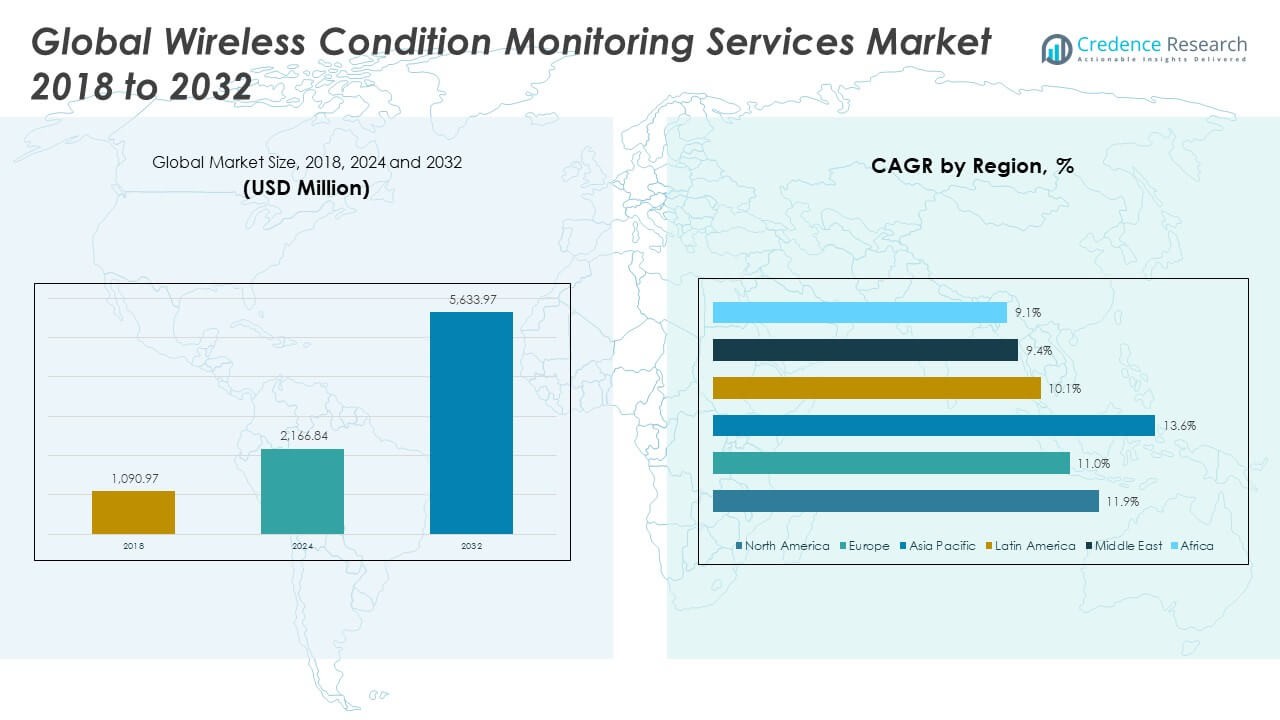
The Global Wireless Condition Monitoring Services Market size was valued at USD 1,090.97 million in 2018 to USD 2,166.84 million in 2024 and is anticipated to reach USD 5,633.97 million by 2032, at a CAGR of 11.82% during the forecast period.
| REPORT ATTRIBUTE | DETAILS |
|---|---|
| Historical Period | 2020-2023 |
| Base Year | 2024 |
| Forecast Period | 2025-2032 |
| Wireless Condition Monitoring Services Market Size 2024 | USD 2,166.84 Million |
| Wireless Condition Monitoring Services Market , CAGR | 11.82% |
| Wireless Condition Monitoring Services Market Size 2032 | USD 5,633.97 Million |
The market is expanding rapidly due to the rising demand for predictive maintenance, improved equipment uptime, and operational efficiency. Industries are shifting from reactive to condition-based maintenance strategies to reduce unplanned downtime. Growing adoption of IoT-enabled wireless sensors, AI-powered data analytics, and cloud platforms is supporting this transition. Sectors such as manufacturing, energy, and transportation are increasingly integrating these technologies to enhance asset performance and reduce maintenance costs.
North America leads the Global Wireless Condition Monitoring Services Market due to its strong digital infrastructure, early technology adoption, and focus on industrial automation. Europe follows with widespread investments in smart factories and energy-efficient asset management solutions. Asia Pacific is emerging rapidly, driven by industrial expansion in China, India, and Southeast Asia. The Middle East and Latin America are showing steady growth supported by developments in energy, oil, and gas industries. The accelerating pace of digital transformation and industrial modernization is strengthening market penetration across all major regions.
Market Insights:
- The Global Wireless Condition Monitoring Services Market was valued at USD 1,090.97 million in 2018 and USD 2,166.84 million in 2024, with a projected value of USD 5,633.97 million by 2032 at a CAGR of 11.82%.
- North America led with 36% market share in 2024, supported by strong digital infrastructure and early adoption. Europe followed with 29% due to smart factory investments, while Asia Pacific held 24% driven by rapid industrialization.
- Asia Pacific is the fastest-growing region, projected to expand its share beyond 30% by 2032, supported by manufacturing growth in China and India and Industry 4.0 adoption.
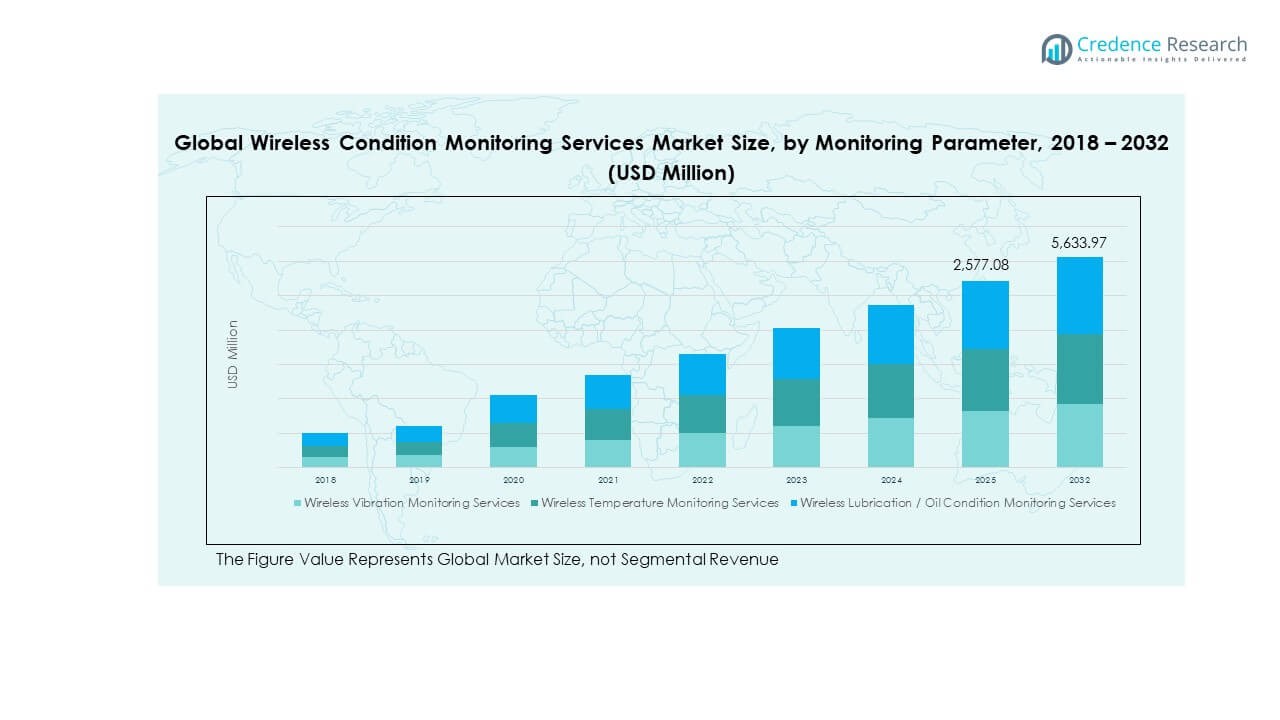
- Wireless vibration monitoring held 48% of the Global Wireless Condition Monitoring Services Market in 2024, making it the largest monitoring parameter segment.
- Wireless temperature monitoring accounted for 34%, while oil condition monitoring represented the remaining share, reflecting growing multi-parameter monitoring strategies across industries.
Market Drivers
Rising Demand for Predictive Maintenance and Equipment Uptime Optimization
The Global Wireless Condition Monitoring Services Market is witnessing strong demand due to the growing need for predictive maintenance strategies. Industries are shifting from traditional scheduled maintenance to condition-based maintenance to avoid unexpected failures. Wireless monitoring enables real-time data collection from critical assets, helping teams detect faults early. It improves operational uptime, lowers maintenance costs, and extends equipment life. Sectors such as manufacturing, power generation, and oil and gas are increasingly adopting such solutions. The deployment of wireless sensor networks enhances flexibility in monitoring remote assets. This development supports productivity gains and operational reliability across industries.
Expanding Industrial Automation and Smart Manufacturing Practices
Industrial automation initiatives are increasing the use of wireless monitoring solutions in manufacturing environments. The integration of IoT sensors and advanced analytics is driving better decision-making in production operations. Automation reduces manual inspections and enhances visibility into asset health. It supports real-time condition tracking, which aligns with lean manufacturing goals. Wireless networks allow quick deployment without extensive wiring, saving time and cost. The flexibility of wireless infrastructure supports equipment mobility and scalability. Industries benefit from reduced downtime and improved throughput. This approach accelerates digital transformation in several production facilities.
- For example, Siemens Energy, working with Amazon Web Services, deployed an Industrial IoT platform using AWS IoT SiteWise across 18 factories to cut manual data-collection time by 50%, reduce maintenance costs by 25%, and increase machine availability by 15%.
Growing Emphasis on Energy Efficiency and Sustainable Operations
Enterprises are focusing on optimizing energy consumption and minimizing operational inefficiencies. Wireless monitoring solutions help identify energy wastage through vibration, temperature, and load data analysis. It enables timely maintenance actions that reduce power loss and operational strain on equipment. Energy-intensive industries, including utilities and oil and gas, are prioritizing this shift. By integrating wireless condition monitoring, companies achieve better sustainability targets. Regulatory pressure to reduce carbon footprints supports this adoption. Wireless systems offer low-cost and low-energy deployment options. This trend is pushing many industries to modernize their maintenance infrastructure.
Rapid Advancements in IoT and Sensor Technologies
The increasing sophistication of wireless sensors is strengthening market expansion. Modern sensors deliver higher accuracy, longer battery life, and better connectivity across industrial environments. It allows enterprises to capture precise data and predict equipment failures more effectively. IoT platforms support data aggregation and advanced analytics. Wireless communication protocols ensure seamless integration with existing maintenance systems. These developments support scaling condition monitoring across large facilities. It simplifies complex processes and improves cost-effectiveness. This ongoing innovation creates favorable conditions for market growth.
- For instance, Emerson expanded its WirelessHART ecosystem in 2024 with the Rosemount 802 Wireless Multi-Discrete Input/Output Transmitter, offering eight configurable I/O channels, and X-well Technology sensors for non-intrusive temperature measurement. In 2025, Emerson confirmed its 1410S Wireless Gateway supports up to 500 connected devices per antenna, enhancing scalability for industrial deployments.
Market Trends
Widening Integration of Edge Analytics and AI in Condition Monitoring Solutions
The Global Wireless Condition Monitoring Services Market is experiencing a notable trend toward integrating edge computing and AI into monitoring frameworks. Edge analytics enables faster decision-making by processing data closer to the source. AI algorithms improve fault detection accuracy and reduce false alarms. This combination supports predictive maintenance with higher reliability. Enterprises benefit from improved data security and reduced latency. These technologies also lower bandwidth use, making monitoring more efficient. Several industries are embedding AI models directly into wireless devices. This trend is reshaping asset monitoring architectures globally.
- For instance, Siemens’ Senseye Predictive Maintenance platform integrates AI-driven anomaly detection and degradation forecasting to support predictive maintenance across connected assets. In February 2024, Siemens announced the addition of generative AI capabilities to Senseye to enhance equipment performance monitoring in industrial environments.
Adoption of Cloud-Native Platforms and Data-Driven Maintenance Systems
Cloud platforms are increasingly used to manage wireless monitoring data at scale. These platforms provide secure storage, advanced analytics, and real-time visualization tools. It enables enterprises to centralize data from multiple locations. Cloud-native solutions offer easy integration with enterprise maintenance systems. They enhance collaboration between field and control teams. The shift supports faster deployment and lower IT infrastructure costs. Industries gain better asset visibility and improved decision-making capabilities. This approach drives market maturity and operational flexibility.
Focus on Modular and Scalable Wireless Infrastructure Deployment
Organizations are preferring modular and scalable wireless networks for condition monitoring. These systems adapt easily to changing production layouts. It helps industries expand their monitoring coverage without replacing infrastructure. Modular deployment reduces installation time and upfront investment. Scalable systems support multiple sensor types and protocols. It enables phased implementation aligned with operational needs. This trend appeals to small and medium enterprises aiming for gradual digital transformation. The adoption of such architectures enhances monitoring precision and cost efficiency.
Increased Use of Digital Twins and Real-Time Equipment Modeling
Digital twin technology is emerging as a key enabler of advanced asset monitoring. It creates virtual replicas of equipment to simulate performance under real conditions. It helps maintenance teams predict failures before they occur. Real-time data from wireless sensors feeds into these models to enhance accuracy. This integration supports advanced forecasting and decision support. It improves maintenance planning and resource allocation. Industries leverage this capability to optimize production output. The adoption of digital twins is accelerating in manufacturing and energy sectors.
- For instance, GE Vernova’s Asset Performance Management suite, including SmartSignal, monitors over 7,000 industrial assets using more than 350 digital twin blueprints. The company reports over USD 1.6 billion in customer-verified savings through predictive maintenance, with a documented case involving Competitive Power Ventures (CPV).
Market Challenges Analysis
High Initial Investment Costs and Integration Complexity Across Existing Infrastructure
The Global Wireless Condition Monitoring Services Market faces cost-related and integration challenges. Many industries hesitate to adopt wireless solutions due to upfront equipment and installation costs. The integration of new systems with legacy infrastructure often involves complex processes. It requires specialized skills, which increases deployment time and expenses. Companies in developing regions find these costs harder to absorb. Data synchronization issues can arise when multiple equipment types are involved. Limited standardization in communication protocols creates additional barriers. These factors slow down adoption, especially among small enterprises. A gradual implementation strategy may be necessary to overcome such resistance.
Data Security Concerns and Limited Technical Expertise in Some Industries
The increasing use of wireless connectivity raises concerns about cybersecurity risks. Unauthorized access to sensor networks can disrupt operational continuity. Many industries lack strong IT security frameworks to protect monitoring systems. This vulnerability creates hesitation toward large-scale deployment. A shortage of skilled personnel further complicates adoption. Industries with limited digital maturity struggle to operate and maintain advanced solutions effectively. Poor training and inadequate support infrastructure reduce system efficiency. Addressing these gaps will be critical for sustained market expansion.
Market Opportunities
Expansion in Emerging Industrial Hubs and Energy-Intensive Sectors
The Global Wireless Condition Monitoring Services Market holds strong opportunities in emerging economies with rapid industrialization. Growing manufacturing activity in Asia Pacific, Latin America, and the Middle East is creating demand for efficient maintenance systems. Energy-intensive sectors are exploring wireless monitoring to enhance asset longevity. Governments are promoting Industry 4.0 initiatives to support infrastructure modernization. The scalable nature of wireless systems suits greenfield industrial projects. Enterprises in these regions aim to improve competitiveness through digital tools. This scenario offers a favorable ground for market penetration.
Development of Advanced Wireless Technologies and Strategic Collaborations
Continuous innovation in low-power, long-range wireless communication technologies is expanding opportunities. It allows cost-effective deployment across large industrial facilities. Strategic collaborations between technology providers and industry players are accelerating adoption. Joint ventures help reduce implementation costs and address technical barriers. Improved interoperability standards simplify integration into diverse operating environments. The emphasis on energy efficiency and operational resilience supports long-term demand. These factors create a strong foundation for sustainable market growth.
Market Segmentation Analysis:
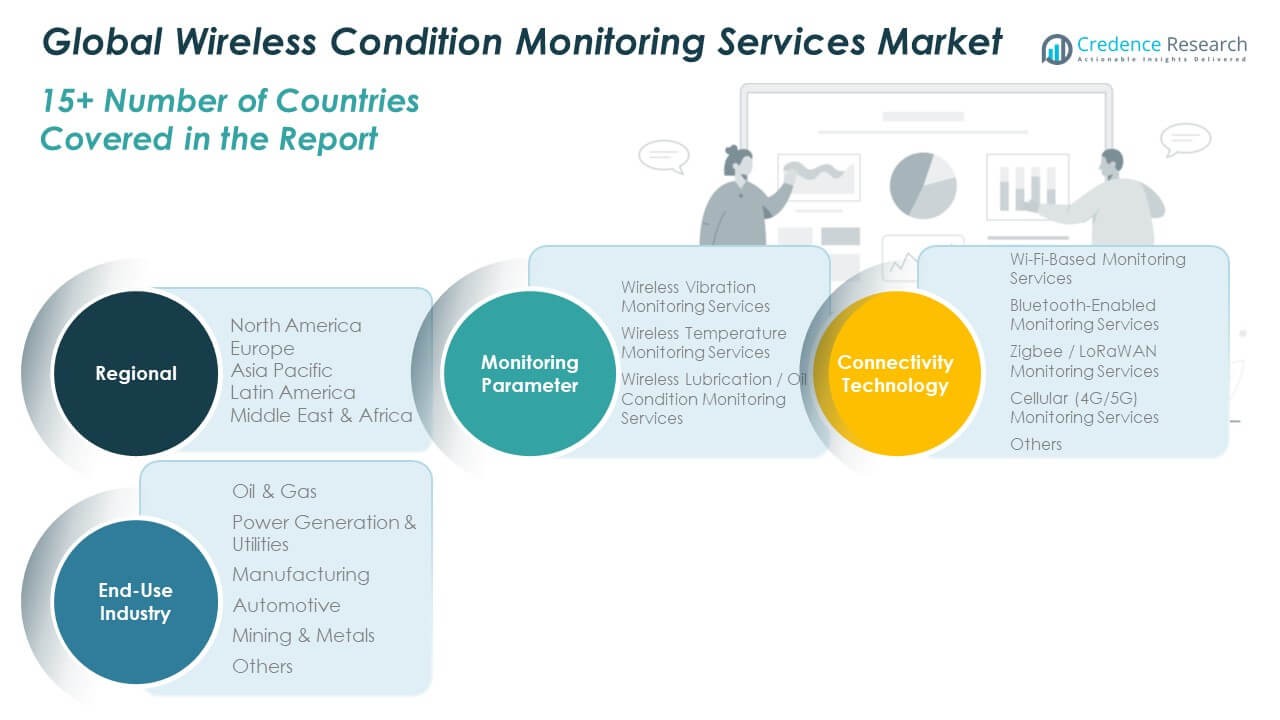
The Global Wireless Condition Monitoring Services Market is segmented by monitoring parameter, connectivity technology, and end-use industry.
By monitoring parameter, wireless vibration monitoring services dominate the segment with the highest adoption across manufacturing and energy sectors. Wireless temperature monitoring services hold a strong share, driven by their role in real-time thermal tracking. Wireless lubrication and oil condition monitoring services are expanding rapidly due to their importance in preventing mechanical wear and improving operational safety. This segment mix reflects a growing focus on multi-parameter monitoring strategies to optimize asset performance.
- For instance, Crystal Instruments’ wireless vibration sensors support high-frequency data capture between 0.5 Hz and 6.5 kHz, enabling accurate monitoring across multiple machine types in industrial environments. The technology is designed to enhance vibration analysis and real-time condition monitoring.
By connectivity technology, Wi-Fi-based monitoring services lead due to their stable bandwidth and ease of deployment in industrial environments. Bluetooth-enabled systems are gaining traction in smaller and mobile equipment applications. Zigbee and LoRaWAN technologies are preferred in remote and wide-area industrial networks. Cellular 4G/5G monitoring services are accelerating in adoption for critical infrastructure and distributed assets. Other niche technologies support specialized industrial use cases, providing flexibility in connectivity solutions.
By end-use industry, manufacturing holds the largest share, supported by its strong shift toward predictive maintenance strategies. Oil and gas as well as power generation and utilities are major adopters, leveraging monitoring solutions for operational safety and energy efficiency. Automotive, mining, and metals sectors are expanding adoption to reduce downtime and optimize production cycles. This diverse adoption landscape underlines the market’s alignment with industrial modernization and digital transformation initiatives worldwide.
- For instance, Bosch applies AI-driven predictive maintenance in its production facilities using IoT-based vibration and temperature sensors to detect equipment failures early. This approach integrates real-time monitoring with enterprise systems, reducing unplanned downtime and improving operational efficiency.
Segmentation:
By Monitoring Parameter
- Wireless Vibration Monitoring Services
- Wireless Temperature Monitoring Services
- Wireless Lubrication / Oil Condition Monitoring Services
By Connectivity Technology
- Wi-Fi-Based Monitoring Services
- Bluetooth-Enabled Monitoring Services
- Zigbee / LoRaWAN Monitoring Services
- Cellular (4G/5G) Monitoring Services
- Others
By End-Use Industry
- Oil & Gas
- Power Generation & Utilities
- Manufacturing
- Automotive
- Mining & Metals
- Others
By Region:
- North America
- U.S.
- Canada
- Mexico
- Europe
- Germany
- France
- U.K.
- Italy
- Spain
- Rest of Europe
- Asia Pacific
- China
- Japan
- India
- South Korea
- South-east Asia
- Rest of Asia Pacific
- Latin America
- Brazil
- Argentina
- Rest of Latin America
- Middle East & Africa
- GCC Countries
- South Africa
- Rest of the Middle East and Africa
Regional Analysis:
North America
The North America Global Wireless Condition Monitoring Services Market size was valued at USD 477.13 million in 2018 to USD 937.83 million in 2024 and is anticipated to reach USD 2,445.20 million by 2032, at a CAGR of 11.9% during the forecast period. Regional market share: 2024 is 43.3%. North America leads on technology deployment depth. Manufacturers invest to cut downtime and raise OEE. Asset-heavy sectors adopt AI-aided diagnostics at scale. Utilities use cellular and private LTE for grid assets. Refineries use vibration and oil analysis for safety. Cybersecurity standards drive secure device onboarding. Vendors bundle sensors, gateways, and analytics in service models. The Global Wireless Condition Monitoring Services Market gains scale here. It benefits from strong cloud and edge ecosystems.
Europe
The Europe Global Wireless Condition Monitoring Services Market size was valued at USD 309.97 million in 2018 to USD 593.49 million in 2024 and is anticipated to reach USD 1,452.98 million by 2032, at a CAGR of 11.0% during the forecast period. Regional market share: 2024 is 27.4%. Europe advances with Industry 4.0 programs. EU regulations push energy efficiency and uptime. Automotive hubs adopt plant-wide wireless diagnostics. Wind and hydrogen assets expand monitoring spend. Brownfield plants prefer Bluetooth and LoRaWAN retrofits. Data residency rules shape cloud choices. OEM service contracts include predictive SLAs. The Global Wireless Condition Monitoring Services Market grows with retrofit demand. It also benefits from green funding and grants.
Asia Pacific
The Asia Pacific Global Wireless Condition Monitoring Services Market size was valued at USD 204.27 million in 2018 to USD 440.67 million in 2024 and is anticipated to reach USD 1,301.50 million by 2032, at a CAGR of 13.6 during the forecast period. Regional market share: 2024 is 20.3%. Asia Pacific expands fastest on industrial capacity growth. Semiconductor, EV, and battery plants scale uptime programs. Ports and metros deploy condition sensors for fleets. 5G private networks back low-latency analytics. Cost-sensitive users adopt subscription services first. Multisite enterprises favor cloud dashboards. Harsh environments drive IP-rated sensors. The Global Wireless Condition Monitoring Services Market gains from capex cycles. Local system integrators speed deployments.
Latin America
The Latin America Global Wireless Condition Monitoring Services Market size was valued at USD 50.44 million in 2018 to USD 98.91 million in 2024 and is anticipated to reach USD 226.98 million by 2032, at a CAGR of 10.1 during the forecast period. Regional market share: 2024 is 4.6%. Adoption rises in oil, mining, and cement. Remote sites value wireless over wired builds. Utilities begin grid asset monitoring pilots. Currency risk encourages service-based contracts. Cloud-hosted portals reduce support costs. Safety and compliance bolster demand in process plants. Training and local support remain key. The Global Wireless Condition Monitoring Services Market advances with brownfield retrofits. Regional distributors extend reach across secondary cities.
Middle East
The Middle East Global Wireless Condition Monitoring Services Market size was valued at USD 29.83 million in 2018 to USD 54.04 million in 2024 and is anticipated to reach USD 117.97 million by 2032, at a CAGR of 9.4 during the forecast period. Regional market share: 2024 is 2.5%. Hydrocarbon assets drive core demand. Operators monitor rotating equipment and pipelines. Mega projects add smart maintenance scopes. Harsh climates require ruggedized sensors. Private 5G supports refineries and terminals. Vendors pair analytics with reliability consulting. National programs promote digital twins. The Global Wireless Condition Monitoring Services Market grows with greenfield complexes. Service partnerships address skills gaps.
Africa
The Africa Global Wireless Condition Monitoring Services Market size was valued at USD 19.33 million in 2018 to USD 41.90 million in 2024 and is anticipated to reach USD 89.34 million by 2032, at a CAGR of 9.1 during the forecast period. Regional market share: 2024 is 1.9%. Growth centers on mining, power, and midstream. Remote operations favor low-power wide-area links. Utilities deploy sensors for transformer health. OEMs bundle monitoring with equipment sales. Skills development programs unlock value. Cloud access reduces onsite IT needs. Financing models ease upfront barriers. The Global Wireless Condition Monitoring Services Market progresses with regional integration. Cross-border projects expand service footprints.
Key Player Analysis:
- Emerson Electric Co.
- SKF Group
- Honeywell International Inc.
- Siemens AG
- Schneider Electric SE
- ABB Ltd.
- General Electric (GE Vernova)
Competitive Analysis:
The Global Wireless Condition Monitoring Services Market features a concentrated competitive landscape with strong participation from industrial technology leaders. It includes players such as Emerson Electric Co., SKF Group, Honeywell International Inc., Siemens AG, Schneider Electric SE, ABB Ltd., and General Electric. These companies focus on expanding connectivity technology portfolios and strengthening predictive maintenance capabilities. It reflects rising investments in cloud analytics, vibration sensing, and AI integration. Strategic moves include mergers, regional expansions, and product innovations to improve service coverage. It emphasizes differentiation through cybersecurity, interoperability, and data-driven asset optimization. Vendors align offerings with key industries such as oil and gas, manufacturing, and power generation. Partnerships with system integrators enhance local delivery capabilities. Start-ups target niche wireless technologies to gain footholds in emerging regions. Competitive intensity remains high as service providers race to secure multi-year reliability contracts.
Recent Developments:
- In October 2025, Honeywell International Inc. and LS Electricannounced a global strategic collaboration to develop integrated power management and wireless monitoring systems for data centers and industrial sites. The partnership aims to combine Honeywell’s automation expertise and LS Electric’s power management systems to enhance predictive maintenance and energy optimization through AI-enabled condition-based monitoring platforms.
- In October 2025, GE Vernovaand Verizon announced a joint launch of the GE Vernova MDS Orbit industrial wireless platform, designed to enhance communication infrastructure for utility operations. The platform, now hosted on Verizon’s cellular network, supports resilient and secure data transfer for SCADA and asset monitoring systems.
- In October 2025, MISTRAS Group entered into a partnership with Villari to enhance its wireless crack detection and structural health monitoring solutions. Announced on October 13, 2025, this collaboration allows MISTRAS to integrate Villari’s advanced wireless sensor technology into its service offerings, particularly targeting steel structures at risk of cracking.
- In January 2025, Siemens AG presented new Industrial AI capabilitiesintegrated into its Siemens Xcelerator portfolio at CES 2025. The company introduced the Siemens Industrial Copilot, a system designed to integrate AI directly into industrial edge environments to boost maintenance efficiency and condition monitoring at the machine level.
Report Coverage:
The research report offers an in-depth analysis based on Monitoring Parameter, Connectivity Technology and End-Use Industry. It details leading market players, providing an overview of their business, product offerings, investments, revenue streams, and key applications. Additionally, the report includes insights into the competitive environment, SWOT analysis, current market trends, as well as the primary drivers and constraints. Furthermore, it discusses various factors that have driven market expansion in recent years. The report also explores market dynamics, regulatory scenarios, and technological advancements that are shaping the industry. It assesses the impact of external factors and global economic changes on market growth. Lastly, it provides strategic recommendations for new entrants and established companies to navigate the complexities of the market.
Future Outlook:
- Digital transformation across asset-heavy industries will accelerate adoption of wireless monitoring services.
- AI-driven predictive analytics will enhance equipment performance insights and reduce unplanned downtime.
- Integration with cloud platforms will enable real-time data sharing and faster decision-making.
- Advanced sensor technologies will improve measurement accuracy and expand operational coverage.
- 5G and LPWAN networks will support large-scale, low-latency deployments in complex facilities.
- Service-based business models will gain traction as enterprises seek cost-effective maintenance solutions.
- Vendors will focus on cybersecurity to address growing concerns in connected operational environments.
- Partnerships between OEMs and technology firms will strengthen end-to-end monitoring ecosystems.
- Regional expansions will create new opportunities in underpenetrated markets with industrial modernization goals.
- Sustainability goals will drive investments in smart maintenance systems that reduce energy waste and extend asset life.

Request a Free Sample
Fill in your details and we'll send you a free sample report.
- Sample data tables & charts
- Research methodology
Need a Custom Version of This Report?
Tailor the scope, geography, or segments to your exact requirements.
- Custom geography or segment scope
- Direct access to our analyst team
Frequently Asked Questions
What is the current market size for Global Wireless Condition Monitoring Services Market, and what is its projected size in 2032?
At what Compound Annual Growth Rate is the Global Wireless Condition Monitoring Services Market projected to grow between 2024 and 2032?
Which Global Wireless Condition Monitoring Services Market segment held the largest share in 2024?
What are the primary factors fueling the growth of the Global Wireless Condition Monitoring Services Market?
Who are the leading companies in the Global Wireless Condition Monitoring Services Market?
Which region commanded the largest share of the Global Wireless Condition Monitoring Services Market in 2024?
Table of Content
Chapter 1 Market Segmentation
- 1.1 Segmentation Framework
- 1.1.1 Product and Service Classification
- 1.1.2 Application and End-Use Classification
- 1.1.3 Technology and Solution Classification
- 1.1.4 Customer and Distribution Channel Classification
- 1.1.5 Geographic Segmentation
- 1.1.6 Market Segment Definitions and Boundaries
Chapter 2 Introduction
- 2.1 Report Objectives and Scope
- 2.2 Product Definition and Industry Terminology
- 2.3 Market Inclusions and Exclusions
- 2.4 Research Process
- 2.4.1 Primary Research and Expert Interviews
- 2.4.2 Secondary Research and Source Review
- 2.4.3 Top-Down and Bottom-Up Estimation
- 2.4.4 Data Triangulation and Verification
- 2.5 Market Size Measurement Basis
- 2.5.1 2024: USD 2,166.84 million → 2032: USD 5,633.97 million
- 2.6 Historical and Forecast Reference Periods
- 2.6.1 Base Year: 2024
- 2.6.2 Forecast Period: 2024-2032
- 2.7 Research Assumptions and Limitations
Chapter 3 Executive Summary
- 3.1 Market Snapshot and Key Findings
- 3.2 Base-Year Market Size, 2024
- 3.3 Forecast Market Size, 2032
- 3.4 Revenue and Volume Growth Outlook
- 3.5 Key Demand and Supply Indicators
- 3.6 Leading Market Segments
- 3.7 Fastest-Growing Market Opportunities
- 3.8 Regional Performance Highlights
- 3.9 Technology and Industry Transformation
- 3.10 Competitive Landscape Summary
- 3.11 Analyst View and Strategic Implications
Chapter 4 Global Wireless Condition Monitoring Services Market Trends and Developments
- 4.1 Historical Industry Development
- 4.2 Recent Market Trends and Developments
- 4.3 Demand and Customer Behavior Trends
- 4.4 Technology and Product Innovation
- 4.5 Artificial Intelligence, Automation and Digitalization
- 4.6 Local Manufacturing and Supply Chain Realignment
- 4.7 Industry Partnerships, Mergers and Acquisitions
- 4.8 Sustainability and Circular Economy Developments
- 4.9 Government and Private Sector Investment Trends
- 4.10 Emerging Business Models and Commercialization
- 4.11 Industry Developments and Announcements
Chapter 5 Global Wireless Condition Monitoring Services Market Supply and Demand Analysis
- 5.1 Demand Trend and Consumption Analysis
- 5.2 Demand Forecast, 2024-2032
- 5.3 Supply Chain Structure and Procurement Trends
- 5.4 Supply-Demand Gap and Bottlenecks
- 5.5 Import Dependence and Sourcing Structure
- 5.6 Regional Supply and Demand Concentration
Chapter 6 Global Wireless Condition Monitoring Services Market Pricing Analysis
- 6.1 Pricing Structure and Measurement
- 6.2 Historical Pricing Trends
- 6.3 Pricing Outlook, 2024-2032
- 6.4 Pricing by Product and Market Segment
- 6.5 Geographic Pricing Differences
- 6.6 Key Input, Energy, Labor and Logistics Costs
- 6.7 Contract Pricing and Purchasing Models
- 6.8 Pricing Sensitivity and Competitive Positioning
- 6.9 Price, Margin and Profitability Implications
Chapter 7 Global Wireless Condition Monitoring Services Market Dynamics
- 7.1 Market Growth Drivers
- 7.1.1 Demand-Side Drivers
- 7.1.2 Technology and Innovation Drivers
- 7.1.3 Infrastructure and Investment Drivers
- 7.1.4 Regulatory and Policy Drivers
- 7.2 Market Restraints
- 7.2.1 Cost and Affordability Constraints
- 7.2.2 Technology and Adoption Barriers
- 7.2.3 Supply Chain and Operational Constraints
- 7.3 Market Challenges
- 7.3.1 Competitive Pressure and Margin Erosion
- 7.3.2 Skills, Infrastructure and Implementation Gaps
- 7.4 Emerging Market Opportunities
- 7.5 Market Dynamics Impact and Time-Horizon Assessment
Chapter 8 Global Wireless Condition Monitoring Services Value Chain Analysis
- 8.1 Industry Value Chain Overview
- 8.2 Upstream Suppliers and Critical Inputs
- 8.3 Technology and Component Providers
- 8.4 Manufacturing or Service Delivery
- 8.5 Distribution, Channel Partners and Integrators
- 8.6 Downstream Applications and End Users
- 8.7 Value Addition and Profit Pools
- 8.8 Vertical Integration and Outsourcing
- 8.9 Supplier Concentration and Risk
- 8.10 Supply Chain Localization and Resilience
Chapter 9 Global Wireless Condition Monitoring Services Market Regulations and Policies
- 9.1 Relevant Laws, Standards and Compliance Frameworks
- 9.2 Product, Service, Safety and Quality Requirements
- 9.3 Government Policies, Incentives and Subsidies
- 9.4 Imports, Exports and Trade Barriers
- 9.5 Public Procurement and Local Content Requirements
- 9.6 Data Protection, AI and Cybersecurity Compliance
- 9.7 Upcoming Policy Changes and Market Implications
Chapter 10 Global Wireless Condition Monitoring Services Market Hotspots and Opportunities
- 10.1 Market Opportunity Mapping and Growth Hotspots
- 10.2 High-Growth Applications and Customer Groups
- 10.3 Underserved Markets and White-Space Opportunities
- 10.4 Emerging Technology and Product Opportunities
- 10.5 New Capacity and Investment Hotspots
- 10.6 Market Entry and Expansion Opportunities
- 10.7 Distribution and Partnership Opportunities
- 10.8 Near-Term and Long-Term Commercial Potential
- 10.9 Opportunity Attractiveness and Execution Risks
Chapter 11 Global Wireless Condition Monitoring Services Market Outlook, 2024-2032
- 11.1 Market Size and Analysis
- 11.1.1 Revenue (Market Measurement: 2024: USD 2,166.84 million → 2032: USD 5,633.97 million)
- 11.1.2 Historical Market Size
- 11.1.3 Base-Year Market Size, 2024
- 11.2 Market Forecast, 2024-2032
- 11.2.1 Revenue Forecast to 2032
- 11.2.2 CAGR and Year-on-Year Growth
- 11.2.3 Incremental Revenue Opportunity
- 11.3 Forecast Assumptions and Scenario Analysis
- 11.3.1 Base-Case Forecast
- 11.3.2 Optimistic and Conservative Scenarios
- 11.3.3 Technology, Pricing and Policy Sensitivities
- 11.4 Market Attractiveness and Growth Outlook
Chapter 12 Global Wireless Condition Monitoring Services Market Segmentation and Outlook
- 12.1 Segmentation Summary and Market Shares, 2024
- 12.2 Largest and Fastest-Growing Segments
- 12.3 Segment Growth Comparison
- 12.4 Segment Attractiveness and Priority Matrix
Chapter 13 Global Wireless Condition Monitoring Services Geographic Market Outlook, 2024-2032
- 13.1 Regional Market Size and Share, 2024
- 13.2 Regional Market Forecast, 2024-2032
- 13.3 Regional Pricing, Production and Demand Differences
- 13.4 North America
- 13.4.1 United States
- 13.4.2 Canada
- 13.4.3 Mexico
- 13.5 Europe
- 13.5.1 Germany
- 13.5.2 France
- 13.5.3 Italy
- 13.5.4 United Kingdom
- 13.5.5 Spain
- 13.5.6 Poland
- 13.5.7 Russia
- 13.5.8 Netherlands
- 13.5.9 Belgium
- 13.5.10 Sweden
- 13.5.11 Denmark
- 13.5.12 Norway
- 13.5.13 Rest of Europe
- 13.6 Asia Pacific
- 13.6.1 China
- 13.6.2 India
- 13.6.3 Japan
- 13.6.4 South Korea
- 13.6.5 Thailand
- 13.6.6 Indonesia
- 13.6.7 Vietnam
- 13.6.8 Malaysia
- 13.6.9 Australia
- 13.6.10 Rest of Asia Pacific
- 13.7 Latin America
- 13.7.1 Brazil
- 13.7.2 Argentina
- 13.7.3 Colombia
- 13.7.4 Chile
- 13.7.5 Rest of Latin America
- 13.8 Middle East
- 13.8.1 Saudi Arabia
- 13.8.2 United Arab Emirates
- 13.8.3 Turkey
- 13.8.4 Israel
- 13.8.5 Iran
- 13.8.6 Rest of the Middle East
- 13.9 Africa
- 13.9.1 South Africa
- 13.9.2 Egypt
- 13.9.3 Nigeria
- 13.9.4 Morocco
- 13.9.5 Rest of Africa
- 13.10 Regional Investment, Policy and Supply Chain Differences
- 13.11 Regional Competitive Landscape
- 13.12 Geographic Growth Hotspots
Chapter 14 Global Wireless Condition Monitoring Services Technology, Innovation and Sustainability Outlook
- 14.1 Technology Landscape and Maturity
- 14.2 Product, Process and Service Innovation
- 14.3 AI, Automation and Digital Tools in the Industry
- 14.4 Technology Adoption and Performance Benchmarking
- 14.5 Innovation Pipeline and R&D Investment
- 14.6 Energy Efficiency and Resource Management
- 14.7 Sustainability, Recycling and Circularity
- 14.8 Technology Roadmap, 2024-2032
- 14.9 Risks of Obsolescence and Technology Substitution
Chapter 15 Global Wireless Condition Monitoring Services Market Key Strategic Imperatives
- 15.1 Growth and Market Entry Priorities
- 15.2 High-Return Products and Segments
- 15.3 Pricing, Profitability and Cost Optimization
- 15.4 Technology Investment and Product Differentiation
- 15.5 Supply Chain Localization and Resilience
- 15.6 Distribution and Customer Acquisition
- 15.7 Partnership, Acquisition and Capacity Strategy
- 15.8 Regional Expansion Priorities
- 15.9 Short-, Medium- and Long-Term Actions
Chapter 16 Competition Outlook
- 16.1 Industry Competition Characteristics
- 16.2 Market Structure and Concentration
- 16.3 Market Share and Competitive Positioning, 2024
- 16.4 Company-Wise Revenue and Product Benchmarking
- 16.5 Production and Service Capacity Benchmarking
- 16.6 Technology, Pricing and Differentiation
- 16.7 Regional Footprint and Distribution Strength
- 16.8 Mergers, Acquisitions and Strategic Alliances
- 16.9 New Entrants and Competitive Threats
- 16.10 Porter's Five Forces and Industry Attractiveness
- 16.11 Competitive Outlook, 2024-2032
Chapter 17 Company Profiles
- 17.1 Company Coverage and Selection Criteria
- 17.2 Leading Market Participants – Standard Profile Structure
- 17.2.1 Business Description
- 17.2.2 Company Ownership and Geographic Presence
- 17.2.3 Product and Service Portfolio
- 17.2.4 Manufacturing and Operating Footprint
- 17.2.5 Financial Performance and Investment
- 17.2.6 Market Share and Competitive Position
- 17.2.7 Technology and Innovation Capabilities
- 17.2.8 Strategic Alliances or Partnerships
- 17.2.9 Recent Developments
- 17.2.10 Growth Strategy and Outlook
- 17.3 Other Relevant Market Participants
Note: Every listed company is profiled on the structure shown under the first company. The company list is preliminary and may change based on research findings, market developments, data availability and client requirements.
Chapter 18 Disclaimer
- 18.1 Research and Forecast Disclaimer
- 18.2 Data Source and Estimation Limitations
Note: The depth of individual sections depends on data availability for this market. Volume, capacity, trade and other unit-based metrics are included where applicable.

