
Market Overview:
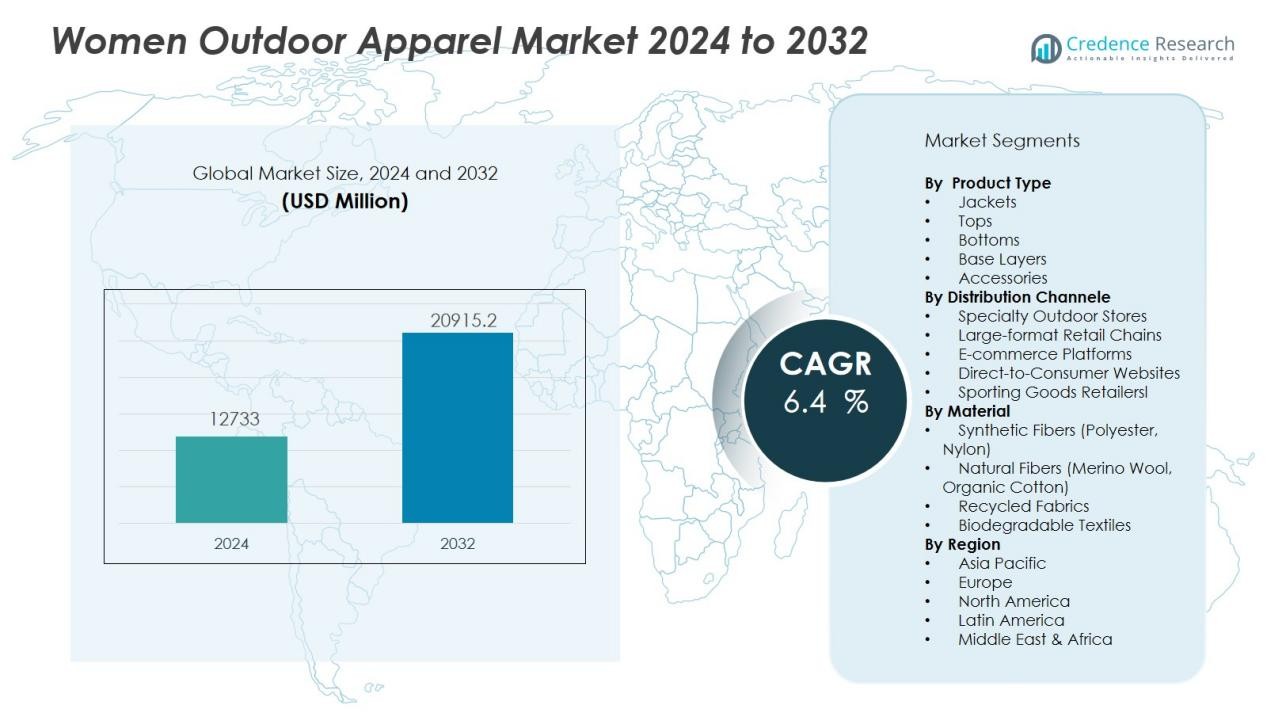
The Women outdoor apparel market size was valued at USD 12733 million in 2024 and is anticipated to reach USD 20915.2 million by 2032, at a CAGR of 6.4 % during the forecast period (2024-2032).
| REPORT ATTRIBUTE | DETAILS |
|---|---|
| Historical Period | 2020-2024 |
| Base Year | 2024 |
| Forecast Period | 2025-2032 |
| Women Outdoor Apparel Market Size 2024 | USD 12733 Million |
| Women Outdoor Apparel Market, CAGR | 6.4 % |
| Women Outdoor Apparel Market Size 2032 | USD 20915.2 Million |
Key drivers for market growth include a growing emphasis on health and wellness, the influence of social media on active lifestyles, and an increasing number of women entering outdoor sports such as hiking, trekking, running, and cycling. Brands are focusing on technical advancements-such as moisture-wicking materials, UV protection, and sustainable fabric solutions-to meet the evolving demands of female consumers. Additionally, collaborations with athletes and influencers are elevating product visibility and appeal.
Regionally, North America leads the women outdoor apparel market, supported by high disposable incomes, well-established outdoor culture, and the presence of major brands. Europe follows, driven by robust interest in outdoor recreation and strong retail infrastructure. Meanwhile, Asia-Pacific is witnessing the fastest growth, attributed to urbanization, rising middle-class populations, and increasing awareness about outdoor activities and women’s fitness trends.
Market Insights:
- The women outdoor apparel market reached USD 12,733 million in 2024 and will likely hit USD 20,915.2 million by 2032, supported by a 6.4% CAGR.
- Rising participation of women in outdoor activities such as hiking, cycling, and running drives sustained demand for functional and stylish apparel.
- Health and wellness trends boost premium product adoption, with consumers seeking performance fabrics, breathability, and ergonomic designs.
- Social media influence and digital campaigns accelerate market growth by elevating product awareness and shaping purchasing decisions.
- Innovation in sustainable and eco-friendly materials, including UV protection and lightweight construction, attracts environmentally conscious shoppers.
- Intense price competition and frequent promotions challenge profit margins and force brands to balance quality with affordability.
- North America leads with 37% market share, Europe holds 28%, and Asia-Pacific commands 22%, with rapid growth spurred by urbanization and digital adoption.
Market Drivers:
Rising Participation of Women in Outdoor Activities Fuels Apparel Demand:
The women outdoor apparel market benefits significantly from the growing number of women engaging in outdoor activities, including hiking, cycling, running, and adventure sports. Increased awareness of physical fitness and mental well-being has encouraged more women to participate in active lifestyles. Schools, universities, and community organizations promote outdoor engagement, further strengthening this trend. Companies in the market recognize this shift and design apparel specifically to support comfort and performance for female consumers.
Health and Wellness Trends Drive Premium Product Adoption:
A strong focus on health and wellness contributes to the demand for advanced women’s outdoor apparel. Consumers increasingly seek apparel that supports their commitment to fitness and an active lifestyle. The market responds with products that feature advanced performance fabrics, breathability, and ergonomic design. Companies highlight benefits such as temperature regulation and moisture management to attract health-conscious customers.
- For instance, ASRV's Tetra-Lite fabric technology demonstrates 6X stretch capability in all directions while maintaining durability, with their AeroSilver yarn integration testing at 25% higher fiber strength compared to standard materials.
Influence of Social Media and Digital Platforms Accelerates Market Growth:
Social media platforms and digital marketing strategies play a crucial role in shaping purchasing decisions in the women outdoor apparel market. Influencers, athletes, and outdoor enthusiasts share their experiences online, inspiring their audiences to explore outdoor activities and related gear. Brands invest in collaborations with well-known personalities, leveraging authentic storytelling to boost product awareness. It leads to higher visibility and quicker adoption of new styles and technologies.
Product Innovation and Sustainability Initiatives Attract New Customers:
Continuous innovation in materials and product design helps the women outdoor apparel market address evolving consumer expectations. The market sees increased use of sustainable and eco-friendly fabrics, reflecting growing environmental concerns among consumers. Companies introduce features such as UV protection, water resistance, and lightweight construction to enhance product value. It positions brands as leaders in responsible manufacturing and appeals to a broad base of environmentally conscious shoppers.
- For instance, Columbia Sportswear’s Omni-Shade™ technology offers sun protection with a UPF rating of 50+, blocking both UVA and UVB rays while earning The Skin Cancer Foundation's Seal of Recommendation for meeting stringent protection standards.
Market Trends:
Technological Advancements and Customization Shape Product Offerings:
The women outdoor apparel market reflects a clear shift toward technologically advanced products and increased customization options. Brands invest heavily in research and development to launch apparel with enhanced features such as moisture-wicking, antimicrobial treatments, and thermal regulation. Consumers seek products that deliver comfort and performance across diverse weather conditions and terrains. Customization options, including adjustable fits and personalized color choices, have gained popularity among female consumers who value both functionality and self-expression. Companies leverage digital tools and online platforms to enable made-to-order or semi-customized product lines. It strengthens customer loyalty and differentiates brands in a highly competitive environment.
- For instance, Lululemon’s Silverescent™ line infuses 99.9 percent pure silver ions directly into the yarn fiber to inhibit bacterial growth throughout the garment’s lifespan.
Sustainability and Ethical Sourcing Influence Purchasing Behavior:
The emphasis on sustainability continues to transform the women outdoor apparel market, prompting brands to prioritize eco-friendly materials and ethical manufacturing practices. Companies integrate recycled fibers, organic cotton, and biodegradable packaging into their product lines to address environmental concerns. Transparent supply chains and fair labor practices are now key selling points, influencing purchase decisions for a growing segment of socially conscious consumers. It encourages leading brands to obtain third-party certifications and share clear information about their sourcing policies. Collaborations with environmental organizations further reinforce credibility and brand trust. These trends shape the market’s direction and appeal to a new generation of environmentally aware buyers.
- For instance, Patagonia operates Fair Trade Certified™ factories producing over 90% of its line, impacting more than 85,000 workers globally through community development funds that workers control democratically.
Market Challenges Analysis:
Price Sensitivity and Market Competition Constrain Growth:
The women outdoor apparel market faces challenges from price-sensitive consumers who prioritize value over premium features. Many shoppers compare prices across brands and expect frequent promotions, which puts downward pressure on margins. Intense competition from established players and new entrants complicates differentiation, making it difficult for brands to build lasting loyalty. It forces companies to balance product quality with competitive pricing strategies. Smaller brands struggle to achieve scale and visibility in a crowded marketplace. This dynamic limits the potential for premiumization and sustained profit growth.
Supply Chain Disruptions and Sustainability Compliance Present Operational Hurdles:
Frequent disruptions in global supply chains create volatility in the women outdoor apparel market, impacting production timelines and product availability. Volatile raw material costs and logistical delays challenge companies to maintain consistent inventory and pricing. Sustainability requirements and regulatory pressures add complexity, requiring investment in traceable sourcing and ethical labor practices. It places additional financial and operational strain on both large and small manufacturers. Balancing sustainability commitments with cost efficiency remains a persistent challenge in the current market landscape.
Market Opportunities:
Expansion into Emerging Markets Unlocks Growth Potential:
The women outdoor apparel market presents significant opportunities through expansion into emerging economies where outdoor recreation and fitness trends are rising. Urbanization and increasing disposable incomes in regions such as Asia-Pacific, Latin America, and the Middle East drive interest in active lifestyles. Brands can introduce affordable product lines tailored to local climate and preferences, capturing new consumer segments. Targeted marketing campaigns and strategic retail partnerships can increase brand visibility and accessibility. It enables companies to diversify revenue streams and build a loyal customer base in underpenetrated areas. The potential for first-mover advantage remains strong in these dynamic regions.
Product Diversification and Digital Integration Drive Customer Engagement:
Growing demand for specialized outdoor apparel creates opportunities for brands to diversify product portfolios with niche offerings, such as apparel for women’s climbing, trail running, or water sports. Companies can integrate digital technologies, such as virtual fitting rooms and personalized online experiences, to enhance the customer journey. The women outdoor apparel market benefits from innovation in both product design and retail channels. It allows brands to engage directly with consumers, collect valuable feedback, and refine product development. A focus on technology-driven engagement supports higher conversion rates and long-term loyalty.
Market Segmentation Analysis:
By Product Type:
The women outdoor apparel market features diverse product categories, including jackets, tops, bottoms, base layers, and accessories. Jackets hold the largest share, driven by high demand for weather protection and technical performance in activities such as hiking and trekking. Tops and bottoms, including shirts, t-shirts, leggings, and shorts, attract fitness enthusiasts and casual outdoor participants. Base layers and thermal wear gain traction in colder regions, while accessories such as hats, gloves, and socks round out the product mix. Brands focus on functional design and seasonal versatility to meet varying activity needs.
By Distribution Channel:
The women outdoor apparel market utilizes multiple distribution channels to maximize reach and customer convenience. Specialty outdoor stores and large-format retail chains provide in-depth product expertise and allow hands-on evaluation. E-commerce platforms experience rapid growth, offering wide assortments, personalized recommendations, and convenient delivery options. Direct-to-consumer websites strengthen brand engagement and loyalty, while sporting goods retailers cater to a broad customer base. Omni-channel strategies that integrate online and offline experiences enhance the overall shopping journey.
- For instance, Arc’teryx reported that its direct-to-consumer technical apparel sales, including women’s collections, grew 42.8% to over $1.5 billion in 2024, with brand stores generating $1,928 in sales per square foot.
By Material:
Material innovation remains a defining feature in the women outdoor apparel market, with synthetic fibers such as polyester and nylon leading due to their durability, moisture-wicking, and lightweight properties. Natural fibers, including merino wool and organic cotton, appeal to environmentally conscious consumers seeking comfort and breathability. Sustainable materials, such as recycled fabrics and biodegradable textiles, gain momentum as brands align product development with eco-friendly goals. It highlights the market’s focus on performance, sustainability, and evolving consumer preferences.
- For instance, adidas produced 11 million pairs of shoes using Parley Ocean Plastic in 2019, leveraging intercepted marine waste to create durable performance products while diverting the equivalent of over 110 million plastic bottles from the oceans.
Segmentations:
By Product Type:
- Jackets
- Tops
- Bottoms
- Base Layers
- Accessories
By Distribution Channel:
- Specialty Outdoor Stores
- Large-format Retail Chains
- E-commerce Platforms
- Direct-to-Consumer Websites
- Sporting Goods Retailers
By Material:
- Synthetic Fibers (Polyester, Nylon)
- Natural Fibers (Merino Wool, Organic Cotton)
- Recycled Fabrics
- Biodegradable Textiles
By Region:
- North America
- U.S.
- Canada
- Mexico
- Europe
- Germany
- France
- U.K.
- Italy
- Spain
- Rest of Europe
- Asia Pacific
- China
- Japan
- India
- South Korea
- South-east Asia
- Rest of Asia Pacific
- Latin America
- Brazil
- Argentina
- Rest of Latin America
- Middle East & Africa
- GCC Countries
- South Africa
- Rest of the Middle East and Africa
Regional Analysis:
North America :
North America holds a market share of 37% in the women outdoor apparel market, maintaining its dominance due to high participation rates in outdoor activities and strong consumer purchasing power. A well-developed retail network and the presence of leading international brands support steady growth across the United States and Canada. It benefits from a robust ecosystem of specialty stores, e-commerce platforms, and outdoor events that raise brand visibility and product awareness. Local consumers value technical innovation, sustainability, and performance, encouraging companies to invest in research and development. Strong collaborations with athletes and outdoor influencers further accelerate new product adoption. Seasonal variations and diverse climates in the region drive demand for a wide range of functional and versatile apparel.
Europe :
Europe holds a 28% share in the women outdoor apparel market, supported by a vibrant culture of outdoor sports, travel, and recreation. Countries such as Germany, France, and the United Kingdom drive consistent demand, reflecting established fitness habits and a preference for high-quality gear. It benefits from a dense retail infrastructure, active promotion of outdoor lifestyles, and strict sustainability regulations that encourage eco-friendly products. The tourism industry boosts demand during peak seasons, while fashion-conscious consumers seek versatile designs suitable for urban and outdoor use. Strong cross-border trade and regional marketing campaigns strengthen the competitive environment. Local brands often emphasize ethical sourcing and product traceability to appeal to environmentally aware buyers.
Asia-Pacific :
Asia-Pacific commands a 22% share in the women outdoor apparel market and registers the fastest growth, driven by rapid urbanization and rising disposable incomes. China, Japan, Australia, and India represent high-potential markets, where consumers increasingly prioritize health, fitness, and outdoor recreation. It benefits from expanding retail channels, digital adoption, and rising influence of global brands entering new markets. Seasonal festivals, adventure tourism, and government-led health campaigns further stimulate market demand. Local brands adapt to unique climate conditions and evolving fashion trends to capture diverse customer preferences. E-commerce platforms and influencer-led marketing enhance accessibility and product awareness across urban and suburban populations.
Key Player Analysis:
- Arc'teryx
- Fjällräven
- Black Diamond
- Patagonia
- Prana
- Columbia Sportswear
- Helly Hansen
- Marmot
- Mountain Hardwear
- Kari Traa
- Outdoor Research
- Rab
Competitive Analysis:
The women outdoor apparel market features intense competition among global and regional players, each striving to differentiate through innovation, sustainability, and brand loyalty. Leading brands such as Arc'teryx, Fjällräven, Black Diamond, Patagonia, Prana, Columbia Sportswear, Helly Hansen, and Marmot shape the market landscape with strong product portfolios and extensive retail networks. It rewards brands that invest in research and development, introducing advanced materials and functional designs tailored for diverse outdoor activities. Sustainability remains a key competitive lever, with major players adopting eco-friendly practices and transparent supply chains. Collaborations with athletes, influencers, and outdoor communities help brands build credibility and reach new consumer segments. The ability to anticipate trends, respond quickly to market demands, and provide personalized experiences secures long-term growth in this dynamic industry.
Recent Developments:
- In March 2025, Fenix Outdoor, the parent company of Fjällräven, acquired 65% of Devold Norway AS, a premium wool clothing brand, for 35 million EUR.
- In April 2025, Anta Sports, the parent company of Arc'teryx, acquired Jack Wolfskin to expand its outdoor portfolio, with the deal expected to close in late Q2 or early Q3 2025.
- In May 2025, Clarus Corporation, Black Diamond's parent company, reached an agreement to divest Pieps (its avalanche safety brand) for €7.8 million, with an expected close by the end of Q3 2025.
Market Concentration & Characteristics:
The women outdoor apparel market exhibits moderate to high market concentration, with a few global players such as Columbia Sportswear, The North Face, Patagonia, and Adidas capturing significant revenue share through established brand recognition and extensive distribution networks. It features a dynamic mix of multinational corporations and emerging regional brands that cater to diverse consumer needs and preferences. Product innovation, sustainability initiatives, and digital engagement define the competitive landscape, while entry barriers stem from brand loyalty, technological requirements, and evolving regulatory standards. The market rewards companies that invest in research and development and adapt quickly to changing trends in materials, style, and functionality.
Report Coverage:
The research report offers an in-depth analysis based on Product Type, Distribution Channel, Material and Region. It details leading Market players, providing an overview of their business, product offerings, investments, revenue streams, and key applications. Additionally, the report includes insights into the competitive environment, SWOT analysis, current Market trends, as well as the primary drivers and constraints. Furthermore, it discusses various factors that have driven Market expansion in recent years. The report also explores Market dynamics, regulatory scenarios, and technological advancements that are shaping the industry. It assesses the impact of external factors and global economic changes on Market growth. Lastly, it provides strategic recommendations for new entrants and established companies to navigate the complexities of the Market.
Future Outlook:
- Brands will integrate advanced performance technologies, such as adaptive insulation and smart-fabric sensors, to improve comfort and functionality.
- Sustainability will play a pivotal role-companies will adopt recycled fibers and renewable materials to meet growing eco-conscious demand.
- E-commerce platforms will further expand reach through personalized shopping experiences and virtual product trials.
- Direct-to-consumer channels will gain traction, enabling brands to control pricing and engage customers more effectively.
- Collaboration with athletes and outdoor content creators will strengthen brand credibility and inspire new consumer segments.
- Regional expansion into under‑penetrated markets in Asia, Latin America, and Africa will drive top‑line opportunities.
- Gene‑based customization and fit‑profiling tools will allow tailored apparel that matches individual body metrics and activity preferences.
- Circular economy models, including resale, repair and recycling programs, will promote customer retention and reduce waste.
- Multifunctional apparel that transitions seamlessly from outdoor to urban environments will appeal to active‑lifestyle consumers.
- Brands will leverage predictive analytics and consumer data to forecast trends and optimize inventory, reducing markdown risk.

Request a Free Sample
Fill in your details and we'll send you a free sample report.
- Sample data tables & charts
- Research methodology
Market Dynamics
Rising Participation of Women in Outdoor Activities
More women are engaging in outdoor sports such as hiking, trekking, running, and cycling, driving sustained demand for functional and stylish outdoor apparel tailored to female needs.
Health and Wellness Trends
A growing focus on health and wellness is boosting the adoption of premium outdoor apparel, as consumers seek performance fabrics, breathability, and ergonomic designs that support active lifestyles.
Influence of Social Media and Digital Platforms
Social media campaigns and influencer collaborations are elevating product visibility, shaping purchasing decisions, and accelerating the adoption of new styles and technologies among women consumers.
Product Innovation and Sustainability Initiatives
Brands are investing in advanced materials like moisture-wicking, UV-protective, and sustainable fabrics, attracting environmentally conscious shoppers and differentiating themselves in a competitive market.
Expansion into Emerging Markets
Urbanization and rising disposable incomes in Asia-Pacific, Latin America, and the Middle East are creating new opportunities for brands to introduce affordable, climate-appropriate outdoor apparel and capture untapped consumer segments.
Need a Custom Version of This Report?
Tailor the scope, geography, or segments to your exact requirements.
- Custom geography or segment scope
- Direct access to our analyst team
Frequently Asked Questions
What is the current market size for the women outdoor apparel market, and what is its projected size in 2032?
At what Compound Annual Growth Rate is the women outdoor apparel market projected to grow between 2024 and 2032?
Which women outdoor apparel market segment held the largest share in 2024?
What are the primary factors fueling the growth of the women outdoor apparel market?
Who are the leading companies in the women outdoor apparel market?
Which region commanded the largest share of the women outdoor apparel market in 2024?
Table of Content
Chapter 1 Market Segmentation
- 1.1 Segmentation Framework
- 1.1.1 Product and Service Classification
- 1.1.2 Application and End-Use Classification
- 1.1.3 Technology and Solution Classification
- 1.1.4 Customer and Distribution Channel Classification
- 1.1.5 Geographic Segmentation
- 1.1.6 Market Segment Definitions and Boundaries
- 1.2 By Material
- 1.2.1 Synthetic Fibers (Polyester, Nylon)
- 1.2.2 Natural Fibers (Merino Wool, Organic Cotton)
- 1.2.3 Recycled Fabrics
- 1.2.4 Biodegradable Textiles
- 1.3 By Product Type
- 1.3.1 Jackets
- 1.3.2 Tops
- 1.3.3 Bottoms
- 1.3.4 Base Layers
- 1.3.5 Accessories
Chapter 2 Introduction
- 2.1 Report Objectives and Scope
- 2.2 Product Definition and Industry Terminology
- 2.3 Market Inclusions and Exclusions
- 2.4 Research Process
- 2.4.1 Primary Research and Expert Interviews
- 2.4.2 Secondary Research and Source Review
- 2.4.3 Top-Down and Bottom-Up Estimation
- 2.4.4 Data Triangulation and Verification
- 2.5 Market Size Measurement Basis
- 2.5.1 2024: USD 12,733 million → 2032: USD 20,915.2 million
- 2.6 Historical and Forecast Reference Periods
- 2.6.1 Base Year: 2024
- 2.6.2 Forecast Period: 2024-2032
- 2.7 Research Assumptions and Limitations
Chapter 3 Executive Summary
- 3.1 Market Snapshot and Key Findings
- 3.2 Base-Year Market Size, 2024
- 3.3 Forecast Market Size, 2032
- 3.4 Revenue and Volume Growth Outlook
- 3.5 Key Demand and Supply Indicators
- 3.6 Leading Market Segments
- 3.7 Fastest-Growing Market Opportunities
- 3.8 Regional Performance Highlights
- 3.9 Technology and Industry Transformation
- 3.10 Competitive Landscape Summary
- 3.11 Analyst View and Strategic Implications
Chapter 4 Global Women Outdoor Apparel Market Trends and Developments
- 4.1 Historical Industry Development
- 4.2 Recent Market Trends and Developments
- 4.3 Demand and Customer Behavior Trends
- 4.4 Technology and Product Innovation
- 4.5 Artificial Intelligence, Automation and Digitalization
- 4.6 Local Manufacturing and Supply Chain Realignment
- 4.7 Industry Partnerships, Mergers and Acquisitions
- 4.8 Sustainability and Circular Economy Developments
- 4.9 Government and Private Sector Investment Trends
- 4.10 Emerging Business Models and Commercialization
- 4.11 Industry Developments and Announcements
Chapter 5 Global Women Outdoor Apparel Market Production, Supply and Demand Analysis
- 5.1 Demand Trend and Consumption Analysis
- 5.2 Demand Forecast, 2024-2032
- 5.3 Production and Output Trend
- 5.4 Production and Output Forecast, 2024-2032
- 5.5 Installed Capacity and Capacity Utilization
- 5.6 Company-Wise Production Plants and Statistics
- 5.6.1 Installed Production Capacity
- 5.6.2 Actual Production
- 5.6.3 Planned Capacity and Expansion Targets
- 5.7 Supply Chain Structure and Procurement Trends
- 5.8 Supply-Demand Gap and Bottlenecks
- 5.9 Import Dependence and Sourcing Structure
- 5.10 Contract Manufacturing and Outsourcing
- 5.11 Regional Supply and Demand Concentration
Chapter 6 Global Women Outdoor Apparel Market Pricing Analysis
- 6.1 Pricing Structure and Measurement
- 6.2 Historical Pricing Trends
- 6.3 Pricing Outlook, 2024-2032
- 6.4 Average Selling Price and Unit Economics
- 6.5 Pricing by Product and Market Segment
- 6.6 Geographic Pricing Differences
- 6.7 Key Input, Energy, Labor and Logistics Costs
- 6.8 Contract Pricing and Purchasing Models
- 6.9 Pricing Sensitivity and Competitive Positioning
- 6.10 Price, Margin and Profitability Implications
Chapter 7 Global Women Outdoor Apparel Market Dynamics
- 7.1 Market Growth Drivers
- 7.1.1 Demand-Side Drivers
- 7.1.2 Technology and Innovation Drivers
- 7.1.3 Infrastructure and Investment Drivers
- 7.1.4 Regulatory and Policy Drivers
- 7.2 Market Restraints
- 7.2.1 Cost and Affordability Constraints
- 7.2.2 Technology and Adoption Barriers
- 7.2.3 Supply Chain and Operational Constraints
- 7.3 Market Challenges
- 7.3.1 Competitive Pressure and Margin Erosion
- 7.3.2 Skills, Infrastructure and Implementation Gaps
- 7.4 Emerging Market Opportunities
- 7.5 Market Dynamics Impact and Time-Horizon Assessment
Chapter 8 Global Women Outdoor Apparel Value Chain Analysis
- 8.1 Industry Value Chain Overview
- 8.2 Upstream Suppliers and Critical Inputs
- 8.3 Technology and Component Providers
- 8.4 Manufacturing or Service Delivery
- 8.5 Distribution, Channel Partners and Integrators
- 8.6 Downstream Applications and End Users
- 8.7 Value Addition and Profit Pools
- 8.8 Vertical Integration and Outsourcing
- 8.9 Supplier Concentration and Risk
- 8.10 Supply Chain Localization and Resilience
Chapter 9 Global Women Outdoor Apparel Market Regulations and Policies
- 9.1 Relevant Laws, Standards and Compliance Frameworks
- 9.2 Product, Service, Safety and Quality Requirements
- 9.3 Government Policies, Incentives and Subsidies
- 9.4 Imports, Exports and Trade Barriers
- 9.5 Public Procurement and Local Content Requirements
- 9.6 Environmental and Sustainability Compliance
- 9.7 Upcoming Policy Changes and Market Implications
Chapter 10 Global Women Outdoor Apparel Market Hotspots and Opportunities
- 10.1 Market Opportunity Mapping and Growth Hotspots
- 10.2 High-Growth Applications and Customer Groups
- 10.3 Underserved Markets and White-Space Opportunities
- 10.4 Emerging Technology and Product Opportunities
- 10.5 New Capacity and Investment Hotspots
- 10.6 Market Entry and Expansion Opportunities
- 10.7 Distribution and Partnership Opportunities
- 10.8 Near-Term and Long-Term Commercial Potential
- 10.9 Opportunity Attractiveness and Execution Risks
Chapter 11 Global Women Outdoor Apparel Market Outlook, 2024-2032
- 11.1 Market Size and Analysis
- 11.1.1 Revenue (Market Measurement: 2024: USD 12,733 million → 2032: USD 20,915.2 million)
- 11.1.2 Market Volume and Quantity Sold
- 11.1.3 Historical Market Size
- 11.1.4 Base-Year Market Size, 2024
- 11.2 Market Forecast, 2024-2032
- 11.2.1 Revenue Forecast to 2032
- 11.2.2 Volume Forecast to 2032
- 11.2.3 CAGR and Year-on-Year Growth
- 11.2.4 Incremental Revenue Opportunity
- 11.3 Forecast Assumptions and Scenario Analysis
- 11.3.1 Base-Case Forecast
- 11.3.2 Optimistic and Conservative Scenarios
- 11.3.3 Technology, Pricing and Policy Sensitivities
- 11.4 Market Attractiveness and Growth Outlook
Chapter 12 Global Women Outdoor Apparel Market Segmentation and Outlook
- 12.1 Segmentation Summary and Market Shares, 2024
- 12.2 Largest and Fastest-Growing Segments
- 12.3 By Material - Market Size and Forecast, 2024-2032
- 12.3.1 Segment Definition and Scope
- 12.3.2 Historical Market Size
- 12.3.3 Revenue Forecast, 2024-2032
- 12.3.4 Volume Forecast, 2024-2032
- 12.3.5 Base-Year Market Share, 2024
- 12.3.6 Segment CAGR and Growth Drivers
- 12.3.7 Subsegment Market Size and Forecast
- 12.3.7.1 Synthetic Fibers (Polyester, Nylon)
- 12.3.7.2 Natural Fibers (Merino Wool, Organic Cotton)
- 12.3.7.3 Recycled Fabrics
- 12.3.7.4 Biodegradable Textiles
- 12.3.8 Subsegment Pricing and Adoption Trends
- 12.3.9 Leading Suppliers and Competition
- 12.3.10 Regional Demand and Opportunities
- 12.4 By Product Type - Market Size and Forecast, 2024-2032
- 12.4.1 Segment Definition and Scope
- 12.4.2 Historical Market Size
- 12.4.3 Revenue Forecast, 2024-2032
- 12.4.4 Volume Forecast, 2024-2032
- 12.4.5 Base-Year Market Share, 2024
- 12.4.6 Segment CAGR and Growth Drivers
- 12.4.7 Subsegment Market Size and Forecast
- 12.4.7.1 Jackets
- 12.4.7.2 Tops
- 12.4.7.3 Bottoms
- 12.4.7.4 Base Layers
- 12.4.7.5 Accessories
- 12.4.8 Subsegment Pricing and Adoption Trends
- 12.4.9 Leading Suppliers and Competition
- 12.4.10 Regional Demand and Opportunities
- 12.5 Segment Growth Comparison
- 12.6 Segment Attractiveness and Priority Matrix
Chapter 13 Global Women Outdoor Apparel Geographic Market Outlook, 2024-2032
- 13.1 Regional Market Size and Share, 2024
- 13.2 Regional Market Forecast, 2024-2032
- 13.3 Regional Pricing, Production and Demand Differences
- 13.4 North America
- 13.4.1 United States
- 13.4.2 Canada
- 13.4.3 Mexico
- 13.5 Europe
- 13.5.1 Germany
- 13.5.2 France
- 13.5.3 Italy
- 13.5.4 United Kingdom
- 13.5.5 Spain
- 13.5.6 Poland
- 13.5.7 Russia
- 13.5.8 Netherlands
- 13.5.9 Belgium
- 13.5.10 Sweden
- 13.5.11 Denmark
- 13.5.12 Norway
- 13.5.13 Rest of Europe
- 13.6 Asia Pacific
- 13.6.1 China
- 13.6.2 India
- 13.6.3 Japan
- 13.6.4 South Korea
- 13.6.5 Thailand
- 13.6.6 Indonesia
- 13.6.7 Vietnam
- 13.6.8 Malaysia
- 13.6.9 Australia
- 13.6.10 Rest of Asia Pacific
- 13.7 Latin America
- 13.7.1 Brazil
- 13.7.2 Argentina
- 13.7.3 Colombia
- 13.7.4 Chile
- 13.7.5 Rest of Latin America
- 13.8 Middle East
- 13.8.1 Saudi Arabia
- 13.8.2 United Arab Emirates
- 13.8.3 Turkey
- 13.8.4 Israel
- 13.8.5 Iran
- 13.8.6 Rest of the Middle East
- 13.9 Africa
- 13.9.1 South Africa
- 13.9.2 Egypt
- 13.9.3 Nigeria
- 13.9.4 Morocco
- 13.9.5 Rest of Africa
- 13.10 Regional Investment, Policy and Supply Chain Differences
- 13.11 Regional Competitive Landscape
- 13.12 Geographic Growth Hotspots
Chapter 14 Global Women Outdoor Apparel Technology, Innovation and Sustainability Outlook
- 14.1 Technology Landscape and Maturity
- 14.2 Product, Process and Service Innovation
- 14.3 AI, Automation and Digital Tools in the Industry
- 14.4 Technology Adoption and Performance Benchmarking
- 14.5 Innovation Pipeline and R&D Investment
- 14.6 Patent and Intellectual Property Trends
- 14.7 Energy Efficiency and Resource Management
- 14.8 Sustainability, Recycling and Circularity
- 14.9 Technology Roadmap, 2024-2032
- 14.10 Risks of Obsolescence and Technology Substitution
Chapter 15 Global Women Outdoor Apparel Market Key Strategic Imperatives
- 15.1 Growth and Market Entry Priorities
- 15.2 High-Return Products and Segments
- 15.3 Pricing, Profitability and Cost Optimization
- 15.4 Technology Investment and Product Differentiation
- 15.5 Supply Chain Localization and Resilience
- 15.6 Distribution and Customer Acquisition
- 15.7 Partnership, Acquisition and Capacity Strategy
- 15.8 Regional Expansion Priorities
- 15.9 Short-, Medium- and Long-Term Actions
Chapter 16 Competition Outlook
- 16.1 Industry Competition Characteristics
- 16.2 Market Structure and Concentration
- 16.3 Market Share and Competitive Positioning, 2024
- 16.4 Company-Wise Revenue and Product Benchmarking
- 16.5 Production and Service Capacity Benchmarking
- 16.6 Technology, Pricing and Differentiation
- 16.7 Regional Footprint and Distribution Strength
- 16.8 Mergers, Acquisitions and Strategic Alliances
- 16.9 New Entrants and Competitive Threats
- 16.10 Porter's Five Forces and Industry Attractiveness
- 16.11 Competitive Outlook, 2024-2032
Chapter 17 Company Profiles
- 17.1 Company Coverage and Selection Criteria
- 17.2 Arc'teryx
- 17.2.1 Business Description
- 17.2.2 Company Ownership and Geographic Presence
- 17.2.3 Product and Service Portfolio
- 17.2.4 Manufacturing and Operating Footprint
- 17.2.5 Production Capacity and Expansion Plans
- 17.2.6 Financial Performance and Investment
- 17.2.7 Market Share and Competitive Position
- 17.2.8 Technology and Innovation Capabilities
- 17.2.9 Strategic Alliances or Partnerships
- 17.2.10 Recent Developments
- 17.2.11 Growth Strategy and Outlook
- 17.3 Fjällräven
- 17.4 Black Diamond
- 17.5 Patagonia
- 17.6 Prana
- 17.7 Columbia Sportswear
- 17.8 Helly Hansen
- 17.9 Marmot
- 17.10 Mountain Hardwear
- 17.11 The North Face
- 17.12 Other Relevant Market Participants
Note: Every listed company is profiled on the structure shown under the first company. The company list is preliminary and may change based on research findings, market developments, data availability and client requirements.
Chapter 18 Disclaimer
- 18.1 Research and Forecast Disclaimer
- 18.2 Data Source and Estimation Limitations
Note: The depth of individual sections depends on data availability for this market. Volume, capacity, trade and other unit-based metrics are included where applicable.

