
| REPORT ATTRIBUTE | DETAILS |
|---|---|
| Historical Period | 2019-2022 |
| Base Year | 2023 |
| Forecast Period | 2024-2032 |
| Argan Oil Market Size 2024 | USD 87815.2 Million |
| Argan Oil Market, CAGR | 20.50% |
| Argan Oil Market Size 2032 | USD 470384.6 Million |
Market Insights
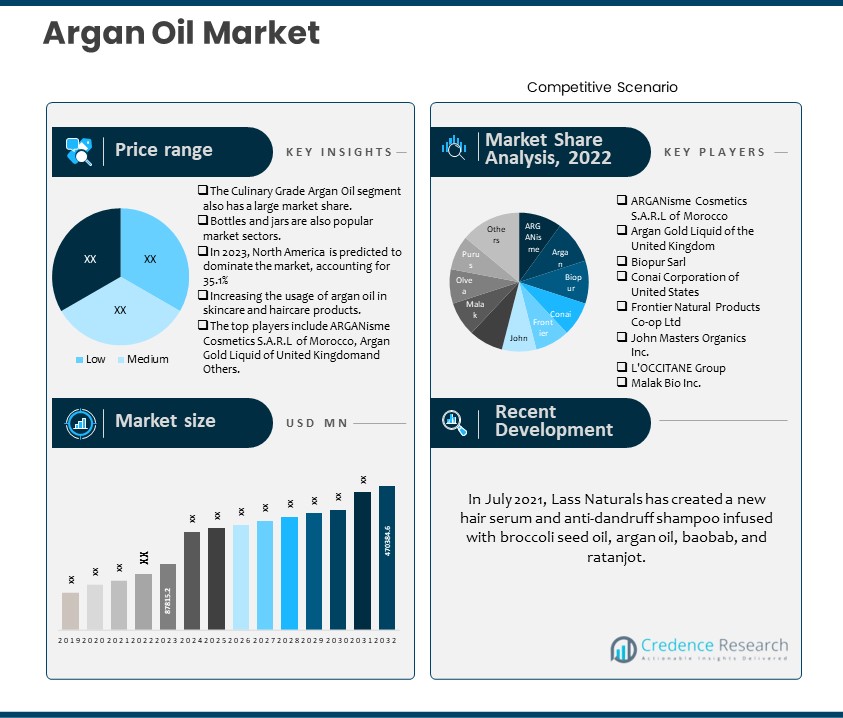
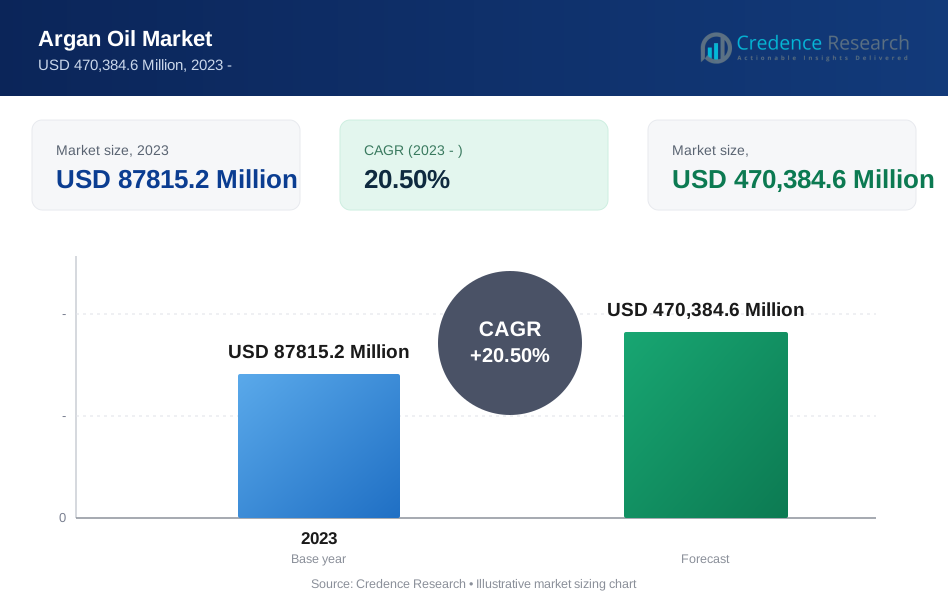
- The global demand for Argan Oil was valued at USD 87815.2 Million in 2023 and is expected to reach USD 470384.6 Million in 2032, growing at a CAGR of 20.50% between 2024 and 2032.
- Cosmetic-grade argan Oil is the most in-demand category in the Argan Oil Market, although the Culinary-Grade Argan Oil segment also has a significant market share.
- Mechanical extraction is the largest part of the argan oil market.
- In 2023, the Skin Care and hair Care Products category dominated the market, accounting for 50.3% of total revenue. Medicinal and Therapeutic Uses are another prominent area in the market.
- Single-use packets are the fastest-growing segment of the Argan Oil Market. Another prominent market sector is bottles and jars.
- North America is predicted to dominate the market in 2023, accounting for 35.1%, while Europe's Argan Oil Market is expected to develop the quickest in terms of value throughout the forecast period.
- The rising demand for cosmetics and personal care products propels market expansion.
- Substitutes are prevalent, although their availability is limited.
Executive Summary
Market Definition
Argan oil is a plant oil derived from the kernels of the Moroccan argan tree (Argania spinosa). This natural resource is highly prized for its numerous health and esthetic benefits. Argan oil, which is high in vital fatty acids, vitamin E, and antioxidants, has a wide range of applications, including skin and hair care and cooking.
Argan oil is a highly effective moisturizer that may be applied directly to the skin. Its necessary fatty acids serve to maintain the skin's natural barrier and vitamin E acts as an antioxidant, combating free radicals and environmental damage.
Market Overview
The global Argan Oil Market has witnessed steady growth in recent years and is expected to grow at a CAGR of 20.50% between 2024 and 2032. The market was valued at USD 87815.2 million in 2023 and is expected to reach USD 470384.6 million in 2032.
The increase can be attributed to rising product demand from a variety of end-use industries, including food and beverage, cosmetics, and medicine. It has become one of the most popular items, especially in the cosmetics and personal care industry. This can be ascribed to its unique qualities, which include significant antioxidant and anti-inflammatory content, as well as other remarkable skincare and haircare advantages.
Men's grooming products such as beard and hair oil, waxes enriched with argan, essential oils, and shower gels have gained popularity in recent years. Organic products are completely free of any potentially dangerous chemicals. Demand for organic personal care products has increased in recent years as consumers become more aware of the numerous benefits they have over synthetic alternatives.
Customers are more concerned with their appearance and place a higher importance on having healthy-looking, youthful skin. This trend is expected to drive up demand for natural cosmetics and personal care products, benefiting the worldwide argan oil market.
Segmentation By Product Type
- Cosmetic Grade Argan Oil is the most in-demand category of the Argan Oil Market. This market is in great demand because of the popularity of argan oil in skincare and haircare products.
- The Culinary Grade Argan Oil segment also has a substantial market share. While not as popular as cosmetic argan oil, culinary-grade argan oil is in high demand for use in cooking and food preparation, particularly in places where it is a traditional ingredient.
Segmentation By Processing Method
- Mechanical Extraction is the dominant segment of the Argan Oil Market. This approach uses contemporary machinery to extract oil from argan kernels, which is more efficient and enables larger-scale production than previous methods. Mechanical Extraction is preferred due to its increased output and consistency of quality.
Segmentation by End-Use Application
- In 2023, the Skincare and Haircare Products segment dominated the market, accounting for 50.3% of total revenue. Argan oil is incredibly flexible, with applications for skin, hair, and nails, making it a must-have in personal care and cosmetics.
- Medicinal and Therapeutic Uses is the another important segment in the market
Segmentation By Packaging
- Single-use packets are the fastest-growing section of the Argan Oil Market. This segment is increasing in popularity due to its ease and portability, making it a top choice for consumers seeking on-the-go skincare and haircare solutions.
- Another popular market sector is Bottles and jars, which provide a more traditional packaging option for argan oil products.
Segmentation by Region
- The North America region is expected to dominate the market in 2023, accounting for 35.1%.
- The Europe Argan Oil Market is expected to grow the fastest in terms of value over the forecast period.
- The rest of the world, including Latin America, the Middle East, and Africa, supplies the remaining demand for Argan Oil.
In 2023, North America dominated the industry. This was ascribed to the increasing popularity of bio-based cosmetics, personal care products, and aromatherapy items. It is utilized in aromatherapy to enhance physical, spiritual, and mental wellbeing. Aromatherapy massage balances the body, relieves stress, and aids numerous body functions in combating illness. As a result, aromatherapy products have gained popularity in North America, where they are widely available in specialist stores and online shopping malls. Hair care products are predicted to be in high demand due to increased innovation in hair styling techniques and consumer awareness of beautiful looks, especially in developed economies such as North America.
Moreover, The Europe market is predicted to increase at a moderate rate in terms of revenue throughout the forecast period. Cosmetic manufacturers are seeking more organic components to make their products more sustainable. Rising health awareness and demand for sustainable products are likely to fuel market revenue growth in the area.
Key Highlights of the Report
Product Type, Processing Method, End-Use Application, Packaging, and region segment of the global Argan Oil Market. In 2023, Mechanical extraction is the dominating segment of the Argan Oil Market, with single-use packages being the fastest-growing. Likewise, Cosmetic Grade Argan Oil is the most popular category, and Another popular market category is bottles and jars with North America driving its growth.
The Argan Oil Market is primarily driven by rising demand for natural and organic beauty products, as consumers seek out products containing natural ingredients. In addition, the market confronts constraints such as a restricted supply of argan oil, which is primarily obtained from specific regions, posing difficulty in fulfilling rising demand. Also, the Argan Oil Market provides several opportunities for growth. The increasing consumer awareness and demand for natural chemicals in beauty products creates a favorable environment for the market to expand.
In 2023, North America dominated the industry, accounting for 35.1% of total revenue. This is due to the growing popularity of bio-based cosmetics, personal care products, and aromatherapy items. Furthermore, the Europe market is expected to grow at a moderate rate in terms of revenue throughout the forecast period.
What Are The Main Drivers Of The Global Argan Oil Market?
As people become more mindful of their appearance, demand for argan oil rises. Argan oil is in high demand in confectionaries, frozen desserts, candies, and snacks because it adds flavor to these things, which promotes growth. Nowadays, people choose to eat flavored foods in accordance with the current argan oil industry trend, hence driving market growth. Argan oil is utilized in the majority of beauty products, which has contributed to the rise of the argan oil market.
What Are The Major Challenges Faced By The Global Argan Oil Market?
The adulteration of argan oil by local manufacturers becomes a serious challenge, impeding market expansion. Government certification and standardization of authorities are frequently tough concerns. Traditional processes for argan oil extraction are inefficient and less productive, which is the most productive aspect.
What Are The Growth Opportunities In The Global Argan Oil Market?
Despite these challenges, Using argan oil on hair and skin promotes health because it has various antioxidant characteristics and is high in vitamin E, omega-6, omega-3 fatty acids, and triterpenoids, enhancing the potential for argan oil market growth. It reduces inflammation and acne, prevents the appearance of stretch marks, and moisturizes the skin, all of which contribute to the global market value and size of argan oil.
Market Drivers
Several factors drive the global Argan Oil Market. The following are the key drivers of the global Argan Oil Market:
Rising Demand For Cosmetics And Personal Care Products
One key driver of the global argan oil market is increased consumer awareness of its multiple health and beauty benefits. People are becoming more concerned about the hazardous consequences of synthetic chemicals included in many cosmetic goods. As a result, they are looking for natural and organic alternatives, with argan oil being a popular choice due to its perceived safety and effectiveness.
Argan oil is frequently utilized in cosmetics and personal care products because of its moisturizing, anti-aging, and hair-nourishing characteristics. The trend toward natural and organic beauty products has increased demand for argan oil in the cosmetics business. In 2012, the Moroccan government announced plans to increase argan oil production from 2,500 to 4,000 tonnes by 2020. To ensure quality, they began randomly testing Argan oil shipments for purity.
Market Restraints
The global Argan Oil Market faces some challenges that may hinder its growth. These include the following:
Substitutes Are Common, But Availability Is Limited
There are an increasing variety of replacements for argan oil, including hazelnut and walnut oil. The nutty flavor of hazelnut oil may limit the usage of argan oil in culinary products, lowering its global demand. Hazelnut oil is an excellent option for argan oil for reducing hyperpigmentation, protecting against UV damage, reducing scar appearance, boosting collagen synthesis, moisturizing, and hydrating the skin. Because of their nutritional benefits, other essential oils are increasingly being employed as substitutes for this oil.
According to a report, on April 24, 2022, Argan oil is classified as a threatened, wild, and at-risk plant, also known as a flagship species, and must be preserved. Insufficient argan supply raises oil extraction costs and limits supply in other industries where this oil is used extensively.
Opportunities
The global Argan Oil Market offers significant growth opportunities. These include the following:
Expanding Pharmaceutical Sector And The Health Advantages Of Argan Oil
Argan oil's antioxidant capabilities and fat content make it a crucial element in therapeutic products. Its high antioxidant content, including linoleic and oleic acids, can help combat aging by neutralizing free radicals that damage cells. This oil contains vitamin E, which can help increase the body's immunity. Argan oil's qualities can help heal a variety of skin ailments, including eczema, psoriasis, acne, skin infections, and many more.
The presence of fatty acids benefits the body by increasing good cholesterol and decreasing bad cholesterol, as well as lowering the risk of heart disease. This oil's antiproliferative, hepatoprotective, anti-diabetic, anti-sebum, and anti-aging characteristics have led producers to use it into cosmetology and beauty products. Thus, the increasing use of argan oil in medicinal products is driving revenue growth in the market.
Competitive Landscape
Key Players
The global Argan Oil Market is highly competitive, with several key players. Some of the major players in the market and their market share are as follows:
- ARGANisme Cosmetics S.A.R.L of Morocco
- Argan Gold Liquid of the United Kingdom
- Biopur Sarl
- Conai Corporation of United States
- Frontier Natural Products Co-op Ltd
- John Masters Organics Inc.
- L'OCCITANE Group
- Malak Bio Inc.
- Olvea Group
- Purus International
- Zineglob ltd
These organizations prioritize product innovation, End-Use Application expansion, and mergers and acquisitions to stay competitive.
The global Argan Oil Market's key players continually seek to stay ahead by offering new products and developments.
In May 2022, Namaste Beauty has released a cruelty-free, high-quality vegan product range based on ancient Indian holistic wellness to care for skin and hair by regenerating skin, nourishing spirit, and emphasizing natural beauty. The presence of argan oil in many types of cosmetic products is predicted to stimulate revenue growth.
In January 2022, Josie Maran, the pioneer of argan oil-powered beauty, has released its first OTC-approved formula, Argan Apothecary. This vegan, cruelty-free, and clean cosmetics collection contains this oil, which provides an anti-aging solution, pore tightening characteristics, and acne fighting properties.
In December 2021, L'Oréal Paris used NFTs to develop a new lipstick with argan oil and vitamin E.
In August, 2019, Lakme Absolute has announced the debut of their Argan Oil skincare and cosmetics line.
Summary of Key Findings
- The rising pharmaceutical industry and the health benefits of argan oil
- The market is segmented by Product Type, Processing Method, End-Use Application , Packaging, and region.
- Mechanical extraction is the main segment in the Argan Oil Market.
- Single-use packets are the fastest-growing segment of the Argan Oil Market.
- North America is leading in market growth; the market is highly competitive, with key players including ARGANisme Cosmetics S.A.R.L of Morocco, Argan Gold Liquid of United Kingdom. and Others.
Future Outlook
- There is a growing desire for natural and organic beauty products.
- Increasing the usage of argan oil in skincare and haircare products.
- Growth in the beauty and personal care business.
How CXOs Can Benefit from the Credence Research Argan Oil Market Report
The Credence Research Argan Oil Market Report provides CXOs with a comprehensive overview of the market, including:
- Market size and growth forecast: The report provides detailed estimates of the global Argan Oil Market size, segmented By Product Type, Processing Method, End-Use Application , Packaging and region. It also includes forecasts for the market through 2032 based on key trends and drivers.
- Market segmentation: The report segments the Argan Oil Market By by Product Type, Processing Method, End-Use Application , Packaging, and region. This segmentation provides CXOs with a granular understanding of the market and the opportunities in each segment.
- Competitive Landscape: The report profiles the key players in the Argan Oil Market and provides insights into their strategies, product offerings, and financial performance. This information can help CXOs identify and assess their competition.
- Key trends and drivers: The report identifies and analyzes the key trends and drivers that are shaping the Argan Oil Market. This information can help CXOs to make informed decisions about their investments and strategies.
CXOs can use the insights from the Credence Research Argan Oil Market Report to:
- Identify growth opportunities: The report can help CXOs identify new growth opportunities in the Argan Oil Market. By analyzing the data and trends in the report, they can make informed decisions about where to invest and expand their business.
- Make informed investment decisions: The report can help CXOs make informed investment decisions about Argan Oil. For example, it may provide useful insights into market trends, customer preferences, the competitive landscape, and growth prospects in the Argan Oil Market.
- Develop competitive strategies: The report can help CXOs develop competitive strategies for their Argan Oil businesses. For example, by analyzing market trends, client preferences, and the competitive environment mentioned in the report, CXOs can fine-tune their strategies, differentiate their offers, and effectively position their firms in the marketplace.
- Track market developments: The report can help CXOs monitor market developments and stay ahead of the curve. For example, it provides insights into the latest trends and innovations in the Argan Oil Market.
Overall, the Credence Research Argan Oil Market Report is a valuable reprocessing Method for CXOs who want to gain a deeper understanding of the market and identify opportunities for growth.
Segmentation
- By Product Type:
- Cosmetic Grade Argan Oil
- Culinary Grade Argan Oil
- Medical Grade Argan Oil
- By Processing Method:
- Traditional Extraction
- Mechanical Extraction
- By End-Use Application:
- Skincare and Haircare Products
- Culinary Applications
- Medicinal and Therapeutic Uses
- By Packaging:
- Bottles and Jars
- Bulk Packaging
- Single-Use Packets
- By Region
- North America
- The U.S.
- Canada
- Mexico
- Europe
- Germany
- France
- The U.K.
- Italy
- Spain
- Rest of Europe
- Asia Pacific
- China
- Japan
- India
- South Korea
- South-east Asia
- Rest of Asia Pacific
- Latin America
- Brazil
- Argentina
- Rest of Latin America
- Middle East & Africa
- GCC Countries
- South Africa
- Rest of the Middle East and Africa
- North America
Request a Free Sample
Fill in your details and we'll send you a free sample report.
- Sample data tables & charts
- Research methodology
Need a Custom Version of This Report?
Tailor the scope, geography, or segments to your exact requirements.
- Custom geography or segment scope
- Direct access to our analyst team
Frequently Asked Questions
What is the current size of the global Argan Oil Market?
What is the expected growth rate of the Argan Oil Market between 2024 and 2032?
Which segment is leading the market share in terms of End-Use Application?
Which region is fueling the growth of the Argan Oil industry?
Who are the major players in the global Argan Oil Market?
Table of Content
Chapter 1. Report Introduction
- 1.1 Report Description & Purpose
- 1.1.1 Report Title & Market Definition
- 1.1.2 Unique Selling Propositions (USP) & Key Differentiators
- 1.1.3 Value Proposition for Stakeholders
- 1.2 Research Objectives
- 1.2.1 Market Sizing Objectives (Volume & Revenue)
- 1.2.2 Segmentation Objectives
- 1.2.3 Competitive Intelligence Objectives
- 1.2.4 Forecast & Scenario Objectives
- 1.3 Report Scope
- 1.3.1 Argan Oil Scope – Types & Subtypes Covered
- 1.3.2 Geographic Scope – Regions & Countries Covered
- 1.3.3 Historical Period, Base Year & Forecast Period (2023; forecast to the forecast period)
- 1.3.4 Inclusions & Exclusions
- 1.4 HS Code & Classification Framework
- 1.5 Currency, Units & Pricing Basis
- 1.6 Target Stakeholders
- 1.7 Limitations & Assumptions
Chapter 2. Executive Summary
- 2.1 Global Argan Oil Market Snapshot
- 2.1.1 Market Size – Historical (2023) & Forecast (the forecast period) (2023: USD 87815.2 Million → forecast year: USD 470,384.6 Million)
- 2.1.2 Volume & Revenue – Global Totals
- 2.1.3 Key Market Highlights – Top Five Facts
- 2.2 Argan Oil Market Segmentation Snapshot
- 2.2.1 Market Split by Region – 2023 vs.
- 2.3 Competitive Snapshot
- 2.3.1 Top 10 Players by Revenue Share – 2023
- 2.3.2 Top 10 Players by Volume Share – 2023
- 2.3.3 Recent Strategic Developments (18-Month Summary)
- 2.4 Key Investment Highlights & Strategic Conclusions
Chapter 3. Argan Oil Market Dynamics & Industry Analysis
- 3.1 Market Overview & Context
- 3.1.1 Argan Oil Market Position in the Broader Automotive Value Chain
- 3.1.2 OEM vs. Replacement Market Dynamics
- 3.1.3 Market Maturity & Development Stage by Region
- 3.2 Argan Oil Market Drivers
- 3.3 Argan Oil Market Restraints & Challenges
- 3.4 Argan Oil Market Opportunities
- 3.5 Porter's Five Forces Analysis
- 3.5.1 Threat of New Entrants
- 3.5.2 Bargaining Power of Suppliers
- 3.5.3 Bargaining Power of Buyers
- 3.5.4 Threat of Substitutes
- 3.5.5 Competitive Rivalry – Intensity Assessment
- 3.6 Argan Oil Value Chain Analysis
- 3.6.1 Upstream – Raw Material/Input Suppliers
- 3.6.1.1 Raw Material/Input 1
- 3.6.1.2 Raw Material/Input 2
- 3.6.1.3 Raw Material/Input 3
- 3.6.2 Midstream – Production/Manufacturing/Service Delivery
- 3.6.2.1 Production/Process Overview
- 3.6.2.2 Key Facility Locations & Capacity by Manufacturer
- 3.6.3 Downstream – Distribution & End Consumer
- 3.6.3.1 Primary Channel – B2B/OEM
- 3.6.3.2 Secondary Channels – Dealer, Retail, Online, Direct
- 3.6.4 Value Chain Profitability Analysis
- 3.6.1 Upstream – Raw Material/Input Suppliers
- 3.7 PESTEL Analysis
- 3.7.1 Political Factors
- 3.7.2 Economic Factors
- 3.7.3 Social Factors
- 3.7.4 Technological Factors
- 3.7.5 Environmental Factors
- 3.7.6 Legal Factors
- 3.8 Argan Oil Supply Chain Analysis
- 3.8.1 Raw Material/Input Supply Risk Assessment
- 3.8.2 Manufacturing Concentration Risk (Geographic Exposure)
- 3.8.3 Trade Disruption Impact Analysis
- 3.9 Regulatory & Policy Landscape
Note: The regulatory and policy landscape section covers regulations based on their applicability to the market, Argan Oil category, geography, and scope of the study. Only regulatory frameworks with a material impact on operations, compliance, trade, sustainability, or market access are analyzed in detail.
Chapter 4. Key Investment Pockets & Opportunity Analysis
- 4.1 Argan Oil Market Attractiveness Analysis
- 4.1.1 By Region – Investment Attractiveness Matrix (Volume × CAGR)
- 4.2 Absolute Revenue Growth Opportunity
- 4.2.1 By Region – Absolute USD Growth Through the forecast period
- 4.3 Incremental Volume Opportunity
- 4.3.1 By Region – Incremental Volume Through the forecast period
- 4.3.2 Segment – Incremental Volume
- 4.4 Emerging Submarket Opportunity Deep Dive (Subject to Applicability)
- 4.5 Emerging Market Opportunity Scorecards
- 4.5.1 United States
- 4.5.2 Europe
- 4.5.3 Asia
- 4.5.4 Middle East & Africa
Note: Emerging Market Opportunity Scorecards will be included based on relevance and strategic importance. Regions listed are indicative and may vary depending on data availability and market dynamics.
Chapter 5. Argan Oil Import-Export Analysis & Trade Flows
- 5.1 Global Trade Overview
- 5.1.1 Global Export Value by Country (2023)
- 5.1.2 Global Export Volume by Country (2023)
- 5.1.3 Global Import Value by Country (2023)
- 5.1.4 Global Import Volume by Country (2023)
- 5.1.5 Net Trade Balance by Country (2023)
- 5.2 Export Analysis – Segment
- 5.2.1 Type 1 (HS Code)
- 5.2.2 Type 2 (HS Code)
- 5.2.3 Type 3 (HS Code)
- 5.2.4 Type 4 (HS Code)
- 5.2.5 Type 5 (HS Code)
- 5.3 Import Analysis – Segment
- 5.3.1 Type 1 (HS Code)
- 5.3.2 Type 2 (HS Code)
- 5.3.3 Type 3 (HS Code)
- 5.3.4 Type 4 (HS Code)
- 5.3.5 Type 5 (HS Code)
- 5.4 Average Unit Trade Prices
- 5.4.1 Average Export Price – Segment & Country
- 5.4.2 Average Import Price – Segment & Source Country
- 5.4.3 Price Trends (2023)
- 5.5 Key Trade Route Analysis
- 5.5.1 Trade Route 1
- 5.5.2 Trade Route 2
- 5.5.3 Trade Route 3
- 5.5.4 Trade Route 4
- 5.5.5 Trade Route 5
- 5.6 Trade Policy Impact Assessment
- 5.6.1 US Anti-Dumping & Section 301 Tariffs
- 5.6.2 EU Customs Union Impact
- 5.6.3 Major Free Trade Agreements
- 5.6.4 USMCA Rules of Origin
Note: Trade policy analysis will be included only where relevant to the Argan Oil market.
Chapter 6. Competitive Landscape & Company Benchmarking
- 6.1 Argan Oil Market Concentration & Structure
- 6.1.1 Herfindahl-Hirschman Index (HHI) – vs. 2023
- 6.1.2 Tier 1, Tier 2 & Tier 3 Market Structure
- 6.1.3 Global, Regional & Local Player Dynamics
- 6.2 Argan Oil Market Share Analysis – 2023
- 6.2.1 Global Revenue Share by Company
- 6.2.2 Global Volume Share by Company
- 6.2.3 Regional Revenue Share
- 6.2.4 Market Share Evolution ( vs. 2023)
- 6.2.5 OEM Segment Share by Company
- 6.2.6 Replacement Segment Share by Company
- 6.3 Production/Delivery Capacity & Facility Analysis
- 6.3.1 Global Installed Capacity
- 6.3.2 Capacity Utilization Rates
- 6.3.3 Production/Output Volume
- 6.3.4 Facility Locations & Capacity Map
- 6.3.5 Planned Capacity Additions
- 6.4 Argan Oil Competitive Benchmarking Matrix
- 6.4.1 Revenue, Volume, CAGR & Profitability Comparison
- 6.4.2 Channel Revenue Mix
- 6.4.3 Geographic Revenue Exposure
- 6.4.4 R&D Intensity
- 6.4.5 Sustainability Maturity
- 6.5 Strategic Developments in Argan Oil (Last 24 Months)
- 6.5.1 Mergers, Acquisitions & Divestments
- 6.5.2 New Argan Oil Launches
- 6.5.3 Facility Expansions
- 6.5.4 Strategic Alliances, Joint Ventures & Partnerships
- 6.5.5 Distribution Expansion & Market Entry
- 6.5.6 Sustainability & ESG Initiatives
- 6.6 Competitive Strategy Mapping
- 6.6.1 Leader, Challenger, Follower & Niche Classification
- 6.6.2 Pricing Strategy Comparison
- 6.6.3 Channel Strategy Matrix
Note: Strategic developments are included based on their materiality and the availability of reliable information.
Chapter 7. Global Argan Oil Market – By Distribution Channel
- 7.1 Segment Overview
- 7.1.1 Volume & Revenue Split by Channel (2023 & )
- 7.1.2 Channel Mix Evolution (the forecast period)
Chapter 8. Regional Market Analysis – Global Overview
- 8.1 Global Regional Overview
- 8.1.1 Regional Volume Share
- 8.1.2 Regional Revenue Share
- 8.1.3 Regional Volume by Region
- 8.1.4 Regional Revenue by Region
- 8.1.5 Regional Forecast Through the forecast period
- 8.2 Cross-Regional Segment Analysis
- 8.2.1 By Distribution Channel
- 8.2.2 By Brand/Price Tier
Chapter 9. North America Argan Oil Market
- 9.1 United States
- 9.2 Canada
- 9.3 Mexico
Chapter 10. Europe Argan Oil Market
- 10.1 Germany
- 10.2 France
- 10.3 Italy
- 10.4 United Kingdom
- 10.5 Spain
- 10.6 Poland
- 10.7 Russia
- 10.8 Netherlands
- 10.9 Belgium
- 10.10 Sweden
- 10.11 Denmark
- 10.12 Norway
- 10.13 Rest of Europe
Chapter 11. Asia Pacific Argan Oil Market
- 11.1 China
- 11.2 India
- 11.3 Japan
- 11.4 South Korea
- 11.5 Thailand
- 11.6 Indonesia
- 11.7 Vietnam
- 11.8 Malaysia
- 11.9 Australia
- 11.10 Rest of Asia Pacific
Chapter 12. Latin America Argan Oil Market
- 12.1 Brazil
- 12.2 Argentina
- 12.3 Colombia
- 12.4 Chile
- 12.5 Rest of Latin America
Chapter 13. Middle East Argan Oil Market
- 13.1 Saudi Arabia
- 13.2 United Arab Emirates
- 13.3 Turkey
- 13.4 Israel
- 13.5 Iran
- 13.6 Rest of the Middle East
Chapter 14. Africa Argan Oil Market
- 14.1 South Africa
- 14.2 Egypt
- 14.3 Nigeria
- 14.4 Morocco
- 14.5 Rest of Africa
Chapter 15. Argan Oil Company Profiles
- 15.1 [Company 01]
- 15.1.1 Company Overview
- 15.1.2 Key Management Personnel
- 15.1.3 Products & Services Portfolio
- 15.1.4 Financial Performance
- 15.1.5 Key Market Focus & Geographic Presence
- 15.1.6 Recent Developments & Strategic Initiatives
Note: The company profile list is preliminary and may change based on research findings, market developments, data availability, and client requirements.
Chapter 16. Appendices
- Appendix A – List of Abbreviations & Acronyms
- Appendix B – Industry Classification Code Reference – Full Series
- Appendix C – Production & Capacity Data Tables
- Appendix D – End-Use & Demand Base Tables
- Appendix E – Consumption & Replacement Rate Assumptions
- Appendix F – ASP Reference Tables
- Appendix G – Manufacturing & Facility Database
- Appendix H – Import-Export Data Tables
- Appendix I – Regulatory Summary Tables
- Appendix J – Primary Research Participant List (Anonymized)
- Appendix K – Primary Research Questionnaire Framework
- Appendix L – Data Sources & Bibliography
- Appendix M – Market Size Divergence & Source Comparison
Chapter 17. Research Methodology
- 17.1 Research Framework & Philosophy
- 17.2 Secondary Research – Sources, Hierarchy & Data Extraction
- 17.3 Data Modeling – Bottom-Up & Top-Down Market Sizing
- 17.4 Primary Research – Stakeholder Framework, LOI & Sample Sizes
- 17.5 Forecast Methodology – Regression, Scenario & Sensitivity Analysis
- 17.6 Quality Control – Four-Layer Validation Framework
- 17.7 Limitations & Standard Assumptions
- 17.8 Disclaimer
