
Automotive Lightweight Materials Market Overview:
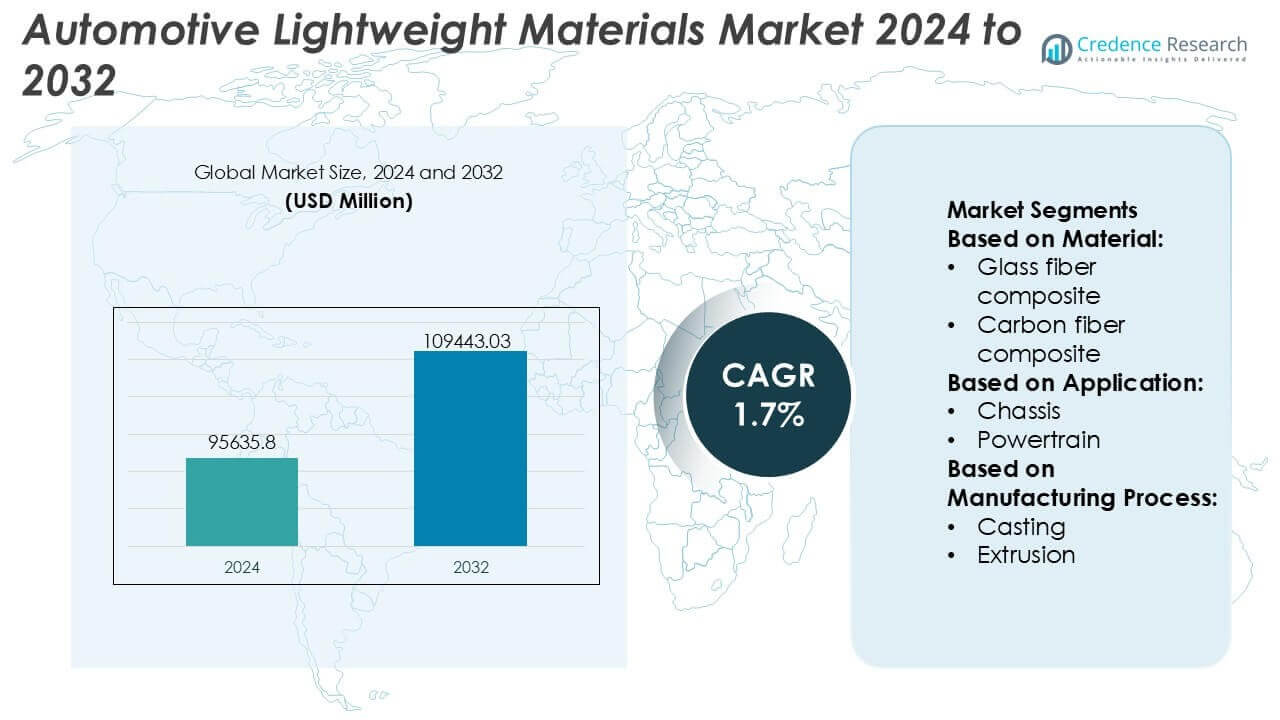
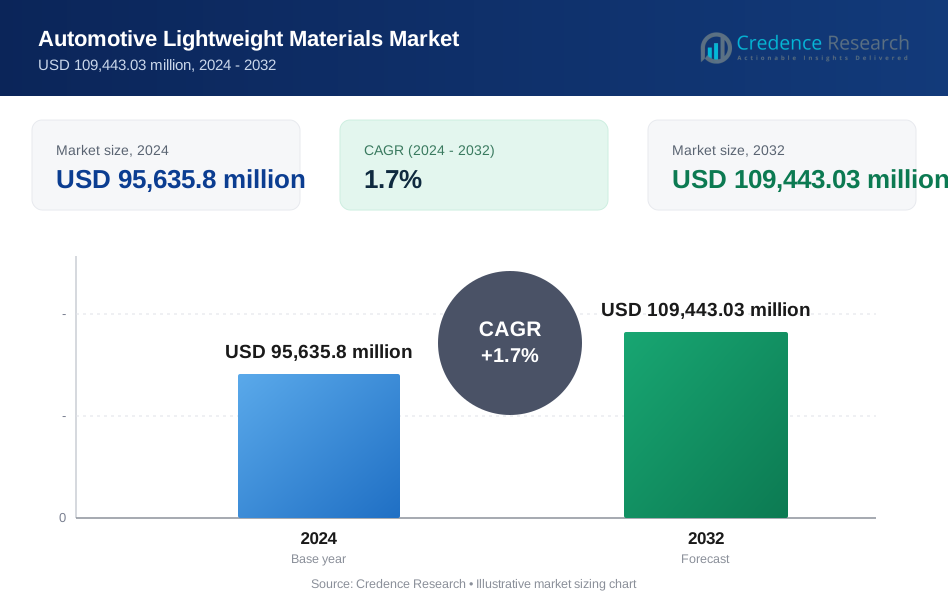
Automotive Lightweight Materials Market size was valued USD 95635.8 million in 2024 and is anticipated to reach USD 109443.03 million by 2032, at a CAGR of 1.7% during the forecast period.
| REPORT ATTRIBUTE | DETAILS |
|---|---|
| Historical Period | 2020-2023 |
| Base Year | 2024 |
| Forecast Period | 2025-2032 |
| Automotive Lightweight Materials Market Size 2024 | USD 95635.8 million |
| Automotive Lightweight Materials Market, CAGR | 1.7% |
| Automotive Lightweight Materials Market Size 2032 | USD 109443.03 million |
Automotive Lightweight Materials Market Insights
- Market growth is primarily driven by rising fuel-efficiency regulations, electrification trends, and OEM demand for materials that reduce vehicle mass while preserving crashworthiness and durability.
- Key market trends include increased use of advanced aluminum alloys, high-strength steels, and engineered polymers, with aluminum-based materials holding the dominant segment share at around 36% due to cost-performance balance and recyclability.
- Competitive dynamics center on material innovation, scalable manufacturing, and long-term OEM partnerships, with suppliers investing heavily in R&D and sustainable production technologies.
- Regionally, Asia-Pacific leads with an exact 38% market share, driven by high vehicle production, rapid EV adoption, and strong manufacturing ecosystems across China, Japan, South Korea, and India.
Automotive Lightweight Materials Market Segmentation Analysis:
By Material
By material, metals & alloys dominate the automotive lightweight materials market, accounting for an estimated 47% market share, driven by their structural strength, recyclability, and compatibility with existing automotive manufacturing lines. Within this segment, high-strength steel leads due to its favorable cost-to-performance ratio and widespread use in body-in-white and chassis applications, while aluminum follows closely, supported by its high strength-to-weight advantage in closures and structural parts. Plastics and composites continue to gain traction, but metals remain dominant due to proven crash performance, large-scale availability, and strong OEM confidence.
- For instance, Owens Corning has advanced automotive-grade glass fiber reinforcements with tensile strengths exceeding 3,400 MPa and elastic moduli above 72 GPa, enabling metal-composite hybrid structures that reduce component mass while maintaining load-bearing performance in structural automotive applications.
By Application
By application, body-in-white (BIW) represents the dominant segment with approximately 36% market share, supported by aggressive vehicle weight reduction targets and stringent emission regulations. Automakers increasingly deploy lightweight steels, aluminum panels, and composite reinforcements in BIW to improve fuel efficiency without compromising safety. The chassis and powertrain segments follow, benefiting from lightweight suspension components and engine parts that enhance vehicle dynamics. Interior and exterior applications steadily expand, driven by lightweight plastics and composites that improve design flexibility, acoustic performance, and overall vehicle efficiency.
- For instance, POSCO has commercialized third-generation AHSS grades such as Giga Steel with tensile strengths reaching 1,500 MPa, enabling BIW components to achieve significant mass reduction while meeting global crash safety requirements.
By Manufacturing Process
By manufacturing process, casting leads the market with an estimated 33% share, owing to its cost efficiency, high-volume suitability, and ability to produce complex lightweight metal components. Aluminum and magnesium castings are widely used in engine blocks, transmission housings, and structural brackets. Extrusion and forming follow, supporting lightweight profiles for frames, crash management systems, and body structures. Meanwhile, closed molding processes are gaining importance for composite parts, driven by demand for high-strength, lightweight components with improved surface quality and dimensional precision.
Key Growth Drivers
Stringent Emission and Fuel-Efficiency Regulations
Global automotive emission regulations are a primary growth driver for lightweight materials adoption. Governments across major markets enforce strict CO₂ and fuel-efficiency standards, compelling OEMs to reduce vehicle mass to improve energy efficiency. Lightweight metals, high-strength steels, engineered plastics, and composites enable significant weight reduction without compromising structural integrity or safety. As regulatory scrutiny intensifies for both internal combustion engine vehicles and electric vehicles, automakers increasingly substitute conventional steel with advanced lightweight materials to achieve compliance while maintaining performance, durability, and crashworthiness standards.
- For instance, BASF has developed Ultramid® polyamide grades used in structural automotive components that deliver tensile strengths above 240 MPa and heat resistance exceeding 220 °C, enabling replacement of metal parts while achieving measurable component-level mass reduction and long-term thermal stability in powertrain and under-hood applications.
Rising Electric Vehicle Production and Battery Optimization
The rapid expansion of electric vehicle production strongly accelerates demand for lightweight materials. Reducing vehicle weight directly improves driving range, battery efficiency, and overall energy consumption, which are critical performance metrics for EVs. Lightweight aluminum structures, polymer components, and composite materials offset the added mass of battery packs and power electronics. Automakers integrate these materials across body-in-white, chassis, and interior components to enhance range per charge while enabling flexible vehicle architectures, supporting large-scale electrification strategies across passenger and commercial vehicle segments.
- For instance, Stratasys Ltd. supports EV lightweighting through industrial FDM materials such as ULTEM™ 9085 resin, which delivers tensile strength of 70 MPa, a heat deflection temperature of 153 °C, and certified flame-smoke-toxicity performance, enabling production of lightweight structural brackets, housings, and tooling components suitable for EV manufacturing environments.
Advancements in Material Science and Manufacturing Technologies
Continuous innovation in material science and processing technologies is driving broader adoption of lightweight materials. Advances in high-strength alloys, fiber-reinforced composites, and engineering plastics deliver improved strength-to-weight ratios, corrosion resistance, and thermal performance. Simultaneously, modern manufacturing techniques such as precision casting, advanced extrusion, and automated molding improve scalability and cost efficiency. These developments allow OEMs to integrate lightweight materials into high-volume production platforms, reducing historical barriers related to cost, complexity, and manufacturability.
Key Trends & Opportunities
Growing Use of Multi-Material Vehicle Architectures
Automakers increasingly adopt multi-material vehicle architectures to optimize performance, cost, and weight reduction. Rather than relying on a single material, OEMs strategically combine high-strength steel, aluminum, plastics, and composites within a single vehicle platform. This approach maximizes the functional advantages of each material while minimizing overall mass. The trend creates strong opportunities for suppliers offering advanced joining technologies, material compatibility solutions, and integrated design expertise that support efficient bonding, welding, and structural integration across mixed-material assemblies.
- For instance, Alcoa Corporation develops automotive 6xxx-series aluminum sheet alloys that deliver yield strengths exceeding 240 MPa in the final T6 temper.
Expansion of Lightweight Materials in Interior and Exterior Applications
Lightweight materials are gaining traction beyond structural components, expanding rapidly into interior and exterior vehicle applications. Advanced plastics, polymer blends, and composite panels enable complex designs, improved aesthetics, and integrated functionality such as ambient lighting and electronic embedding. Exterior applications benefit from corrosion resistance and design flexibility, while interiors leverage lightweight materials for comfort, acoustics, and sustainability objectives. This trend opens opportunities for material suppliers that offer recyclable, low-emission, and high-durability solutions aligned with evolving consumer and regulatory expectations.
- For instance, Tata Steel has developed automotive-grade advanced high-strength steel such as DP780, which features a minimum tensile strength of 780 MPa and typical total elongation of around 18-20%.
Sustainability and Circular-Economy Focus
Sustainability considerations increasingly shape material selection strategies in the automotive sector. OEMs prioritize recyclable metals, bio-based polymers, and low-carbon composite solutions to reduce lifecycle environmental impact. Lightweight materials contribute to emissions reduction not only during vehicle operation but also across production and end-of-life phases. This shift creates opportunities for suppliers investing in recycled content, closed-loop manufacturing systems, and eco-designed materials that support automakers’ long-term environmental, social, and governance objectives.
Key Challenges
High Material and Processing Costs
Despite performance advantages, lightweight materials often involve higher raw material and processing costs compared to conventional steel. Advanced alloys, carbon fiber composites, and specialty polymers require complex manufacturing processes and specialized tooling, increasing overall production expenses. Cost sensitivity remains a significant challenge, particularly in mass-market and price-competitive vehicle segments. OEMs must carefully balance weight-reduction benefits against cost constraints, while suppliers face pressure to improve economies of scale and reduce processing complexity to support wider adoption.
Manufacturing Complexity and Repairability Issues
Integrating lightweight materials introduces manufacturing and repair challenges across vehicle lifecycles. Multi-material structures require specialized joining methods, quality control systems, and skilled labor, increasing production complexity. Additionally, repairability of advanced composites and bonded structures remains limited compared to traditional steel components, affecting service costs and insurance considerations. Addressing these challenges requires investments in workforce training, standardized repair procedures, and advanced diagnostic tools to ensure lightweight vehicles remain economically viable throughout ownership cycles.
Regional Analysis
North America
North America accounts for approximately 36% market share in the Automotive Lightweight Materials Market, supported by stringent fuel-efficiency and emission regulations, strong electric vehicle penetration, and advanced manufacturing capabilities. Automakers in the United States and Canada actively integrate aluminum, high-strength steel, and polymer composites to offset battery weight and improve vehicle range. The region benefits from well-established OEM–Tier-1 collaboration, extensive R&D investments, and early adoption of multi-material vehicle architectures. Rising demand for pickup trucks and SUVs, combined with lightweight chassis and body-in-white solutions, continues to reinforce North America’s leading position.
Europe
Europe holds around 28% market share, driven by aggressive CO₂ reduction targets, lightweighting mandates, and a strong premium automotive base. Automakers increasingly deploy aluminum-intensive platforms, magnesium components, and carbon-fiber composites to achieve weight reduction without compromising safety or performance. Germany, France, and the UK remain core innovation hubs, supported by advanced forming, extrusion, and closed-molding technologies. The region also leads in sustainable lightweight materials, including recyclable composites and bio-based polymers. Growth is further supported by the rapid electrification of passenger cars and regulatory pressure favoring lightweight structural and interior components.
Asia-Pacific
Asia-Pacific commands approximately 30% market share, making it the fastest-growing regional market due to high vehicle production volumes and expanding electric vehicle adoption. China, Japan, South Korea, and India drive demand for cost-effective lightweight materials such as high-strength steel, aluminum, and engineered plastics. OEMs in the region focus on mass-production compatibility, weight optimization, and affordability, particularly for compact and mid-segment vehicles. Government incentives for EVs and fuel-efficient vehicles accelerate lightweight material integration across body, chassis, and powertrain applications, reinforcing Asia-Pacific’s strong growth momentum.
Latin America
Latin America represents about 4% market share, with growth supported by gradual modernization of vehicle platforms and increasing regulatory alignment with global emission standards. Brazil and Mexico serve as regional manufacturing hubs, where automakers adopt lightweight plastics, aluminum components, and high-strength steel to improve fuel economy at controlled costs. The market favors materials compatible with high-volume production and existing manufacturing infrastructure. Although adoption of advanced composites remains limited, rising exports, localized EV assembly, and platform sharing with North American OEMs are steadily expanding lightweight material usage.
Middle East & Africa
The Middle East & Africa region holds nearly 2% market share, reflecting early-stage adoption of automotive lightweight materials. Demand is primarily driven by vehicle imports, localized assembly operations, and increasing fuel-efficiency awareness. Lightweight plastics and aluminum components dominate due to cost efficiency and suitability for harsh climatic conditions. Gulf countries show growing interest in electric and hybrid vehicles, supporting gradual uptake of advanced lightweight materials. While limited local manufacturing constrains rapid growth, infrastructure development, regulatory evolution, and rising vehicle ownership create long-term opportunities for lightweight material integration.
Automotive Lightweight Materials Market Segmentations:
By Material:
- Glass fiber composite
- Carbon fiber composite
By Application:
- Chassis
- Powertrain
By Manufacturing Process:
- Casting
- Extrusion
By Geography
- North America
- U.S.
- Canada
- Mexico
- Europe
- Germany
- France
- U.K.
- Italy
- Spain
- Rest of Europe
- Asia Pacific
- China
- Japan
- India
- South Korea
- South-east Asia
- Rest of Asia Pacific
- Latin America
- Brazil
- Argentina
- Rest of Latin America
- Middle East & Africa
- GCC Countries
- South Africa
- Rest of the Middle East and Africa
Competitive Landscape
The competitive landscape of the Automotive Lightweight Materials Market players such as Owens Corning, POSCO, BASF, Stratasys Ltd., Alcoa Corporation, Tata Steel, LyondellBasell, Toray Industries, Inc., ArcelorMittal. the Automotive Lightweight Materials Market is defined by intense competition among global material suppliers focused on reducing vehicle weight while maintaining safety, durability, and cost efficiency. Companies compete through continuous innovation in aluminum alloys, advanced high-strength steels, engineered polymers, and fiber-reinforced composites that support fuel efficiency and electric vehicle range targets. Strong emphasis on research and development enables suppliers to deliver materials with improved strength-to-weight ratios, corrosion resistance, and formability. Strategic collaborations with automotive OEMs and Tier-1 suppliers play a critical role in securing long-term contracts and early adoption at the vehicle platform level. In parallel, sustainability has become a key competitive lever, with manufacturers investing in recycled content, low-carbon production processes, and closed-loop supply chains. Overall, competitive differentiation increasingly depends on material performance, manufacturing scalability, regulatory compliance, and the ability to support evolving vehicle architectures.
Key Player Analysis
- Owens Corning
- POSCO
- BASF
- Stratasys Ltd.
- Alcoa Corporation
- Tata Steel
- LyondellBasell
- Toray Industries, Inc.
- ArcelorMittal
- Novelis Inc.
Recent Developments
- In March 2025, Luvly AB to assess its innovative, lightweight, flat-pack electric vehicle (EV) technology, aiming to explore cost-effective, sustainable urban mobility with Luvly's ultra-light chassis and energy-absorbing design, potentially revolutionizing compact car production by shipping kits for assembly in micro-factories, similar to IKEA.
- In July 2024, LyondellBasell launched its new Schulamid ET100 polyamide-based compound targeting the automotive sector for structural parts like door window frames, offering enhanced aesthetics, durability, and sustainability through lower density, reduced VOCs, and excellent flow for complex injection molding.
- In April 2024, Hyundai and carbon fiber specialist Toray indeed began a strategic partnership to develop lightweight, high-strength, and sustainable materials, focusing on Carbon Fiber-Reinforced Plastic (CFRP) for enhancing EV battery/motor performance, vehicle safety, and future mobility like robotics, leveraging Toray's advanced composite technology for lighter, stronger automotive components.
Report Coverage
The research report offers an in-depth analysis based on Material, Application, Manufacturing Process and Geography. It details leading market players, providing an overview of their business, product offerings, investments, revenue streams, and key applications. Additionally, the report includes insights into the competitive environment, SWOT analysis, current market trends, as well as the primary drivers and constraints. Furthermore, it discusses various factors that have driven market expansion in recent years. The report also explores market dynamics, regulatory scenarios, and technological advancements that are shaping the industry. It assesses the impact of external factors and global economic changes on market growth. Lastly, it provides strategic recommendations for new entrants and established companies to navigate the complexities of the market.
Future Outlook
- Automotive manufacturers will increasingly adopt lightweight materials to improve energy efficiency and extend electric vehicle driving range.
- Advanced aluminum alloys and high-strength steels will gain wider penetration due to balanced cost, formability, and structural performance.
- Carbon-fiber and glass-fiber composites will see rising use in premium and performance vehicle segments as production scalability improves.
- Integration of lightweight materials into battery enclosures and structural components will accelerate with the growth of electric mobility.
- Sustainability initiatives will drive higher use of recycled metals and bio-based or recyclable polymers across vehicle platforms.
- Material suppliers will expand collaboration with OEMs to enable early-stage lightweighting at the vehicle design phase.
- Advancements in manufacturing processes such as hot forming and additive manufacturing will support complex lightweight part geometries.
- Regulatory pressure on emissions and fuel efficiency will continue to reinforce long-term demand for lightweight solutions.
- Cost optimization and supply-chain localization will become critical as automakers scale lightweight materials for mass-market vehicles.
- Digital simulation and material modeling will play a growing role in optimizing weight reduction without compromising safety or durability.
Request a Free Sample
Fill in your details and we'll send you a free sample report.
- Sample data tables & charts
- Research methodology
Need a Custom Version of This Report?
Tailor the scope, geography, or segments to your exact requirements.
- Custom geography or segment scope
- Direct access to our analyst team
Frequently Asked Questions
What is the current market size for the Automotive Lightweight Materials Market, and what is its projected size in 2032?
At what Compound Annual Growth Rate is the Automotive Lightweight Materials Market projected to grow between 2024 and 2032?
Which Automotive Lightweight Materials Market segment held the largest share in 2024?
What are the primary factors fueling the growth of the Automotive Lightweight Materials Market?
Who are the leading companies in the Automotive Lightweight Materials Market?
Which region commanded the largest share of the Automotive Lightweight Materials Market in 2024?
Table of Content
Chapter 1. Report Introduction
- 1.1 Report Description & Purpose
- 1.1.1 Report Title & Market Definition
- 1.1.2 Unique Selling Propositions (USP) & Key Differentiators
- 1.1.3 Value Proposition for Stakeholders
- 1.2 Research Objectives
- 1.2.1 Market Sizing Objectives (Volume & Revenue)
- 1.2.2 Segmentation Objectives
- 1.2.3 Competitive Intelligence Objectives
- 1.2.4 Forecast & Scenario Objectives
- 1.3 Report Scope
- 1.3.1 Automotive Lightweight Materials Scope – Types & Subtypes Covered
- 1.3.2 Geographic Scope – Regions & Countries Covered
- 1.3.3 Historical Period, Base Year & Forecast Period (2024; forecast to 2032)
- 1.3.4 Inclusions & Exclusions
- 1.4 HS Code & Classification Framework
- 1.5 Currency, Units & Pricing Basis
- 1.6 Target Stakeholders
- 1.7 Limitations & Assumptions
Chapter 2. Executive Summary
- 2.1 Global Automotive Lightweight Materials Market Snapshot
- 2.1.1 Market Size – Historical (2024) & Forecast (2024-2032) (2024: USD 95,635.8 million → 2032: USD 109,443.03 million)
- 2.1.2 Volume & Revenue – Global Totals
- 2.1.3 Key Market Highlights – Top Five Facts
- 2.2 Automotive Lightweight Materials Market Segmentation Snapshot
- 2.2.1 Market Split by Region – 2024 vs. 2032
- 2.3 Competitive Snapshot
- 2.3.1 Top 10 Players by Revenue Share – 2024
- 2.3.2 Top 10 Players by Volume Share – 2024
- 2.3.3 Recent Strategic Developments (18-Month Summary)
- 2.4 Key Investment Highlights & Strategic Conclusions
Chapter 3. Automotive Lightweight Materials Market Dynamics & Industry Analysis
- 3.1 Market Overview & Context
- 3.1.1 Automotive Lightweight Materials Market Position in the Broader Automotive Value Chain
- 3.1.2 OEM vs. Replacement Market Dynamics
- 3.1.3 Market Maturity & Development Stage by Region
- 3.2 Automotive Lightweight Materials Market Drivers
- 3.3 Automotive Lightweight Materials Market Restraints & Challenges
- 3.4 Automotive Lightweight Materials Market Opportunities
- 3.5 Porter's Five Forces Analysis
- 3.5.1 Threat of New Entrants
- 3.5.2 Bargaining Power of Suppliers
- 3.5.3 Bargaining Power of Buyers
- 3.5.4 Threat of Substitutes
- 3.5.5 Competitive Rivalry – Intensity Assessment
- 3.6 Automotive Lightweight Materials Value Chain Analysis
- 3.6.1 Upstream – Raw Material/Input Suppliers
- 3.6.1.1 Raw Material/Input 1
- 3.6.1.2 Raw Material/Input 2
- 3.6.1.3 Raw Material/Input 3
- 3.6.2 Midstream – Production/Manufacturing/Service Delivery
- 3.6.2.1 Production/Process Overview
- 3.6.2.2 Key Facility Locations & Capacity by Manufacturer
- 3.6.3 Downstream – Distribution & End Consumer
- 3.6.3.1 Primary Channel – B2B/OEM
- 3.6.3.2 Secondary Channels – Dealer, Retail, Online, Direct
- 3.6.4 Value Chain Profitability Analysis
- 3.6.1 Upstream – Raw Material/Input Suppliers
- 3.7 PESTEL Analysis
- 3.7.1 Political Factors
- 3.7.2 Economic Factors
- 3.7.3 Social Factors
- 3.7.4 Technological Factors
- 3.7.5 Environmental Factors
- 3.7.6 Legal Factors
- 3.8 Automotive Lightweight Materials Supply Chain Analysis
- 3.8.1 Raw Material/Input Supply Risk Assessment
- 3.8.2 Manufacturing Concentration Risk (Geographic Exposure)
- 3.8.3 Trade Disruption Impact Analysis
- 3.9 Regulatory & Policy Landscape
Note: The regulatory and policy landscape section covers regulations based on their applicability to the market, Automotive Lightweight Materials category, geography, and scope of the study. Only regulatory frameworks with a material impact on operations, compliance, trade, sustainability, or market access are analyzed in detail.
Chapter 4. Key Investment Pockets & Opportunity Analysis
- 4.1 Automotive Lightweight Materials Market Attractiveness Analysis
- 4.1.1 By Region – Investment Attractiveness Matrix (Volume × CAGR)
- 4.2 Absolute Revenue Growth Opportunity
- 4.2.1 By Region – Absolute USD Growth Through 2032
- 4.3 Incremental Volume Opportunity
- 4.3.1 By Region – Incremental Volume Through 2032
- 4.3.2 Segment – Incremental Volume
- 4.4 Emerging Submarket Opportunity Deep Dive (Subject to Applicability)
- 4.5 Emerging Market Opportunity Scorecards
- 4.5.1 United States
- 4.5.2 Europe
- 4.5.3 Asia
- 4.5.4 Middle East & Africa
Note: Emerging Market Opportunity Scorecards will be included based on relevance and strategic importance. Regions listed are indicative and may vary depending on data availability and market dynamics.
Chapter 5. Automotive Lightweight Materials Import-Export Analysis & Trade Flows
- 5.1 Global Trade Overview
- 5.1.1 Global Export Value by Country (2024)
- 5.1.2 Global Export Volume by Country (2024)
- 5.1.3 Global Import Value by Country (2024)
- 5.1.4 Global Import Volume by Country (2024)
- 5.1.5 Net Trade Balance by Country (2024)
- 5.2 Export Analysis – Segment
- 5.2.1 Type 1 (HS Code)
- 5.2.2 Type 2 (HS Code)
- 5.2.3 Type 3 (HS Code)
- 5.2.4 Type 4 (HS Code)
- 5.2.5 Type 5 (HS Code)
- 5.3 Import Analysis – Segment
- 5.3.1 Type 1 (HS Code)
- 5.3.2 Type 2 (HS Code)
- 5.3.3 Type 3 (HS Code)
- 5.3.4 Type 4 (HS Code)
- 5.3.5 Type 5 (HS Code)
- 5.4 Average Unit Trade Prices
- 5.4.1 Average Export Price – Segment & Country
- 5.4.2 Average Import Price – Segment & Source Country
- 5.4.3 Price Trends (2024)
- 5.5 Key Trade Route Analysis
- 5.5.1 Trade Route 1
- 5.5.2 Trade Route 2
- 5.5.3 Trade Route 3
- 5.5.4 Trade Route 4
- 5.5.5 Trade Route 5
- 5.6 Trade Policy Impact Assessment
- 5.6.1 US Anti-Dumping & Section 301 Tariffs
- 5.6.2 EU Customs Union Impact
- 5.6.3 Major Free Trade Agreements
- 5.6.4 USMCA Rules of Origin
Note: Trade policy analysis will be included only where relevant to the Automotive Lightweight Materials market.
Chapter 6. Competitive Landscape & Company Benchmarking
- 6.1 Automotive Lightweight Materials Market Concentration & Structure
- 6.1.1 Herfindahl-Hirschman Index (HHI) – vs. 2024
- 6.1.2 Tier 1, Tier 2 & Tier 3 Market Structure
- 6.1.3 Global, Regional & Local Player Dynamics
- 6.2 Automotive Lightweight Materials Market Share Analysis – 2024
- 6.2.1 Global Revenue Share by Company
- 6.2.2 Global Volume Share by Company
- 6.2.3 Regional Revenue Share
- 6.2.4 Market Share Evolution ( vs. 2024)
- 6.2.5 OEM Segment Share by Company
- 6.2.6 Replacement Segment Share by Company
- 6.3 Production/Delivery Capacity & Facility Analysis
- 6.3.1 Global Installed Capacity
- 6.3.2 Capacity Utilization Rates
- 6.3.3 Production/Output Volume
- 6.3.4 Facility Locations & Capacity Map
- 6.3.5 Planned Capacity Additions
- 6.4 Automotive Lightweight Materials Competitive Benchmarking Matrix
- 6.4.1 Revenue, Volume, CAGR & Profitability Comparison
- 6.4.2 Channel Revenue Mix
- 6.4.3 Geographic Revenue Exposure
- 6.4.4 R&D Intensity
- 6.4.5 Sustainability Maturity
- 6.5 Strategic Developments in Automotive Lightweight Materials (Last 24 Months)
- 6.5.1 Mergers, Acquisitions & Divestments
- 6.5.2 New Automotive Lightweight Materials Launches
- 6.5.3 Facility Expansions
- 6.5.4 Strategic Alliances, Joint Ventures & Partnerships
- 6.5.5 Distribution Expansion & Market Entry
- 6.5.6 Sustainability & ESG Initiatives
- 6.6 Competitive Strategy Mapping
- 6.6.1 Leader, Challenger, Follower & Niche Classification
- 6.6.2 Pricing Strategy Comparison
- 6.6.3 Channel Strategy Matrix
Note: Strategic developments are included based on their materiality and the availability of reliable information.
Chapter 7. Global Automotive Lightweight Materials Market – By Distribution Channel
- 7.1 Segment Overview
- 7.1.1 Volume & Revenue Split by Channel (2024 & 2032)
- 7.1.2 Channel Mix Evolution (2024-2032)
Chapter 8. Regional Market Analysis – Global Overview
- 8.1 Global Regional Overview
- 8.1.1 Regional Volume Share
- 8.1.2 Regional Revenue Share
- 8.1.3 Regional Volume by Region
- 8.1.4 Regional Revenue by Region
- 8.1.5 Regional Forecast Through 2032
- 8.2 Cross-Regional Segment Analysis
- 8.2.1 By Distribution Channel
- 8.2.2 By Brand/Price Tier
Chapter 9. North America Automotive Lightweight Materials Market
- 9.1 United States
- 9.2 Canada
- 9.3 Mexico
Chapter 10. Europe Automotive Lightweight Materials Market
- 10.1 Germany
- 10.2 France
- 10.3 Italy
- 10.4 United Kingdom
- 10.5 Spain
- 10.6 Poland
- 10.7 Russia
- 10.8 Netherlands
- 10.9 Belgium
- 10.10 Sweden
- 10.11 Denmark
- 10.12 Norway
- 10.13 Rest of Europe
Chapter 11. Asia Pacific Automotive Lightweight Materials Market
- 11.1 China
- 11.2 India
- 11.3 Japan
- 11.4 South Korea
- 11.5 Thailand
- 11.6 Indonesia
- 11.7 Vietnam
- 11.8 Malaysia
- 11.9 Australia
- 11.10 Rest of Asia Pacific
Chapter 12. Latin America Automotive Lightweight Materials Market
- 12.1 Brazil
- 12.2 Argentina
- 12.3 Colombia
- 12.4 Chile
- 12.5 Rest of Latin America
Chapter 13. Middle East Automotive Lightweight Materials Market
- 13.1 Saudi Arabia
- 13.2 United Arab Emirates
- 13.3 Turkey
- 13.4 Israel
- 13.5 Iran
- 13.6 Rest of the Middle East
Chapter 14. Africa Automotive Lightweight Materials Market
- 14.1 South Africa
- 14.2 Egypt
- 14.3 Nigeria
- 14.4 Morocco
- 14.5 Rest of Africa
Chapter 15. Automotive Lightweight Materials Company Profiles
- 15.1 [Company 01]
- 15.1.1 Company Overview
- 15.1.2 Key Management Personnel
- 15.1.3 Products & Services Portfolio
- 15.1.4 Financial Performance
- 15.1.5 Key Market Focus & Geographic Presence
- 15.1.6 Recent Developments & Strategic Initiatives
Note: The company profile list is preliminary and may change based on research findings, market developments, data availability, and client requirements.
Chapter 16. Appendices
- Appendix A – List of Abbreviations & Acronyms
- Appendix B – Industry Classification Code Reference – Full Series
- Appendix C – Production & Capacity Data Tables
- Appendix D – End-Use & Demand Base Tables
- Appendix E – Consumption & Replacement Rate Assumptions
- Appendix F – ASP Reference Tables
- Appendix G – Manufacturing & Facility Database
- Appendix H – Import-Export Data Tables
- Appendix I – Regulatory Summary Tables
- Appendix J – Primary Research Participant List (Anonymized)
- Appendix K – Primary Research Questionnaire Framework
- Appendix L – Data Sources & Bibliography
- Appendix M – Market Size Divergence & Source Comparison
Chapter 17. Research Methodology
- 17.1 Research Framework & Philosophy
- 17.2 Secondary Research – Sources, Hierarchy & Data Extraction
- 17.3 Data Modeling – Bottom-Up & Top-Down Market Sizing
- 17.4 Primary Research – Stakeholder Framework, LOI & Sample Sizes
- 17.5 Forecast Methodology – Regression, Scenario & Sensitivity Analysis
- 17.6 Quality Control – Four-Layer Validation Framework
- 17.7 Limitations & Standard Assumptions
- 17.8 Disclaimer
