Market Overview:
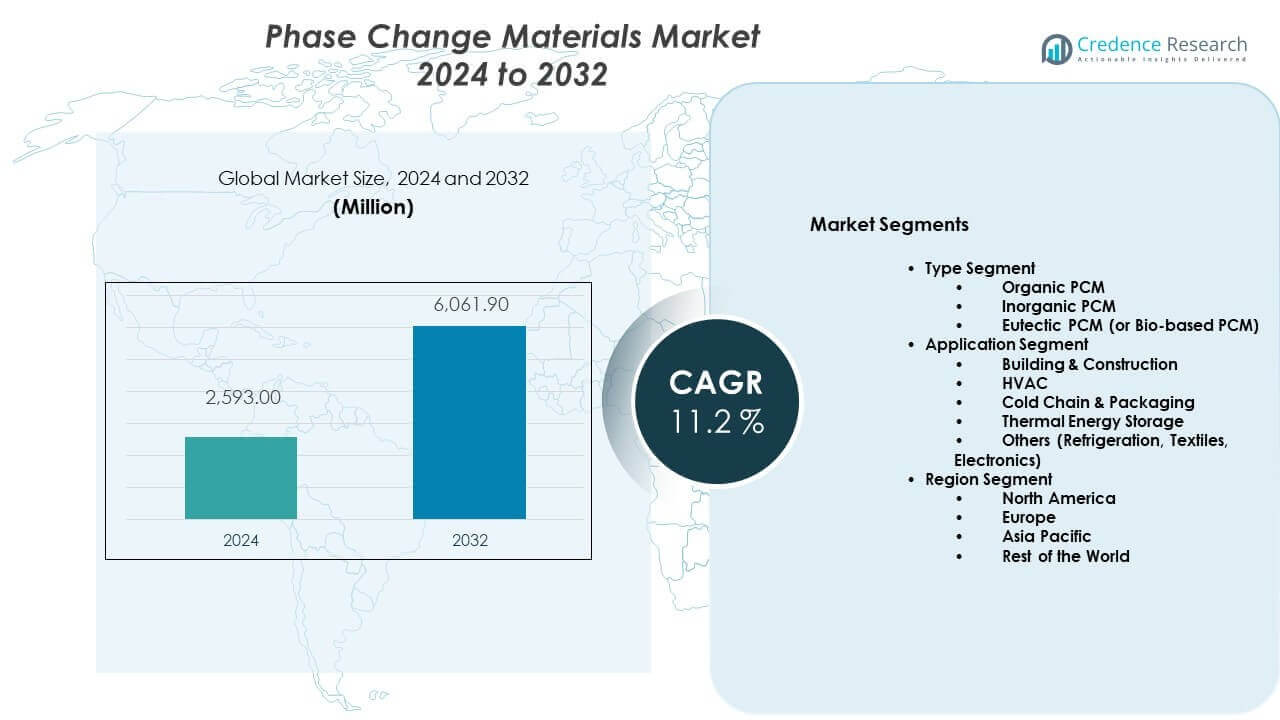
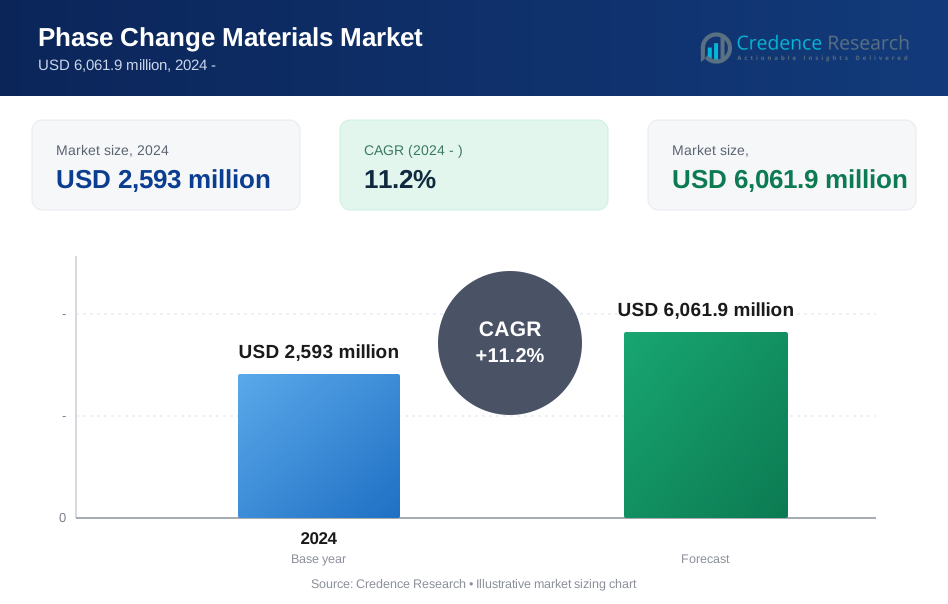
The Phase change materials market is projected to grow from USD 2,593 million in 2024 to an estimated USD 6,061.9 million by 2032, with a compound annual growth rate (CAGR) of 11.2% from 2024 to 2032.
| REPORT ATTRIBUTE | DETAILS |
|---|---|
| Historical Period | 2020-2023 |
| Base Year | 2024 |
| Forecast Period | 2025-2032 |
| Phase Change Materials Market Size 2024 | USD 2,593 million |
| Phase Change Materials Market, CAGR | 11.2% |
| Phase Change Materials Market Size 2032 | USD 6,061.9 million |
Market growth is driven by rising energy efficiency targets across buildings and industrial systems. Phase change materials support thermal regulation and reduce energy loss. Construction firms adopt these materials to manage indoor temperatures. Cold chain logistics rely on thermal storage for product safety. Electronics makers use phase change materials to control device heat. Government efficiency standards encourage adoption. Growth in renewable energy storage also supports demand. Industrial users value cost savings from reduced energy use.
North America and Europe lead due to strict energy regulations and early technology adoption. The United States and Germany show strong use in buildings and cold storage. Asia-Pacific is emerging fast, led by China, Japan, and South Korea. Rapid urban growth increases demand for thermal control solutions. Manufacturing expansion supports wider adoption. Middle East markets gain traction in temperature-sensitive infrastructure projects. Latin America and Africa remain developing, supported by gradual industrial growth.
Market Insights:
- The market size reached USD 2,593 million in 2024 and is projected to reach USD 6,061.9 million by 2032, growing at a CAGR of 11.2%, driven by rising energy efficiency and thermal storage demand.
- Asia Pacific leads with about 34% share due to rapid urbanization and manufacturing growth, followed by North America at 32% supported by strict energy codes, and Europe at 28% driven by sustainability policies.
- Asia Pacific is also the fastest-growing region, holding 34% share, supported by large-scale construction, HVAC expansion, and cold chain investments across China and Southeast Asia.
- By type, Organic PCM holds the largest share at around 45% due to stable performance and wide use in buildings, while Inorganic PCM accounts for nearly 35% supported by energy storage and industrial applications.
- By application, Building and Construction leads with about 40% share, while Cold Chain and Packaging follows with nearly 25%, driven by food safety and pharmaceutical logistics needs.
Market Drivers:
Rising Focus On Energy Efficiency Across Building And Infrastructure Projects
The Phase change materials market gains support from strict energy efficiency goals worldwide. Governments enforce tighter building energy codes. Developers seek materials that stabilize indoor temperatures. These materials reduce heating and cooling loads. Commercial buildings adopt them to lower operating costs. Residential projects use them for thermal comfort. Industrial facilities value predictable heat control. Energy audits favor solutions with measurable savings. This driver sustains steady material demand.
- For instance, BASF’s Micronal PCM panels installed in European office buildings cut peak indoor temperature swings by up to 4°C and reduced HVAC energy demand by nearly 20%, according to project performance data.
Expansion Of Cold Chain And Temperature-Sensitive Logistics Networks
The Phase change materials market benefits from global cold chain expansion. Food logistics require stable temperature control. Pharmaceutical transport depends on reliable thermal protection. These materials ensure safe transit without constant power use. Logistics firms value passive cooling solutions. Vaccines and biologics raise performance expectations. Warehousing operators adopt thermal buffering systems. E-commerce grocery services add further demand. This driver supports volume growth.
- For instance, Rubitherm PCM packs are used in pharmaceutical shippers that maintain 2–8°C stability for over 72 hours, supporting compliant vaccine transport without active refrigeration.
Growing Thermal Management Needs In Electronics And Industrial Equipment
The Phase change materials market responds to heat control challenges in electronics. Compact devices generate higher heat loads. Manufacturers require materials with fast heat absorption. Data centers use them for peak load control. Industrial machines rely on thermal stability for uptime. Automotive electronics also raise demand levels. Electric components need protection from heat spikes. Engineers prefer passive thermal solutions. This driver improves material relevance.
Supportive Policies For Renewable Energy And Thermal Storage Adoption
The Phase change materials market gains traction from clean energy policies. Solar and wind systems need energy storage support. Thermal storage improves system efficiency. Utilities test materials for load shifting. Grid operators value flexible storage options. Public funding supports pilot installations. Research programs advance storage design. Policy alignment encourages adoption. This driver strengthens long-term demand.
Market Trends:
Shift Toward Bio-Based And Environment-Friendly Material Formulations
The Phase change materials market shows interest in bio-based solutions. Manufacturers reduce reliance on petroleum inputs. Customers demand safer material profiles. Regulatory bodies favor low-toxicity products. Natural waxes gain wider use. Bio-based salts attract research funding. Product labels highlight sustainability claims. Green building projects prefer such materials. This trend reshapes product portfolios.
- For instance, Croda International developed plant-based PCM derived from renewable fatty acids that achieved over 90% bio-based carbon content, supporting low-VOC building material certifications.
Increasing Customization For Application-Specific Thermal Performance Needs
The Phase change materials market moves toward tailored solutions. Users demand precise melting points. Construction projects require climate-specific designs. Electronics firms request compact thermal modules. Packaging users seek lightweight formats. Suppliers offer application-driven formulations. Engineering teams co-develop solutions with clients. Custom blends improve system compatibility. This trend boosts value-added offerings.
- For instance, Honeywell engineered PCM composites for data center enclosures that absorbed short-term heat spikes of over 200 W per module, improving equipment thermal stability during peak loads.
Integration Of Phase Change Materials Into Composite And Smart Materials
The Phase change materials market aligns with smart material development. Engineers embed materials into panels and composites. Smart walls improve indoor thermal stability. Industrial insulation gains added functionality. Textile applications see gradual adoption. Material integration simplifies installation processes. Product designers seek multifunctional components. This trend enhances usability across sectors.
Growing Use In Modular And Prefabricated Construction Systems
The Phase change materials market benefits from modular construction growth. Prefabricated units need built-in thermal control. These materials suit factory-based installation. Builders reduce on-site labor complexity. Modular housing projects expand globally. Speed and efficiency drive adoption. Thermal regulation improves occupant comfort. This trend supports construction sector demand.
Market Challenges Analysis:
High Initial Material Cost And Limited Price Sensitivity Among End Users
The Phase change materials market faces cost-related barriers. Advanced formulations remain expensive. Small builders resist higher upfront spending. Budget-focused projects avoid premium materials. Price volatility affects raw material sourcing. Procurement teams prioritize short-term savings. Long payback periods slow adoption decisions. Cost concerns limit penetration in developing regions. This challenge affects volume growth.
Performance Stability And Long-Term Reliability Under Repeated Thermal Cycles
The Phase change materials market encounters durability concerns. Repeated phase cycles stress material structure. Leakage risks affect user confidence. Performance loss reduces system efficiency. Testing standards vary across regions. End users demand long service life. Quality assurance adds development costs. Field failures slow repeat purchases. This challenge impacts trust levels.
Market Opportunities:
Rising Adoption In Electric Vehicles And Battery Thermal Control Systems
The Phase change materials market finds opportunity in electric mobility. Battery systems need controlled temperature ranges. These materials manage heat during fast charging. Automakers seek passive safety solutions. Lightweight thermal systems improve vehicle efficiency. Research supports automotive-grade formulations. Electric buses and fleets expand usage scope. This opportunity drives innovation focus.
Growing Demand From Emerging Economies With Rapid Urban Development
The Phase change materials market benefits from urban growth in emerging regions. Cities invest in energy-efficient housing. Infrastructure projects adopt modern materials. Rising incomes support quality construction demand. Industrial zones need thermal stability solutions. Local manufacturing lowers supply barriers. Public awareness of energy savings increases. This opportunity supports geographic expansion.
Market Segmentation Analysis:
Type Segment
Organic PCM dominates use due to thermal stability and safe handling. Builders select this type for walls and roofs. HVAC systems rely on predictable melting behavior. Paraffin and fatty acids support wide temperature ranges. Low corrosion risk improves material life. Cost control supports large projects. Indoor applications favor this option. Inorganic PCM serves systems that require high heat storage density. Salt hydrates lead this category. Energy storage units use compact thermal designs. Industrial systems value fast heat transfer. Performance consistency remains important. Material refinement improves reliability. Infrastructure projects drive demand. Eutectic or bio-based PCM addresses precision and sustainability needs. These materials offer defined phase change points. Designers use them for targeted thermal control. Environmental goals support bio-based choices. Packaging applications value safety profiles. Research improves formulation balance. Adoption rises in specialized uses.
- For instance, DuPont-integrated paraffin-based PCM sheets in commercial ceilings demonstrated repeatable phase cycling beyond 10,000 thermal cycles without material degradation.
Application Segment
Building and construction leads adoption across regions. PCM improves indoor thermal comfort. Energy efficiency rules support wider use. Developers reduce cooling and heating loads. Material integration suits modern designs. Retrofit projects add demand. Long-term savings drive uptake. HVAC applications use PCM for load balancing. Systems manage peak temperature demand. These materials improve operational efficiency. Facility managers value stable performance. Installation flexibility supports adoption. Commercial buildings show strong interest. Cold chain and packaging rely on PCM for passive temperature control. Food and pharma logistics depend on stability. Transport without constant power saves cost. Safety standards support use. Reliability ensures product integrity. Thermal energy storage and others expand steadily. Utilities use PCM for load shifting. Electronics and textiles drive niche growth. Refrigeration systems adopt compact solutions. The Phase change materials market benefits from diversified applications.
- For instance, PCM-integrated air handling units demonstrated peak load shifting of several hours during daily cooling cycles in commercial offices.
Segmentation:
Type Segment- Organic PCM
- Inorganic PCM
- Eutectic PCM (or Bio-based PCM)
- Building & Construction
- HVAC
- Cold Chain & Packaging
- Thermal Energy Storage
- Others (Refrigeration, Textiles, Electronics)
- North America
- U.S.
- Canada
- Mexico
- Europe
- Germany
- France
- U.K.
- Italy
- Spain
- Rest of Europe
- Asia Pacific
- China
- Japan
- India
- South Korea
- South-east Asia
- Rest of Asia Pacific
- Latin America
- Brazil
- Argentina
- Rest of Latin America
- Middle East & Africa
- GCC Countries
- South Africa
- Rest of the Middle East and Africa
Regional Analysis:
North America
The Phase change materials market shows strong maturity in North America, holding about 32% market share. The United States leads regional demand across buildings and cold chain systems. Strict energy efficiency codes support material adoption. Commercial construction projects use PCM for thermal control. Cold storage and pharma logistics drive steady volume demand. Technology awareness supports faster deployment. Canada contributes through green building initiatives.
Europe
Europe accounts for nearly 28% of global market share. Germany, France, and the UK lead regional adoption. Energy transition policies support thermal storage solutions. Building renovation projects increase PCM use. Industrial insulation and district energy systems add demand. Sustainability goals favor bio-based materials. Regulatory clarity improves supplier confidence.
Asia Pacific And Rest Of The World
Asia Pacific holds the largest share at around 34%. China, Japan, and South Korea lead regional growth. Rapid urbanization drives construction demand. Manufacturing expansion supports industrial applications. HVAC and cold chain sectors grow fast. Rest of the World holds about 6% share. Middle East projects and Latin America logistics support gradual uptake.
Key Player Analysis:
- Honeywell International Inc.
- DuPont de Nemours, Inc.
- Croda International Plc
- BASF SE
- Rubitherm Technologies GmbH
Competitive Analysis:
The Phase change materials market features moderate consolidation with global chemical firms and specialized material suppliers. Leading players focus on product reliability, thermal performance, and safety standards. Companies invest in formulation upgrades to address durability and leakage concerns. Portfolio breadth supports access to construction, cold chain, and energy storage customers. Strategic partnerships help suppliers expand application reach. Competitive positioning depends on technical support and customization capability. Cost control remains critical for large-scale projects. It rewards firms with strong distribution networks and regulatory expertise.
Recent Developments:
- In October 2025, Honeywell completed a transformative restructuring of its business portfolio by spinning off its Advanced Materials division into an independent, publicly traded company named Solstice Advanced Materials. The Board of Directors formally approved this spin-off on October 16, 2025, with the distribution completed on October 30, 2025. This strategic move represents a culmination of plans initially announced in October 2024, when Honeywell first outlined its intention to separate the Advanced Materials unit to unlock shareholder value and create more focused enterprises.
Report Coverage:
The research report offers an in-depth analysis based on Type and Application segments. It details leading market players, providing an overview of their business, product offerings, investments, revenue streams, and key applications. Additionally, the report includes insights into the competitive environment, SWOT analysis, current market trends, as well as the primary drivers and constraints. Furthermore, it discusses various factors that have driven market expansion in recent years. The report also explores market dynamics, regulatory scenarios, and technological advancements that are shaping the industry. It assesses the impact of external factors and global economic changes on market growth. Lastly, it provides strategic recommendations for new entrants and established companies to navigate the complexities of the market.
Future Outlook:
- Adoption of phase change materials will increase in energy-efficient building designs across residential and commercial projects.
- Cold chain logistics will expand use of phase change materials to ensure stable temperature control during transport.
- Bio-based and low-toxicity materials will gain preference due to sustainability and safety requirements.
- Customized formulations will support wider use across application-specific thermal management needs.
- Integration of phase change materials into composite and smart materials will improve ease of installation.
- HVAC systems will increasingly rely on phase change materials for peak load and heat management.
- Electric vehicles and battery systems will create new demand for advanced thermal control solutions.
- Modular and prefabricated construction will support embedded use of phase change materials.
- Industrial thermal energy storage applications will expand with greater focus on efficiency.
- Regional manufacturing expansion will strengthen supply security and reduce cost pressures.
Request a Free Sample
Fill in your details and we'll send you a free sample report.
- Sample data tables & charts
- Research methodology
Need a Custom Version of This Report?
Tailor the scope, geography, or segments to your exact requirements.
- Custom geography or segment scope
- Direct access to our analyst team
Frequently Asked Questions
What is the current market size for Phase change materials market, and what is its projected size in 2032?
At what Compound Annual Growth Rate is the Phase change materials market projected to grow between 2025 and 2032?
Which Phase change materials market segment held the largest share in 2024?
What are the primary factors fueling the growth of the Phase change materials market?
Who are the leading companies in the Phase change materials market?
Which region commanded the largest share of the Phase change materials market in 2024?
Table of Content
Chapter 1 Market Segmentation
- 1.1 Segmentation Framework
- 1.1.1 Product and Service Classification
- 1.1.2 Application and End-Use Classification
- 1.1.3 Technology and Solution Classification
- 1.1.4 Customer and Distribution Channel Classification
- 1.1.5 Geographic Segmentation
- 1.1.6 Market Segment Definitions and Boundaries
Chapter 2 Introduction
- 2.1 Report Objectives and Scope
- 2.2 Product Definition and Industry Terminology
- 2.3 Market Inclusions and Exclusions
- 2.4 Research Process
- 2.4.1 Primary Research and Expert Interviews
- 2.4.2 Secondary Research and Source Review
- 2.4.3 Top-Down and Bottom-Up Estimation
- 2.4.4 Data Triangulation and Verification
- 2.5 Market Size Measurement Basis
- 2.5.1 2024: USD 2,593 million → 2032: USD 6,061.9 million
- 2.6 Historical and Forecast Reference Periods
- 2.6.1 Base Year: 2024
- 2.6.2 Forecast Period: 2024-2032
- 2.7 Research Assumptions and Limitations
Chapter 3 Executive Summary
- 3.1 Market Snapshot and Key Findings
- 3.2 Base-Year Market Size, 2024
- 3.3 Forecast Market Size, 2032
- 3.4 Revenue and Volume Growth Outlook
- 3.5 Key Demand and Supply Indicators
- 3.6 Leading Market Segments
- 3.7 Fastest-Growing Market Opportunities
- 3.8 Regional Performance Highlights
- 3.9 Technology and Industry Transformation
- 3.10 Competitive Landscape Summary
- 3.11 Analyst View and Strategic Implications
Chapter 4 Global Phase Change Materials Market Trends and Developments
- 4.1 Historical Industry Development
- 4.2 Recent Market Trends and Developments
- 4.3 Demand and Customer Behavior Trends
- 4.4 Technology and Product Innovation
- 4.5 Artificial Intelligence, Automation and Digitalization
- 4.6 Local Manufacturing and Supply Chain Realignment
- 4.7 Industry Partnerships, Mergers and Acquisitions
- 4.8 Sustainability and Circular Economy Developments
- 4.9 Government and Private Sector Investment Trends
- 4.10 Emerging Business Models and Commercialization
- 4.11 Industry Developments and Announcements
Chapter 5 Global Phase Change Materials Market Production, Supply and Demand Analysis
- 5.1 Demand Trend and Consumption Analysis
- 5.2 Demand Forecast, 2024-2032
- 5.3 Production and Output Trend
- 5.4 Production and Output Forecast, 2024-2032
- 5.5 Installed Capacity and Capacity Utilization
- 5.6 Company-Wise Production Plants and Statistics
- 5.6.1 Installed Production Capacity
- 5.6.2 Actual Production
- 5.6.3 Planned Capacity and Expansion Targets
- 5.7 Supply Chain Structure and Procurement Trends
- 5.8 Supply-Demand Gap and Bottlenecks
- 5.9 Import Dependence and Sourcing Structure
- 5.10 Contract Manufacturing and Outsourcing
- 5.11 Regional Supply and Demand Concentration
Chapter 6 Global Phase Change Materials Market Pricing Analysis
- 6.1 Pricing Structure and Measurement
- 6.2 Historical Pricing Trends
- 6.3 Pricing Outlook, 2024-2032
- 6.4 Average Selling Price and Unit Economics
- 6.5 Pricing by Product and Market Segment
- 6.6 Geographic Pricing Differences
- 6.7 Key Input, Energy, Labor and Logistics Costs
- 6.8 Contract Pricing and Purchasing Models
- 6.9 Pricing Sensitivity and Competitive Positioning
- 6.10 Price, Margin and Profitability Implications
Chapter 7 Global Phase Change Materials Market Dynamics
- 7.1 Market Growth Drivers
- 7.1.1 Demand-Side Drivers
- 7.1.2 Technology and Innovation Drivers
- 7.1.3 Infrastructure and Investment Drivers
- 7.1.4 Regulatory and Policy Drivers
- 7.2 Market Restraints
- 7.2.1 Cost and Affordability Constraints
- 7.2.2 Technology and Adoption Barriers
- 7.2.3 Supply Chain and Operational Constraints
- 7.3 Market Challenges
- 7.3.1 Competitive Pressure and Margin Erosion
- 7.3.2 Skills, Infrastructure and Implementation Gaps
- 7.4 Emerging Market Opportunities
- 7.5 Market Dynamics Impact and Time-Horizon Assessment
Chapter 8 Global Phase Change Materials Value Chain Analysis
- 8.1 Industry Value Chain Overview
- 8.2 Upstream Suppliers and Critical Inputs
- 8.3 Technology and Component Providers
- 8.4 Manufacturing or Service Delivery
- 8.5 Distribution, Channel Partners and Integrators
- 8.6 Downstream Applications and End Users
- 8.7 Value Addition and Profit Pools
- 8.8 Vertical Integration and Outsourcing
- 8.9 Supplier Concentration and Risk
- 8.10 Supply Chain Localization and Resilience
Chapter 9 Global Phase Change Materials Market Regulations and Policies
- 9.1 Relevant Laws, Standards and Compliance Frameworks
- 9.2 Product, Service, Safety and Quality Requirements
- 9.3 Government Policies, Incentives and Subsidies
- 9.4 Imports, Exports and Trade Barriers
- 9.5 Public Procurement and Local Content Requirements
- 9.6 Environmental and Sustainability Compliance
- 9.7 Upcoming Policy Changes and Market Implications
Chapter 10 Global Phase Change Materials Market Hotspots and Opportunities
- 10.1 Market Opportunity Mapping and Growth Hotspots
- 10.2 High-Growth Applications and Customer Groups
- 10.3 Underserved Markets and White-Space Opportunities
- 10.4 Emerging Technology and Product Opportunities
- 10.5 New Capacity and Investment Hotspots
- 10.6 Market Entry and Expansion Opportunities
- 10.7 Distribution and Partnership Opportunities
- 10.8 Near-Term and Long-Term Commercial Potential
- 10.9 Opportunity Attractiveness and Execution Risks
Chapter 11 Global Phase Change Materials Market Outlook, 2024-2032
- 11.1 Market Size and Analysis
- 11.1.1 Revenue (Market Measurement: 2024: USD 2,593 million → 2032: USD 6,061.9 million)
- 11.1.2 Market Volume and Quantity Sold
- 11.1.3 Historical Market Size
- 11.1.4 Base-Year Market Size, 2024
- 11.2 Market Forecast, 2024-2032
- 11.2.1 Revenue Forecast to 2032
- 11.2.2 Volume Forecast to 2032
- 11.2.3 CAGR and Year-on-Year Growth
- 11.2.4 Incremental Revenue Opportunity
- 11.3 Forecast Assumptions and Scenario Analysis
- 11.3.1 Base-Case Forecast
- 11.3.2 Optimistic and Conservative Scenarios
- 11.3.3 Technology, Pricing and Policy Sensitivities
- 11.4 Market Attractiveness and Growth Outlook
Chapter 12 Global Phase Change Materials Market Segmentation and Outlook
- 12.1 Segmentation Summary and Market Shares, 2024
- 12.2 Largest and Fastest-Growing Segments
- 12.3 Segment Growth Comparison
- 12.4 Segment Attractiveness and Priority Matrix
Chapter 13 Global Phase Change Materials Geographic Market Outlook, 2024-2032
- 13.1 Regional Market Size and Share, 2024
- 13.2 Regional Market Forecast, 2024-2032
- 13.3 Regional Pricing, Production and Demand Differences
- 13.4 North America
- 13.4.1 United States
- 13.4.2 Canada
- 13.4.3 Mexico
- 13.5 Europe
- 13.5.1 Germany
- 13.5.2 France
- 13.5.3 Italy
- 13.5.4 United Kingdom
- 13.5.5 Spain
- 13.5.6 Poland
- 13.5.7 Russia
- 13.5.8 Netherlands
- 13.5.9 Belgium
- 13.5.10 Sweden
- 13.5.11 Denmark
- 13.5.12 Norway
- 13.5.13 Rest of Europe
- 13.6 Asia Pacific
- 13.6.1 China
- 13.6.2 India
- 13.6.3 Japan
- 13.6.4 South Korea
- 13.6.5 Thailand
- 13.6.6 Indonesia
- 13.6.7 Vietnam
- 13.6.8 Malaysia
- 13.6.9 Australia
- 13.6.10 Rest of Asia Pacific
- 13.7 Latin America
- 13.7.1 Brazil
- 13.7.2 Argentina
- 13.7.3 Colombia
- 13.7.4 Chile
- 13.7.5 Rest of Latin America
- 13.8 Middle East
- 13.8.1 Saudi Arabia
- 13.8.2 United Arab Emirates
- 13.8.3 Turkey
- 13.8.4 Israel
- 13.8.5 Iran
- 13.8.6 Rest of the Middle East
- 13.9 Africa
- 13.9.1 South Africa
- 13.9.2 Egypt
- 13.9.3 Nigeria
- 13.9.4 Morocco
- 13.9.5 Rest of Africa
- 13.10 Regional Investment, Policy and Supply Chain Differences
- 13.11 Regional Competitive Landscape
- 13.12 Geographic Growth Hotspots
Chapter 14 Global Phase Change Materials Technology, Innovation and Sustainability Outlook
- 14.1 Technology Landscape and Maturity
- 14.2 Product, Process and Service Innovation
- 14.3 AI, Automation and Digital Tools in the Industry
- 14.4 Technology Adoption and Performance Benchmarking
- 14.5 Innovation Pipeline and R&D Investment
- 14.6 Patent and Intellectual Property Trends
- 14.7 Energy Efficiency and Resource Management
- 14.8 Sustainability, Recycling and Circularity
- 14.9 Technology Roadmap, 2024-2032
- 14.10 Risks of Obsolescence and Technology Substitution
Chapter 15 Global Phase Change Materials Market Key Strategic Imperatives
- 15.1 Growth and Market Entry Priorities
- 15.2 High-Return Products and Segments
- 15.3 Pricing, Profitability and Cost Optimization
- 15.4 Technology Investment and Product Differentiation
- 15.5 Supply Chain Localization and Resilience
- 15.6 Distribution and Customer Acquisition
- 15.7 Partnership, Acquisition and Capacity Strategy
- 15.8 Regional Expansion Priorities
- 15.9 Short-, Medium- and Long-Term Actions
Chapter 16 Competition Outlook
- 16.1 Industry Competition Characteristics
- 16.2 Market Structure and Concentration
- 16.3 Market Share and Competitive Positioning, 2024
- 16.4 Company-Wise Revenue and Product Benchmarking
- 16.5 Production and Service Capacity Benchmarking
- 16.6 Technology, Pricing and Differentiation
- 16.7 Regional Footprint and Distribution Strength
- 16.8 Mergers, Acquisitions and Strategic Alliances
- 16.9 New Entrants and Competitive Threats
- 16.10 Porter's Five Forces and Industry Attractiveness
- 16.11 Competitive Outlook, 2024-2032
Chapter 17 Company Profiles
- 17.1 Company Coverage and Selection Criteria
- 17.2 Leading Market Participants – Standard Profile Structure
- 17.2.1 Business Description
- 17.2.2 Company Ownership and Geographic Presence
- 17.2.3 Product and Service Portfolio
- 17.2.4 Manufacturing and Operating Footprint
- 17.2.5 Production Capacity and Expansion Plans
- 17.2.6 Financial Performance and Investment
- 17.2.7 Market Share and Competitive Position
- 17.2.8 Technology and Innovation Capabilities
- 17.2.9 Strategic Alliances or Partnerships
- 17.2.10 Recent Developments
- 17.2.11 Growth Strategy and Outlook
- 17.3 Other Relevant Market Participants
Note: Every listed company is profiled on the structure shown under the first company. The company list is preliminary and may change based on research findings, market developments, data availability and client requirements.
Chapter 18 Disclaimer
- 18.1 Research and Forecast Disclaimer
- 18.2 Data Source and Estimation Limitations
Note: The depth of individual sections depends on data availability for this market. Volume, capacity, trade and other unit-based metrics are included where applicable.