
Cheese Market Overview:
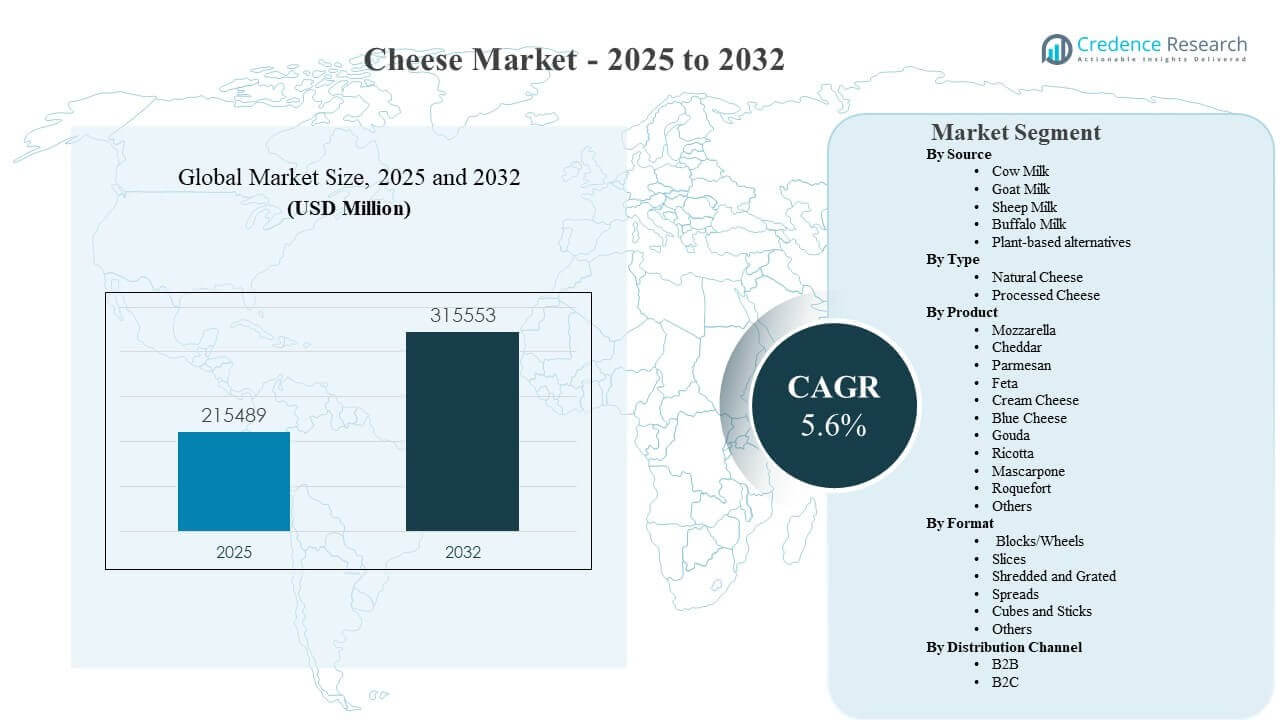
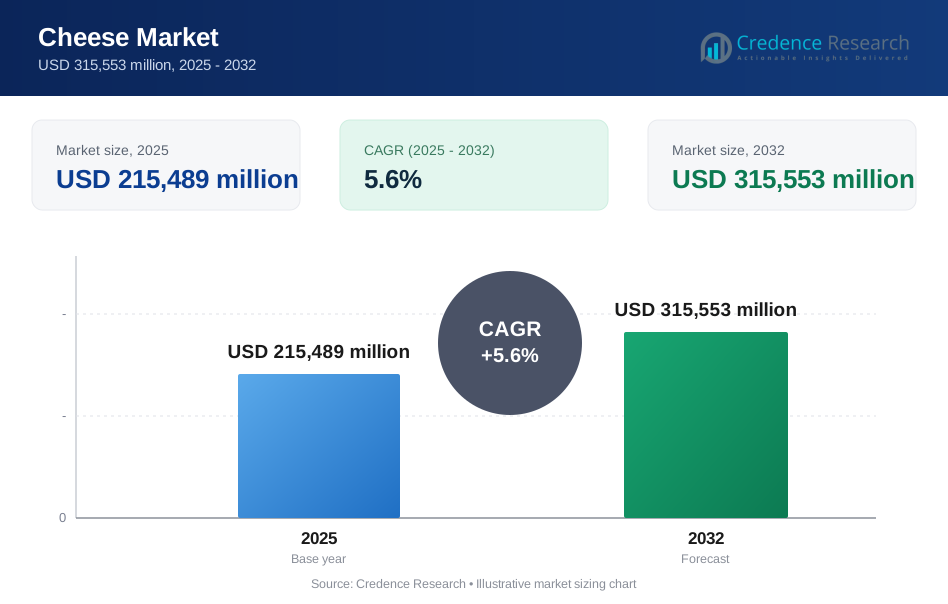
The global cheese market size was estimated at USD 215,489 million in 2025 and is expected to reach USD 315,553 million by 2032, growing at a CAGR of 5.6% from 2025 to 2032. Growth is primarily supported by steady expansion in household consumption and foodservice demand, where cheese remains a high-frequency ingredient across quick meals, snacking, and dining occasions. The cheese market also benefits from broader availability of convenient formats and wider product choice across modern retail and e-commerce channels.
| REPORT ATTRIBUTE | DETAILS |
|---|---|
| Historical Period | 2020-2024 |
| Base Year | 2025 |
| Forecast Period | 2026-2032 |
| Cheese Market Size 2025 | USD 215,489 million |
| Cheese Market, CAGR | 5.6% |
| Cheese Market Size 2032 | USD 315,553 million |
Key Market Trends & Insights
- The cheese market is projected to expand at a CAGR of 5.6% during 2025–2032, increasing from USD 215,489 million (2025) to USD 315,553 million (2032).
- Europe accounted for 38.9% of global cheese market revenue in 2025, reflecting the region’s mature consumption base and diversified product mix.
- Cow milk accounted for the largest share of 51.6% in 2025, supported by scale advantages in milk supply, processing capacity, and mainstream consumer preference.
- Natural cheese accounted for the largest share of 70.8% in 2025, indicating sustained premium and authenticity positioning versus more heavily processed alternatives.
- Asia Pacific is the fastest-growing region at 19.6% supported by expanding modern retail, increasing western-style cuisine adoption, and foodservice growth.
Segment Analysis
The cheese market shows clear demand layering between everyday staples and premium or specialty offerings, with consumption driven by convenience, taste, cooking versatility, and strong integration into foodservice menus. The 2025 mix reflects broad reliance on conventional dairy inputs, with cow milk remaining the dominant base because large-scale production supports consistent availability and pricing. The cheese market also benefits from rising format diversity, where blocks, slices, shreds, and spreads align with different usage occasions such as cooking, sandwiches, snacking, and ready-to-assemble meals.
Consumer buying behavior increasingly favors convenience-led packaging and predictable functional performance such as meltability, shreddability, portion control, and shelf stability. Across developed markets, the cheese market is supported by strong retail merchandising and wide SKU breadth, which encourages repeat purchase and brand switching within familiar styles. At the same time, premiumization continues through aged and specialty cheeses, while plant-based alternatives remain an innovation area tied to dietary preferences, lactose avoidance, and ethical considerations.
By Source Insights
Cow Milk accounted for the largest share of 51.6% in 2025. Cow milk dominance is supported by large-scale procurement networks, established processing infrastructure, and broad standardization across industrial and artisanal production. Cow milk cheese styles also align with the widest range of culinary applications, supporting household penetration as well as foodservice volumes. Goat milk and sheep milk variants are typically positioned as specialty or premium products, which supports value growth even when volumes remain smaller. Plant-based alternatives continue to evolve through formulation improvements in melt, stretch, and texture, which strengthens adoption in select consumer segments.
By Type Insights
Natural Cheese accounted for the largest share of 70.8% in 2025. Natural cheese leadership reflects strong consumer preference for taste authenticity, tradition-linked varieties, and perceived quality cues tied to aging and ingredient simplicity. Natural cheese also benefits from broad application coverage spanning cooking, snacking, and table use, which supports consistent replenishment behavior. Processed cheese continues to play an important role in convenience and foodservice channels due to uniform performance, portion formats, and suitability for quick meals. The cheese market therefore maintains a two-tier structure where natural cheese anchors value, and processed cheese supports high-frequency convenience use cases.
By Product Insights
Product-level performance in the cheese market is shaped by menu exposure, household familiarity, and usage intensity across everyday meals. Mozzarella and cheddar typically benefit from strong linkage to pizza, burgers, sandwiches, and cooking applications, which sustains high baseline volumes in retail and foodservice channels. Hard cheeses such as parmesan support repeat purchase through cooking and finishing applications, supported by longer shelf life and strong flavor intensity. Fresh and spreadable cheeses such as cream cheese, ricotta, and mascarpone expand usage in breakfast, baking, and snacking occasions, improving basket mix. Specialty cheeses such as blue and roquefort remain important for premiumization and differentiated taste profiles within mature retail environments.
By Format Insights
Blocks/Wheels accounted for the largest share of 25.9% in 2025. Blocks and wheels remain a core household and foodservice input format because blocks and wheels support flexible portioning across cooking, grating, and slicing needs. Slices are gaining relevance where convenience and portion control are prioritized, particularly for sandwiches, burgers, and ready-to-assemble meals. Shredded and grated formats continue to expand with home cooking and time-saving requirements, improving usage frequency for pizzas, pasta, and casseroles. Spreads and snacking formats such as cubes and sticks strengthen incremental occasions, supporting broader daypart penetration.
By Distribution Channel Insights
B2C accounted for the largest share of 60.7% in 2025. B2C leadership reflects strong packaged cheese penetration across supermarkets, hypermarkets, and convenience retail, where assortment breadth drives frequent purchases. Online grocery also supports expansion by improving access to specialty varieties and premium SKUs, strengthening category exploration. Specialty stores remain important for premium and imported cheese positioning, particularly in mature markets with high culinary engagement. B2B demand remains structurally significant through restaurants, QSR chains, and food processors, supporting stable volume pull-through even when household patterns fluctuate.
Cheese Market Drivers
Expanding foodservice consumption and menu integration
Foodservice demand is a major structural driver for the cheese market because cheese is embedded in high-velocity menu categories such as pizza, burgers, sandwiches, pasta, and baked products. Consistent menu presence supports predictable procurement patterns across QSR and casual dining. Standardized cheese formats improve kitchen throughput and reduce preparation time, which supports operational adoption. Product innovation in slices, shreds, and blends also supports portion control and performance consistency. These factors collectively sustain baseline demand across economic cycles.
Retail availability, merchandising, and format convenience
Modern retail expansion supports the cheese market through wider shelf presence, stronger cold-chain execution, and improved consumer access to diversified product portfolios. Convenience-led formats such as slices, shredded cheese, spreads, and snack packs improve usage frequency and support incremental purchase occasions. Packaging improvements that extend shelf life and preserve quality reduce waste and increase consumer confidence in stocking behavior. Multipack offerings and differentiated pack sizes also broaden addressability across household types. These dynamics improve category penetration and repeat purchase rates.
Premiumization and specialty positioning in mature markets
Premiumization supports value growth through aged cheeses, protected-origin styles, artisanal positioning, and flavor-led variety. Mature consumers often trade up to specialty products for entertaining, gifting, and culinary experimentation, strengthening mix benefits. Premium private label offerings and expanded specialty aisles increase accessibility to higher-priced categories. Food pairing culture and cooking content across digital channels also reinforces premium discovery. These factors contribute to higher revenue per unit even when volume growth moderates.
Product innovation across health, functionality, and alternatives
The cheese market benefits from innovation aimed at improving nutritional profiles, functional performance, and dietary inclusivity. Reduced lactose, protein-forward positioning, and controlled portion formats support broader consumer segments. Plant-based alternatives remain an innovation pathway that targets lactose avoidance and ethical preferences, with a focus on improved meltability and texture. Blended dairy products and fortified variants can also expand adoption where health cues influence purchase decisions. Innovation-led differentiation supports shelf visibility and brand competitiveness.
Cheese Market Challenges
The cheese market faces sensitivity to dairy input costs, including milk price volatility and energy-intensive processing requirements. Cost pressure can compress margins, particularly for manufacturers competing in price-focused retail segments. Regulatory requirements and labeling compliance can also influence product reformulation needs and add operational complexity. In addition, cold-chain dependence increases logistics costs and can constrain distribution in less developed retail environments.
- For instance, Arla Foods stated it now runs all its European sites on 100% renewable electricity, covering 46 locations across seven countries, and noted that around 93% of its total electricity consumption sits within Europe an energy-procurement shift that reduces exposure to power-price volatility in processing operations.
Competition in the cheese market remains intense due to broad brand availability and strong private label participation across many regions. Shelf space constraints and high promotional activity can increase customer acquisition costs and reduce brand loyalty. Shifts in consumer preferences toward lighter eating patterns can also soften demand for certain high-fat styles without innovation in portioning or positioning. Plant-based alternatives create incremental competition for certain usage occasions, particularly within urban and younger consumer cohorts.
Cheese Market Trends and Opportunities
Convenience-led consumption is strengthening through slices, shredded formats, snack packs, and spreads that support quick meals and on-the-go eating. The cheese market is also seeing growing relevance of online grocery and direct-to-consumer distribution for premium and specialty varieties. Premium and artisanal styles are benefiting from culinary exploration, food pairing culture, and higher willingness to pay for taste differentiation. Manufacturers that optimize format innovation and packaging functionality can strengthen mix and protect margins.
- For instance, Sargento’s Shareables snack-tray format uses a resealable tray that combines two cheese varieties with portioned inclusions (e.g., packs featuring 16 crackers plus 16 total cheese slices 8 cheddar and 8 Colby-Jack), designed for sharing and freshness retention in ready-to-eat occasions.
Asia Pacific represents a major opportunity because faster consumption growth is supported by expanding modern retail, foodservice development, and western-style cuisine adoption. Cross-border demand for specialty cheeses is also rising where cold-chain improves and import availability expands. Plant-based alternatives provide another opportunity tied to dietary inclusivity, where performance improvements can lift repeat purchase. Strategic capacity investments, localization of production, and targeted brand positioning can accelerate share gains in high-growth demand corridors.
Regional Insights
North America
North America accounted for 26.7% of global cheese market revenue in 2025. The regional cheese market is supported by strong household penetration, high frequency of use in everyday meals, and sustained foodservice pull-through across QSR and casual dining. Retail channels provide broad product availability across mainstream and specialty styles, supporting consistent demand. Format-led convenience such as slices and shreds supports quick-meal behavior and category stability. Product innovation and strong brand competition reinforce assortment expansion and promotional intensity.
Europe
Europe accounted for 38.9% of global cheese market revenue in 2025. The regional cheese market benefits from deep-rooted consumption habits, strong tradition-linked variety, and mature distribution structures that support both everyday and premium products. Specialty and origin-linked positioning supports premiumization, with a wide diversity of hard, soft, fresh, and blue cheese styles. Food culture and culinary usage keep demand broad-based across households and foodservice. Competitive intensity remains high due to strong regional brands, private label penetration, and well-developed specialty retail.
Asia Pacific
Asia Pacific accounted for 19.6% of global cheese market revenue in 2025. Growth is supported by expanding modern retail, increasing adoption of western-style cuisine, and foodservice scaling across urban centers. Demand is also supported by rising middle-income consumption and wider availability of packaged cheese formats. Manufacturers prioritize localized product offerings, cold-chain strengthening, and channel partnerships to improve reach. Convenience formats and foodservice-oriented offerings typically lead early adoption in many Asia Pacific markets.
Latin America
Latin America accounted for 7.4% of global cheese market revenue in 2025. The regional cheese market is supported by steady household consumption patterns and expanding modern retail in major urban areas. Price sensitivity can be higher across parts of Latin America, influencing mix toward value offerings and mainstream varieties. Foodservice demand supports consistent volume where quick-service and casual dining are expanding. Local production capacity and distribution coverage shape competitive positioning across countries.
Middle East & Africa
Middle East & Africa accounted for 7.4% of global cheese market revenue in 2025. The regional cheese market benefits from growth in modern retail, increasing demand for packaged dairy, and expansion of foodservice in major cities. Product mix often includes strong demand for spreads and portioned formats that align with convenience-led consumption. Cold-chain development and import availability influence category breadth and premium penetration. Manufacturers that strengthen local distribution partnerships and optimize pack affordability can improve addressable demand.
Competitive Landscape
The cheese market is characterized by strong competition across multinational dairy groups, cooperatives, and large regional manufacturers, with differentiation shaped by brand portfolios, product quality, format innovation, and channel coverage. Competitive strategies commonly include expansion of value-added formats such as slices, shreds, snacking packs, and spreads, along with portfolio diversification across natural and processed categories. Foodservice partnerships remain important for high-volume pull-through, while retail promotions and private label participation sustain price competition. Scale advantages in milk procurement and processing capacity support consistent supply and cost management.
Groupe Lactalis competes through broad dairy scale, diversified brand assets, and category breadth that supports both mainstream and premium cheese segments. Groupe Lactalis continues to emphasize value-added retail offerings and brand-led differentiation, which supports higher-margin mix in core categories. Groupe Lactalis also benefits from distribution reach that supports national and cross-regional execution across retail and foodservice. Portfolio breadth supports resilience across consumer cycles by balancing everyday staples with premium and specialty exposure.
The industry research and growth report includes detailed analyses of the competitive landscape of the market and information about key companies, including:
- Groupe Lactalis
- Arla Foods amba
- Fonterra Co-operative Group Limited
- Saputo Inc.
- The Bel Group
- The Kraft Heinz Company
- Royal FrieslandCampina N.V.
- Dairy Farmers of America, Inc.
- Savencia SA
- Glanbia plc
- Schreiber Foods Inc.
- Land O’Lakes, Inc.
- Gujarat Cooperative Milk Marketing Federation Ltd. (Amul)
- Meiji Holdings Co., Ltd.
Qualitative and quantitative analysis of companies has been conducted to help clients understand the wider business environment as well as the strengths and weaknesses of key industry players. Data is qualitatively analyzed to categorize companies as pure play, category-focused, industry-focused, and diversified; it is quantitatively analyzed to categorize companies as dominant, leading, strong, tentative, and weak.
Recent Developments
- In January 2026, Tropical Cheese announced the acquisition of Cibao Meat Products, a deal the company said would broaden its Hispanic refrigerated foods platform; Tropical Cheese was described in the announcement as a leading producer of Hispanic dairy products and a category leader in Hispanic cheeses across the Eastern U.S.
- In August 2025, Dairy Farmers of America (DFA) announced the acquisition of W&W Dairy in Monroe, Wisconsin, adding the company’s licensed brands and manufacturing facility that produces Hispanic cheese products such as queso fresco, cotija, queso blanco, quesadilla, panela, and para freir.
- In June 2025, Sartori Cheese announced that it had acquired Rumiano Cheese Company, with the company saying the transaction supports its growth plans and expands its position in organic cheese and butter.
- In March 2025, Sargento launched Sargento Natural American Cheese, Sargento Seasoned Shredded Cheese, and Sargento Shareables snacking trays, while also highlighting collaborations with McCormick & Co. and Mondelez International as part of the rollout.
Report Scope
| Report Attribute | Details |
| Market size value in 2025 | USD 215,489 million |
| Revenue forecast in 2032 | USD 315,553 million |
| Growth rate (CAGR) | 5.6% (2025–2032) |
| Base year | 2025 |
| Forecast period | 2026-2032 |
| Quantitative units | USD million |
| Segments covered | By Source Outlook: Cow Milk, Goat Milk, Sheep Milk, Buffalo Milk, Plant-based alternatives; By Type Outlook: Natural Cheese, Processed Cheese; By Product Outlook: Mozzarella, Cheddar, Parmesan, Feta, Cream Cheese, Blue Cheese, Gouda, Ricotta, Mascarpone, Roquefort, Others; By Format Outlook: Blocks/Wheels, Slices, Shredded and Grated, Spreads, Cubes and Sticks, Others; By Distribution Channel Outlook: B2B, B2C (Supermarkets/Hypermarkets, Specialty Stores, Convenience Stores, Online, Other Offline Retail) |
| Regional scope | North America, Europe, Asia Pacific, Latin America, Middle East & Africa |
| Key companies profiled | Groupe Lactalis, Arla Foods amba, Fonterra Co-operative Group Limited, Saputo Inc., The Bel Group, The Kraft Heinz Company, Royal FrieslandCampina N.V., Dairy Farmers of America, Inc., Savencia SA, Glanbia plc, Schreiber Foods Inc., Land O’Lakes, Inc., Gujarat Cooperative Milk Marketing Federation Ltd. (Amul), Meiji Holdings Co., Ltd. |
| No. of Pages | 343 |
Segmentation
By Source
- Cow Milk
- Goat Milk
- Sheep Milk
- Buffalo Milk
- Plant-based alternatives
By Type
- Natural Cheese
- Processed Cheese
By Product
- Mozzarella
- Cheddar
- Parmesan
- Feta
- Cream Cheese
- Blue Cheese
- Gouda
- Ricotta
- Mascarpone
- Roquefort
- Others
By Format
- Blocks/Wheels
- Slices
- Shredded and Grated
- Spreads
- Cubes and Sticks
- Others
By Distribution Channel
- B2B
- B2C
- Supermarkets/Hypermarkets
- Specialty Stores
- Convenience Stores
- Online
- Other Offline Retail
By Region
- North America
- U.S.
- Canada
- Mexico
- Europe
- Germany
- France
- U.K.
- Italy
- Spain
- Rest of Europe
- Asia Pacific
- China
- Japan
- India
- South Korea
- South-east Asia
- Rest of Asia Pacific
- Latin America
- Brazil
- Argentina
- Rest of Latin America
- Middle East & Africa
- GCC Countries
- South Africa
- Rest of the Middle East and Africa
Request a Free Sample
Fill in your details and we'll send you a free sample report.
- Sample data tables & charts
- Research methodology
Need a Custom Version of This Report?
Tailor the scope, geography, or segments to your exact requirements.
- Custom geography or segment scope
- Direct access to our analyst team
Frequently Asked Questions
What is the current size and forecast size of the cheese market?
What is the growth rate of the cheese market?
Which segment is the largest in the cheese market?
What are the key growth factors for the cheese market?
Who are the leading companies in the cheese market?
Which region leads the cheese market?
Table of Content
Chapter 1. Report Introduction
- 1.1 Report Description & Purpose
- 1.1.1 Report Title & Market Definition
- 1.1.2 Unique Selling Propositions (USP) & Key Differentiators
- 1.1.3 Value Proposition for Stakeholders
- 1.2 Research Objectives
- 1.2.1 Market Sizing Objectives (Volume & Revenue)
- 1.2.2 Segmentation Objectives
- 1.2.3 Competitive Intelligence Objectives
- 1.2.4 Forecast & Scenario Objectives
- 1.3 Report Scope
- 1.3.1 Cheese Scope – Types & Subtypes Covered
- 1.3.2 Geographic Scope – Regions & Countries Covered
- 1.3.3 Historical Period, Base Year & Forecast Period (2025; forecast to 2032)
- 1.3.4 Inclusions & Exclusions
- 1.4 HS Code & Classification Framework
- 1.5 Currency, Units & Pricing Basis
- 1.6 Target Stakeholders
- 1.7 Limitations & Assumptions
Chapter 2. Executive Summary
- 2.1 Global Cheese Market Snapshot
- 2.1.1 Market Size – Historical (2025) & Forecast (2025-2032) (2025: USD 215,489 million → 2032: USD 315,553 million)
- 2.1.2 Volume & Revenue – Global Totals
- 2.1.3 Key Market Highlights – Top Five Facts
- 2.2 Cheese Market Segmentation Snapshot
- 2.2.1 Market Split by Region – 2025 vs. 2032
- 2.3 Competitive Snapshot
- 2.3.1 Top 10 Players by Revenue Share – 2025
- 2.3.2 Top 10 Players by Volume Share – 2025
- 2.3.3 Recent Strategic Developments (18-Month Summary)
- 2.4 Key Investment Highlights & Strategic Conclusions
Chapter 3. Cheese Market Dynamics & Industry Analysis
- 3.1 Market Overview & Context
- 3.1.1 Cheese Market Position in the Broader Automotive Value Chain
- 3.1.2 OEM vs. Replacement Market Dynamics
- 3.1.3 Market Maturity & Development Stage by Region
- 3.2 Cheese Market Drivers
- 3.3 Cheese Market Restraints & Challenges
- 3.4 Cheese Market Opportunities
- 3.5 Porter's Five Forces Analysis
- 3.5.1 Threat of New Entrants
- 3.5.2 Bargaining Power of Suppliers
- 3.5.3 Bargaining Power of Buyers
- 3.5.4 Threat of Substitutes
- 3.5.5 Competitive Rivalry – Intensity Assessment
- 3.6 Cheese Value Chain Analysis
- 3.6.1 Upstream – Raw Material/Input Suppliers
- 3.6.1.1 Raw Material/Input 1
- 3.6.1.2 Raw Material/Input 2
- 3.6.1.3 Raw Material/Input 3
- 3.6.2 Midstream – Production/Manufacturing/Service Delivery
- 3.6.2.1 Production/Process Overview
- 3.6.2.2 Key Facility Locations & Capacity by Manufacturer
- 3.6.3 Downstream – Distribution & End Consumer
- 3.6.3.1 Primary Channel – B2B/OEM
- 3.6.3.2 Secondary Channels – Dealer, Retail, Online, Direct
- 3.6.4 Value Chain Profitability Analysis
- 3.6.1 Upstream – Raw Material/Input Suppliers
- 3.7 PESTEL Analysis
- 3.7.1 Political Factors
- 3.7.2 Economic Factors
- 3.7.3 Social Factors
- 3.7.4 Technological Factors
- 3.7.5 Environmental Factors
- 3.7.6 Legal Factors
- 3.8 Cheese Supply Chain Analysis
- 3.8.1 Raw Material/Input Supply Risk Assessment
- 3.8.2 Manufacturing Concentration Risk (Geographic Exposure)
- 3.8.3 Trade Disruption Impact Analysis
- 3.9 Regulatory & Policy Landscape
Note: The regulatory and policy landscape section covers regulations based on their applicability to the market, Cheese category, geography, and scope of the study. Only regulatory frameworks with a material impact on operations, compliance, trade, sustainability, or market access are analyzed in detail.
Chapter 4. Key Investment Pockets & Opportunity Analysis
- 4.1 Cheese Market Attractiveness Analysis
- 4.1.1 By Region – Investment Attractiveness Matrix (Volume × CAGR)
- 4.2 Absolute Revenue Growth Opportunity
- 4.2.1 By Region – Absolute USD Growth Through 2032
- 4.3 Incremental Volume Opportunity
- 4.3.1 By Region – Incremental Volume Through 2032
- 4.3.2 Segment – Incremental Volume
- 4.4 Emerging Submarket Opportunity Deep Dive (Subject to Applicability)
- 4.5 Emerging Market Opportunity Scorecards
- 4.5.1 United States
- 4.5.2 Europe
- 4.5.3 Asia
- 4.5.4 Middle East & Africa
Note: Emerging Market Opportunity Scorecards will be included based on relevance and strategic importance. Regions listed are indicative and may vary depending on data availability and market dynamics.
Chapter 5. Cheese Import-Export Analysis & Trade Flows
- 5.1 Global Trade Overview
- 5.1.1 Global Export Value by Country (2025)
- 5.1.2 Global Export Volume by Country (2025)
- 5.1.3 Global Import Value by Country (2025)
- 5.1.4 Global Import Volume by Country (2025)
- 5.1.5 Net Trade Balance by Country (2025)
- 5.2 Export Analysis – Segment
- 5.2.1 Type 1 (HS Code)
- 5.2.2 Type 2 (HS Code)
- 5.2.3 Type 3 (HS Code)
- 5.2.4 Type 4 (HS Code)
- 5.2.5 Type 5 (HS Code)
- 5.3 Import Analysis – Segment
- 5.3.1 Type 1 (HS Code)
- 5.3.2 Type 2 (HS Code)
- 5.3.3 Type 3 (HS Code)
- 5.3.4 Type 4 (HS Code)
- 5.3.5 Type 5 (HS Code)
- 5.4 Average Unit Trade Prices
- 5.4.1 Average Export Price – Segment & Country
- 5.4.2 Average Import Price – Segment & Source Country
- 5.4.3 Price Trends (2025)
- 5.5 Key Trade Route Analysis
- 5.5.1 Trade Route 1
- 5.5.2 Trade Route 2
- 5.5.3 Trade Route 3
- 5.5.4 Trade Route 4
- 5.5.5 Trade Route 5
- 5.6 Trade Policy Impact Assessment
- 5.6.1 US Anti-Dumping & Section 301 Tariffs
- 5.6.2 EU Customs Union Impact
- 5.6.3 Major Free Trade Agreements
- 5.6.4 USMCA Rules of Origin
Note: Trade policy analysis will be included only where relevant to the Cheese market.
Chapter 6. Competitive Landscape & Company Benchmarking
- 6.1 Cheese Market Concentration & Structure
- 6.1.1 Herfindahl-Hirschman Index (HHI) – vs. 2025
- 6.1.2 Tier 1, Tier 2 & Tier 3 Market Structure
- 6.1.3 Global, Regional & Local Player Dynamics
- 6.2 Cheese Market Share Analysis – 2025
- 6.2.1 Global Revenue Share by Company
- 6.2.2 Global Volume Share by Company
- 6.2.3 Regional Revenue Share
- 6.2.4 Market Share Evolution ( vs. 2025)
- 6.2.5 OEM Segment Share by Company
- 6.2.6 Replacement Segment Share by Company
- 6.3 Production/Delivery Capacity & Facility Analysis
- 6.3.1 Global Installed Capacity
- 6.3.2 Capacity Utilization Rates
- 6.3.3 Production/Output Volume
- 6.3.4 Facility Locations & Capacity Map
- 6.3.5 Planned Capacity Additions
- 6.4 Cheese Competitive Benchmarking Matrix
- 6.4.1 Revenue, Volume, CAGR & Profitability Comparison
- 6.4.2 Channel Revenue Mix
- 6.4.3 Geographic Revenue Exposure
- 6.4.4 R&D Intensity
- 6.4.5 Sustainability Maturity
- 6.5 Strategic Developments in Cheese (Last 24 Months)
- 6.5.1 Mergers, Acquisitions & Divestments
- 6.5.2 New Cheese Launches
- 6.5.3 Facility Expansions
- 6.5.4 Strategic Alliances, Joint Ventures & Partnerships
- 6.5.5 Distribution Expansion & Market Entry
- 6.5.6 Sustainability & ESG Initiatives
- 6.6 Competitive Strategy Mapping
- 6.6.1 Leader, Challenger, Follower & Niche Classification
- 6.6.2 Pricing Strategy Comparison
- 6.6.3 Channel Strategy Matrix
Note: Strategic developments are included based on their materiality and the availability of reliable information.
Chapter 7. Global Cheese Market – By Distribution Channel
- 7.1 Segment Overview
- 7.1.1 Volume & Revenue Split by Channel (2025 & 2032)
- 7.1.2 Channel Mix Evolution (2025-2032)
Chapter 8. Regional Market Analysis – Global Overview
- 8.1 Global Regional Overview
- 8.1.1 Regional Volume Share
- 8.1.2 Regional Revenue Share
- 8.1.3 Regional Volume by Region
- 8.1.4 Regional Revenue by Region
- 8.1.5 Regional Forecast Through 2032
- 8.2 Cross-Regional Segment Analysis
- 8.2.1 By Distribution Channel
- 8.2.2 By Brand/Price Tier
Chapter 9. North America Cheese Market
- 9.1 United States
- 9.2 Canada
- 9.3 Mexico
Chapter 10. Europe Cheese Market
- 10.1 Germany
- 10.2 France
- 10.3 Italy
- 10.4 United Kingdom
- 10.5 Spain
- 10.6 Poland
- 10.7 Russia
- 10.8 Netherlands
- 10.9 Belgium
- 10.10 Sweden
- 10.11 Denmark
- 10.12 Norway
- 10.13 Rest of Europe
Chapter 11. Asia Pacific Cheese Market
- 11.1 China
- 11.2 India
- 11.3 Japan
- 11.4 South Korea
- 11.5 Thailand
- 11.6 Indonesia
- 11.7 Vietnam
- 11.8 Malaysia
- 11.9 Australia
- 11.10 Rest of Asia Pacific
Chapter 12. Latin America Cheese Market
- 12.1 Brazil
- 12.2 Argentina
- 12.3 Colombia
- 12.4 Chile
- 12.5 Rest of Latin America
Chapter 13. Middle East Cheese Market
- 13.1 Saudi Arabia
- 13.2 United Arab Emirates
- 13.3 Turkey
- 13.4 Israel
- 13.5 Iran
- 13.6 Rest of the Middle East
Chapter 14. Africa Cheese Market
- 14.1 South Africa
- 14.2 Egypt
- 14.3 Nigeria
- 14.4 Morocco
- 14.5 Rest of Africa
Chapter 15. Cheese Company Profiles
- 15.1 [Company 01]
- 15.1.1 Company Overview
- 15.1.2 Key Management Personnel
- 15.1.3 Products & Services Portfolio
- 15.1.4 Financial Performance
- 15.1.5 Key Market Focus & Geographic Presence
- 15.1.6 Recent Developments & Strategic Initiatives
Note: The company profile list is preliminary and may change based on research findings, market developments, data availability, and client requirements.
Chapter 16. Appendices
- Appendix A – List of Abbreviations & Acronyms
- Appendix B – Industry Classification Code Reference – Full Series
- Appendix C – Production & Capacity Data Tables
- Appendix D – End-Use & Demand Base Tables
- Appendix E – Consumption & Replacement Rate Assumptions
- Appendix F – ASP Reference Tables
- Appendix G – Manufacturing & Facility Database
- Appendix H – Import-Export Data Tables
- Appendix I – Regulatory Summary Tables
- Appendix J – Primary Research Participant List (Anonymized)
- Appendix K – Primary Research Questionnaire Framework
- Appendix L – Data Sources & Bibliography
- Appendix M – Market Size Divergence & Source Comparison
Chapter 17. Research Methodology
- 17.1 Research Framework & Philosophy
- 17.2 Secondary Research – Sources, Hierarchy & Data Extraction
- 17.3 Data Modeling – Bottom-Up & Top-Down Market Sizing
- 17.4 Primary Research – Stakeholder Framework, LOI & Sample Sizes
- 17.5 Forecast Methodology – Regression, Scenario & Sensitivity Analysis
- 17.6 Quality Control – Four-Layer Validation Framework
- 17.7 Limitations & Standard Assumptions
- 17.8 Disclaimer
