
| REPORT ATTRIBUTE | DETAILS |
|---|---|
| Historical Period | 2019-2022 |
| Base Year | 2023 |
| Forecast Period | 2024-2032 |
| Chronic Myeloid Leukemia (CML) Treatment Market 2023 | USD 7514.2 Million |
| Chronic Myeloid Leukemia (CML) Treatment Market, CAGR | 6.20% |
| Chronic Myeloid Leukemia (CML) Treatment Market Size 2032 | USD 12912.2 Million |
Market Insights
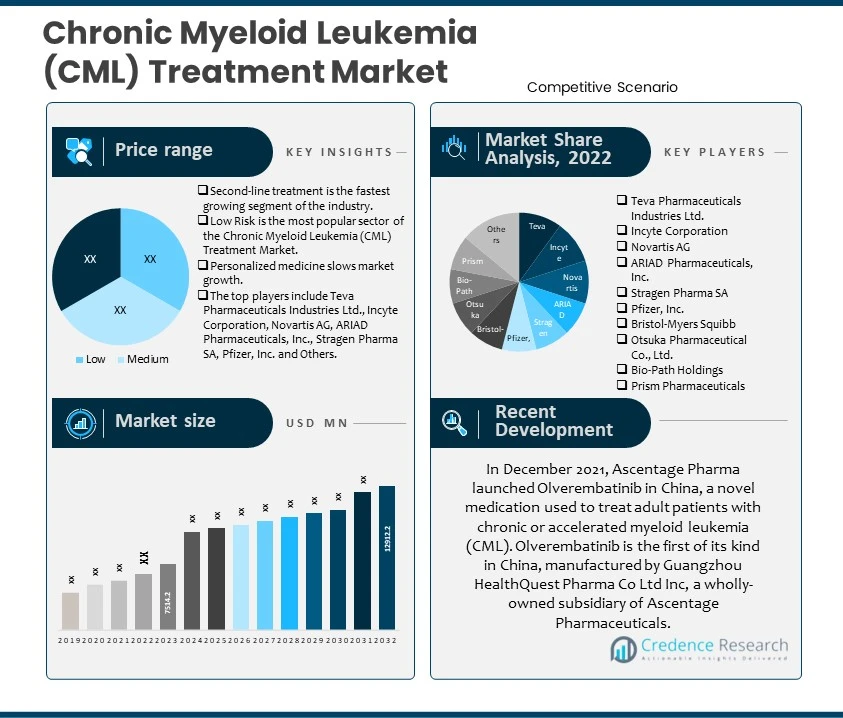
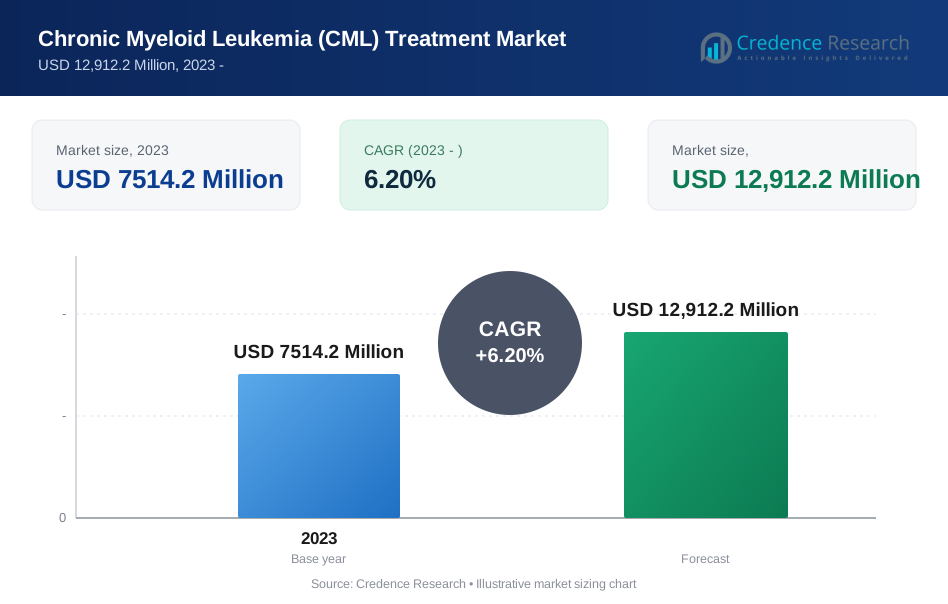
- The global demand for Chronic Myeloid Leukemia (CML) Treatment was valued at USD 7514.2 Million in 2023 and is expected to reach USD 12912.2 Million in 2032, growing at a CAGR of 6.20% between 2024 and 2032.
- Tyrosine kinase inhibitors (KIs), dominate the market, and the Interferon Therapy sector is expected to develop significantly over the projection period.
- Second-line treatment is the most quickly increasing segment of the Chronic Myeloid Leukemia (CML) Treatment Market; another key market area is first-line treatment.
- The Chronic Myeloid Leukemia (CML) Treatment Market is dominated by the Low Risk sector, with the High Risk group also making significant contributions.
- The Chronic Myeloid Leukemia (CML) Treatment Market in North America is estimated to have the biggest revenue share (38%) throughout the forecast period, followed by Europe with a 28% share by 2032. Asia Pacific is projected to expand the fastest.
- Increasing healthcare spending and awareness fuels market growth.
- Personalized medicine slows market growth.
Executive Summary
Market Definition
The Chronic Myeloid Leukemia (CML) Treatment Market is the industry dedicated to developing and delivering treatments for CML, a kind of cancer that affects the bone marrow and blood. This market encompasses a variety of drugs, treatments, and procedures used to manage and treat CML. The market is constantly evolving as medical research advances, resulting in better therapy options for CML patients. Pharmaceutical companies, healthcare providers, and research organizations all play important roles in fostering innovation and increasing access to therapies in this sector. The goal is to improve the quality of life and prognosis for individuals with CML by using effective and tailored treatment options.
Market Overview
The global Chronic Myeloid Leukemia (CML) Treatment Market has witnessed steady growth in recent years and is expected to grow at a CAGR of 6.20% between 2024 and 2032. The market was valued at USD 7514.2 million in 2023 and is expected to reach USD 12912.2 million in 2032.
The chronic myeloid leukemia (CML) therapy industry is undergoing considerable development and transformation, fueled by a convergence of demographic trends, technology advancements, and scientific breakthroughs. The growing prevalence of CML, particularly among the elderly, has created a greater demand for effective treatments.
This increase in demand is fueled by advances in diagnostic capabilities, which allow for the early detection and correct diagnosis of CML, extending the patient base eligible for treatment. The market's growth is primarily driven by the introduction and success of innovative therapeutic drugs, particularly tyrosine kinase inhibitors (TKIs), which have transformed the treatment landscape by providing tailored therapy alternatives. These breakthroughs have not only improved patient outcomes
but have also sparked more research and development initiatives aimed at increasing the efficacy and lowering the negative effects of present medicines. The pharmaceutical industry's commitment to innovation, combined with supportive regulatory settings, has continued to promote the launch of new medications and treatment modalities, highlighting a dynamic and shifting market landscape.
However, the CML treatment market faces its own set of issues, including the high prices associated with newer, more advanced medicines, which create substantial hurdles to access, particularly in low- and middle-income nations. Despite the effectiveness of current treatment choices, concerns such as resistance to therapy and unpleasant side effects persist, emphasizing the importance of continued research to develop more accessible, effective, and bearable medicines. The treatment techniques for CML have moved considerably from conventional approaches to more complex, targeted medications, with TKIs emerging as the cornerstone of treatment due to their ability to manage the illness with manageable complications. However, the therapy landscape is constantly changing, with new medications and combination regimens showing promise in reducing resistance and improving outcomes for individuals with advanced or resistant types of CML.
Segmentation by Treatment Type
- Tyrosine kinase inhibitors (KIs), dominate the market due to their ability to suppress the BCR-ABL protein, which promotes leukemia cell proliferation. TKIs such as imatinib, dasatinib, and nilotinib have changed CML treatment, allowing patients to achieve long-term disease control while experiencing manageable side effects.
- The Interferon Therapy sector is predicted to grow significantly throughout the forecast period.
Segmentation by Phase of Treatment
- Second-Line Treatment is the most rapidly developing section of the Chronic Myeloid Leukemia (CML) Treatment Market. This market is rapidly expanding due to advances in therapy for patients who have not reacted well to earlier treatments, resulting in a renewed emphasis on finding more effective second-line treatment alternatives customized to specific patient needs.
- Another major market area is first-line treatment, which is critical in laying the groundwork for overall CML care. First-line treatments are the first therapies prescribed to patients after diagnosis, with the goal of achieving remission and controlling disease progression, emphasizing the importance of early intervention and effective management strategies in improving patient outcomes in the CML treatment landscape.
Segmentation by Patient Risk Stratification
- Low Risk is the most popular sector of the Chronic Myeloid Leukemia (CML) Treatment Market. This segment is well known for its importance in identifying patients with a lower risk of disease progression. It allows for more conservative treatment approaches and closely monitored management strategies, emphasizing the importance of risk stratification in guiding treatment decisions for people with CML.
- The High Risk group is also a substantial market contributor.
Segmentation by Region
- The Chronic Myeloid Leukemia (CML) Treatment Market in North America is expected to have the highest revenue share (38%) during the forecast period.
- Europe is the second-largest market, with a predicted 28% share by 2032. Asia Pacific is expected to grow the fastest.
- The rest of the world, including Latin America, the Middle East, and Africa, supplies the remaining demand for Chronic Myeloid Leukemia (CML) Treatment.
North America is predicted to have the greatest share of the worldwide market during the forecast period. Favorable reimbursement policies, high diagnostic rates, availability to advanced healthcare infrastructure, and the presence of significant players position North America to account for an estimated 38% of the market by 2032.
Moreover, Europe is the second-largest geographical market, with a projected 28% share by 2032. Growth will be driven by supportive government measures that promote research and a high rate of new product approvals. Rapidly aging populations are vulnerable to target diseases, which drives market growth.
Also, Asia Pacific is expected to develop at the fastest rate in the following years, with a 16% market share by 2032. Developing healthcare infrastructure, increased healthcare spending, rising public awareness, and massive unmet clinical needs all present promising opportunities. China and India will play an important role, thanks to their growing patient populations and disposable budgets.
Key Highlights of the Report
The global Chronic Myeloid Leukemia (CML) Treatment Market is segmented by Treatment Type, Phase of Treatment, Patient Risk Stratification, and region. In 2023, tyrosine kinase inhibitors (KIs) will dominate the market. And the Interferon Therapy sector is expected to expand dramatically. In addition, Second-Line Treatment is the most rapidly increasing portion of the market. At the same time, Low Risk is the most popular sector of the Market, with North America leading the market growth.
The Chronic Myeloid Leukemia (CML) Treatment Market is being positively influenced by advances in targeted therapies, an increase in CML cases, and a shift toward personalized medicine, all of which are contributing to the development of more effective and individualized treatment options for patients. Despite the industry's expansion, issues such as high treatment costs, potential adverse effects of current medicines, and regulatory hurdles in the drug approval process operate as roadblocks, impeding market advancement and accessibility for people seeking CML therapy. Looking ahead, potential for market expansion include increased investments in research & development, treatment choice diversity, and continued technological developments in treatment modalities, all of which point to a positive future for CML therapy.
The Chronic Myeloid Leukemia (CML) Treatment Market in North America is expected to have the highest revenue share throughout the forecast period. Furthermore, Europe is the second-largest geographical market, while Asia Pacific is forecast to grow at the fastest rate.
What Are The Main Drivers Of The Global Chronic Myeloid Leukemia (CML) Treatment Market?
Advancements in targeted therapies are propelling the Chronic Myeloid Leukemia (CML) Treatment Market, the increasing number of CML cases, and the emphasis on personalized medicine, all contributing to the development of more effective and tailored treatment options for patients.
What Are The Major Challenges Faced By The Global Chronic Myeloid Leukemia (CML) Treatment Market?
Challenges such as high treatment costs, the potential side effects of current treatments, and regulatory hurdles in the drug approval process pose constraints on the market's growth and accessibility, impacting the overall landscape of CML treatment.
What Are The Growth Opportunities In The Global Chronic Myeloid Leukemia (CML) Treatment Market?
The market offers opportunities for growth and improvement, including the surge in investments in research and development, the expansion of treatment choices, and the ongoing technological innovations in treatment approaches, which promise a more hopeful future for individuals battling CML.
Market Drivers
Several factors drive the global Chronic Myeloid Leukemia (CML) Treatment Market. The following are the key drivers of the global Chronic Myeloid Leukemia (CML) Treatment Market:
Increasing Healthcare Expenditures And Awareness
The global growth in healthcare expenditure is critical to the development and implementation of novel CML treatments. With more resources given to healthcare, there is more room for investment in cutting-edge research, which leads to the discovery and implementation of innovative treatment alternatives. Furthermore, increased awareness of CML among the general population and healthcare professionals results in earlier identification and treatment, which is critical for effective disease management. This increased knowledge, combined with more favorable payment regulations, makes sophisticated CML treatments available to a wider spectrum of patients. These financial and educational advancements are crucial for supporting the expansion of the CML treatment market and ensuring that patients benefit from the most recent discoveries in medical science.
Market Restraints
The global Chronic Myeloid Leukemia (CML) Treatment Market faces some challenges that may hinder its growth. These include the following:
Personalized Medicine
The development of customized medicine in the treatment of CML is a direct result of our growing understanding of the disease's genetic foundation. Personalized medicine tailors treatment procedures to each individual's unique genetic profile, promising even more effective and tailored treatment options. This strategy uses genetic insights to find the best therapy alternatives for each patient, with the potential to make CML treatment more efficient and outcome-oriented. As research continues to uncover the genetic complexity of CML, personalized medicine is at the forefront of revolutionary treatment techniques, providing fresh hope for targeted and effective disease management.
Opportunities
The global Chronic Myeloid Leukemia (CML) Treatment Market offers significant growth opportunities. These include the following:
Development of New and More Effective Treatments
The therapeutic environment for CML has changed dramatically, owing to considerable advances in medical research and pharmaceutical innovation. The introduction of targeted treatments, particularly tyrosine kinase inhibitors (TKIs), has transformed CML treatment. These new therapies provide a more targeted approach to fighting the cancer, targeting specific genetic markers with fewer side effects than conventional chemotherapy.
This transition to tailored therapy improves patient outcomes while also lowering the total burden of therapeutic adverse effects. The industry's continued investment in research and development of innovative therapies demonstrates its dedication to improving the efficacy and tolerance of CML treatments, hence supporting market growth.
Competitive Landscape
Key Players
The global Chronic Myeloid Leukemia (CML) Treatment Market is highly competitive, with several key players. Some of the major players in the market and their market share are as follows:
- Teva Pharmaceuticals Industries Ltd.
- Incyte Corporation
- Novartis AG
- ARIAD Pharmaceuticals, Inc.
- Stragen Pharma SA
- Pfizer, Inc.
- Bristol-Myers Squibb
- Otsuka Pharmaceutical Co., Ltd.
- Bio-Path Holdings
- Prism Pharmaceuticals
- Hospira, Inc.
These organizations prioritize product innovation, distribution channel expansion, and mergers and acquisitions to stay competitive.
The global Chronic Myeloid Leukemia (CML) Treatment Market's key players continually seek to stay ahead by offering new products and developments.
In December 2021, Ascentage Pharma launched its novel medicine, Olverembatinib, in China, marking a significant milestone in the treatment of adult patients with chronic or accelerated stages of chronic myeloid leukemia (CML). Notably, Olverembatinib is the first medicine of its sort in China, manufactured by Guangzhou HealthQuest Pharma Co., Ltd., a wholly owned subsidiary of Ascentage Pharma. This launch marks a significant step forward in delivering unique therapy choices to the CML patient community in China, opening up fresh avenues for patients dealing with this difficult ailment.
In June 2023, Novartis released results from the CML SUN survey, which revealed differences in treatment goals and priorities between patients and clinicians. The survey results underscore the important need for improved communication and treatment plan customization to meet the unique needs of each patient. This data reflects a broader issue in the CML treatment landscape, underlining the significance of patient-centered care approaches.
Summary of Key Findings
- The development of new and more effective treatments is the primary opportunity in the market.
- Market segmented by Treatment Type, Phase of Treatment, Patient Risk Stratification, and region.
- Targeted therapies, notably tyrosine kinase inhibitors (KIs), dominate the market.
- Second-line treatment is the most quickly increasing part of the Chronic Myeloid Leukemia (CML) Treatment Market
- North America is leading market growth; the market is highly competitive with key players including Teva Pharmaceuticals Industries Ltd., Incyte Corporation, Novartis AG, ARIAD Pharmaceuticals, Inc., Stragen Pharma SA, Pfizer, Inc. and Others.
Future Outlook
- Continued development of targeted therapies
- Personalized treatment approaches
- Focus on improving patient outcomes
- Increasing research in precision medicine
- Enhanced accessibility to innovative treatments
How CXOs Can Benefit from the Credence Research Chronic Myeloid Leukemia (CML) Treatment Market Report
The Credence Research Chronic Myeloid Leukemia (CML) Treatment Market Report provides CXOs with a comprehensive overview of the market, including:
- Market size and growth forecast: The report provides detailed estimates of the global Chronic Myeloid Leukemia (CML) Treatment Market size, segmented by Treatment Type, Phase of Treatment, Patient Risk Stratification, and region. It also includes forecasts for the market through 2032, based on key trends and drivers.
- Market segmentation: The report segments the Chronic Myeloid Leukemia (CML) Treatment Market by Treatment Type, Phase of Treatment, Patient Risk Stratification, and region. This segmentation provides CXOs with a granular understanding of the market and the opportunities in each segment.
- Competitive landscape: The report profiles the key players in the Chronic Myeloid Leukemia (CML) Treatment Market and provides insights into their strategies, product offerings, and financial performance. This information can help CXOs to identify and assess their competition.
- Key trends and drivers: The report identifies and analyzes the key trends and drivers that are shaping the Chronic Myeloid Leukemia (CML) Treatment Market. This information can help CXOs to make informed decisions about their investments and strategies.
CXOs can use the insights from the Credence Research Chronic Myeloid Leukemia (CML) Treatment Market Report to:
- Identify growth opportunities: The report can help CXOs to identify new growth opportunities in the Chronic Myeloid Leukemia (CML) Treatment Market. For example, by analyzing emerging therapies, technological advancements, and evolving patient needs, CXOs can uncover untapped market segments, explore strategic partnerships, and develop innovative solutions to address unmet medical needs in the CML treatment landscape.
- Make informed investment decisions: The report can help CXOs to make informed investment decisions about Chronic Myeloid Leukemia (CML) Treatment. For example, by analyzing market trends, treatment advancements, patient demographics, and competitive landscape, CXOs can identify growth opportunities, assess potential risks, and allocate resources effectively in the CML treatment market.
- Develop competitive strategies: The report can help CXOs to develop competitive strategies for their Chronic Myeloid Leukemia (CML) Treatment businesses. For example, by delving into market dynamics, competitor analysis, and regulatory landscape, CXOs can gain valuable insights to differentiate their offerings, enhance market positioning, and drive business growth in the CML treatment sector.
- Track market developments: The report can help CXOs to track market developments and stay ahead of the curve. For example, the report provides insights into the latest trends and innovations in the Chronic Myeloid Leukemia (CML) Treatment Market .
Overall, the Credence Research Chronic Myeloid Leukemia (CML) Treatment Market Report is a valuable resource for CXOs who are looking to gain a deeper understanding of the market and identify opportunities for growth.
Segmentation
- Treatment Type:
- Tyrosine Kinase Inhibitors (TKIs)
- Stem Cell Transplantation
- Interferon Therapy
- Others
- Phase of Treatment:
- First-Line Treatment
- Second-Line Treatment
- Third-Line and Beyond
- Patient Risk Stratification:
- Low Risk
- High Risk
- By Region
- North America
- The U.S.
- Canada
- Mexico
- Europe
- Germany
- France
- The U.K.
- Italy
- Spain
- Rest of Europe
- Asia Pacific
- China
- Japan
- India
- South Korea
- South-east Asia
- Rest of Asia Pacific
- Latin America
- Brazil
- Argentina
- Rest of Latin America
- Middle East & Africa
- GCC Countries
- South Africa
- Rest of Middle East and Africa
- North America
Request a Free Sample
Fill in your details and we'll send you a free sample report.
- Sample data tables & charts
- Research methodology
Need a Custom Version of This Report?
Tailor the scope, geography, or segments to your exact requirements.
- Custom geography or segment scope
- Direct access to our analyst team
Frequently Asked Questions
What is the current size of the global Chronic Myeloid Leukemia (CML) Treatment Market?
What is the expected growth rate of the Chronic Myeloid Leukemia (CML) Treatment Market between 2024 and 2032?
Which segment is leading the market share in terms of Treatment Type?
Which Patient Risk Stratification segment governs the demand for Chronic Myeloid Leukemia (CML) Treatments in the world?
Who are the major players in the global Chronic Myeloid Leukemia (CML) Treatment Market?
Table of Content
Chapter 1. Report Introduction
- 1.1 Report Description & Purpose
- 1.1.1 Report Title & Market Definition
- 1.1.2 Unique Selling Propositions (USP) & Key Differentiators
- 1.1.3 Value Proposition for Stakeholders
- 1.2 Research Objectives
- 1.2.1 Market Sizing Objectives (Volume & Revenue)
- 1.2.2 Segmentation Objectives
- 1.2.3 Competitive Intelligence Objectives
- 1.2.4 Forecast & Scenario Objectives
- 1.3 Report Scope
- 1.3.1 Chronic Myeloid Leukemia (CML) Treatment Scope – Types & Subtypes Covered
- 1.3.2 Geographic Scope – Regions & Countries Covered
- 1.3.3 Historical Period, Base Year & Forecast Period (2023; forecast to the forecast period)
- 1.3.4 Inclusions & Exclusions
- 1.4 HS Code & Classification Framework
- 1.5 Currency, Units & Pricing Basis
- 1.6 Target Stakeholders
- 1.7 Limitations & Assumptions
Chapter 2. Executive Summary
- 2.1 Global Chronic Myeloid Leukemia (CML) Treatment Market Snapshot
- 2.1.1 Market Size – Historical (2023) & Forecast (the forecast period) (2023: USD 7514.2 Million → forecast year: USD 12,912.2 Million)
- 2.1.2 Volume & Revenue – Global Totals
- 2.1.3 Key Market Highlights – Top Five Facts
- 2.2 Chronic Myeloid Leukemia (CML) Treatment Market Segmentation Snapshot
- 2.2.1 Market Split by Region – 2023 vs.
- 2.3 Competitive Snapshot
- 2.3.1 Top 10 Players by Revenue Share – 2023
- 2.3.2 Top 10 Players by Volume Share – 2023
- 2.3.3 Recent Strategic Developments (18-Month Summary)
- 2.4 Key Investment Highlights & Strategic Conclusions
Chapter 3. Chronic Myeloid Leukemia (CML) Treatment Market Dynamics & Industry Analysis
- 3.1 Market Overview & Context
- 3.1.1 Chronic Myeloid Leukemia (CML) Treatment Market Position in the Broader Automotive Value Chain
- 3.1.2 OEM vs. Replacement Market Dynamics
- 3.1.3 Market Maturity & Development Stage by Region
- 3.2 Chronic Myeloid Leukemia (CML) Treatment Market Drivers
- 3.3 Chronic Myeloid Leukemia (CML) Treatment Market Restraints & Challenges
- 3.4 Chronic Myeloid Leukemia (CML) Treatment Market Opportunities
- 3.5 Porter's Five Forces Analysis
- 3.5.1 Threat of New Entrants
- 3.5.2 Bargaining Power of Suppliers
- 3.5.3 Bargaining Power of Buyers
- 3.5.4 Threat of Substitutes
- 3.5.5 Competitive Rivalry – Intensity Assessment
- 3.6 Chronic Myeloid Leukemia (CML) Treatment Value Chain Analysis
- 3.6.1 Upstream – Raw Material/Input Suppliers
- 3.6.1.1 Raw Material/Input 1
- 3.6.1.2 Raw Material/Input 2
- 3.6.1.3 Raw Material/Input 3
- 3.6.2 Midstream – Production/Manufacturing/Service Delivery
- 3.6.2.1 Production/Process Overview
- 3.6.2.2 Key Facility Locations & Capacity by Manufacturer
- 3.6.3 Downstream – Distribution & End Consumer
- 3.6.3.1 Primary Channel – B2B/OEM
- 3.6.3.2 Secondary Channels – Dealer, Retail, Online, Direct
- 3.6.4 Value Chain Profitability Analysis
- 3.6.1 Upstream – Raw Material/Input Suppliers
- 3.7 PESTEL Analysis
- 3.7.1 Political Factors
- 3.7.2 Economic Factors
- 3.7.3 Social Factors
- 3.7.4 Technological Factors
- 3.7.5 Environmental Factors
- 3.7.6 Legal Factors
- 3.8 Chronic Myeloid Leukemia (CML) Treatment Supply Chain Analysis
- 3.8.1 Raw Material/Input Supply Risk Assessment
- 3.8.2 Manufacturing Concentration Risk (Geographic Exposure)
- 3.8.3 Trade Disruption Impact Analysis
- 3.9 Regulatory & Policy Landscape
Note: The regulatory and policy landscape section covers regulations based on their applicability to the market, Chronic Myeloid Leukemia (CML) Treatment category, geography, and scope of the study. Only regulatory frameworks with a material impact on operations, compliance, trade, sustainability, or market access are analyzed in detail.
Chapter 4. Key Investment Pockets & Opportunity Analysis
- 4.1 Chronic Myeloid Leukemia (CML) Treatment Market Attractiveness Analysis
- 4.1.1 By Region – Investment Attractiveness Matrix (Volume × CAGR)
- 4.2 Absolute Revenue Growth Opportunity
- 4.2.1 By Region – Absolute USD Growth Through the forecast period
- 4.3 Incremental Volume Opportunity
- 4.3.1 By Region – Incremental Volume Through the forecast period
- 4.3.2 Segment – Incremental Volume
- 4.4 Emerging Submarket Opportunity Deep Dive (Subject to Applicability)
- 4.5 Emerging Market Opportunity Scorecards
- 4.5.1 United States
- 4.5.2 Europe
- 4.5.3 Asia
- 4.5.4 Middle East & Africa
Note: Emerging Market Opportunity Scorecards will be included based on relevance and strategic importance. Regions listed are indicative and may vary depending on data availability and market dynamics.
Chapter 5. Chronic Myeloid Leukemia (CML) Treatment Import-Export Analysis & Trade Flows
- 5.1 Global Trade Overview
- 5.1.1 Global Export Value by Country (2023)
- 5.1.2 Global Export Volume by Country (2023)
- 5.1.3 Global Import Value by Country (2023)
- 5.1.4 Global Import Volume by Country (2023)
- 5.1.5 Net Trade Balance by Country (2023)
- 5.2 Export Analysis – Segment
- 5.2.1 Type 1 (HS Code)
- 5.2.2 Type 2 (HS Code)
- 5.2.3 Type 3 (HS Code)
- 5.2.4 Type 4 (HS Code)
- 5.2.5 Type 5 (HS Code)
- 5.3 Import Analysis – Segment
- 5.3.1 Type 1 (HS Code)
- 5.3.2 Type 2 (HS Code)
- 5.3.3 Type 3 (HS Code)
- 5.3.4 Type 4 (HS Code)
- 5.3.5 Type 5 (HS Code)
- 5.4 Average Unit Trade Prices
- 5.4.1 Average Export Price – Segment & Country
- 5.4.2 Average Import Price – Segment & Source Country
- 5.4.3 Price Trends (2023)
- 5.5 Key Trade Route Analysis
- 5.5.1 Trade Route 1
- 5.5.2 Trade Route 2
- 5.5.3 Trade Route 3
- 5.5.4 Trade Route 4
- 5.5.5 Trade Route 5
- 5.6 Trade Policy Impact Assessment
- 5.6.1 US Anti-Dumping & Section 301 Tariffs
- 5.6.2 EU Customs Union Impact
- 5.6.3 Major Free Trade Agreements
- 5.6.4 USMCA Rules of Origin
Note: Trade policy analysis will be included only where relevant to the Chronic Myeloid Leukemia (CML) Treatment market.
Chapter 6. Competitive Landscape & Company Benchmarking
- 6.1 Chronic Myeloid Leukemia (CML) Treatment Market Concentration & Structure
- 6.1.1 Herfindahl-Hirschman Index (HHI) – vs. 2023
- 6.1.2 Tier 1, Tier 2 & Tier 3 Market Structure
- 6.1.3 Global, Regional & Local Player Dynamics
- 6.2 Chronic Myeloid Leukemia (CML) Treatment Market Share Analysis – 2023
- 6.2.1 Global Revenue Share by Company
- 6.2.2 Global Volume Share by Company
- 6.2.3 Regional Revenue Share
- 6.2.4 Market Share Evolution ( vs. 2023)
- 6.2.5 OEM Segment Share by Company
- 6.2.6 Replacement Segment Share by Company
- 6.3 Production/Delivery Capacity & Facility Analysis
- 6.3.1 Global Installed Capacity
- 6.3.2 Capacity Utilization Rates
- 6.3.3 Production/Output Volume
- 6.3.4 Facility Locations & Capacity Map
- 6.3.5 Planned Capacity Additions
- 6.4 Chronic Myeloid Leukemia (CML) Treatment Competitive Benchmarking Matrix
- 6.4.1 Revenue, Volume, CAGR & Profitability Comparison
- 6.4.2 Channel Revenue Mix
- 6.4.3 Geographic Revenue Exposure
- 6.4.4 R&D Intensity
- 6.4.5 Sustainability Maturity
- 6.5 Strategic Developments in Chronic Myeloid Leukemia (CML) Treatment (Last 24 Months)
- 6.5.1 Mergers, Acquisitions & Divestments
- 6.5.2 New Chronic Myeloid Leukemia (CML) Treatment Launches
- 6.5.3 Facility Expansions
- 6.5.4 Strategic Alliances, Joint Ventures & Partnerships
- 6.5.5 Distribution Expansion & Market Entry
- 6.5.6 Sustainability & ESG Initiatives
- 6.6 Competitive Strategy Mapping
- 6.6.1 Leader, Challenger, Follower & Niche Classification
- 6.6.2 Pricing Strategy Comparison
- 6.6.3 Channel Strategy Matrix
Note: Strategic developments are included based on their materiality and the availability of reliable information.
Chapter 7. Global Chronic Myeloid Leukemia (CML) Treatment Market – By Distribution Channel
- 7.1 Segment Overview
- 7.1.1 Volume & Revenue Split by Channel (2023 & )
- 7.1.2 Channel Mix Evolution (the forecast period)
Chapter 8. Regional Market Analysis – Global Overview
- 8.1 Global Regional Overview
- 8.1.1 Regional Volume Share
- 8.1.2 Regional Revenue Share
- 8.1.3 Regional Volume by Region
- 8.1.4 Regional Revenue by Region
- 8.1.5 Regional Forecast Through the forecast period
- 8.2 Cross-Regional Segment Analysis
- 8.2.1 By Distribution Channel
- 8.2.2 By Brand/Price Tier
Chapter 9. North America Chronic Myeloid Leukemia (CML) Treatment Market
- 9.1 United States
- 9.2 Canada
- 9.3 Mexico
Chapter 10. Europe Chronic Myeloid Leukemia (CML) Treatment Market
- 10.1 Germany
- 10.2 France
- 10.3 Italy
- 10.4 United Kingdom
- 10.5 Spain
- 10.6 Poland
- 10.7 Russia
- 10.8 Netherlands
- 10.9 Belgium
- 10.10 Sweden
- 10.11 Denmark
- 10.12 Norway
- 10.13 Rest of Europe
Chapter 11. Asia Pacific Chronic Myeloid Leukemia (CML) Treatment Market
- 11.1 China
- 11.2 India
- 11.3 Japan
- 11.4 South Korea
- 11.5 Thailand
- 11.6 Indonesia
- 11.7 Vietnam
- 11.8 Malaysia
- 11.9 Australia
- 11.10 Rest of Asia Pacific
Chapter 12. Latin America Chronic Myeloid Leukemia (CML) Treatment Market
- 12.1 Brazil
- 12.2 Argentina
- 12.3 Colombia
- 12.4 Chile
- 12.5 Rest of Latin America
Chapter 13. Middle East Chronic Myeloid Leukemia (CML) Treatment Market
- 13.1 Saudi Arabia
- 13.2 United Arab Emirates
- 13.3 Turkey
- 13.4 Israel
- 13.5 Iran
- 13.6 Rest of the Middle East
Chapter 14. Africa Chronic Myeloid Leukemia (CML) Treatment Market
- 14.1 South Africa
- 14.2 Egypt
- 14.3 Nigeria
- 14.4 Morocco
- 14.5 Rest of Africa
Chapter 15. Chronic Myeloid Leukemia (CML) Treatment Company Profiles
- 15.1 [Company 01]
- 15.1.1 Company Overview
- 15.1.2 Key Management Personnel
- 15.1.3 Products & Services Portfolio
- 15.1.4 Financial Performance
- 15.1.5 Key Market Focus & Geographic Presence
- 15.1.6 Recent Developments & Strategic Initiatives
Note: The company profile list is preliminary and may change based on research findings, market developments, data availability, and client requirements.
Chapter 16. Appendices
- Appendix A – List of Abbreviations & Acronyms
- Appendix B – Industry Classification Code Reference – Full Series
- Appendix C – Production & Capacity Data Tables
- Appendix D – End-Use & Demand Base Tables
- Appendix E – Consumption & Replacement Rate Assumptions
- Appendix F – ASP Reference Tables
- Appendix G – Manufacturing & Facility Database
- Appendix H – Import-Export Data Tables
- Appendix I – Regulatory Summary Tables
- Appendix J – Primary Research Participant List (Anonymized)
- Appendix K – Primary Research Questionnaire Framework
- Appendix L – Data Sources & Bibliography
- Appendix M – Market Size Divergence & Source Comparison
Chapter 17. Research Methodology
- 17.1 Research Framework & Philosophy
- 17.2 Secondary Research – Sources, Hierarchy & Data Extraction
- 17.3 Data Modeling – Bottom-Up & Top-Down Market Sizing
- 17.4 Primary Research – Stakeholder Framework, LOI & Sample Sizes
- 17.5 Forecast Methodology – Regression, Scenario & Sensitivity Analysis
- 17.6 Quality Control – Four-Layer Validation Framework
- 17.7 Limitations & Standard Assumptions
- 17.8 Disclaimer
