
Curcumin Market Overview:
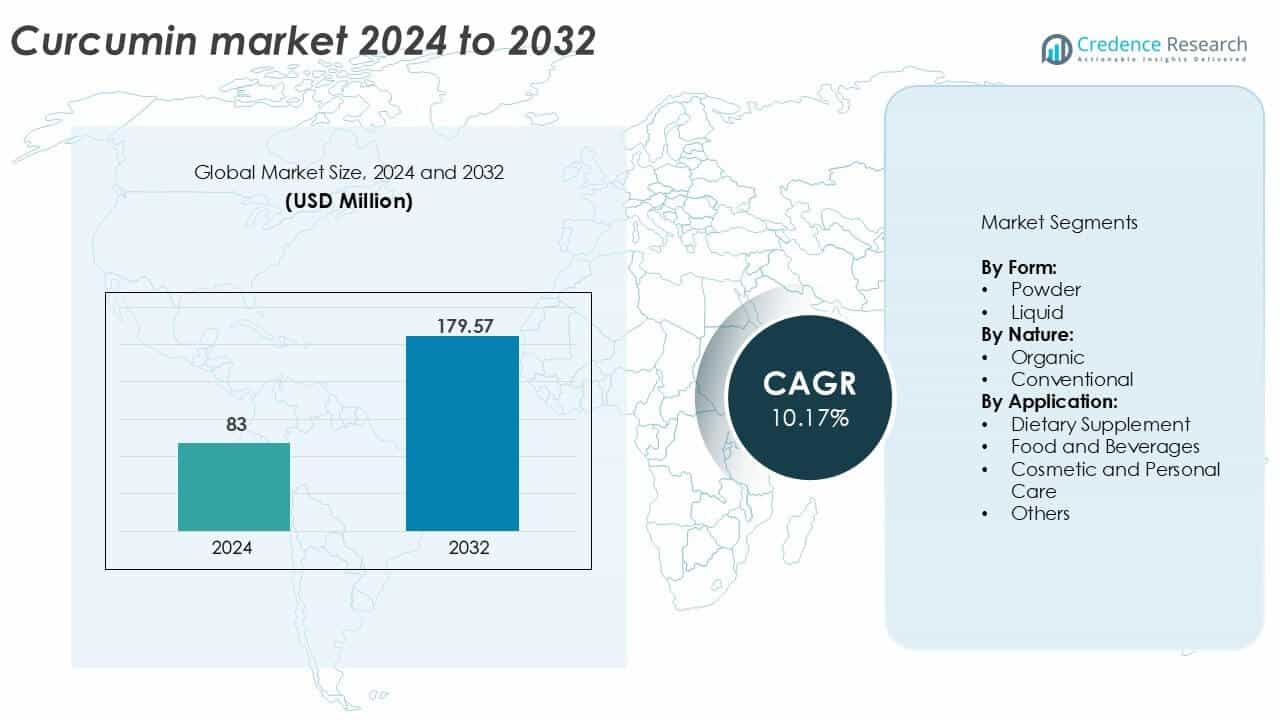
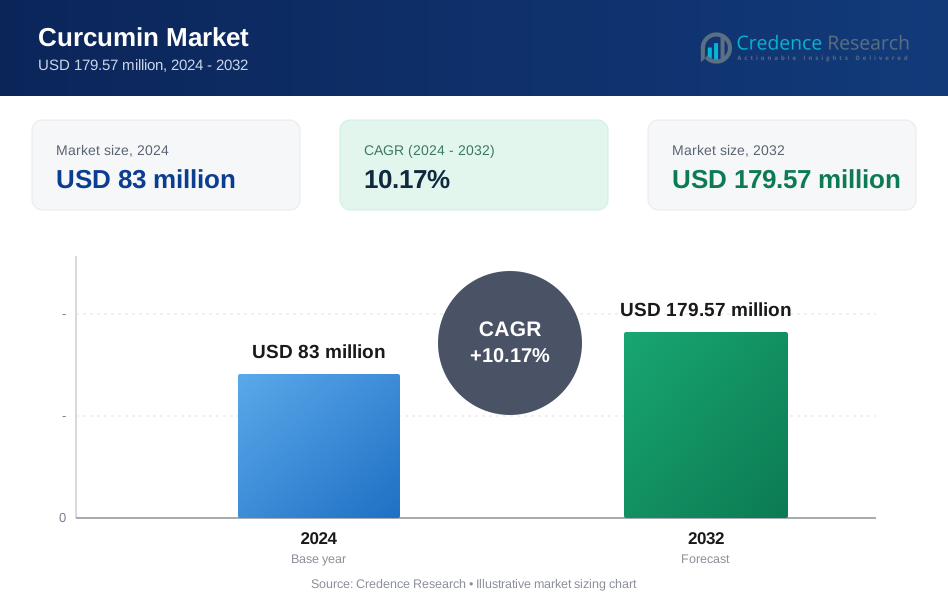
The Curcumin Market size was valued at USD 83 million in 2024 and is anticipated to reach USD 179.57 million by 2032, at a CAGR of 10.17% during the forecast period.
| REPORT ATTRIBUTE | DETAILS |
|---|---|
| Historical Period | 2020-2024 |
| Base Year | 2025 |
| Forecast Period | 2026-2032 |
| Curcumin Market Size 2024 | USD 83 million |
| Curcumin Market, CAGR | 10.17% |
| Curcumin Market Size 2032 | USD 179.57 million |
Curcumin Market Insights
- Rising demand for natural health supplements and herbal remedies is driving large-scale adoption across nutraceutical, food, and cosmetic industries.
- Clean-label trends, growing popularity of organic curcumin, and innovations in high-bioavailability formulations are shaping product development across global markets.
- Leading players include Sami-Sabinsa Group, Arjuna Natural, Synthite Industries, and Wacker Chemie AG, with India dominating global production and exports.
- North America holds the largest regional share at 35%, followed by Europe at 25% and Asia-Pacific at 20%; segment-wise, powder form leads with over 75%, while dietary supplements remain the top application with over 40% share.
Curcumin Market Segmentation Analysis:
By Form
The powder segment dominates the curcumin market, accounting for over 75% of the total share in 2024. Powdered curcumin is widely used in dietary supplements, functional foods, and herbal medicine due to its longer shelf life and ease of formulation. Manufacturers prefer powder form for capsules, tablets, and bulk food blending. Its cost-effectiveness, storage convenience, and compatibility with multiple processing methods further strengthen its position. The liquid segment is growing steadily, driven by rising use in beverages and cosmetics, but still holds a smaller share due to higher processing and packaging costs.
- For instance, Sabinsa processes curcumin powder standardized to 95% curcuminoids, supplying batch sizes exceeding 500 kg for global nutraceutical manufacturers.
By Nature:
Conventional curcumin holds the largest market share, exceeding 65% in 2024, supported by its mass availability and lower production cost. Food and supplement manufacturers rely on conventional turmeric sources to maintain pricing competitiveness across high-volume applications. However, the organic segment is expanding rapidly, driven by consumer demand for clean-label and pesticide-free products. Organic curcumin is gaining momentum in premium supplement brands and cosmetic formulations. Regulatory approvals and sustainability certifications are encouraging its wider adoption, though limited supply and high production costs currently constrain its overall market penetration.
- For instance, as the world's largest producer of spice extracts with a 30% global market share, Synthite Industries operates seven state-of-the-art manufacturing plants with a total oleoresin processing capacity of 300 metric tons per day.
By Application:
Dietary supplements lead the curcumin market with a dominant share of over 40% in 2024. Curcumin’s anti-inflammatory and antioxidant properties make it a key ingredient in joint health, immunity, and general wellness products. The food and beverages segment follows, fueled by functional food trends and increased use in health drinks, snacks, and herbal teas. Cosmetic and personal care applications are also rising, driven by natural ingredient preferences in skincare. The “others” segment includes pet supplements and pharmaceutical use, but remains niche compared to the leading health-focused categories.
Key Growth Drivers
Rising Demand for Natural and Herbal Supplements
The growing global preference for plant-based and natural health solutions is a major driver for the curcumin market. Consumers increasingly seek herbal supplements for immunity, inflammation control, joint support, and chronic condition management. Curcumin, as the bioactive compound in turmeric, offers strong anti-inflammatory and antioxidant benefits, making it a top choice in dietary supplements. Pharmaceutical and nutraceutical companies incorporate curcumin into capsules, soft gels, and functional blends to address consumer demand for clean-label and clinically supported products. This trend is reinforced by expanding geriatric populations and growing awareness of long-term health maintenance. In regions like North America and Europe, curcumin-based supplements are being adopted as daily wellness aids. Ongoing clinical studies validating curcumin’s efficacy further boost product development.
- For instance, Sabinsa’s Curcumin C3 Complex is standardized to 95% curcuminoids and is supported by more than 60 published clinical studies evaluating bioavailability and anti-inflammatory response.
Expanding Applications in Food, Beverages, and Cosmetics
The versatility of curcumin across multiple industries is accelerating market growth beyond traditional health supplements. In the food and beverage industry, curcumin is gaining traction as a functional additive, natural colorant, and flavor enhancer. Manufacturers use it in health drinks, protein bars, dairy alternatives, and condiments to cater to health-conscious consumers. Meanwhile, the cosmetics and personal care sector is increasingly adopting curcumin in anti-aging, anti-acne, and skin-brightening formulations due to its antimicrobial and anti-inflammatory properties. Clean-label beauty trends and rising demand for chemical-free skincare products are fueling this adoption. Major personal care brands are launching turmeric-based product lines across markets in Asia-Pacific, North America, and Europe.
- For instance, Givaudan supplies curcumin-based coloring solutions with thermal stability up to 180 °C, enabling use in baked and processed foods.
Increasing R&D for Enhanced Bioavailability
Low natural bioavailability of curcumin has historically limited its therapeutic efficiency, but advancements in R&D are addressing this barrier. Research institutions and pharmaceutical companies are investing in new formulations such as nanoparticles, liposomal curcumin, micelles, and phospholipid complexes to improve absorption rates. These innovations significantly increase curcumin’s effectiveness in delivering health benefits, which in turn drives wider acceptance across supplements, therapeutics, and clinical nutrition. Companies like Sabinsa, Indena, and OmniActive Health Technologies have developed proprietary technologies that enhance solubility and bioactivity. These breakthroughs not only expand curcumin’s use in chronic disease management but also open doors for medical applications like cancer prevention, cardiovascular health, and neurological support. Enhanced formulations also reduce dosage requirements, improving compliance and safety.
Key Trends & Opportunities
Growing Popularity of Organic and Sustainable Curcumin
Rising environmental awareness and clean-label preferences are driving the demand for organically sourced curcumin. Consumers increasingly scrutinize ingredient origins, prompting manufacturers to offer products free from pesticides, synthetic additives, and GMOs. Organic curcumin appeals strongly to vegan, natural, and health-conscious buyers, especially in North America and Europe. This trend is also supported by regulatory frameworks and certifications like USDA Organic and EU Organic, which help brands position themselves in the premium segment. Producers are investing in sustainable farming practices and traceability tools to align with green standards. The rising demand also creates export opportunities for organic turmeric cultivators in India, which remains the largest producer. This shift presents value-added growth for manufacturers who can meet quality benchmarks.
- For instance, Givaudan sources organic curcumin from certified farms audited under USDA and EU Organic programs, with full batch traceability from farm to extract.
E-Commerce and Direct-to-Consumer Sales Expansion
The rise of digital retail and health-focused online platforms offers a major growth opportunity for curcumin product vendors. E-commerce channels enable supplement and wellness brands to bypass traditional distribution barriers, access niche customer segments, and provide detailed product information. Direct-to-consumer (DTC) models allow for personalized marketing, subscription-based sales, and flexible bundling of curcumin-based offerings. This approach is especially popular for liquid extracts, gummies, and powder mixes, which appeal to millennials and tech-savvy buyers. Global players are leveraging influencer marketing, targeted social media campaigns, and content-based education to drive awareness. The COVID-19 pandemic further accelerated this shift, normalizing the purchase of health supplements and personal care products through online platforms.
Key Challenges
Low Bioavailability and Formulation Limitations
Despite curcumin’s recognized health benefits, its poor bioavailability remains a significant market challenge. Traditional curcumin has limited solubility in water and is rapidly metabolized and excreted, reducing its effectiveness. Without advanced delivery systems, high dosages are required to achieve therapeutic impact, which can raise safety concerns and product costs. This restricts curcumin’s use in mainstream pharmaceuticals and reduces consumer trust in standalone formulations. Manufacturers must invest in innovative formulation technologies, such as nano-emulsions, phospholipid complexes, or piperine combinations, to enhance absorption. However, these innovations increase production complexity and regulatory approval requirements.
Regulatory Complexity and Standardization Gaps
The curcumin market faces regulatory hurdles due to inconsistent quality standards, labeling practices, and approval protocols across countries. While classified as a dietary supplement in the U.S., curcumin may fall under novel food regulations or medicinal claims scrutiny in the EU, China, and other jurisdictions. Lack of harmonized global guidelines creates confusion for exporters and importers, delaying market entry and raising compliance costs. Additionally, variations in curcumin concentration, purity, and origin among suppliers lead to authenticity issues and product recalls. Adulteration and mislabeling have affected consumer trust, particularly in mass-market supplements. Regulatory agencies are beginning to tighten controls, requiring validated sourcing, traceability, and third-party testing.
Regional Analysis
North America
North America leads the global curcumin market, holding over 35% market share in 2024. The U.S. drives demand through its large dietary supplement sector, high consumer health awareness, and preference for natural ingredients. Curcumin is widely used in functional foods, nutraceuticals, and clean-label cosmetics across the region. Regulatory backing from FDA for dietary use and expanding e-commerce sales further strengthen market growth. The presence of established players and increasing R&D into high-bioavailability curcumin products support innovation. Canada also contributes significantly, driven by demand for organic products and government support for herbal supplement development.
Europe
Europe accounts for around 25% of the global curcumin market, led by Germany, the UK, France, and Italy. Strong consumer interest in herbal wellness, coupled with a well-established regulatory framework for botanical products, supports regional growth. Curcumin is integrated into a wide range of supplements and functional foods marketed for joint, skin, and cognitive health. Demand for organic and sustainably sourced curcumin continues to rise, especially in Germany and Nordic countries. Strict quality standards and traceability requirements drive premium positioning. Clean beauty trends also boost demand in natural cosmetic applications across major Western European markets.
Asia-Pacific
Asia-Pacific holds approximately 20% market share in 2024, with India dominating as the largest producer and exporter of curcumin. India also shows strong domestic demand due to traditional Ayurvedic usage. China, Japan, South Korea, and Australia are emerging as key consumers due to increasing health awareness and expanding nutraceutical markets. Rapid urbanization, rising disposable incomes, and preference for functional foods contribute to market growth. Local manufacturers invest in curcumin extraction and processing technologies. Regulatory reforms and growing e-commerce platforms are helping international brands enter these markets more effectively. Organic and clean-label trends are gaining momentum regionally.
Latin America
Latin America represents around 10% of the curcumin market, led by Brazil and Mexico. The region is experiencing growing interest in natural remedies and plant-based supplements. Brazil’s large population and expanding middle class drive demand for curcumin in wellness and beauty products. The food and beverage industry uses turmeric-derived ingredients in health drinks and functional foods. Regional players are partnering with Indian suppliers for raw material imports. However, limited awareness and regulatory inconsistencies remain challenges. Government promotion of herbal medicine and rising digital retail channels are expected to improve accessibility and consumer adoption in the coming years.
Middle East & Africa
The Middle East & Africa (MEA) accounts for under 5% of the global curcumin market but shows promising growth potential. The UAE and South Africa lead regional consumption, driven by rising health consciousness and demand for natural personal care products. Curcumin is increasingly used in premium supplements and clean-label beauty formulations. Import dependence remains high, with most products sourced from India and Europe. Consumer awareness is growing, supported by expanding modern retail and wellness chains. Limited domestic production and lower income levels in some parts of Africa restrict market size, but awareness campaigns and government herbal health programs offer upside potential.
Curcumin Market Segmentations:
By Form:
- Powder
- Liquid
By Nature:
- Organic
- Conventional
By Application:
- Dietary Supplement
- Food and Beverages
- Cosmetic and Personal Care
- Others
By Geography:
- North America
- U.S.
- Canada
- Mexico
- Europe
- Germany
- France
- U.K.
- Italy
- Spain
- Rest of Europe
- Asia Pacific
- China
- Japan
- India
- South Korea
- South-east Asia
- Rest of Asia Pacific
- Latin America
- Brazil
- Argentina
- Rest of Latin America
- Middle East & Africa
- GCC Countries
- South Africa
- Rest of the Middle East and Africa
Competitive Landscape
The curcumin market features a moderately fragmented competitive landscape dominated by Indian manufacturers due to the country’s position as the largest turmeric producer. Leading players such as Sami-Sabinsa Group, Synthite Industries, Arjuna Natural, and Plant Lipids drive innovation through patented extraction methods and high-bioavailability formulations. These companies invest in clinical studies and global certifications to expand their reach in regulated markets like the U.S. and Europe. Multinational firms such as Wacker Chemie AG focus on advanced curcumin delivery systems, including cyclodextrin complexes. Mid-sized firms like Biomax Life Sciences and Vidya Herbs strengthen market presence through exports and strategic partnerships. Competitive factors include pricing, purity levels, organic certifications, and solubility technologies. Players increasingly focus on sustainability, traceability, and clean-label compliance to meet rising consumer expectations. The shift toward organic, functional, and value-added curcumin products continues to shape company strategies, prompting investments in R&D, capacity expansion, and global distribution networks.
Key Player Analysis
- Konark Herbals and Health Care Pvt. Ltd. (India)
- Wacker Chemie AG (Germany)
- Sami-Sabinsa Group (India)
- Biomax Life Sciences Limited (India)
- Plant Lipids Private Limited (India)
- Synthite Industries Ltd. (India)
- Kothari Phytochemicals & Industries Ltd. (India)
- Arjuna Natural Pvt. Ltd. (India)
- Vidya Herbs Private Limited (India)
- Sydler Group of Companies (India)
Recent Developments
- In January 2025, India’s Ministry of Commerce & Industry inaugurated the National Turmeric Board to upgrade cultivation, processing, and export competitiveness.
- In September 2023, NutriOriginal, in collaboration with Star-Hi Herbs Pvt. Ltd, introduced TurmiMax Bio, a turmeric-based supplement featuring enhanced absorption and water solubility using the patented OptiBio Assurance process.
- In February 2023, Herbalife Nutrition incorporated nanotechnology to develop a turmeric-based supplement. This technology will help to enhance the solubility and concentration of curcumin in the body. The product was first launched in Indonesia and will soon be available in Asia Pacific.
Report Coverage
The research report offers an in-depth analysis based on Form, Nature, Application and Geography. It details leading market players, providing an overview of their business, product offerings, investments, revenue streams, and key applications. Additionally, the report includes insights into the competitive environment, SWOT analysis, current market trends, as well as the primary drivers and constraints. Furthermore, it discusses various factors that have driven market expansion in recent years. The report also explores market dynamics, regulatory scenarios, and technological advancements that are shaping the industry. It assesses the impact of external factors and global economic changes on market growth. Lastly, it provides strategic recommendations for new entrants and established companies to navigate the complexities of the market.
Future Outlook
- Curcumin demand will continue rising due to growing adoption in nutraceuticals, cosmetics, and food applications.
- Innovations in bioavailability enhancement will drive wider pharmaceutical and therapeutic usage.
- Organic curcumin will gain momentum as clean-label and sustainability preferences grow globally.
- North America will maintain dominance in consumption, supported by high supplement penetration and awareness.
- Asia-Pacific, led by India and China, will emerge as a key growth region driven by production and rising domestic use.
- Powder form will remain the preferred format due to ease of use and processing flexibility.
- Dietary supplements will continue to hold the largest application share, driven by chronic disease prevention trends.
- Strategic collaborations, patents, and clinical validation will become essential for market differentiation.
- Regulatory harmonization and quality standardization will impact global expansion and compliance requirements.
- Raw material supply challenges and pricing fluctuations may pressure margins for small and mid-sized manufacturers.
Request a Free Sample
Fill in your details and we'll send you a free sample report.
- Sample data tables & charts
- Research methodology
Need a Custom Version of This Report?
Tailor the scope, geography, or segments to your exact requirements.
- Custom geography or segment scope
- Direct access to our analyst team
Frequently Asked Questions
What is the current market size for the Curcumin market, and what is its projected size in 2032?
At what Compound Annual Growth Rate is the Curcumin market projected to grow between 2024 and 2032?
Which Curcumin market segment held the largest share in 2024?
What are the primary factors fueling the growth of the Curcumin market?
Who are the leading companies in the Curcumin market?
Which region commanded the largest share of the Curcumin market in 2024?
Table of Content
Chapter 1. Report Introduction
- 1.1 Report Description & Purpose
- 1.1.1 Report Title & Market Definition
- 1.1.2 Unique Selling Propositions (USP) & Key Differentiators
- 1.1.3 Value Proposition for Stakeholders
- 1.2 Research Objectives
- 1.2.1 Market Sizing Objectives (Volume & Revenue)
- 1.2.2 Segmentation Objectives
- 1.2.3 Competitive Intelligence Objectives
- 1.2.4 Forecast & Scenario Objectives
- 1.3 Report Scope
- 1.3.1 Curcumin Scope – Types & Subtypes Covered
- 1.3.2 Geographic Scope – Regions & Countries Covered
- 1.3.3 Historical Period, Base Year & Forecast Period (2024; forecast to 2032)
- 1.3.4 Inclusions & Exclusions
- 1.4 HS Code & Classification Framework
- 1.5 Currency, Units & Pricing Basis
- 1.6 Target Stakeholders
- 1.7 Limitations & Assumptions
Chapter 2. Executive Summary
- 2.1 Global Curcumin Market Snapshot
- 2.1.1 Market Size – Historical (2024) & Forecast (2024-2032) (2024: USD 83 million → 2032: USD 179.57 million)
- 2.1.2 Volume & Revenue – Global Totals
- 2.1.3 Key Market Highlights – Top Five Facts
- 2.2 Curcumin Market Segmentation Snapshot
- 2.2.1 Market Split by Region – 2024 vs. 2032
- 2.3 Competitive Snapshot
- 2.3.1 Top 10 Players by Revenue Share – 2024
- 2.3.2 Top 10 Players by Volume Share – 2024
- 2.3.3 Recent Strategic Developments (18-Month Summary)
- 2.4 Key Investment Highlights & Strategic Conclusions
Chapter 3. Curcumin Market Dynamics & Industry Analysis
- 3.1 Market Overview & Context
- 3.1.1 Curcumin Market Position in the Broader Automotive Value Chain
- 3.1.2 OEM vs. Replacement Market Dynamics
- 3.1.3 Market Maturity & Development Stage by Region
- 3.2 Curcumin Market Drivers
- 3.3 Curcumin Market Restraints & Challenges
- 3.4 Curcumin Market Opportunities
- 3.5 Porter's Five Forces Analysis
- 3.5.1 Threat of New Entrants
- 3.5.2 Bargaining Power of Suppliers
- 3.5.3 Bargaining Power of Buyers
- 3.5.4 Threat of Substitutes
- 3.5.5 Competitive Rivalry – Intensity Assessment
- 3.6 Curcumin Value Chain Analysis
- 3.6.1 Upstream – Raw Material/Input Suppliers
- 3.6.1.1 Raw Material/Input 1
- 3.6.1.2 Raw Material/Input 2
- 3.6.1.3 Raw Material/Input 3
- 3.6.2 Midstream – Production/Manufacturing/Service Delivery
- 3.6.2.1 Production/Process Overview
- 3.6.2.2 Key Facility Locations & Capacity by Manufacturer
- 3.6.3 Downstream – Distribution & End Consumer
- 3.6.3.1 Primary Channel – B2B/OEM
- 3.6.3.2 Secondary Channels – Dealer, Retail, Online, Direct
- 3.6.4 Value Chain Profitability Analysis
- 3.6.1 Upstream – Raw Material/Input Suppliers
- 3.7 PESTEL Analysis
- 3.7.1 Political Factors
- 3.7.2 Economic Factors
- 3.7.3 Social Factors
- 3.7.4 Technological Factors
- 3.7.5 Environmental Factors
- 3.7.6 Legal Factors
- 3.8 Curcumin Supply Chain Analysis
- 3.8.1 Raw Material/Input Supply Risk Assessment
- 3.8.2 Manufacturing Concentration Risk (Geographic Exposure)
- 3.8.3 Trade Disruption Impact Analysis
- 3.9 Regulatory & Policy Landscape
Note: The regulatory and policy landscape section covers regulations based on their applicability to the market, Curcumin category, geography, and scope of the study. Only regulatory frameworks with a material impact on operations, compliance, trade, sustainability, or market access are analyzed in detail.
Chapter 4. Key Investment Pockets & Opportunity Analysis
- 4.1 Curcumin Market Attractiveness Analysis
- 4.1.1 By Region – Investment Attractiveness Matrix (Volume × CAGR)
- 4.2 Absolute Revenue Growth Opportunity
- 4.2.1 By Region – Absolute USD Growth Through 2032
- 4.3 Incremental Volume Opportunity
- 4.3.1 By Region – Incremental Volume Through 2032
- 4.3.2 Segment – Incremental Volume
- 4.4 Emerging Submarket Opportunity Deep Dive (Subject to Applicability)
- 4.5 Emerging Market Opportunity Scorecards
- 4.5.1 United States
- 4.5.2 Europe
- 4.5.3 Asia
- 4.5.4 Middle East & Africa
Note: Emerging Market Opportunity Scorecards will be included based on relevance and strategic importance. Regions listed are indicative and may vary depending on data availability and market dynamics.
Chapter 5. Curcumin Import-Export Analysis & Trade Flows
- 5.1 Global Trade Overview
- 5.1.1 Global Export Value by Country (2024)
- 5.1.2 Global Export Volume by Country (2024)
- 5.1.3 Global Import Value by Country (2024)
- 5.1.4 Global Import Volume by Country (2024)
- 5.1.5 Net Trade Balance by Country (2024)
- 5.2 Export Analysis – Segment
- 5.2.1 Type 1 (HS Code)
- 5.2.2 Type 2 (HS Code)
- 5.2.3 Type 3 (HS Code)
- 5.2.4 Type 4 (HS Code)
- 5.2.5 Type 5 (HS Code)
- 5.3 Import Analysis – Segment
- 5.3.1 Type 1 (HS Code)
- 5.3.2 Type 2 (HS Code)
- 5.3.3 Type 3 (HS Code)
- 5.3.4 Type 4 (HS Code)
- 5.3.5 Type 5 (HS Code)
- 5.4 Average Unit Trade Prices
- 5.4.1 Average Export Price – Segment & Country
- 5.4.2 Average Import Price – Segment & Source Country
- 5.4.3 Price Trends (2024)
- 5.5 Key Trade Route Analysis
- 5.5.1 Trade Route 1
- 5.5.2 Trade Route 2
- 5.5.3 Trade Route 3
- 5.5.4 Trade Route 4
- 5.5.5 Trade Route 5
- 5.6 Trade Policy Impact Assessment
- 5.6.1 US Anti-Dumping & Section 301 Tariffs
- 5.6.2 EU Customs Union Impact
- 5.6.3 Major Free Trade Agreements
- 5.6.4 USMCA Rules of Origin
Note: Trade policy analysis will be included only where relevant to the Curcumin market.
Chapter 6. Competitive Landscape & Company Benchmarking
- 6.1 Curcumin Market Concentration & Structure
- 6.1.1 Herfindahl-Hirschman Index (HHI) – vs. 2024
- 6.1.2 Tier 1, Tier 2 & Tier 3 Market Structure
- 6.1.3 Global, Regional & Local Player Dynamics
- 6.2 Curcumin Market Share Analysis – 2024
- 6.2.1 Global Revenue Share by Company
- 6.2.2 Global Volume Share by Company
- 6.2.3 Regional Revenue Share
- 6.2.4 Market Share Evolution ( vs. 2024)
- 6.2.5 OEM Segment Share by Company
- 6.2.6 Replacement Segment Share by Company
- 6.3 Production/Delivery Capacity & Facility Analysis
- 6.3.1 Global Installed Capacity
- 6.3.2 Capacity Utilization Rates
- 6.3.3 Production/Output Volume
- 6.3.4 Facility Locations & Capacity Map
- 6.3.5 Planned Capacity Additions
- 6.4 Curcumin Competitive Benchmarking Matrix
- 6.4.1 Revenue, Volume, CAGR & Profitability Comparison
- 6.4.2 Channel Revenue Mix
- 6.4.3 Geographic Revenue Exposure
- 6.4.4 R&D Intensity
- 6.4.5 Sustainability Maturity
- 6.5 Strategic Developments in Curcumin (Last 24 Months)
- 6.5.1 Mergers, Acquisitions & Divestments
- 6.5.2 New Curcumin Launches
- 6.5.3 Facility Expansions
- 6.5.4 Strategic Alliances, Joint Ventures & Partnerships
- 6.5.5 Distribution Expansion & Market Entry
- 6.5.6 Sustainability & ESG Initiatives
- 6.6 Competitive Strategy Mapping
- 6.6.1 Leader, Challenger, Follower & Niche Classification
- 6.6.2 Pricing Strategy Comparison
- 6.6.3 Channel Strategy Matrix
Note: Strategic developments are included based on their materiality and the availability of reliable information.
Chapter 7. Global Curcumin Market – By Distribution Channel
- 7.1 Segment Overview
- 7.1.1 Volume & Revenue Split by Channel (2024 & 2032)
- 7.1.2 Channel Mix Evolution (2024-2032)
Chapter 8. Regional Market Analysis – Global Overview
- 8.1 Global Regional Overview
- 8.1.1 Regional Volume Share
- 8.1.2 Regional Revenue Share
- 8.1.3 Regional Volume by Region
- 8.1.4 Regional Revenue by Region
- 8.1.5 Regional Forecast Through 2032
- 8.2 Cross-Regional Segment Analysis
- 8.2.1 By Distribution Channel
- 8.2.2 By Brand/Price Tier
Chapter 9. North America Curcumin Market
- 9.1 United States
- 9.2 Canada
- 9.3 Mexico
Chapter 10. Europe Curcumin Market
- 10.1 Germany
- 10.2 France
- 10.3 Italy
- 10.4 United Kingdom
- 10.5 Spain
- 10.6 Poland
- 10.7 Russia
- 10.8 Netherlands
- 10.9 Belgium
- 10.10 Sweden
- 10.11 Denmark
- 10.12 Norway
- 10.13 Rest of Europe
Chapter 11. Asia Pacific Curcumin Market
- 11.1 China
- 11.2 India
- 11.3 Japan
- 11.4 South Korea
- 11.5 Thailand
- 11.6 Indonesia
- 11.7 Vietnam
- 11.8 Malaysia
- 11.9 Australia
- 11.10 Rest of Asia Pacific
Chapter 12. Latin America Curcumin Market
- 12.1 Brazil
- 12.2 Argentina
- 12.3 Colombia
- 12.4 Chile
- 12.5 Rest of Latin America
Chapter 13. Middle East Curcumin Market
- 13.1 Saudi Arabia
- 13.2 United Arab Emirates
- 13.3 Turkey
- 13.4 Israel
- 13.5 Iran
- 13.6 Rest of the Middle East
Chapter 14. Africa Curcumin Market
- 14.1 South Africa
- 14.2 Egypt
- 14.3 Nigeria
- 14.4 Morocco
- 14.5 Rest of Africa
Chapter 15. Curcumin Company Profiles
- 15.1 [Company 01]
- 15.1.1 Company Overview
- 15.1.2 Key Management Personnel
- 15.1.3 Products & Services Portfolio
- 15.1.4 Financial Performance
- 15.1.5 Key Market Focus & Geographic Presence
- 15.1.6 Recent Developments & Strategic Initiatives
Note: The company profile list is preliminary and may change based on research findings, market developments, data availability, and client requirements.
Chapter 16. Appendices
- Appendix A – List of Abbreviations & Acronyms
- Appendix B – Industry Classification Code Reference – Full Series
- Appendix C – Production & Capacity Data Tables
- Appendix D – End-Use & Demand Base Tables
- Appendix E – Consumption & Replacement Rate Assumptions
- Appendix F – ASP Reference Tables
- Appendix G – Manufacturing & Facility Database
- Appendix H – Import-Export Data Tables
- Appendix I – Regulatory Summary Tables
- Appendix J – Primary Research Participant List (Anonymized)
- Appendix K – Primary Research Questionnaire Framework
- Appendix L – Data Sources & Bibliography
- Appendix M – Market Size Divergence & Source Comparison
Chapter 17. Research Methodology
- 17.1 Research Framework & Philosophy
- 17.2 Secondary Research – Sources, Hierarchy & Data Extraction
- 17.3 Data Modeling – Bottom-Up & Top-Down Market Sizing
- 17.4 Primary Research – Stakeholder Framework, LOI & Sample Sizes
- 17.5 Forecast Methodology – Regression, Scenario & Sensitivity Analysis
- 17.6 Quality Control – Four-Layer Validation Framework
- 17.7 Limitations & Standard Assumptions
- 17.8 Disclaimer
