
| REPORT ATTRIBUTE | DETAILS |
|---|---|
| Historical Period | 2019-2022 |
| Base Year | 2023 |
| Forecast Period | 2024-2032 |
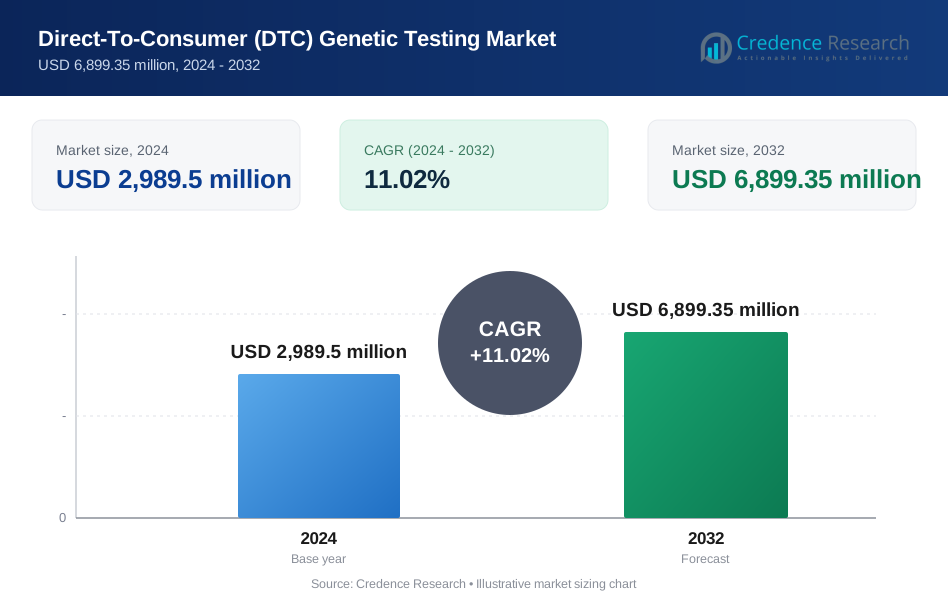
| Direct-To-Consumer (DTC) genetic testing Market Size 2024 | USD 2,989.5 million |
| Direct-To-Consumer (DTC) genetic testing Market, CAGR | 11.02% |
| Direct-To-Consumer (DTC) genetic testing Market Size 2032 | USD 6,899.35 million |
Market Overview
The Direct-To-Consumer (DTC) genetic testing market is projected to grow from USD 2,989.5 million in 2024 to USD 6,899.35 million by 2032, at a compound annual growth rate (CAGR) of 11.02%.
The Direct-To-Consumer (DTC) genetic testing market is driven by increasing consumer awareness about personalized medicine and the rising prevalence of genetic disorders. Technological advancements, such as improved accuracy and accessibility of testing kits, are also boosting market growth. Furthermore, the growing trend of health-conscious consumers seeking preventive healthcare solutions contributes to the demand for genetic testing. Regulatory support and the expansion of online sales channels further fuel market expansion. Additionally, the integration of AI and data analytics in genetic analysis is enhancing user experience and driving innovation in DTC genetic testing solutions.
The Direct-To-Consumer (DTC) genetic testing market is predominantly driven by key players in North America and Europe. In North America, companies such as 23andMe, Ancestry DNA, and Helix OpCo LLC lead the market with diverse testing services and significant consumer awareness. Meanwhile, Europe boasts influential players like Living DNA Ltd, MyHeritage Ltd, and Prenetics Limited, which cater to the growing demand for personalized healthcare and ancestry testing. As the market expands, other firms, including Veritas Genetics, Fulgent Genomics, and Full Genomes Corporation, Inc., continue to enhance their offerings, contributing to competitive growth in both regions.
Market Drivers
Increasing Consumer Awareness and Interest
The growing awareness of genetic testing and its potential benefits has significantly increased consumer interest in understanding their genetic makeup. This surge in interest is largely fueled by media coverage, social media discussions, and the expanding presence of direct-to-consumer (DTC) genetic testing companies. For instance, a recent survey by the National Human Genome Research Institute found that public awareness of genomics and personalized medicine is not increasing in line with advancements in the industry. Consumers are becoming more knowledgeable about how genetic insights can guide personalized health strategies and lifestyle changes. As more people share their positive experiences with genetic testing, awareness continues to grow, further driving demand in the market.
Technological Advancements and Accessibility
Technological advancements in genetic testing have made these services more affordable and accessible to a wider audience. Innovations in testing methods have improved the accuracy and ease of use, making it possible for consumers to conduct tests at home with minimal effort. For instance, the integration of CRISPR technologies with advanced biosensing platforms has enabled rapid, real-time diagnostics for genetic disorders. The reduced cost of testing kits and the increased efficiency of genetic analysis have contributed to a larger number of people choosing to undergo testing. This technological progress, coupled with the growing variety of applications, has made genetic testing a mainstream health option.
Rising Interest in Personalized Healthcare
Consumers are increasingly seeking personalized healthcare solutions tailored to their unique genetic profiles. This shift towards individualized health management is driven by the desire for more effective and targeted interventions that can lead to better outcomes. DTC genetic testing allows individuals to gain insight into their genetic predispositions, enabling them to make informed decisions about their health and lifestyle. The appeal of customized health recommendations is further propelling the adoption of genetic testing services.
Competitive Pricing and Convenience
The DTC genetic testing market benefits from competitive pricing, making these services more affordable to a broader range of consumers. Companies often offer promotions and packages that attract cost-conscious customers. Additionally, the convenience of purchasing testing kits online and receiving results at home has made genetic testing an accessible option for many. Despite some concerns about privacy and data security, most companies are addressing these issues by implementing strict measures to safeguard consumer data, ensuring the responsible use of genetic information.
Market Trends
Expanding Applications and Integration with Healthcare
The DTC genetic testing market is experiencing growth due to the increasing diversity of its applications. While ancestry testing and health risk assessment remain popular, new areas such as carrier screening, pharmacogenomics, and personalized nutrition are expanding the utility of genetic tests. This diversification is attracting a broader consumer base and driving market expansion. Furthermore, DTC genetic testing companies are increasingly integrating their services with healthcare providers. Collaborations with physicians and clinics ensure that genetic tests are part of comprehensive healthcare solutions, enabling accurate interpretation and appropriate follow-up care. This integration strengthens the value proposition of genetic testing, making it more reliable and medically relevant.
Consumer Education, Data Privacy, and Innovation
As genetic test results can be complex and have significant implications, DTC genetic testing companies are placing a growing emphasis on consumer education and counseling. For instance, the National Human Genome Research Institute has created resources to help healthcare professionals understand the diverse landscape of DTC genetic testing, enhancing the overall experience and trust in the service. At the same time, companies are focusing on ensuring data privacy and security, given the sensitive nature of genetic information. Measures are being implemented to safeguard consumer data, addressing concerns about misuse and ensuring responsible use. Additionally, the market is seeing increased competition, driving innovation, lower prices, and improved services. Companies are utilizing artificial intelligence (AI) to provide more personalized insights, and integrating genetic testing with wearable devices and health apps, allowing consumers to track health data over time. This convergence of technology and healthcare is set to further transform the DTC genetic testing landscape.
Market Challenges Analysis
Regulatory Uncertainty and Privacy Concerns
One of the primary challenges facing the DTC genetic testing market is the complex and varied regulatory landscape. Regulations differ significantly between countries, leading to uncertainty for both companies and consumers. For instance, a study found that the laws and agency regulation surrounding genetic privacy and DTC-GT services are fragmented and insufficient. This lack of regulatory consistency can create barriers to market entry, as companies must navigate different legal frameworks and compliance requirements. Additionally, data privacy and security remain pressing concerns. The collection and storage of sensitive genetic data raise potential risks, and companies must implement robust safeguards to protect consumer information from breaches or misuse. Addressing these concerns is essential to building consumer trust and ensuring responsible handling of genetic data in an increasingly digital world.
Interpretation Challenges and Ethical Dilemmas
Another significant challenge is the complexity involved in interpreting genetic test results. Consumers without specialized knowledge may struggle to understand their results, leading to potential misinterpretations that could result in harmful health decisions. This is compounded by the fact that DTC genetic tests can produce false positives or negatives, contributing to unnecessary anxiety or missed health interventions. Moreover, the market faces ethical concerns, such as the potential for genetic discrimination and the implications of test results on reproductive decisions. The lack of access to professional genetic counseling further exacerbates these issues, leaving consumers without the guidance they need to make informed decisions. The limited clinical utility of certain tests also raises questions about the overall value of DTC genetic testing, as some results may not provide actionable health insights. Ethical considerations, coupled with the potential psychological distress from learning about genetic predispositions, represent significant hurdles that the industry must address to ensure responsible and beneficial use of genetic testing technologies.
Market Segmentation Analysis:
By Product:
The Direct-To-Consumer (DTC) genetic testing market is segmented by various product types, each addressing different consumer needs. Pharmacogenetics tests, which analyze an individual's genetic response to medications, are gaining traction as personalized medicine becomes more prominent. Carrier screening tests, used to identify genetic mutations that could be passed to offspring, are in high demand among prospective parents. Genetic Health Risk (GHR) tests assess an individual’s predisposition to specific health conditions, while cancer predisposition tests focus on identifying genetic markers linked to higher cancer risks. Low-risk general wellness tests, which provide insights into overall health, and ancestry tests, which help consumers trace their genetic lineage, also account for a significant portion of the market. The diverse applications of these products cater to a broad spectrum of consumer interests, from health risk assessments to lifestyle improvements and ancestry exploration.
By Technology:
The technology used in DTC genetic testing plays a crucial role in the accuracy and reliability of the results. Single Nucleotide Polymorphism (SNP) chip technology, which analyzes specific genetic variations, is widely used for ancestry testing and general wellness assessments due to its cost-effectiveness and ability to process large volumes of data. Whole genome sequencing (WGS), on the other hand, provides a more comprehensive analysis of an individual’s entire genetic makeup. While WGS is more expensive, it offers detailed insights into health risks, disease predisposition, and pharmacogenomics, making it ideal for consumers seeking in-depth genetic information. As technology advances, the adoption of WGS is expected to increase, particularly in segments like cancer predisposition and GHR tests, where comprehensive data is critical. The integration of these technologies ensures that DTC genetic testing companies can offer a range of services that meet the needs of both budget-conscious consumers and those seeking extensive genetic analysis.
Segments:
Based on Product:
- Pharmacogenetics Tests
- Carrier Screening Tests
- Genetic Health Risk (GHR) Tests
- Cancer Predisposition Tests
- Low-Risk General Wellness Tests
- Ancestry Tests
Based on Technology:
- Single Nucleotide Polymorphism Chip
- Whole Genome Sequencing
Based on Sample:
- Saliva
- Urine
- Blood
Based on Sales Channel:
- Institutional Sales
- Hospitals
- Specialty Clinics
- Diagnostic Laboratories
- Others
- Retail Sales
- Retail Pharmacies
- Online Sales
Based on the Geography:
- North America
- U.S.
- Canada
- Mexico
- Europe
- Germany
- France
- U.K.
- Italy
- Spain
- Rest of Europe
- Asia Pacific
- China
- Japan
- India
- South Korea
- South-east Asia
- Rest of Asia Pacific
- Latin America
- Brazil
- Argentina
- Rest of Latin America
- Middle East & Africa
- GCC Countries
- South Africa
- Rest of the Middle East and Africa
Regional Analysis
North America
North America holds the largest market share in the Direct-To-Consumer (DTC) genetic testing market, accounting for over 40% of the global market. This dominance is fueled by the region’s strong consumer awareness and widespread adoption of personalized healthcare solutions. The United States, in particular, drives the market due to the presence of major companies such as 23andMe and AncestryDNA, as well as the availability of a broad range of genetic testing services. For instance, a recent survey by the Centers for Disease Control and Prevention (CDC) highlighted that consumer genetic testing has become mainstream, with significant growth in sales of bundled ancestry and health packages. High levels of media exposure, increased access to online sales channels, and a favorable regulatory environment further contribute to the market's growth. Additionally, advancements in technologies like AI-based data analytics and whole genome sequencing enhance the region's competitive edge. North America’s well-established healthcare infrastructure supports the integration of genetic testing into preventive and personalized care, securing its leadership position in the global market.
Europe
Europe accounts for approximately 30% of the global DTC genetic testing market, making it the second-largest region. The market's growth in Europe is driven by increasing consumer interest in ancestry, health risk assessments, and personalized medicine. Key countries, including the United Kingdom, Germany, and France, contribute significantly to the region’s share. Despite some regulatory challenges, Europe continues to experience expansion as consumer education and awareness of genetic testing increase. The region’s growing focus on pharmacogenomics, cancer predisposition tests, and genetic health risk assessments is also fueling demand. Furthermore, advancements in genetic technologies and improved accessibility through online platforms strengthen Europe’s position as a leading market for DTC genetic testing.
Key Player Analysis
- Living DNA Ltd
- Veritas Genetics
- Fulgent Genomics
- 23andMe
- Genetic Technology (EasyDNA)
- MyHeritage Ltd
- Ancestry DNA
- Helix OpCo LLC
- Full Genomes Corporation, Inc.
- Prenetics Limited
Competitive Analysis
The Direct-To-Consumer (DTC) genetic testing market is characterized by intense competition among leading players, including 23andMe, Ancestry DNA, Living DNA Ltd, MyHeritage Ltd, Helix OpCo LLC, Veritas Genetics, Prenetics Limited, Fulgent Genomics, and Full Genomes Corporation, Inc. These companies differentiate themselves through unique product offerings, pricing strategies, and customer engagement. Leading firms differentiate themselves through innovative pricing strategies, customer engagement, and the breadth of their genetic testing solutions. While some companies focus on ancestry-related services, others emphasize health and wellness testing, catering to a growing consumer interest in personalized healthcare. Technological advancements, such as AI-driven analytics and enhanced data security measures, play a crucial role in shaping the competitive landscape. Additionally, as consumer demand for comprehensive genetic insights increases, companies are continuously evolving their services to provide more accurate and user-friendly testing experiences. This dynamic environment fosters ongoing innovation, encouraging firms to enhance their service offerings and maintain a competitive edge in the rapidly growing market.
Recent Developments
- In September 2024, MyHeritage offered a limited-time promotion allowing users to upload their DNA data and access all DNA features for free.
- In June 2023, Prenetics Global Limited, a leading genomics and precision oncology company, announced financial results for the first quarter ending March 31, 2023, along with recent business updates.
- In January 2022, 23andMe Holding Co., a leading consumer genetics and research company, received FDA clearance for a genetic health risk report on a hereditary prostate cancer marker.
Market Concentration & Characteristics
The Direct-To-Consumer (DTC) genetic testing market exhibits moderate concentration, with a few key players dominating significant market shares while allowing room for smaller, innovative companies. This competitive landscape is characterized by diverse offerings, including ancestry testing, health risk assessments, and personalized wellness solutions, catering to various consumer preferences. The market is driven by advancements in technology, such as improved sequencing methods and user-friendly online platforms, which facilitate greater accessibility for consumers. Additionally, the increasing demand for personalized healthcare solutions and growing awareness of genetic testing's benefits contribute to market expansion. As companies focus on enhancing their service quality and addressing consumer concerns regarding data privacy and interpretation, the DTC genetic testing market is expected to experience continuous growth and evolution. This dynamic environment encourages both established firms and emerging players to innovate and differentiate their offerings, further shaping the market's characteristics.Top of Form
Report Coverage
The research report offers an in-depth analysis based on Product, Technology, Sample, Sales Channel and Geography. It details leading market players, providing an overview of their business, product offerings, investments, revenue streams, and key applications. Additionally, the report includes insights into the competitive environment, SWOT analysis, current market trends, as well as the primary drivers and constraints. Furthermore, it discusses various factors that have driven market expansion in recent years. The report also explores market dynamics, regulatory scenarios, and technological advancements that are shaping the industry. It assesses the impact of external factors and global economic changes on market growth. Lastly, it provides strategic recommendations for new entrants and established companies to navigate the complexities of the market.
Future Outlook
- The DTC genetic testing market is expected to grow significantly, driven by increasing consumer interest in personalized healthcare solutions.
- Advances in sequencing technologies will enhance the accuracy and efficiency of genetic tests, leading to more reliable results.
- Companies will increasingly integrate artificial intelligence to analyze genetic data, providing consumers with personalized insights and recommendations.
- The rise in telehealth services will facilitate access to genetic counseling, helping consumers interpret their results effectively.
- Regulatory frameworks are likely to evolve, promoting better data privacy and security measures while ensuring consumer protection.
- A growing focus on social responsibility will encourage companies to address ethical concerns related to genetic testing, such as discrimination.
- Increased collaboration between DTC genetic testing companies and healthcare providers will integrate genetic testing into broader healthcare services.
- The market will witness a diversification of applications, expanding beyond ancestry and health risk assessments to include personalized nutrition and pharmacogenomics.
- Consumer education initiatives will enhance understanding of genetic testing, fostering greater acceptance and usage among diverse demographics.
- Competitive pricing strategies will emerge as more companies enter the market, making genetic testing more affordable and accessible for consumers.
Request a Free Sample
Fill in your details and we'll send you a free sample report.
- Sample data tables & charts
- Research methodology
Need a Custom Version of This Report?
Tailor the scope, geography, or segments to your exact requirements.
- Custom geography or segment scope
- Direct access to our analyst team
Frequently Asked Questions
What is the size of Direct-To-Consumer (DTC) Genetic Testing Market?
What factors are driving the growth of the Direct-To-Consumer (DTC) Genetic Testing market?
What are the key segments within the Direct-To-Consumer (DTC) Genetic Testing market?
What are some challenges faced by the Direct-To-Consumer (DTC) Genetic Testing market
Who are the major players in this market?
Table of Content
Chapter 1. Report Introduction
- 1.1 Report Description & Purpose
- 1.1.1 Report Title & Market Definition
- 1.1.2 Unique Selling Propositions (USP) & Key Differentiators
- 1.1.3 Value Proposition for Stakeholders
- 1.2 Research Objectives
- 1.2.1 Market Sizing Objectives (Volume & Revenue)
- 1.2.2 Segmentation Objectives
- 1.2.3 Competitive Intelligence Objectives
- 1.2.4 Forecast & Scenario Objectives
- 1.3 Report Scope
- 1.3.1 Direct-To-Consumer (DTC) Genetic Testing Scope – Types & Subtypes Covered
- 1.3.2 Geographic Scope – Regions & Countries Covered
- 1.3.3 Historical Period, Base Year & Forecast Period (2024; forecast to 2032)
- 1.3.4 Inclusions & Exclusions
- 1.4 HS Code & Classification Framework
- 1.5 Currency, Units & Pricing Basis
- 1.6 Target Stakeholders
- 1.7 Limitations & Assumptions
Chapter 2. Executive Summary
- 2.1 Global Direct-To-Consumer (DTC) Genetic Testing Market Snapshot
- 2.1.1 Market Size – Historical (2024) & Forecast (2024-2032) (2024: USD 2,989.5 million → 2032: USD 6,899.35 million)
- 2.1.2 Volume & Revenue – Global Totals
- 2.1.3 Key Market Highlights – Top Five Facts
- 2.2 Direct-To-Consumer (DTC) Genetic Testing Market Segmentation Snapshot
- 2.2.1 Market Split by Region – 2024 vs. 2032
- 2.3 Competitive Snapshot
- 2.3.1 Top 10 Players by Revenue Share – 2024
- 2.3.2 Top 10 Players by Volume Share – 2024
- 2.3.3 Recent Strategic Developments (18-Month Summary)
- 2.4 Key Investment Highlights & Strategic Conclusions
Chapter 3. Direct-To-Consumer (DTC) Genetic Testing Market Dynamics & Industry Analysis
- 3.1 Market Overview & Context
- 3.1.1 Direct-To-Consumer (DTC) Genetic Testing Market Position in the Broader Automotive Value Chain
- 3.1.2 OEM vs. Replacement Market Dynamics
- 3.1.3 Market Maturity & Development Stage by Region
- 3.2 Direct-To-Consumer (DTC) Genetic Testing Market Drivers
- 3.3 Direct-To-Consumer (DTC) Genetic Testing Market Restraints & Challenges
- 3.4 Direct-To-Consumer (DTC) Genetic Testing Market Opportunities
- 3.5 Porter's Five Forces Analysis
- 3.5.1 Threat of New Entrants
- 3.5.2 Bargaining Power of Suppliers
- 3.5.3 Bargaining Power of Buyers
- 3.5.4 Threat of Substitutes
- 3.5.5 Competitive Rivalry – Intensity Assessment
- 3.6 Direct-To-Consumer (DTC) Genetic Testing Value Chain Analysis
- 3.6.1 Upstream – Raw Material/Input Suppliers
- 3.6.1.1 Raw Material/Input 1
- 3.6.1.2 Raw Material/Input 2
- 3.6.1.3 Raw Material/Input 3
- 3.6.2 Midstream – Production/Manufacturing/Service Delivery
- 3.6.2.1 Production/Process Overview
- 3.6.2.2 Key Facility Locations & Capacity by Manufacturer
- 3.6.3 Downstream – Distribution & End Consumer
- 3.6.3.1 Primary Channel – B2B/OEM
- 3.6.3.2 Secondary Channels – Dealer, Retail, Online, Direct
- 3.6.4 Value Chain Profitability Analysis
- 3.6.1 Upstream – Raw Material/Input Suppliers
- 3.7 PESTEL Analysis
- 3.7.1 Political Factors
- 3.7.2 Economic Factors
- 3.7.3 Social Factors
- 3.7.4 Technological Factors
- 3.7.5 Environmental Factors
- 3.7.6 Legal Factors
- 3.8 Direct-To-Consumer (DTC) Genetic Testing Supply Chain Analysis
- 3.8.1 Raw Material/Input Supply Risk Assessment
- 3.8.2 Manufacturing Concentration Risk (Geographic Exposure)
- 3.8.3 Trade Disruption Impact Analysis
- 3.9 Regulatory & Policy Landscape
Note: The regulatory and policy landscape section covers regulations based on their applicability to the market, Direct-To-Consumer (DTC) Genetic Testing category, geography, and scope of the study. Only regulatory frameworks with a material impact on operations, compliance, trade, sustainability, or market access are analyzed in detail.
Chapter 4. Key Investment Pockets & Opportunity Analysis
- 4.1 Direct-To-Consumer (DTC) Genetic Testing Market Attractiveness Analysis
- 4.1.1 By Region – Investment Attractiveness Matrix (Volume × CAGR)
- 4.2 Absolute Revenue Growth Opportunity
- 4.2.1 By Region – Absolute USD Growth Through 2032
- 4.3 Incremental Volume Opportunity
- 4.3.1 By Region – Incremental Volume Through 2032
- 4.3.2 Segment – Incremental Volume
- 4.4 Emerging Submarket Opportunity Deep Dive (Subject to Applicability)
- 4.5 Emerging Market Opportunity Scorecards
- 4.5.1 United States
- 4.5.2 Europe
- 4.5.3 Asia
- 4.5.4 Middle East & Africa
Note: Emerging Market Opportunity Scorecards will be included based on relevance and strategic importance. Regions listed are indicative and may vary depending on data availability and market dynamics.
Chapter 5. Direct-To-Consumer (DTC) Genetic Testing Import-Export Analysis & Trade Flows
- 5.1 Global Trade Overview
- 5.1.1 Global Export Value by Country (2024)
- 5.1.2 Global Export Volume by Country (2024)
- 5.1.3 Global Import Value by Country (2024)
- 5.1.4 Global Import Volume by Country (2024)
- 5.1.5 Net Trade Balance by Country (2024)
- 5.2 Export Analysis – Segment
- 5.2.1 Type 1 (HS Code)
- 5.2.2 Type 2 (HS Code)
- 5.2.3 Type 3 (HS Code)
- 5.2.4 Type 4 (HS Code)
- 5.2.5 Type 5 (HS Code)
- 5.3 Import Analysis – Segment
- 5.3.1 Type 1 (HS Code)
- 5.3.2 Type 2 (HS Code)
- 5.3.3 Type 3 (HS Code)
- 5.3.4 Type 4 (HS Code)
- 5.3.5 Type 5 (HS Code)
- 5.4 Average Unit Trade Prices
- 5.4.1 Average Export Price – Segment & Country
- 5.4.2 Average Import Price – Segment & Source Country
- 5.4.3 Price Trends (2024)
- 5.5 Key Trade Route Analysis
- 5.5.1 Trade Route 1
- 5.5.2 Trade Route 2
- 5.5.3 Trade Route 3
- 5.5.4 Trade Route 4
- 5.5.5 Trade Route 5
- 5.6 Trade Policy Impact Assessment
- 5.6.1 US Anti-Dumping & Section 301 Tariffs
- 5.6.2 EU Customs Union Impact
- 5.6.3 Major Free Trade Agreements
- 5.6.4 USMCA Rules of Origin
Note: Trade policy analysis will be included only where relevant to the Direct-To-Consumer (DTC) Genetic Testing market.
Chapter 6. Competitive Landscape & Company Benchmarking
- 6.1 Direct-To-Consumer (DTC) Genetic Testing Market Concentration & Structure
- 6.1.1 Herfindahl-Hirschman Index (HHI) – vs. 2024
- 6.1.2 Tier 1, Tier 2 & Tier 3 Market Structure
- 6.1.3 Global, Regional & Local Player Dynamics
- 6.2 Direct-To-Consumer (DTC) Genetic Testing Market Share Analysis – 2024
- 6.2.1 Global Revenue Share by Company
- 6.2.2 Global Volume Share by Company
- 6.2.3 Regional Revenue Share
- 6.2.4 Market Share Evolution ( vs. 2024)
- 6.2.5 OEM Segment Share by Company
- 6.2.6 Replacement Segment Share by Company
- 6.3 Production/Delivery Capacity & Facility Analysis
- 6.3.1 Global Installed Capacity
- 6.3.2 Capacity Utilization Rates
- 6.3.3 Production/Output Volume
- 6.3.4 Facility Locations & Capacity Map
- 6.3.5 Planned Capacity Additions
- 6.4 Direct-To-Consumer (DTC) Genetic Testing Competitive Benchmarking Matrix
- 6.4.1 Revenue, Volume, CAGR & Profitability Comparison
- 6.4.2 Channel Revenue Mix
- 6.4.3 Geographic Revenue Exposure
- 6.4.4 R&D Intensity
- 6.4.5 Sustainability Maturity
- 6.5 Strategic Developments in Direct-To-Consumer (DTC) Genetic Testing (Last 24 Months)
- 6.5.1 Mergers, Acquisitions & Divestments
- 6.5.2 New Direct-To-Consumer (DTC) Genetic Testing Launches
- 6.5.3 Facility Expansions
- 6.5.4 Strategic Alliances, Joint Ventures & Partnerships
- 6.5.5 Distribution Expansion & Market Entry
- 6.5.6 Sustainability & ESG Initiatives
- 6.6 Competitive Strategy Mapping
- 6.6.1 Leader, Challenger, Follower & Niche Classification
- 6.6.2 Pricing Strategy Comparison
- 6.6.3 Channel Strategy Matrix
Note: Strategic developments are included based on their materiality and the availability of reliable information.
Chapter 7. Global Direct-To-Consumer (DTC) Genetic Testing Market – By Distribution Channel
- 7.1 Segment Overview
- 7.1.1 Volume & Revenue Split by Channel (2024 & 2032)
- 7.1.2 Channel Mix Evolution (2024-2032)
Chapter 8. Regional Market Analysis – Global Overview
- 8.1 Global Regional Overview
- 8.1.1 Regional Volume Share
- 8.1.2 Regional Revenue Share
- 8.1.3 Regional Volume by Region
- 8.1.4 Regional Revenue by Region
- 8.1.5 Regional Forecast Through 2032
- 8.2 Cross-Regional Segment Analysis
- 8.2.1 By Distribution Channel
- 8.2.2 By Brand/Price Tier
Chapter 9. North America Direct-To-Consumer (DTC) Genetic Testing Market
- 9.1 United States
- 9.2 Canada
- 9.3 Mexico
Chapter 10. Europe Direct-To-Consumer (DTC) Genetic Testing Market
- 10.1 Germany
- 10.2 France
- 10.3 Italy
- 10.4 United Kingdom
- 10.5 Spain
- 10.6 Poland
- 10.7 Russia
- 10.8 Netherlands
- 10.9 Belgium
- 10.10 Sweden
- 10.11 Denmark
- 10.12 Norway
- 10.13 Rest of Europe
Chapter 11. Asia Pacific Direct-To-Consumer (DTC) Genetic Testing Market
- 11.1 China
- 11.2 India
- 11.3 Japan
- 11.4 South Korea
- 11.5 Thailand
- 11.6 Indonesia
- 11.7 Vietnam
- 11.8 Malaysia
- 11.9 Australia
- 11.10 Rest of Asia Pacific
Chapter 12. Latin America Direct-To-Consumer (DTC) Genetic Testing Market
- 12.1 Brazil
- 12.2 Argentina
- 12.3 Colombia
- 12.4 Chile
- 12.5 Rest of Latin America
Chapter 13. Middle East Direct-To-Consumer (DTC) Genetic Testing Market
- 13.1 Saudi Arabia
- 13.2 United Arab Emirates
- 13.3 Turkey
- 13.4 Israel
- 13.5 Iran
- 13.6 Rest of the Middle East
Chapter 14. Africa Direct-To-Consumer (DTC) Genetic Testing Market
- 14.1 South Africa
- 14.2 Egypt
- 14.3 Nigeria
- 14.4 Morocco
- 14.5 Rest of Africa
Chapter 15. Direct-To-Consumer (DTC) Genetic Testing Company Profiles
- 15.1 [Company 01]
- 15.1.1 Company Overview
- 15.1.2 Key Management Personnel
- 15.1.3 Products & Services Portfolio
- 15.1.4 Financial Performance
- 15.1.5 Key Market Focus & Geographic Presence
- 15.1.6 Recent Developments & Strategic Initiatives
Note: The company profile list is preliminary and may change based on research findings, market developments, data availability, and client requirements.
Chapter 16. Appendices
- Appendix A – List of Abbreviations & Acronyms
- Appendix B – Industry Classification Code Reference – Full Series
- Appendix C – Production & Capacity Data Tables
- Appendix D – End-Use & Demand Base Tables
- Appendix E – Consumption & Replacement Rate Assumptions
- Appendix F – ASP Reference Tables
- Appendix G – Manufacturing & Facility Database
- Appendix H – Import-Export Data Tables
- Appendix I – Regulatory Summary Tables
- Appendix J – Primary Research Participant List (Anonymized)
- Appendix K – Primary Research Questionnaire Framework
- Appendix L – Data Sources & Bibliography
- Appendix M – Market Size Divergence & Source Comparison
Chapter 17. Research Methodology
- 17.1 Research Framework & Philosophy
- 17.2 Secondary Research – Sources, Hierarchy & Data Extraction
- 17.3 Data Modeling – Bottom-Up & Top-Down Market Sizing
- 17.4 Primary Research – Stakeholder Framework, LOI & Sample Sizes
- 17.5 Forecast Methodology – Regression, Scenario & Sensitivity Analysis
- 17.6 Quality Control – Four-Layer Validation Framework
- 17.7 Limitations & Standard Assumptions
- 17.8 Disclaimer
