
Market Overview
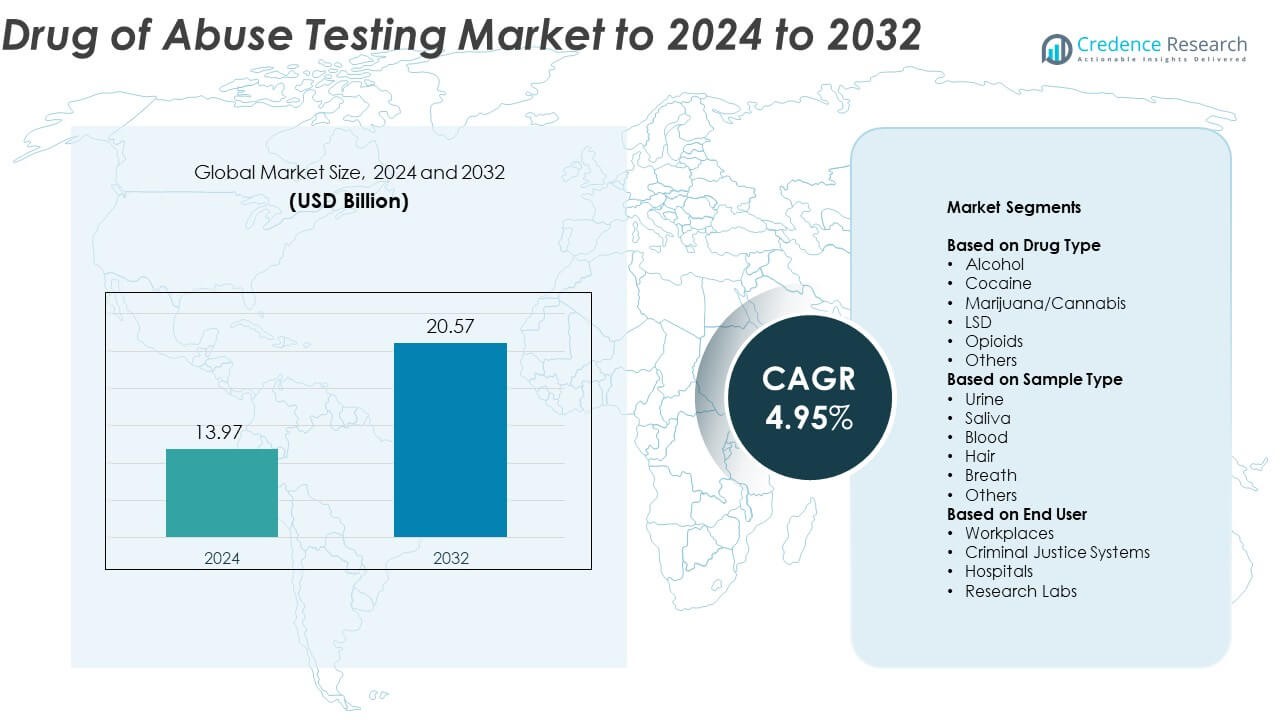
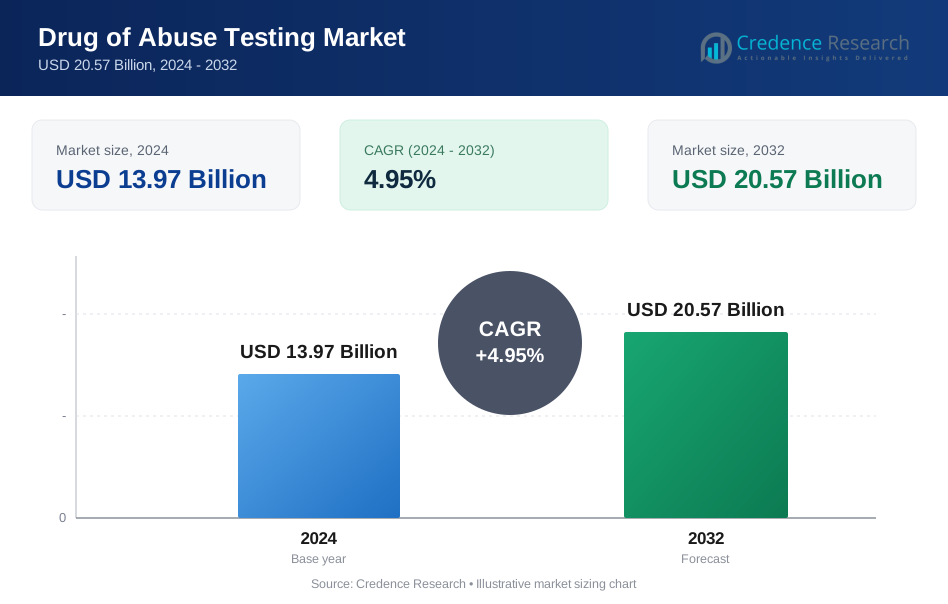
Drug of Abuse Testing Market size was valued at USD 13.97 Billion in 2024 and is anticipated to reach USD 20.57 Billion by 2032, at a CAGR of 4.95% during the forecast period.| REPORT ATTRIBUTE | DETAILS |
|---|---|
| Historical Period | 2020-2023 |
| Base Year | 2024 |
| Forecast Period | 2025-2032 |
| Drug of Abuse Testing Market Size 2024 | USD 13.97 Billion |
| Drug of Abuse Testing Market, CAGR | 4.95% |
| Drug of Abuse Testing Market Size 2032 | USD 20.57 Billion |
Market Insights
- The drug of abuse testing market was valued at USD 13.97 Billion in 2024 and is projected to reach USD 20.57 Billion by 2032, expanding at a CAGR of 4.95%. • Growing prevalence of substance abuse and increasing workplace testing programs are major drivers supporting consistent market growth across developed and emerging economies. • Technological advancements such as point-of-care testing devices and multi-panel rapid kits are shaping industry trends, enabling faster and more accurate detection. • The market is moderately competitive, with key players focusing on innovation, digital data integration, and service expansion to strengthen their global presence. • North America leads with 37.2% share, followed by Europe at 28.6% and Asia Pacific at 22.4%, while the marijuana or cannabis segment dominates the market among drug types with 32.6% share due to high consumption and legalization trends.
Market Segmentation Analysis:
By Drug Type The marijuana or cannabis segment dominates the drug of abuse testing market with nearly 32.6% share in 2024. Its dominance is driven by the increasing prevalence of cannabis use among young adults and its legalization in several countries, which has prompted the need for effective monitoring and workplace testing. Advances in analytical methods such as liquid chromatography-mass spectrometry have improved detection accuracy for THC metabolites. Rising adoption of multi-panel testing kits and government-led awareness campaigns on substance misuse further support the expansion of cannabis testing programs worldwide.- For instance, Shimadzu Corporation's LCMS-8050 platform is widely used in certified forensic laboratories for cannabis analysis, including the detection of THC metabolites, with published application notes demonstrating the capability to detect these metabolites in urine samples at a Limit of Quantification (LOQ) of 5 ng/mL.
- For instance, Quest’s 2024 DTI analyzed over 2.8 million federally mandated urine tests.
Key Growth Drivers
Rising Substance Abuse Prevalence The growing global prevalence of drug misuse is a major growth driver for the drug of abuse testing market. Increasing cases of opioid, cannabis, and synthetic drug consumption have prompted stricter enforcement of screening programs across workplaces, healthcare facilities, and transportation sectors. Governments are mandating regular testing to ensure safety and compliance, while healthcare providers are expanding diagnostic coverage. This surge in substance abuse detection initiatives directly boosts demand for rapid, accurate, and multi-panel testing solutions worldwide.- For instance, Millennium Health assessed 1.4 million fentanyl-positive urine tests in 2024 analyses.
- For instance, First Advantage analyzed 100 million+ screening checks in 2022 for employers.
Key Trends & Opportunities
Growing Adoption of Point-of-Care Testing Point-of-care testing devices are increasingly gaining traction due to their portability, rapid results, and ease of use. These tools are particularly beneficial for law enforcement, emergency departments, and on-site workplace testing. Miniaturized analyzers and disposable testing kits enable real-time decision-making while maintaining regulatory compliance. The trend toward decentralized diagnostics presents major opportunities for manufacturers offering compact, multi-drug detection systems.- For instance, Abbott’s SoToxa detects up to six drug classes in about 5 minutes.
- For instance, Bamboo Health supports ~7 billion PDMP queries yearly across 44 jurisdictions.
Key Challenges
Regulatory and Ethical Concerns Stringent regulatory frameworks and ethical concerns surrounding privacy pose significant challenges for the drug of abuse testing industry. Variations in drug testing laws across regions create complexity for global companies. Additionally, concerns about individual rights, false positives, and data confidentiality hinder wider adoption. Addressing these regulatory inconsistencies while ensuring accurate and ethical testing practices remains critical for sustained market growth. High Cost and Limited Accessibility The high cost of advanced analytical instruments and testing reagents limits accessibility in low-income regions. Many small organizations and public institutions lack resources to adopt high-end laboratory-based testing. Furthermore, maintenance and calibration costs add to operational burdens. Expanding affordable, easy-to-use testing solutions and improving infrastructure in emerging economies are essential to overcome these challenges and achieve broader market penetration.Regional Analysis
North America North America dominates the drug of abuse testing market with nearly 37.2% share in 2024. The region’s leadership stems from strict government regulations, widespread workplace testing policies, and rising substance abuse rates. The United States contributes significantly through robust adoption of urine and saliva-based testing across corporate and transportation sectors. Continuous technological innovation, coupled with established laboratory infrastructure, supports market growth. Increasing awareness of drug-related health risks and strong enforcement measures by federal agencies such as SAMHSA and DOT further reinforce North America’s position as the leading regional market. Europe Europe holds around 28.6% share of the global drug of abuse testing market in 2024. The region benefits from strong public health initiatives, expanding drug monitoring programs, and regulatory emphasis on workplace safety. Countries such as Germany, the United Kingdom, and France are at the forefront due to increasing drug use among young adults and professionals. Widespread implementation of oral fluid and hair testing technologies enhances adoption. Ongoing investment in laboratory automation and data management systems, along with rising demand for point-of-care testing, continues to strengthen Europe’s market presence. Asia Pacific Asia Pacific accounts for approximately 22.4% share of the drug of abuse testing market in 2024. The region is witnessing rapid expansion driven by growing awareness of drug misuse, especially in emerging economies such as China, India, and Japan. Governments are implementing national-level drug surveillance programs and increasing investment in diagnostic infrastructure. The expansion of workplace drug screening and public health initiatives further contributes to growth. Rising affordability of test kits and international collaborations with research institutions are expected to enhance adoption across both urban and rural areas. Latin America Latin America captures about 7.1% share of the drug of abuse testing market in 2024. The region’s growth is supported by rising drug trafficking, increasing substance misuse, and expanding law enforcement initiatives. Brazil and Mexico lead due to strengthened government policies and investments in forensic testing. Growing adoption of workplace and roadside testing programs enhances demand for portable detection devices. However, limited healthcare infrastructure and inconsistent regulatory enforcement remain challenges. Ongoing efforts to modernize laboratory facilities and promote public awareness are gradually improving testing penetration in the region. Middle East & Africa The Middle East and Africa region represents nearly 4.7% share of the global drug of abuse testing market in 2024. Growth is driven by rising government campaigns addressing addiction and expanding screening in transportation and healthcare sectors. Gulf countries such as Saudi Arabia and the UAE are investing in advanced diagnostic facilities to combat substance misuse. In Africa, increasing drug abuse awareness and collaborations with international organizations are helping build testing capacity. However, limited funding and lack of standardized regulations constrain widespread adoption, though gradual progress is evident in urban centers.Market Segmentations:
By Drug Type- Alcohol
- Cocaine
- Marijuana/Cannabis
- LSD
- Opioids
- Others
- Urine
- Saliva
- Blood
- Hair
- Breath
- Others
- Workplaces
- Criminal Justice Systems
- Hospitals
- Research Labs
- North America
- U.S.
- Canada
- Mexico
- Europe
- Germany
- France
- U.K.
- Italy
- Spain
- Rest of Europe
- Asia Pacific
- China
- Japan
- India
- South Korea
- South-east Asia
- Rest of Asia Pacific
- Latin America
- Brazil
- Argentina
- Rest of Latin America
- Middle East & Africa
- GCC Countries
- South Africa
- Rest of the Middle East and Africa
Competitive Landscape
The competitive landscape of the drug of abuse testing market includes key players such as Quest Diagnostics, Inc., Abbott Laboratories, LGC Group, Cordant Health Solutions, Precision Diagnostics, Mayo Clinic Laboratories, DrugScan, Legacy Medical Services, LabCorp, and Danaher Corporation. The market is characterized by continuous innovation in testing technologies, expansion of product portfolios, and strategic partnerships to enhance service capabilities. Companies are focusing on developing multi-panel, rapid testing solutions that provide faster and more accurate results for workplace, clinical, and forensic applications. Investments in automation, digital reporting systems, and portable testing devices are shaping future competitiveness. Moreover, collaborations with regulatory agencies and healthcare institutions are supporting compliance with global testing standards. The increasing demand for remote and point-of-care testing, coupled with the integration of cloud-based data management, is further intensifying competition among leading manufacturers and service providers across the global landscape.Key Player Analysis
- Quest Diagnostics, Inc.
- Abbott Laboratories
- LGC Group
- Cordant Health Solutions
- Precision Diagnostics
- Mayo Clinic Laboratories
- DrugScan
- Legacy Medical Services
- LabCorp
- Danaher Corporation
Recent Developments
- In 2025, Danaher announced a strategic partnership with AstraZeneca focused on the development and commercialization of novel diagnostic tools, aiming to advance precision medicine, including drug testing areas.
- In 2025, LabCorp Published its “Evolving Drug Trends” clinical toxicology report noting shifts such as rising medetomidine detections in fentanyl-positive samples.
- In 2023, Quest Diagnostics introduced a Drug Monitoring panel targeting Novel Psychoactive Substances (NPS), utilizing liquid chromatography with tandem mass spectrometry (LC-MS/MS) to identify major classes of NPS.
Report Coverage
The research report offers an in-depth analysis based on Drug Type, Sample Type, End-User and Geography. It details leading market players, providing an overview of their business, product offerings, investments, revenue streams, and key applications. Additionally, the report includes insights into the competitive environment, SWOT analysis, current market trends, as well as the primary drivers and constraints. Furthermore, it discusses various factors that have driven market expansion in recent years. The report also explores market dynamics, regulatory scenarios, and technological advancements that are shaping the industry. It assesses the impact of external factors and global economic changes on market growth. Lastly, it provides strategic recommendations for new entrants and established companies to navigate the complexities of the market.Future Outlook
- Rising awareness of substance misuse will continue to drive global testing demand.
- Integration of AI and automation will enhance testing accuracy and efficiency.
- Point-of-care testing devices will gain popularity for rapid, on-site screening.
- Expansion of workplace testing programs will strengthen market penetration.
- Advances in chromatography and immunoassay technologies will improve detection sensitivity.
- Government-led initiatives will boost adoption across healthcare and transportation sectors.
- Growing focus on prescription drug monitoring will open new market opportunities.
- Emerging economies will experience faster adoption due to improved healthcare infrastructure.
- Ethical and regulatory standardization will support consistent global testing practices.
- Continuous innovation in portable analyzers will make testing more accessible and cost-effective.
Request a Free Sample
Fill in your details and we'll send you a free sample report.
- Sample data tables & charts
- Research methodology
Need a Custom Version of This Report?
Tailor the scope, geography, or segments to your exact requirements.
- Custom geography or segment scope
- Direct access to our analyst team
Frequently Asked Questions
What is the current market size for Drug of Abuse Testing Market, and what is its projected size in 2032?
At what Compound Annual Growth Rate is the Drug of Abuse Testing Market projected to grow between 2025 and 2032?
Which Drug of Abuse Testing Market segment held the largest share in 2024?
What are the primary factors fueling the growth of the Drug of Abuse Testing Market?
Who are the leading companies in the Drug of Abuse Testing Market?
Which region commanded the largest share of the Drug of Abuse Testing Market in 2024?
Table of Content
Chapter 1. Report Introduction
- 1.1 Report Description & Purpose
- 1.1.1 Report Title & Market Definition
- 1.1.2 Unique Selling Propositions (USP) & Key Differentiators
- 1.1.3 Value Proposition for Stakeholders
- 1.2 Research Objectives
- 1.2.1 Market Sizing Objectives (Volume & Revenue)
- 1.2.2 Segmentation Objectives
- 1.2.3 Competitive Intelligence Objectives
- 1.2.4 Forecast & Scenario Objectives
- 1.3 Report Scope
- 1.3.1 Drug of Abuse Testing Scope – Types & Subtypes Covered
- 1.3.2 Geographic Scope – Regions & Countries Covered
- 1.3.3 Historical Period, Base Year & Forecast Period (2024; forecast to 2032)
- 1.3.4 Inclusions & Exclusions
- 1.4 HS Code & Classification Framework
- 1.5 Currency, Units & Pricing Basis
- 1.6 Target Stakeholders
- 1.7 Limitations & Assumptions
Chapter 2. Executive Summary
- 2.1 Global Drug of Abuse Testing Market Snapshot
- 2.1.1 Market Size – Historical (2024) & Forecast (2024-2032) (2024: USD 13.97 Billion → 2032: USD 20.57 Billion)
- 2.1.2 Volume & Revenue – Global Totals
- 2.1.3 Key Market Highlights – Top Five Facts
- 2.2 Drug of Abuse Testing Market Segmentation Snapshot
- 2.2.1 Market Split by Region – 2024 vs. 2032
- 2.3 Competitive Snapshot
- 2.3.1 Top 10 Players by Revenue Share – 2024
- 2.3.2 Top 10 Players by Volume Share – 2024
- 2.3.3 Recent Strategic Developments (18-Month Summary)
- 2.4 Key Investment Highlights & Strategic Conclusions
Chapter 3. Drug of Abuse Testing Market Dynamics & Industry Analysis
- 3.1 Market Overview & Context
- 3.1.1 Drug of Abuse Testing Market Position in the Broader Automotive Value Chain
- 3.1.2 OEM vs. Replacement Market Dynamics
- 3.1.3 Market Maturity & Development Stage by Region
- 3.2 Drug of Abuse Testing Market Drivers
- 3.3 Drug of Abuse Testing Market Restraints & Challenges
- 3.4 Drug of Abuse Testing Market Opportunities
- 3.5 Porter's Five Forces Analysis
- 3.5.1 Threat of New Entrants
- 3.5.2 Bargaining Power of Suppliers
- 3.5.3 Bargaining Power of Buyers
- 3.5.4 Threat of Substitutes
- 3.5.5 Competitive Rivalry – Intensity Assessment
- 3.6 Drug of Abuse Testing Value Chain Analysis
- 3.6.1 Upstream – Raw Material/Input Suppliers
- 3.6.1.1 Raw Material/Input 1
- 3.6.1.2 Raw Material/Input 2
- 3.6.1.3 Raw Material/Input 3
- 3.6.2 Midstream – Production/Manufacturing/Service Delivery
- 3.6.2.1 Production/Process Overview
- 3.6.2.2 Key Facility Locations & Capacity by Manufacturer
- 3.6.3 Downstream – Distribution & End Consumer
- 3.6.3.1 Primary Channel – B2B/OEM
- 3.6.3.2 Secondary Channels – Dealer, Retail, Online, Direct
- 3.6.4 Value Chain Profitability Analysis
- 3.6.1 Upstream – Raw Material/Input Suppliers
- 3.7 PESTEL Analysis
- 3.7.1 Political Factors
- 3.7.2 Economic Factors
- 3.7.3 Social Factors
- 3.7.4 Technological Factors
- 3.7.5 Environmental Factors
- 3.7.6 Legal Factors
- 3.8 Drug of Abuse Testing Supply Chain Analysis
- 3.8.1 Raw Material/Input Supply Risk Assessment
- 3.8.2 Manufacturing Concentration Risk (Geographic Exposure)
- 3.8.3 Trade Disruption Impact Analysis
- 3.9 Regulatory & Policy Landscape
Note: The regulatory and policy landscape section covers regulations based on their applicability to the market, Drug of Abuse Testing category, geography, and scope of the study. Only regulatory frameworks with a material impact on operations, compliance, trade, sustainability, or market access are analyzed in detail.
Chapter 4. Key Investment Pockets & Opportunity Analysis
- 4.1 Drug of Abuse Testing Market Attractiveness Analysis
- 4.1.1 By Region – Investment Attractiveness Matrix (Volume × CAGR)
- 4.2 Absolute Revenue Growth Opportunity
- 4.2.1 By Region – Absolute USD Growth Through 2032
- 4.3 Incremental Volume Opportunity
- 4.3.1 By Region – Incremental Volume Through 2032
- 4.3.2 Segment – Incremental Volume
- 4.4 Emerging Submarket Opportunity Deep Dive (Subject to Applicability)
- 4.5 Emerging Market Opportunity Scorecards
- 4.5.1 United States
- 4.5.2 Europe
- 4.5.3 Asia
- 4.5.4 Middle East & Africa
Note: Emerging Market Opportunity Scorecards will be included based on relevance and strategic importance. Regions listed are indicative and may vary depending on data availability and market dynamics.
Chapter 5. Drug of Abuse Testing Import-Export Analysis & Trade Flows
- 5.1 Global Trade Overview
- 5.1.1 Global Export Value by Country (2024)
- 5.1.2 Global Export Volume by Country (2024)
- 5.1.3 Global Import Value by Country (2024)
- 5.1.4 Global Import Volume by Country (2024)
- 5.1.5 Net Trade Balance by Country (2024)
- 5.2 Export Analysis – Segment
- 5.2.1 Type 1 (HS Code)
- 5.2.2 Type 2 (HS Code)
- 5.2.3 Type 3 (HS Code)
- 5.2.4 Type 4 (HS Code)
- 5.2.5 Type 5 (HS Code)
- 5.3 Import Analysis – Segment
- 5.3.1 Type 1 (HS Code)
- 5.3.2 Type 2 (HS Code)
- 5.3.3 Type 3 (HS Code)
- 5.3.4 Type 4 (HS Code)
- 5.3.5 Type 5 (HS Code)
- 5.4 Average Unit Trade Prices
- 5.4.1 Average Export Price – Segment & Country
- 5.4.2 Average Import Price – Segment & Source Country
- 5.4.3 Price Trends (2024)
- 5.5 Key Trade Route Analysis
- 5.5.1 Trade Route 1
- 5.5.2 Trade Route 2
- 5.5.3 Trade Route 3
- 5.5.4 Trade Route 4
- 5.5.5 Trade Route 5
- 5.6 Trade Policy Impact Assessment
- 5.6.1 US Anti-Dumping & Section 301 Tariffs
- 5.6.2 EU Customs Union Impact
- 5.6.3 Major Free Trade Agreements
- 5.6.4 USMCA Rules of Origin
Note: Trade policy analysis will be included only where relevant to the Drug of Abuse Testing market.
Chapter 6. Competitive Landscape & Company Benchmarking
- 6.1 Drug of Abuse Testing Market Concentration & Structure
- 6.1.1 Herfindahl-Hirschman Index (HHI) – vs. 2024
- 6.1.2 Tier 1, Tier 2 & Tier 3 Market Structure
- 6.1.3 Global, Regional & Local Player Dynamics
- 6.2 Drug of Abuse Testing Market Share Analysis – 2024
- 6.2.1 Global Revenue Share by Company
- 6.2.2 Global Volume Share by Company
- 6.2.3 Regional Revenue Share
- 6.2.4 Market Share Evolution ( vs. 2024)
- 6.2.5 OEM Segment Share by Company
- 6.2.6 Replacement Segment Share by Company
- 6.3 Production/Delivery Capacity & Facility Analysis
- 6.3.1 Global Installed Capacity
- 6.3.2 Capacity Utilization Rates
- 6.3.3 Production/Output Volume
- 6.3.4 Facility Locations & Capacity Map
- 6.3.5 Planned Capacity Additions
- 6.4 Drug of Abuse Testing Competitive Benchmarking Matrix
- 6.4.1 Revenue, Volume, CAGR & Profitability Comparison
- 6.4.2 Channel Revenue Mix
- 6.4.3 Geographic Revenue Exposure
- 6.4.4 R&D Intensity
- 6.4.5 Sustainability Maturity
- 6.5 Strategic Developments in Drug of Abuse Testing (Last 24 Months)
- 6.5.1 Mergers, Acquisitions & Divestments
- 6.5.2 New Drug of Abuse Testing Launches
- 6.5.3 Facility Expansions
- 6.5.4 Strategic Alliances, Joint Ventures & Partnerships
- 6.5.5 Distribution Expansion & Market Entry
- 6.5.6 Sustainability & ESG Initiatives
- 6.6 Competitive Strategy Mapping
- 6.6.1 Leader, Challenger, Follower & Niche Classification
- 6.6.2 Pricing Strategy Comparison
- 6.6.3 Channel Strategy Matrix
Note: Strategic developments are included based on their materiality and the availability of reliable information.
Chapter 7. Global Drug of Abuse Testing Market – By Distribution Channel
- 7.1 Segment Overview
- 7.1.1 Volume & Revenue Split by Channel (2024 & 2032)
- 7.1.2 Channel Mix Evolution (2024-2032)
Chapter 8. Regional Market Analysis – Global Overview
- 8.1 Global Regional Overview
- 8.1.1 Regional Volume Share
- 8.1.2 Regional Revenue Share
- 8.1.3 Regional Volume by Region
- 8.1.4 Regional Revenue by Region
- 8.1.5 Regional Forecast Through 2032
- 8.2 Cross-Regional Segment Analysis
- 8.2.1 By Distribution Channel
- 8.2.2 By Brand/Price Tier
Chapter 9. North America Drug of Abuse Testing Market
- 9.1 United States
- 9.2 Canada
- 9.3 Mexico
Chapter 10. Europe Drug of Abuse Testing Market
- 10.1 Germany
- 10.2 France
- 10.3 Italy
- 10.4 United Kingdom
- 10.5 Spain
- 10.6 Poland
- 10.7 Russia
- 10.8 Netherlands
- 10.9 Belgium
- 10.10 Sweden
- 10.11 Denmark
- 10.12 Norway
- 10.13 Rest of Europe
Chapter 11. Asia Pacific Drug of Abuse Testing Market
- 11.1 China
- 11.2 India
- 11.3 Japan
- 11.4 South Korea
- 11.5 Thailand
- 11.6 Indonesia
- 11.7 Vietnam
- 11.8 Malaysia
- 11.9 Australia
- 11.10 Rest of Asia Pacific
Chapter 12. Latin America Drug of Abuse Testing Market
- 12.1 Brazil
- 12.2 Argentina
- 12.3 Colombia
- 12.4 Chile
- 12.5 Rest of Latin America
Chapter 13. Middle East Drug of Abuse Testing Market
- 13.1 Saudi Arabia
- 13.2 United Arab Emirates
- 13.3 Turkey
- 13.4 Israel
- 13.5 Iran
- 13.6 Rest of the Middle East
Chapter 14. Africa Drug of Abuse Testing Market
- 14.1 South Africa
- 14.2 Egypt
- 14.3 Nigeria
- 14.4 Morocco
- 14.5 Rest of Africa
Chapter 15. Drug of Abuse Testing Company Profiles
- 15.1 [Company 01]
- 15.1.1 Company Overview
- 15.1.2 Key Management Personnel
- 15.1.3 Products & Services Portfolio
- 15.1.4 Financial Performance
- 15.1.5 Key Market Focus & Geographic Presence
- 15.1.6 Recent Developments & Strategic Initiatives
Note: The company profile list is preliminary and may change based on research findings, market developments, data availability, and client requirements.
Chapter 16. Appendices
- Appendix A – List of Abbreviations & Acronyms
- Appendix B – Industry Classification Code Reference – Full Series
- Appendix C – Production & Capacity Data Tables
- Appendix D – End-Use & Demand Base Tables
- Appendix E – Consumption & Replacement Rate Assumptions
- Appendix F – ASP Reference Tables
- Appendix G – Manufacturing & Facility Database
- Appendix H – Import-Export Data Tables
- Appendix I – Regulatory Summary Tables
- Appendix J – Primary Research Participant List (Anonymized)
- Appendix K – Primary Research Questionnaire Framework
- Appendix L – Data Sources & Bibliography
- Appendix M – Market Size Divergence & Source Comparison
Chapter 17. Research Methodology
- 17.1 Research Framework & Philosophy
- 17.2 Secondary Research – Sources, Hierarchy & Data Extraction
- 17.3 Data Modeling – Bottom-Up & Top-Down Market Sizing
- 17.4 Primary Research – Stakeholder Framework, LOI & Sample Sizes
- 17.5 Forecast Methodology – Regression, Scenario & Sensitivity Analysis
- 17.6 Quality Control – Four-Layer Validation Framework
- 17.7 Limitations & Standard Assumptions
- 17.8 Disclaimer
