
| REPORT ATTRIBUTE | DETAILS |
|---|---|
| Historical Period | 2019-2022 |
| Base Year | 2023 |
| Forecast Period | 2024-2032 |
| Edible Insects Market Size 2023 | USD 18341.2 Million |
| Edible Insects Market, CAGR | 34.80% |
| Edible Insects Market Size 2032 | USD 269548.41 Million |
Market Insights
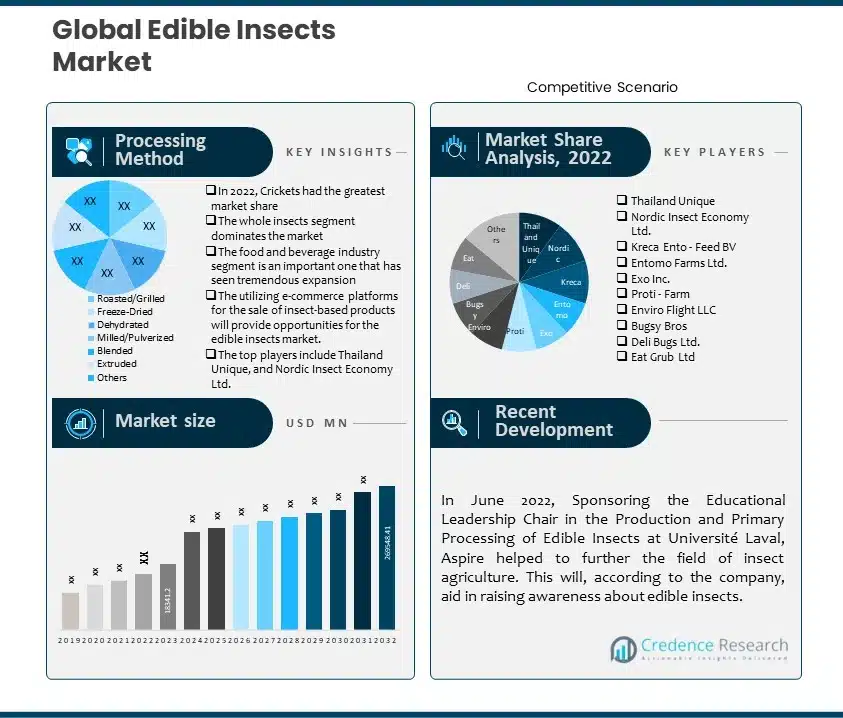
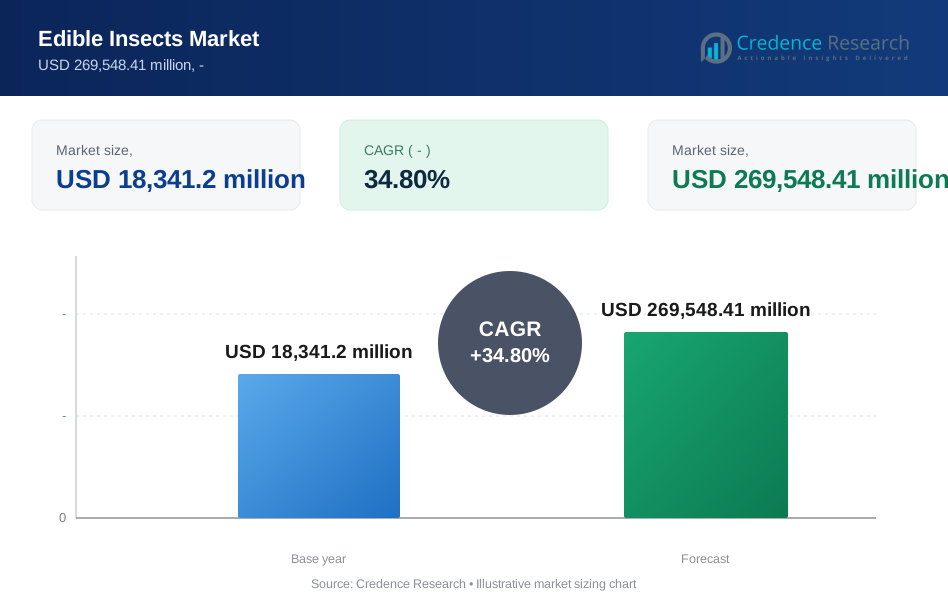
- The global market for edible insects is expected to grow from its estimated USD 18341.2 million in 2023 to USD 269548.41 million in 2032 at a compound annual growth rate (CAGR) of 34.80% between 2024 and 2032.
- The most significant category is crickets. On the other hand, mealworms are expected to grow at a strong CAGR.
- The leading form segment is whole insects.
- The CAGR for the food and beverage industry is expected to be the highest during the projection period.
- The roasted/grilled method will probably have the highest CAGR throughout the prediction period.
- Supermarkets and hypermarkets are estimated to have the greatest CAGR during the forecast period.
- North America dominated the edible insects market.
- Regarding the market share of edible insects, Europe is expected to come second.
- In the edible insect market, Asia Pacific is anticipated to grow fastest.
- The market is growing due to growing awareness of alternative protein sources and technological advancements in insect farming that boost cost- and production-effectiveness.
- Developing a range of snacks made from insects, investigating useful components, and focusing on ethical agricultural practices and sourcing all contribute to demonstrating the market's potential.
Executive Summary
Market Definition
The industry or economic sector that deals with the production, marketing, processing, and consumption of insects fit for human consumption is known as the Edible Insects Market. Since they offer a more nutrient- and protein-rich alternative to conventional livestock, edible insects have drawn interest as a sustainable and healthy food source. This market includes everything from insect farming to processing plants, product creation, marketing, and distribution routes for items made from edible insects.
Market Overview
The edible insects sector is estimated to develop at a 34.80% compound annual growth rate (CAGR) between 2024 and 2032, maintaining its current upward trend. The market will keep developing, rising from its estimated value of USD 18341.2 million in 2023 to USD 269548.41 million in 2032.
The market for edible insects has expanded quickly due to consumers' growing consumption of edible insects. The food and feed industries are also becoming more interested in edible insects because they contain essential minerals and amino acids. In the upcoming years, the market for edible insects is expected to grow due to increased demand from different food industries. Most people regularly consume edible insects. However, some nations are less aware of their existence than others. Due to their high mineral and amino acid content, edible insects are used as both human food and animal feed alike. The rich sources of nutrition for poultry are edible insects, such as cockroaches, wasps, scale insects, ants, crickets, flies, bees, termites, and grasshoppers.
Moreover, growing consumer preferences for foods high in protein and a shift in many people's eating habits are anticipated to drive the edible insect market in the years to come. In order to provide crops with vital nutrients, agriculture uses edible insects. Additionally, growing government initiatives about edible insects and the growing significance of farming are two more factors propelling market growth during the forecast period.
Segmentation by Type of Insect
- Crickets are the market leader by type of insect. Crickets are a great source of vitamins, minerals, and protein. Because they include all of the essential amino acids, they offer a complete protein source. In addition, iron, zinc, and B vitamins can all be found in abundance in crickets.
- The mealworms category will exhibit a sizable CAGR during the projected period. Mealworms are very environmentally friendly and sustainable. Compared to conventional livestock like cattle or pigs, they require fewer resources to farm.
- Other types of insects, such as grasshoppers, beetles, ants, silkworms, caterpillars, termites, and others (e.g., locusts, flies, scorpions), also contribute to the demand for edible insects.
Segmentation by Form
- The significant form category is whole insects. Whole insects are a great source of important nutrients, including minerals, vitamins, healthy fats, and protein. Their nutritional profile is well-rounded, which sets them apart from conventional protein sources like meat.
- The insect flour/powder category will likely register a significant CAGR during forecasting. Due to its high content of protein, fiber, vitamins, and minerals, insect flour is becoming more and more popular among people looking for high-nutrient foods.
- Other forms, such as insect protein bars, insect snacks (e.g., roasted, flavored), insect protein powders, insect pasta/noodles, insect baked goods (e.g., cookies, bread), insect beverages (e.g., insect-based shakes, smoothies), and insect protein supplements, also contribute to the demand for edible insects.
Segmentation by End-Use Application
- The food and beverage industry category is projected to grow at the fastest rate over the projection period. Within the Edible Insects Market, the Food and Beverage Industry encompasses cultivating, handling, distributing, and ingesting edible insects for human consumption. To meet the rising global demand for food while reducing their negative effects on the environment, edible insects have drawn more and more attention as a wholesome and sustainable alternative source of protein.
- Other end-use applications, such as snack foods, protein bars, baked goods, pasta and noodles, beverages, dairy products, meat alternatives, condiments and spreads, animal feed and pet food, pharmaceuticals and nutraceuticals, cosmetics and personal care products, and others, also contribute to the demand for edible insects.
Segmentation by Processing Method
- The roasted/grilled category will likely have the highest CAGR during the projection period. Insects are cooked through roasting, which usually involves an oven or an open flame. Similar to how other meats are prepared, grilling entails cooking insects over an open flame or on a grill.
- Other processing methods, such as freeze-dried, dehydrated, milled/pulverized, blended, extruded, and others, also contribute to the demand for edible insects.
Segmentation by Distribution Channel
- Supermarkets and hypermarkets will be expected to have the foremost CAGR during the prediction period. Big-box retailers that serve a wide range of customers include supermarkets and hypermarkets. This opens up a wider market for the products, including people who might not actively look for other protein sources, by offering edible insects in these establishments.
- Other distribution channels, such as convenience stores, online retailers, specialty stores, food service providers, and direct-to-consumer (e.g., farm stands and farmer's markets), also contribute to the demand for edible insects.
Segmentation by Region
- The edible insects market is dominated by North America. This region's growing need for environmentally friendly, high-protein food is the reason for the rising demand for edible insects.
- Europe is estimated to rank second in market size for edible insects.
- Asia Pacific will witness the most rapid growth of the edible insects market.
- The remaining requirement for edible insects is covered by world regions such as Africa, the Middle East, and Latin America.
Most edible insects are collected in the wild, but a few insect species have been domesticated due to their valuable products. Bees and silkworms are the most well-known examples. Sericulture, the practice of rearing silkworms for the production of raw silk, originated in China. Additionally, agriculture raises insects for pollination or to counter insect pests. Significant rearing operations generate large quantities of beneficial insects like parasitoids and predators, which aids in biological control. These insects, such as egg parasitoids (Trichogramma spp.) and larval parasitoids (Cotesia flavipes) to combat sugarcane borers, are frequently sold to growers of fruits, vegetables, and flowers to help them fight insect pests. Farmer assistance in pollinating crops and fruit orchards is provided by the global rearing of bumblebees (Bombus spp.) and honeybees (Apis spp.).
Regarding forecasting, North America is likely to lead the edible insects market. When compared to conventional livestock, edible insects are frequently regarded as a sustainable and environmentally friendly source of protein. The demand for edible insects may increase as consumers in North America become more interested in plant-based protein options due to growing concerns about food security and sustainability. Customers may look for alternatives if they become more conscious of how traditional livestock farming affects the environment. Because edible insects use fewer resources and emit fewer greenhouse gases, they are a more environmentally friendly choice. This understanding and acceptance of eating insects may influence North America's market dominance.
The United States accounts for nearly 25% of the global market value, whereas the North American market accounts for 33% of it. Consumers' focus has shifted to alternative sources of protein to meet their needs for the nutrients necessary for the body to function properly. In developing nations such as the United States, there is a growing emphasis on optimizing diets to maximize potential, particularly in light of the growing rates of agricultural area loss and nutrient deficiencies in the populace.
Throughout the forecast, the edible insects market in Asia-Pacific is anticipated to expand fastest. The Asia Pacific edible insect market is expanding rapidly because of the rise in insect farming, low raw material costs, and low transportation costs. During the forecast period, the Asia Pacific edible insects market is expected to grow due to a number of factors, including the growing demand for natural ingredients in various convenience food products.
Key Highlights of the Report
The global edible insects market is segmented by type of insect, form, end-use application, processing method, distribution channel, and region. As far as the type of insect is concerned, crickets are the market spearhead. Whole insects are the topmost category. The food and beverage industry category is anticipated to increase at the highest CAGR throughout the projection period. The roasted/grilled method will experience the highest CAGR during the forecast period. The edible insects market is expanding mostly in North America.
Insects are regarded as an essential component of food security, so many nations are concentrating on enforcing regulations on their use. In a small space, insects can be raised in large quantities and grown rapidly. In addition, the increasing number of advantages of edible insects is driving up demand for them. As globalization has increased, so too has the demand for edible insects. Through the use of farming, semi-domestication, and wild harvesting, edible insects are produced. Very little money is needed for these techniques. These factors support the growth of the global edible insects market.
North America is expected to account for the largest portion of the edible insects market globally. Numerous cutting-edge food businesses and startups investigating insect-based products are in North America. The market may expand even more due to large investments in the study and development of methods for processing food and insect farming. The Asia Pacific region is also assumed to have the market's sharpest growth. Government programs and policies that support alternative and sustainable food sources have a big effect on the market. The Asia Pacific region may see an increase in the edible insect market if favorable laws and incentives are in place.
Which Key Factors Are Driving The Global Edible Insects Market?
The factors driving the global market for edible insects are the rise in alternative diets, collaboration with the food industry, and growing interest from investors and venture capitalists in insect farming operations.
What Are The Main Challenges Confronting The Edible Insects Market Globally?
Limited competition with established proteins, limited acceptance in the culinary arts, and limited knowledge of the environmental sustainability and nutritional advantages. These are the difficulties preventing the edible insect sector from expanding.
What Market Opportunities Exist For Edible Insects Globally?
Investing in environmentally friendly and sustainable packaging for insect-based products and hosting cooking shows featuring insects as the main ingredient. These elements create prospects for the global edible insect industry.
Market Drivers
Multiple factors propel the edible insects industry across the globe. The primary factors propelling the global edible insects market are as follows:
Technology Adaptation is Expected to Open Up New Paths
Businesses can more effectively comprehend and convey the nutritional advantages of eating insects due to advanced technologies that enable a thorough nutritional analysis of edible insects. When marketing insects as a sustainable and wholesome food source, this information may be extremely important. The efficiency with which edible insects are processed and produced can be improved by technology. Insect farming can become more economical and scalable with advancements in farming practices, automated harvesting systems, and processing techniques. This could lead to an increase in the market's overall supply of edible insects. New products based on insects can be developed with the help of technology. This could be making protein powders and snacks made from insects or adding insects to already-made food items. Technologically driven research and development can produce novel and enticing insect-based food products.
Market Restraints
There are several obstacles that the global edible insect market must overcome to continue growing. Among them are the following:
Elevated Production Expenses
Insect farming feed is frequently the main cause of high production costs in the edible insect industry. Generally, special diets are used to raise insects so they are safe and nutrient-rich enough to eat. Creating or acquiring premium feed can come at a significant cost, which immediately impacts the total cost of production. For insect farming, it can be costly to build and maintain adequate facilities. Establishing regulated spaces with appropriate humidity, temperature, and ventilation controls is part of this. The processing and management of waste may also call for sophisticated systems. Significant research and development expenditures might be necessary to implement new approaches to insect farming, feed formulation, and processing. It's possible that insect farming hasn't developed to the point where economies of scale lead to appreciable cost savings in production. In contrast to more developed food industries, insect farming's comparatively smaller scale may limit the cost-saving benefits that come with higher production volumes.
Opportunities
There are plenty of potential prospects in the global edible insect industry. Among these are the following:
Growing Consciousness About the Advantages of Nutrition
As an appealing alternative protein source, edible insects are high in protein. Customers are looking for sustainable and alternative protein sources as they become more aware of how important protein is to a balanced diet. Comparing insects to traditional livestock, they are much more efficient at turning feed into protein. Their production of the same amount of protein requires less land, water, and feed, which helps to reduce environmental impact and promote sustainability. Excitement over more sustainable food sources, such as edible insects, is driven by growing environmental awareness. Sustainable and effective food sources are required as the world's population is predicted to continue expanding. Because they offer a nutrient-dense and resource-efficient food option, edible insects offer a chance to address global food security issues. Insects are used by the food industry to make protein bars, snacks, and powders, among other products. This invention satisfies customer demands for accessible and tasty insect-based products. To encourage the production and consumption of edible insects, some governments have established regulatory frameworks after realizing the potential of these tiny animals. This gives the sector credibility and promotes funding and investigation.
Competitive Landscape
Key Players
There are several major competitors in the fiercely competitive global edible insects market. The following are a few of the leading market participants and their market shares:
- Thailand Unique
- Nordic Insect Economy Ltd.
- Kreca Ento - Feed BV
- Entomo Farms Ltd.
- Exo Inc.
- Proti - Farm
- Enviro Flight LLC
- Bugsy Bros
- Deli Bugs Ltd.
- Eat Grub Ltd.
- Others
To remain competitive, these companies prioritize product innovation, distribution channel expansion, mergers, and acquisitions.
The largest suppliers in the global edible insects market continuously work to keep one step ahead of the competition by developing innovative concepts and products.
In October 2023, During a significant event held at Zimbabwe's Chinhoyi University of Technology, the cookbook "Edible Insects: Food for the Future" was unveiled, revealing the unrealized culinary potential of edible insects in African cuisine.
In January 2023, Ynsect expanded its reach internationally by establishing Ynfarm, which is acknowledged as the largest insect farm in the world. An important step in Ynsect's mission to satisfy the rising demand for insect-based products, this strategic expansion intends to improve the company's ability to deliver its products to customers effectively.
In September 2022, Leading South Korean snack and ice cream producer Lotte Confectionery and Aspire Food Group, a Canadian business renowned for its innovative approaches to food technology and insect agriculture, signed an MOU to cooperate on protein alternatives and edible insects.
In September 2022, ADM and Cargill supported the French company InnovaFeed in raising $250 million to grow their edible insect business by increasing the production of black farm army flies in Decatur, Illinois.
In April 2022, 18 edible insect businesses received services valued at EUR 460,000 (USD 496,600) from the ValuSect consortium of European insect manufacturers. North-West European insect production and consumer acceptance will both increase with the assistance of knowledgeable partners for the novel ideas developed by the chosen enterprises.
Summary of Key Findings
- Continuous research and development might result in the creation of novel edible insects that support market expansion.
- The market is segmented by type of insect, form, end-use application, processing method, distribution channel, and region.
- The most popular type of insect in the market is crickets.
- Whole insects are the foremost category.
- Regarding CAGR, roasted/grilled methods are expected to grow fastest during the forecast period.
- The supermarkets and hypermarkets category will likely see the highest CAGR during the anticipated time frame.
- North America is leading market development; the market is highly competitive with key players including Thailand Unique, Nordic Insect Economy Ltd., Kreca Ento - Feed BV, Entomo Farms Ltd., Exo Inc., Proti - Farm, Enviro Flight LLC, Bugsy Bros, Deli Bugs Ltd., Eat Grub Ltd, and Others.
Future Outlook
- The edible insects industry is expected to increase significantly in North America and has a positive outlook worldwide.
- As interest in health and wellness grows, edible insects are becoming more and more widespread.
- The challenge of transferring live insects or processed goods without causing spoilage is one of the primary factors anticipated to restrict the growth of the edible insect market during the forecast period.
- To stay ahead of the competition, key enterprises must develop new products, expand their market reach, and keep their prices competitive.
How CXOs Can Benefit from the Credence Research Edible Insects Market Report
CXOs may get a detailed picture of the market in the Credence Research Edible Insects Market Report, which includes:
- Market size and growth forecast: The report provides detailed estimates of the global edible insects market size, segmented by type of insect, form, end-use application, processing method, distribution channel, and region. It also includes forecasts for the market through 2032 based on key trends and drivers.
- Market segmentation: The research report breaks down the market for edible insects into segments based on the type of insect, form, end-use application, processing method, distribution channel, and region. This segmentation provides CXOs with a granular understanding of the market and the opportunities in each segment.
- Competitive landscape: The research report offers a detailed analysis of the major companies in the edible insects industry, including information on their business plans, line of products, and earnings. CXOs can use this information to evaluate and identify their competitors.
- Key trends and drivers: The research report identifies and evaluates the main trends and factors influencing the market for edible insects. CXOs can use this information to make well-informed choices regarding their plans and investments.
CXOs can use the insights from the Credence Research Edible Insects Market Report to:
- Identify growth opportunities: With the help of this analysis, CXOs may identify new growth opportunities in the edible insects sector. For example, the report identifies the growing demand for edible insects from the supplemental insect-based proteins industry as a key opportunity.
- Make informed investment decisions: With the help of the report, CXOs can choose edible insects wisely. For example, the research study provides information on the critical factors to consider while selecting edible insect solutions and evaluating edible insect suppliers.
- Develop competitive strategies: The research report can be used by CXOs to develop competitive strategies for their edible insects businesses. For example, the research paper outlines the main strategies suppliers of edible insects utilize to differentiate themselves from competitors.
- Track market developments: CXOs may stay ahead of the curve by tracking market developments with the aid of this research report. For instance, the research report offers insights into the most recent developments and trends in the market for edible insects.
In general, CXOs seeking to expand their industry knowledge and spot growth prospects will find the Credence Research Edible Insects Market Report a useful tool.
Segmentation
- By Type of Insect
- Crickets
- Mealworms
- Grasshoppers
- Beetles
- Ants
- Silkworms
- Caterpillars
- Termites
- Others (e.g., locusts, flies, scorpions)
- By Form
- Whole Insects
- Insect Flour/Powder
- Insect Protein Bars
- Insect Snacks (e.g., roasted, flavored)
- Insect Protein Powders
- Insect Pasta/Noodles
- Insect Baked Goods (e.g., cookies, bread)
- Insect Beverages (e.g., insect-based shakes, smoothies)
- Insect Protein Supplements
- By End-Use Application
- Food and Beverage Industry
- Snack Foods
- Protein Bars
- Baked Goods
- Pasta and Noodles
- Beverages
- Dairy Products
- Meat Alternatives
- Condiments and Spreads
- Animal Feed and Pet Food
- Pharmaceuticals and Nutraceuticals
- Cosmetics and Personal Care Products
- Others
- By Processing Method
- Roasted/Grilled
- Freeze-Dried
- Dehydrated
- Milled/Pulverized
- Blended
- Extruded
- Others
- By Distribution Channel
- Supermarkets and Hypermarkets
- Convenience Stores
- Online Retailers
- Specialty Stores
- Foodservice Providers
- Direct-to-consumer (e.g., farm stands, farmer's markets)
- By Region
- North America
- The U.S.
- Canada
- Mexico
- Europe
- Germany
- France
- The U.K.
- Italy
- Spain
- Rest of Europe
- Asia Pacific
- China
- Japan
- India
- South Korea
- Southeast Asia
- Rest of Asia Pacific
- Latin America
- Brazil
- Argentina
- Rest of Latin America
- Middle East & Africa
- GCC Countries
- South Africa
- Rest of Middle East and Africa
- North America
Request a Free Sample
Fill in your details and we'll send you a free sample report.
- Sample data tables & charts
- Research methodology
Need a Custom Version of This Report?
Tailor the scope, geography, or segments to your exact requirements.
- Custom geography or segment scope
- Direct access to our analyst team
Frequently Asked Questions
How much does the global market currently hold for edible insects?
What is the edible insect market's projected growth rate between 2024 and 2032?
In terms of the type of insect, which market category is leading?
Which distribution channel segment is estimated to have the highest CAGR throughout the forecast period?
Who are the main players in the edible insects industry globally?
Table of Content
Chapter 1. Report Introduction
- 1.1 Report Description & Purpose
- 1.1.1 Report Title & Market Definition
- 1.1.2 Unique Selling Propositions (USP) & Key Differentiators
- 1.1.3 Value Proposition for Stakeholders
- 1.2 Research Objectives
- 1.2.1 Market Sizing Objectives (Volume & Revenue)
- 1.2.2 Segmentation Objectives
- 1.2.3 Competitive Intelligence Objectives
- 1.2.4 Forecast & Scenario Objectives
- 1.3 Report Scope
- 1.3.1 Edible Insects Scope – Types & Subtypes Covered
- 1.3.2 Geographic Scope – Regions & Countries Covered
- 1.3.3 Historical Period, Base Year & Forecast Period (the historical period; forecast to the forecast period)
- 1.3.4 Inclusions & Exclusions
- 1.4 HS Code & Classification Framework
- 1.5 Currency, Units & Pricing Basis
- 1.6 Target Stakeholders
- 1.7 Limitations & Assumptions
Chapter 2. Executive Summary
- 2.1 Global Edible Insects Market Snapshot
- 2.1.1 Market Size – Historical (the historical period) & Forecast (the forecast period) (base year: USD 18,341.2 million → forecast year: USD 269,548.41 million)
- 2.1.2 Volume & Revenue – Global Totals
- 2.1.3 Key Market Highlights – Top Five Facts
- 2.2 Edible Insects Market Segmentation Snapshot
- 2.2.1 Market Split by Region – vs.
- 2.3 Competitive Snapshot
- 2.3.1 Top 10 Players by Revenue Share –
- 2.3.2 Top 10 Players by Volume Share –
- 2.3.3 Recent Strategic Developments (18-Month Summary)
- 2.4 Key Investment Highlights & Strategic Conclusions
Chapter 3. Edible Insects Market Dynamics & Industry Analysis
- 3.1 Market Overview & Context
- 3.1.1 Edible Insects Market Position in the Broader Automotive Value Chain
- 3.1.2 OEM vs. Replacement Market Dynamics
- 3.1.3 Market Maturity & Development Stage by Region
- 3.2 Edible Insects Market Drivers
- 3.3 Edible Insects Market Restraints & Challenges
- 3.4 Edible Insects Market Opportunities
- 3.5 Porter's Five Forces Analysis
- 3.5.1 Threat of New Entrants
- 3.5.2 Bargaining Power of Suppliers
- 3.5.3 Bargaining Power of Buyers
- 3.5.4 Threat of Substitutes
- 3.5.5 Competitive Rivalry – Intensity Assessment
- 3.6 Edible Insects Value Chain Analysis
- 3.6.1 Upstream – Raw Material/Input Suppliers
- 3.6.1.1 Raw Material/Input 1
- 3.6.1.2 Raw Material/Input 2
- 3.6.1.3 Raw Material/Input 3
- 3.6.2 Midstream – Production/Manufacturing/Service Delivery
- 3.6.2.1 Production/Process Overview
- 3.6.2.2 Key Facility Locations & Capacity by Manufacturer
- 3.6.3 Downstream – Distribution & End Consumer
- 3.6.3.1 Primary Channel – B2B/OEM
- 3.6.3.2 Secondary Channels – Dealer, Retail, Online, Direct
- 3.6.4 Value Chain Profitability Analysis
- 3.6.1 Upstream – Raw Material/Input Suppliers
- 3.7 PESTEL Analysis
- 3.7.1 Political Factors
- 3.7.2 Economic Factors
- 3.7.3 Social Factors
- 3.7.4 Technological Factors
- 3.7.5 Environmental Factors
- 3.7.6 Legal Factors
- 3.8 Edible Insects Supply Chain Analysis
- 3.8.1 Raw Material/Input Supply Risk Assessment
- 3.8.2 Manufacturing Concentration Risk (Geographic Exposure)
- 3.8.3 Trade Disruption Impact Analysis
- 3.9 Regulatory & Policy Landscape
Note: The regulatory and policy landscape section covers regulations based on their applicability to the market, Edible Insects category, geography, and scope of the study. Only regulatory frameworks with a material impact on operations, compliance, trade, sustainability, or market access are analyzed in detail.
Chapter 4. Key Investment Pockets & Opportunity Analysis
- 4.1 Edible Insects Market Attractiveness Analysis
- 4.1.1 By Region – Investment Attractiveness Matrix (Volume × CAGR)
- 4.2 Absolute Revenue Growth Opportunity
- 4.2.1 By Region – Absolute USD Growth Through the forecast period
- 4.3 Incremental Volume Opportunity
- 4.3.1 By Region – Incremental Volume Through the forecast period
- 4.3.2 Segment – Incremental Volume
- 4.4 Emerging Submarket Opportunity Deep Dive (Subject to Applicability)
- 4.5 Emerging Market Opportunity Scorecards
- 4.5.1 United States
- 4.5.2 Europe
- 4.5.3 Asia
- 4.5.4 Middle East & Africa
Note: Emerging Market Opportunity Scorecards will be included based on relevance and strategic importance. Regions listed are indicative and may vary depending on data availability and market dynamics.
Chapter 5. Edible Insects Import-Export Analysis & Trade Flows
- 5.1 Global Trade Overview
- 5.1.1 Global Export Value by Country (the historical period)
- 5.1.2 Global Export Volume by Country (the historical period)
- 5.1.3 Global Import Value by Country (the historical period)
- 5.1.4 Global Import Volume by Country (the historical period)
- 5.1.5 Net Trade Balance by Country (the historical period)
- 5.2 Export Analysis – Segment
- 5.2.1 Type 1 (HS Code)
- 5.2.2 Type 2 (HS Code)
- 5.2.3 Type 3 (HS Code)
- 5.2.4 Type 4 (HS Code)
- 5.2.5 Type 5 (HS Code)
- 5.3 Import Analysis – Segment
- 5.3.1 Type 1 (HS Code)
- 5.3.2 Type 2 (HS Code)
- 5.3.3 Type 3 (HS Code)
- 5.3.4 Type 4 (HS Code)
- 5.3.5 Type 5 (HS Code)
- 5.4 Average Unit Trade Prices
- 5.4.1 Average Export Price – Segment & Country
- 5.4.2 Average Import Price – Segment & Source Country
- 5.4.3 Price Trends (the historical period)
- 5.5 Key Trade Route Analysis
- 5.5.1 Trade Route 1
- 5.5.2 Trade Route 2
- 5.5.3 Trade Route 3
- 5.5.4 Trade Route 4
- 5.5.5 Trade Route 5
- 5.6 Trade Policy Impact Assessment
- 5.6.1 US Anti-Dumping & Section 301 Tariffs
- 5.6.2 EU Customs Union Impact
- 5.6.3 Major Free Trade Agreements
- 5.6.4 USMCA Rules of Origin
Note: Trade policy analysis will be included only where relevant to the Edible Insects market.
Chapter 6. Competitive Landscape & Company Benchmarking
- 6.1 Edible Insects Market Concentration & Structure
- 6.1.1 Herfindahl-Hirschman Index (HHI) – vs.
- 6.1.2 Tier 1, Tier 2 & Tier 3 Market Structure
- 6.1.3 Global, Regional & Local Player Dynamics
- 6.2 Edible Insects Market Share Analysis –
- 6.2.1 Global Revenue Share by Company
- 6.2.2 Global Volume Share by Company
- 6.2.3 Regional Revenue Share
- 6.2.4 Market Share Evolution ( vs. )
- 6.2.5 OEM Segment Share by Company
- 6.2.6 Replacement Segment Share by Company
- 6.3 Production/Delivery Capacity & Facility Analysis
- 6.3.1 Global Installed Capacity
- 6.3.2 Capacity Utilization Rates
- 6.3.3 Production/Output Volume
- 6.3.4 Facility Locations & Capacity Map
- 6.3.5 Planned Capacity Additions
- 6.4 Edible Insects Competitive Benchmarking Matrix
- 6.4.1 Revenue, Volume, CAGR & Profitability Comparison
- 6.4.2 Channel Revenue Mix
- 6.4.3 Geographic Revenue Exposure
- 6.4.4 R&D Intensity
- 6.4.5 Sustainability Maturity
- 6.5 Strategic Developments in Edible Insects (Last 24 Months)
- 6.5.1 Mergers, Acquisitions & Divestments
- 6.5.2 New Edible Insects Launches
- 6.5.3 Facility Expansions
- 6.5.4 Strategic Alliances, Joint Ventures & Partnerships
- 6.5.5 Distribution Expansion & Market Entry
- 6.5.6 Sustainability & ESG Initiatives
- 6.6 Competitive Strategy Mapping
- 6.6.1 Leader, Challenger, Follower & Niche Classification
- 6.6.2 Pricing Strategy Comparison
- 6.6.3 Channel Strategy Matrix
Note: Strategic developments are included based on their materiality and the availability of reliable information.
Chapter 7. Global Edible Insects Market – By Distribution Channel
- 7.1 Segment Overview
- 7.1.1 Volume & Revenue Split by Channel ( & )
- 7.1.2 Channel Mix Evolution (the forecast period)
Chapter 8. Regional Market Analysis – Global Overview
- 8.1 Global Regional Overview
- 8.1.1 Regional Volume Share
- 8.1.2 Regional Revenue Share
- 8.1.3 Regional Volume by Region
- 8.1.4 Regional Revenue by Region
- 8.1.5 Regional Forecast Through the forecast period
- 8.2 Cross-Regional Segment Analysis
- 8.2.1 By Distribution Channel
- 8.2.2 By Brand/Price Tier
Chapter 9. North America Edible Insects Market
- 9.1 United States
- 9.2 Canada
- 9.3 Mexico
Chapter 10. Europe Edible Insects Market
- 10.1 Germany
- 10.2 France
- 10.3 Italy
- 10.4 United Kingdom
- 10.5 Spain
- 10.6 Poland
- 10.7 Russia
- 10.8 Netherlands
- 10.9 Belgium
- 10.10 Sweden
- 10.11 Denmark
- 10.12 Norway
- 10.13 Rest of Europe
Chapter 11. Asia Pacific Edible Insects Market
- 11.1 China
- 11.2 India
- 11.3 Japan
- 11.4 South Korea
- 11.5 Thailand
- 11.6 Indonesia
- 11.7 Vietnam
- 11.8 Malaysia
- 11.9 Australia
- 11.10 Rest of Asia Pacific
Chapter 12. Latin America Edible Insects Market
- 12.1 Brazil
- 12.2 Argentina
- 12.3 Colombia
- 12.4 Chile
- 12.5 Rest of Latin America
Chapter 13. Middle East Edible Insects Market
- 13.1 Saudi Arabia
- 13.2 United Arab Emirates
- 13.3 Turkey
- 13.4 Israel
- 13.5 Iran
- 13.6 Rest of the Middle East
Chapter 14. Africa Edible Insects Market
- 14.1 South Africa
- 14.2 Egypt
- 14.3 Nigeria
- 14.4 Morocco
- 14.5 Rest of Africa
Chapter 15. Edible Insects Company Profiles
- 15.1 [Company 01]
- 15.1.1 Company Overview
- 15.1.2 Key Management Personnel
- 15.1.3 Products & Services Portfolio
- 15.1.4 Financial Performance
- 15.1.5 Key Market Focus & Geographic Presence
- 15.1.6 Recent Developments & Strategic Initiatives
Note: The company profile list is preliminary and may change based on research findings, market developments, data availability, and client requirements.
Chapter 16. Appendices
- Appendix A – List of Abbreviations & Acronyms
- Appendix B – Industry Classification Code Reference – Full Series
- Appendix C – Production & Capacity Data Tables
- Appendix D – End-Use & Demand Base Tables
- Appendix E – Consumption & Replacement Rate Assumptions
- Appendix F – ASP Reference Tables
- Appendix G – Manufacturing & Facility Database
- Appendix H – Import-Export Data Tables
- Appendix I – Regulatory Summary Tables
- Appendix J – Primary Research Participant List (Anonymized)
- Appendix K – Primary Research Questionnaire Framework
- Appendix L – Data Sources & Bibliography
- Appendix M – Market Size Divergence & Source Comparison
Chapter 17. Research Methodology
- 17.1 Research Framework & Philosophy
- 17.2 Secondary Research – Sources, Hierarchy & Data Extraction
- 17.3 Data Modeling – Bottom-Up & Top-Down Market Sizing
- 17.4 Primary Research – Stakeholder Framework, LOI & Sample Sizes
- 17.5 Forecast Methodology – Regression, Scenario & Sensitivity Analysis
- 17.6 Quality Control – Four-Layer Validation Framework
- 17.7 Limitations & Standard Assumptions
- 17.8 Disclaimer
