| REPORT ATTRIBUTE | DETAILS |
|---|---|
| Historical Period | 2019-2022 |
| Base Year | 2023 |
| Forecast Period | 2024-2032 |
| Fat Replacers and Salt Reducer Market Size 2023 | USD 2951.2 Million |
| Fat Replacers and Salt Reducer Market CAGR | 6.50% |
| Fat Replacers and Salt Reducer Market Size 2032 | USD 5201.7 Million |
Market Insights
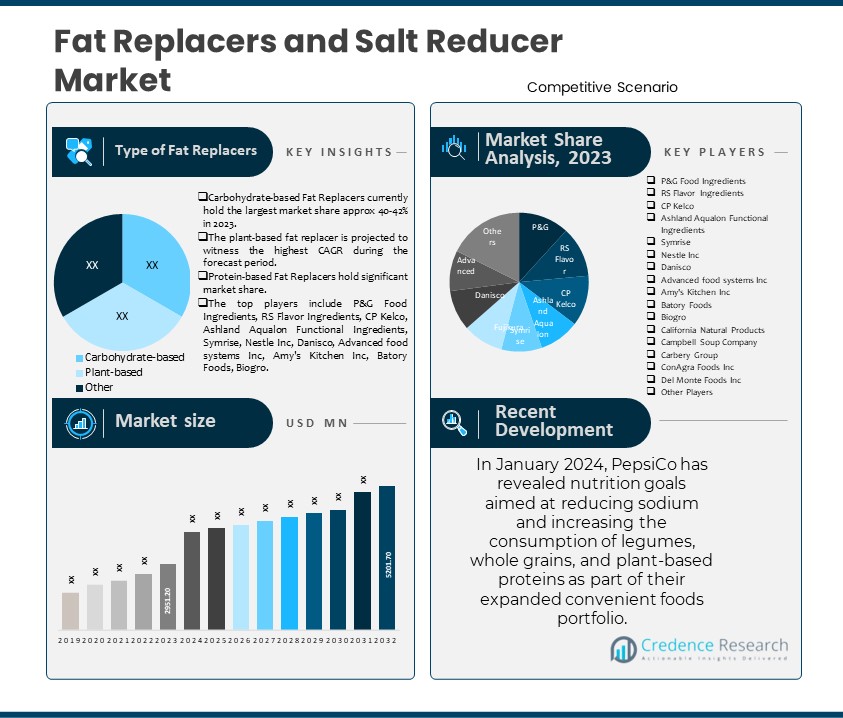
- The global Fat Replacers and Salt Reducer Market reached a valuation of USD 2951.2 Million in 2023 and is anticipated to surge to USD 5201.7 Million by 2032, exhibiting a robust CAGR of 6.50% from 2024 to 2032.
- Among the key segments, Carbohydrate-based Fat Replacers emerged as the market leader by type, holding approximately 40-42% of the total market share in 2023. However, Plant-based Fat Replacers are projected to witness the highest growth rate during the forecast period.
- Bakery and Confectionery currently hold the largest market share approx 30-35% in 2023, while Snacks and Ready-to-Eat Foods is projected to witness the highest CAGR during the forecast period. This growth can be attributed to the growing demand for convenient and nutritious foods, and the expanding middle class a changing lifestyle preferences as well.
- Texture Enhancement currently hold the largest market share approx 30-38% in 2023 owing to texture-enhancing fat substitutes are used to maintain desirable textures in foods, especially baked goods, desserts and sauces.
- Athletes and Fitness Enthusiasts is projected to witness the highest CAGR during the forecast period.
- North America accounts for the largest share of the market in 2023, followed by Europe and Asia Pacific with a collective share of just under 55%.
- The rise in demand for fat replacers and salt reducers, driven by health consciousness among consumers, government regulations promoting healthier diets, and increasing incidence of lifestyle-related diseases, fuels the growth of the Fat Replacers and Salt Reducer Market.
- Key opportunities in the market include significant growth potential in the bakery and confectionery sector, increased adoption across various food applications and processing companies, and continuous advancements in technology, fostering market expansion.
Executive Summary
Market Definition
Fat replacement and salt reduction are products or ingredients used in foods to reduce the amount of fat and sodium while preserving the flavor, texture and and overall quality of the product. The market for these ingredients has been growing in recent years due to increasing consumer demand for healthier food options and stricter regulations on food manufacturers to reduce the levels of saturated fats and added sugars in their products.
Replacement fats can be classified into different categories, including carbohydrate, protein, and fiber. Carbohydrate-based fat substitutes include polydextrose, maltodextrin and gum arabic, commonly used in baked goods, desserts and sauces Protein-containing fat substitutes te as whey protein, soy protein and often dairy products, meat products, baked goods are used. Fiber-based fat substitutes such as psyllium husk and chitosan are commonly found in snacks, cereals, and baked goods. But salt-reducing supplements are designed to reduce the amount of sodium in foods without affecting the rach. These can be achieved by using potassium salts, natural spices and flavorings. Some common desalination agents include potassium chloride, magnesium sulfate, and yeast extract.
Market Overview
The Fat Replacers and Salt Reducer Market has demonstrated consistent expansion and is projected to maintain a robust CAGR of 6.50% from 2024 to 2032. Valued at USD 2951.2 million in 2023, this market is expected to reach USD 5201.7 million by 2032.
Carbohydrate-based Fat Replacers dominated the market landscape by type, comprising approximately 40-42% of the total market share in 2023. However, Plant-based Fat Replacers are anticipated to observe the highest CAGR over the forecast period.
Bakery and Confectionery currently hold the largest market share approx 30-35% in 2023. However, Snacks and Ready-to-Eat Foods is projected to witness the highest CAGR during the forecast period.
Texture Enhancement currently hold the largest market share approx 30-38% in 2023. However, Flavor Enhancement is projected to witness the highest CAGR during the forecast period. Flavor Enhancement are used to enhance the flavor of foods, especially in savory products such as soups, sauces and condiments.
Health-conscious Consumers emerged as the leading consumer segment in 2023, with a market share of about 35-42%, primarily due to the increasing demand for healthier food options without compromising taste and texture.
North America constituted a significant portion of the market in 2023, followed by Europe and Asia Pacific, collectively representing just under 55% of the market share.
The rise in demand for fat replacers and salt reducers is driven by factors such as health consciousness among consumers, government regulations promoting healthier diets, and increasing incidence of lifestyle-related diseases, particularly in regions like North America and Europe.
Continuous advancements in technology, including improved formulations and processing techniques, are further driving the demand for fat replacers and salt reducers, especially in industries requiring healthier food product offerings.
Segmentation by Type of Fat
- Carbohydrate-based Fat Replacers currently hold the largest market share approx 40-42% in 2023. Carbohydrate-based fat replacements are widely used in breads, desserts and sauces, are relatively inexpensive compared to other types of fat substitutes.
- The plant-based fat replacer is projected to witness the highest CAGR during the forecast period. This growth can be attributed to the growing demand for sustainable natural products and the increasing awareness of the health benefits associated with a plant-based diet.
Segmentation by Application
- Bakery and Confectionery currently hold the largest market share approx 30-35% in 2023. Fat replacers are widely used in baked goods, such as bread, cakes, cookies, and pastries, as well as in confectionery products like chocolates and candies.
- Snacks and Ready-to-Eat Foods is projected to witness the highest CAGR during the forecast period. This growth can be attributed to the growing demand for convenient and nutritious foods, and the expanding middle class a changing lifestyle preferences as well.
Segmentation by Functionality
- Texture Enhancement currently hold the largest market share approx 30-38% in 2023. Texture-enhancing fat substitutes are used to maintain desirable textures in foods, especially baked goods, desserts and sauces.
- Flavor Enhancement is projected to witness the highest CAGR during the forecast period. Flavor Enhancement are used to enhance the flavor of foods, especially in savory products such as soups, sauces and condiments.
Segmentation by Consumer
- Health-conscious Consumers hold the largest market share approx 35-42% in 2023. Health-conscious consumers are looking for ways to reduce their intake of unhealthy fats and sugars, and fat substitutes offer a solution that provides the foods they love without compromising their health goals.
- Athletes and Fitness Enthusiasts is projected to witness the highest CAGR during the forecast period. Athletes and fitness enthusiasts are looking for ways to improve performance and recovery, and fat replacement supplements offer a solution that can help them achieve their goals. Fat substitutes can be used in sports drinks, energy drinks, and other energy boosters.
Segmentation by Region
- North America held significant share around 35-40% of the market in 2023. Obesity is the most prevalent of related health issues in the US. and Canada are driving demand for healthy alternatives to traditional fats and sugars.
- Asia Pacific and Europe collectively account for just under 55% share in 2023, with Europe holding over 20% share in the same year.
- The rest of the world, including Latin America, the Middle East, and Africa, supplies the remaining demand for Fat Replacers and Salt Reducer.
Growing health consciousness, rising incidence of chronic diseases, increasing availability of low-fat and low-sodium foods, as well as key players in the industry, are also contributing to market growth.
The North America region held the largest market share of the Fat Replacers and Salt Reducer market. This can be attributed to several factors, such as the growing awareness in this region on the negative health effects of excess fat and sodium intake. The increasing prevalence of obesity, diabetes, and heart diseases in the region has led to a surge in demand for healthier alternatives to traditional fats and salts. Moreover, key players in the industry, such as Kraft Heinz, PepsiCo, General Mills, etc. have contributed significantly to the growth of the market. These companies offer innovative products and technologies catering to the evolving needs of healthcare handle results customers. For instance, in January 2024, PepsiCo has revealed nutrition goals aimed at reducing sodium and increasing the consumption of legumes, whole grains, and plant-based proteins as part of their expanded convenient foods portfolio. These commitments are part of PepsiCo Positive (pep+), the company's initiative towards sustainable food production, which includes transitioning to regenerative practices and striving for net-zero emissions by 2040, among other climate objectives. PepsiCo’s move to reduce sodium, increase the intake of fruits, whole grains and plant-based protein in their products could lead to market demand for fat substitutes and reduced salt. Another important factor driving the growth of the salt substitute fat reduction market in North America is the supportive regulatory environment. The Food and Drug Administration (FDA) has implemented stricter regulations on food manufacturers, encouraging them to develop healthier products with lower fat and sodium content . Fat replacement and salt reduction are widespread in product categories such as snacks and beverages.
Asia Pacific is the prominent share in Fat Replacers and Salt Reducer Market. The region has a large and growing population, with many cusumers in countries such as China and India. This leads to greater demand for foods, including those that are healthy and low in fat and sodium. Alongwith consumers in the Asia-Pacific region are increasingly aware of the importance of a healthy diet and the negative effects of excess fat and sodium intake and this has led to a demand for healthier food options , including the use of fat replacement and salt reduction have increased. However, Asia Pacific is home to many leading food and beverage manufacturers, who are constantly looking for ways to improve the health of their products, this has led to innovation and product development in fat replacers and salt reduction have increased, with many companies introducing new and improved products that cater to the growing demand for healthier food options. For instance, in March 2023, Cargill and CUBIQ FOODS have partnered to develop a cutting-edge fat technology that enables plant-based food producers to create products with improved taste, texture, and nutritional profiles. This collaboration will facilitate the rapid development of innovative plant-based solutions that meet consumer demands for healthier, more sustainable options. Moreover, various government policies and regulations in Asia-Pacific region also support the growth of salt replacement fat reduction market. For instance, the Chinese government has implemented programs to reduce the amount of salt and oil used in cooking, while the Indian government has launched programs to promote the use of healthy oils and reduced saturated fat intake.
Key Highlights of the Report
The Fat Replacers and Salt Reducer Market is segmented by Type of Fat Replacers, Application, Functionality, Consumer, and Region. The growing demand for fat replacers and salt reducers is driven by factors such as increasing health consciousness among consumers, regulatory push for healthier food options, and the need for reducing saturated fats and sodium content in various food products.
Carbohydrate-based Fat Replacers dominate the segment, serving crucial roles in reducing fat content in baked goods, desserts, and sauces due to their cost-effectiveness and wide applicability. Texture Enhancement lead the market owing to texture-enhancing fat substitutes are used to maintain desirable textures in foods, especially baked goods, desserts and sauces.
Health-conscious Consumers hold a significant market share in the consumer segment, driving the demand for fat replacers and salt reducers in producing foods that align with healthier dietary choices. The snacks and ready-to-eat foods application segment is witnessing rapid growth, fueled by the increasing demand for convenient yet nutritious food options.
North America held the largest share of the fat replacers and salt reducer market, supported by stringent regulatory measures promoting healthier eating habits and the presence of key players such as Kraft Heinz and PepsiCo. These companies focus on product innovation and strategic partnerships to maintain their market dominance and competitiveness..
What Are The Main Drivers Of The Global Fat Replacers and Salt Reducer Market?
The global Fat Replacers and Salt Reducer market ising health consciousness among consumers, government regulations promoting healthy eating and lifestyle related diseases such as obesity and hypertension are propelling the market growth. Adoption of various strategies among market players further boost the market. Innovations in food processing technology and shift in consumer preference towards low-fat and low-sodium foods are also contributing to the expansion of the market. Manufacturers are innovating to create products that mimic the taste and texture of traditional ingredients, reducing fat and salt. Additionally, the growing food industry in food processing technology is fueling market expansion as companies strive to meet consumer demand for healthier products.
What Are The Major Challenges Faced By The Global Fat Replacers and Salt Reducer Market?
The global Fat Replacers and Salt Reducer market faces challenges such as achieving desired taste and texture in fat-free and salt-free products without compromising sensory properties. Regulatory constraints and labeling requirements add complexity, requiring close compliance and transparency. Moreover, cost considerations and limitations in the scale of products may prevent the widespread adoption of fat substitution and salt reduction in the food industry.
What Are The Growth Opportunities In The Global Fat Replacers and Salt Reducer Market?
The global Fat Replacers and Salt Reducer market presents growth opportunities include innovations in industrial ingredients offer a more effective natural alternative, catering to growing food preferences. Expansion into emerging markets, where health concerns are growing in relation to economic growth, offers untapped potential. Collaboration between food processing and research institutes can lead to success in product development and manufacturing. In addition, strategic marketing efforts emphasizing the health benefits of low-fat and low-salt products can capitalize on changes in consumer behavior, stimulating market growth again.
Market Drivers
The global Fat Replacers and Salt Reducer market is driven by several factors. The following are the key drivers of the global Fat Replacers and Salt Reducer market:
Adoption Of Various Strategies Among Market Players
The major companies serving the global Fat Replacers and Salt Reducer Market are P&G Food Ingredients, Synthite, RS Flavor Ingredients, CP Kelco, Ashland Aqualon Functional Ingredients, Symrise, Nestle Inc, Danisco, Advanced food systems Inc, Amy's Kitchen Inc, Batory Foods, among others. The market players are considerably contributing to the market growth by the adoption of various strategies including mergers & acquisitions, collaborations, funding, and new product launches, to stay competitive in the market. For instance, in June 2023, Synthite has collaborated with US-based PMEDS and the Indian Institute of Science (IISC) to introduce a plant-based dairy alternative. This collaboration led to the establishment of Pfoods Pvt. Ltd, a food-tech joint venture, showcasing Synthite's commitment to innovation and the development of healthier food alternatives.
Market Restraints
The global Fat Replacers and Salt Reducer market faces some challenges that may hinder its growth. These include the following:
Regulatory Constraints And Labeling Requirements Restraints The Market
Regulatory restrictions and labeling requirements pose challenges to the fat replacement salt reduction market. Stricter regulations on food additives and labeling requirements can restrict the use of certain products and make it difficult for manufacturers to introduce new products. Furthermore, inconsistent regulations across sectors can lead to confusion and additional costs for manufacturers, making it difficult for them to comply with local standards. This can hinder the growth of the market and limit the availability of fat replacers and salt reducers in certain regions.
Opportunities
The global Fat Replacers and Salt Reducer market offers significant growth opportunities. These include the following:
Emergence Of Plant-Based Fat Alternatives Presents Opportunities
The emergence of plant-based fat alternatives presents opportunities for growth in the Fat Replacers and Salt Reducer Market. The use of plant-based fats can reduce saturated fats and calories in foods while improving flavor and taste. This trend is in line with consumers’ desire for healthy and sustainable food options. Companies can take advantage of this trend by replacing fats with vegetables and reduced salt to meet the growing demand for healthier food choices. For instance, in March 2023, Shiru, a California-based startup, has developed plant-based fats that can replace saturated animal or tropical fats in various applications. The company has identified plant-based proteins that can be combined with healthy oils to create structured fats that mimic the properties of animal fat. This innovation has the potential to revolutionize the food industry and provide consumers with healthier and more sustainable options. This type of innovations could contribute to growth in the fat replacement and salt reduction markets, as consumers increasingly demand healthier and more sustainable foods.
Competitive Landscape
Key Players
The global Fat Replacers and Salt Reducer market is highly competitive, with several key players. Some of the major players in the market and their market share are as follows:
- P&G Food Ingredients
- RS Flavor Ingredients
- CP Kelco
- Ashland Aqualon Functional Ingredients
- Symrise
- Nestle Inc
- Danisco
- Advanced food systems Inc
- Amy's Kitchen Inc
- Batory Foods
- Biogro
- California Natural Products
- Campbell Soup Company
- Carbery Group
- ConAgra Foods Inc
- Del Monte Foods Inc
- DSM Food Specialties
- FMC BioPolymer
- Forum Products Ltd
- Frito-Lay Inc
- General Mills Inc
- H. J. Heinz Co
- Hormel Foods Corp
- J. Rettenmaier& Sohne
- Kellogg Company
- Kraft Foods Inc
- Lesaffre Yeast Corp.
- Levapan SA
- National Starch Food Innovation Group
- Novotaste
- PGP International, Inc.,
- Savoury Systems International
- The Hain Celestial Group Inc
- TIC Gums, Inc.
- Ulrick & Short Ltd.
- Unilever Inc.
- Z-Trim Holdings, Inc
- Others
These organizations prioritize product innovation, distribution channel expansion, and mergers and acquisitions to stay competitive.
The global Fat Replacers and Salt Reducer market's key players continually seek to stay ahead by offering new products and developments.
In February 2024, FiberGel Technologies has launched a new line of fat replacers, Z-Trim, made from non-GM oat and soy ingredients. The product is designed to reduce calories and increase healthy insoluble fiber in various food products without affecting taste. Z-Trim is considered a natural, zero-calorie fat replacement and has GRAS status.
In January 2024, PepsiCo has revealed nutrition goals aimed at reducing sodium and increasing the consumption of legumes, whole grains, and plant-based proteins as part of their expanded convenient foods portfolio.
Summary of Key Findings
- The Fat Replacers and Salt Reducer Market is undergoing significant growth, driven by the increasing demand for healthier food options and stricter regulations on food manufacturers to reduce fat and sodium content. Key drivers contributing to this growth include growing health consciousness among consumers, rising incidence of chronic diseases, and the availability of low-fat and low-sodium foods.
- Market segmentation within the Fat Replacers and Salt Reducer Market includes factors such as type of fat replacers, application, functionality, consumer, and region, reflecting the diverse needs and preferences within the industry.
- Carbohydrate-based Fat Replacers lead the market segment, offering a cost-effective solution for reducing fat content in various food products such as baked goods and sauces. The plant-based fat replacers segment is projected to witness the highest growth rate, driven by the increasing demand for sustainable and natural products.
- Bakery and confectionery applications hold the largest market share, fueled by the widespread use of fat replacers in products like bread, cakes, and chocolates. However, the snacks and ready-to-eat foods segment is expected to experience significant growth due to the demand for convenient and nutritious food options.
- Texture enhancement is the dominant functionality segment, used to maintain desirable textures in foods like desserts and sauces. Flavor enhancement is projected to witness the highest growth rate, driven by the need to enhance the taste of savory products such as soups and condiments.
- Health-conscious consumers represent the largest consumer segment, driving the demand for fat replacers and salt reducers in producing healthier food options. Athletes and fitness enthusiasts are expected to witness significant growth, seeking products to support their performance and recovery goals.
- Geographically, North America holds the largest market share, driven by strict regulatory measures promoting healthier food options and the presence of key industry players. Asia Pacific and Europe collectively account for a significant share of the market, with Europe experiencing growth due to increasing demand for sustainable food options and advancements in food processing technology.
Future Outlook
- The Fat Replacers and Salt Reducer Market presents promising growth prospects, particularly within industries like food production, healthcare, and dietary supplements, fueled by the increasing demand for healthier food options and stricter regulations on fat and sodium content. However, the market may face challenges such as stiff competition, adapting to new technologies, and significant initial investment costs.
- Strategies for maintaining competitiveness in the Fat Replacers and Salt Reducer Market include continuous product innovation, strategic partnerships, securing financial backing, and introducing new product lines. Industry participants need to prioritize meeting consumer demands, enhancing product effectiveness, and exploring opportunities in emerging markets to ensure sustained growth amid the evolving market landscape.
How CXOs Can Benefit from the Credence Research Fat Replacers and Salt Reducer Networks Market Report
The Credence Research Fat Replacers and Salt Reducer Networks Market Report provides CXOs with a comprehensive overview of the market, including:
- Market size and growth forecast: The report provides detailed estimates of the global Fat Replacers and Salt Reducer networks market size, segmented by type of fat replacers, application, functionality, consumer, and region. It also includes forecasts for the market through 2032, based on key trends and drivers.
- Market segmentation: The report segments the Fat Replacers and Salt Reducer networks market by type of fat replacers, application, functionality, consumer, and region. The increasing demand for advanced solutions is driven. This segmentation provides CXOs with a granular understanding of the market and the opportunities in each segment.
- Competitive landscape: The report profiles the key players in the Fat Replacers and Salt Reducer networks market and provides insights into their strategies, product offerings, and financial performance. This information can help CXOs to identify and assess their competition.
- Key trends and drivers: The report identifies and analyzes the key trends and drivers that are shaping the Fat Replacers and Salt Reducer networks market. This information can help CXOs to make informed decisions about their investments and strategies.
CXOs can use the insights from the Credence Research Fat Replacers and Salt Reducer Networks Market Report to:
- Identify growth opportunities: The report can help CXOs to identify new growth opportunities in the Fat Replacers and Salt Reducer networks market. For example, the report identifies the growing demand for Fat Replacers and Salt Reducer networks from cloud computing providers and telecom companies as a key opportunity.
- Make informed investment decisions: The report can help CXOs to make informed investment decisions about Fat Replacers and Salt Reducer networks. For example, the report provides insights into the key factors to consider when evaluating Fat Replacers and Salt Reducer providers and selecting Fat Replacers and Salt Reducer solutions.
- Develop competitive strategies: The report can help CXOs to develop competitive strategies for their Fat Replacers and Salt Reducer networks businesses. For example, the report identifies the key strategies that Fat Replacers and Salt Reducer providers are using to differentiate themselves from their competitors.
- Track market developments: The report can help CXOs to track market developments and stay ahead of the curve. For example, the report provides insights into the latest trends and innovations in the Fat Replacers and Salt Reducer networks market.
Overall, the Credence Research Fat Replacers and Salt Reducer Networks Market Report is a valuable resource for CXOs who are looking to gain a deeper understanding of the market and identify opportunities for growth.
Segmentation
- Type of Fat Replacers:
- Carbohydrate-based Fat Replacers
- Protein-based Fat Replacers
- Plant-based Fat Replacers
- Synthetic Fat Replacers
- Application Segmentation:
- Dairy and Dairy Alternatives
- Bakery and Confectionery
- Processed Meat and Meat Alternatives
- Snacks and Ready-to-Eat Foods
- Sauces, Dressings, and Condiments
- Market Segmentation by Functionality:
- Texture Enhancement
- Emulsification
- Moisture Retention
- Flavor Enhancement
- Nutritional Enrichment
- Consumer Segmentation:
- Health-conscious Consumers
- Allergy-sensitive Consumers
- Athletes and Fitness Enthusiasts
- Children and Families
- Aging Population
- By Region
- North America
- The U.S.
- Canada
- Mexico
- Europe
- Germany
- France
- The U.K.
- Italy
- Spain
- Rest of Europe
- Asia Pacific
- China
- Japan
- India
- South Korea
- South-east Asia
- Rest of Asia Pacific
- Latin America
- Brazil
- Argentina
- Rest of Latin America
- Middle East & Africa
- GCC Countries
- South Africa
- Rest of Middle East and Africa
- North America

Request a Free Sample
Fill in your details and we'll send you a free sample report.
- Sample data tables & charts
- Research methodology
Market Dynamics
Health Consciousness and Lifestyle Diseases
Increasing awareness of the health risks associated with high fat and sodium intake, such as obesity, hypertension, and cardiovascular diseases, is driving consumers and manufacturers to adopt fat replacers and salt reducers in food products.
Regulatory Push for Healthier Foods
Government regulations and guidelines in major markets like North America and Europe are mandating lower levels of saturated fats and sodium in processed foods, compelling food manufacturers to reformulate products using fat replacers and salt reducers.
Technological Advancements in Food Processing
Continuous innovation in ingredient formulation and processing technologies enables the development of fat and salt substitutes that closely mimic the taste and texture of traditional ingredients, making them more acceptable to consumers and expanding their use across food categories.
Growth of Convenience and Functional Foods
The rising demand for convenient, ready-to-eat, and functional foods - especially among urban populations and the expanding middle class - fuels the adoption of fat replacers and salt reducers to meet consumer expectations for healthier yet tasty products.
Expansion of Plant-based and Clean Label Trends
Consumer preference for plant-based, natural, and clean label ingredients is accelerating the growth of plant-based fat replacers and natural salt reducers, as food companies seek to align with sustainability and transparency trends.
Need a Custom Version of This Report?
Tailor the scope, geography, or segments to your exact requirements.
- Custom geography or segment scope
- Direct access to our analyst team
Frequently Asked Questions
What is the current size of the global Fat Replacers and Salt Reducer market?
What is the expected growth rate of the Fat Replacers and Salt Reducer market between 2024 and 2032?
Which segment is leading the market share in terms of Type of Fat Replacers?
Which Application Segments governs the demand for Fat Replacers and Salt Reducers in the world?
Who are the major players in the global Fat Replacers and Salt Reducer market?
Table of Content
Chapter 1 Market Segmentation
- 1.1 Segmentation Framework
- 1.1.1 Product and Service Classification
- 1.1.2 Application and End-Use Classification
- 1.1.3 Technology and Solution Classification
- 1.1.4 Customer and Distribution Channel Classification
- 1.1.5 Geographic Segmentation
- 1.1.6 Market Segment Definitions and Boundaries
- 1.2 By Consumer
- 1.2.1 Health-conscious Consumers
- 1.2.2 Allergy-sensitive Consumers
- 1.2.3 Athletes and Fitness Enthusiasts
- 1.2.4 Children and Families
- 1.2.5 Aging Population
- 1.3 By Application
- 1.3.1 Dairy and Dairy Alternatives
- 1.3.2 Bakery and Confectionery
- 1.3.3 Processed Meat and Meat Alternatives
- 1.3.4 Snacks and Ready-to-Eat Foods
- 1.3.5 Sauces, Dressings, and Condiments
- 1.4 By Functionality
- 1.4.1 Texture Enhancement
- 1.4.2 Emulsification
- 1.4.3 Moisture Retention
- 1.4.4 Flavor Enhancement
- 1.4.5 Nutritional Enrichment
- 1.5 By Type of Fat Replacers
- 1.5.1 Carbohydrate-based Fat Replacers
- 1.5.2 Protein-based Fat Replacers
- 1.5.3 Plant-based Fat Replacers
- 1.5.4 Synthetic Fat Replacers
Chapter 2 Introduction
- 2.1 Report Objectives and Scope
- 2.2 Product Definition and Industry Terminology
- 2.3 Market Inclusions and Exclusions
- 2.4 Research Process
- 2.4.1 Primary Research and Expert Interviews
- 2.4.2 Secondary Research and Source Review
- 2.4.3 Top-Down and Bottom-Up Estimation
- 2.4.4 Data Triangulation and Verification
- 2.5 Market Size Measurement Basis
- 2.5.1 2023: USD 2951.2 Million → 2032: USD 5,201.7 Million
- 2.6 Historical and Forecast Reference Periods
- 2.6.1 Base Year: 2023
- 2.6.2 Forecast Period: 2023-2032
- 2.7 Research Assumptions and Limitations
Chapter 3 Executive Summary
- 3.1 Market Snapshot and Key Findings
- 3.2 Base-Year Market Size, 2023
- 3.3 Forecast Market Size, 2032
- 3.4 Revenue and Volume Growth Outlook
- 3.5 Key Demand and Supply Indicators
- 3.6 Leading Market Segments
- 3.7 Fastest-Growing Market Opportunities
- 3.8 Regional Performance Highlights
- 3.9 Technology and Industry Transformation
- 3.10 Competitive Landscape Summary
- 3.11 Analyst View and Strategic Implications
Chapter 4 Global Fat Replacers and Salt Reducer Market Trends and Developments
- 4.1 Historical Industry Development
- 4.2 Recent Market Trends and Developments
- 4.3 Demand and Customer Behavior Trends
- 4.4 Technology and Product Innovation
- 4.5 Artificial Intelligence, Automation and Digitalization
- 4.6 Local Manufacturing and Supply Chain Realignment
- 4.7 Industry Partnerships, Mergers and Acquisitions
- 4.8 Sustainability and Circular Economy Developments
- 4.9 Government and Private Sector Investment Trends
- 4.10 Emerging Business Models and Commercialization
- 4.11 Industry Developments and Announcements
Chapter 5 Global Fat Replacers and Salt Reducer Market Production, Supply and Demand Analysis
- 5.1 Demand Trend and Consumption Analysis
- 5.2 Demand Forecast, 2023-2032
- 5.3 Production and Output Trend
- 5.4 Production and Output Forecast, 2023-2032
- 5.5 Installed Capacity and Capacity Utilization
- 5.6 Company-Wise Production Plants and Statistics
- 5.6.1 Installed Production Capacity
- 5.6.2 Actual Production
- 5.6.3 Planned Capacity and Expansion Targets
- 5.7 Supply Chain Structure and Procurement Trends
- 5.8 Supply-Demand Gap and Bottlenecks
- 5.9 Import Dependence and Sourcing Structure
- 5.10 Contract Manufacturing and Outsourcing
- 5.11 Regional Supply and Demand Concentration
Chapter 6 Global Fat Replacers and Salt Reducer Market Pricing Analysis
- 6.1 Pricing Structure and Measurement
- 6.2 Historical Pricing Trends
- 6.3 Pricing Outlook, 2023-2032
- 6.4 Average Selling Price and Unit Economics
- 6.5 Pricing by Product and Market Segment
- 6.6 Geographic Pricing Differences
- 6.7 Key Input, Energy, Labor and Logistics Costs
- 6.8 Contract Pricing and Purchasing Models
- 6.9 Pricing Sensitivity and Competitive Positioning
- 6.10 Price, Margin and Profitability Implications
Chapter 7 Global Fat Replacers and Salt Reducer Market Dynamics
- 7.1 Market Growth Drivers
- 7.1.1 Demand-Side Drivers
- 7.1.2 Technology and Innovation Drivers
- 7.1.3 Infrastructure and Investment Drivers
- 7.1.4 Regulatory and Policy Drivers
- 7.2 Market Restraints
- 7.2.1 Cost and Affordability Constraints
- 7.2.2 Technology and Adoption Barriers
- 7.2.3 Supply Chain and Operational Constraints
- 7.3 Market Challenges
- 7.3.1 Competitive Pressure and Margin Erosion
- 7.3.2 Skills, Infrastructure and Implementation Gaps
- 7.4 Emerging Market Opportunities
- 7.5 Market Dynamics Impact and Time-Horizon Assessment
Chapter 8 Global Fat Replacers and Salt Reducer Value Chain Analysis
- 8.1 Industry Value Chain Overview
- 8.2 Upstream Suppliers and Critical Inputs
- 8.3 Technology and Component Providers
- 8.4 Manufacturing or Service Delivery
- 8.5 Distribution, Channel Partners and Integrators
- 8.6 Downstream Applications and End Users
- 8.7 Value Addition and Profit Pools
- 8.8 Vertical Integration and Outsourcing
- 8.9 Supplier Concentration and Risk
- 8.10 Supply Chain Localization and Resilience
Chapter 9 Global Fat Replacers and Salt Reducer Market Regulations and Policies
- 9.1 Relevant Laws, Standards and Compliance Frameworks
- 9.2 Product, Service, Safety and Quality Requirements
- 9.3 Government Policies, Incentives and Subsidies
- 9.4 Imports, Exports and Trade Barriers
- 9.5 Public Procurement and Local Content Requirements
- 9.6 Environmental and Sustainability Compliance
- 9.7 Upcoming Policy Changes and Market Implications
Chapter 10 Global Fat Replacers and Salt Reducer Market Hotspots and Opportunities
- 10.1 Market Opportunity Mapping and Growth Hotspots
- 10.2 High-Growth Applications and Customer Groups
- 10.3 Underserved Markets and White-Space Opportunities
- 10.4 Emerging Technology and Product Opportunities
- 10.5 New Capacity and Investment Hotspots
- 10.6 Market Entry and Expansion Opportunities
- 10.7 Distribution and Partnership Opportunities
- 10.8 Near-Term and Long-Term Commercial Potential
- 10.9 Opportunity Attractiveness and Execution Risks
Chapter 11 Global Fat Replacers and Salt Reducer Market Outlook, 2023-2032
- 11.1 Market Size and Analysis
- 11.1.1 Revenue (Market Measurement: 2023: USD 2951.2 Million → 2032: USD 5,201.7 Million)
- 11.1.2 Market Volume and Quantity Sold
- 11.1.3 Historical Market Size
- 11.1.4 Base-Year Market Size, 2023
- 11.2 Market Forecast, 2023-2032
- 11.2.1 Revenue Forecast to 2032
- 11.2.2 Volume Forecast to 2032
- 11.2.3 CAGR and Year-on-Year Growth
- 11.2.4 Incremental Revenue Opportunity
- 11.3 Forecast Assumptions and Scenario Analysis
- 11.3.1 Base-Case Forecast
- 11.3.2 Optimistic and Conservative Scenarios
- 11.3.3 Technology, Pricing and Policy Sensitivities
- 11.4 Market Attractiveness and Growth Outlook
Chapter 12 Global Fat Replacers and Salt Reducer Market Segmentation and Outlook
- 12.1 Segmentation Summary and Market Shares, 2023
- 12.2 Largest and Fastest-Growing Segments
- 12.3 By Consumer - Market Size and Forecast, 2023-2032
- 12.3.1 Segment Definition and Scope
- 12.3.2 Historical Market Size
- 12.3.3 Revenue Forecast, 2023-2032
- 12.3.4 Volume Forecast, 2023-2032
- 12.3.5 Base-Year Market Share, 2023
- 12.3.6 Segment CAGR and Growth Drivers
- 12.3.7 Subsegment Market Size and Forecast
- 12.3.7.1 Health-conscious Consumers
- 12.3.7.2 Allergy-sensitive Consumers
- 12.3.7.3 Athletes and Fitness Enthusiasts
- 12.3.7.4 Children and Families
- 12.3.7.5 Aging Population
- 12.3.8 Subsegment Pricing and Adoption Trends
- 12.3.9 Leading Suppliers and Competition
- 12.3.10 Regional Demand and Opportunities
- 12.4 By Application - Market Size and Forecast, 2023-2032
- 12.4.1 Segment Definition and Scope
- 12.4.2 Historical Market Size
- 12.4.3 Revenue Forecast, 2023-2032
- 12.4.4 Volume Forecast, 2023-2032
- 12.4.5 Base-Year Market Share, 2023
- 12.4.6 Segment CAGR and Growth Drivers
- 12.4.7 Subsegment Market Size and Forecast
- 12.4.7.1 Dairy and Dairy Alternatives
- 12.4.7.2 Bakery and Confectionery
- 12.4.7.3 Processed Meat and Meat Alternatives
- 12.4.7.4 Snacks and Ready-to-Eat Foods
- 12.4.7.5 Sauces, Dressings, and Condiments
- 12.4.8 Subsegment Pricing and Adoption Trends
- 12.4.9 Leading Suppliers and Competition
- 12.4.10 Regional Demand and Opportunities
- 12.5 By Functionality - Market Size and Forecast, 2023-2032
- 12.5.1 Segment Definition and Scope
- 12.5.2 Historical Market Size
- 12.5.3 Revenue Forecast, 2023-2032
- 12.5.4 Volume Forecast, 2023-2032
- 12.5.5 Base-Year Market Share, 2023
- 12.5.6 Segment CAGR and Growth Drivers
- 12.5.7 Subsegment Market Size and Forecast
- 12.5.7.1 Texture Enhancement
- 12.5.7.2 Emulsification
- 12.5.7.3 Moisture Retention
- 12.5.7.4 Flavor Enhancement
- 12.5.7.5 Nutritional Enrichment
- 12.5.8 Subsegment Pricing and Adoption Trends
- 12.5.9 Leading Suppliers and Competition
- 12.5.10 Regional Demand and Opportunities
- 12.6 By Type of Fat Replacers - Market Size and Forecast, 2023-2032
- 12.6.1 Segment Definition and Scope
- 12.6.2 Historical Market Size
- 12.6.3 Revenue Forecast, 2023-2032
- 12.6.4 Volume Forecast, 2023-2032
- 12.6.5 Base-Year Market Share, 2023
- 12.6.6 Segment CAGR and Growth Drivers
- 12.6.7 Subsegment Market Size and Forecast
- 12.6.7.1 Carbohydrate-based Fat Replacers
- 12.6.7.2 Protein-based Fat Replacers
- 12.6.7.3 Plant-based Fat Replacers
- 12.6.7.4 Synthetic Fat Replacers
- 12.6.8 Subsegment Pricing and Adoption Trends
- 12.6.9 Leading Suppliers and Competition
- 12.6.10 Regional Demand and Opportunities
- 12.7 Segment Growth Comparison
- 12.8 Segment Attractiveness and Priority Matrix
Chapter 13 Global Fat Replacers and Salt Reducer End-Use and Application Market Outlook
- 13.1 End-Use Industry and Customer Demand Structure
- 13.2 Leading Applications and Customer Groups
- 13.3 End-Use Market Size, Share and Forecast
- 13.4 Major End-Use Industry Deep Dives
- 13.4.1 Customer Requirements and Use Cases
- 13.4.2 Demand and Replacement Cycles
- 13.4.3 Technical and Regulatory Considerations
- 13.4.4 Purchasing and Procurement Models
- 13.4.5 Leading Vendors and Distribution Channels
- 13.4.6 Forecast and Commercial Opportunities
- 13.5 Emerging Applications and Cross-Segment Demand
- 13.6 End-Use Industry Investment Priorities
Chapter 14 Global Fat Replacers and Salt Reducer Geographic Market Outlook, 2023-2032
- 14.1 Regional Market Size and Share, 2023
- 14.2 Regional Market Forecast, 2023-2032
- 14.3 Regional Pricing, Production and Demand Differences
- 14.4 North America
- 14.4.1 United States
- 14.4.2 Canada
- 14.4.3 Mexico
- 14.5 Europe
- 14.5.1 Germany
- 14.5.2 France
- 14.5.3 Italy
- 14.5.4 United Kingdom
- 14.5.5 Spain
- 14.5.6 Poland
- 14.5.7 Russia
- 14.5.8 Netherlands
- 14.5.9 Belgium
- 14.5.10 Sweden
- 14.5.11 Denmark
- 14.5.12 Norway
- 14.5.13 Rest of Europe
- 14.6 Asia Pacific
- 14.6.1 China
- 14.6.2 India
- 14.6.3 Japan
- 14.6.4 South Korea
- 14.6.5 Thailand
- 14.6.6 Indonesia
- 14.6.7 Vietnam
- 14.6.8 Malaysia
- 14.6.9 Australia
- 14.6.10 Rest of Asia Pacific
- 14.7 Latin America
- 14.7.1 Brazil
- 14.7.2 Argentina
- 14.7.3 Colombia
- 14.7.4 Chile
- 14.7.5 Rest of Latin America
- 14.8 Middle East
- 14.8.1 Saudi Arabia
- 14.8.2 United Arab Emirates
- 14.8.3 Turkey
- 14.8.4 Israel
- 14.8.5 Iran
- 14.8.6 Rest of the Middle East
- 14.9 Africa
- 14.9.1 South Africa
- 14.9.2 Egypt
- 14.9.3 Nigeria
- 14.9.4 Morocco
- 14.9.5 Rest of Africa
- 14.10 Regional Investment, Policy and Supply Chain Differences
- 14.11 Regional Competitive Landscape
- 14.12 Geographic Growth Hotspots
Chapter 15 Global Fat Replacers and Salt Reducer Technology, Innovation and Sustainability Outlook
- 15.1 Technology Landscape and Maturity
- 15.2 Product, Process and Service Innovation
- 15.3 AI, Automation and Digital Tools in the Industry
- 15.4 Technology Adoption and Performance Benchmarking
- 15.5 Innovation Pipeline and R&D Investment
- 15.6 Patent and Intellectual Property Trends
- 15.7 Energy Efficiency and Resource Management
- 15.8 Sustainability, Recycling and Circularity
- 15.9 Technology Roadmap, 2023-2032
- 15.10 Risks of Obsolescence and Technology Substitution
Chapter 16 Global Fat Replacers and Salt Reducer Market Key Strategic Imperatives
- 16.1 Growth and Market Entry Priorities
- 16.2 High-Return Products and Segments
- 16.3 Pricing, Profitability and Cost Optimization
- 16.4 Technology Investment and Product Differentiation
- 16.5 Supply Chain Localization and Resilience
- 16.6 Distribution and Customer Acquisition
- 16.7 Partnership, Acquisition and Capacity Strategy
- 16.8 Regional Expansion Priorities
- 16.9 Short-, Medium- and Long-Term Actions
Chapter 17 Competition Outlook
- 17.1 Industry Competition Characteristics
- 17.2 Market Structure and Concentration
- 17.3 Market Share and Competitive Positioning, 2023
- 17.4 Company-Wise Revenue and Product Benchmarking
- 17.5 Production and Service Capacity Benchmarking
- 17.6 Technology, Pricing and Differentiation
- 17.7 Regional Footprint and Distribution Strength
- 17.8 Mergers, Acquisitions and Strategic Alliances
- 17.9 New Entrants and Competitive Threats
- 17.10 Porter's Five Forces and Industry Attractiveness
- 17.11 Competitive Outlook, 2023-2032
Chapter 18 Company Profiles
- 18.1 Company Coverage and Selection Criteria
- 18.2 Nestle Inc
- 18.2.1 Business Description
- 18.2.2 Company Ownership and Geographic Presence
- 18.2.3 Product and Service Portfolio
- 18.2.4 Manufacturing and Operating Footprint
- 18.2.5 Production Capacity and Expansion Plans
- 18.2.6 Financial Performance and Investment
- 18.2.7 Market Share and Competitive Position
- 18.2.8 Technology and Innovation Capabilities
- 18.2.9 Strategic Alliances or Partnerships
- 18.2.10 Recent Developments
- 18.2.11 Growth Strategy and Outlook
- 18.3 Kraft Heinz Company
- 18.4 PepsiCo
- 18.5 General Mills Inc
- 18.6 Unilever Inc
- 18.7 Danisco (DuPont)
- 18.8 CP Kelco
- 18.9 Symrise
- 18.10 Ashland Aqualon Functional Ingredients
- 18.11 FMC BioPolymer
- 18.12 Other Relevant Market Participants
Note: Every listed company is profiled on the structure shown under the first company. The company list is preliminary and may change based on research findings, market developments, data availability and client requirements.
Chapter 19 Disclaimer
- 19.1 Research and Forecast Disclaimer
- 19.2 Data Source and Estimation Limitations
Note: The depth of individual sections depends on data availability for this market. Volume, capacity, trade and other unit-based metrics are included where applicable.