
| REPORT ATTRIBUTE | DETAILS |
|---|---|
| Historical Period | 2019-2022 |
| Base Year | 2023 |
| Forecast Period | 2024-2032 |
| Food Certification Market Size 2023 | USD 1725.8 million |
| Food Certification Market, CAGR | 32.30% |
| Food Certification Market Size 2032 | USD 21430.34 million |
Market Insights
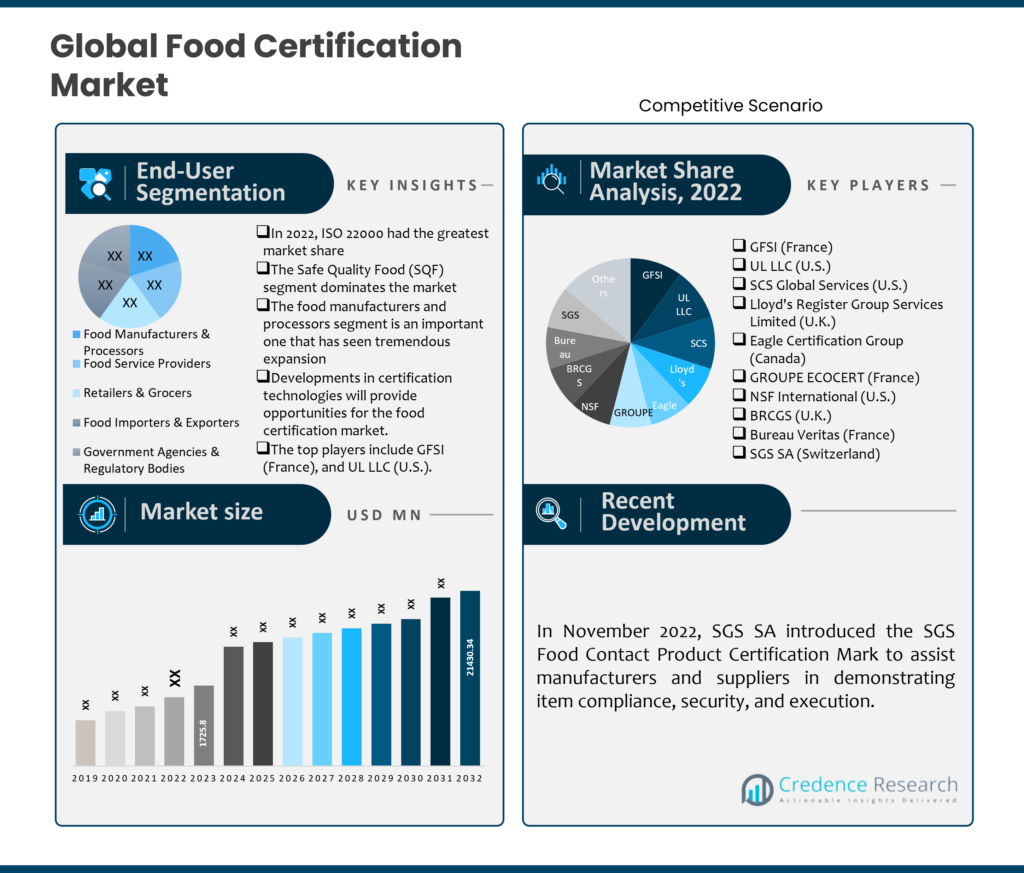
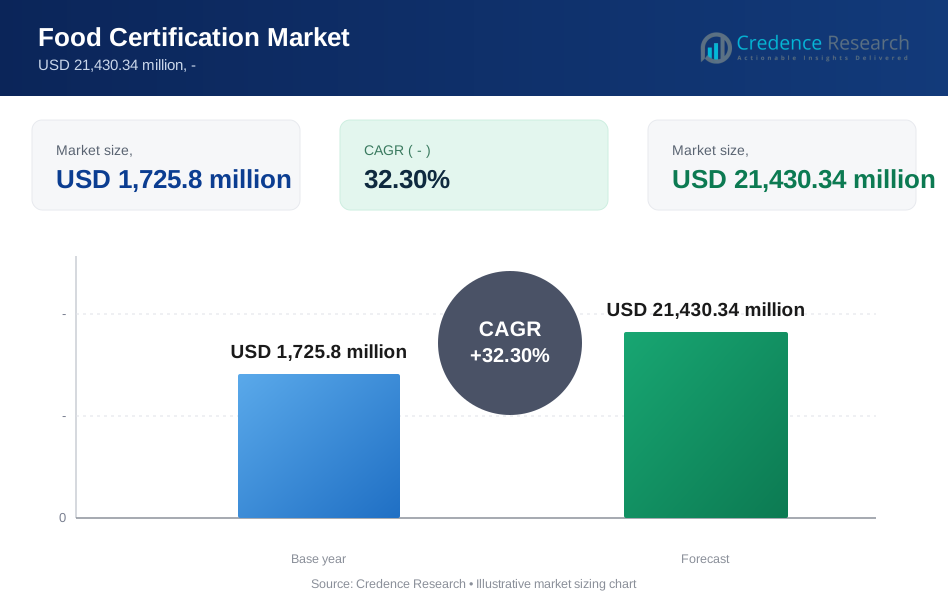
- Between 2024 and 2032, the global market for food certification is projected to rise at a compound annual growth rate (CAGR) of 32.30%, from an estimated USD 1725.8 million in 2023 to USD 21430.34 million in 2032.
- The largest category is ISO 22000. Safe quality food (SQF), on the other hand, is expected to grow at a strong CAGR.
- The food manufacturers and processors category will expand at a rapid rate of growth.
- North America governed the market for food certification.
- Regarding the market share of food certification, Europe is expected to come second.
- In the food certification market, Asia Pacific is anticipated to grow fastest.
- The market for food certification is driven by customers' growing knowledge of food safety and quality requirements.
- Businesses are encouraged to gain certifications by supportive government regulations and incentives, which promote food certification market expansion.
Executive Summary
Market Definition
The industry that verifies, evaluates, and ensures that food items comply with different standards, laws, and requirements is known as the food certification market. Throughout the supply chain, food certification includes a broad range of procedures and actions meant to guarantee the food products' sustainability, quality, safety, and authenticity.
Market Overview
The food certification sector is predicted to continue its upward trend between 2024 and 2032, growing at a compound annual growth rate (CAGR) of 32.30%. From its projected USD 1725.8 million in 2023 to USD 21430.34 million in 2032, the market will continue to grow.
Manufacturers in the food certification industry have more growth potential as a result of the expansion of food trade among emerging nations. Food certification is becoming more and more important in winning over customers due to the rise in foodborne illness cases and the poor processing and sanitary standards in food production factories of certain nations, like Indonesia. China is an important market for food certification since it has the ability to import and export food. Regulations that were first implemented in developing nations have facilitated the food trade, given authorities the authority to forbid the import and distribution of tainted food to enforce food recalls, and required nutrition labeling on food products. The need for certification services in these regions is expected to be driven by these factors.
Large amounts of genetically modified crops are imported from the US by nations including China, South Korea, and India. The testing of genetically modified food has further increased consumer and regulatory authority awareness, which could lead to a rise in demand. The penetration of GM crops, along with changes in food consumption patterns and high nutrient requirements, are the main drivers expected to propel demand for non-GMO certification services in India. As a result, there are significant growth prospects for food certification services when developing nations implement strict food safety regulations.
Segmentation by Certification Type
- The ISO 22000 category is the market leader in terms of certification type. The administration of food safety is covered by ISO 22000 in a number of ways, including assessment of risks, control measures, and hazard analysis. It creates a methodical framework for detecting any hazards, putting preventative measures in place, and keeping an eye on the whole food supply and production chain. By using this certification, businesses may lessen the possibility of contamination, product recalls, and foodborne diseases by efficiently identifying and controlling food hazards.
- The safe quality food (SQF) category will exhibit a sizable CAGR during the projected period. Customers are becoming more concerned about the safety of the food they eat as concerns regarding food safety become more widely known. SQF accreditation reduces consumer fears and fosters brand trust by ensuring that food items adhere to strict safety regulations.
- Other certification types, including organic certification, food safety certification, hazard analysis and critical control points (HACCP), GMO-free certification, kosher certification, halal certification, gluten-free certification, allergen-free certification, and other specialty certifications, also support the need for food certification.
Segmentation by End-User Segmentation
- The finest end-users are thought to be food manufacturers and processors. Food manufacturers and processors can reduce their exposure to liability claims, product recalls, and events involving food safety by obtaining certifications. Businesses can protect their reputation and revenue line by proactively identifying and addressing possible hazards by putting in place strong food safety management systems and conducting routine audits.
- The food service providers category will likely register a significant CAGR during forecasting. Local health authorities enforce standards regarding food safety for food service operators. Food service operators may ensure safe food handling procedures and regulatory compliance by obtaining certifications like ServSafe, HACCP (Hazard Analysis and Critical Control Points), and ISO 22000.
- Other end-users, such as retailers and grocers, food importers and exporters, and government agencies and regulatory bodies, also contribute to the demand for food certification.
Segmentation by Region
- North America leads the food certification industry. This is due to the rising demand for food certification from North American countries such as the US, Canada, and Mexico.
- Europe is estimated to rank second in food certification market size.
- The food certification industry is predicted to flourish rapidly in Asia Pacific.
- The remaining need for food certification is covered by regions including Latin America, Africa, and the Middle East.
In Europe, the food sector is enormous. Solid regulatory frameworks for food safety and quality have been established in Europe. The General Food Law, the Hygiene Package, and the Novel Food Regulation are just a few of the directives and rules that the European Union (EU) has put into effect. In order to assure food safety, these regulations mandate that food firms adhere to stringent standards and go through certification procedures. Therefore, there is a great need for food certification services throughout Europe. Global food safety and quality standards are frequently influenced by the strict rules and high standards of the European region. When creating worldwide norms, international bodies like the Codex Alimentarius Commission consider European standards. This impact extends to certification programs since international recognition has been accorded to European certification agencies and standards.
Based on projections, North America is anticipated to control the food certification market. The certifying authorities in the North American region ensure that businesses producing food and beverages adhere to appropriate food management procedures through comprehensive audits and follow-ups. The United States Department of Agriculture (USDA) claims that manufacturers are compelled by stringent regulations to abide by the rules in order to maintain market dominance. The new FSMA regulations have a significant impact on the food business, and consumers want more information about food use. The FDA finalized seven important rules in 2022 to implement the Food Safety Modernization Act (FSMA), acknowledging that many diverse locations in the global supply chain share responsibility for protecting the safety of the food supply. It is anticipated that this will increase demand for food certification.
Asia Pacific's food certification market is expected to grow at a rapid pace during the forecast period. Demand for certified products is being driven by growing consumer awareness in India about food safety and quality. Foods that are organic, GMO-free, halal, and sourced ethically are in high demand as India's middle class grows and becomes more conscious of health, wellness, and food quality. A regulatory body like the Food Safety and Standards Authority of India (FSSAI) assists the government in its efforts to raise the bar for food safety standards, which in turn encourages businesses to get certifications in order to meet regulations and win over customers.
Key Highlights of the Report
The global food certification market is segmented by certification type, end-user segmentation, and region. The ISO 22000 category is the market spearhead in terms of certification type, and food manufacturers and processors are the top end-users. The food certification market is expanding mostly in North America.
Food goods find considerable domestic and international market share in Europe. Exporters from other regions are required to adhere to European food safety and quality requirements in order to get access to European markets. Exporters must now obtain certification in order to prove conformity and obtain access to markets. The European Union (EU) has implemented distinct policies pertaining to organic products, such as EU Organic Certification, protected geographical indications (PGI), and protected designations of origin (PDO). Customers are reassured by these certifications regarding the genuineness and caliber of particular food goods. The need for certification services is driven by regional rules and consumer needs, making it an essential part of the European food business.
North America is expected to account for the largest food certification market globally. Due to rising public knowledge of the harmful effects of contaminated food products and increased health consciousness in the country, the United States dominated the North American market. Introducing the first completely accredited and non-GMO British Cheddar, Somerdale International is the top importer of British cheeses and dairy products into the US market. NSF International has certified the new 'Westminster Sharp' as non-GMO. It is also anticipated that the market will develop at the fastest rate in the Asia Pacific region. As India continues to increase its exports of agricultural and processed food products, certification to international standards becomes crucial to get access to foreign markets in the Asia Pacific region. India's food certification market is anticipated to experience substantial expansion and diversification over the projected period due to the country's substantial agricultural base and growing emphasis on ethical and sustainable practices.
Which Key Factors Are Driving The Global Food Certification Market?
The food certification industry is growing due to strict laws governing food safety and quality, consumer awareness, and the globalization of the food trade.
What Are The Main Challenges Confronting The Global Food Certification Market?
The food certification industry is faced with several significant challenges, including high costs, complicated certification procedures and standards that may be difficult for firms to comply with, and a lack of regional consistency in certification standards.
What Market Opportunities Exist For Food Certification Globally?
Food certifications have the potential for growth due to their beneficial outcomes on an organization's image and client confidence, retailer demands, and the ability to enter novel markets by adhering to local consumer interests and legal norms.
Market Drivers
Certification Demands and Strict Standards for the Food Industry
In the upcoming years, the food certification business is expected to be impacted by the regulatory interventions. Prolonged industry standards, certification requirements, and more government-enforced restrictions are expected to encourage market expansion. Businesses are anticipated to spend in certification compliance as a result of the imposition of harsher fines on non-compliant parties. Positive effects on the market's growth are anticipated from these aspects. Worldwide and national laws impose stringent controls on the production of food. Wide-ranging legislative measures, including the US Food Safety Modernization Act (FSMA) and the Canadian "Multi-Year Regulatory Modernization Plan," have been introduced or are currently undergoing full implementation. To assure food safety and be able to operate in specific markets, food firms freely and widely use third-party certifications and industry standards to comply with national and international legislation that regulates the food sector.
Market Restraints
In Underdeveloped Nations, There is Insufficient Infrastructure and Financial Assistance for Ensuring Food Security and Safety
The implementation of global food safety laws presents distinct obstacles for developing countries. Some common features of the food processing industries in developing nations are their tiny size, restricted workspace, and the majority of them beginning in unassuming locations. Additionally, non-food technologists occasionally run small-scale firms since they don't think hiring food technologists would be a more costly or needless addition to their present needs. One major obstacle impeding the expansion of the food certification sector is the deficiency of infrastructure and staff in emerging nations.
Due to inadequate infrastructure and scarce resources, many developing nations rely on their local and small-scale food enterprises, which are unable to achieve global food certifications. This is a crucial element that has an additional influence on the market's growth for food certification.
The infrastructure and facilities for implementing food safety systems are inadequate in emerging nations like India and those in East and North Africa. Because these nations lack the fundamental infrastructure needed to enable food product certification, the market for food certification is expected to grow more slowly.
Opportunities
Developments in Certification Technologies
Improvements in efficiency, transparency, and credibility brought about by certification technology advancements provide substantial prospects for the food certification sector. Large amounts of data produced by supply chain activities, customer input, and certification processes can be analyzed by certification organizations due to big data analytics techniques. Certification organizations can improve certification procedures and standards continuously by using data analytics to more efficiently identify trends, patterns, and possible hazards. Stakeholders, such as food producers, suppliers, and consumers, can easily access information and services linked to certification through mobile applications. To improve engagement and transparency throughout the supply chain, certification organizations can create mobile applications for certification management, training, and communication. Technological developments in certification assist certifying bodies in better-serving stakeholders throughout the food supply chain, adjusting to changing industry demands, and improving their services. These technologies contribute to the growth of the food certification industry by providing prospects for innovation, efficiency advantages, and enhanced confidence and openness.
Competitive Landscape
Key Players
In the highly competitive global food certification market, there are a number of significant rivals. A few of the top market players are shown below, together with their respective market shares:
- GFSI (France)
- UL LLC (U.S.)
- SCS Global Services (U.S.)
- Lloyd's Register Group Services Limited (U.K.)
- Eagle Certification Group (Canada)
- GROUPE ECOCERT (France)
- NSF International (U.S.)
- BRCGS (U.K.)
- Bureau Veritas (France)
- SGS SA (Switzerland)
- Intertek Group Plc (U.K.)
- TÜV NORD GROUP (Germany)
- DNV GL (Norway)
- DEKRA (Germany)
- Mérieux NutriSciences (France)
- Eurofins Scientific (Luxembourg)
- ALS Limited (Australia)
- AsureQuality (New Zealand)
- Control Union Certifications Germany gmbh (Germany)
- FoodChain ID Group Inc. (U.S.)
- Kiwa (Netherlands)
- Others
To stay competitive, these businesses give priority to product innovation, expanding their distribution networks, and completing mergers and acquisitions.
The biggest vendors in the global food certification market consistently strive to keep one step ahead of the competition by creating cutting-edge ideas and goods.
In November 2022, Plant-based certification was introduced by SCS Global Services. The initiative honors innovation in a broad spectrum of consumer goods and advocates for plant-based substitutes. The SCS-109 Standard allows for certification of food, drinks, CBD, and body care items. Certification guarantees that no materials originating from animals are utilized in the creation of the product. Furthermore, at least 95% of the ingredients in products intended for human and animal use must come from plants, while at least 50% of the ingredients in other products, such as body care items, must come from plants.
In September 2022, A new vegan food certification mark was introduced by Intertek Group PLC to guarantee total confidence in product claims. Evaluating food goods for consumers who follow a vegan or plant-based diet is the goal of the Intertek Vegan Certification. By leveraging Intertek's ATIC technique to complete third-party verification through auditing, testing, inspection, and training, this tailored program goes above and beyond the typical label evaluation to support a vegan claim.
How are Companies Performing in the Food Certification Market?
The substantial performance of companies in the food certification market can be attributed to some noteworthy reasons. Due to globalization, the majority of companies engage in mergers and acquisitions often, and the top international companies hold a significant share of the market. Through mergers and acquisitions, these major companies in the market are also able to maintain their control over smaller regional competitors. One example is the acquisition of AET France, a consumer testing company established in France that offers testing services and product development, by Bureau Veritas in September 2021. With the support of AET France's experience, the company claims that the most important objective of this acquisition is to bolster its core research and development division. As a result, the company is able to recognize a certain product in-depth and provide customers with improved service.
In an effort to meet the constantly changing requirements of food business operators (FBOs), the leading company GFSI was pleased to announce in November 2023 the launch of the new GFSI GMaPTM, a Global Markets Program that gives FBOs simple access to a set of tools for self-assessment of food safety proficiencies based on CODEX Alimentarius. The new GFSI GMaPTM toolkits, which are centered on primary production and manufacturing operations, include training and competency models, a food safety checklist and related protocols, and other resources to support the various ways that FBOs can demonstrate their overall food safety capabilities to improve their ability to trade both domestically and internationally. For more than fifteen years, GFSI has been invested in helping organizations build their capacities for food safety.
Companies that have obtained ISO 22000 certification are anticipated to gain a competitive advantage in the global market by fulfilling regulatory obligations and meeting consumer demands for safe and superior-quality food products.
Summary of Key Findings
- The certification procedure is made easier and more affordable for firms by technological advancements. In emerging regions, consumer demand for certified food items is supported by growing economies and increased disposable incomes.
- The market is segmented by certification type, end-user segmentation, and region.
- In the market, ISO 22000 is the most widely used certification type.
- Food manufacturers and processors are the foremost end-user category.
- North America is leading market development; the market is highly competitive with key players including GFSI (France), UL LLC (U.S.), SCS Global Services (U.S.), Lloyd's Register Group Services Limited (U.K.), Eagle Certification Group (Canada), GROUPE ECOCERT (France), NSF International (U.S.), BRCGS (U.K.), Bureau Veritas (France), SGS SA (Switzerland), Intertek Group Plc (U.K.), TÜV NORD GROUP (Germany), DNV GL (Norway), DEKRA (Germany), Mérieux NutriSciences (France), Eurofins Scientific (Luxembourg), ALS Limited (Australia), AsureQuality (New Zealand), Control Union Certifications Germany gmbh (Germany), FoodChain ID Group Inc (U.S.), Kiwa (Netherlands), and Others.
Future Outlook
- The food certification industry is expected to increase significantly in North America, and its outlook is positive worldwide.
- Certification requirements change over time to reflect best practices and handle new issues, which encourages continued adoption.
- The cost of obtaining and maintaining certifications can be high for smaller enterprises, particularly those in developing nations.
- Major organizations need to create novel offerings, reach a wider audience, and maintain competitive pricing in order to stay ahead of other businesses.
How the Credence Research Food Certification Market Report Can Help CXOs
The Credence Research Food Certification Market Report provides CXOs with an extensive market overview and comprises the following:
- Market size and growth forecast: The study offers comprehensive market estimations for food certification globally, broken down by certification type, end-user segmentation, and region. In addition, projections for the market through 2032 based on significant drivers and trends are included.
- Market segmentation: The food certification market is divided into segments by certification type, end-user segmentation, and region in the research report. CXOs are given a detailed grasp of the market and the potential inside each sector due to this segmentation.
- Competitive landscape: The study report provides a thorough analysis of the leading businesses in the food certification sector, together with details on their revenue streams, product lines, and business strategies. CXOs can assess and identify their competitors with this information.
- Key trends and drivers: The study report analyzes and highlights the key developments and elements driving the market for food certification. CXOs can utilize this information to make well-informed choices regarding their plans and investments.
The Credence Research Food Certification Market Report provides CXOs with insights that they may utilize to:
- Identify growth opportunities: This analysis is likely to help CXOs find fresh growth prospects in the food certification sector. For example, the research recognizes the increasing requirement for food certification from food manufacturers and processors as a crucial opportunity.
- Make informed investment decisions: The study aids CXOs in making informed decisions about food certification. For example, it delivers information on the key variables to consider while picking food certification solutions and evaluating suppliers.
- Develop competitive strategies: CXOs can utilize the research report to establish competitive strategies for their food certification firms. The study paper explores the primary tactics employed by food certification providers to set themselves apart from their rivals.
- Track market developments: By tracking market advancements, this research report could assist CXOs in remaining ahead of the curve. For example, it provides information about the latest advancements and patterns in the food certification industry.
The Credence Research Food Certification Market Report is helpful for CXOs who want to learn more about the market and identify potential opportunities.
Segmentation
-
By Certification Type
- Organic Certification
- Food Safety Certification
- Hazard Analysis and Critical Control Points (HACCP)
- ISO 22000
- Safe Quality Food (SQF)
- GMO-Free Certification
- Kosher Certification
- Halal Certification
- Gluten-Free Certification
- Allergen-Free Certification
- Other Specialty Certifications
-
By End-User Segmentation
- Food Manufacturers and Processors
- Food Service Providers
- Retailers and Grocers
- Food Importers and Exporters
- Government Agencies and Regulatory Bodies
-
By Region
- North America
- U.S.
- Canada
- Mexico
- Europe
- Germany
- France
- UK.
- Italy
- Spain
- Rest of Europe
- Asia Pacific
- China
- Japan
- India
- South Korea
- South-east Asia
- Rest of Asia Pacific
- Latin America
- Brazil
- Argentina
- Rest of Latin America
- Middle East & Africa
- GCC Countries
- South Africa
- The Rest of the Middle East and Africa
- North America
Request a Free Sample
Fill in your details and we'll send you a free sample report.
- Sample data tables & charts
- Research methodology
Need a Custom Version of This Report?
Tailor the scope, geography, or segments to your exact requirements.
- Custom geography or segment scope
- Direct access to our analyst team
Frequently Asked Questions
How much does the global market currently hold for food certification?
What is the food certification market's projected growth rate between 2024 and 2032?
What is the most significant market segment in terms of certification type?
Regarding the end-user, which market category is in the lead?
Which certification type is anticipated to grow at the fastest rate throughout the projected period?
In which region is the market for food certification expanding?
Who are the main players in the global food certification industry?
Which market factors are the primary drivers of the food certification industry?
What main market challenges prevent the growth of the food certification sector?
What are the main market opportunities for the food certification sector?
Table of Content
Chapter 1. Report Introduction
- 1.1 Report Description & Purpose
- 1.1.1 Report Title & Market Definition
- 1.1.2 Unique Selling Propositions (USP) & Key Differentiators
- 1.1.3 Value Proposition for Stakeholders
- 1.2 Research Objectives
- 1.2.1 Market Sizing Objectives (Volume & Revenue)
- 1.2.2 Segmentation Objectives
- 1.2.3 Competitive Intelligence Objectives
- 1.2.4 Forecast & Scenario Objectives
- 1.3 Report Scope
- 1.3.1 Food Certification Scope – Types & Subtypes Covered
- 1.3.2 Geographic Scope – Regions & Countries Covered
- 1.3.3 Historical Period, Base Year & Forecast Period (the historical period; forecast to the forecast period)
- 1.3.4 Inclusions & Exclusions
- 1.4 HS Code & Classification Framework
- 1.5 Currency, Units & Pricing Basis
- 1.6 Target Stakeholders
- 1.7 Limitations & Assumptions
Chapter 2. Executive Summary
- 2.1 Global Food Certification Market Snapshot
- 2.1.1 Market Size – Historical (the historical period) & Forecast (the forecast period) (base year: USD 1,725.8 million → forecast year: USD 21,430.34 million)
- 2.1.2 Volume & Revenue – Global Totals
- 2.1.3 Key Market Highlights – Top Five Facts
- 2.2 Food Certification Market Segmentation Snapshot
- 2.2.1 Market Split by Region – vs.
- 2.3 Competitive Snapshot
- 2.3.1 Top 10 Players by Revenue Share –
- 2.3.2 Top 10 Players by Volume Share –
- 2.3.3 Recent Strategic Developments (18-Month Summary)
- 2.4 Key Investment Highlights & Strategic Conclusions
Chapter 3. Food Certification Market Dynamics & Industry Analysis
- 3.1 Market Overview & Context
- 3.1.1 Food Certification Market Position in the Broader Automotive Value Chain
- 3.1.2 OEM vs. Replacement Market Dynamics
- 3.1.3 Market Maturity & Development Stage by Region
- 3.2 Food Certification Market Drivers
- 3.3 Food Certification Market Restraints & Challenges
- 3.4 Food Certification Market Opportunities
- 3.5 Porter's Five Forces Analysis
- 3.5.1 Threat of New Entrants
- 3.5.2 Bargaining Power of Suppliers
- 3.5.3 Bargaining Power of Buyers
- 3.5.4 Threat of Substitutes
- 3.5.5 Competitive Rivalry – Intensity Assessment
- 3.6 Food Certification Value Chain Analysis
- 3.6.1 Upstream – Raw Material/Input Suppliers
- 3.6.1.1 Raw Material/Input 1
- 3.6.1.2 Raw Material/Input 2
- 3.6.1.3 Raw Material/Input 3
- 3.6.2 Midstream – Production/Manufacturing/Service Delivery
- 3.6.2.1 Production/Process Overview
- 3.6.2.2 Key Facility Locations & Capacity by Manufacturer
- 3.6.3 Downstream – Distribution & End Consumer
- 3.6.3.1 Primary Channel – B2B/OEM
- 3.6.3.2 Secondary Channels – Dealer, Retail, Online, Direct
- 3.6.4 Value Chain Profitability Analysis
- 3.6.1 Upstream – Raw Material/Input Suppliers
- 3.7 PESTEL Analysis
- 3.7.1 Political Factors
- 3.7.2 Economic Factors
- 3.7.3 Social Factors
- 3.7.4 Technological Factors
- 3.7.5 Environmental Factors
- 3.7.6 Legal Factors
- 3.8 Food Certification Supply Chain Analysis
- 3.8.1 Raw Material/Input Supply Risk Assessment
- 3.8.2 Manufacturing Concentration Risk (Geographic Exposure)
- 3.8.3 Trade Disruption Impact Analysis
- 3.9 Regulatory & Policy Landscape
Note: The regulatory and policy landscape section covers regulations based on their applicability to the market, Food Certification category, geography, and scope of the study. Only regulatory frameworks with a material impact on operations, compliance, trade, sustainability, or market access are analyzed in detail.
Chapter 4. Key Investment Pockets & Opportunity Analysis
- 4.1 Food Certification Market Attractiveness Analysis
- 4.1.1 By Region – Investment Attractiveness Matrix (Volume × CAGR)
- 4.2 Absolute Revenue Growth Opportunity
- 4.2.1 By Region – Absolute USD Growth Through the forecast period
- 4.3 Incremental Volume Opportunity
- 4.3.1 By Region – Incremental Volume Through the forecast period
- 4.3.2 Segment – Incremental Volume
- 4.4 Emerging Submarket Opportunity Deep Dive (Subject to Applicability)
- 4.5 Emerging Market Opportunity Scorecards
- 4.5.1 United States
- 4.5.2 Europe
- 4.5.3 Asia
- 4.5.4 Middle East & Africa
Note: Emerging Market Opportunity Scorecards will be included based on relevance and strategic importance. Regions listed are indicative and may vary depending on data availability and market dynamics.
Chapter 5. Food Certification Import-Export Analysis & Trade Flows
- 5.1 Global Trade Overview
- 5.1.1 Global Export Value by Country (the historical period)
- 5.1.2 Global Export Volume by Country (the historical period)
- 5.1.3 Global Import Value by Country (the historical period)
- 5.1.4 Global Import Volume by Country (the historical period)
- 5.1.5 Net Trade Balance by Country (the historical period)
- 5.2 Export Analysis – Segment
- 5.2.1 Type 1 (HS Code)
- 5.2.2 Type 2 (HS Code)
- 5.2.3 Type 3 (HS Code)
- 5.2.4 Type 4 (HS Code)
- 5.2.5 Type 5 (HS Code)
- 5.3 Import Analysis – Segment
- 5.3.1 Type 1 (HS Code)
- 5.3.2 Type 2 (HS Code)
- 5.3.3 Type 3 (HS Code)
- 5.3.4 Type 4 (HS Code)
- 5.3.5 Type 5 (HS Code)
- 5.4 Average Unit Trade Prices
- 5.4.1 Average Export Price – Segment & Country
- 5.4.2 Average Import Price – Segment & Source Country
- 5.4.3 Price Trends (the historical period)
- 5.5 Key Trade Route Analysis
- 5.5.1 Trade Route 1
- 5.5.2 Trade Route 2
- 5.5.3 Trade Route 3
- 5.5.4 Trade Route 4
- 5.5.5 Trade Route 5
- 5.6 Trade Policy Impact Assessment
- 5.6.1 US Anti-Dumping & Section 301 Tariffs
- 5.6.2 EU Customs Union Impact
- 5.6.3 Major Free Trade Agreements
- 5.6.4 USMCA Rules of Origin
Note: Trade policy analysis will be included only where relevant to the Food Certification market.
Chapter 6. Competitive Landscape & Company Benchmarking
- 6.1 Food Certification Market Concentration & Structure
- 6.1.1 Herfindahl-Hirschman Index (HHI) – vs.
- 6.1.2 Tier 1, Tier 2 & Tier 3 Market Structure
- 6.1.3 Global, Regional & Local Player Dynamics
- 6.2 Food Certification Market Share Analysis –
- 6.2.1 Global Revenue Share by Company
- 6.2.2 Global Volume Share by Company
- 6.2.3 Regional Revenue Share
- 6.2.4 Market Share Evolution ( vs. )
- 6.2.5 OEM Segment Share by Company
- 6.2.6 Replacement Segment Share by Company
- 6.3 Production/Delivery Capacity & Facility Analysis
- 6.3.1 Global Installed Capacity
- 6.3.2 Capacity Utilization Rates
- 6.3.3 Production/Output Volume
- 6.3.4 Facility Locations & Capacity Map
- 6.3.5 Planned Capacity Additions
- 6.4 Food Certification Competitive Benchmarking Matrix
- 6.4.1 Revenue, Volume, CAGR & Profitability Comparison
- 6.4.2 Channel Revenue Mix
- 6.4.3 Geographic Revenue Exposure
- 6.4.4 R&D Intensity
- 6.4.5 Sustainability Maturity
- 6.5 Strategic Developments in Food Certification (Last 24 Months)
- 6.5.1 Mergers, Acquisitions & Divestments
- 6.5.2 New Food Certification Launches
- 6.5.3 Facility Expansions
- 6.5.4 Strategic Alliances, Joint Ventures & Partnerships
- 6.5.5 Distribution Expansion & Market Entry
- 6.5.6 Sustainability & ESG Initiatives
- 6.6 Competitive Strategy Mapping
- 6.6.1 Leader, Challenger, Follower & Niche Classification
- 6.6.2 Pricing Strategy Comparison
- 6.6.3 Channel Strategy Matrix
Note: Strategic developments are included based on their materiality and the availability of reliable information.
Chapter 7. Global Food Certification Market – By Distribution Channel
- 7.1 Segment Overview
- 7.1.1 Volume & Revenue Split by Channel ( & )
- 7.1.2 Channel Mix Evolution (the forecast period)
Chapter 8. Regional Market Analysis – Global Overview
- 8.1 Global Regional Overview
- 8.1.1 Regional Volume Share
- 8.1.2 Regional Revenue Share
- 8.1.3 Regional Volume by Region
- 8.1.4 Regional Revenue by Region
- 8.1.5 Regional Forecast Through the forecast period
- 8.2 Cross-Regional Segment Analysis
- 8.2.1 By Distribution Channel
- 8.2.2 By Brand/Price Tier
Chapter 9. North America Food Certification Market
- 9.1 United States
- 9.2 Canada
- 9.3 Mexico
Chapter 10. Europe Food Certification Market
- 10.1 Germany
- 10.2 France
- 10.3 Italy
- 10.4 United Kingdom
- 10.5 Spain
- 10.6 Poland
- 10.7 Russia
- 10.8 Netherlands
- 10.9 Belgium
- 10.10 Sweden
- 10.11 Denmark
- 10.12 Norway
- 10.13 Rest of Europe
Chapter 11. Asia Pacific Food Certification Market
- 11.1 China
- 11.2 India
- 11.3 Japan
- 11.4 South Korea
- 11.5 Thailand
- 11.6 Indonesia
- 11.7 Vietnam
- 11.8 Malaysia
- 11.9 Australia
- 11.10 Rest of Asia Pacific
Chapter 12. Latin America Food Certification Market
- 12.1 Brazil
- 12.2 Argentina
- 12.3 Colombia
- 12.4 Chile
- 12.5 Rest of Latin America
Chapter 13. Middle East Food Certification Market
- 13.1 Saudi Arabia
- 13.2 United Arab Emirates
- 13.3 Turkey
- 13.4 Israel
- 13.5 Iran
- 13.6 Rest of the Middle East
Chapter 14. Africa Food Certification Market
- 14.1 South Africa
- 14.2 Egypt
- 14.3 Nigeria
- 14.4 Morocco
- 14.5 Rest of Africa
Chapter 15. Food Certification Company Profiles
- 15.1 [Company 01]
- 15.1.1 Company Overview
- 15.1.2 Key Management Personnel
- 15.1.3 Products & Services Portfolio
- 15.1.4 Financial Performance
- 15.1.5 Key Market Focus & Geographic Presence
- 15.1.6 Recent Developments & Strategic Initiatives
Note: The company profile list is preliminary and may change based on research findings, market developments, data availability, and client requirements.
Chapter 16. Appendices
- Appendix A – List of Abbreviations & Acronyms
- Appendix B – Industry Classification Code Reference – Full Series
- Appendix C – Production & Capacity Data Tables
- Appendix D – End-Use & Demand Base Tables
- Appendix E – Consumption & Replacement Rate Assumptions
- Appendix F – ASP Reference Tables
- Appendix G – Manufacturing & Facility Database
- Appendix H – Import-Export Data Tables
- Appendix I – Regulatory Summary Tables
- Appendix J – Primary Research Participant List (Anonymized)
- Appendix K – Primary Research Questionnaire Framework
- Appendix L – Data Sources & Bibliography
- Appendix M – Market Size Divergence & Source Comparison
Chapter 17. Research Methodology
- 17.1 Research Framework & Philosophy
- 17.2 Secondary Research – Sources, Hierarchy & Data Extraction
- 17.3 Data Modeling – Bottom-Up & Top-Down Market Sizing
- 17.4 Primary Research – Stakeholder Framework, LOI & Sample Sizes
- 17.5 Forecast Methodology – Regression, Scenario & Sensitivity Analysis
- 17.6 Quality Control – Four-Layer Validation Framework
- 17.7 Limitations & Standard Assumptions
- 17.8 Disclaimer
