Market Overview
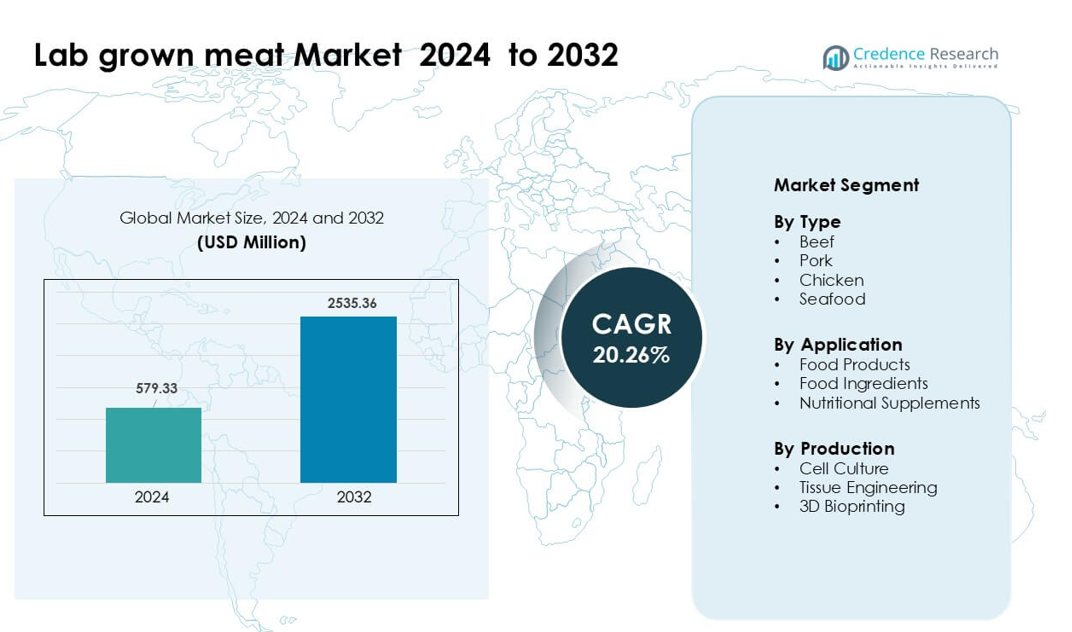
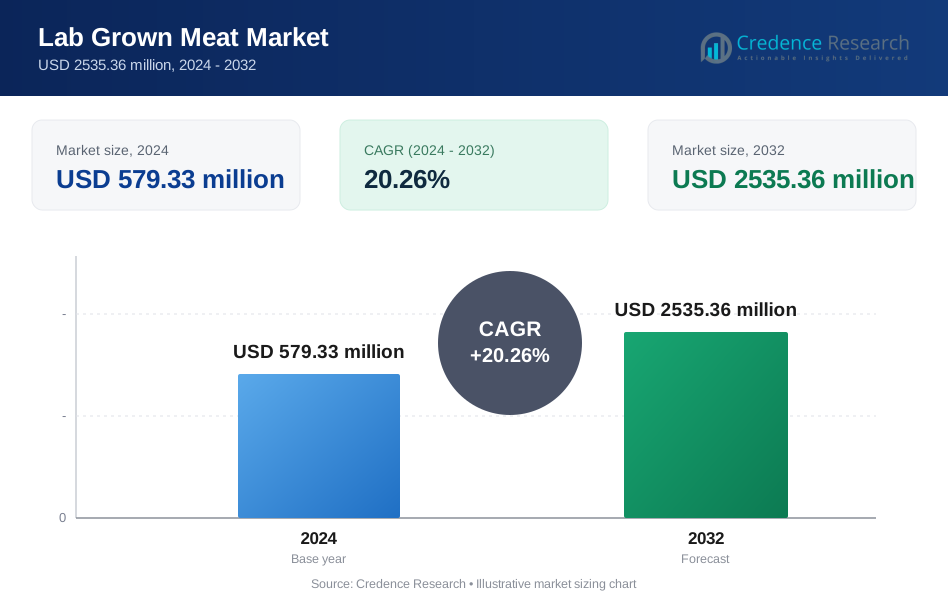
Lab grown meat Market was valued at USD 579.33 million in 2024 and is anticipated to reach USD 2535.36 million by 2032, growing at a CAGR of 20.26 % during the forecast period.
| REPORT ATTRIBUTE | DETAILS |
|---|---|
| Historical Period | 2020-2023 |
| Base Year | 2024 |
| Forecast Period | 2025-2032 |
| Lab Grown Meat Market Size 2024 | USD 579.33 million |
| Lab Grown Meat Market, CAGR | 20.26% |
| Lab Grown Meat Market Size 2032 | USD 2535.36 million |
Leading players in the lab-grown meat market include Mosa Meat, Avant Meats, SCiFi Foods, Aleph Farms, BlueNalu, Future Meat Technologies, BioCraft Pet Nutrition, Shiok Meats, Meatable, and Eat Just. These companies accelerate commercialization through advances in cell culture, scalable bioreactors, and serum-free media that lower production costs. Firms also expand into beef, chicken, pork, and seafood to strengthen product reach and attract food-service partners. North America remained the leading region in 2024 with about 41% share, supported by strong investment, active regulatory pathways, and rapid pilot-scale adoption across restaurant and retail channels.
Market Insights
- The lab-grown meat market was valued at USD 33 million in 2024 and is projected to reach USD 2535.36 million by 2032 at a CAGR of 20.26%.
- Demand grew due to rising interest in sustainable and ethical protein, with beef leading the type segment at 38% share in 2024 because consumers favored low-emission alternatives.
- Major trends include rapid advances in cell culture, bioreactors, and hybrid products that mix cultured cells with plant proteins, helping companies reduce costs and improve texture for early commercial launches.
- The competitive landscape features strong activity from Mosa Meat, Aleph Farms, BlueNalu, Eat Just, Meatable, Shiok Meats, Avant Meats, Future Meat Technologies, SCiFi Foods, and BioCraft Pet Nutrition, all working to secure regulatory approvals and scale infrastructure.
- North America led the market with 41% share in 2024, followed by Europe at 30% and Asia Pacific at 22%, supported by rising trials, regulatory progress, and strong investment across all regions.
Market Segmentation Analysis:
By Type
Beef held the dominant position in 2024 with about 38% share in the lab-grown meat market. This category advanced due to strong demand for premium protein and growing interest in sustainable alternatives to conventional beef. Producers focused on developing cell lines that deliver real-meat texture, which improved acceptance among restaurants and retail partners. Chicken and pork gained pace, but beef stayed ahead because consumer trials showed stronger willingness to pay for cruelty-free and low-emission beef products. Wider investment from food-tech firms also strengthened development pipelines for cultured beef.
- For instance, Mosa Meat, a Dutch company, reported that from a single sample of less than one gram of bovine muscle cells, they can theoretically produce 10,000 kg of cultured beef.
By Application
Food products led the application segment in 2024 with nearly 52% share. Rising adoption of burgers, nuggets, and minced formats created strong momentum as brands targeted flexitarian shoppers looking for familiar taste and lower environmental impact. Manufacturers prioritized ready-to-cook formats because these products require minimal processing changes and show faster regulatory acceptance. Food ingredients and supplements grew slowly, but food products maintained leadership due to clear use-case visibility, expanding pilot launches, and strong partnerships with restaurant chains for market testing.
- For instance, SuperMeat, an Israeli cell-cultured chicken firm, opened a test restaurant adjacent to its pilot plant in Ness Ziona where diners could try meal-ready chicken pieces grown from its cell lines.
By Production
Cell culture dominated the production segment in 2024 with close to 57% share. This method remained preferred because it supports scalable biomass generation and offers lower production variability compared to tissue engineering or 3D bioprinting. Companies invested in optimized growth media and bioreactor systems that help reduce cost per kilogram. Tissue engineering showed promise for structured cuts, while 3D bioprinting advanced niche applications, but cell culture remained in front due to higher maturity, broader commercial trials, and strong backing from large food-tech investors aiming for early mass-market entry.
Key Growth Drivers
Rising Demand for Sustainable Protein
Growing demand for sustainable and ethical protein strongly accelerates the lab-grown meat market. Consumers seek options that lower greenhouse gas emissions and reduce land and water use compared to conventional livestock. Many countries also promote climate-friendly protein sources through food innovation grants and pilot approvals. This support encourages startups to scale cell lines that deliver real-meat taste without raising animals. Rising awareness of animal welfare strengthens adoption among flexitarian and health-conscious shoppers. The push for net-zero goals by global food companies further boosts investment in cultivated meat, making sustainability a major growth force.
- For instance, the foundational 2011 life-cycle assessment (LCA) by Tuomisto and Teixeira de Mattos, based on a hypothetical large-scale production model, projected that cultured meat production could yield 78–96% lower greenhouse gas emissions, use up to 99% less land, and 82–96% less water compared to conventionally produced European meat.
Advances in Cell Culture and Biomanufacturing
Rapid improvements in cell culture media, bioreactors, and scaffolding methods drive strong cost reduction in cultivated meat. Food-tech companies work on serum-free media that cut production expenses while improving cell growth efficiency. New bioreactors allow higher-density cultivation, enabling stable yields at pilot and commercial scale. Structured tissue engineering techniques also help producers match the texture of beef, chicken, and seafood. These advancements attract venture capital and corporate funding, helping firms progress toward regulatory approvals. The continued shift from lab protocols to industrial processes remains a major catalyst for mass-market readiness.
- For instance, Bene Meat Technologies has developed serum-free growth media and cell-line protocols as part of its technological ecosystem, enabling industry partners to scale without using fetal bovine serum.
Supportive Regulatory Developments
Regulatory progress in regions such as the U.S., Singapore, and Israel creates confidence for global expansion of cultivated meat. Agencies now evaluate cell lines, production systems, and safety datasets, which encourages investment in commercial facilities. Early approvals for cultivated chicken help brands run controlled launches with restaurant partners. Clearer rulebooks guide firms on labeling, safety testing, and quality standards, reducing uncertainty for new entrants. Governments fund food-innovation centers that support testing and scale-up, strengthening regional ecosystems. As regulatory clarity expands, companies accelerate commercialization plans and secure new distribution partnerships.
Key Trend & Opportunity
Expansion of Hybrid Meat Products
Hybrid meat products that combine cultured cells with plant proteins create a strong opportunity for cost reduction and faster market entry. These blends offer improved texture compared to plant-only formats while keeping prices closer to mainstream meat alternatives. Companies explore hybrid nuggets, patties, and sausages because these formats need simpler structure and allow flexible cell-to-plant ratios. Grocery chains express interest in stocking such products due to better affordability and easier regulatory approval. This trend helps producers build brand visibility while full-cultured products continue scaling.
- For instance, GOOD Meat (division of Eat Just) launched a hybrid protein product in Singapore containing 3% cultivated chicken blended with plant-based proteins.
Growth of Biomanufacturing Infrastructure
Global investment in biomanufacturing facilities opens large opportunities for industrial-scale production of cultivated meat. New plants in the U.S., Europe, and Asia support higher-capacity bioreactors, downstream processing units, and pilot lines for structured cuts. Shared fermentation hubs reduce capital requirements for startups and enable faster R&D cycles. Governments and large food companies form partnerships to expand regional bio-manufacturing clusters. This infrastructure growth supports lower costs, reliable supply, and wider product testing across retail and food-service sectors, creating long-term market opportunities.
- For instance, in China, a new protein-innovation base in Beijing includes a 200-litre cell culture line plus a 2,000-litre bioreactor line, with plans to add more pilot facilities
Diversification Across New Meat Categories
Producers expand beyond chicken and beef to develop cultured seafood, pork, and premium meats like wagyu and bluefin tuna. These categories offer higher price tolerance, making early commercialization more viable. Seafood receives strong attention because many species face overfishing and contamination risks, giving cultivated alternatives clear value. Companies also explore niche meats to build brand differentiation and partner with fine-dining restaurants for early adoption. This diversification broadens revenue streams and expands consumer exposure to cultured meat options.
Key Challenge
High Production Costs and Scale Limitations
High production cost remains a major barrier to mass adoption of cultivated meat. Cell culture media, growth factors, and bioreactor operations demand significant expense, keeping prices above conventional meat. Scaling biomass production without compromising texture or flavor requires advanced equipment that only a few companies can access. The transition from lab-scale to industrial manufacturing also increases operational risk. Limited availability of food-grade bioreactors and skilled personnel slows expansion. Unless costs fall sharply, retail penetration will remain limited to premium or hybrid products in early years.
Regulatory and Consumer Acceptance Hurdles
Regulatory approvals progress slowly across many regions, delaying large-scale launches. Agencies require extensive safety data, which increases time and cost for producers. Consumer acceptance also varies due to concerns about “lab-made” food, unfamiliar production methods, and perceived unnaturalness. Clear communication and transparent labeling remain essential to build trust. Lack of standardized naming rules complicates marketing efforts across countries. Without strong education campaigns and regulatory harmonization, adoption of cultivated meat may face resistance in mainstream markets.
Regional Analysis
North America
North America held about 41% share in the lab-grown meat market in 2024. Strong startup activity increased product launches across pilot stores and restaurants. Supportive regulations improved testing of chicken and beef alternatives. Venture funding raised large facilities for cell culture growth. Consumers showed high interest in sustainable proteins. Food chains tested hybrid formats in major cities. Universities backed new bioreactor designs and low-cost media. These factors kept the region in a clear leadership position.
Europe
Europe accounted for nearly 30% share due to strong investment in food-tech innovation. The region pushed strict safety rules that shaped product testing. Governments funded cellular agriculture hubs across major countries. Food companies explored hybrid products for early adoption. Sustainability goals increased demand for low-impact proteins. Research labs advanced tissue engineering for structured cuts. Retail chains partnered with startups for limited trials. Europe maintained steady growth momentum through coordinated public and private programs.
Asia Pacific
Asia Pacific captured close to 22% share with rising focus on food security. Countries invested in local production to cut reliance on imported meat. Urban consumers supported cultured chicken and seafood. Governments funded biomanufacturing plants for large-scale trials. Startups used fast-growing cell lines to lower costs. Food brands explored premium seafood like tuna and snapper. Strong population density boosted long-term demand. The region remained a major growth hotspot.
Latin America
Latin America held roughly 4% share, supported by rising awareness of sustainable meat. Regional producers explored cultured beef due to strong local demand. Universities studied new cell media using local ingredients. Restaurants showed interest in hybrid patties for future menus. Funding remained limited but increased each year. Climate concerns pushed interest in low-impact protein sources. Supply chains improved through small pilot labs. Growth stayed steady but at an early stage.
Middle East & Africa
Middle East & Africa accounted for about 3% share, driven by food security needs. Governments studied cultivated meat for long-term supply stability. Import-dependent nations explored local bioreactor setups. Premium restaurants tested early samples through global partners. Climate limits supported interest in land-saving protein solutions. Funding grew mainly from Gulf countries. Research groups worked on serum-free media. Adoption remained slow but showed clear future potential.
Market Segmentations:
By Type
- Beef
- Pork
- Chicken
- Seafood
By Application
- Food Products
- Food Ingredients
- Nutritional Supplements
By Production
- Cell Culture
- Tissue Engineering
- 3D Bioprinting
By Geography
- North America
- U.S.
- Canada
- Mexico
- Europe
- Germany
- France
- U.K.
- Italy
- Spain
- Rest of Europe
- Asia Pacific
- China
- Japan
- India
- South Korea
- South-east Asia
- Rest of Asia Pacific
- Latin America
- Brazil
- Argentina
- Rest of Latin America
- Middle East & Africa
- GCC Countries
- South Africa
- Rest of the Middle East and Africa
Competitive Landscape
The competitive landscape of the lab-grown meat market features leading innovators such as Aleph Farms, Mosa Meat, BlueNalu, Meatable, Eat Just, Shiok Meats, Future Meat Technologies, Avant Meats, SCiFi Foods, and BioCraft Pet Nutrition at the forefront of commercialization. These companies advance cell culture, tissue engineering, and bioreactor technologies to reduce production costs and scale pilot facilities into commercial plants. Many firms focus on serum-free media and hybrid meat formats to accelerate regulatory approvals and improve affordability. Partnerships with food-service chains, biotech suppliers, and government-backed research centers help expand testing and expand early retail presence. Firms also diversify product portfolios across beef, chicken, pork, and seafood to target premium and high-demand categories. Strong venture funding, IP development, and national regulatory progress shape competition, while companies race to achieve price parity, scalable output, and stable quality.
Key Player Analysis
- Mosa Meat (Netherlands)
- Avant Meats (Hong Kong)
- SCiFi Foods (United States)
- Aleph Farms (Israel)
- BlueNalu (United States)
- Future Meat Technologies (Israel)
- BioCraft Pet Nutrition (United States)
- Shiok Meats (Singapore)
- Meatable (Netherlands)
- Eat Just (United States)
Recent Developments
- In March 2025, Aleph Farms (Israel) Raised US$29 M and announced cost-reduction modifications to its whole-cut cultivated beef technology
- In February 2025, Mosa Meat (Netherlands) announced a move toward Switzerland commercialization by submitting a novel food authorization dossier for its cultivated beef fat.
- In June 2024, SCiFi Foods (United States) Company announced it was shutting down operations due to inability to raise required capital
Report Coverage
The research report offers an in-depth analysis based on Type, Application, Production and Geography. It details leading market players, providing an overview of their business, product offerings, investments, revenue streams, and key applications. Additionally, the report includes insights into the competitive environment, SWOT analysis, current market trends, as well as the primary drivers and constraints. Furthermore, it discusses various factors that have driven market expansion in recent years. The report also explores market dynamics, regulatory scenarios, and technological advancements that are shaping the industry. It assesses the impact of external factors and global economic changes on market growth. Lastly, it provides strategic recommendations for new entrants and established companies to navigate the complexities of the market.
Future Outlook
- The market will expand as large food companies invest in commercial-scale bioreactors.
- Production costs will decline as serum-free media and high-density cell systems improve.
- Hybrid products will gain traction and support early retail penetration across major cities.
- Regulatory approvals will increase across Asia, Europe, and North America.
- Cultivated seafood will grow quickly due to strong demand for safe and sustainable options.
- Structured cuts like steaks and fillets will move from pilot trials to limited commercial launches.
- Partnerships between biotech firms and restaurant chains will speed consumer acceptance.
- Regional biomanufacturing hubs will reduce supply bottlenecks and support faster scaling.
- Branding and transparent labeling will shape consumer trust and long-term adoption.
- Investment in automation and AI-driven cell optimization will boost yield consistency and quality.
Request a Free Sample
Fill in your details and we'll send you a free sample report.
- Sample data tables & charts
- Research methodology
Market Dynamics
Demand for Sustainable and Ethical Protein
Consumers and food companies are increasingly seeking alternatives to conventional meat that reduce greenhouse gas emissions, land, and water use. Lab-grown meat addresses these concerns, aligning with climate goals and animal welfare priorities, which accelerates market adoption.
Advances in Cell Culture and Biomanufacturing
Rapid improvements in serum-free media, scalable bioreactors, and cell line optimization are reducing production costs and enabling higher yields. These technological advancements make commercial-scale production more feasible and attract significant investment.
Supportive Regulatory Developments
Progressive regulatory frameworks in regions like the U.S., Singapore, and Israel are enabling pilot launches and commercial approvals for cultivated meat. Clearer guidelines and government support encourage investment and speed up time-to-market for new products.
Expansion of Hybrid Meat Products
Companies are launching hybrid products that blend cultured cells with plant proteins, offering improved texture and affordability. These products face fewer regulatory hurdles and help build consumer familiarity, supporting early market penetration.
Growth of Biomanufacturing Infrastructure
Investment in large-scale biomanufacturing facilities and regional production hubs is increasing capacity and reducing supply chain bottlenecks. This infrastructure expansion supports reliable supply, cost reduction, and broader product testing across retail and food-service channels.
Need a Custom Version of This Report?
Tailor the scope, geography, or segments to your exact requirements.
- Custom geography or segment scope
- Direct access to our analyst team
Frequently Asked Questions
What is the current market size for Lab grown meat Market, and what is its projected size in 2032?
At what Compound Annual Growth Rate is Lab grown meat Market projected to grow between 2025 and 2032?
Which region will contribute notably towards the lab-grown meat market value?
Which are the significant players leveraging the lab-grown meat market growth?
Who are the leading companies in Lab grown meat Market?
Table of Content
Chapter 1 Market Segmentation
- 1.1 Segmentation Framework
- 1.1.1 Product and Service Classification
- 1.1.2 Application and End-Use Classification
- 1.1.3 Technology and Solution Classification
- 1.1.4 Customer and Distribution Channel Classification
- 1.1.5 Geographic Segmentation
- 1.1.6 Market Segment Definitions and Boundaries
- 1.2 By Type
- 1.2.1 Beef
- 1.2.2 Pork
- 1.2.3 Chicken
- 1.2.4 Seafood
- 1.3 By Production
- 1.3.1 Cell Culture
- 1.3.2 Tissue Engineering
- 1.3.3 3D Bioprinting
- 1.4 By Application
- 1.4.1 Food Products
- 1.4.2 Food Ingredients
- 1.4.3 Nutritional Supplements
Chapter 2 Introduction
- 2.1 Report Objectives and Scope
- 2.2 Product Definition and Industry Terminology
- 2.3 Market Inclusions and Exclusions
- 2.4 Research Process
- 2.4.1 Primary Research and Expert Interviews
- 2.4.2 Secondary Research and Source Review
- 2.4.3 Top-Down and Bottom-Up Estimation
- 2.4.4 Data Triangulation and Verification
- 2.5 Market Size Measurement Basis
- 2.5.1 2024: USD 579.33 million → 2032: USD 2535.36 million
- 2.6 Historical and Forecast Reference Periods
- 2.6.1 Base Year: 2024
- 2.6.2 Forecast Period: 2024-2032
- 2.7 Research Assumptions and Limitations
Chapter 3 Executive Summary
- 3.1 Market Snapshot and Key Findings
- 3.2 Base-Year Market Size, 2024
- 3.3 Forecast Market Size, 2032
- 3.4 Revenue and Volume Growth Outlook
- 3.5 Key Demand and Supply Indicators
- 3.6 Leading Market Segments
- 3.7 Fastest-Growing Market Opportunities
- 3.8 Regional Performance Highlights
- 3.9 Technology and Industry Transformation
- 3.10 Competitive Landscape Summary
- 3.11 Analyst View and Strategic Implications
Chapter 4 Global Lab Grown Meat Market Trends and Developments
- 4.1 Historical Industry Development
- 4.2 Recent Market Trends and Developments
- 4.3 Demand and Customer Behavior Trends
- 4.4 Technology and Product Innovation
- 4.5 Artificial Intelligence, Automation and Digitalization
- 4.6 Local Manufacturing and Supply Chain Realignment
- 4.7 Industry Partnerships, Mergers and Acquisitions
- 4.8 Sustainability and Circular Economy Developments
- 4.9 Government and Private Sector Investment Trends
- 4.10 Emerging Business Models and Commercialization
- 4.11 Industry Developments and Announcements
Chapter 5 Global Lab Grown Meat Market Production, Supply and Demand Analysis
- 5.1 Demand Trend and Consumption Analysis
- 5.2 Demand Forecast, 2024-2032
- 5.3 Production and Output Trend
- 5.4 Production and Output Forecast, 2024-2032
- 5.5 Installed Capacity and Capacity Utilization
- 5.6 Company-Wise Production Plants and Statistics
- 5.6.1 Installed Production Capacity
- 5.6.2 Actual Production
- 5.6.3 Planned Capacity and Expansion Targets
- 5.7 Supply Chain Structure and Procurement Trends
- 5.8 Supply-Demand Gap and Bottlenecks
- 5.9 Import Dependence and Sourcing Structure
- 5.10 Contract Manufacturing and Outsourcing
- 5.11 Regional Supply and Demand Concentration
Chapter 6 Global Lab Grown Meat Market Pricing Analysis
- 6.1 Pricing Structure and Measurement
- 6.2 Historical Pricing Trends
- 6.3 Pricing Outlook, 2024-2032
- 6.4 Average Selling Price and Unit Economics
- 6.5 Pricing by Product and Market Segment
- 6.6 Geographic Pricing Differences
- 6.7 Key Input, Energy, Labor and Logistics Costs
- 6.8 Contract Pricing and Purchasing Models
- 6.9 Pricing Sensitivity and Competitive Positioning
- 6.10 Price, Margin and Profitability Implications
Chapter 7 Global Lab Grown Meat Market Dynamics
- 7.1 Market Growth Drivers
- 7.1.1 Demand-Side Drivers
- 7.1.2 Technology and Innovation Drivers
- 7.1.3 Infrastructure and Investment Drivers
- 7.1.4 Regulatory and Policy Drivers
- 7.2 Market Restraints
- 7.2.1 Cost and Affordability Constraints
- 7.2.2 Technology and Adoption Barriers
- 7.2.3 Supply Chain and Operational Constraints
- 7.3 Market Challenges
- 7.3.1 Competitive Pressure and Margin Erosion
- 7.3.2 Skills, Infrastructure and Implementation Gaps
- 7.4 Emerging Market Opportunities
- 7.5 Market Dynamics Impact and Time-Horizon Assessment
Chapter 8 Global Lab Grown Meat Value Chain Analysis
- 8.1 Industry Value Chain Overview
- 8.2 Upstream Suppliers and Critical Inputs
- 8.3 Technology and Component Providers
- 8.4 Manufacturing or Service Delivery
- 8.5 Distribution, Channel Partners and Integrators
- 8.6 Downstream Applications and End Users
- 8.7 Value Addition and Profit Pools
- 8.8 Vertical Integration and Outsourcing
- 8.9 Supplier Concentration and Risk
- 8.10 Supply Chain Localization and Resilience
Chapter 9 Global Lab Grown Meat Market Regulations and Policies
- 9.1 Relevant Laws, Standards and Compliance Frameworks
- 9.2 Product, Service, Safety and Quality Requirements
- 9.3 Government Policies, Incentives and Subsidies
- 9.4 Imports, Exports and Trade Barriers
- 9.5 Public Procurement and Local Content Requirements
- 9.6 Environmental and Sustainability Compliance
- 9.7 Upcoming Policy Changes and Market Implications
Chapter 10 Global Lab Grown Meat Market Hotspots and Opportunities
- 10.1 Market Opportunity Mapping and Growth Hotspots
- 10.2 High-Growth Applications and Customer Groups
- 10.3 Underserved Markets and White-Space Opportunities
- 10.4 Emerging Technology and Product Opportunities
- 10.5 New Capacity and Investment Hotspots
- 10.6 Market Entry and Expansion Opportunities
- 10.7 Distribution and Partnership Opportunities
- 10.8 Near-Term and Long-Term Commercial Potential
- 10.9 Opportunity Attractiveness and Execution Risks
Chapter 11 Global Lab Grown Meat Market Outlook, 2024-2032
- 11.1 Market Size and Analysis
- 11.1.1 Revenue (Market Measurement: 2024: USD 579.33 million → 2032: USD 2535.36 million)
- 11.1.2 Market Volume and Quantity Sold
- 11.1.3 Historical Market Size
- 11.1.4 Base-Year Market Size, 2024
- 11.2 Market Forecast, 2024-2032
- 11.2.1 Revenue Forecast to 2032
- 11.2.2 Volume Forecast to 2032
- 11.2.3 CAGR and Year-on-Year Growth
- 11.2.4 Incremental Revenue Opportunity
- 11.3 Forecast Assumptions and Scenario Analysis
- 11.3.1 Base-Case Forecast
- 11.3.2 Optimistic and Conservative Scenarios
- 11.3.3 Technology, Pricing and Policy Sensitivities
- 11.4 Market Attractiveness and Growth Outlook
Chapter 12 Global Lab Grown Meat Market Segmentation and Outlook
- 12.1 Segmentation Summary and Market Shares, 2024
- 12.2 Largest and Fastest-Growing Segments
- 12.3 By Type - Market Size and Forecast, 2024-2032
- 12.3.1 Segment Definition and Scope
- 12.3.2 Historical Market Size
- 12.3.3 Revenue Forecast, 2024-2032
- 12.3.4 Volume Forecast, 2024-2032
- 12.3.5 Base-Year Market Share, 2024
- 12.3.6 Segment CAGR and Growth Drivers
- 12.3.7 Subsegment Market Size and Forecast
- 12.3.7.1 Beef
- 12.3.7.2 Pork
- 12.3.7.3 Chicken
- 12.3.7.4 Seafood
- 12.3.8 Subsegment Pricing and Adoption Trends
- 12.3.9 Leading Suppliers and Competition
- 12.3.10 Regional Demand and Opportunities
- 12.4 By Production - Market Size and Forecast, 2024-2032
- 12.4.1 Segment Definition and Scope
- 12.4.2 Historical Market Size
- 12.4.3 Revenue Forecast, 2024-2032
- 12.4.4 Volume Forecast, 2024-2032
- 12.4.5 Base-Year Market Share, 2024
- 12.4.6 Segment CAGR and Growth Drivers
- 12.4.7 Subsegment Market Size and Forecast
- 12.4.7.1 Cell Culture
- 12.4.7.2 Tissue Engineering
- 12.4.7.3 3D Bioprinting
- 12.4.8 Subsegment Pricing and Adoption Trends
- 12.4.9 Leading Suppliers and Competition
- 12.4.10 Regional Demand and Opportunities
- 12.5 By Application - Market Size and Forecast, 2024-2032
- 12.5.1 Segment Definition and Scope
- 12.5.2 Historical Market Size
- 12.5.3 Revenue Forecast, 2024-2032
- 12.5.4 Volume Forecast, 2024-2032
- 12.5.5 Base-Year Market Share, 2024
- 12.5.6 Segment CAGR and Growth Drivers
- 12.5.7 Subsegment Market Size and Forecast
- 12.5.7.1 Food Products
- 12.5.7.2 Food Ingredients
- 12.5.7.3 Nutritional Supplements
- 12.5.8 Subsegment Pricing and Adoption Trends
- 12.5.9 Leading Suppliers and Competition
- 12.5.10 Regional Demand and Opportunities
- 12.6 Segment Growth Comparison
- 12.7 Segment Attractiveness and Priority Matrix
Chapter 13 Global Lab Grown Meat End-Use and Application Market Outlook
- 13.1 End-Use Industry and Customer Demand Structure
- 13.2 Leading Applications and Customer Groups
- 13.3 End-Use Market Size, Share and Forecast
- 13.4 Major End-Use Industry Deep Dives
- 13.4.1 Customer Requirements and Use Cases
- 13.4.2 Demand and Replacement Cycles
- 13.4.3 Technical and Regulatory Considerations
- 13.4.4 Purchasing and Procurement Models
- 13.4.5 Leading Vendors and Distribution Channels
- 13.4.6 Forecast and Commercial Opportunities
- 13.5 Emerging Applications and Cross-Segment Demand
- 13.6 End-Use Industry Investment Priorities
Chapter 14 Global Lab Grown Meat Geographic Market Outlook, 2024-2032
- 14.1 Regional Market Size and Share, 2024
- 14.2 Regional Market Forecast, 2024-2032
- 14.3 Regional Pricing, Production and Demand Differences
- 14.4 North America
- 14.4.1 United States
- 14.4.2 Canada
- 14.4.3 Mexico
- 14.5 Europe
- 14.5.1 Germany
- 14.5.2 France
- 14.5.3 Italy
- 14.5.4 United Kingdom
- 14.5.5 Spain
- 14.5.6 Poland
- 14.5.7 Russia
- 14.5.8 Netherlands
- 14.5.9 Belgium
- 14.5.10 Sweden
- 14.5.11 Denmark
- 14.5.12 Norway
- 14.5.13 Rest of Europe
- 14.6 Asia Pacific
- 14.6.1 China
- 14.6.2 India
- 14.6.3 Japan
- 14.6.4 South Korea
- 14.6.5 Thailand
- 14.6.6 Indonesia
- 14.6.7 Vietnam
- 14.6.8 Malaysia
- 14.6.9 Australia
- 14.6.10 Rest of Asia Pacific
- 14.7 Latin America
- 14.7.1 Brazil
- 14.7.2 Argentina
- 14.7.3 Colombia
- 14.7.4 Chile
- 14.7.5 Rest of Latin America
- 14.8 Middle East
- 14.8.1 Saudi Arabia
- 14.8.2 United Arab Emirates
- 14.8.3 Turkey
- 14.8.4 Israel
- 14.8.5 Iran
- 14.8.6 Rest of the Middle East
- 14.9 Africa
- 14.9.1 South Africa
- 14.9.2 Egypt
- 14.9.3 Nigeria
- 14.9.4 Morocco
- 14.9.5 Rest of Africa
- 14.10 Regional Investment, Policy and Supply Chain Differences
- 14.11 Regional Competitive Landscape
- 14.12 Geographic Growth Hotspots
Chapter 15 Global Lab Grown Meat Technology, Innovation and Sustainability Outlook
- 15.1 Technology Landscape and Maturity
- 15.2 Product, Process and Service Innovation
- 15.3 AI, Automation and Digital Tools in the Industry
- 15.4 Technology Adoption and Performance Benchmarking
- 15.5 Innovation Pipeline and R&D Investment
- 15.6 Patent and Intellectual Property Trends
- 15.7 Energy Efficiency and Resource Management
- 15.8 Sustainability, Recycling and Circularity
- 15.9 Technology Roadmap, 2024-2032
- 15.10 Risks of Obsolescence and Technology Substitution
Chapter 16 Global Lab Grown Meat Market Key Strategic Imperatives
- 16.1 Growth and Market Entry Priorities
- 16.2 High-Return Products and Segments
- 16.3 Pricing, Profitability and Cost Optimization
- 16.4 Technology Investment and Product Differentiation
- 16.5 Supply Chain Localization and Resilience
- 16.6 Distribution and Customer Acquisition
- 16.7 Partnership, Acquisition and Capacity Strategy
- 16.8 Regional Expansion Priorities
- 16.9 Short-, Medium- and Long-Term Actions
Chapter 17 Competition Outlook
- 17.1 Industry Competition Characteristics
- 17.2 Market Structure and Concentration
- 17.3 Market Share and Competitive Positioning, 2024
- 17.4 Company-Wise Revenue and Product Benchmarking
- 17.5 Production and Service Capacity Benchmarking
- 17.6 Technology, Pricing and Differentiation
- 17.7 Regional Footprint and Distribution Strength
- 17.8 Mergers, Acquisitions and Strategic Alliances
- 17.9 New Entrants and Competitive Threats
- 17.10 Porter's Five Forces and Industry Attractiveness
- 17.11 Competitive Outlook, 2024-2032
Chapter 18 Company Profiles
- 18.1 Company Coverage and Selection Criteria
- 18.2 Mosa Meat
- 18.2.1 Business Description
- 18.2.2 Company Ownership and Geographic Presence
- 18.2.3 Product and Service Portfolio
- 18.2.4 Manufacturing and Operating Footprint
- 18.2.5 Production Capacity and Expansion Plans
- 18.2.6 Financial Performance and Investment
- 18.2.7 Market Share and Competitive Position
- 18.2.8 Technology and Innovation Capabilities
- 18.2.9 Strategic Alliances or Partnerships
- 18.2.10 Recent Developments
- 18.2.11 Growth Strategy and Outlook
- 18.3 Avant Meats
- 18.4 SCiFi Foods
- 18.5 Aleph Farms
- 18.6 BlueNalu
- 18.7 Future Meat Technologies
- 18.8 BioCraft Pet Nutrition
- 18.9 Shiok Meats
- 18.10 Meatable
- 18.11 Eat Just
- 18.12 Other Relevant Market Participants
Note: Every listed company is profiled on the structure shown under the first company. The company list is preliminary and may change based on research findings, market developments, data availability and client requirements.
Chapter 19 Disclaimer
- 19.1 Research and Forecast Disclaimer
- 19.2 Data Source and Estimation Limitations
Note: The depth of individual sections depends on data availability for this market. Volume, capacity, trade and other unit-based metrics are included where applicable.