
Market Overview
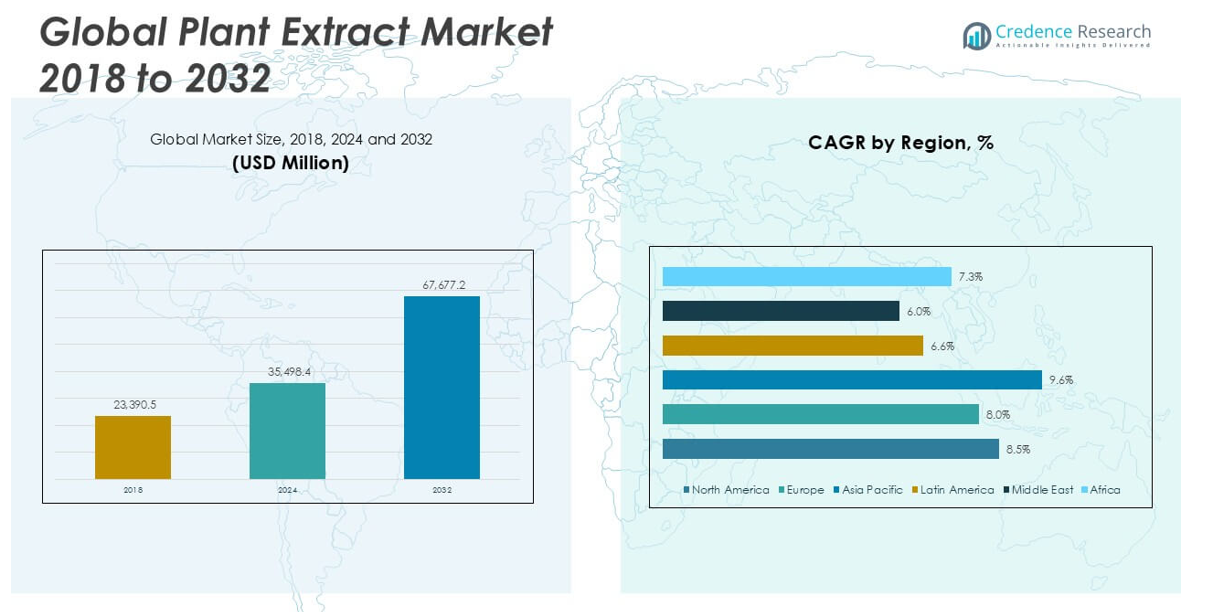
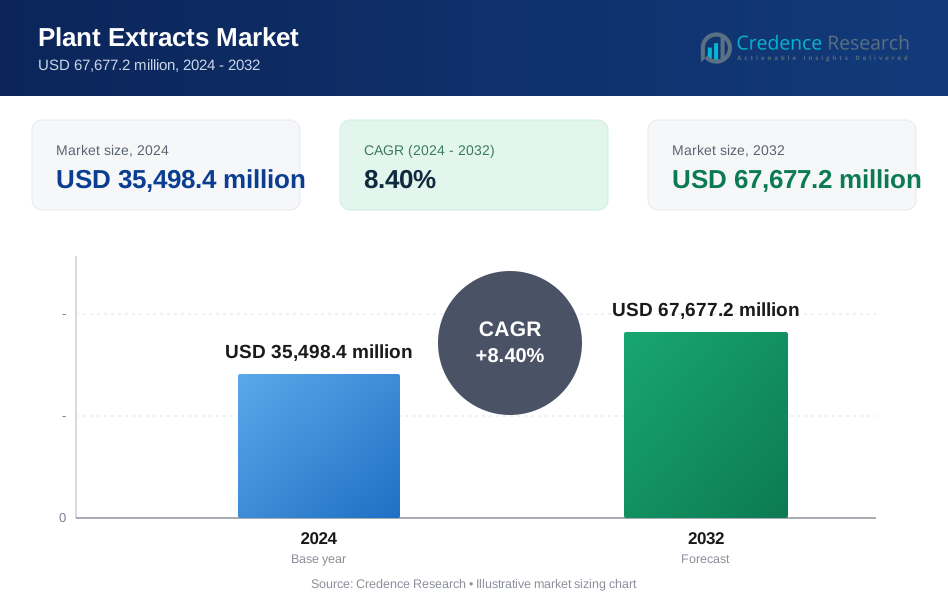
The Plant Extracts Market size was valued at USD 23,390.5 million in 2018, increased to USD 35,498.4 million in 2024, and is anticipated to reach USD 67,677.2 million by 2032, at a CAGR of 8.40% during the forecast period.
| REPORT ATTRIBUTE | DETAILS |
|---|---|
| Historical Period | 2020-2023 |
| Base Year | 2024 |
| Forecast Period | 2025-2032 |
| Plant Extracts Market Size 2024 | USD 35,498.4 million |
| Plant Extracts Market, CAGR | 8.40% |
| Plant Extracts Market Size 2032 | USD 67,677.2 million |
The Plant Extract market is highly competitive, with key players including Givaudan, Symrise AG, International Flavors & Fragrances Inc. (IFF), Dohler GmbH, Sensient Technologies Corporation, Martin Bauer Group, Indena S.p.A., Synthite Industries Ltd., Arjuna Natural Pvt Ltd, Kancor Ingredients Limited, Biolandes SAS, T. Hasegawa Co., Ltd., Kalsec Inc., and Nexira. These companies focus on expanding their product portfolios, investing in advanced extraction technologies, and pursuing strategic collaborations to strengthen their market positions. Asia Pacific leads the global market with a 30.5% market share in 2024, driven by strong demand across pharmaceuticals, food, and cosmetics. North America and Europe follow, supported by high consumer awareness and stringent regulations promoting natural products.
Market Insights
- The Global Plant Extract Market was valued at USD 35,498.4 million in 2024 and is expected to reach USD 67,677.2 million by 2032, growing at a CAGR of 8.40% during the forecast period.
- Increasing consumer demand for natural, clean-label, and plant-based products across food, beverages, pharmaceuticals, and cosmetics is a key driver accelerating market growth.
- Rising trends in functional foods, herbal supplements, and natural cosmetics, along with advancements in extraction technologies, are creating new opportunities in the market.
- The market is highly competitive, with key players like Givaudan, Symrise AG, IFF, Dohler GmbH, and Sensient Technologies focusing on product innovation and strategic partnerships to maintain their market positions.
- Asia Pacific leads the global market with a 30.5% share in 2024, followed by Europe at 29.0% and North America at 26.5%; the spices segment holds the largest share within the product types.
Market Segmentation Analysis:
By Type:
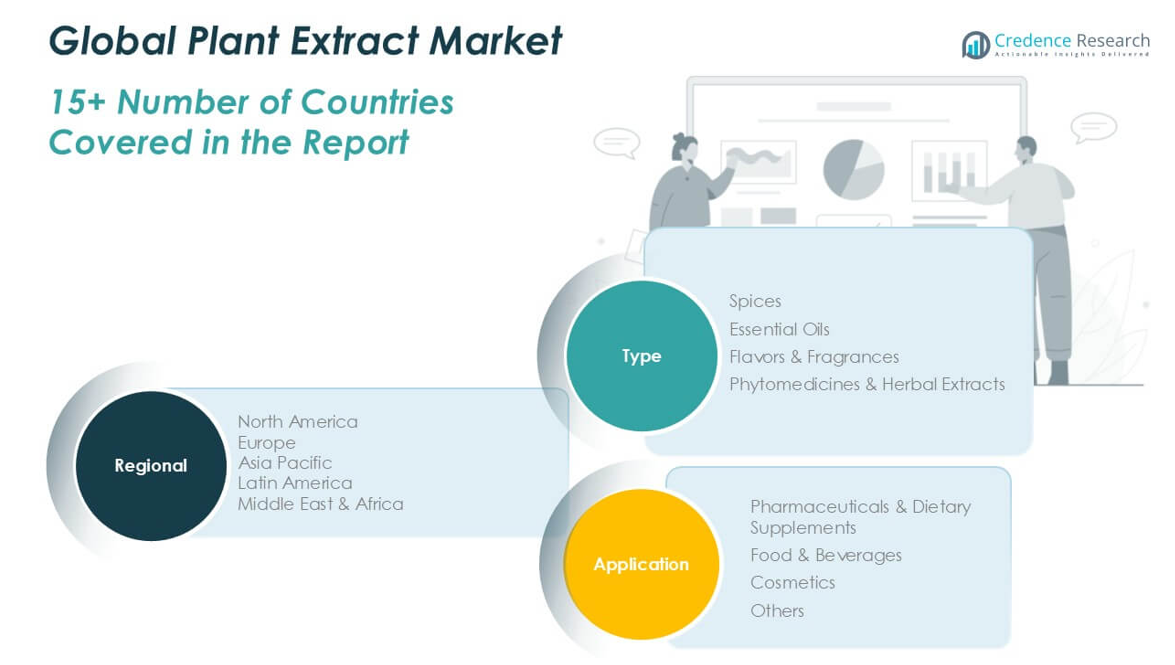
The Plant Extract market by Type is segmented into Spices, Essential Oils, Flavors & Fragrances, and Phytomedicines & Herbal Extracts. Among these, the spices segment holds the dominant market share, primarily driven by its extensive use as natural flavoring agents in the food and beverage industry and the rising consumer demand for chemical-free products. The essential oils segment also shows strong growth, supported by their increasing application in aromatherapy, cosmetics, and pharmaceuticals, where natural and organic ingredients are highly preferred. Flavors and fragrances are rapidly gaining momentum, particularly in the food and personal care sectors, as manufacturers shift towards plant-based, eco-friendly options. Meanwhile, phytomedicines and herbal extracts command a substantial share in the pharmaceutical and dietary supplement industries, driven by the growing reliance on traditional medicine and preventive healthcare.
- For instance, Synthite Industries Ltd. processes over 3,500 metric tons of spices annually to supply global markets with high-quality spice extracts.
By Application:
The Plant Extract market is categorized into Pharmaceuticals & Dietary Supplements, Food & Beverages, Cosmetics, and Others. The pharmaceuticals and dietary supplements segment leads the market, driven by the increasing consumer focus on natural, plant-based health products for immunity and chronic disease management. The food and beverages segment follows closely, supported by strong demand for natural flavoring and clean-label ingredients, with spice and essential oil extracts playing a pivotal role. The cosmetics segment is also expanding significantly as consumers prioritize natural, organic, and sustainable beauty solutions. Plant extracts in skincare and personal care products are highly valued for their therapeutic benefits and minimal side effects, making this a fast-growing application area within the market.
- For instance, IFF's Taste division serves over 38,000 food and beverage product formulations globally.
Market Overview
Rising Demand for Natural and Clean-Label Products
The growing consumer preference for natural, organic, and clean-label products is a major growth driver for the plant extract market. Consumers are increasingly avoiding synthetic additives and chemical ingredients, particularly in food, beverages, cosmetics, and pharmaceuticals. Plant extracts, known for their natural origin and health benefits, are becoming a preferred choice across industries. This shift is further reinforced by stringent regulations promoting the use of natural ingredients and the rising awareness regarding the adverse effects of artificial substances on health and the environment.
- For instance, Dohler GmbH has expanded its portfolio to include over 7,000 natural and plant-based ingredients to meet this demand across food and beverage sectors
Expanding Applications in Pharmaceuticals and Dietary Supplements
The plant extract market is experiencing significant growth due to their expanding use in pharmaceuticals and dietary supplements. Plant-based products are gaining acceptance for their therapeutic properties, minimal side effects, and compatibility with preventive healthcare trends. Consumers are showing strong interest in herbal remedies and phytomedicines for boosting immunity, managing chronic conditions, and enhancing overall well-being. This increasing reliance on plant-based healthcare solutions is accelerating demand for plant extracts in capsules, tablets, and functional food products, supporting long-term market expansion.
- For instance, Arjuna Natural Pvt Ltd produces over 1,000 metric tons of botanical extracts annually for pharmaceutical and nutraceutical use.
Growing Demand in Cosmetics and Personal Care Industry
The cosmetics and personal care industry is driving substantial growth in the plant extract market, fueled by consumer demand for natural, safe, and sustainable beauty products. Plant extracts are widely used in skincare, haircare, and aromatherapy for their beneficial properties, including anti-aging, moisturizing, and anti-inflammatory effects. The clean beauty movement and rising environmental consciousness are pushing manufacturers to replace synthetic chemicals with plant-derived alternatives. This demand for botanical ingredients in premium and mass-market cosmetic products is significantly expanding the application base for plant extracts.
Key Trends & Opportunities
Increasing Focus on Functional Foods and Beverages
A growing trend in the plant extract market is the rising demand for functional foods and beverages enriched with plant-derived ingredients. Consumers are increasingly seeking products that offer added health benefits, such as improved digestion, stress reduction, and immunity support. This creates an opportunity for manufacturers to innovate and develop new formulations using plant extracts like spices, essential oils, and herbal concentrates. The trend is particularly strong in the health-conscious consumer segment, opening new avenues for product diversification and market penetration.
- For instance, Nexira has introduced over 50 plant-based functional ingredients specifically formulated for health-focused food and beverage products.
Technological Advancements in Extraction Processes
Advancements in extraction technologies, such as supercritical fluid extraction and ultrasound-assisted extraction, are creating new opportunities in the plant extract market. These modern techniques enable the production of high-quality, pure extracts while preserving their bioactive compounds. Improved extraction methods also increase production efficiency and reduce solvent usage, aligning with the growing demand for sustainable processing. As companies invest in technological innovations, they can offer superior products with enhanced efficacy, which is expected to drive competitiveness and market growth.
- For instance, Kancor Ingredients Limited has installed over 30 supercritical CO₂ extraction units to optimize plant extract purity and yield
Key Challenges
Raw Material Supply Fluctuations
One of the key challenges in the plant extract market is the fluctuating availability and pricing of raw materials. Plant-based raw materials are heavily dependent on seasonal variations, climatic conditions, and agricultural yields, which can impact supply consistency and cost stability. This variability poses significant risks for manufacturers in terms of production planning and profit margins. Additionally, the increasing demand for certain plant species may lead to overharvesting, further complicating raw material sourcing and sustainability.
Regulatory and Quality Compliance Issues
Compliance with varying international regulations and quality standards presents a significant challenge for the plant extract market. Different countries impose strict guidelines on the use, labeling, and safety of plant-based ingredients, particularly in pharmaceuticals and food applications. Ensuring consistent quality, traceability, and meeting regulatory approvals across regions can be complex and time-consuming. These hurdles may restrict market entry for smaller players and increase operational costs for manufacturers striving to meet evolving compliance requirements.
Intense Market Competition and Price Pressure
The plant extract market faces intense competition from both established and emerging players, leading to price sensitivity and margin pressure. Many companies are offering similar products, which often results in price-driven competition rather than differentiation based on product quality or innovation. Additionally, the entry of low-cost suppliers, especially from developing countries, adds to pricing challenges. To remain competitive, manufacturers must invest in product innovation, sustainable sourcing, and brand positioning to differentiate themselves in a crowded marketplace.
Regional Analysis
North America
In the Plant Extract market, North America accounted for USD 6,666.3 million in 2018 and reached USD 9,407.1 million in 2024, with projected growth to USD 16,174.9 million by 2032, reflecting a CAGR of 8.5%. The region holds approximately 26.5% market share in 2024, driven by strong demand in pharmaceuticals, dietary supplements, and clean-label food products. The growing focus on preventive healthcare, rising consumer preference for natural ingredients, and well-established regulatory frameworks support market expansion. Additionally, increasing applications in the cosmetics and personal care sectors further reinforce North America’s dominant position in the global market.
Europe
Europe represented USD 7,204.3 million in 2018 and grew to USD 10,294.5 million in 2024, with an expected rise to USD 17,325.4 million by 2032, at a CAGR of 8.0%. The region holds around 29.0% market share in 2024, supported by stringent regulations favoring natural and sustainable products. Strong consumer demand for plant-based dietary supplements, organic cosmetics, and functional foods drives the plant extract market in Europe. Increasing awareness of herbal medicine and environmental sustainability, along with well-developed research capabilities, position Europe as a key contributor to the global plant extract industry’s growth.
Asia Pacific
The Asia Pacific market was valued at USD 6,245.3 million in 2018 and surged to USD 10,827.0 million in 2024, with projections reaching USD 24,905.2 million by 2032, making it the fastest-growing region with a CAGR of 9.6%. Holding approximately 30.5% market share in 2024, Asia Pacific leads the global market, driven by high consumer awareness, traditional medicinal practices, and rapid growth in the food, pharmaceutical, and cosmetics sectors. Countries like China, India, and Japan significantly contribute to the market expansion, benefiting from abundant raw material availability and increasing investment in plant-based health products.
Latin America
Latin America’s plant extract market was valued at USD 654.9 million in 2018, rising to USD 1,135.9 million in 2024, with expectations to reach USD 2,977.8 million by 2032, growing at a CAGR of 6.6%. The region holds about 3.2% market share in 2024, supported by increasing demand for natural food additives and herbal supplements. Brazil and Mexico are key contributors, driven by the rising awareness of natural wellness products and expanding pharmaceutical applications. Despite its smaller share, the region presents growth opportunities as consumers increasingly shift towards plant-based, organic, and chemical-free products.
Middle East
The Middle East plant extract market was valued at USD 1,380.0 million in 2018, reaching USD 2,129.9 million in 2024, and is expected to grow to USD 4,534.4 million by 2032, with a CAGR of 6.0%. The region accounts for approximately 6.0% market share in 2024. Growth is driven by rising consumer interest in natural health products and the increasing use of plant extracts in food, beverages, and personal care products. Cultural preferences for herbal remedies and growing urbanization are supporting market expansion, although regulatory complexities and limited raw material sourcing may restrain faster growth.
Africa
Africa’s plant extract market stood at USD 1,239.7 million in 2018 and grew to USD 1,703.9 million in 2024, with projections to reach USD 1,759.6 million by 2032, growing at a CAGR of 7.3%. The region holds roughly 4.8% market share in 2024. Market growth in Africa is supported by increasing traditional medicine use and the gradual rise in demand for plant-based cosmetic and food products. Local industries are showing greater interest in utilizing indigenous plant resources. However, limited industrial processing capabilities and low consumer purchasing power may pose challenges to sustained growth across the region.
Market Segmentations:
By Type
- Spices
- Essential Oils
- Flavors & Fragrances
- Phytomedicines & Herbal Extracts
By Application
- Pharmaceuticals & Dietary Supplements
- Food & Beverages
- Cosmetics
- Others
By Geography
- North America
- U.S.
- Canada
- Mexico
- Europe
- Germany
- France
- U.K.
- Italy
- Spain
- Rest of Europe
- Asia Pacific
- China
- Japan
- India
- South Korea
- South-east Asia
- Rest of Asia Pacific
- Latin America
- Brazil
- Argentina
- Rest of Latin America
- Middle East & Africa
- GCC Countries
- South Africa
- Rest of the Middle East and Africa
Competitive Landscape
The Plant Extract Market shows a moderately concentrated structure with a mix of global and regional players competing for market share. It is characterized by strong demand from diverse industries, including food, beverages, pharmaceuticals, and cosmetics. Major companies focus on expanding their product portfolios, investing in advanced extraction technologies, and forming strategic partnerships to strengthen their market positions. The market prioritizes natural, clean-label, and sustainable products, which drives continuous innovation. Consumer preference is shifting toward plant-based and chemical-free solutions, pushing companies to develop high-quality, pure extracts. Key players such as Givaudan, Symrise AG, IFF, Dohler GmbH, and Sensient Technologies dominate significant shares. The market also sees growing participation from local producers offering region-specific extracts. Price competition remains strong, though quality, traceability, and regulatory compliance are key factors that influence purchasing decisions. Asia Pacific holds the leading regional share, driven by local sourcing and traditional medicine practices, while North America and Europe follow with steady demand.
Key Player Analysis
- Givaudan
- Symrise AG
- International Flavors & Fragrances Inc. (IFF)
- Dohler GmbH
- Sensient Technologies Corporation
- Martin Bauer Group
- Indena S.p.A.
- Synthite Industries Ltd.
- Arjuna Natural Pvt Ltd
- Kancor Ingredients Limited
- Biolandes SAS
- Hasegawa Co., Ltd.
- Kalsec Inc.
- Nexira
Recent Developments
- In June 2025, Givaudan introduced Rainforest Alliance certified vanilla extracts for the European market, emphasizing sustainability and traceability in vanilla sourcing and extraction.
- In May 2025, Givaudan Launched Zensera™, a patent-pending lemon balm extract clinically shown to support cognitive performance under stress, suitable for nutraceutical and beverage applications at a low 300mg dose.
- In August 2023, Döhler acquired Boon Flavors in Thailand, expanding its access to Southeast Asian botanicals and integrating Boon’s state-of-the-art flavor plant and application labs into its global network.
Market Concentration & Characteristics
The Plant Extract Market shows a moderately concentrated structure with a mix of global and regional players competing for market share. It is characterized by strong demand from diverse industries, including food, beverages, pharmaceuticals, and cosmetics. Major companies focus on expanding their product portfolios, investing in advanced extraction technologies, and forming strategic partnerships to strengthen their market positions. The market prioritizes natural, clean-label, and sustainable products, which drives continuous innovation. Consumer preference is shifting toward plant-based and chemical-free solutions, pushing companies to develop high-quality, pure extracts. Key players such as Givaudan, Symrise AG, IFF, Dohler GmbH, and Sensient Technologies dominate significant shares. The market also sees growing participation from local producers offering region-specific extracts. Price competition remains strong, though quality, traceability, and regulatory compliance are key factors that influence purchasing decisions. Asia Pacific holds the leading regional share, driven by local sourcing and traditional medicine practices, while North America and Europe follow with steady demand.
Report Coverage
The research report offers an in-depth analysis based on Type, Application and Geography. It details leading market players, providing an overview of their business, product offerings, investments, revenue streams, and key applications. Additionally, the report includes insights into the competitive environment, SWOT analysis, current market trends, as well as the primary drivers and constraints. Furthermore, it discusses various factors that have driven market expansion in recent years. The report also explores market dynamics, regulatory scenarios, and technological advancements that are shaping the industry. It assesses the impact of external factors and global economic changes on market growth. Lastly, it provides strategic recommendations for new entrants and established companies to navigate the complexities of the market.
Future Outlook
- The Plant Extract Market will experience steady growth driven by rising demand for natural and clean-label products.
- Food and beverage manufacturers will increasingly incorporate plant extracts to meet consumer preferences for chemical-free ingredients.
- Pharmaceuticals and dietary supplements will continue to adopt plant-based formulations for preventive healthcare and immunity support.
- The cosmetics industry will expand its use of plant extracts in natural skincare and personal care products.
- Technological advancements in extraction processes will improve product purity and production efficiency.
- Asia Pacific will remain the leading regional market supported by local sourcing and traditional medicine demand.
- Europe and North America will maintain stable growth with strict regulations favoring natural and organic products.
- Companies will focus on expanding product portfolios and forming strategic partnerships to strengthen market positions.
- Raw material sourcing challenges and supply fluctuations will continue to impact market stability.
- Increasing consumer awareness about sustainability and plant-based health solutions will shape future product development.
Request a Free Sample
Fill in your details and we'll send you a free sample report.
- Sample data tables & charts
- Research methodology
Need a Custom Version of This Report?
Tailor the scope, geography, or segments to your exact requirements.
- Custom geography or segment scope
- Direct access to our analyst team
Frequently Asked Questions
What is the current size of the Plant Extract Market?
What factors are driving the growth of the Plant Extract Market?
What are the key segments within the Plant Extract Market?
What are some challenges faced by the Plant Extract Market?
Who are the major players in the Plant Extract Market?
Table of Content
Chapter 1. Report Introduction
- 1.1 Report Description & Purpose
- 1.1.1 Report Title & Market Definition
- 1.1.2 Unique Selling Propositions (USP) & Key Differentiators
- 1.1.3 Value Proposition for Stakeholders
- 1.2 Research Objectives
- 1.2.1 Market Sizing Objectives (Volume & Revenue) (Volume Where Applicable)
- 1.2.2 Segmentation Objectives
- 1.2.3 Competitive Intelligence Objectives
- 1.2.4 Forecast & Scenario Objectives
- 1.3 Report Scope
- 1.3.1 Plant Extracts Scope – Segments & Subsegments Covered
- 1.3.2 Geographic Scope – Regions & Countries Covered
- 1.3.3 Historical Period, Base Year & Forecast Period (2024; forecast to 2032)
- 1.3.4 Inclusions & Exclusions
- 1.4 Industry Classification & Applicable Codes
- 1.5 Currency, Measurement Units & Valuation Basis
- 1.6 Target Stakeholders
- 1.7 Limitations & Assumptions
Chapter 2. Executive Summary
- 2.1 Global Plant Extracts Market Snapshot
- 2.1.1 Market Size – Historical (2024) & Forecast (2024-2032) (2024: USD 35,498.4 million → 2032: USD 67,677.2 million)
- 2.1.2 Volume & Revenue – Global Totals (Volume Where Applicable)
- 2.1.3 Key Market Highlights – Top Five Facts
- 2.2 Plant Extracts Market Segmentation Snapshot
- 2.2.1 Market Split by Region – 2024 vs. 2032
- 2.3 Competitive Snapshot
- 2.3.1 Top 10 Players by Revenue Share – 2024
- 2.3.2 Top 10 Players by Volume Share – 2024 (Volume Where Applicable)
- 2.3.3 Recent Strategic Developments (18-Month Summary)
- 2.4 Key Investment Highlights & Strategic Conclusions
Chapter 3. Plant Extracts Market Dynamics & Industry Analysis
- 3.1 Market Overview & Context
- 3.1.1 Plant Extracts Market Position in the Broader Industry Value Chain
- 3.1.2 Demand Structure & Purchasing Dynamics
- 3.1.3 Market Maturity & Development Stage by Region
- 3.2 Plant Extracts Market Drivers
- 3.3 Plant Extracts Market Restraints & Challenges
- 3.4 Plant Extracts Market Opportunities
- 3.5 Porter's Five Forces Analysis
- 3.5.1 Threat of New Entrants
- 3.5.2 Bargaining Power of Suppliers
- 3.5.3 Bargaining Power of Buyers
- 3.5.4 Threat of Substitutes
- 3.5.5 Competitive Rivalry – Intensity Assessment
- 3.6 Plant Extracts Value Chain Analysis
- 3.6.1 Upstream – Key Inputs, Resources & Suppliers
- 3.6.1.1 Key Input/Resource 1
- 3.6.1.2 Key Input/Resource 2
- 3.6.1.3 Key Input/Resource 3
- 3.6.2 Midstream – Core Operations & Value Creation
- 3.6.2.1 Operating Model & Process Overview
- 3.6.2.2 Key Operating Locations & Capabilities by Company
- 3.6.3 Downstream – Market Channels & End Users
- 3.6.3.1 Direct Sales & Customer Engagement Channels
- 3.6.3.2 Indirect Sales, Intermediaries & Partner Channels
- 3.6.4 Value Chain Profitability Analysis
- 3.6.1 Upstream – Key Inputs, Resources & Suppliers
- 3.7 PESTEL Analysis
- 3.7.1 Political Factors
- 3.7.2 Economic Factors
- 3.7.3 Social Factors
- 3.7.4 Technological Factors
- 3.7.5 Environmental Factors
- 3.7.6 Legal Factors
- 3.8 Plant Extracts Supply Chain Analysis
- 3.8.1 Critical Input & Resource Availability Risk Assessment
- 3.8.2 Supplier & Operational Concentration Risk (Geographic Exposure)
- 3.8.3 Supply & Service Disruption Impact Analysis
- 3.9 Regulatory & Policy Landscape
Note: The regulatory and policy landscape section covers regulations based on their applicability to the market, Plant Extracts category, geography, and scope of the study. Only regulatory frameworks with a material impact on operations, compliance, trade, sustainability, or market access are analyzed in detail.
Chapter 4. Key Investment Pockets & Opportunity Analysis
- 4.1 Plant Extracts Market Attractiveness Analysis
- 4.1.1 By Region – Investment Attractiveness Matrix (Market Size × CAGR)
- 4.2 Absolute Revenue Growth Opportunity
- 4.2.1 By Region – Absolute Revenue Growth Through 2032
- 4.3 Incremental Demand Opportunity
- 4.3.1 By Region – Incremental Demand Through 2032
- 4.3.2 Segment – Incremental Demand
- 4.4 Emerging Submarket Opportunity Deep Dive (Subject to Applicability)
- 4.5 Priority Market Opportunity Scorecards
- 4.5.1 United States
- 4.5.2 Europe
- 4.5.3 Asia
- 4.5.4 Middle East & Africa
Note: Priority market opportunity scorecards reflect the geographic scope and strategic relevance of the study. Listed markets are indicative and may be adapted to the industry.
Chapter 5. Plant Extracts Cross-Border Trade & Market Access Analysis
- 5.1 International Trade & Cross-Border Activity Overview
- 5.1.1 Global Export Value by Country (2024)
- 5.1.2 Global Export Volume by Country (2024) (Volume Where Applicable)
- 5.1.3 Global Import Value by Country (2024)
- 5.1.4 Global Import Volume by Country (2024) (Volume Where Applicable)
- 5.1.5 Net Trade Balance by Country (2024)
- 5.2 Export Analysis – Segment
- 5.2.1 Category 1 (Applicable Classification Code)
- 5.2.2 Category 2 (Applicable Classification Code)
- 5.2.3 Category 3 (Applicable Classification Code)
- 5.2.4 Category 4 (Applicable Classification Code)
- 5.2.5 Category 5 (Applicable Classification Code)
- 5.3 Import Analysis – Segment
- 5.3.1 Category 1 (Applicable Classification Code)
- 5.3.2 Category 2 (Applicable Classification Code)
- 5.3.3 Category 3 (Applicable Classification Code)
- 5.3.4 Category 4 (Applicable Classification Code)
- 5.3.5 Category 5 (Applicable Classification Code)
- 5.4 Cross-Border Pricing & Transaction Benchmarks
- 5.4.1 Export Pricing – Segment & Country
- 5.4.2 Import Pricing – Segment & Source Country
- 5.4.3 Price Trends (2024)
- 5.5 Key Cross-Border Trade & Delivery Routes
- 5.5.1 Cross-Border Trade/Delivery Route 1
- 5.5.2 Cross-Border Trade/Delivery Route 2
- 5.5.3 Cross-Border Trade/Delivery Route 3
- 5.5.4 Cross-Border Trade/Delivery Route 4
- 5.5.5 Cross-Border Trade/Delivery Route 5
- 5.6 Trade Policy & Market Access Impact Assessment
- 5.6.1 Tariff & Non-Tariff Barriers
- 5.6.2 Regional Trade & Economic Integration Frameworks
- 5.6.3 Bilateral & Multilateral Trade Agreements
- 5.6.4 Cross-Border Operating, Licensing & Localization Requirements
Note: This chapter applies where cross-border trade or delivery is relevant to Plant Extracts. Goods, services, and digital offerings are assessed using applicable classifications and transaction measures. Import-export volumes, trade balances, and route analyses are included only where meaningful to the market.
Chapter 6. Competitive Landscape & Company Benchmarking
- 6.1 Plant Extracts Market Concentration & Structure
- 6.1.1 Herfindahl-Hirschman Index (HHI) – vs. 2024
- 6.1.2 Leading, Mid-Sized & Emerging Player Structure
- 6.1.3 Global, Regional & Local Player Dynamics
- 6.2 Plant Extracts Market Share Analysis – 2024
- 6.2.1 Global Revenue Share by Company
- 6.2.2 Global Volume Share by Company (Volume Where Applicable)
- 6.2.3 Regional Revenue Share
- 6.2.4 Market Share Evolution ( vs. 2024)
- 6.2.5 Company Market Share by Key Segment
- 6.2.6 Company Market Share by Customer Group
- 6.3 Operating Scale, Capacity & Infrastructure Analysis
- 6.3.1 Global Operating Scale & Supply Capacity
- 6.3.2 Resource Utilization & Operating Efficiency
- 6.3.3 Output, Service Delivery & Activity Metrics
- 6.3.4 Operating Footprint & Infrastructure Map
- 6.3.5 Planned Operational & Capacity Expansion
- 6.4 Plant Extracts Competitive Benchmarking Matrix
- 6.4.1 Revenue, Growth, Profitability & Operating Metric Comparison
- 6.4.2 Channel Revenue Mix
- 6.4.3 Geographic Revenue Exposure
- 6.4.4 R&D Intensity
- 6.4.5 Sustainability Maturity
- 6.5 Strategic Developments in Plant Extracts (Last 24 Months)
- 6.5.1 Mergers, Acquisitions & Divestments
- 6.5.2 New Products, Services & Solutions in Plant Extracts
- 6.5.3 Operational & Infrastructure Expansions
- 6.5.4 Strategic Alliances, Joint Ventures & Partnerships
- 6.5.5 Distribution Expansion & Market Entry
- 6.5.6 Sustainability & ESG Initiatives
- 6.6 Competitive Strategy Mapping
- 6.6.1 Leader, Challenger, Follower & Niche Classification
- 6.6.2 Pricing Strategy Comparison
- 6.6.3 Channel Strategy Matrix
Note: Strategic developments are included based on their materiality and the availability of reliable information.
Chapter 7. Global Plant Extracts Market – By Sales & Delivery Channel
- 7.1 Segment Overview
- 7.1.1 Volume & Revenue Split by Channel (2024 & 2032) (Volume Where Applicable)
- 7.1.2 Channel Mix Evolution (2024-2032)
Chapter 8. Regional Market Analysis – Global Overview
- 8.1 Global Regional Overview
- 8.1.1 Regional Volume Share (Volume Where Applicable)
- 8.1.2 Regional Revenue Share
- 8.1.3 Regional Volume by Region (Volume Where Applicable)
- 8.1.4 Regional Revenue by Region
- 8.1.5 Regional Forecast Through 2032
- 8.2 Cross-Regional Segment Analysis
- 8.2.1 By Sales & Delivery Channel
- 8.2.2 By Competitive Positioning & Price Tier
Chapter 9. North America Plant Extracts Market
- 9.1 United States
- 9.2 Canada
- 9.3 Mexico
Chapter 10. Europe Plant Extracts Market
- 10.1 Germany
- 10.2 France
- 10.3 Italy
- 10.4 United Kingdom
- 10.5 Spain
- 10.6 Poland
- 10.7 Russia
- 10.8 Netherlands
- 10.9 Belgium
- 10.10 Sweden
- 10.11 Denmark
- 10.12 Norway
- 10.13 Rest of Europe
Chapter 11. Asia Pacific Plant Extracts Market
- 11.1 China
- 11.2 India
- 11.3 Japan
- 11.4 South Korea
- 11.5 Thailand
- 11.6 Indonesia
- 11.7 Vietnam
- 11.8 Malaysia
- 11.9 Australia
- 11.10 Rest of Asia Pacific
Chapter 12. Latin America Plant Extracts Market
- 12.1 Brazil
- 12.2 Argentina
- 12.3 Colombia
- 12.4 Chile
- 12.5 Rest of Latin America
Chapter 13. Middle East Plant Extracts Market
- 13.1 Saudi Arabia
- 13.2 United Arab Emirates
- 13.3 Turkey
- 13.4 Israel
- 13.5 Iran
- 13.6 Rest of the Middle East
Chapter 14. Africa Plant Extracts Market
- 14.1 South Africa
- 14.2 Egypt
- 14.3 Nigeria
- 14.4 Morocco
- 14.5 Rest of Africa
Chapter 15. Plant Extracts Company Profiles
- 15.1 [Company 01]
- 15.1.1 Company Overview
- 15.1.2 Key Management Personnel
- 15.1.3 Products & Services Portfolio
- 15.1.4 Financial Performance
- 15.1.5 Key Market Focus & Geographic Presence
- 15.1.6 Recent Developments & Strategic Initiatives
Note: The company profile list is preliminary and may change based on research findings, market developments, data availability, and client requirements.
Chapter 16. Appendices
- Appendix A – List of Abbreviations & Acronyms
- Appendix B – Industry Classification Code Reference – Full Series
- Appendix C – Supply, Output & Operating Capacity Data Tables
- Appendix D – End-Use & Demand Base Tables
- Appendix E – Demand, Adoption & Usage Assumptions
- Appendix F – Pricing & Revenue Metric Reference Tables
- Appendix G – Company Operations & Infrastructure Database
- Appendix H – Cross-Border Trade & Activity Data Tables (Where Applicable)
- Appendix I – Regulatory Summary Tables
- Appendix J – Primary Research Participant List (Anonymized)
- Appendix K – Primary Research Questionnaire Framework
- Appendix L – Data Sources & Bibliography
- Appendix M – Market Size Divergence & Source Comparison
Chapter 17. Research Methodology
- 17.1 Research Framework & Philosophy
- 17.2 Secondary Research – Sources, Hierarchy & Data Extraction
- 17.3 Data Modeling – Bottom-Up & Top-Down Market Sizing
- 17.4 Primary Research – Stakeholder Framework, LOI & Sample Sizes
- 17.5 Forecast Methodology – Regression, Scenario & Sensitivity Analysis
- 17.6 Quality Control – Four-Layer Validation Framework
- 17.7 Limitations & Standard Assumptions
- 17.8 Disclaimer
