
| REPORT ATTRIBUTE | DETAILS |
|---|---|
| Historical Period | 2019-2022 |
| Base Year | 2023 |
| Forecast Period | 2024-2032 |
| Gas Engines Market Size 2023 | USD 4951.2 Million |
| Gas Engines Market, CAGR | 4.60% |
| Gas Engines Market Size 2032 | USD 7421.5 Million |
Market Insights
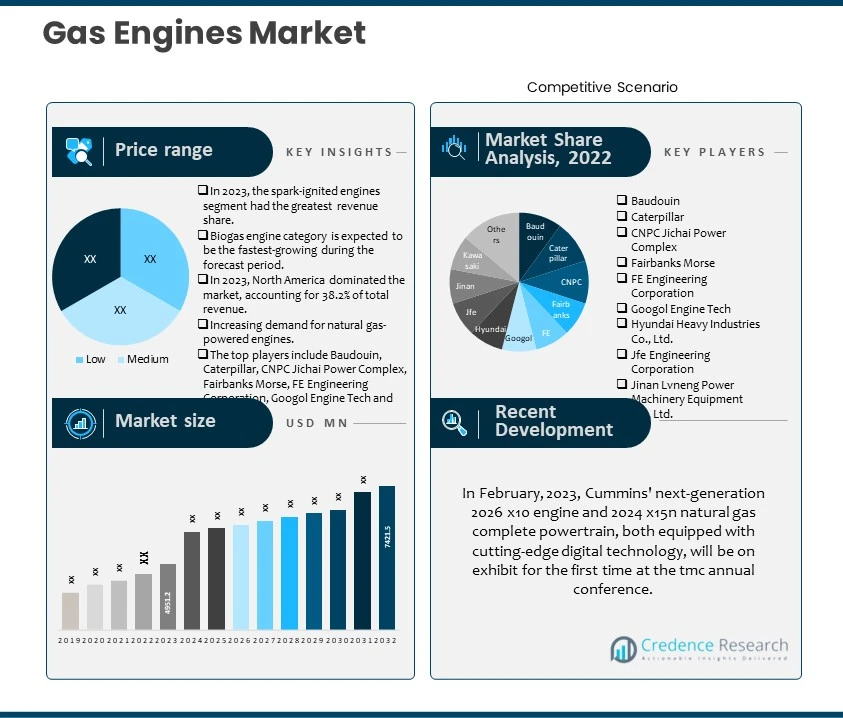
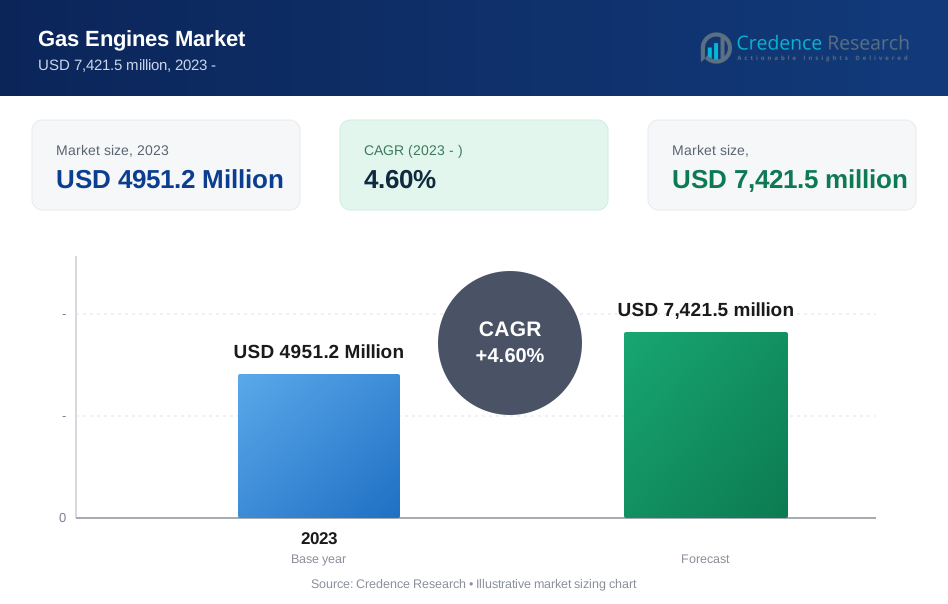
- The global demand for Gas engines was valued at USD 4951.2 million in 2023 and is expected to reach USD 7421.5 million in 2032, growing at a CAGR of 4.60% between 2024 and 2032.
- The natural gas gensets segment had the biggest revenue share in 2023 and The Biogas engine category is anticipated to be the fastest-growing during the forecast period
- In 2023, the spark-ignited engines segment had the highest revenue share.
- In 2023, the 1-2 MW segment dominated the gas engine market.
- The power-generating segment had the biggest share in 2023 and is likely to maintain its dominance during the projection period. The mechanical drive sector accounts for the majority of the gas engine market.
- The utilities category has the greatest market share and is anticipated to grow significantly during the forecast period. Manufacturing is the most popular segment in the market in 2023
- In 2023, North America dominated the market, accounting for 38.2% of total revenue. The Europe market is expected to rise at a significant CAGR, while the Asia Pacific market will grow steadily and quickly..
- Implementing Stringent Emission Regulations to Promote Growth
- Natural gas reserves and prices are both limited.
Executive Summary
Market Definition
A gas engine is a reciprocating internal combustion engine that runs largely on natural gas and other specialized gases including shale gas, mine gas, biogas, landfill gas, sewage gas, and syngas. These engines typically reach greater than 90% efficiency because to their excellent electrical and thermal efficiency, low operating and service costs, and high dependability.
They are utilized in a variety of applications, including power generation, cogeneration, mechanical drive, and tri-generation, such as district heating systems, hospitals, universities, and industrial units.
Market Overview
The global Gas Engines Market has witnessed steady growth in recent years and is expected to grow at a CAGR of 4.60% between 2024 and 2032. The market was valued at USD 4951.2 million in 2023 and is expected to reach USD 7421.5 million in 2032.
Gas engines have several advantages over other types of engines, including lower pollutants, increased efficiency, and cheaper maintenance costs. The gas engine market is being driven by rising demand for clean and efficient power production technologies, an increase in the usage of distributed power generation systems, and stricter emissions restrictions.
Internal combustion engines use gaseous fuels such as natural gas, biogas, landfill gas, or hydrogen. They are employed in a variety of purposes, including power generation, transportation, and industrial processes. Gas engines have several advantages over other types of engines, including lower pollutants, increased efficiency, and cheaper maintenance costs. The increased demand for clean and efficient power generation technologies has increased the number of gas engines. This is primarily because they emit less pollutants, are more efficient, and require less maintenance than other engine types.
This is primarily because they emit less pollutants, are more efficient, and require less maintenance than other engine types.
Segmentation By Type of Gas Engines
- The natural gas gensets segment had the highest revenue share in 2023. Natural gas gensets, often known as generators, are a type of generator that operates on natural gas rather than gasoline or diesel. Natural gas generators are inexpensive, easy to operate, and better for the environment. Natural gas is a stable and abundant fuel source that provides a steady and continuous power supply for gensets. It is also a clean-burning fuel that emits less emissions than other fossil fuels such as coal or diesel, which is driving revenue growth in the sector.
- The Biogas engine category is predicted to be the fastest-growing during the projection period. Biogas is a sustainable energy source used in gas engines to generate electricity, particularly in waste treatment plants and farms. Biogas is created by anaerobic digestion of organic materials such as sewage, agricultural waste, and landfills.
Segmentation By Technology
- In 2023, the spark-ignited engines segment had the biggest revenue share. Spark-ignited engines play an important part in the Internal Combustion Engine (ICE) sector. They are widely used in cars and power generation applications. Spark-ignited engines are used to generate energy in power plants and to power a variety of equipment and machinery, including generators and portable power tools. They are commonly used in vehicles such as cars, trucks, buses, and motorcycles because they provide a good blend of power, efficiency, and cost.
Segmentation By Power Output
- The 1-2 MW segment accounted for the majority of gas engine market share in 2023, and it is predicted to rise since these generators are largely employed in power production and cogeneration. Cogeneration engines generate power as well as energy for space heating and water heating, resulting in up to a 60% energy savings.
- Gas engines with power outputs below 1 MW are necessary for small-scale applications. These engines are distinguished by their small size, efficiency, and versatility, making them valuable in a variety of applications.
Segmentation by Application
- The power generation segment had the largest share in 2023 and is expected to maintain its dominance throughout the projection period. These engines are generally utilized in manufacturing plants, commercial buildings, public buildings, and utilities to provide on-site electricity.
- The mechanical drive segment accounts for the greatest proportion of the gas engine market and is predicted to grow significantly during the forecast period. Gas engines provide direct power to mechanical devices such as pumps, compressors, blowers, chillers, and other spinning gear.
Segmentation by End-User Industry
- The utilities category has the largest market share and is predicted to develop significantly during the forecast period. Gas engines play an important role in helping utility companies achieve their goals. One of their key functions is to generate electricity from natural gas or other fuels, which gas engines do efficiently. These engines are frequently used in power plants, both large and small, to generate electricity for distribution via the grid.
- Manufacturing is the popular segment in the market in 2023.
Segmentation by Region
- In 2023, North America dominated the market, accounting for 38.2% of total revenue.
- The Europe market is projected to develop at a considerable CAGR, while the Asia Pacific market will have steady and quick revenue growth.
- The rest of the world, including Latin America, the Middle East, and Africa, supplies the remaining demand for Gas Engines.
North America's market accounted for the biggest revenue share in 2023, owing to rigorous emission 3requirements and the necessity for efficient power generation in nations like the United States and Canada. Natural gas price reductions have had a significant impact on the regional economy, which is another element driving the market's revenue growth. Furthermore, the presence of prominent competitors in the region, as well as their numerous product launches, is supporting the market's revenue growth.
Moreover, Over the forecast period, the Europe market is expected to grow significantly in terms of revenue CAGR. Increasing concern about energy efficiency, cost-effectiveness, and environmental sustainability is a major driver driving revenue growth in this region. Furthermore, the presence of industry-leading businesses and partnerships in the region is boosting revenue growth in the market.
The Asia Pacific market is expected to have consistent and rapid revenue growth throughout the projected period. The region's revenue growth is being driven by the increasing usage of natural gas engines in the commercial sector and rising demand for clean and efficient power production technologies in nations such as India, China, and Japan.
Key Highlights of the Report
Type of Gas Engines, Technology, Power Output, Application, End-User Industry and region segment the global Gas Engines Market. The natural gas gensets section had the biggest revenue share in 2023, while the biogas engine category is expected to develop the fastest. In addition, the 1-2 MW category accounted for the majority of the gas engine market share, and manufacturing is the most popular segment in the industry, with North America dominating market growth.
Several factors are driving growth in the Gas Engines Market, including rising demand for natural gas-powered engines, a growing emphasis on greener energy solutions, and increased gas engine usage across a variety of industries. However, the market faces constraints such as fluctuating natural gas costs, regulatory issues connected to emission requirements, and competition from alternative energy sources. Despite these limitations, there are prospects for expansion, such as improved gas engine efficiency, expanded uses in power production and transportation, and the development of novel gas engine technologies. These factors affect the landscape of the Gas Engines Market, determining its trajectory and future growth potential.
North America had the highest revenue share in 2023, owing to severe pollution requirements and the need for efficient power generation in nations such as the United States and Canada. The Europe market is predicted to expand significantly in terms of revenue CAGR. The growing concern about energy efficiency, cost-effectiveness, and environmental sustainability is a primary driver of revenue growth in this region. In addition, the Asia Pacific market is likely to grow consistently and rapidly over the forecast period.
What Are The Main Drivers Of The Global Gas Engines Market?
Increasing demand for natural gas-powered engines, growing focus on cleaner and more sustainable energy solutions, and rising usage of gas engines in various industries are the primary drivers of the market.
What Are The Major Challenges Faced By The Global Gas Engines Market?
The primary market restrictions are fluctuating natural gas costs, regulatory difficulties and emissions regulations, and competition from other energy sources.
What Are The Growth Opportunities In The Global Gas Engines Market?
The significant market possibilities are technological breakthroughs in gas engine efficiency, expansion of gas engine applications in power production and transportation, and development of unique gas engine solutions.
Market Drivers
Several factors drive the global Gas Engines Market. The following are the key drivers of the global Gas Engines Market:
Implementing Stricter Emission Regulations
Various factors driving global market expansion include expanding demand for gas-fired power production technology and a growing emphasis on minimizing carbon emissions. The US Energy Information Administration (EIA) reports that natural gas output increased by 9.8 billion cubic feet per day (Bcf/d) in 2019, up 10% from 2018. These engines are widely employed in power plants to provide power to drive the generator, which produces electricity and supplies power to various utilities. They also offer a high operational rate, quick startup, and changeable load efficiency based on power consumption. Such factors are likely to expand the use of natural gas-powered engines for electricity generation.
Many countries around the world, including Canada, India, and Germany, are working to build natural gas-powered engines for power plants. For instance, under the Intended Nationally Determined Contributions (INDC), Canada intends to cut greenhouse gas emissions by 30% below 2005 levels by 2030. Such reasons would lead to increased installation in power plants, as these engines emit less carbon dioxide than coal and diesel engines.
Market Restraints
The global Gas Engines Market faces some challenges that may hinder its growth. These include the following:
Limited Natural Gas Reserves and Prices
Differences between countries can impede growth. Natural gas reserve abnormalities and fluctuating prices are projected to impede market growth. According to the BP Energy Outlook 2019, former Soviet Union countries such as Iran and Qatar own two-thirds of the world's natural gas reserves. Furthermore, the discovery and supply of the majority of the world's natural gas are concentrated in a few nations, resulting in price disparities among distributors.
According to the U.S. Energy Information Administration's (EIA) Short-Term Energy Outlook (STEO), natural gas prices averaged USD 2.30 per million British thermal units (MMBtu) in August 2020, up from USD 1.77/MMBtu in July. The Energy Information Administration (EIA) predicts that rising domestic consumption and increased natural gas exports, combined with decreasing production, would lead natural gas prices to rise to a monthly average of USD 3.40/MMBtu in January 2021. This aspect is projected to stymie gas engine market expansion over the forecast year.
Opportunities
The global Gas Engines Market offers significant growth opportunities. These include the following:
Increased Innovation In The Development Of Efficient Gasoline Engines
The increased level of innovation seen in the development of efficient gas engines suggests a possible avenue for growth in the gas engine market. This is due to the possibility of new and improved products and services that can effectively meet client wants and expectations. This trend has the potential to provide manufacturers and suppliers in the gas engine industry with competitive advantages and new market opportunities. Developing new and better technologies to increase gas engine performance, reliability, and cost-effectiveness. Advanced combustion modes are innovative ways of burning the fuel-air mixture in the engine cylinder to provide improved efficiency, reduced emissions, and greater fuel flexibility.
Competitive Landscape
Key Players
The global Gas Engines Market is highly competitive, with several key players. Some of the major players in the market and their market share are as follows:
- Baudouin
- Caterpillar
- CNPC Jichai Power Complex
- Fairbanks Morse
- FE Engineering Corporation
- Googol Engine Tech
- Hyundai Heavy Industries Co., Ltd.
- Jfe Engineering Corporation
- Jinan Lvneng Power Machinery Equipment Co., Ltd.
- Kawasaki Heavy Industries, Ltd.
- Liebherr, Mitsubishi Heavy Industries, Ltd.
- Ningbo C.S.I Power & Machinery Group Co. Ltd.
- R Schmitt Enertec
- Siemens Energy
- Volkswagen (Man Energy Solutions).
These organizations prioritize product innovation, End-User Industry expansion, and mergers and acquisitions to stay competitive.
The global Gas Engines Market's key players continually seek to stay ahead by offering new products and developments.
In March 2023, ITP Aero, a Spanish aviation engine manufacturer, has stated that it will head a national collaboration to test and build the first hydrogen-fueled commercial aircraft engine built locally. The USD 13 million Cryogenics, Fuel Cells, and Hydrogen Combustion in Air Transport project is part of the Spanish the Minister of Science's Aeronautical Technology Plan, which CDTI, the Spanish Center for Technological Development and Innovation manage. It is also co-funded by European Union Next Gen strategic investment funding.
In November 2022, The Weichai Group introduced a commercial natural gas engine with a base thermal efficiency of 54.16%. The natural gas engine is most likely built on Westport high-pressure direct injection (HPDI) technology. Technical enhancements to the 54.16% BTE natural gas engine include high thermal efficiency technology found in diesel engines, such as high-efficiency turbocharging and low friction technologies. The engine has a 'dual-step' (or 'two-step') combustion chamber arrangement, which could refer to a stepped lip bowl.
In April 2023, Cummins announced more than $1 billion in investments across its U.S. manufacturing network. The investment will modernize those facilities to enable the industry's first fuel-agnostic engine platforms. These platforms will run on low-carbon fuels such as natural gas, diesel, and, eventually, hydrogen, thereby helping to decarbonize the nation's truck fleets.
Summary of Key Findings
- Increased innovation in the development of efficient gasoline engines is a crucial opportunity for the market.
- Market segmented By Type of Gas Engines, Technology, Power Output, Application, End-User Industry and region.
- In 2023, the spark-ignited engine segment had the largest revenue share.
- In 2023, the 1-2 MW segment had the majority of the gas engine market share.
- North America is leading in market growth; the market is highly competitive with key players, including Baudouin, Caterpillar, CNPC Jichai Power Complex, Fairbanks Morse, FE Engineering Corporation, Googol Engine Tech and Others.
Future Outlook
- Increasing demand for natural gas-powered engines.
- Growing emphasis on cleaner, more sustainable energy options.
- Increased usage of gas engines in many industries.
- Technological innovations propel market expansion.
- Increasing gas engine usage in power generation and transportation.
How CXOs Can Benefit from the Credence Research Gas Engines Market Report
The Credence Research Gas Engines Market Report provides CXOs with a comprehensive overview of the market, including:
- Market size and growth forecast: The report provides detailed estimates of the global Gas Engines Market size, segmented By Type of Gas Engines, Technology, Power Output, Application , End-User Industry and region. It also includes forecasts for the market through 2032 based on key trends and drivers.
- Market segmentation: The report segments the Gas Engines Market By Type of Gas Engines, Technology, Power Output, Application , End-User Industry and region. This segmentation provides CXOs with a granular understanding of the market and the opportunities in each segment.
- Competitive Landscape: The report profiles the key players in the Gas Engines Market and provides insights into their strategies, product offerings, and financial performance. This information can help CXOs to identify and assess their competition.
- Key trends and drivers: The report identifies and analyzes the key trends and drivers that are shaping the Gas Engines Market. This information can help CXOs to make informed decisions about their investments and strategies.
CXOs can use the insights from the Credence Research Gas Engines Market Report to:
- Identify growth opportunities: The report can help CXOs identify new growth opportunities in the Gas Engines Market. By analyzing the data and trends in the report, they can make informed decisions about where to invest and expand their business.
- Make informed investment decisions: The report can help CXOs make informed investment decisions about Gas Engines. By examining the insights and trends in the report, they can strategically allocate resources and capitalize on the right opportunities in the market.
- Develop competitive strategies: The report can help CXOs develop competitive strategies for their Gas Engines businesses. For example, by delving into the insights and trends within the report, they can strategically position themselves in the market and stay ahead of the competition.
- Track market developments: The report can help CXOs monitor market developments and stay ahead of the curve. For example, it provides insights into the latest trends and innovations in the Gas Engines Market.
Overall, the Credence Research Gas Engines Market Report is a valuable resource for CXOs who are looking to gain a deeper understanding of the market and identify opportunities for growth.
Segmentation
- By Type of Gas Engine:
- Natural Gas Engines
- Biogas Engines
- Landfill Gas Engines
- Syngas Engines
- Others
- By Technology:
- Spark Ignition (Otto Cycle) Gas Engines
- Compression Ignition (Diesel Cycle) Gas Engines
- By Power Output:
- Below 1 MW
- 1 MW to 2 MW
- 2 MW to 5 MW
- Above 5 MW
- By Application:
- Power Generation
- Cogeneration/Combined Heat and Power (CHP)
- Mechanical Drive (e.g., industrial pumps, compressors)
- Others
- By End-User Industry:
- Utilities
- Manufacturing
- Oil & Gas
- Commercial Buildings
- Residential Buildings
- Agriculture
- Mining
- Healthcare
- Others
- By Region
- North America
- The U.S.
- Canada
- Mexico
- Europe
- Germany
- France
- The U.K.
- Italy
- Spain
- Rest of Europe
- Asia Pacific
- China
- Japan
- India
- South Korea
- South-east Asia
- Rest of Asia Pacific
- Latin America
- Brazil
- Argentina
- Rest of Latin America
- Middle East & Africa
- GCC Countries
- South Africa
- Rest of the Middle East and Africa
- North America
Request a Free Sample
Fill in your details and we'll send you a free sample report.
- Sample data tables & charts
- Research methodology
Need a Custom Version of This Report?
Tailor the scope, geography, or segments to your exact requirements.
- Custom geography or segment scope
- Direct access to our analyst team
Frequently Asked Questions
What is the current size of the global Gas Engines Market?
What is the expected growth rate of the Gas Engines Market between 2024 and 2032?
Which segment is leading the market share in terms of Application?
Which End-User Industry segment governs the demand for Gas Engines in the world?
Who are the major players in the global Gas Engines Market?
Table of Content
Chapter 1. Report Introduction
- 1.1 Report Description & Purpose
- 1.1.1 Report Title & Market Definition
- 1.1.2 Unique Selling Propositions (USP) & Key Differentiators
- 1.1.3 Value Proposition for Stakeholders
- 1.2 Research Objectives
- 1.2.1 Market Sizing Objectives (Volume & Revenue) (Volume Where Applicable)
- 1.2.2 Segmentation Objectives
- 1.2.3 Competitive Intelligence Objectives
- 1.2.4 Forecast & Scenario Objectives
- 1.3 Report Scope
- 1.3.1 Gas Engines Scope – Segments & Subsegments Covered
- 1.3.2 Geographic Scope – Regions & Countries Covered
- 1.3.3 Historical Period, Base Year & Forecast Period (2023; forecast to the forecast period)
- 1.3.4 Inclusions & Exclusions
- 1.4 Industry Classification & Applicable Codes
- 1.5 Currency, Measurement Units & Valuation Basis
- 1.6 Target Stakeholders
- 1.7 Limitations & Assumptions
Chapter 2. Executive Summary
- 2.1 Global Gas Engines Market Snapshot
- 2.1.1 Market Size – Historical (2023) & Forecast (the forecast period) (2023: USD 4951.2 Million → forecast year: USD 7,421.5 million)
- 2.1.2 Volume & Revenue – Global Totals (Volume Where Applicable)
- 2.1.3 Key Market Highlights – Top Five Facts
- 2.2 Gas Engines Market Segmentation Snapshot
- 2.2.1 Market Split by Region – 2023 vs.
- 2.3 Competitive Snapshot
- 2.3.1 Top 10 Players by Revenue Share – 2023
- 2.3.2 Top 10 Players by Volume Share – 2023 (Volume Where Applicable)
- 2.3.3 Recent Strategic Developments (18-Month Summary)
- 2.4 Key Investment Highlights & Strategic Conclusions
Chapter 3. Gas Engines Market Dynamics & Industry Analysis
- 3.1 Market Overview & Context
- 3.1.1 Gas Engines Market Position in the Broader Industry Value Chain
- 3.1.2 Demand Structure & Purchasing Dynamics
- 3.1.3 Market Maturity & Development Stage by Region
- 3.2 Gas Engines Market Drivers
- 3.3 Gas Engines Market Restraints & Challenges
- 3.4 Gas Engines Market Opportunities
- 3.5 Porter's Five Forces Analysis
- 3.5.1 Threat of New Entrants
- 3.5.2 Bargaining Power of Suppliers
- 3.5.3 Bargaining Power of Buyers
- 3.5.4 Threat of Substitutes
- 3.5.5 Competitive Rivalry – Intensity Assessment
- 3.6 Gas Engines Value Chain Analysis
- 3.6.1 Upstream – Key Inputs, Resources & Suppliers
- 3.6.1.1 Key Input/Resource 1
- 3.6.1.2 Key Input/Resource 2
- 3.6.1.3 Key Input/Resource 3
- 3.6.2 Midstream – Core Operations & Value Creation
- 3.6.2.1 Operating Model & Process Overview
- 3.6.2.2 Key Operating Locations & Capabilities by Company
- 3.6.3 Downstream – Market Channels & End Users
- 3.6.3.1 Direct Sales & Customer Engagement Channels
- 3.6.3.2 Indirect Sales, Intermediaries & Partner Channels
- 3.6.4 Value Chain Profitability Analysis
- 3.6.1 Upstream – Key Inputs, Resources & Suppliers
- 3.7 PESTEL Analysis
- 3.7.1 Political Factors
- 3.7.2 Economic Factors
- 3.7.3 Social Factors
- 3.7.4 Technological Factors
- 3.7.5 Environmental Factors
- 3.7.6 Legal Factors
- 3.8 Gas Engines Supply Chain Analysis
- 3.8.1 Critical Input & Resource Availability Risk Assessment
- 3.8.2 Supplier & Operational Concentration Risk (Geographic Exposure)
- 3.8.3 Supply & Service Disruption Impact Analysis
- 3.9 Regulatory & Policy Landscape
Note: The regulatory and policy landscape section covers regulations based on their applicability to the market, Gas Engines category, geography, and scope of the study. Only regulatory frameworks with a material impact on operations, compliance, trade, sustainability, or market access are analyzed in detail.
Chapter 4. Key Investment Pockets & Opportunity Analysis
- 4.1 Gas Engines Market Attractiveness Analysis
- 4.1.1 By Region – Investment Attractiveness Matrix (Market Size × CAGR)
- 4.2 Absolute Revenue Growth Opportunity
- 4.2.1 By Region – Absolute Revenue Growth Through the forecast period
- 4.3 Incremental Demand Opportunity
- 4.3.1 By Region – Incremental Demand Through the forecast period
- 4.3.2 Segment – Incremental Demand
- 4.4 Emerging Submarket Opportunity Deep Dive (Subject to Applicability)
- 4.5 Priority Market Opportunity Scorecards
- 4.5.1 United States
- 4.5.2 Europe
- 4.5.3 Asia
- 4.5.4 Middle East & Africa
Note: Priority market opportunity scorecards reflect the geographic scope and strategic relevance of the study. Listed markets are indicative and may be adapted to the industry.
Chapter 5. Gas Engines Cross-Border Trade & Market Access Analysis
- 5.1 International Trade & Cross-Border Activity Overview
- 5.1.1 Global Export Value by Country (2023)
- 5.1.2 Global Export Volume by Country (2023) (Volume Where Applicable)
- 5.1.3 Global Import Value by Country (2023)
- 5.1.4 Global Import Volume by Country (2023) (Volume Where Applicable)
- 5.1.5 Net Trade Balance by Country (2023)
- 5.2 Export Analysis – Segment
- 5.2.1 Category 1 (Applicable Classification Code)
- 5.2.2 Category 2 (Applicable Classification Code)
- 5.2.3 Category 3 (Applicable Classification Code)
- 5.2.4 Category 4 (Applicable Classification Code)
- 5.2.5 Category 5 (Applicable Classification Code)
- 5.3 Import Analysis – Segment
- 5.3.1 Category 1 (Applicable Classification Code)
- 5.3.2 Category 2 (Applicable Classification Code)
- 5.3.3 Category 3 (Applicable Classification Code)
- 5.3.4 Category 4 (Applicable Classification Code)
- 5.3.5 Category 5 (Applicable Classification Code)
- 5.4 Cross-Border Pricing & Transaction Benchmarks
- 5.4.1 Export Pricing – Segment & Country
- 5.4.2 Import Pricing – Segment & Source Country
- 5.4.3 Price Trends (2023)
- 5.5 Key Cross-Border Trade & Delivery Routes
- 5.5.1 Cross-Border Trade/Delivery Route 1
- 5.5.2 Cross-Border Trade/Delivery Route 2
- 5.5.3 Cross-Border Trade/Delivery Route 3
- 5.5.4 Cross-Border Trade/Delivery Route 4
- 5.5.5 Cross-Border Trade/Delivery Route 5
- 5.6 Trade Policy & Market Access Impact Assessment
- 5.6.1 Tariff & Non-Tariff Barriers
- 5.6.2 Regional Trade & Economic Integration Frameworks
- 5.6.3 Bilateral & Multilateral Trade Agreements
- 5.6.4 Cross-Border Operating, Licensing & Localization Requirements
Note: This chapter applies where cross-border trade or delivery is relevant to Gas Engines. Goods, services, and digital offerings are assessed using applicable classifications and transaction measures. Import-export volumes, trade balances, and route analyses are included only where meaningful to the market.
Chapter 6. Competitive Landscape & Company Benchmarking
- 6.1 Gas Engines Market Concentration & Structure
- 6.1.1 Herfindahl-Hirschman Index (HHI) – vs. 2023
- 6.1.2 Leading, Mid-Sized & Emerging Player Structure
- 6.1.3 Global, Regional & Local Player Dynamics
- 6.2 Gas Engines Market Share Analysis – 2023
- 6.2.1 Global Revenue Share by Company
- 6.2.2 Global Volume Share by Company (Volume Where Applicable)
- 6.2.3 Regional Revenue Share
- 6.2.4 Market Share Evolution ( vs. 2023)
- 6.2.5 Company Market Share by Key Segment
- 6.2.6 Company Market Share by Customer Group
- 6.3 Operating Scale, Capacity & Infrastructure Analysis
- 6.3.1 Global Operating Scale & Supply Capacity
- 6.3.2 Resource Utilization & Operating Efficiency
- 6.3.3 Output, Service Delivery & Activity Metrics
- 6.3.4 Operating Footprint & Infrastructure Map
- 6.3.5 Planned Operational & Capacity Expansion
- 6.4 Gas Engines Competitive Benchmarking Matrix
- 6.4.1 Revenue, Growth, Profitability & Operating Metric Comparison
- 6.4.2 Channel Revenue Mix
- 6.4.3 Geographic Revenue Exposure
- 6.4.4 R&D Intensity
- 6.4.5 Sustainability Maturity
- 6.5 Strategic Developments in Gas Engines (Last 24 Months)
- 6.5.1 Mergers, Acquisitions & Divestments
- 6.5.2 New Products, Services & Solutions in Gas Engines
- 6.5.3 Operational & Infrastructure Expansions
- 6.5.4 Strategic Alliances, Joint Ventures & Partnerships
- 6.5.5 Distribution Expansion & Market Entry
- 6.5.6 Sustainability & ESG Initiatives
- 6.6 Competitive Strategy Mapping
- 6.6.1 Leader, Challenger, Follower & Niche Classification
- 6.6.2 Pricing Strategy Comparison
- 6.6.3 Channel Strategy Matrix
Note: Strategic developments are included based on their materiality and the availability of reliable information.
Chapter 7. Global Gas Engines Market – By Sales & Delivery Channel
- 7.1 Segment Overview
- 7.1.1 Volume & Revenue Split by Channel (2023 & ) (Volume Where Applicable)
- 7.1.2 Channel Mix Evolution (the forecast period)
Chapter 8. Regional Market Analysis – Global Overview
- 8.1 Global Regional Overview
- 8.1.1 Regional Volume Share (Volume Where Applicable)
- 8.1.2 Regional Revenue Share
- 8.1.3 Regional Volume by Region (Volume Where Applicable)
- 8.1.4 Regional Revenue by Region
- 8.1.5 Regional Forecast Through the forecast period
- 8.2 Cross-Regional Segment Analysis
- 8.2.1 By Sales & Delivery Channel
- 8.2.2 By Competitive Positioning & Price Tier
Chapter 9. North America Gas Engines Market
- 9.1 United States
- 9.2 Canada
- 9.3 Mexico
Chapter 10. Europe Gas Engines Market
- 10.1 Germany
- 10.2 France
- 10.3 Italy
- 10.4 United Kingdom
- 10.5 Spain
- 10.6 Poland
- 10.7 Russia
- 10.8 Netherlands
- 10.9 Belgium
- 10.10 Sweden
- 10.11 Denmark
- 10.12 Norway
- 10.13 Rest of Europe
Chapter 11. Asia Pacific Gas Engines Market
- 11.1 China
- 11.2 India
- 11.3 Japan
- 11.4 South Korea
- 11.5 Thailand
- 11.6 Indonesia
- 11.7 Vietnam
- 11.8 Malaysia
- 11.9 Australia
- 11.10 Rest of Asia Pacific
Chapter 12. Latin America Gas Engines Market
- 12.1 Brazil
- 12.2 Argentina
- 12.3 Colombia
- 12.4 Chile
- 12.5 Rest of Latin America
Chapter 13. Middle East Gas Engines Market
- 13.1 Saudi Arabia
- 13.2 United Arab Emirates
- 13.3 Turkey
- 13.4 Israel
- 13.5 Iran
- 13.6 Rest of the Middle East
Chapter 14. Africa Gas Engines Market
- 14.1 South Africa
- 14.2 Egypt
- 14.3 Nigeria
- 14.4 Morocco
- 14.5 Rest of Africa
Chapter 15. Gas Engines Company Profiles
- 15.1 [Company 01]
- 15.1.1 Company Overview
- 15.1.2 Key Management Personnel
- 15.1.3 Products & Services Portfolio
- 15.1.4 Financial Performance
- 15.1.5 Key Market Focus & Geographic Presence
- 15.1.6 Recent Developments & Strategic Initiatives
Note: The company profile list is preliminary and may change based on research findings, market developments, data availability, and client requirements.
Chapter 16. Appendices
- Appendix A – List of Abbreviations & Acronyms
- Appendix B – Industry Classification Code Reference – Full Series
- Appendix C – Supply, Output & Operating Capacity Data Tables
- Appendix D – End-Use & Demand Base Tables
- Appendix E – Demand, Adoption & Usage Assumptions
- Appendix F – Pricing & Revenue Metric Reference Tables
- Appendix G – Company Operations & Infrastructure Database
- Appendix H – Cross-Border Trade & Activity Data Tables (Where Applicable)
- Appendix I – Regulatory Summary Tables
- Appendix J – Primary Research Participant List (Anonymized)
- Appendix K – Primary Research Questionnaire Framework
- Appendix L – Data Sources & Bibliography
- Appendix M – Market Size Divergence & Source Comparison
Chapter 17. Research Methodology
- 17.1 Research Framework & Philosophy
- 17.2 Secondary Research – Sources, Hierarchy & Data Extraction
- 17.3 Data Modeling – Bottom-Up & Top-Down Market Sizing
- 17.4 Primary Research – Stakeholder Framework, LOI & Sample Sizes
- 17.5 Forecast Methodology – Regression, Scenario & Sensitivity Analysis
- 17.6 Quality Control – Four-Layer Validation Framework
- 17.7 Limitations & Standard Assumptions
- 17.8 Disclaimer
