
Laboratory Filtration Market Overview:
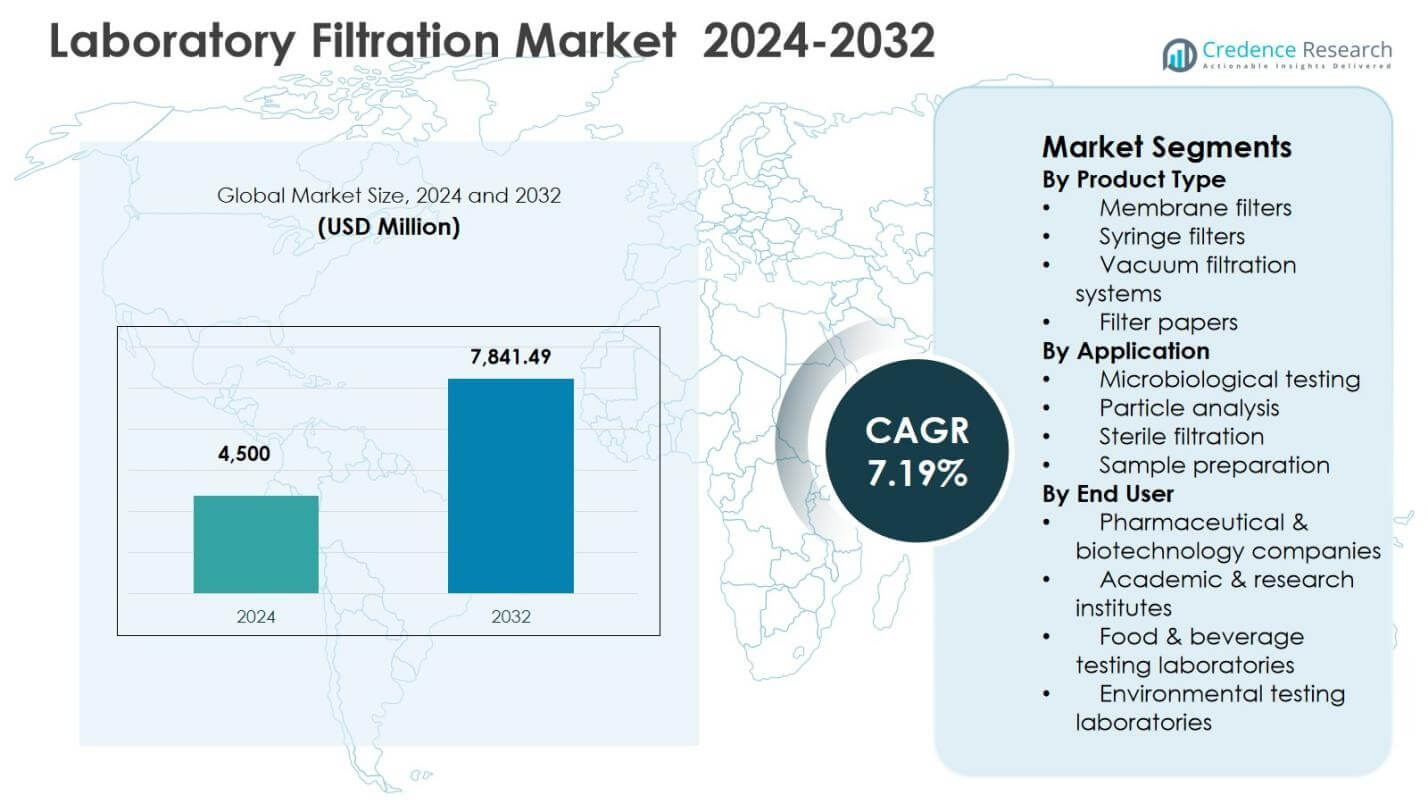
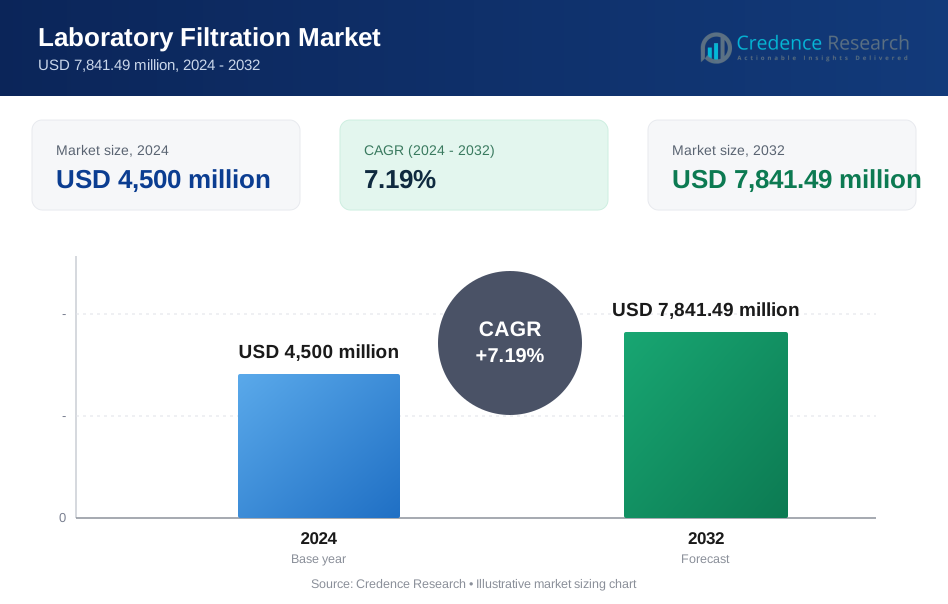
Laboratory Filtration Market size was valued USD 4,500 million in 2024 and is anticipated to reach USD 7,841.49 million by 2032, at a CAGR of 7.19% during the forecast period.
| REPORT ATTRIBUTE | DETAILS |
|---|---|
| Historical Period | 2020-2023 |
| Base Year | 2024 |
| Forecast Period | 2025-2032 |
| Laboratory Filtration Market Size 2024 | USD 4,500 million |
| Laboratory Filtration Market, CAGR | 7.19% |
| Laboratory Filtration Market Size 2032 | USD 7,841.49 million |
Laboratory Filtration Market Insights
- Market growth is driven by rising pharmaceutical and biotechnology production, increasing clinical diagnostics, and expanding microbiological testing, with membrane filters leading the product segment at 8% share in 2024 due to high efficiency and sterile applications.
- Ongoing trends include strong adoption of membrane and single-use filtration technologies, growth in sterile filtration applications holding 6% share, and increasing demand from environmental and food testing laboratories worldwide.
- Market expansion faces restraints from high costs of advanced filtration systems and stringent regulatory and validation requirements, which can limit adoption among small and mid-sized laboratories.
- Regionally, North America led with 36.8% market share in 2024, followed by Europe at 28.4% and Asia Pacific at 23.6%, while Latin America and Middle East & Africa together accounted for the remaining share, supported by gradual infrastructure development.
Laboratory Filtration Market Segmentation Analysis:
By Product Type:
The Laboratory Filtration Market by product type is led by membrane filters, which accounted for 41.8% market share in 2024, driven by their high filtration efficiency, chemical compatibility, and suitability for sterile and analytical applications. Membrane filters are widely used in pharmaceutical quality control and microbiological testing due to precise pore-size control. Syringe filters followed with 26.4% share, supported by growing sample preparation needs. Vacuum filtration systems held 18.7%, benefiting from high-throughput laboratory workflows, while filter papers contributed 13.1%, mainly used in routine and educational laboratories.
- For instance, Sirion Biotech GmbH uses Sartorius Sartoclear Dynamics Lab with Multistation to clarify up to 6 L of viral vector lysates in minutes, achieving high rAAV recoveries ready for downstream FPLC.
By Application:
By application, sterile filtration dominated the Laboratory Filtration Market with a 38.6% share in 2024, supported by rising pharmaceutical production, biologics development, and stringent contamination-control requirements. Sterile filtration is critical in ensuring product safety during drug formulation and clinical research. Microbiological testing accounted for 27.9%, driven by increased diagnostic testing and food safety regulations. Sample preparation captured 20.3%, supported by analytical research growth, while particle analysis represented 13.2%, mainly used in material science and environmental monitoring applications.
- For instance, Sartorius offers Sartolab® P20 pressure filters (20 cm² surface) for sample preparation in particle analysis, processing up to 10 L batches for detecting heavy metals and chlorine in water with highest flow rates.
By End User: Based on end users, pharmaceutical & biotechnology companies held the largest share of 46.2% in 2024, driven by expanding drug pipelines, vaccine manufacturing, and regulatory compliance for filtration processes. These organizations rely heavily on advanced filtration technologies for R&D and production-scale operations. Academic & research institutes accounted for 22.8%, supported by government-funded research activities. Food & beverage testing laboratories captured 17.1%, driven by quality assurance needs, while environmental testing laboratories represented 13.9%, supported by rising water and air quality monitoring initiatives.
Key Growth Drivers
Rising Pharmaceutical and Biotechnology Production
The Laboratory Filtration Market is strongly driven by the rapid expansion of pharmaceutical and biotechnology manufacturing, supported by increasing drug approvals, vaccine development, and biologics production. Filtration plays a critical role in ensuring sterility, product purity, and regulatory compliance across research, quality control, and manufacturing workflows. Growing investments in biologics, cell and gene therapies, and biosimilars have increased demand for membrane and sterile filtration products. Additionally, stringent regulatory standards imposed by global health authorities continue to reinforce the adoption of high-performance laboratory filtration solutions.
- For instance, Merck's Stericup and Steritop systems, equipped with Millipore Express® PLUS membranes, enable sterile filtration of cell culture media, buffers, and reagents in volumes from 150 mL to 1,000 mL.
Growth in Clinical, Diagnostic, and Microbiological Testing
The increasing volume of clinical diagnostics and microbiological testing is another major growth driver for the Laboratory Filtration Market. Rising prevalence of infectious diseases, foodborne illnesses, and chronic conditions has significantly expanded laboratory testing activities. Filtration systems are widely used in sample preparation, pathogen detection, and contamination control processes. Expansion of diagnostic laboratories, particularly in emerging economies, along with increased funding for public health infrastructure, continues to accelerate demand for reliable and efficient laboratory filtration technologies.
- For instance, Sartorius AG offers ultrafiltration devices like Vivaspin® for clinical diagnostics, concentrating disease markers such as Bence Jones protein from blood serum, urine, and cerebrospinal fluid samples in multiple myeloma testing.
Expansion of Academic and Industrial Research Activities
Growing investments in academic research, life-science innovation, and industrial R&D activities are fueling laboratory filtration demand. Universities, research institutes, and contract research organizations increasingly rely on advanced filtration solutions for analytical testing, material science studies, and environmental analysis. Government funding programs and private research grants have strengthened laboratory infrastructure globally. The increasing complexity of research workflows, coupled with the need for precise and reproducible results, continues to support sustained growth in laboratory filtration product adoption.
Key Trends & Opportunities
Shift Toward Advanced Membrane and Single-Use Filtration Technologies
A major trend in the Laboratory Filtration Market is the growing adoption of advanced membrane technologies and single-use filtration systems. Laboratories are increasingly shifting toward disposable filtration products to reduce cross-contamination risks, minimize cleaning validation requirements, and improve operational efficiency. Advancements in polymer science have enhanced membrane durability, chemical resistance, and flow rates. This trend creates strong opportunities for manufacturers to develop application-specific, high-performance filtration solutions tailored for biopharmaceutical and diagnostic laboratories.
- For instance, Merck Millipore's Mobius® single-use final fill assemblies incorporate Durapore® PVDF and Millipore Express® PES membranes for sterile filtration in biopharma processes.
Increasing Demand from Environmental and Food Testing Laboratories
The rising focus on environmental sustainability and food safety is creating new growth opportunities for the Laboratory Filtration Market. Stricter regulations related to water quality, air pollution, and food contamination are driving higher testing volumes across environmental and food laboratories. Filtration systems are essential for sample concentration, particulate removal, and microbial analysis. Expanding environmental monitoring programs and global food trade compliance requirements are expected to generate sustained demand for laboratory filtration products over the forecast period.
- For instance, Sigma Aldrich's Stericup® E and Steritop® E sterile filters eliminate the plastic funnel by attaching directly to media bottles, cutting plastic waste by 23-48% per unit and reducing packaging needs.
Key Challenges
High Cost of Advanced Filtration Systems
One of the key challenges facing the Laboratory Filtration Market is the relatively high cost of advanced filtration products and systems. High-performance membranes, sterile filtration units, and automated filtration equipment involve significant upfront investment. Smaller laboratories and research institutions with limited budgets may hesitate to adopt premium filtration solutions. Additionally, recurring costs associated with consumables and replacements can further restrict market penetration, particularly in cost-sensitive emerging markets.
Stringent Regulatory and Validation Requirements
The Laboratory Filtration Market faces challenges related to complex regulatory and validation requirements, especially in pharmaceutical and biotechnology applications. Filtration products must comply with strict quality, safety, and performance standards, which increases product development time and compliance costs for manufacturers. Validation and documentation requirements can also slow down product adoption among end users. Navigating diverse regulatory frameworks across regions remains a critical challenge, particularly for companies operating in global markets.
Regional Analysis
North America
North America dominated the Laboratory Filtration Market with a 36.8% market share in 2024, driven by strong pharmaceutical manufacturing, advanced research infrastructure, and high adoption of sterile filtration technologies. The United States leads regional growth due to significant investments in biopharmaceutical R&D, clinical diagnostics, and life-science innovation. Strict regulatory standards for drug safety and laboratory quality control continue to support sustained demand for membrane and syringe filters. The presence of major filtration product manufacturers and contract research organizations further strengthens market expansion across academic, industrial, and diagnostic laboratories.
Europe
Europe accounted for a 28.4% share of the Laboratory Filtration Market in 2024, supported by well-established pharmaceutical industries, strong academic research funding, and stringent quality regulations. Countries such as Germany, the United Kingdom, and France drive demand through increased biologics production and environmental testing activities. Regulatory frameworks emphasizing contamination control and product safety accelerate the adoption of advanced filtration solutions. Growth in food and beverage testing laboratories, coupled with rising environmental monitoring initiatives, continues to reinforce the market’s expansion across Western and Northern Europe.
Asia Pacific
Asia Pacific held a 23.6% market share in 2024, reflecting rapid growth in pharmaceutical manufacturing, diagnostics, and research activities across China, India, Japan, and South Korea. Expanding healthcare infrastructure and increasing investments in biotechnology research are key growth drivers. The rising number of academic institutions and contract research organizations has significantly increased demand for laboratory filtration products. Government initiatives supporting domestic pharmaceutical production and environmental testing laboratories further strengthen regional growth, making Asia Pacific the fastest-growing region in the Laboratory Filtration Market.
Latin America
Latin America captured a 6.7% share of the Laboratory Filtration Market in 2024, driven by gradual expansion of pharmaceutical production and diagnostic laboratory services. Brazil and Mexico lead regional demand due to improving healthcare infrastructure and increased focus on quality testing standards. Growth in food safety testing and environmental monitoring programs is supporting filtration product adoption. Although budget constraints limit rapid technology upgrades, rising regulatory awareness and increasing private healthcare investments continue to enhance market penetration across key Latin American economies.
Middle East & Africa
The Middle East & Africa region accounted for a 4.5% market share in 2024, supported by growing investments in healthcare infrastructure, environmental testing, and academic research facilities. Countries such as Saudi Arabia, the UAE, and South Africa are driving demand through laboratory modernization initiatives. Increasing emphasis on water quality monitoring and food safety regulations contributes to steady adoption of laboratory filtration products. While market growth remains moderate, expanding diagnostic capabilities and government-backed healthcare programs continue to create long-term opportunities.
Laboratory Filtration Market Segmentations
By Product Type
- Membrane filters
- Syringe filters
- Vacuum filtration systems
- Filter papers
By Application
- Microbiological testing
- Particle analysis
- Sterile filtration
- Sample preparation
By End User
- Pharmaceutical & biotechnology companies
- Academic & research institutes
- Food & beverage testing laboratories
- Environmental testing laboratories
By Geography
- North America
- U.S.
- Canada
- Mexico
- Europe
- Germany
- France
- U.K.
- Italy
- Spain
- Rest of Europe
- Asia Pacific
- China
- Japan
- India
- South Korea
- South-east Asia
- Rest of Asia Pacific
- Latin America
- Brazil
- Argentina
- Rest of Latin America
- Middle East & Africa
- GCC Countries
- South Africa
- Rest of the Middle East and Africa
Competitive Landscape
Competitive landscape analysis of the Laboratory Filtration Market features key players including Merck KGaA, Thermo Fisher Scientific Inc., Danaher Corporation, Sartorius AG, 3M, GEA Group Aktiengesellschaft, STERIS, Avantor, Inc., ALFA LAVAL, and Veolia Water Technologies. The market remains moderately consolidated, with leading companies focusing on product innovation, advanced membrane technologies, and application-specific filtration solutions to strengthen their positions. Strategic investments in research and development, expansion of manufacturing capacities, and development of single-use and high-throughput filtration products are key competitive strategies. Companies are also emphasizing global distribution expansion and partnerships with pharmaceutical, biotechnology, and research institutions. Compliance with stringent regulatory standards and the ability to deliver consistent product quality continue to define competitive differentiation, while emerging players focus on cost-effective solutions to penetrate price-sensitive markets.
Key Player Analysis
- Sartorius AG (Germany)
- Thermo Fisher Scientific Inc. (U.S.)
- Veolia Water Technologies (France)
- 3M (U.S.)
- ALFA LAVAL (Sweden)
- Avantor, Inc. (U.S.)
- GEA Group Aktiengesellschaft (Germany)
- Danaher Corporation (U.S.)
- STERIS (Ireland)
- Merck KGaA (Germany)
Recent Developments
- In September 2025, Thermo Fisher Scientific completed the acquisition of Solventum’s Purification and Filtration business, strengthening its filtration portfolio in bioproduction and purification workflows for laboratory and biopharmaceutical applications.
- In June 2025, Cytiva expanded filtration manufacturing capacity by establishing new filtration production lines in Pensacola, Florida, aiming to boost North American membrane filter output by 20%.
- In 2025, Repligen launched the CTech™ SoloVPE PLUS System, an advanced UV-based variable pathlength technology enhancing laboratory filtration analytics and process control for bioprocess laboratories.
Report Coverage
The research report offers an in-depth analysis based on Product Type, Application, End User and Geography. It details leading market players, providing an overview of their business, product offerings, investments, revenue streams, and key applications. Additionally, the report includes insights into the competitive environment, SWOT analysis, current market trends, as well as the primary drivers and constraints. Furthermore, it discusses various factors that have driven market expansion in recent years. The report also explores market dynamics, regulatory scenarios, and technological advancements that are shaping the industry. It assesses the impact of external factors and global economic changes on market growth. Lastly, it provides strategic recommendations for new entrants and established companies to navigate the complexities of the market.
Future Outlook
- The Laboratory Filtration Market will continue to expand due to rising pharmaceutical and biotechnology research activities.
- Increasing adoption of sterile and membrane filtration technologies will strengthen product demand across laboratories.
- Growth in biologics, vaccines, and cell-based therapies will drive sustained filtration requirements.
- Diagnostic and microbiological testing volumes will rise, supporting higher usage of filtration consumables.
- Advancements in membrane materials will improve filtration efficiency and application versatility.
- Single-use and disposable filtration systems will gain wider acceptance to enhance laboratory safety and efficiency.
- Expanding environmental and food testing regulations will create new opportunities for filtration product adoption.
- Emerging economies will witness faster growth due to improving laboratory infrastructure and research funding.
- Manufacturers will focus on customized and application-specific filtration solutions to gain competitive advantage.
- Strategic partnerships and global distribution expansion will remain key to long-term market development.
Request a Free Sample
Fill in your details and we'll send you a free sample report.
- Sample data tables & charts
- Research methodology
Need a Custom Version of This Report?
Tailor the scope, geography, or segments to your exact requirements.
- Custom geography or segment scope
- Direct access to our analyst team
Frequently Asked Questions
What is the current market size for the Laboratory Filtration Market, and what is its projected size in 2032?
At what Compound Annual Growth Rate is the Laboratory Filtration Market projected to grow between 2024 and 2032?
Which Laboratory Filtration Market segment held the largest share in 2024?
What are the primary factors fueling the growth of the Laboratory Filtration Market?
Who are the leading companies in the Laboratory Filtration Market?
Which region commanded the largest share of the Laboratory Filtration Market in 2024?
Table of Content
Chapter 1. Report Introduction
- 1.1 Report Description & Purpose
- 1.1.1 Report Title & Market Definition
- 1.1.2 Unique Selling Propositions (USP) & Key Differentiators
- 1.1.3 Value Proposition for Stakeholders
- 1.2 Research Objectives
- 1.2.1 Market Sizing Objectives (Volume & Revenue)
- 1.2.2 Segmentation Objectives
- 1.2.3 Competitive Intelligence Objectives
- 1.2.4 Forecast & Scenario Objectives
- 1.3 Report Scope
- 1.3.1 Laboratory Filtration Scope – Types & Subtypes Covered
- 1.3.2 Geographic Scope – Regions & Countries Covered
- 1.3.3 Historical Period, Base Year & Forecast Period (2024; forecast to 2032)
- 1.3.4 Inclusions & Exclusions
- 1.4 HS Code & Classification Framework
- 1.5 Currency, Units & Pricing Basis
- 1.6 Target Stakeholders
- 1.7 Limitations & Assumptions
Chapter 2. Executive Summary
- 2.1 Global Laboratory Filtration Market Snapshot
- 2.1.1 Market Size – Historical (2024) & Forecast (2024-2032) (2024: USD 4,500 million → 2032: USD 7,841.49 million)
- 2.1.2 Volume & Revenue – Global Totals
- 2.1.3 Key Market Highlights – Top Five Facts
- 2.2 Laboratory Filtration Market Segmentation Snapshot
- 2.2.1 Market Split by Region – 2024 vs. 2032
- 2.3 Competitive Snapshot
- 2.3.1 Top 10 Players by Revenue Share – 2024
- 2.3.2 Top 10 Players by Volume Share – 2024
- 2.3.3 Recent Strategic Developments (18-Month Summary)
- 2.4 Key Investment Highlights & Strategic Conclusions
Chapter 3. Laboratory Filtration Market Dynamics & Industry Analysis
- 3.1 Market Overview & Context
- 3.1.1 Laboratory Filtration Market Position in the Broader Automotive Value Chain
- 3.1.2 OEM vs. Replacement Market Dynamics
- 3.1.3 Market Maturity & Development Stage by Region
- 3.2 Laboratory Filtration Market Drivers
- 3.3 Laboratory Filtration Market Restraints & Challenges
- 3.4 Laboratory Filtration Market Opportunities
- 3.5 Porter's Five Forces Analysis
- 3.5.1 Threat of New Entrants
- 3.5.2 Bargaining Power of Suppliers
- 3.5.3 Bargaining Power of Buyers
- 3.5.4 Threat of Substitutes
- 3.5.5 Competitive Rivalry – Intensity Assessment
- 3.6 Laboratory Filtration Value Chain Analysis
- 3.6.1 Upstream – Raw Material/Input Suppliers
- 3.6.1.1 Raw Material/Input 1
- 3.6.1.2 Raw Material/Input 2
- 3.6.1.3 Raw Material/Input 3
- 3.6.2 Midstream – Production/Manufacturing/Service Delivery
- 3.6.2.1 Production/Process Overview
- 3.6.2.2 Key Facility Locations & Capacity by Manufacturer
- 3.6.3 Downstream – Distribution & End Consumer
- 3.6.3.1 Primary Channel – B2B/OEM
- 3.6.3.2 Secondary Channels – Dealer, Retail, Online, Direct
- 3.6.4 Value Chain Profitability Analysis
- 3.6.1 Upstream – Raw Material/Input Suppliers
- 3.7 PESTEL Analysis
- 3.7.1 Political Factors
- 3.7.2 Economic Factors
- 3.7.3 Social Factors
- 3.7.4 Technological Factors
- 3.7.5 Environmental Factors
- 3.7.6 Legal Factors
- 3.8 Laboratory Filtration Supply Chain Analysis
- 3.8.1 Raw Material/Input Supply Risk Assessment
- 3.8.2 Manufacturing Concentration Risk (Geographic Exposure)
- 3.8.3 Trade Disruption Impact Analysis
- 3.9 Regulatory & Policy Landscape
Note: The regulatory and policy landscape section covers regulations based on their applicability to the market, Laboratory Filtration category, geography, and scope of the study. Only regulatory frameworks with a material impact on operations, compliance, trade, sustainability, or market access are analyzed in detail.
Chapter 4. Key Investment Pockets & Opportunity Analysis
- 4.1 Laboratory Filtration Market Attractiveness Analysis
- 4.1.1 By Region – Investment Attractiveness Matrix (Volume × CAGR)
- 4.2 Absolute Revenue Growth Opportunity
- 4.2.1 By Region – Absolute USD Growth Through 2032
- 4.3 Incremental Volume Opportunity
- 4.3.1 By Region – Incremental Volume Through 2032
- 4.3.2 Segment – Incremental Volume
- 4.4 Emerging Submarket Opportunity Deep Dive (Subject to Applicability)
- 4.5 Emerging Market Opportunity Scorecards
- 4.5.1 United States
- 4.5.2 Europe
- 4.5.3 Asia
- 4.5.4 Middle East & Africa
Note: Emerging Market Opportunity Scorecards will be included based on relevance and strategic importance. Regions listed are indicative and may vary depending on data availability and market dynamics.
Chapter 5. Laboratory Filtration Import-Export Analysis & Trade Flows
- 5.1 Global Trade Overview
- 5.1.1 Global Export Value by Country (2024)
- 5.1.2 Global Export Volume by Country (2024)
- 5.1.3 Global Import Value by Country (2024)
- 5.1.4 Global Import Volume by Country (2024)
- 5.1.5 Net Trade Balance by Country (2024)
- 5.2 Export Analysis – Segment
- 5.2.1 Type 1 (HS Code)
- 5.2.2 Type 2 (HS Code)
- 5.2.3 Type 3 (HS Code)
- 5.2.4 Type 4 (HS Code)
- 5.2.5 Type 5 (HS Code)
- 5.3 Import Analysis – Segment
- 5.3.1 Type 1 (HS Code)
- 5.3.2 Type 2 (HS Code)
- 5.3.3 Type 3 (HS Code)
- 5.3.4 Type 4 (HS Code)
- 5.3.5 Type 5 (HS Code)
- 5.4 Average Unit Trade Prices
- 5.4.1 Average Export Price – Segment & Country
- 5.4.2 Average Import Price – Segment & Source Country
- 5.4.3 Price Trends (2024)
- 5.5 Key Trade Route Analysis
- 5.5.1 Trade Route 1
- 5.5.2 Trade Route 2
- 5.5.3 Trade Route 3
- 5.5.4 Trade Route 4
- 5.5.5 Trade Route 5
- 5.6 Trade Policy Impact Assessment
- 5.6.1 US Anti-Dumping & Section 301 Tariffs
- 5.6.2 EU Customs Union Impact
- 5.6.3 Major Free Trade Agreements
- 5.6.4 USMCA Rules of Origin
Note: Trade policy analysis will be included only where relevant to the Laboratory Filtration market.
Chapter 6. Competitive Landscape & Company Benchmarking
- 6.1 Laboratory Filtration Market Concentration & Structure
- 6.1.1 Herfindahl-Hirschman Index (HHI) – vs. 2024
- 6.1.2 Tier 1, Tier 2 & Tier 3 Market Structure
- 6.1.3 Global, Regional & Local Player Dynamics
- 6.2 Laboratory Filtration Market Share Analysis – 2024
- 6.2.1 Global Revenue Share by Company
- 6.2.2 Global Volume Share by Company
- 6.2.3 Regional Revenue Share
- 6.2.4 Market Share Evolution ( vs. 2024)
- 6.2.5 OEM Segment Share by Company
- 6.2.6 Replacement Segment Share by Company
- 6.3 Production/Delivery Capacity & Facility Analysis
- 6.3.1 Global Installed Capacity
- 6.3.2 Capacity Utilization Rates
- 6.3.3 Production/Output Volume
- 6.3.4 Facility Locations & Capacity Map
- 6.3.5 Planned Capacity Additions
- 6.4 Laboratory Filtration Competitive Benchmarking Matrix
- 6.4.1 Revenue, Volume, CAGR & Profitability Comparison
- 6.4.2 Channel Revenue Mix
- 6.4.3 Geographic Revenue Exposure
- 6.4.4 R&D Intensity
- 6.4.5 Sustainability Maturity
- 6.5 Strategic Developments in Laboratory Filtration (Last 24 Months)
- 6.5.1 Mergers, Acquisitions & Divestments
- 6.5.2 New Laboratory Filtration Launches
- 6.5.3 Facility Expansions
- 6.5.4 Strategic Alliances, Joint Ventures & Partnerships
- 6.5.5 Distribution Expansion & Market Entry
- 6.5.6 Sustainability & ESG Initiatives
- 6.6 Competitive Strategy Mapping
- 6.6.1 Leader, Challenger, Follower & Niche Classification
- 6.6.2 Pricing Strategy Comparison
- 6.6.3 Channel Strategy Matrix
Note: Strategic developments are included based on their materiality and the availability of reliable information.
Chapter 7. Global Laboratory Filtration Market – By Distribution Channel
- 7.1 Segment Overview
- 7.1.1 Volume & Revenue Split by Channel (2024 & 2032)
- 7.1.2 Channel Mix Evolution (2024-2032)
Chapter 8. Regional Market Analysis – Global Overview
- 8.1 Global Regional Overview
- 8.1.1 Regional Volume Share
- 8.1.2 Regional Revenue Share
- 8.1.3 Regional Volume by Region
- 8.1.4 Regional Revenue by Region
- 8.1.5 Regional Forecast Through 2032
- 8.2 Cross-Regional Segment Analysis
- 8.2.1 By Distribution Channel
- 8.2.2 By Brand/Price Tier
Chapter 9. North America Laboratory Filtration Market
- 9.1 United States
- 9.2 Canada
- 9.3 Mexico
Chapter 10. Europe Laboratory Filtration Market
- 10.1 Germany
- 10.2 France
- 10.3 Italy
- 10.4 United Kingdom
- 10.5 Spain
- 10.6 Poland
- 10.7 Russia
- 10.8 Netherlands
- 10.9 Belgium
- 10.10 Sweden
- 10.11 Denmark
- 10.12 Norway
- 10.13 Rest of Europe
Chapter 11. Asia Pacific Laboratory Filtration Market
- 11.1 China
- 11.2 India
- 11.3 Japan
- 11.4 South Korea
- 11.5 Thailand
- 11.6 Indonesia
- 11.7 Vietnam
- 11.8 Malaysia
- 11.9 Australia
- 11.10 Rest of Asia Pacific
Chapter 12. Latin America Laboratory Filtration Market
- 12.1 Brazil
- 12.2 Argentina
- 12.3 Colombia
- 12.4 Chile
- 12.5 Rest of Latin America
Chapter 13. Middle East Laboratory Filtration Market
- 13.1 Saudi Arabia
- 13.2 United Arab Emirates
- 13.3 Turkey
- 13.4 Israel
- 13.5 Iran
- 13.6 Rest of the Middle East
Chapter 14. Africa Laboratory Filtration Market
- 14.1 South Africa
- 14.2 Egypt
- 14.3 Nigeria
- 14.4 Morocco
- 14.5 Rest of Africa
Chapter 15. Laboratory Filtration Company Profiles
- 15.1 [Company 01]
- 15.1.1 Company Overview
- 15.1.2 Key Management Personnel
- 15.1.3 Products & Services Portfolio
- 15.1.4 Financial Performance
- 15.1.5 Key Market Focus & Geographic Presence
- 15.1.6 Recent Developments & Strategic Initiatives
Note: The company profile list is preliminary and may change based on research findings, market developments, data availability, and client requirements.
Chapter 16. Appendices
- Appendix A – List of Abbreviations & Acronyms
- Appendix B – Industry Classification Code Reference – Full Series
- Appendix C – Production & Capacity Data Tables
- Appendix D – End-Use & Demand Base Tables
- Appendix E – Consumption & Replacement Rate Assumptions
- Appendix F – ASP Reference Tables
- Appendix G – Manufacturing & Facility Database
- Appendix H – Import-Export Data Tables
- Appendix I – Regulatory Summary Tables
- Appendix J – Primary Research Participant List (Anonymized)
- Appendix K – Primary Research Questionnaire Framework
- Appendix L – Data Sources & Bibliography
- Appendix M – Market Size Divergence & Source Comparison
Chapter 17. Research Methodology
- 17.1 Research Framework & Philosophy
- 17.2 Secondary Research – Sources, Hierarchy & Data Extraction
- 17.3 Data Modeling – Bottom-Up & Top-Down Market Sizing
- 17.4 Primary Research – Stakeholder Framework, LOI & Sample Sizes
- 17.5 Forecast Methodology – Regression, Scenario & Sensitivity Analysis
- 17.6 Quality Control – Four-Layer Validation Framework
- 17.7 Limitations & Standard Assumptions
- 17.8 Disclaimer
