
| REPORT ATTRIBUTE | DETAILS |
|---|---|
| Historical Period | 2019-2022 |
| Base Year | 2023 |
| Forecast Period | 2024-2032 |
| Low Calorie Food Market Size 2023 | USD 12541.2Million |
| Low Calorie Food Market, CAGR | 7.80% |
| Low Calorie Food Market Size 2032 | USD 24655.1 Million |
Market Insights
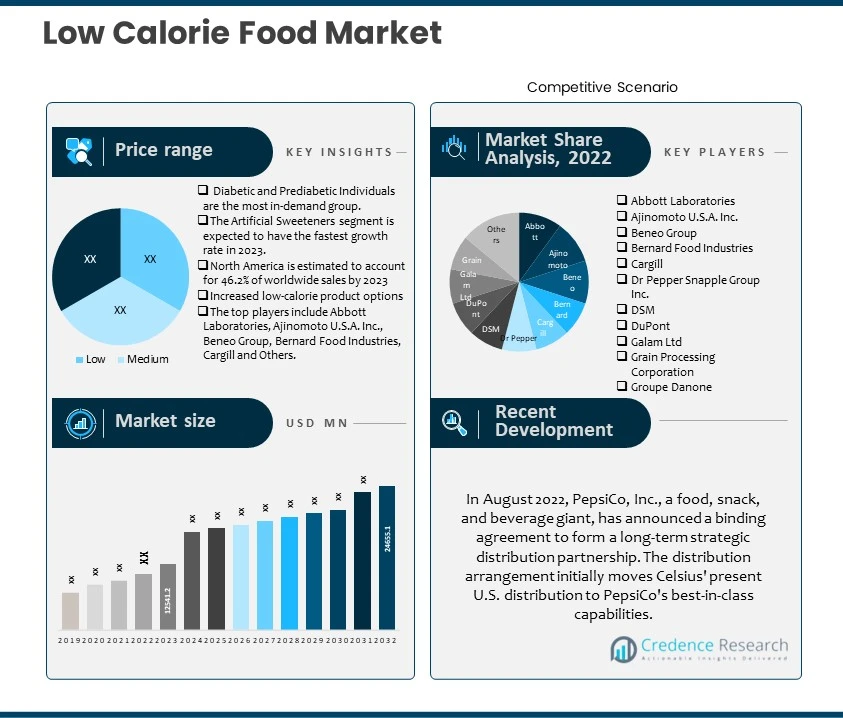
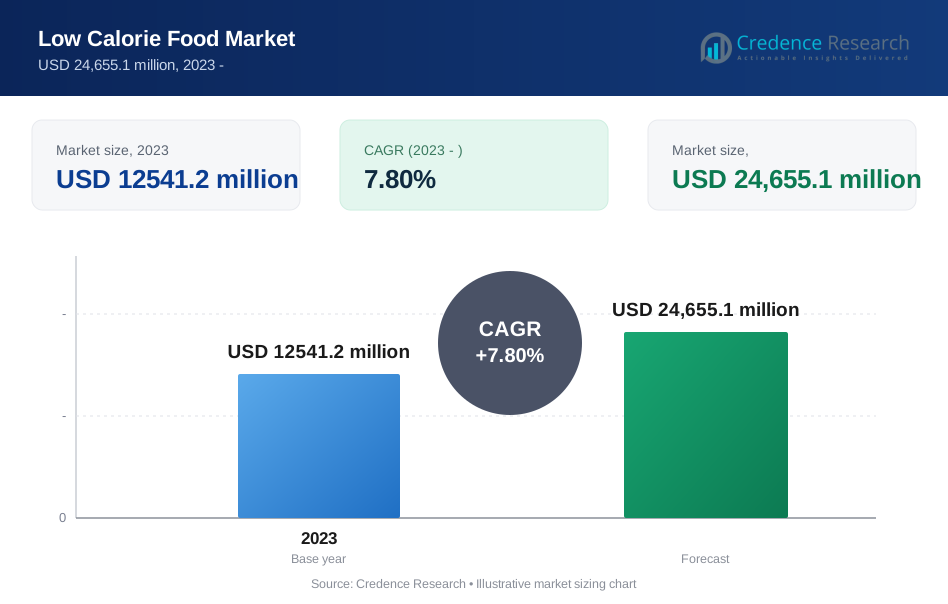
- The global demand for Low Calorie Food was valued at USD 12541.2 million in 2023 and is expected to reach USD 24655.1 million in 2032, growing at a CAGR of 7.80% between 2024 and 2032.
- The Low-Calorie Snacks sector is predicted to grow at a CAGR of 12.01% and account for the largest revenue share. The Low-Calorie Baked Goods industry will have the second-highest share.
- The Artificial Sweeteners segment is expected to have the fastest growth rate in 2023.
- The Low-Carb category is quite popular, while the Low-Fat category also has a significant market share.
- Weight-conscious consumers are the fastest-growing sector, while Diabetic and Prediabetic Individuals are the most in-demand group.
- The pouches section is predicted to have the greatest revenue share, rising at a CAGR of 11.9%, while the bottles division will have the second-largest shareholding.
- Supermarkets and hypermarkets are the leading segments; online retail is the second-largest share-holding category; and convenience stores are the third most popular segment.
- North America is estimated to account for 46.2% of worldwide sales by 2023, while the low-calorie food industry in Asia Pacific is expected to expand rapidly.
- Market expansion is driven by increased health awareness and demand for convenient foods.
- Healthier substitutes impedes market growth.
Executive Summary
Market Definition
Low-calorie foods are a fantastic way to speed up weight loss by controlling overall weight management. These foods are not only low in calories, but also high in protein and fiber, which promotes fullness and reduces hunger. Low-calorie foods are also high in vitamins and minerals, which help to improve general health. Furthermore, low-calorie foods help digestion and blood sugar levels, reducing cravings for fast food. Greek yogurt, oats, berries, soup, eggs, chia seeds, and fish are some of the low-calorie foods eaten worldwide.
Market Overview
The global Low-Calorie Food Market has witnessed steady growth in recent years and is expected to grow at a CAGR of 7.80% between 2024 and 2032. The market was valued at USD 12541.2 million in 2023 and is expected to reach USD 24655.1 million in 2032.
Low-calorie foods are a fast-growing business in the health food industry. This market is expanding because to changing lifestyles and growing health concerns. People prefer low-calorie foods since they aid with a variety of health issues. Small amounts of food are ingested as snacks in between meals. There are numerous varieties of snacks, including packaged snacks and other processed foods. Snack foods are products that contain proteins, vitamins, minerals, and other healthy and nutritious ingredients. Low-calorie snacks like potato chips, baked products like bagels, pancakes, and cookies, and confections like candies, chocolates, and raisins all contain gluten-free components.
Segmentation by Type of Product
- The Low-Calorie Snacks segment is expected to increase at a CAGR of 12.01% and account for the greatest revenue share. Rapid urbanization and expanding population consumption both have a substantial impact on the growth of the food and beverage business.
- The Low-Calorie Baked Goods sector will have the second-largest proportion. The sector is rising as a result of customers' growing desire for sweet delights like cakes, pastries, ice cream, and muffins as they become more health conscious.
Segmentation by Sweeteners Used
- The Artificial Sweeteners segment is predicted to have the fastest growth rate in 2023. Low-calorie sugar replacements are sweeteners that contain less or no calories than sugar. They are commonly used to sweeten foods and beverages without adding too many calories. Artificial sweeteners include aspartame, stevia, saccharin, and sucralose. Sugar alternatives provide health-conscious customers with benefits such as weight management and diabetes treatment. Artificial sweeteners have no carbohydrates and hence do not elevate blood sugar levels. Sugar replacements have almost no calories, whereas a teaspoon of sugar contains approximately 15 calories.
Segmentation By Dietary Preferences
- The Low-Carb category is particularly popular. Many consumers choose this sector to regulate their carbohydrate intake for a variety of health reasons.
- The Low-Fat category also holds a large market share. Low-fat items are sought after by those seeking to minimize their fat consumption while still enjoying delectable and healthful eating options.
Segmentation by End-User Demographics
- Weight-conscious consumers are the fastest-growing sector. As more people become health-conscious and concerned about their weight, the demand for low-calorie foods among weight-conscious people grows significantly.
- Furthermore, Diabetic and Prediabetic Individuals are the market's highest-demand category.
Segmentation by Packaging Type
- The pouches segment is expected to have the largest revenue share, growing at a CAGR of 11.9%. Pouches were formerly regarded to be the most popular and widely used type of packaging. They are typically one of the most reusable and low-risk alternatives.
- The bottles division will hold the second-largest shareholding. Can packaging manufacturers are setting a new benchmark in R&D by focusing on cost-effective manufacturing and close-proximity supply.
Segmentation by Distribution Channel
- Supermarkets and hypermarkets are the leading segments. These huge retail stores provide a diverse range of low-calorie food options, attracting a sizable number of customers.
- Online Retail is the second-largest share-holding segment. With the increasing popularity of online shopping, many consumers prefer the ease of purchasing low-calorie items online.
- Convenience Stores are the third most popular segment when compared to others. These establishments meet the quick and on-the-go demands of consumers seeking low-calorie snacks and meals, making them a popular choice in the Low-Calorie Food Market.
Segmentation by Region
- North America is expected to account for 46.2% of global sales by 2023.
- The low-calorie food market in the Asia Pacific is projected to increase significantly.
- The rest of the world, including Latin America, the Middle East, and Africa, supplies the remaining demand for Low Calorie Food.
The North America low-calorie food market is predicted to have the largest market share in revenue soon. Growing consumer health awareness will speed the adoption of a happy lifestyle and increase the demand for low-calorie food. There is a growing need for low-calorie cuisine as healthy activities such as yoga, gym workouts, and eating nutritious meals become more popular. As obesity rates climb, low-calorie meals gain favor. On average, two out of three persons are overweight. Rising health concerns will fuel the industry in North America. According to predictions, the United States will have the largest low-calorie food market in the world.
In addition, Asia Pacific is expected to grow significantly in the global Low-Calorie Food market. Consumers' changing lifestyles and increased health concerns have contributed to growth in the Asia Pacific market. The area's market is rapidly changing as a result of shifting dietary tastes, increased urbanization, and free trade rules in the food sector.
Key Highlights of the Report
The global Low Calorie Food Market is segmented based on Type of Product, Sweeteners Used, Dietary Preferences, End-User Demographics, Packaging Type, Distribution Channel, and region. Supermarkets and hypermarkets are among the most prominent segments, with Artificial Sweeteners expected to increase at the fastest rate in 2023. The low-carb category is particularly popular. Furthermore, weight-conscious customers are the fastest-growing sector, and the pouches category is predicted to have the biggest revenue share North America is driving market expansion.
The market is primarily driven by the increased adoption of a healthy lifestyle, which is supporting the expansion of low-calorie meals. The increased acceptance of healthy activities such as yoga, going to the gym, and eating healthy meals is fueling the expansion of the low-calorie food sector. Additionally, the key market constraints include the high cost of low-calorie beverages, which is likely to limit market expansion, and the addition of chemical preservatives in low-calorie foods, which is expected to threaten the low-calorie food industry.
The North America low-calorie food market is expected to have the highest revenue share in the near future. Growing consumer health awareness will accelerate the adoption of a healthy lifestyle and raise demand for low-calorie foods. In addition, Asia Pacific is expected to grow significantly in the global Low-Calorie Food market. Consumers' changing lifestyles and increased health concerns have contributed to growth in the Asia Pacific market.
What Are The Main Drivers Of The Global Low Calorie Food Market?
Several drivers are propelling its growth. Consumer health and wellness awareness is increasing, boosting the adoption of a healthy lifestyle and fueling the market growth of low-calorie foods. The growing acceptance of healthy behaviors such as yoga, gym membership, and healthy food consumption is driving market growth for low-calorie foods. Furthermore, as the prevalence of diseases connected with an unhealthy lifestyle rises, low-calorie foods are in high demand. This is projected to drive market growth.
What Are The Major Challenges Faced By The Global Low Calorie Food Market?
The market faces certain restraints that hinder its progress; Taste is a crucial element in limiting the consumption of low-calorie foods. Furthermore, the high cost of low-calorie beverages is projected to hamper the market growth of low-calorie foods during the projection period. Furthermore, the prevalence of artificial preservatives in low-calorie foods is projected to pose a threat to the low-calorie food industry. Processed and ready-to-eat foods claim to have minimal possible health risks, which is projected to limit the market growth of low-calorie foods over the projection period.
What Are The Growth Opportunities In The Global Low-Calorie Food Market?
Despite these limitations, the Low Calorie Food Market offers numerous potential for expansion and development. One significant opportunity is to grow into new markets with health-conscious consumers who are actively looking for low-calorie food options. Innovation in low-calorie product development allows businesses to present new and compelling offerings to the market.
Market Drivers
Several factors drive the global Low Calorie Food Market. The following are the key drivers of the global Low Calorie Food Market:
Increased Health Awareness and Demand for Convenience Foods
People have gradually become more aware of the importance of eating. A significant increase in chronic health conditions causes this. Consumers nowadays have accepted customized diet regimens to address health difficulties, as well as altered their habits to stay fit. One of the most notable changes linked with this trend is the adoption of low-calorie snack products. Low-calorie snacks are becoming increasingly popular since they are free of additives and are less likely to be nutritionally complete because they contain far less calories than what is needed to maintain a healthy weight.
On the other hand, Non-organic commodities have gone through the cracks as a result of the use of genetically modified organisms (GMOs) during production because of their links to health problems such as organ damage, gastrointestinal and immune system disorders, accelerated aging, and infertility. The market for snack items is expanding due to the benefits of low-calorie organic snacking products and rising consumer awareness of health and fitness. This is attributable to the rising demand for low-calorie snacks.
Market Restraints
The global Low Calorie Food Market faces some challenges that may hinder its growth. These include the following:
Healthier substitutes
Customers' preference for baked goods such as bread, cookies, and rolls over cereals high in proteins, fiber, minerals, and carbohydrates is expected to limit the growth of the low-calorie snacking industry. Although there are numerous healthy snack options on the market, cereal grains are the most effective energy source. They efficiently prevent and treat a variety of ailments, including cancer, excessive blood sugar, constipation, and more. As a result, the availability of healthier alternatives slows market growth.
Opportunities
The global Gasket and seal market offers significant growth opportunities. These include the following:
Consumer Preference for Premium and Eco-Friendly Products
In recent years, developing economies' per capita incomes have risen considerably. In contrast to 2018, China's per capita income rose by 0.3% in 2019. India's personal disposable income increased by approximately 9.4% in 2017 compared with 2016. Customers with higher purchasing power are more likely to buy high-end and ecologically friendly things like low-calorie meals as disposable incomes rise and worldwide fitness awareness grows. Furthermore, attractive government policies and the benefits of corporate wellness initiatives create prospects for the global rise of the low-calorie snacks industry.
Competitive Landscape
Key Players
The global Low Calorie Food Market is highly competitive, with several key players. Some of the major players in the market and their market share are as follows:
- Abbott Laboratories
- Ajinomoto U.S.A. Inc.
- Beneo Group
- Bernard Food Industries
- Cargill
- Dr Pepper Snapple Group Inc.
- DSM
- DuPont
- Galam Ltd
- Grain Processing Corporation
- Groupe Danone
- Ingredion Incorporated
- Keurig Dr Pepper, Inc.
- McNeil Nutritionals LLC,
- Nestle SA, Pepsico Inc.
- PureCircle
- Roquette Frères
- Tate & Lyle
- The Brooklyn Creamery
- The Coca-Cola Company
- Zydus Wellness Ltd,
- Other Prominent players
These organizations prioritize product innovation, Service Provider expansion, and mergers and acquisitions to stay competitive.
The global Low-Calorie Food Market's key players continually seek to stay ahead by offering new products and developments.
In August 2022, PepsiCo, Inc., a food, snack, and beverage corporation, announced partnerships with World Central Kitchen (a non-profit, non-governmental organization) and Save the Children (an Indian non-governmental organization dedicated to protecting children's rights and preventing child abuse) to provide meals, potable water, and disaster relief to those affected by severe flooding in eastern Kentucky.
In March 2022, PepsiCo and Archer Daniels Midland Company, two global leaders in sustainable agriculture and nutrition, announced a groundbreaking 7.5-year strategic commercial agreement to collaborate closely on initiatives that will significantly increase the use of regenerative agriculture across their respective North American supply chains. This strategic cooperation between two multinational firms with ambitious carbon-reduction goals is expected to span up to 2 million acres by 2030.
Summary of Key Findings
- Consumers like premium and eco-friendly products.
- The market is segmented by Type of Product, Sweeteners Used, Dietary Preferences, End-User Demographics, Packaging Type, Distribution Channel, and Region.
- Weight-conscious consumers are the fastest-growing sector
- The Low-Carb category is extremely popular
- North America is leading market growth. The market is highly competitive, with key players including Abbott Laboratories, Ajinomoto U.S.A. Inc., Beneo Group, Bernard Food Industries, Cargill and Others.
Future Outlook
- Consumers are increasingly focusing on health and fitness.
- Increased demand for weight-management products
- Growing awareness of the significance of good eating habits.
- Increased low-calorie product options
How CXOs Can Benefit from the Credence Research Low Calorie Food Market Report
The Credence Research Low Calorie Food Market Report provides CXOs with a comprehensive overview of the market, including:
- Market Size and Growth Forecast: The report provides detailed estimates of the global Low Calorie Food Market segmented by Type of Product, Sweeteners Used, Dietary Preferences, End-User Demographics, Packaging Type, Distribution Channel, and Region. It also includes forecasts for the market through 2032 based on key trends and drivers.
- Market segmentation: The report segments the Low Calorie Food Market by Type of Product, Sweeteners Used, Dietary Preferences, End-User Demographics, Packaging Type, Distribution Channel, and Region. This segmentation provides CXOs with a granular understanding of the market and the opportunities in each segment.
- Competitive Landscape: The report profiles the key players in the Low Calorie Food Market and provides insights into their strategies, product offerings, and financial performance. This information can help CXOs to identify and assess their competition.
- Key trends and drivers: The report identifies and analyzes the key trends and drivers shaping the Low Calorie Food Market. This information can help CXOs make informed decisions about their investments and strategies.
CXOs can use the insights from the Credence Research Low Calorie Food Market Report to:
- Identify growth opportunities: The report can help CXOs identify new growth opportunities in the Low Calorie Food Market. It provides valuable insights and analysis that can assist them in making informed decisions and strategic plans for their businesses.
- Make in Informed investment decisions: The report can help CXOs to make informed investment decisions about Low Calorie Food. For example, it provides valuable market insights such as growth trends, market size, and competitive analysis. CXOs can use this information to assess the potential profitability and growth opportunities in the Low Calorie Food Market.
- Develop competitive strategies: The report can help CXOs develop competitive strategies for their Low Calorie Food businesses. It provides insights into market trends, customer preferences, and competitive landscape analysis.
- Track market developments: The report can help CXOs track market developments and stay ahead of the curve. For example, It provides valuable insights and analysis that can inform strategic decision-making and help them stay ahead of the competition.
Overall, the Credence Research Low Calorie Food Market Report is a valuable resource for CXOs who are looking to gain a deeper understanding of the market and identify opportunities for growth.
Segmentation
By Type of Product:- Low-Calorie Beverages
- Low-Calorie Snacks
- Low-Calorie Dairy Products
- Low-Calorie Baked Goods
- Low-Calorie Confectionery
- Low-Calorie Frozen Foods
- Low-Calorie Sauces and Dressings
- Low-Calorie Ready-to-Eat Meals
- Others
- Natural Sweeteners (e.g., stevia, erythritol, monk fruit extract)
- Artificial Sweeteners (e.g., aspartame, sucralose, saccharin)
- Sugar Alcohols (e.g., xylitol, sorbitol, mannitol)
- Others
- Low-Carb
- Low-Fat
- Low-Sugar
- Low-Sodium
- Others
- General Population
- Weight-Conscious Consumers
- Diabetic and Prediabetic Individuals
- Fitness Enthusiasts
- Others
- Bottles
- Pouches
- Cartons
- Tubs
- Others
- Supermarkets and Hypermarkets
- Convenience Stores
- Online Retail
- Health Food Stores
- Others
- North America
- The U.S.
- Canada
- Mexico
- Europe
- Germany
- France
- The U.K.
- Italy
- Spain
- Rest of Europe
- Asia Pacific
- China
- Japan
- India
- South Korea
- South-east Asia
- Rest of Asia Pacific
- Latin America
- Brazil
- Argentina
- Rest of Latin America
- Middle East & Africa
- GCC Countries
- South Africa
- Rest of the Middle East and Africa
Request a Free Sample
Fill in your details and we'll send you a free sample report.
- Sample data tables & charts
- Research methodology
Need a Custom Version of This Report?
Tailor the scope, geography, or segments to your exact requirements.
- Custom geography or segment scope
- Direct access to our analyst team
Frequently Asked Questions
What is the current Type of Product of the global Low Calorie Food Market?
What is the expected growth rate of the Low Calorie Food Market between 2024 and 2032?
Which segment is leading the market share in terms of Distribution Channel?
Which Dietary Preferences segment governs the demand for rapid pharmaceutical microbiology testing in the world?
Who are the major players in the global Low Calorie Food Market?
Table of Content
Chapter 1. Report Introduction
- 1.1 Report Description & Purpose
- 1.1.1 Report Title & Market Definition
- 1.1.2 Unique Selling Propositions (USP) & Key Differentiators
- 1.1.3 Value Proposition for Stakeholders
- 1.2 Research Objectives
- 1.2.1 Market Sizing Objectives (Volume & Revenue)
- 1.2.2 Segmentation Objectives
- 1.2.3 Competitive Intelligence Objectives
- 1.2.4 Forecast & Scenario Objectives
- 1.3 Report Scope
- 1.3.1 Low Calorie Food Scope – Types & Subtypes Covered
- 1.3.2 Geographic Scope – Regions & Countries Covered
- 1.3.3 Historical Period, Base Year & Forecast Period (2023; forecast to the forecast period)
- 1.3.4 Inclusions & Exclusions
- 1.4 HS Code & Classification Framework
- 1.5 Currency, Units & Pricing Basis
- 1.6 Target Stakeholders
- 1.7 Limitations & Assumptions
Chapter 2. Executive Summary
- 2.1 Global Low Calorie Food Market Snapshot
- 2.1.1 Market Size – Historical (2023) & Forecast (the forecast period) (2023: USD 12541.2 million → forecast year: USD 24,655.1 million)
- 2.1.2 Volume & Revenue – Global Totals
- 2.1.3 Key Market Highlights – Top Five Facts
- 2.2 Low Calorie Food Market Segmentation Snapshot
- 2.2.1 Market Split by Region – 2023 vs.
- 2.3 Competitive Snapshot
- 2.3.1 Top 10 Players by Revenue Share – 2023
- 2.3.2 Top 10 Players by Volume Share – 2023
- 2.3.3 Recent Strategic Developments (18-Month Summary)
- 2.4 Key Investment Highlights & Strategic Conclusions
Chapter 3. Low Calorie Food Market Dynamics & Industry Analysis
- 3.1 Market Overview & Context
- 3.1.1 Low Calorie Food Market Position in the Broader Automotive Value Chain
- 3.1.2 OEM vs. Replacement Market Dynamics
- 3.1.3 Market Maturity & Development Stage by Region
- 3.2 Low Calorie Food Market Drivers
- 3.3 Low Calorie Food Market Restraints & Challenges
- 3.4 Low Calorie Food Market Opportunities
- 3.5 Porter's Five Forces Analysis
- 3.5.1 Threat of New Entrants
- 3.5.2 Bargaining Power of Suppliers
- 3.5.3 Bargaining Power of Buyers
- 3.5.4 Threat of Substitutes
- 3.5.5 Competitive Rivalry – Intensity Assessment
- 3.6 Low Calorie Food Value Chain Analysis
- 3.6.1 Upstream – Raw Material/Input Suppliers
- 3.6.1.1 Raw Material/Input 1
- 3.6.1.2 Raw Material/Input 2
- 3.6.1.3 Raw Material/Input 3
- 3.6.2 Midstream – Production/Manufacturing/Service Delivery
- 3.6.2.1 Production/Process Overview
- 3.6.2.2 Key Facility Locations & Capacity by Manufacturer
- 3.6.3 Downstream – Distribution & End Consumer
- 3.6.3.1 Primary Channel – B2B/OEM
- 3.6.3.2 Secondary Channels – Dealer, Retail, Online, Direct
- 3.6.4 Value Chain Profitability Analysis
- 3.6.1 Upstream – Raw Material/Input Suppliers
- 3.7 PESTEL Analysis
- 3.7.1 Political Factors
- 3.7.2 Economic Factors
- 3.7.3 Social Factors
- 3.7.4 Technological Factors
- 3.7.5 Environmental Factors
- 3.7.6 Legal Factors
- 3.8 Low Calorie Food Supply Chain Analysis
- 3.8.1 Raw Material/Input Supply Risk Assessment
- 3.8.2 Manufacturing Concentration Risk (Geographic Exposure)
- 3.8.3 Trade Disruption Impact Analysis
- 3.9 Regulatory & Policy Landscape
Note: The regulatory and policy landscape section covers regulations based on their applicability to the market, Low Calorie Food category, geography, and scope of the study. Only regulatory frameworks with a material impact on operations, compliance, trade, sustainability, or market access are analyzed in detail.
Chapter 4. Key Investment Pockets & Opportunity Analysis
- 4.1 Low Calorie Food Market Attractiveness Analysis
- 4.1.1 By Region – Investment Attractiveness Matrix (Volume × CAGR)
- 4.2 Absolute Revenue Growth Opportunity
- 4.2.1 By Region – Absolute USD Growth Through the forecast period
- 4.3 Incremental Volume Opportunity
- 4.3.1 By Region – Incremental Volume Through the forecast period
- 4.3.2 Segment – Incremental Volume
- 4.4 Emerging Submarket Opportunity Deep Dive (Subject to Applicability)
- 4.5 Emerging Market Opportunity Scorecards
- 4.5.1 United States
- 4.5.2 Europe
- 4.5.3 Asia
- 4.5.4 Middle East & Africa
Note: Emerging Market Opportunity Scorecards will be included based on relevance and strategic importance. Regions listed are indicative and may vary depending on data availability and market dynamics.
Chapter 5. Low Calorie Food Import-Export Analysis & Trade Flows
- 5.1 Global Trade Overview
- 5.1.1 Global Export Value by Country (2023)
- 5.1.2 Global Export Volume by Country (2023)
- 5.1.3 Global Import Value by Country (2023)
- 5.1.4 Global Import Volume by Country (2023)
- 5.1.5 Net Trade Balance by Country (2023)
- 5.2 Export Analysis – Segment
- 5.2.1 Type 1 (HS Code)
- 5.2.2 Type 2 (HS Code)
- 5.2.3 Type 3 (HS Code)
- 5.2.4 Type 4 (HS Code)
- 5.2.5 Type 5 (HS Code)
- 5.3 Import Analysis – Segment
- 5.3.1 Type 1 (HS Code)
- 5.3.2 Type 2 (HS Code)
- 5.3.3 Type 3 (HS Code)
- 5.3.4 Type 4 (HS Code)
- 5.3.5 Type 5 (HS Code)
- 5.4 Average Unit Trade Prices
- 5.4.1 Average Export Price – Segment & Country
- 5.4.2 Average Import Price – Segment & Source Country
- 5.4.3 Price Trends (2023)
- 5.5 Key Trade Route Analysis
- 5.5.1 Trade Route 1
- 5.5.2 Trade Route 2
- 5.5.3 Trade Route 3
- 5.5.4 Trade Route 4
- 5.5.5 Trade Route 5
- 5.6 Trade Policy Impact Assessment
- 5.6.1 US Anti-Dumping & Section 301 Tariffs
- 5.6.2 EU Customs Union Impact
- 5.6.3 Major Free Trade Agreements
- 5.6.4 USMCA Rules of Origin
Note: Trade policy analysis will be included only where relevant to the Low Calorie Food market.
Chapter 6. Competitive Landscape & Company Benchmarking
- 6.1 Low Calorie Food Market Concentration & Structure
- 6.1.1 Herfindahl-Hirschman Index (HHI) – vs. 2023
- 6.1.2 Tier 1, Tier 2 & Tier 3 Market Structure
- 6.1.3 Global, Regional & Local Player Dynamics
- 6.2 Low Calorie Food Market Share Analysis – 2023
- 6.2.1 Global Revenue Share by Company
- 6.2.2 Global Volume Share by Company
- 6.2.3 Regional Revenue Share
- 6.2.4 Market Share Evolution ( vs. 2023)
- 6.2.5 OEM Segment Share by Company
- 6.2.6 Replacement Segment Share by Company
- 6.3 Production/Delivery Capacity & Facility Analysis
- 6.3.1 Global Installed Capacity
- 6.3.2 Capacity Utilization Rates
- 6.3.3 Production/Output Volume
- 6.3.4 Facility Locations & Capacity Map
- 6.3.5 Planned Capacity Additions
- 6.4 Low Calorie Food Competitive Benchmarking Matrix
- 6.4.1 Revenue, Volume, CAGR & Profitability Comparison
- 6.4.2 Channel Revenue Mix
- 6.4.3 Geographic Revenue Exposure
- 6.4.4 R&D Intensity
- 6.4.5 Sustainability Maturity
- 6.5 Strategic Developments in Low Calorie Food (Last 24 Months)
- 6.5.1 Mergers, Acquisitions & Divestments
- 6.5.2 New Low Calorie Food Launches
- 6.5.3 Facility Expansions
- 6.5.4 Strategic Alliances, Joint Ventures & Partnerships
- 6.5.5 Distribution Expansion & Market Entry
- 6.5.6 Sustainability & ESG Initiatives
- 6.6 Competitive Strategy Mapping
- 6.6.1 Leader, Challenger, Follower & Niche Classification
- 6.6.2 Pricing Strategy Comparison
- 6.6.3 Channel Strategy Matrix
Note: Strategic developments are included based on their materiality and the availability of reliable information.
Chapter 7. Global Low Calorie Food Market – By Distribution Channel
- 7.1 Segment Overview
- 7.1.1 Volume & Revenue Split by Channel (2023 & )
- 7.1.2 Channel Mix Evolution (the forecast period)
Chapter 8. Regional Market Analysis – Global Overview
- 8.1 Global Regional Overview
- 8.1.1 Regional Volume Share
- 8.1.2 Regional Revenue Share
- 8.1.3 Regional Volume by Region
- 8.1.4 Regional Revenue by Region
- 8.1.5 Regional Forecast Through the forecast period
- 8.2 Cross-Regional Segment Analysis
- 8.2.1 By Distribution Channel
- 8.2.2 By Brand/Price Tier
Chapter 9. North America Low Calorie Food Market
- 9.1 United States
- 9.2 Canada
- 9.3 Mexico
Chapter 10. Europe Low Calorie Food Market
- 10.1 Germany
- 10.2 France
- 10.3 Italy
- 10.4 United Kingdom
- 10.5 Spain
- 10.6 Poland
- 10.7 Russia
- 10.8 Netherlands
- 10.9 Belgium
- 10.10 Sweden
- 10.11 Denmark
- 10.12 Norway
- 10.13 Rest of Europe
Chapter 11. Asia Pacific Low Calorie Food Market
- 11.1 China
- 11.2 India
- 11.3 Japan
- 11.4 South Korea
- 11.5 Thailand
- 11.6 Indonesia
- 11.7 Vietnam
- 11.8 Malaysia
- 11.9 Australia
- 11.10 Rest of Asia Pacific
Chapter 12. Latin America Low Calorie Food Market
- 12.1 Brazil
- 12.2 Argentina
- 12.3 Colombia
- 12.4 Chile
- 12.5 Rest of Latin America
Chapter 13. Middle East Low Calorie Food Market
- 13.1 Saudi Arabia
- 13.2 United Arab Emirates
- 13.3 Turkey
- 13.4 Israel
- 13.5 Iran
- 13.6 Rest of the Middle East
Chapter 14. Africa Low Calorie Food Market
- 14.1 South Africa
- 14.2 Egypt
- 14.3 Nigeria
- 14.4 Morocco
- 14.5 Rest of Africa
Chapter 15. Low Calorie Food Company Profiles
- 15.1 [Company 01]
- 15.1.1 Company Overview
- 15.1.2 Key Management Personnel
- 15.1.3 Products & Services Portfolio
- 15.1.4 Financial Performance
- 15.1.5 Key Market Focus & Geographic Presence
- 15.1.6 Recent Developments & Strategic Initiatives
Note: The company profile list is preliminary and may change based on research findings, market developments, data availability, and client requirements.
Chapter 16. Appendices
- Appendix A – List of Abbreviations & Acronyms
- Appendix B – Industry Classification Code Reference – Full Series
- Appendix C – Production & Capacity Data Tables
- Appendix D – End-Use & Demand Base Tables
- Appendix E – Consumption & Replacement Rate Assumptions
- Appendix F – ASP Reference Tables
- Appendix G – Manufacturing & Facility Database
- Appendix H – Import-Export Data Tables
- Appendix I – Regulatory Summary Tables
- Appendix J – Primary Research Participant List (Anonymized)
- Appendix K – Primary Research Questionnaire Framework
- Appendix L – Data Sources & Bibliography
- Appendix M – Market Size Divergence & Source Comparison
Chapter 17. Research Methodology
- 17.1 Research Framework & Philosophy
- 17.2 Secondary Research – Sources, Hierarchy & Data Extraction
- 17.3 Data Modeling – Bottom-Up & Top-Down Market Sizing
- 17.4 Primary Research – Stakeholder Framework, LOI & Sample Sizes
- 17.5 Forecast Methodology – Regression, Scenario & Sensitivity Analysis
- 17.6 Quality Control – Four-Layer Validation Framework
- 17.7 Limitations & Standard Assumptions
- 17.8 Disclaimer
