
| REPORT ATTRIBUTE | DETAILS |
|---|---|
| Historical Period | 2019-2022 |
| Base Year | 2023 |
| Forecast Period | 2024-2032 |
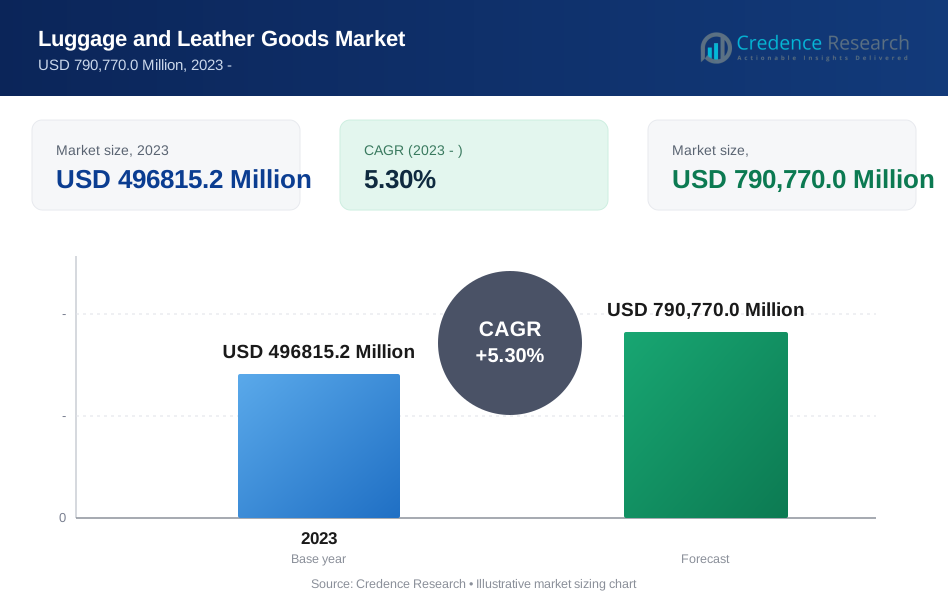
| Luggage and Leather Goods Market Size 2023 | USD 96815.2 Million |
| Luggage and Leather Goods Market, CAGR | 5.30% |
| Luggage and Leather Goods Market Size 2032 | USD 790770.0 Million |
Market Insights
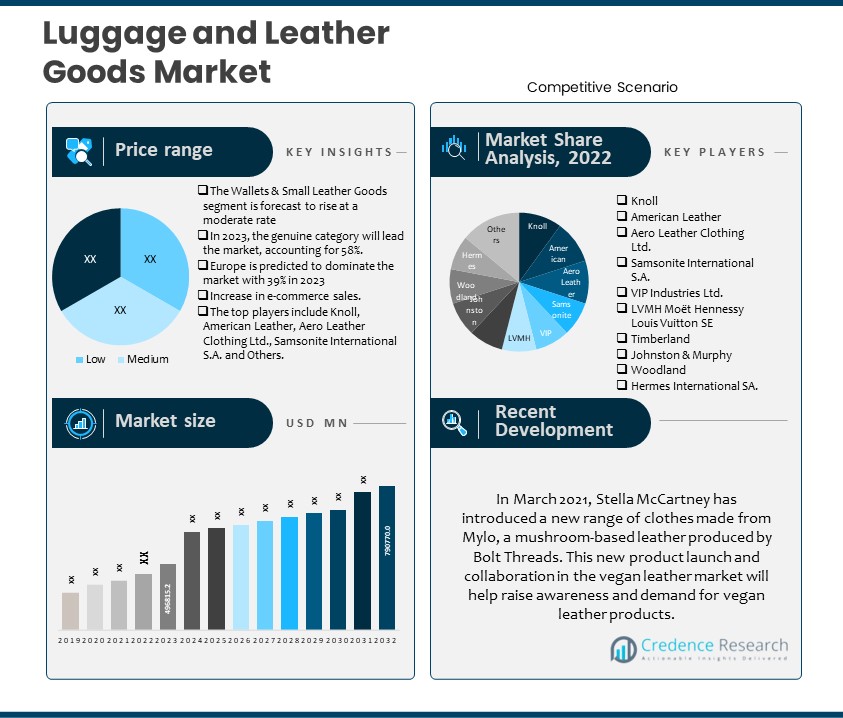
- The global demand for Luggage and Leather Goods was valued at USD 496815.2 Million in 2023 and is expected to reach USD 790770.0 Million in 2032, growing at a CAGR of 5.30% between 2024 and 2032.
- The Handbags & Purses sector contributes significantly to market expansion, while the Wallets & Small Leather Goods segment is expected to rise at a moderate rate throughout the projected period.
- Synthetic leather is the fastest-growing sector, and in 2023, real leather led the market, accounting for 58%.
- In 2023, the Retail Stores sector contributed for the majority of the Leather Goods Market revenue, with online retail being another important segment in the market.
- Europe is predicted to dominate the market with 39% in 2023, with Asia Pacific coming in second at 20%.
- Increased fashion consciousness drives market expansion.
- The emergence of cheaper alternatives slows market expansion.
Executive Summary
Market Definition
Luggage and leather products are created from animal skin. These goods are extremely long-lasting and have an attractive appearance. Leather products include footwear, clutches and wallets, clothes and apparel, upholstery (furniture and automobile), and leather accessories. Leather luggage comprises duffle bags, rolling luggage, backpacks, suitcases, and briefcases, as well as totes and hand baggage. Furthermore, leather is elegant, adding quality to the style because these items may be taken wherever. Furthermore, leather is natural and will never go out of style. Aside from fashion, leather is particularly resistant to harsh weather conditions because it does not peel or split easily, increasing endurance.
Market Overview
The global Luggage and Leather Goods Market has witnessed steady growth in recent years and is expected to grow at a CAGR of 5.30% between 2024 and 2032. The market was valued at USD 496815.2 million in 2023 and is expected to reach USD 790770.0 million in 2032.
Leather baggage includes trolley bags and suitcases for transporting personal belongings, while leather goods include purses, wallets and belts, footwear, handbags, and other items. Growing disposable income, increased domestic and international travel, and improved living conditions all help to drive the leather luggage and products market forward. Global market competitors are always launching new and fashionable leather items in response to shifting consumer demands. Furthermore, the fashionable and compact luggage items given by market leaders provide consumers with convenience and ease of travel. Increased per capita income encourages buyers to choose premium, high-quality leather products.
Segmentation By Product Type
- The Handbags & Purses sector contributes significantly to market growth. Handbags have seen increased demand, prompting manufacturers to open new manufacturing facilities. For instance, Hermes International announced in February 2022 the opening of two new manufacturing facilities in France. The two new facilities will help meet the increased demand for women's handbags.
- The Wallets & Small Leather Goods segment is predicted to develop at a moderate rate throughout the projection period.
Segmentation By Material Type
- Synthetic leather is the fastest-expanding sector. Its items are less expensive than genuine leather goods while maintaining a similar visual appeal, increasing consumer demand. Synthetic leather is mostly composed of synthetic materials such as polyvinyl chloride and polyurethane.
- In 2023, the genuine category dominated the market, accounting for 58%. Factors driving demand for the product include the fact that it is less expensive than genuine leather and is equally appealing in terms of appearance. It is made from polyurethane and polyvinyl chloride. Polyurethane is better for the environment than vinyl because it emits no dioxins.
Segmentation by Distribution Channel
- In 2023, the Retail Stores sector accounted for the majority of Leather Goods Market revenue. Store-based distribution channels are still significant in the leather goods sector since buyers typically prefer to see and touch products before making a purchase. These platforms also provide more personalized customer service and an improved overall buying experience.
- However, the expansion of online retail has offered new options for leather goods businesses to engage clients directly through their own websites or online marketplaces.
Segmentation by Region
- Europe is expected to dominate the market with 39% in 2023.
- Asia Pacific is the second largest region the market in 2023, accounting for 20%.
- The rest of the world, including Latin America, the Middle East, and Africa, supplies the remaining demand for Luggage and Leather Goods.
Europe is expected to dominate the market in 2023. Some of the key drivers fueling the European market's growth include the strong presence of local and international enterprises, product and technological advancements, the rise of online commerce, and the use of social media platforms. Increased fashion awareness, disposable incomes, and a desire for appealing bags are driving Luggage and leather goods sales in the region. Furthermore, as customers become more interested in travel and unique experiences, demand for leather products, such as luggage bags, is rising, particularly in the luxury market, where purchasers seek high-quality items. Furthermore, due to the high presence of fashion-forward countries such as France and Italy, the region remains the market's top customer.
Moreover, Asia Pacific dominated the market in 2024, accounting for 20%. The elements boosting demand for the goods include an increase in demand for premium and luxury products. Bangladesh and Pakistan are major sources of primary leather in Asia Pacific. Bangladesh's very low tariff rates on exported leather products make it a desirable market for international leather goods firms.
Key Highlights of the Report
Product Type, Material Type, Distribution Channel, and region segment of the global Luggage and Leather Goods Market. The Handbags and Purses sector contributes significantly to market growth, while the Wallets and Small Leather Goods section is expected to rise at a moderate rate. In addition, synthetic leather is the fastest-growing industry, with the retail stores sector accounting for the bulk. Online retail is another key component in the market with Europe driving its growth.
The market's primary drivers are increasing travel and tourism activities, rising disposable income in emerging nations, and rising demand for luxury and designer items. However, fluctuating raw material prices, intense competition from counterfeit items, and environmental problems associated with leather production are the primary market restraints. Furthermore, the market's significant opportunities include expansion into online sales channels, innovation in sustainable materials, and customization and personalization trends.
Europe is estimated to account for 39% of the market in 2024. Some of the primary reasons driving the European market's growth include the strong presence of local and international firms, product and technology advancements, the rise of online commerce, and the use of social media platforms. Rising fashion awareness, discretionary incomes, and a desire for stylish bags are driving Luggage and leather products sales in the region. By 2024, Asia Pacific will be the market's second-largest region.
What Are The Main Drivers Of The Global Luggage and Leather Goods Market?
Several variables influence the luggage and leather goods market. To begin, the growing global trend of travel and tourism is driving up demand for baggage and leather items. Furthermore, increased disposable income in emerging nations encourages customers to invest in high-quality leather goods. also, customers' preferences for premium and designer goods are increasing, which is boosting the industry even further.
What Are The Major Challenges Faced By The Global Luggage and Leather Goods Market?
Despite market expansion, there are a few constraints to consider. Fluctuating raw material prices can have an impact on leather goods production costs, influencing pricing and profit margins. Intense competition from counterfeit products is an issue for the industry since it can harm the reputation and sales of real leather goods. Furthermore, environmental concerns around leather production, like as sustainability and ethical sourcing, are becoming increasingly crucial issues that businesses must address.
What Are The Growth Opportunities In The Global Luggage and Leather Goods Market?
Despite the hurdles, there are numerous opportunities in the Luggage and Leather Goods Market. Companies should consider expanding into online sales channels to reach a larger client base and capitalize on the growing e-commerce trend. Companies that innovate in sustainable materials can differentiate themselves and appeal to environmentally sensitive customers.
Market Drivers
Several factors drive the global Luggage and Leather Goods Market. The following are the key drivers of the global Luggage and Leather Goods Market:
Increasing Fashion Consciousness
Consumers' growing fashion consciousness has played a vital role in the recent rise of the worldwide luggage and leather goods market. As consumers become more concerned with personal style and want their accessories, such as bags, wallets, belts, and suitcases, to match their clothes, the demand for trendy and high-quality luggage and leather items has skyrocketed. Consumers want luggage and bags that make a style statement just as much as other fashion items, and they are willing to spend more for brands who offer cutting-edge designs. Manufacturers have also observed this changing consumer behavior and are releasing updated collections throughout the year with a variety of textures, designs, and colors to entice fashion-conscious shoppers.
The growing convergence of luggage, bags, and general fashion has inspired more collaboration among premium brands. For example, high-end labels like Louis Vuitton, Gucci and Prada that are traditionally known for their apparel and accessories lines have expanded into travel products as well. Similarly, luggage titans Rimowa and Samsonite have collaborated with clothing brands to offer co-branded lines.
Market Restraints
The global Luggage and Leather Goods Market faces some challenges that may hinder its growth. These include the following:
Availability Of Cheaper Alternatives
In recent years, the increased availability of lower-cost synthetic and fake leather goods has had a considerable impact on the global luggage and leather goods business. Consumers can purchase low-cost luggage, bags, belts, and other accessories manufactured of plastic and synthetic materials that resemble real leather. While genuine leather is durable and long-lasting, inexpensive plastic alternatives are strong enough for most people's needs, and their lower price makes them quite appealing. This has caused a change in demand from branded leather products to more cheap synthetic alternatives.
For instance, major stores sell entire lines of luggage, backpacks, and purses for less than $50 that are constructed from polyester blends and imitation leathers that closely resemble the look and feel of higher-end leather products.
Opportunities
The global Luggage and Leather Goods Market offers significant growth opportunities. These include the following:
Innovation In Materials And Design
Innovation in materials used for luggage and leather items has enormous potential for growth in the near future. Historically, these industries depended on leather and hard polymers, which can be heavier and less durable. However, new sustainable and lightweight polymers are being created to approximate the appearance and feel of leather while being stronger, longer lasting, and more weather resistant. For instance, advancements in vegan leather made from pineapple leaves and mushroom root are gaining traction. These new materials enable luggage and accessory casings to be thinner while remaining more protective. They are increasingly attractive to eco-conscious consumers and can help firms lessen their environmental effect
Design innovation is another area where these sectors can see increased opportunity. Consumers expect their luggage and bags to be both functional and beautiful. Emerging trends such as modular designs that allow bags to alter dependent on storage requirements, smart features built directly into materials, and 3D printed customisation elicit excitement and loyalty from younger demographics.
Competitive Landscape
Key Players
The global Luggage and Leather Goods Market is highly competitive, with several key players. Some of the major players in the market and their market share are as follows:
- Knoll
- American Leather
- Aero Leather Clothing Ltd.
- Samsonite International S.A.
- VIP Industries Ltd.
- LVMH Moët Hennessy Louis Vuitton SE
- Timberland
- Johnston & Murphy
- Woodland
- Hermes International SA.
These organizations prioritize product innovation, Distribution Channel expansion, and mergers and acquisitions to stay competitive.
The global Luggage and Leather Goods Market's key players continually seek to stay ahead by offering new products and developments.
In April 2021, Adidas AG announced the debut of its new Stan Smith sneakers made from vegan leather and a mushroom-based substance. The new launch is part of the company's broader sustainability aims, which aim to meet the market's growing need for sustainable products.
In March 2021, Hermes announced the debut of its new mushroom leather product line. After three years of creation and development in conjunction with MycoWorks, the company introduced its Fine Mycelium line. The material will be utilized to create Victoria's Bags. This product invention and development will help the company acquire a competitive advantage in the market.
Summary of Key Findings
- Innovation in material and design
- The market is segmented by Product Type, Material Type, Distribution Channel, and region.
- The Handbags & Purses sector contributes significantly to market expansion Innovation in material and design
- In 2023, the Retail Stores sector contributed for the majority of the Leather Goods Market revenue
- Europe is leading in market growth; the market is highly competitive, with key players including Knoll, American Leather, Aero Leather Clothing Ltd., Samsonite International S.A. and Others.
Future Outlook
- Rising demand for premium and bespoke items
- Increase in e-commerce sales.
- Growing emphasis on sustainable and eco-friendly materials.
- Technological advances in smart luggage.
How CXOs Can Benefit from the Credence Research Luggage and Leather Goods Market Report
The Credence Research Luggage and Leather Goods Market Report provides CXOs with a comprehensive overview of the market, including:
- Market size and growth forecast: The report provides detailed estimates of the global Luggage and Leather Goods Market size, segmented By Product Type, Material Type, Distribution Channel, and region. It also includes forecasts for the market through 2032 based on key trends and drivers.
- Market segmentation: The report segments the Luggage and Leather Goods Market By by Product Type, Material Type, Distribution Channel, and region. This segmentation provides CXOs with a granular understanding of the market and the opportunities in each segment.
- Competitive Landscape: The report profiles the key players in the Luggage and Leather Goods Market and provides insights into their strategies, product offerings, and financial performance. This information can help CXOs identify and assess their competition.
- Key trends and drivers: The report identifies and analyzes the key trends and drivers that are shaping the Luggage and Leather Goods Market. This information can help CXOs to make informed decisions about their investments and strategies.
CXOs can use the insights from the Credence Research Luggage and Leather Goods Market Report to:
- Identify growth opportunities: The report can help CXOs identify new growth opportunities in the Luggage and Leather Goods Market. By analyzing the data and trends in the report, they can make informed decisions about where to invest and expand their business.
- Make informed investment decisions: The report can help CXOs make informed investment decisions about Luggage and Leather Goods. For example, it may provide useful insights into market trends, customer preferences, the competitive landscape, and growth prospects in the Luggage and Leather Goods Market.
- Develop competitive strategies: The report can help CXOs develop competitive strategies for their Luggage and Leather Goods businesses. For example, by analyzing market trends, client preferences, and the competitive environment mentioned in the report, CXOs can fine-tune their strategies, differentiate their offers, and effectively position their firms in the marketplace.
- Track market developments: The report can help CXOs monitor market developments and stay ahead of the curve. For example, it provides insights into the latest trends and innovations in the Luggage and Leather Goods Market.
Overall, the Credence Research Luggage and Leather Goods Market Report is a valuable reMaterial Type for CXOs who want to gain a deeper understanding of the market and identify opportunities for growth.
Segmentation
- By Product Type:
- Travel Bags
- Business & Laptop Bags
- Handbags & Purses
- Wallets & Small Leather Goods
- Belts
- Other Leather Goods
- By Material Type:
- Genuine Leather
- Synthetic Materials
- Mixed Materials
- By Distribution Channel:
- Retail Stores
- Online Retail
- Brand Boutiques
- Travel Retail
- By Region
- North America
- The U.S.
- Canada
- Mexico
- Europe
- Germany
- France
- The U.K.
- Italy
- Spain
- Rest of Europe
- Asia Pacific
- China
- Japan
- India
- South Korea
- South-east Asia
- Rest of Asia Pacific
- Latin America
- Brazil
- Argentina
- Rest of Latin America
- Middle East & Africa
- GCC Countries
- South Africa
- Rest of the Middle East and Africa
- North America
Request a Free Sample
Fill in your details and we'll send you a free sample report.
- Sample data tables & charts
- Research methodology
Need a Custom Version of This Report?
Tailor the scope, geography, or segments to your exact requirements.
- Custom geography or segment scope
- Direct access to our analyst team
Frequently Asked Questions
What is the current size of the global Luggage and Leather Goods Market?
What is the expected growth rate of the Luggage and Leather Goods Market between 2024 and 2032?
Which segment is leading the market share in terms of Distribution Channel?
Which Product Type segment governs the demand for Luggage and Leather Goods in the world?
Who are the major players in the global Luggage and Leather Goods Market?
Table of Content
Chapter 1. Report Introduction
- 1.1 Report Description & Purpose
- 1.1.1 Report Title & Market Definition
- 1.1.2 Unique Selling Propositions (USP) & Key Differentiators
- 1.1.3 Value Proposition for Stakeholders
- 1.2 Research Objectives
- 1.2.1 Market Sizing Objectives (Volume & Revenue)
- 1.2.2 Segmentation Objectives
- 1.2.3 Competitive Intelligence Objectives
- 1.2.4 Forecast & Scenario Objectives
- 1.3 Report Scope
- 1.3.1 Luggage and Leather Goods Scope – Types & Subtypes Covered
- 1.3.2 Geographic Scope – Regions & Countries Covered
- 1.3.3 Historical Period, Base Year & Forecast Period (2023; forecast to the forecast period)
- 1.3.4 Inclusions & Exclusions
- 1.4 HS Code & Classification Framework
- 1.5 Currency, Units & Pricing Basis
- 1.6 Target Stakeholders
- 1.7 Limitations & Assumptions
Chapter 2. Executive Summary
- 2.1 Global Luggage and Leather Goods Market Snapshot
- 2.1.1 Market Size – Historical (2023) & Forecast (the forecast period) (2023: USD 496815.2 Million → forecast year: USD 790,770.0 Million)
- 2.1.2 Volume & Revenue – Global Totals
- 2.1.3 Key Market Highlights – Top Five Facts
- 2.2 Luggage and Leather Goods Market Segmentation Snapshot
- 2.2.1 Market Split by Region – 2023 vs.
- 2.3 Competitive Snapshot
- 2.3.1 Top 10 Players by Revenue Share – 2023
- 2.3.2 Top 10 Players by Volume Share – 2023
- 2.3.3 Recent Strategic Developments (18-Month Summary)
- 2.4 Key Investment Highlights & Strategic Conclusions
Chapter 3. Luggage and Leather Goods Market Dynamics & Industry Analysis
- 3.1 Market Overview & Context
- 3.1.1 Luggage and Leather Goods Market Position in the Broader Automotive Value Chain
- 3.1.2 OEM vs. Replacement Market Dynamics
- 3.1.3 Market Maturity & Development Stage by Region
- 3.2 Luggage and Leather Goods Market Drivers
- 3.3 Luggage and Leather Goods Market Restraints & Challenges
- 3.4 Luggage and Leather Goods Market Opportunities
- 3.5 Porter's Five Forces Analysis
- 3.5.1 Threat of New Entrants
- 3.5.2 Bargaining Power of Suppliers
- 3.5.3 Bargaining Power of Buyers
- 3.5.4 Threat of Substitutes
- 3.5.5 Competitive Rivalry – Intensity Assessment
- 3.6 Luggage and Leather Goods Value Chain Analysis
- 3.6.1 Upstream – Raw Material/Input Suppliers
- 3.6.1.1 Raw Material/Input 1
- 3.6.1.2 Raw Material/Input 2
- 3.6.1.3 Raw Material/Input 3
- 3.6.2 Midstream – Production/Manufacturing/Service Delivery
- 3.6.2.1 Production/Process Overview
- 3.6.2.2 Key Facility Locations & Capacity by Manufacturer
- 3.6.3 Downstream – Distribution & End Consumer
- 3.6.3.1 Primary Channel – B2B/OEM
- 3.6.3.2 Secondary Channels – Dealer, Retail, Online, Direct
- 3.6.4 Value Chain Profitability Analysis
- 3.6.1 Upstream – Raw Material/Input Suppliers
- 3.7 PESTEL Analysis
- 3.7.1 Political Factors
- 3.7.2 Economic Factors
- 3.7.3 Social Factors
- 3.7.4 Technological Factors
- 3.7.5 Environmental Factors
- 3.7.6 Legal Factors
- 3.8 Luggage and Leather Goods Supply Chain Analysis
- 3.8.1 Raw Material/Input Supply Risk Assessment
- 3.8.2 Manufacturing Concentration Risk (Geographic Exposure)
- 3.8.3 Trade Disruption Impact Analysis
- 3.9 Regulatory & Policy Landscape
Note: The regulatory and policy landscape section covers regulations based on their applicability to the market, Luggage and Leather Goods category, geography, and scope of the study. Only regulatory frameworks with a material impact on operations, compliance, trade, sustainability, or market access are analyzed in detail.
Chapter 4. Key Investment Pockets & Opportunity Analysis
- 4.1 Luggage and Leather Goods Market Attractiveness Analysis
- 4.1.1 By Region – Investment Attractiveness Matrix (Volume × CAGR)
- 4.2 Absolute Revenue Growth Opportunity
- 4.2.1 By Region – Absolute USD Growth Through the forecast period
- 4.3 Incremental Volume Opportunity
- 4.3.1 By Region – Incremental Volume Through the forecast period
- 4.3.2 Segment – Incremental Volume
- 4.4 Emerging Submarket Opportunity Deep Dive (Subject to Applicability)
- 4.5 Emerging Market Opportunity Scorecards
- 4.5.1 United States
- 4.5.2 Europe
- 4.5.3 Asia
- 4.5.4 Middle East & Africa
Note: Emerging Market Opportunity Scorecards will be included based on relevance and strategic importance. Regions listed are indicative and may vary depending on data availability and market dynamics.
Chapter 5. Luggage and Leather Goods Import-Export Analysis & Trade Flows
- 5.1 Global Trade Overview
- 5.1.1 Global Export Value by Country (2023)
- 5.1.2 Global Export Volume by Country (2023)
- 5.1.3 Global Import Value by Country (2023)
- 5.1.4 Global Import Volume by Country (2023)
- 5.1.5 Net Trade Balance by Country (2023)
- 5.2 Export Analysis – Segment
- 5.2.1 Type 1 (HS Code)
- 5.2.2 Type 2 (HS Code)
- 5.2.3 Type 3 (HS Code)
- 5.2.4 Type 4 (HS Code)
- 5.2.5 Type 5 (HS Code)
- 5.3 Import Analysis – Segment
- 5.3.1 Type 1 (HS Code)
- 5.3.2 Type 2 (HS Code)
- 5.3.3 Type 3 (HS Code)
- 5.3.4 Type 4 (HS Code)
- 5.3.5 Type 5 (HS Code)
- 5.4 Average Unit Trade Prices
- 5.4.1 Average Export Price – Segment & Country
- 5.4.2 Average Import Price – Segment & Source Country
- 5.4.3 Price Trends (2023)
- 5.5 Key Trade Route Analysis
- 5.5.1 Trade Route 1
- 5.5.2 Trade Route 2
- 5.5.3 Trade Route 3
- 5.5.4 Trade Route 4
- 5.5.5 Trade Route 5
- 5.6 Trade Policy Impact Assessment
- 5.6.1 US Anti-Dumping & Section 301 Tariffs
- 5.6.2 EU Customs Union Impact
- 5.6.3 Major Free Trade Agreements
- 5.6.4 USMCA Rules of Origin
Note: Trade policy analysis will be included only where relevant to the Luggage and Leather Goods market.
Chapter 6. Competitive Landscape & Company Benchmarking
- 6.1 Luggage and Leather Goods Market Concentration & Structure
- 6.1.1 Herfindahl-Hirschman Index (HHI) – vs. 2023
- 6.1.2 Tier 1, Tier 2 & Tier 3 Market Structure
- 6.1.3 Global, Regional & Local Player Dynamics
- 6.2 Luggage and Leather Goods Market Share Analysis – 2023
- 6.2.1 Global Revenue Share by Company
- 6.2.2 Global Volume Share by Company
- 6.2.3 Regional Revenue Share
- 6.2.4 Market Share Evolution ( vs. 2023)
- 6.2.5 OEM Segment Share by Company
- 6.2.6 Replacement Segment Share by Company
- 6.3 Production/Delivery Capacity & Facility Analysis
- 6.3.1 Global Installed Capacity
- 6.3.2 Capacity Utilization Rates
- 6.3.3 Production/Output Volume
- 6.3.4 Facility Locations & Capacity Map
- 6.3.5 Planned Capacity Additions
- 6.4 Luggage and Leather Goods Competitive Benchmarking Matrix
- 6.4.1 Revenue, Volume, CAGR & Profitability Comparison
- 6.4.2 Channel Revenue Mix
- 6.4.3 Geographic Revenue Exposure
- 6.4.4 R&D Intensity
- 6.4.5 Sustainability Maturity
- 6.5 Strategic Developments in Luggage and Leather Goods (Last 24 Months)
- 6.5.1 Mergers, Acquisitions & Divestments
- 6.5.2 New Luggage and Leather Goods Launches
- 6.5.3 Facility Expansions
- 6.5.4 Strategic Alliances, Joint Ventures & Partnerships
- 6.5.5 Distribution Expansion & Market Entry
- 6.5.6 Sustainability & ESG Initiatives
- 6.6 Competitive Strategy Mapping
- 6.6.1 Leader, Challenger, Follower & Niche Classification
- 6.6.2 Pricing Strategy Comparison
- 6.6.3 Channel Strategy Matrix
Note: Strategic developments are included based on their materiality and the availability of reliable information.
Chapter 7. Global Luggage and Leather Goods Market – By Distribution Channel
- 7.1 Segment Overview
- 7.1.1 Volume & Revenue Split by Channel (2023 & )
- 7.1.2 Channel Mix Evolution (the forecast period)
Chapter 8. Regional Market Analysis – Global Overview
- 8.1 Global Regional Overview
- 8.1.1 Regional Volume Share
- 8.1.2 Regional Revenue Share
- 8.1.3 Regional Volume by Region
- 8.1.4 Regional Revenue by Region
- 8.1.5 Regional Forecast Through the forecast period
- 8.2 Cross-Regional Segment Analysis
- 8.2.1 By Distribution Channel
- 8.2.2 By Brand/Price Tier
Chapter 9. North America Luggage and Leather Goods Market
- 9.1 United States
- 9.2 Canada
- 9.3 Mexico
Chapter 10. Europe Luggage and Leather Goods Market
- 10.1 Germany
- 10.2 France
- 10.3 Italy
- 10.4 United Kingdom
- 10.5 Spain
- 10.6 Poland
- 10.7 Russia
- 10.8 Netherlands
- 10.9 Belgium
- 10.10 Sweden
- 10.11 Denmark
- 10.12 Norway
- 10.13 Rest of Europe
Chapter 11. Asia Pacific Luggage and Leather Goods Market
- 11.1 China
- 11.2 India
- 11.3 Japan
- 11.4 South Korea
- 11.5 Thailand
- 11.6 Indonesia
- 11.7 Vietnam
- 11.8 Malaysia
- 11.9 Australia
- 11.10 Rest of Asia Pacific
Chapter 12. Latin America Luggage and Leather Goods Market
- 12.1 Brazil
- 12.2 Argentina
- 12.3 Colombia
- 12.4 Chile
- 12.5 Rest of Latin America
Chapter 13. Middle East Luggage and Leather Goods Market
- 13.1 Saudi Arabia
- 13.2 United Arab Emirates
- 13.3 Turkey
- 13.4 Israel
- 13.5 Iran
- 13.6 Rest of the Middle East
Chapter 14. Africa Luggage and Leather Goods Market
- 14.1 South Africa
- 14.2 Egypt
- 14.3 Nigeria
- 14.4 Morocco
- 14.5 Rest of Africa
Chapter 15. Luggage and Leather Goods Company Profiles
- 15.1 [Company 01]
- 15.1.1 Company Overview
- 15.1.2 Key Management Personnel
- 15.1.3 Products & Services Portfolio
- 15.1.4 Financial Performance
- 15.1.5 Key Market Focus & Geographic Presence
- 15.1.6 Recent Developments & Strategic Initiatives
Note: The company profile list is preliminary and may change based on research findings, market developments, data availability, and client requirements.
Chapter 16. Appendices
- Appendix A – List of Abbreviations & Acronyms
- Appendix B – Industry Classification Code Reference – Full Series
- Appendix C – Production & Capacity Data Tables
- Appendix D – End-Use & Demand Base Tables
- Appendix E – Consumption & Replacement Rate Assumptions
- Appendix F – ASP Reference Tables
- Appendix G – Manufacturing & Facility Database
- Appendix H – Import-Export Data Tables
- Appendix I – Regulatory Summary Tables
- Appendix J – Primary Research Participant List (Anonymized)
- Appendix K – Primary Research Questionnaire Framework
- Appendix L – Data Sources & Bibliography
- Appendix M – Market Size Divergence & Source Comparison
Chapter 17. Research Methodology
- 17.1 Research Framework & Philosophy
- 17.2 Secondary Research – Sources, Hierarchy & Data Extraction
- 17.3 Data Modeling – Bottom-Up & Top-Down Market Sizing
- 17.4 Primary Research – Stakeholder Framework, LOI & Sample Sizes
- 17.5 Forecast Methodology – Regression, Scenario & Sensitivity Analysis
- 17.6 Quality Control – Four-Layer Validation Framework
- 17.7 Limitations & Standard Assumptions
- 17.8 Disclaimer
