
| REPORT ATTRIBUTE | DETAILS |
|---|---|
| Historical Period | 2020-2023 |
| Base Year | 2024 |
| Forecast Period | 2025-2032 |
| Military Radar Market Size 2024 | USD 36,401.74 million |
| Military Radar Market, CAGR | 20.26% |
| Military Radar Market Size 2032 | USD 159,234.12 million |
Market Overview
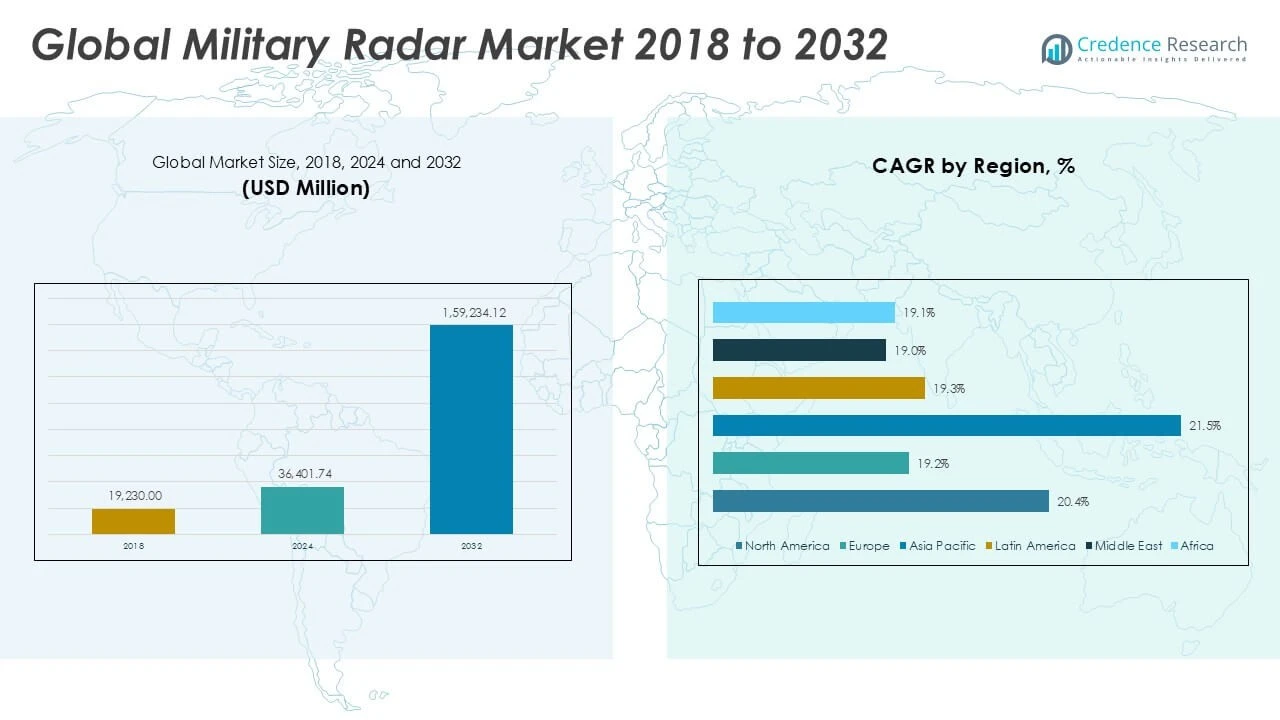
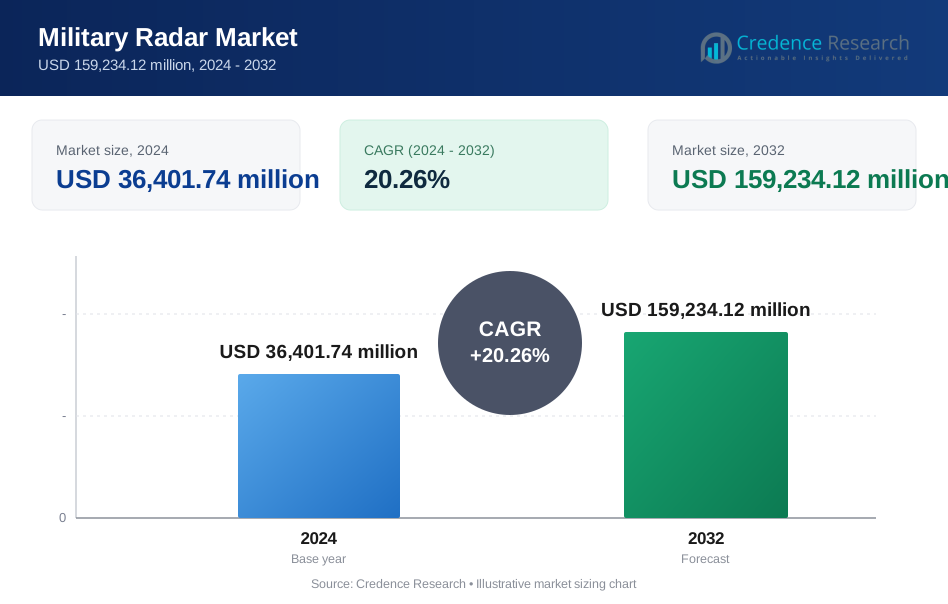
The Global Military Radar Market is projected to grow from USD 36,401.74 million in 2024 to an estimated USD 159,234.12 million by 2032, registering a compound annual growth rate (CAGR) of 20.26% from 2025 to 2032.
Key drivers of the military radar market include the growing emphasis on modernizing defense infrastructure and integrating radar systems with advanced technologies such as artificial intelligence (AI), machine learning (ML), and cloud computing. Trends indicate a shift towards multifunctional radar systems capable of operating across multiple frequency bands to improve accuracy and reduce detection time. Additionally, the development of compact, lightweight, and low-power radar systems for unmanned aerial vehicles (UAVs) and other autonomous platforms further accelerates market growth.
Geographically, North America dominates the military radar market due to substantial defense spending by the United States and Canada and strong technological capabilities. Asia-Pacific is expected to witness the highest growth rate, driven by increasing defense budgets in countries like China, India, and South Korea. Key players operating in this market include Lockheed Martin Corporation, Raytheon Technologies Corporation, BAE Systems plc, Thales Group, and Northrop Grumman Corporation, all of which focus on innovation and strategic partnerships to strengthen their market position.
Market Insights
- The Global Military Radar Market is projected to grow from USD 36,401.74 million in 2024 to USD 159,234.12 million by 2032, registering a CAGR of 20.26%.
- Increasing global defense budgets and modernization initiatives drive the demand for advanced radar systems with improved detection and tracking capabilities.
- Integration of artificial intelligence and machine learning enhances radar accuracy, operational efficiency, and real-time threat analysis.
- High development costs, complex integration processes, and vulnerability to electronic warfare pose challenges to market growth.
- North America holds the largest market share due to significant defense spending and technological advancements, maintaining a strong leadership position.
- Asia Pacific is the fastest-growing region, fueled by rising defense expenditure in China, India, and South Korea amid geopolitical tensions.
- Demand for compact, multifunctional radar systems suitable for unmanned platforms and network-centric warfare boosts innovation and market expansion.
Market Drivers
Rising Defense Budgets and Modernization Initiatives Propel Market Expansion
The Global Military Radar Market benefits significantly from increased defense spending across several countries. Governments prioritize upgrading and modernizing their defense systems to counter evolving threats, which creates strong demand for advanced radar technologies. Investments focus on improving the detection, tracking, and surveillance capabilities of military radars. Modernization initiatives emphasize replacing legacy systems with multifunctional radars that offer enhanced range, accuracy, and resistance to electronic warfare. Military organizations also aim to integrate radars with broader command and control networks, boosting operational efficiency. These strategic priorities drive continuous procurement and development activities in the radar segment.
- For instance, India allocated ₹6,21,940 crore for defense spending in 2024-25, reflecting a strong commitment to modernization and self-reliance in military technology.
Technological Advancements Enhance Radar Capabilities and Application Scope
Rapid innovation in radar technology fuels growth within the Global Military Radar Market. The incorporation of artificial intelligence and machine learning enhances target recognition, reduces false alarms, and optimizes signal processing. Advancements in phased array radar, synthetic aperture radar, and active electronically scanned array (AESA) systems improve detection speed and reliability. These technologies expand radar applications beyond traditional air surveillance to maritime, ground, and space domains. It also enables radars to operate effectively in complex environments with clutter and electronic countermeasures. Continuous technology upgrades support military forces in maintaining tactical advantages.
- For instance, advancements in AESA radar technology have led to widespread adoption in fighter jets, eliminating mechanical steering and improving scanning speed and accuracy.
Integration of Unmanned Systems and Autonomous Platforms Expands Market Demand
Military radars play a critical role in supporting unmanned aerial vehicles (UAVs), drones, and other autonomous systems. These platforms require compact, lightweight radar solutions with low power consumption and high precision. The growing adoption of unmanned systems for intelligence, surveillance, reconnaissance, and combat missions increases radar demand. It also pushes manufacturers to develop specialized radar variants tailored for integration with autonomous platforms. The synergy between unmanned technologies and radar systems broadens operational capabilities and encourages further innovation in radar designs.
Geopolitical Tensions and Security Concerns Drive Strategic Radar Deployments
Heightened geopolitical conflicts and emerging security threats contribute to the growing reliance on military radar systems. Nations seek to bolster their border surveillance, early warning systems, and missile defense networks to respond to potential aggression. It leads to increased radar deployments in contested regions and strategic locations worldwide. Military radar solutions help monitor airspace violations, detect incoming threats, and provide actionable intelligence for defense planning. The continuous focus on national security ensures sustained demand for advanced radar technologies and supports market growth globally.
Market Trends
Adoption of Multifunctional Radar Systems with Enhanced Performance Capabilities
The Global Military Radar Market increasingly favors multifunctional radar systems that combine detection, tracking, and targeting functions into a single platform. These systems reduce hardware footprint and operational costs while improving situational awareness on the battlefield. It supports simultaneous tracking of multiple targets across air, sea, and ground domains with high precision. Manufacturers focus on developing radars that operate across multiple frequency bands to enhance detection accuracy and resilience against jamming. This trend aligns with military demands for flexible, efficient solutions that address diverse operational requirements. The shift toward multifunctional radars marks a significant evolution in defense technology.
- For instance, Hanwha Systems has developed multi-function radar (MFR) that integrates detection, tracking, electronic warfare, and missile guidance into a single system, enhancing operational efficiency and reducing hardware footprint.
Integration of Artificial Intelligence and Machine Learning for Advanced Threat Analysis
Military radar technologies integrate artificial intelligence (AI) and machine learning (ML) algorithms to optimize target recognition and decision-making processes. The Global Military Radar Market benefits from AI-driven systems that analyze vast volumes of radar data in real time to reduce false positives and prioritize critical threats. It enables faster response times and improved operational efficiency. AI also assists in adapting radar parameters dynamically based on environmental conditions and threat characteristics. This trend strengthens radar systems’ ability to operate in contested and cluttered environments. The adoption of AI and ML represents a key technological advancement influencing radar system development.
- For instance, a study on machine learning in military surveillance highlights how AI-driven threat detection systems improve accuracy and adaptability, reducing false positives and enhancing real-time decision-making.
Expansion of Compact and Lightweight Radar Solutions for Unmanned Platforms
Compact and lightweight radar systems gain traction due to their suitability for integration with unmanned aerial vehicles (UAVs), drones, and autonomous platforms. The Global Military Radar Market responds to the rising demand for smaller, power-efficient radars that maintain high performance despite size constraints. These radars enhance the operational capabilities of unmanned systems by providing accurate situational awareness and target tracking. It drives innovation in miniaturization and energy-efficient radar designs. The trend reflects the growing importance of unmanned and remotely operated technologies in modern warfare scenarios.
Focus on Network-Centric Warfare through Advanced Radar Connectivity
Military forces prioritize network-centric warfare strategies that rely heavily on interconnected radar systems and sensor networks. The Global Military Radar Market supports the deployment of radars with enhanced data sharing, real-time communication, and interoperability features. It facilitates integrated battlefield management and coordinated defense responses across multiple platforms. Networked radars enable comprehensive surveillance coverage and improve threat detection accuracy by sharing information across command centers and units. This trend emphasizes the increasing role of connectivity and data integration in military radar solutions.
Market Challenges
High Development Costs and Complex Integration Processes Hinder Market Growth
The Global Military Radar Market faces challenges related to the high costs associated with research, development, and production of advanced radar systems. Developing cutting-edge technologies such as active electronically scanned arrays (AESA) and integrating artificial intelligence requires substantial investment. It often leads to extended development cycles and budget constraints for defense organizations. Complex integration of radar systems with existing military infrastructure and other sensor networks also complicates deployment. Compatibility issues and the need for specialized technical expertise slow down adoption rates. These factors create barriers for both manufacturers and end-users in implementing new radar solutions efficiently.
- For instance, the U.S. Department of Defense allocated over 147 million for sea-based X-band radar systems and 133.5 million for anti-radar missile improvements in its 2024 budget
Vulnerability to Electronic Warfare and Rapid Technological Obsolescence
Military radar systems encounter risks from sophisticated electronic warfare tactics aimed at jamming, deceiving, or disabling radar signals. The Global Military Radar Market must continuously adapt to emerging countermeasures to maintain operational effectiveness. It requires frequent upgrades and innovation to counteract evolving threats, increasing maintenance and lifecycle costs. Rapid technological advancements also cause quick obsolescence of radar equipment, forcing military forces to invest in newer systems regularly. Balancing cost-efficiency with technological superiority remains a persistent challenge for stakeholders. This dynamic environment demands ongoing research and agile development approaches.
Market Opportunities
Expanding Demand for Advanced Radar Technologies in Modern Defense Systems
The Global Military Radar Market offers significant opportunities driven by the increasing need to upgrade aging radar infrastructure worldwide. It creates demand for cutting-edge radar systems featuring artificial intelligence, machine learning, and multifunctional capabilities. Militaries seek solutions that enhance situational awareness, target detection, and electronic warfare resilience. The growing adoption of unmanned aerial vehicles and autonomous platforms further broadens the market for compact, lightweight radar systems. It encourages manufacturers to develop innovative products tailored to diverse operational requirements. The continuous evolution of threat landscapes compels armed forces to invest in advanced radar technologies, presenting sustained growth potential.
Growth Potential in Emerging Regions with Rising Defense Expenditure
Emerging markets in the Asia Pacific, Middle East, and Latin America provide lucrative growth opportunities for the Global Military Radar Market. It benefits from increased defense budgets and strategic focus on border security, maritime surveillance, and airspace control in these regions. Governments emphasize local manufacturing and technology transfer initiatives to reduce reliance on imports. This trend encourages collaboration between international radar providers and regional defense organizations. Expanding geopolitical tensions also drive demand for sophisticated radar systems capable of early warning and rapid response. The growing focus on network-centric warfare promotes integration of radar platforms, fostering market expansion across emerging economies.
Market Segmentation Analysis
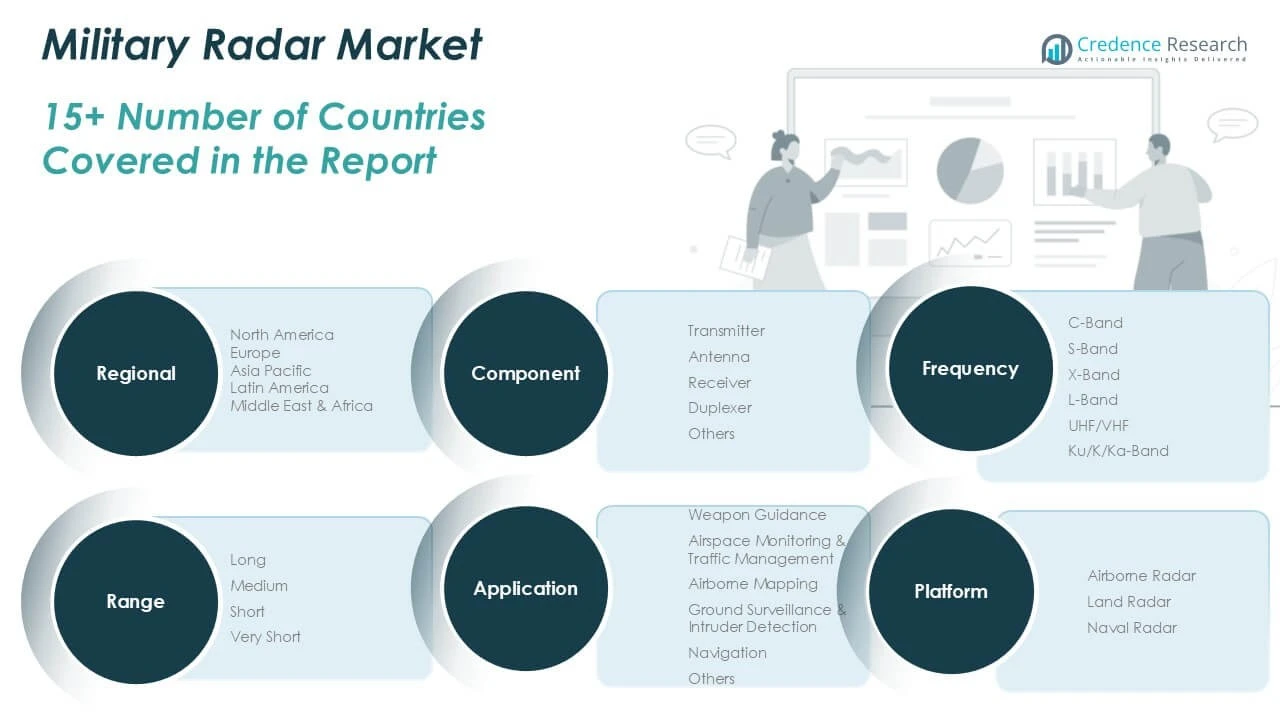
By Component
The Global Military Radar Market divides into key components such as transmitters, antennas, receivers, duplexers, and others. Transmitters generate the radio frequency signals essential for radar operation, while antennas direct and receive these signals for effective detection. Receivers process incoming signals to identify and track targets with precision. Duplexers enable the radar to switch between transmission and reception modes efficiently. The “others” segment includes power supplies, processors, and signal modulators that support overall system functionality. Each component plays a vital role in enhancing radar performance and reliability, influencing procurement decisions within military programs.
By Application
Military radar systems serve multiple applications including weapon guidance, airspace monitoring and traffic management, airborne mapping, ground surveillance and intruder detection, navigation, and others. Weapon guidance relies on radar for precise targeting and missile tracking. Airspace monitoring ensures controlled and secure flight operations in both military and civilian zones. Airborne mapping uses radar to generate detailed terrain and weather data for strategic planning. Ground surveillance detects and tracks enemy movements, enhancing battlefield awareness. Navigation applications provide positioning support for military vehicles and aircraft. These diverse applications drive the demand for specialized radar solutions tailored to mission-specific requirements.
By Frequency
The market segments radar systems by frequency bands such as C-band, S-band, X-band, L-band, UHF/VHF, and Ku/K/Ka-band. Each frequency offers distinct advantages in range, resolution, and penetration capabilities. For example, X-band radars provide high resolution ideal for target tracking and fire control, while L-band radars cover long distances suited for early warning. UHF/VHF bands facilitate detection through foliage and adverse weather. The selection of frequency bands depends on operational needs and environmental conditions. It allows militaries to deploy radars optimized for different combat scenarios.
By Range
Military radar systems classify based on operational range: very short, short, medium, and long. Long-range radars focus on early threat detection over extensive distances, enabling timely response and strategic planning. Medium-range radars balance detection range with mobility and versatility for tactical battlefield use. Short and very short-range radars provide close-in surveillance and targeting support, crucial for quick reaction and defense. These range categories address varied mission requirements from wide-area monitoring to point defense.
By Platform
Radar systems in the Global Military Radar Market deploy across airborne, land, and naval platforms. Airborne radars equip aircraft and UAVs, providing aerial surveillance, targeting, and navigation. Land radars serve ground forces with applications including border security and artillery fire control. Naval radars safeguard maritime assets by detecting surface and underwater threats, ensuring fleet protection. Platform-specific design considerations influence radar capabilities, enabling optimal performance in diverse operational environments.
Segments
Based on Component
- Transmitter
- Antenna
- Receiver
- Duplexer
- Others
Based on Application
- Weapon Guidance
- Airspace Monitoring & Traffic Management
- Airborne Mapping
- Ground Surveillance & Intruder Detection
- Navigation
- Others
Based on Frequency
- C-Band
- S-Band
- X-Band
- L-Band
- UHF/VHF
- Ku/K/Ka-Band
Based on Range
- Long
- Medium
- Short
- Very Short
Based on Platform
- Airborne Radar
- Land Radar
- Naval Radar
Based on Region
- North America
- U.S.
- Canada
- Mexico
- Europe
- UK
- France
- Germany
- Italy
- Spain
- Russia
- Belgium
- Netherlands
- Austria
- Sweden
- Poland
- Denmark
- Switzerland
- Rest of Europe
- Asia Pacific
- China
- Japan
- South Korea
- India
- Australia
- Thailand
- Indonesia
- Vietnam
- Malaysia
- Philippines
- Taiwan
- Rest of Asia Pacific
- Latin America
- Brazil
- Argentina
- Peru
- Chile
- Colombia
- Rest of Latin America
- Middle East
- UAE
- KSA
- Israel
- Turkey
- Iran
- Rest of Middle East
- Africa
- Egypt
- Nigeria
- Algeria
- Morocco
- Rest of Africa
Regional Analysi
North America Military Radar Market
The North America Military Radar Market holds the largest regional share of approximately 38% in 2024, with a market value of USD 13,864.88 million, projected to reach USD 60,817.09 million by 2032. It is expected to grow at a CAGR of 20.4% during the forecast period. The region’s dominance stems from significant defense budgets in the United States and Canada, coupled with advanced technological capabilities. The presence of major defense contractors and continuous investments in modernization programs strengthen its market leadership. It remains a crucial hub for innovation and development of cutting-edge radar systems tailored to meet evolving military needs.
Europe Military Radar Market
Europe accounts for a substantial regional market share of about 18% in 2024, with a market value of USD 6,701.62 million and projected growth to USD 27,085.98 million by 2032. The region exhibits a CAGR of 19.2%, driven by countries like Germany, France, and the United Kingdom investing in defense modernization. Europe focuses on enhancing airspace security and border surveillance capabilities through advanced radar deployment. It also benefits from collaborative defense initiatives within the European Union and NATO, promoting technology sharing and joint development programs. The steady growth reflects strategic efforts to upgrade existing radar infrastructure.
Asia Pacific Military Radar Market
The Asia Pacific Military Radar Market commands a significant regional market share of nearly 29% in 2024, valued at USD 10,524.47 million and expected to reach USD 49,888.85 million by 2032. It projects a CAGR of 21.5%, the highest among all regions. Increasing defense expenditure by China, India, South Korea, and Australia fuels this growth. The region prioritizes border security, maritime surveillance, and air defense systems to address geopolitical tensions. It also drives demand for technologically advanced radar systems and indigenous manufacturing capabilities. The Asia Pacific’s expanding military radar market reflects its rising strategic importance in global defense.
Latin America Military Radar Market
Latin America holds a regional market share of roughly 7% in 2024, with a Military Radar Market valued at USD 2,538.37 million and projected to reach USD 10,356.90 million by 2032, at a CAGR of 19.3%. Countries including Brazil, Mexico, and Argentina invest in upgrading defense infrastructure and enhancing surveillance systems. It focuses on improving coastal security and counter-narcotics operations, which increase demand for versatile radar solutions. The region’s market expansion reflects gradual modernization and growing security concerns. It presents opportunities for radar manufacturers targeting emerging defense markets.
Middle East Military Radar Market
The Middle East Military Radar Market holds an estimated regional market share of 4% in 2024, with a valuation of USD 1,444.00 million, anticipated to grow to USD 5,759.26 million by 2032 at a CAGR of 19.0%. Regional geopolitical tensions and the need for robust border and airspace security drive radar adoption. It prioritizes missile defense, surveillance, and early warning systems across countries such as Saudi Arabia, the UAE, and Israel. Strategic military partnerships and defense spending support market growth. The Middle East remains a vital region for radar technology deployment to counter evolving threats.
Africa Military Radar Market
Africa’s Military Radar Market accounts for around 4% regional market share in 2024, valued at USD 1,328.40 million and expected to reach USD 5,326.05 million by 2032, growing at a CAGR of 19.1%. The market benefits from increased defense budgets among countries like South Africa, Nigeria, and Egypt. It addresses challenges related to border security, counter-terrorism, and maritime surveillance. Investments in radar technology enhance situational awareness and defense preparedness. The region presents growth potential driven by rising security needs and infrastructure development.
Key players
- L3Harris Technologies, Inc.
- BAE Systems
- Leonardo S.p.A.
- General Dynamics Corporation
- Lockheed Martin Corporation
- Northrop Grumman
- RTX
- Thales
- Saab
Competitive Analysis
The Military Radar Market features intense competition among established global defense contractors. Leading companies such as Lockheed Martin Corporation, Northrop Grumman, and L3Harris Technologies, Inc. leverage strong R\&D capabilities and extensive product portfolios to maintain market leadership. It drives continuous innovation in radar technologies, including advanced phased array systems and AI integration. Competitors focus on strategic partnerships, mergers, and acquisitions to expand their geographic reach and technological expertise. Price competitiveness and customization for specific military needs influence contract awards. Emerging players invest in niche technologies targeting unmanned systems and electronic warfare to differentiate themselves. The dynamic market environment demands agility and sustained investment in innovation to secure and grow market share.
Recent Developments
- In May 2025, Raytheon, an RTX business, delivered the first AN/TPY-2 radar equipped with a complete Gallium Nitride (GaN) populated array to the U.S. Missile Defense Agency. This advanced radar system enhances the detection, tracking, and discrimination of ballistic missiles, including hypersonic threats, by providing greater sensitivity, increased range, and expanded surveillance capacity. Additionally, the radar features the latest CX6 high-performance computing software, offering more precise target discrimination and protection against electronic attacks.
- In May 2025, Thales and Tawazun signed an agreement to initiate the domestic production of Ground Master series air surveillance radars in the UAE, enhancing regional defense capabilities.
- In May 2025, Saab and NVIDIA announced a collaboration to integrate artificial intelligence (AI) into radar systems, aiming to enhance military radar performance and effectiveness.
Market Concentration and Characteristics
The Military Radar Market exhibits a moderately concentrated structure dominated by a few large defense contractors such as Lockheed Martin, Northrop Grumman, and L3Harris Technologies. It features high entry barriers due to stringent regulatory requirements, significant capital investments, and advanced technological expertise needed to develop sophisticated radar systems. The market emphasizes innovation, quality, and reliability, driving companies to focus on research and development to maintain competitive advantages. Customization for diverse military applications and strategic government contracts shape market dynamics. Collaboration with governments and defense agencies plays a crucial role in securing long-term projects. While large players control most market share, smaller specialized firms contribute through niche technologies and agile solutions, enhancing the overall ecosystem. The Military Radar Market demands continuous adaptation to evolving threats and technological trends, reinforcing its competitive and innovation-driven characteristics.
Report Coverage
The research report offers an in-depth analysis based on Component, Application, Frequency, Range, Platform and Region. It details leading market players, providing an overview of their business, product offerings, investments, revenue streams, and key applications. Additionally, the report includes insights into the competitive environment, SWOT analysis, current market trends, as well as the primary drivers and constraints. Furthermore, it discusses various factors that have driven market expansion in recent years. The report also explores market dynamics, regulatory scenarios, and technological advancements that are shaping the industry. It assesses the impact of external factors and global economic changes on market growth. Lastly, it provides strategic recommendations for new entrants and established companies to navigate the complexities of the market.
Future Outlook
- The Military Radar Market will witness sustained growth driven by increasing global defense budgets focused on modernizing surveillance and targeting systems.
- Integration of artificial intelligence and machine learning will enhance radar accuracy, threat detection, and decision-making capabilities across military applications.
- Development of multifunctional radars capable of operating across multiple frequency bands will improve operational flexibility and reduce system complexity.
- Demand for compact, lightweight radar systems will rise, supporting the expanding use of unmanned aerial vehicles and autonomous defense platforms.
- Advances in electronic warfare countermeasures will prompt continuous upgrades in radar technologies to maintain effectiveness against sophisticated jamming tactics.
- The Asia Pacific region will emerge as a high-growth market due to rising defense expenditure and increasing focus on border security and maritime surveillance.
- Enhanced network-centric warfare capabilities will drive the adoption of interconnected radar systems that enable real-time data sharing and integrated battlefield awareness.
- Radar manufacturers will invest more in research and development to create cost-effective solutions that balance performance with affordability for diverse military budgets.
- Strategic collaborations and joint ventures between defense contractors and governments will accelerate technology development and market penetration.
- Environmental and regulatory considerations will encourage the design of energy-efficient and sustainable radar systems, aligning with broader defense industry trends.
Request a Free Sample
Fill in your details and we'll send you a free sample report.
- Sample data tables & charts
- Research methodology
Need a Custom Version of This Report?
Tailor the scope, geography, or segments to your exact requirements.
- Custom geography or segment scope
- Direct access to our analyst team
Frequently Asked Questions
What is the projected market size of the Global Military Radar Market in 2023, 2032, and the CAGR?
What factors are driving the growth of the Military Radar Market?
How are technological trends influencing the Military Radar Market?
Who are the key players in the Military Radar Market?
Who are the major players in this market?
Table of Content
Chapter 1. Report Introduction
- 1.1 Report Description & Purpose
- 1.1.1 Report Title & Market Definition
- 1.1.2 Unique Selling Propositions (USP) & Key Differentiators
- 1.1.3 Value Proposition for Stakeholders
- 1.2 Research Objectives
- 1.2.1 Market Sizing Objectives (Volume & Revenue)
- 1.2.2 Segmentation Objectives
- 1.2.3 Competitive Intelligence Objectives
- 1.2.4 Forecast & Scenario Objectives
- 1.3 Report Scope
- 1.3.1 Military Radar Scope – Types & Subtypes Covered
- 1.3.2 Geographic Scope – Regions & Countries Covered
- 1.3.3 Historical Period, Base Year & Forecast Period (2024; forecast to 2032)
- 1.3.4 Inclusions & Exclusions
- 1.4 HS Code & Classification Framework
- 1.5 Currency, Units & Pricing Basis
- 1.6 Target Stakeholders
- 1.7 Limitations & Assumptions
Chapter 2. Executive Summary
- 2.1 Global Military Radar Market Snapshot
- 2.1.1 Market Size – Historical (2024) & Forecast (2024-2032) (2024: USD 36,401.74 million → 2032: USD 159,234.12 million)
- 2.1.2 Volume & Revenue – Global Totals
- 2.1.3 Key Market Highlights – Top Five Facts
- 2.2 Military Radar Market Segmentation Snapshot
- 2.2.1 Market Split by Region – 2024 vs. 2032
- 2.3 Competitive Snapshot
- 2.3.1 Top 10 Players by Revenue Share – 2024
- 2.3.2 Top 10 Players by Volume Share – 2024
- 2.3.3 Recent Strategic Developments (18-Month Summary)
- 2.4 Key Investment Highlights & Strategic Conclusions
Chapter 3. Military Radar Market Dynamics & Industry Analysis
- 3.1 Market Overview & Context
- 3.1.1 Military Radar Market Position in the Broader Automotive Value Chain
- 3.1.2 OEM vs. Replacement Market Dynamics
- 3.1.3 Market Maturity & Development Stage by Region
- 3.2 Military Radar Market Drivers
- 3.3 Military Radar Market Restraints & Challenges
- 3.4 Military Radar Market Opportunities
- 3.5 Porter's Five Forces Analysis
- 3.5.1 Threat of New Entrants
- 3.5.2 Bargaining Power of Suppliers
- 3.5.3 Bargaining Power of Buyers
- 3.5.4 Threat of Substitutes
- 3.5.5 Competitive Rivalry – Intensity Assessment
- 3.6 Military Radar Value Chain Analysis
- 3.6.1 Upstream – Raw Material/Input Suppliers
- 3.6.1.1 Raw Material/Input 1
- 3.6.1.2 Raw Material/Input 2
- 3.6.1.3 Raw Material/Input 3
- 3.6.2 Midstream – Production/Manufacturing/Service Delivery
- 3.6.2.1 Production/Process Overview
- 3.6.2.2 Key Facility Locations & Capacity by Manufacturer
- 3.6.3 Downstream – Distribution & End Consumer
- 3.6.3.1 Primary Channel – B2B/OEM
- 3.6.3.2 Secondary Channels – Dealer, Retail, Online, Direct
- 3.6.4 Value Chain Profitability Analysis
- 3.6.1 Upstream – Raw Material/Input Suppliers
- 3.7 PESTEL Analysis
- 3.7.1 Political Factors
- 3.7.2 Economic Factors
- 3.7.3 Social Factors
- 3.7.4 Technological Factors
- 3.7.5 Environmental Factors
- 3.7.6 Legal Factors
- 3.8 Military Radar Supply Chain Analysis
- 3.8.1 Raw Material/Input Supply Risk Assessment
- 3.8.2 Manufacturing Concentration Risk (Geographic Exposure)
- 3.8.3 Trade Disruption Impact Analysis
- 3.9 Regulatory & Policy Landscape
Note: The regulatory and policy landscape section covers regulations based on their applicability to the market, Military Radar category, geography, and scope of the study. Only regulatory frameworks with a material impact on operations, compliance, trade, sustainability, or market access are analyzed in detail.
Chapter 4. Key Investment Pockets & Opportunity Analysis
- 4.1 Military Radar Market Attractiveness Analysis
- 4.1.1 By Region – Investment Attractiveness Matrix (Volume × CAGR)
- 4.2 Absolute Revenue Growth Opportunity
- 4.2.1 By Region – Absolute USD Growth Through 2032
- 4.3 Incremental Volume Opportunity
- 4.3.1 By Region – Incremental Volume Through 2032
- 4.3.2 Segment – Incremental Volume
- 4.4 Emerging Submarket Opportunity Deep Dive (Subject to Applicability)
- 4.5 Emerging Market Opportunity Scorecards
- 4.5.1 United States
- 4.5.2 Europe
- 4.5.3 Asia
- 4.5.4 Middle East & Africa
Note: Emerging Market Opportunity Scorecards will be included based on relevance and strategic importance. Regions listed are indicative and may vary depending on data availability and market dynamics.
Chapter 5. Military Radar Import-Export Analysis & Trade Flows
- 5.1 Global Trade Overview
- 5.1.1 Global Export Value by Country (2024)
- 5.1.2 Global Export Volume by Country (2024)
- 5.1.3 Global Import Value by Country (2024)
- 5.1.4 Global Import Volume by Country (2024)
- 5.1.5 Net Trade Balance by Country (2024)
- 5.2 Export Analysis – Segment
- 5.2.1 Type 1 (HS Code)
- 5.2.2 Type 2 (HS Code)
- 5.2.3 Type 3 (HS Code)
- 5.2.4 Type 4 (HS Code)
- 5.2.5 Type 5 (HS Code)
- 5.3 Import Analysis – Segment
- 5.3.1 Type 1 (HS Code)
- 5.3.2 Type 2 (HS Code)
- 5.3.3 Type 3 (HS Code)
- 5.3.4 Type 4 (HS Code)
- 5.3.5 Type 5 (HS Code)
- 5.4 Average Unit Trade Prices
- 5.4.1 Average Export Price – Segment & Country
- 5.4.2 Average Import Price – Segment & Source Country
- 5.4.3 Price Trends (2024)
- 5.5 Key Trade Route Analysis
- 5.5.1 Trade Route 1
- 5.5.2 Trade Route 2
- 5.5.3 Trade Route 3
- 5.5.4 Trade Route 4
- 5.5.5 Trade Route 5
- 5.6 Trade Policy Impact Assessment
- 5.6.1 US Anti-Dumping & Section 301 Tariffs
- 5.6.2 EU Customs Union Impact
- 5.6.3 Major Free Trade Agreements
- 5.6.4 USMCA Rules of Origin
Note: Trade policy analysis will be included only where relevant to the Military Radar market.
Chapter 6. Competitive Landscape & Company Benchmarking
- 6.1 Military Radar Market Concentration & Structure
- 6.1.1 Herfindahl-Hirschman Index (HHI) – vs. 2024
- 6.1.2 Tier 1, Tier 2 & Tier 3 Market Structure
- 6.1.3 Global, Regional & Local Player Dynamics
- 6.2 Military Radar Market Share Analysis – 2024
- 6.2.1 Global Revenue Share by Company
- 6.2.2 Global Volume Share by Company
- 6.2.3 Regional Revenue Share
- 6.2.4 Market Share Evolution ( vs. 2024)
- 6.2.5 OEM Segment Share by Company
- 6.2.6 Replacement Segment Share by Company
- 6.3 Production/Delivery Capacity & Facility Analysis
- 6.3.1 Global Installed Capacity
- 6.3.2 Capacity Utilization Rates
- 6.3.3 Production/Output Volume
- 6.3.4 Facility Locations & Capacity Map
- 6.3.5 Planned Capacity Additions
- 6.4 Military Radar Competitive Benchmarking Matrix
- 6.4.1 Revenue, Volume, CAGR & Profitability Comparison
- 6.4.2 Channel Revenue Mix
- 6.4.3 Geographic Revenue Exposure
- 6.4.4 R&D Intensity
- 6.4.5 Sustainability Maturity
- 6.5 Strategic Developments in Military Radar (Last 24 Months)
- 6.5.1 Mergers, Acquisitions & Divestments
- 6.5.2 New Military Radar Launches
- 6.5.3 Facility Expansions
- 6.5.4 Strategic Alliances, Joint Ventures & Partnerships
- 6.5.5 Distribution Expansion & Market Entry
- 6.5.6 Sustainability & ESG Initiatives
- 6.6 Competitive Strategy Mapping
- 6.6.1 Leader, Challenger, Follower & Niche Classification
- 6.6.2 Pricing Strategy Comparison
- 6.6.3 Channel Strategy Matrix
Note: Strategic developments are included based on their materiality and the availability of reliable information.
Chapter 7. Global Military Radar Market – By Distribution Channel
- 7.1 Segment Overview
- 7.1.1 Volume & Revenue Split by Channel (2024 & 2032)
- 7.1.2 Channel Mix Evolution (2024-2032)
Chapter 8. Regional Market Analysis – Global Overview
- 8.1 Global Regional Overview
- 8.1.1 Regional Volume Share
- 8.1.2 Regional Revenue Share
- 8.1.3 Regional Volume by Region
- 8.1.4 Regional Revenue by Region
- 8.1.5 Regional Forecast Through 2032
- 8.2 Cross-Regional Segment Analysis
- 8.2.1 By Distribution Channel
- 8.2.2 By Brand/Price Tier
Chapter 9. North America Military Radar Market
- 9.1 United States
- 9.2 Canada
- 9.3 Mexico
Chapter 10. Europe Military Radar Market
- 10.1 Germany
- 10.2 France
- 10.3 Italy
- 10.4 United Kingdom
- 10.5 Spain
- 10.6 Poland
- 10.7 Russia
- 10.8 Netherlands
- 10.9 Belgium
- 10.10 Sweden
- 10.11 Denmark
- 10.12 Norway
- 10.13 Rest of Europe
Chapter 11. Asia Pacific Military Radar Market
- 11.1 China
- 11.2 India
- 11.3 Japan
- 11.4 South Korea
- 11.5 Thailand
- 11.6 Indonesia
- 11.7 Vietnam
- 11.8 Malaysia
- 11.9 Australia
- 11.10 Rest of Asia Pacific
Chapter 12. Latin America Military Radar Market
- 12.1 Brazil
- 12.2 Argentina
- 12.3 Colombia
- 12.4 Chile
- 12.5 Rest of Latin America
Chapter 13. Middle East Military Radar Market
- 13.1 Saudi Arabia
- 13.2 United Arab Emirates
- 13.3 Turkey
- 13.4 Israel
- 13.5 Iran
- 13.6 Rest of the Middle East
Chapter 14. Africa Military Radar Market
- 14.1 South Africa
- 14.2 Egypt
- 14.3 Nigeria
- 14.4 Morocco
- 14.5 Rest of Africa
Chapter 15. Military Radar Company Profiles
- 15.1 [Company 01]
- 15.1.1 Company Overview
- 15.1.2 Key Management Personnel
- 15.1.3 Products & Services Portfolio
- 15.1.4 Financial Performance
- 15.1.5 Key Market Focus & Geographic Presence
- 15.1.6 Recent Developments & Strategic Initiatives
Note: The company profile list is preliminary and may change based on research findings, market developments, data availability, and client requirements.
Chapter 16. Appendices
- Appendix A – List of Abbreviations & Acronyms
- Appendix B – Industry Classification Code Reference – Full Series
- Appendix C – Production & Capacity Data Tables
- Appendix D – End-Use & Demand Base Tables
- Appendix E – Consumption & Replacement Rate Assumptions
- Appendix F – ASP Reference Tables
- Appendix G – Manufacturing & Facility Database
- Appendix H – Import-Export Data Tables
- Appendix I – Regulatory Summary Tables
- Appendix J – Primary Research Participant List (Anonymized)
- Appendix K – Primary Research Questionnaire Framework
- Appendix L – Data Sources & Bibliography
- Appendix M – Market Size Divergence & Source Comparison
Chapter 17. Research Methodology
- 17.1 Research Framework & Philosophy
- 17.2 Secondary Research – Sources, Hierarchy & Data Extraction
- 17.3 Data Modeling – Bottom-Up & Top-Down Market Sizing
- 17.4 Primary Research – Stakeholder Framework, LOI & Sample Sizes
- 17.5 Forecast Methodology – Regression, Scenario & Sensitivity Analysis
- 17.6 Quality Control – Four-Layer Validation Framework
- 17.7 Limitations & Standard Assumptions
- 17.8 Disclaimer
